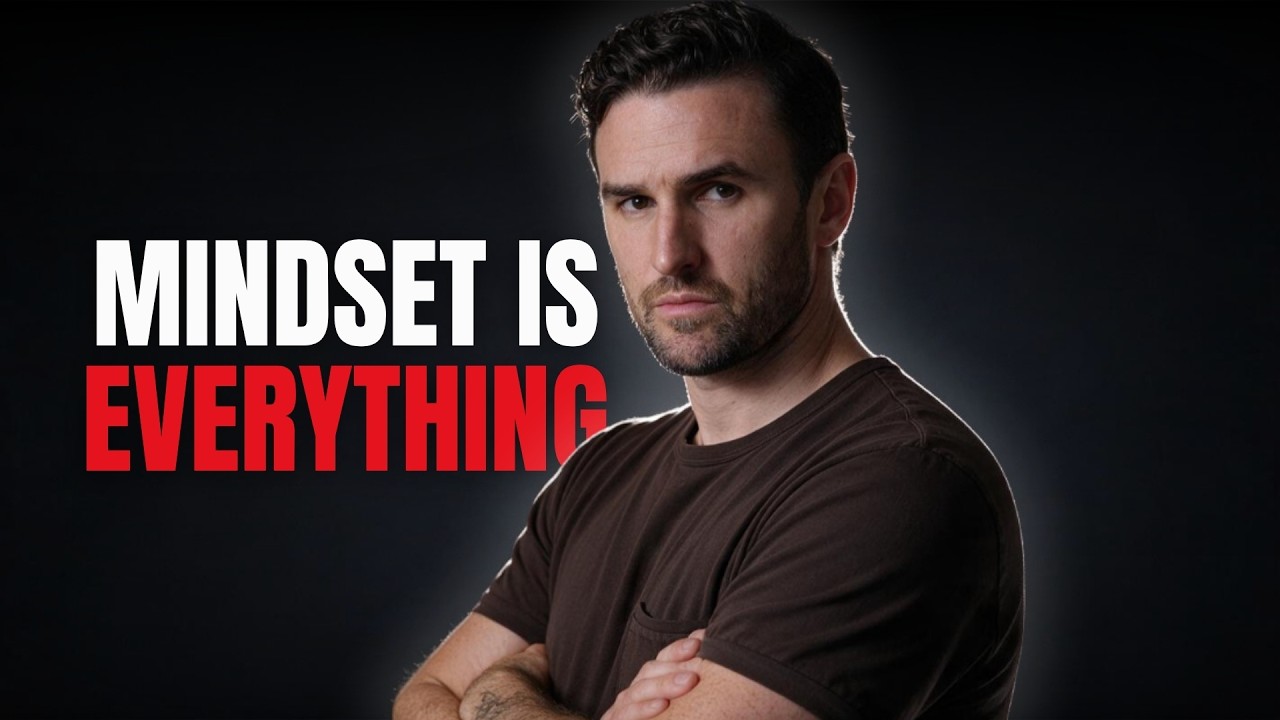
Mindset Is Everything! | That Can Change Your Life Forever
Watch on YouTubeVideo summary
Your mindset is the fundamental force driving every aspect of your life, acting as an invisible filter that determines what you see, how your body reacts, and whether you take action or remain passive. Most people mistakenly believe their mindset consists only of positive affirmations or good vibes, but it is actually a set of unconscious assumptions constructed from childhood beliefs that the brain treats as absolute truth rather than opinions. This internal operating system processes reality by predicting outcomes based on past experiences and then hunting for evidence to confirm those predictions, effectively deleting opportunities you never consciously notice because your brain has already decided they do not exist or are irrelevant to you.
The impact of these unconscious beliefs extends far beyond thoughts into tangible physiological changes within the body. Research demonstrates that simply believing a milkshake is high in calories can trigger hormonal responses identical to actually consuming it, while holding positive views on aging can add years to one's life expectancy independent of diet or exercise. Furthermore, studies reveal that passivity and giving up are default settings for the brain under stress rather than learned behaviors; consequently, many adults walk around with their potential locked away because they were never taught as children that their actions matter. This means you are not inherently lazy or broken but are simply running outdated software on your neural hardware, reacting to a version of reality created by beliefs you did not choose.
To transform this internal landscape and reclaim control over your life, the video outlines three specific strategies: identifying core limiting sentences like "life is blank" or "people always leave," changing the search terms used in self-inquiry from victimhood to learning opportunities, and gathering undeniable evidence through action that contradicts old beliefs. Talking yourself into a new mindset is insufficient; you must perform actions that provide data points proving your brain wrong until it updates its predictive model of who you are. By consistently asking what an empowered version of yourself would do in any given moment and then doing exactly that, you gradually overwrite the default settings of helplessness with a belief system rooted in control and possibility.
Ultimately, understanding mindset is not about adopting fluffy slogans but recognizing that your brain decides which 40 bits out of millions of incoming data points to process every second, directly influencing your health, longevity, and life trajectory. The realization that you are living out chapters written by someone else's beliefs marks the critical turning point where you can finally take back authorship of your own story. Since these patterns are passed down through generations without conscious choice, breaking this cycle requires deliberate effort to examine whose voice is speaking in your head and actively rewriting those narratives with new evidence. By committing to daily updates of your internal operating system, you ensure that the results you achieve align with who you truly want to become rather than recreating familiar but unfulfilling versions of life.
Read the full video transcript
Your mindset is running every single
area of your life right now. It's the
reason why you haven't made the money
that you want to make, why you keep
ending up in the same relationship, why
you keep falling back to the same old
habits that you've had. It's why you can
know exactly what you need to do to
change your life and still not be doing
it. And the terrifying part about it is
that you don't experience this thing as
something that's holding you back. You
don't experience your mindset as
something that's holding you back. You
experience it in your everyday life as
truth. You think, oh, well, that's just
who I am, or that's just how
relationships are, or I'm just not good
with money, or people like me don't
succeed in things like that. But none of
that is actually true. Your brain has
just been constructing a version of
reality based off of beliefs that you
did not choose. And then filtering your
entire life through that system. And
once you understand what's actually
happening inside of your brain, you
realize something that I genuinely
believe every single person needs to
understand. You could spend the next 30
years of your life trying to change your
habits, become more disciplined, work
harder, make more money, and improve
yourself.
But you can still keep recreating
different versions of the exact same
life because you've been trying to
change the results without changing the
thing that's creating the results. And
it's ultimately the reason why I have
dedicated my entire life to
understanding the mind and teaching the
stuff that I learned. So today I'm going
to show you what mindset truly is,
what's going on inside of your brain and
your body right now, and why it's
important to work on it every single
day. Because your mindset isn't just
something that's kind of affecting your
life. It's deciding what your life will
become. So let's dive in. I want to kill
off the definition that you probably
have in your head of mindset.
>> [snorts]
>> When most people hear mindset, they
think, "Oh, it's positive thinking. Oh,
it's it's saying affirmations in the
mirror. It's having good vibes. It's
having a vision board. It's closing your
eyes and manifesting and saying, 'All
areas of the universe are sending me
money into my mailbox.' It's, you know,
manifesting a Lamborghini by staring at
it really hard. You know, it's it's
Like that's what most people think
mindset is. That's not what I'm talking
about. It's never been what I'm talking
about. Your mindset is not what you say.
Your mindset is the set of unconscious
assumptions that your brain uses to
interpret your reality before you have
consciously thought about anything at
all.
It's not a thought. It's the thing that
produces the thoughts.
Do you get that? Like, your habits, your
goals, your morning routine, those are
like apps on your phone, right?
Everybody's obsessed with the apps. Make
sure you do the cold plunges.
Your mindset is not an app. Your mindset
is the operating system that all of the
apps are running on. You can download
all the apps that you want to, but if
the operating system is running code
from like 1994,
they're probably going to crash, right?
Every single time.
And so, what makes this really dangerous
is that you don't experience your
mindset as like a belief. You experience
it as actual truth. Like, nobody walks
around going, "Well, I've adopted the
belief that people can't be trusted."
And we will be right back.
Hey, real quick. If you're someone who's
already doing pretty well in life, like
you've built a business, you've built a
career, you've built everything that
looks pretty good on paper, but you know
that you're nowhere near your potential,
and you've been sitting at the same
level for a few years now, you need to
be at my live event that I'm hosting
called Freedom Live. It's 3 days in
Austin, Texas. It is not for people that
are just starting out. It is for people
who are already running, but they know
that they're running at like 60% of
their capacity. I'm going to teach you
how to operate at your peak performance,
95 to 100% of your potential, so that
you can build a true life of freedom. Go
to freedomlife2026.com
or scan that QR code right there.
There's currently a $50 off coupon if
you join right now. So, once again, go
ahead and go right here or go to that QR
code right there.
And now, back to the show. No.
Like, people walk around thinking people
can't be trusted, and they think that
it's a fact.
So, it's not like you experience this as
this thing. Like, you experience your
mindset in these unconscious set of
beliefs as true. [snorts] Like, it's
written into the fabric of the universe
that people cannot be trusted.
And people who believe that actually
believe it to be true.
So, let me show you real quick the three
major places where your mindset is just
running your life right now. Number one,
your mindset decides what you see.
You have to understand, your brain takes
in about 11 million bits of information
per second. Everything that's hitting
your eyes, your ears, your skin, what
you taste, what you hear,
feel, everything. Your conscious
awareness though only processes about 40
to 50 bits of information per second. 40
to 50 out of 11 million. So, basically,
all of reality is getting deleted
before you're even aware of it.
Do you get that? Like, you've never once
really seen reality in your life. You're
seeing a compressed version based off of
what your brain is filtering in and
filtering out.
It's basically deciding what makes the
cut. And there's [snorts] a part of your
brain called the reticular activating
system. It is your brain's filter.
You've probably heard me talk about it
on the podcast tons of times.
The part that should make your hair
stand up though is that the filter is
set by what you believe.
And a lot of your beliefs, probably most
your beliefs, come from childhood and
they weren't even yours in the first
place. Your brain isn't like a camera,
it's not just seeing things.
Neuroscience is increasingly seeing your
brain as a prediction machine more than
anything else. It's not waiting for
reality. It is guessing what's about to
happen, and then it's hunting for
evidence to confirm that guess.
Do you get that? Like that's that's
crazy thing about You're not seeing
what's actually happening. Your brain is
guessing what's about to happen, and
then hunting for evidence to confirm its
guess true.
Ooh, that's either really exciting or
really scary based off of your beliefs,
isn't it?
So, if you believe underneath everything
that opportunities don't come to people
like you, your brain will delete all of
the opportunities.
Not ignore them, delete them. You'll
walk directly past the thing that could
have changed your life, and you'll never
see it. And then you'll say, "See,
nothing ever works out for me." And your
brain goes, "Correct. Prediction
confirmed." So, that's number one.
Number two, it's in control of what your
body does. That's crazy. This is the
part that turned mindset from something
I found interesting and something that I
found like urgent. I need to learn this.
Because your mindset is not just in your
head, it's in your bloodstream.
Researchers at Yale gave people a
milkshake, same exact milkshake,
identical milkshake, but two different
labels. One group was told that it was
an indulgent 620-calorie
shake, and the other group was told that
it was a sensible, guilt-free
140-calorie shake. Same shake, different
stories. They then measured their
ghrelin, which is your your body's
hunger hormone,
the thing that tells your brain that
you're full.
The group who thought they drank an
indulgent shake had ghrelin drop three
times steeper.
Their bodies responded to the label,
not the actual liquid that was in their
body. Actual hormones, actual chemistry
responding to a belief. Now, that
story's crazy. Do you want to hear
another crazy story? Researchers
followed 660 people over the age of 50
for more than two decades, and they
measured one thing, their attitude about
aging.
Did they believe that getting older
meant becoming useless and forgotten? Or
did they believe that it could mean more
wisdom, more freedom, and becoming more
of themselves? The people who had a
positive perception of their own aging
lived, on average, 7 and 1/2 years
longer.
7 and 1/2 years longer. Not because of
exercise, not because of income, not
because of gender, not because of
loneliness.
They controlled all of those things
because of their belief.
To put that in perspective,
they lived longer. Like, that's a bigger
longevity effect than lowering your
blood pressure.
Bigger than lowering your cholesterol. A
belief
bought them 7 and 1/2 years of their
life.
Isn't that crazy? That's their mind
affecting their body. So, let me say
this as clearly as I can. Your mindset
is a physiological event, as well. It's
not fluffy, it's not soft. Every belief
you hold gets translated into your
nervous system, into hormones, into
immune function, and how fast your cells
actually age. You're not just thinking
your thoughts, you're metabolizing your
thoughts. So, that's number two.
Number three, your mindset affects what
you do. And this is the one that
I really want you to focus on.
Okay? There was a a study that was done
on humans back in the '60s where they
did these experiments on something that
they called learned helplessness.
It's not the greatest experiment, I
promise you that. But, animals were
exposed to stress that they could not
escape. And after enough repetition,
when the escape route was opened,
when they could get out, they didn't
even try.
The door was open
and they stopped looking at it.
And yeah, it's brutal to do to an
animal. I do agree. But it tells you
something about humans and it tells you
something about animals cuz we do the
exact same thing.
And the part that that's really wild is
that most people never even really talk
about about 50 years later, one of the
original researchers of learned
helplessness went back with modern
neuroscience and basically said like,
"Hey, we've got it all backwards.
Helplessness isn't learned. Helplessness
is the default of animals.
Passivity is the factory setting of the
brain under stress.
What has to be learned, and this is
really key, right? What has to be
learned, what gets built into your
prefrontal cortex through repetition, is
the belief that you have control.
Like, do you understand how big that is?
It has to be learned, which means nobody
has to teach you to give up and to be
helpless. Giving up is free. It comes
standard. What has to be built is the
belief that your actions matter.
And if nobody built that into you as a
kid, if you grew up in a house where
nothing that you did ever change in
anything, where chaos came no matter how
good you were, you didn't learn
helplessness, you just never got to be
taught control over your entire life.
So, you walk around as a fully capable
adult today with the door standing wide
open
and you don't even look at it.
And it's not cuz you're lazy or because
you're broken or because you're weak or
because of any of that stuff that people
always think, it's because your brain
never got the update that effort changes
your outcome.
And parents pass it on to their
children, and they pass it on to their
children.
You can't opt out of passing it on.
There is no neutral here. Okay, so what
do we actually do to change this?
There's three things. Write each of
these down, okay? Number one is find the
sentence. Everybody has a core belief
about their life that they've never
really truly examined. And it's usually
like
maximum of eight words long.
Nothing ever comes easy for me. People
always leave. I'm always behind. I'll
never amount to anything. People I love
uh will eventually use me. Whatever it
might be, try to figure out what your
sentence is. Take a piece of paper and I
want you to finish these. I'm going to
give you some sentence stems and these
are going to help you find it, okay?
Life is blank.
Finish that sentence.
Okay? Number two. People are blank.
Finish that sentence.
Next one. Money is blank. Finish that
sentence. And the last one, I am the
kind of person who blank.
Whatever comes out is the first thing I
want you to go with. If first thing that
that comes out of your your mind, it's
not a thought. That's the lens that you
look at your life through.
And ask yourself, whose voice is in
that?
Whose voice is in it? Because a lot of
times it's not yours, it's something
that you learned.
Okay? That's number one. Number two,
change the search terms. Your brain
answers whatever question you feed it.
So, stop feeding it garbage. I've said
this before in the podcast before, but
if you go into Google and you type in,
is coffee good for your eyesight? You
will see a bunch of research that shows
that coffee is good for your eyesight.
If you go in and ask, is coffee bad for
your eyesight? You will see a bunch of
research that shows that coffee's bad
for your eyesight. Your brain is the
exact same way. It will find proof to
whatever questions you ask it. I always
say it's like cosmic Google, right? So,
instead of asking the question like, why
does this always happen to me? And
making yourself a victim, which most
people do. Oh, why does this always
happen to me? Right? Ask yourself, what
is this supposed to teach me?
It's the same event. It's a completely
different lens. Different search terms,
right? Instead of asking, what's wrong
with me?
Like, what's wrong with me? Ask
yourself, what does this part of me need
right now?
It's the same brain. It's the same
power. It's completely different
results.
Do that 10 times a day. Not once, not
twice, 10 times a day.
You just go in and say, "Okay, here's
this." So, instead of saying this, I'm
going to say this. Instead of saying
this, I'm going to say this. Instead of
asking this, I'm going to ask this. And
you actually start to update what you're
asking yourself throughout the day.
Okay? And number three, go get evidence.
And if you have somehow tuned out to
everything else in this podcast episode,
this is the most important part.
You do not change your mindset by just
talking to yourself. Okay? Is talking to
yourself important? Absolutely.
But where you where you really change it
is by giving your brain undeniable proof
that the old story is wrong.
When you stand in the mirror and you
say, "I'm disciplined." Your
meter is going to go off immediately
because there's no evidence for that.
It's thinking about how you slept in
last night and how you haven't worked
out in 3 months.
But if you go and you do the hard thing
once, well, now there's a data point.
Right? If you do it again tomorrow,
there's two. There's another data point.
Do it 400 times, and your brain has no
choice but to update the model of what
it thinks of who you are. It can't keep
predicting failure against that much
contradictory evidence. So, don't try to
become somebody new tomorrow. That's
overwhelming and you'll do probably
nothing. Just ask yourself like, in this
single moment tomorrow, just ask
yourself, "What would somebody who
believes life works out for them do now?
What would somebody who is disciplined
do now? What would somebody who cares
about their family do now? What would
somebody who cares about their health do
now?" You ask yourself those questions,
and then you just do that. And so, to
wrap this up, your mindset is the most
important part of every single thing
that happens in your life.
Every episode for this podcast for over
a decade, four times a week, is me
having a conversation with you that I
wish somebody would have taught me as a
kid.
I'm making these episodes for me as much
as I am for you.
So, when I say mindset is everything,
I'm not being cute.
I'm not making some slogan for a
t-shirt. It decides what you see
out of 11 million bits per second.
It decides what your hormones feel in
your body. It decides whether you look
at the door as open or closed for
certain events in your life. It decides
what you pass on to your kids.
And according to research, it decides
how many years you're going to live.
There's no part of your life that
mindset is not touching.
And so if you're sitting there going,
"Damn, like I've been living out a
chapter that somebody else wrote for
me?" Good. That's the point. This is the
first real moment where you can take
back your life. Because you can't change
a lens in your life if you don't know
what you're looking through.
Now, you know. Hey, thanks so much for
watching today's video. If you love this
video, click this one right here. This
is the one that you need to watch next.
And if you want to make sure you don't
miss any more of these episodes, click
that button right there. Make sure you
subscribe and check out the next one.