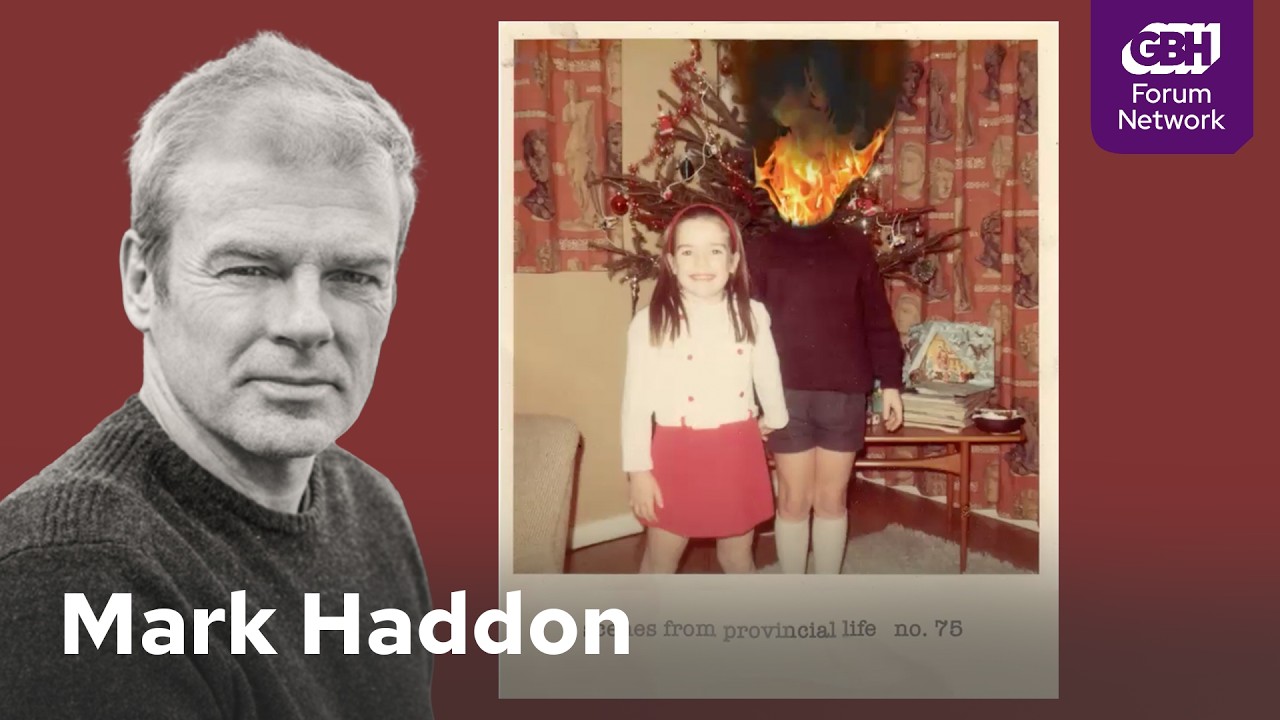
Mark Haddon on his latest work "Leaving Home: A Memoir in Full Colour"
Watch on YouTubeVideo summary
Mark Haddon's latest work, *Leaving Home: A Memoir in Full Colour*, emerged as an unintended consequence of long COVID and the brain fog that followed his triple bypass surgery, conditions that severely limited his working memory and made constructing complex fictional plots impossible. Unable to rely on continuous writing due to these health challenges, Haddon turned instead to small fragments from his own life, integrating photographs sourced from encyclopedias or family albums to create a parallel visual narrative. He emphasizes the importance of crafting text strong enough to stand alone before adding images, ensuring that the illustrations offer freedom rather than serving merely as fillers for gaps in the prose.
The memoir delves deeply into Haddon's childhood in 1960s–70s Northamptonshire, exploring a nostalgia not for people but for objects and settings within a focused "bubble" where ordinary things felt vivid against unpredictable adult behavior. He reveals how posed photographs from that era often masked underlying unhappiness due to the high cost of film at the time, leading him to digitally add flames to one photo of himself on fire as an act of irreverence toward his difficult memories. His upbringing was marked by emotional absence in a loveless marriage between parents who rarely showed affection; while his mother retreated with painkillers and his father remained absent due to work and rugby, the family struggled with class anxiety that pushed Haddon away from literature toward science, eventually finding poetry as a way to articulate darkness through language.
Beyond personal history, Haddon discusses how facing mortality directly after his heart attack ironically freed him from chronic health fears, though he still experiences internal frustration when unable to write continuously despite appearing productive externally. He describes the editing process using the metaphor of combing mud out of a dog's fur, refining messy drafts until they flow smoothly, and notes that while drawing serves as a therapeutic fallback for his writing struggles, both forms share an iterative nature requiring an objective perspective rather than pure emotional honesty. The conversation also touches on his volunteer work with the Samaritans, where he stresses listening without judgment or advice as a radical skill, concluding with reflections on parental legacy and urging parents to teach kindness over imposing their own ambitions upon children.
Read the full video transcript
I think all writers and artists come
from that group of children who feel
slightly ill at ease in the world.
[clears throat] It doesn't guarantee
that you're going to be an artist or a
writer if you feel ill at ease in the
world. But I think those people who swim
through life with grace like dolphins
are not the people who become writers
because the world as it is is entirely
sufficient for them. It works for them.
Whereas the rest of us, the ones for
whom hours and days and weeks are
puzzles that have to be solved, um the
ones who are always taking the bonnet up
and looking inside to see how things
work
for them. It's a very positive thing to
say once upon a time or open a book and
read once upon a time. Um because only
people in that group want to make a
separate parallel world.
Good afternoon everyone. Thanks for
joining this American Inspiration event
presented by American Ancestors in
partnership with Porter Square Books,
Grub Street, and GBH Forum Network. I'm
Margaret Tolett, the creator and
producer of this author series, and the
director of literary programs at
American Ancestors. We're delighted
you're with us this afternoon in the
world of writing, art, and nostalgia,
discussing one man's memoir, as well as
the craft, the impacts of writing about
the past. As good as this afternoon's
talk might be, of course, the real
education comes from reading the printed
book, which my co-host David Samberg of
Porter Squares Books knows all about.
David,
>> thank you so much. Um we are delighted
to be here as we always do partnering
with American Ancestors. We're delighted
to have Mark um and uh from from way
across the ocean uh and and and Claire
who is a regular at Porter Square Books
as both an author and a customer. Uh and
so I'm so happy to be here with all of
you in the uh Mark's evening and our
afternoon.
>> David, fantastic. I want to introduce uh
Mark Haden is uh the author of the
best-selling novels the red house and a
spot of bother. His novel the curious
incident of the dog in the nighttime won
the witbread book of the year award and
the Los Angeles Times book prize for
first fiction. It is the basis of the
Tony Award-winning play. He's the author
of a collection of poetry, The Talking
Horse and The Sad Girl and the and the
Village Under the Sea. Um, he's written
numerous children's books and has won
awards for both his radio dramas and his
television screenplays. He teaches
creative writing for the Arvon
Foundation and lives in Oxford, England.
Uh, now I will also have the honor of
introducing uh our guest moderator,
Claire Massud. She has been with us a
few times in this series and has um done
some really wonderful book events both
here and as David mentioned at Porter
Square Books. Her most recent novel,
this strange eventful history was long
listed for the 2024 Booker and Giller
prizes and for Franc's prefeminina.
The book was inspired by family history
and Ms. Massud has indeed published
essays about family. Most are included
in her book Kant's Little Prussian Head
and Other Reasons Why I Write that is
pictured here and we had a fabulous
event with her um on that book u which I
encourage you to look at in our
archives. Her best-selling novels
include the fabulous book The Emperor's
Children uh The Woman Upstairs and The
Burning Girl, both two of my favorites.
Uh she's currently a writer and
residence at Yale University. She has
taught at Harvard University as well.
She did that from 2015 to 2025. She is
the co-founder of the Mediterranean
Artists Project, an arts and ideas
program in the south of France. I can't
imagine a better guide for our journey
today into memoir writing and into art.
Uh so welcome to you, Claire. We are so
eager to hear from both of you about
leaving home and to also hear about the
craft of writing memoir which so many in
our audience are interested in. So over
to you and to Mark. Welcome to both of
you.
>> Thank you so much Margaret and thank you
so much Mark for um for joining us from
across the ocean. It's wonderful to be
with you and I'm so excited to talk to
you about about your new book. You've
written poetry, you've written
screenplays, you've you've written all
different genres, forms, but am I am I
right that this is your first foray into
memoir?
>> Absolutely. And it was not intended.
It's not something I ever foresaw. I was
rather painted into a corner. I had I
had long COVID and attendant brain frog
for well almost three years and it gave
me a very very small working memory. It
was very very hard to write and I
finally had to embrace something I tell
creative writing students which is to
sort of to look at the restrictions
placed upon you and just um use them as
a way of being forced to write in a
different way which is often a really
productive thing to do. It's what we
often do in workshops when we're
teaching creative writing. And I knew
that I didn't have the brain power to
pull down some great fictional plot from
the ether. So why not use my own life
because it was sitting there to hand and
because I couldn't think in great arcs
and we all know that thinking about a
whole book is quite hard. There's so
many connected pieces. You move
something at the beginning and something
something explodes or or falls apart at
the end. So I decided to write about my
own life and write in very very small
fragments that I could put down on paper
and then polish and then leave aside.
So, I ended up with this fragmentaryary
memoir. And because I'm a visual artist
and I think in pictures all the time and
my father took many photographs, I
realized as I was doing it, I could add
another whole
theme through the whole thing of
pictures, not necessarily illustrations,
but pictures to go with what I'd
written.
>> Right. I mean it it is a it is um a a a
comp utterly compelling and and deeply
moving uh and amazing book but it's also
two books in a way or three books
because it is there's there are the
chapters that are are narrated. There
are the images that tell a a sort of
parallel but not quite connected story
and then there's the the whole um the
whole and and just um just as a as a
perhaps as a first question it might
seem like a question that should come
hour you know an hour into the
conversation but I I'd love to hear a
little about how you how it came
together whether you wrote the chapters
in the order in which they appear
whether the illustrations
um were done sort of, you know, as you
were going along or whether that was
the, you know, whether you wrote
everything and then and then had how did
it all how did all that um how did this
work of art come together?
>> Something very strange happened and it I
think like like most teachers, I've
often said things to people and assumed
them to be true and only much much later
along do I realize they are in fact
true. And I often say to students when
you're writing, don't think about the
big stuff. concentrate on small
technical issues and just worry yourself
about that and sometimes the big
questions resolve themselves in the
background. I so I didn't think about
structure because I had no spare brain
for thinking about structure and
something rather magical happened which
is that the order in which I wrote all
these fragments worked. It wasn't
chronological. It jumped about all over
the place, but it had a certain music to
it. And we changed that order very very
very little. Um, when it comes to the to
the illustrations, I'd go back to
something I learned when I was both
writing and illustrating picture books
for very very young children. I can't
remember who said it to me, but it was a
very wise thing which they said, which
is that if you're writing a picture book
text for young children, don't think
about the illustrations. Don't ever hope
that an illustrator will come along and
fill the holes that you've accidentally
left there. Write a text that stands up
entirely of itself, that you could read
aloud to a group of small children and
entertain them completely.
One of the benefits of doing that is
that when the illustrator comes along,
they have complete freedom to add
something extra. They don't have to do
the job of mopping up after you um and
being your sort of your crutch. And I
think that that principle applied to
this as well. I tried to write a text
that was that worked in and of itself
completely and then I could add another
layer of pictures to go with it.
Um I'm [clears throat] wondering you you
know uh whether we might be able to see
again the the book cover and and maybe
you tell us a little um a little Mark
about that that image um of of I believe
it's your small self uh on a on a we
thought it was a tricycle but I think
it's not a tricycle. um but also just
about the um work if you will that
you've done to this image because it
isn't it isn't perhaps a as it
originally was and and and and and maybe
you could say we could talk a little
also about the title of the memoir at
the same time. Um
>> um funny enough I have done many things
many slightly unforgivable things to
some images in the book most of which I
took from encyclopedias I has as had as
a child and I will probably see those a
bit later but strangely enough I did
very little to this picture. Those
scratches you see on the surface are
actually scratches on the surface of the
35 mil slide that that my father got
made after a photograph. Whe whether it
was my sister and I having some argument
and her taking it out on the slide, I
really don't know. It may just have been
an accident when the slide got stuck in.
I don't know how many people will
remember those those slide projectors
that were always wheeled out by fathers
during some family event to throw the
slides up on a cleared wall just above
the television and everyone had to sit
and watch as sort of specks of dust and
pipe smoke wafted through that cone of
light onto the wall. Yes.
>> So this so this is this picture is
pretty much as it was. One of the
reasons I like it is a because it
we if we cast our minds back there was a
period before digital cameras when every
photo had to be posed and it's no
surprise that when you go back 40 years
everyone looks reasonably happy in
photographs because they had to be happy
because usually your father was standing
there with a camera waiting to sp to use
up an expensive piece of film. So every
bet every person better look tidy and
well behaved. So there's me looking tidy
and well behaved, but there's this
suggestion of something wrong at the
same time. And I like that doubleness. I
also like the fact that the photos from
my youth, and this will no longer be
true for people growing up now because
they're analog. You get the images, but
you get the faults as well. And there is
something for me very nostalgic and
flavorsome about the things that went
wrong with analog photographs whether
it's sunflare double exposures or
scratches like this.
>> Yes, that's I mean it's it's wonderful.
I love the word flavorsome. I it it
there is this sort of richness and
texture and and in this image it's so
interesting that it was just as it were
fate or perhaps you know your sister's
tiny hand um with with with a I don't
know whether a razor blade or a pen but
but you know that that this is damage of
of of decades standing but even aside
from the sort of scratches there's that
there's that kind of um what looks like
a a little wand coming in on the left
you you know on the left hand side of
the photo and there's the sort of
slightly bleached aspect of in the
corner and and and and there's there is
that wonderful um texture which evokes
uh nostalgia, right? In some way it is
there's something nostalgic about it.
And um I I do I do want to ask you about
the title Leaving Home, but I'm also
wondering whether you might um whether
you might uh I know you're going to read
for us later from a little bit later in
the book, but whether you might be
willing to read to us from the beginning
of the book where you where you talk a
little bit about the complexity of
nostalgia.
>> So, as I said, the book's made up of
tiny fragments. I'll skip the first
fragment and I'll read you the second
fragment.
When I see washed out photographs of
English life in the 60s and 70s,
cardiganed grandmothers eating roadside
picnics beside Morris miners, pale men
sunbathing in shoes and socks on stripey
deck chairs, rally choppers and caged
budgery gars and faux leather poofs. I
feel a wave of what can't properly be
called nostalgia because the last thing
I'd want is to return to that age and
those places where I was often
profoundly unhappy and from which I'd
have been desperate to escape if escape
had been a possibility.
Why then this longing, this echo of some
remembered comfort? It's not the people
in these photographs, I think. It's what
surrounds them. The feeling is as
strong, if not stronger, when I see cars
from that period which have been
lovingly preserved. Hillman imps, Ford
Capri,
furniture, packaging, wallpaper, toys,
crockery, a tin of Wattney's party 7,
sheets of Letraet, chocolate cigarettes.
Is it that as children we live inside a
bubble of focused attention which gives
everything inside the bubble a memorable
fierceness? The way one could lie, for
example, on a lawn and look down into
the jungle of the grass to see earwigs
and wood lice lumbering between the pale
green trunks, like brontosauri lumbering
between the ferns and jinkos of the late
Jurassic. The way a ruck bedspread could
become a mountain range stretched below
the wings of a badly painted airfix
spitfire. Or do objects in their
constancy provide consolation in a world
where adults are unpredictable and
distant and unloving?
>> Thank you. I feel that's such a um you
there's that you encapsulate so much um
you know in in that in that short
passage which um evokes I think I'm sure
for everybody listening and every reader
evokes all sorts of um memories and
moments of of of our own childhoods. Um
but but but in in your case it's it's
not it is this it's this paradoxical
state of the of the of the objects that
have some consolation and the memories
themselves perhaps not so much. I I I I
I wonder um I wonder if we might see the
the one of the photos from your
childhood which um which we have
referred to as flame head and and and
and um just you know uh maybe you'd tell
us a little [laughter]
about about that photo and and um I
think that's you um on fire.
>> That's me and my sister um one Christmas
at home. I can see the Christmas tree in
the background and and uh the little
advent calendar. And strangely enough,
that coffee table is actually supporting
this computer at where I am in this very
room now.
>> Isn't that wonderful?
>> I I didn't do this for the book. Um this
was one of a series of of of pictures
I'd amused myself by creating over the
years. Looking at it now, I realize I
mean, one of the subjects of the book is
that my childhood wasn't hugely happy.
And I I realized that I got a kind of
perverse pleasure out of going back to
mmentotos I had from the childhood and
taking possession of them by doing
something slightly irreverent to them.
And that this is one of those pieces of
irreverence.
Funnily enough, when the Financial Times
in the UK um published a review, they
wanted a photograph to go with it and
they selected this photograph and their
picture editor got in touch with my
publisher and said, "Can you tell me
whether this picture has been doctorred
or not?" [laughter]
>> And she was she was quickwitted enough
to get back to them to say, "No, it was
a problem he had medically when he was a
child." [laughter]
>> That's brilliant. That's wonderful. Did
you did you did you actually um I mean
you've you've put in an a sort of
collage image of flames. But did you
also sing the the photograph there?
>> Well, I I confess it's not analog. It is
digital. It's Photoshop. But uh yes,
there there are many superimposed flames
on there.
>> Yeah. It's so And that's your young you
and your younger sister Fiona. That's
right. And and there there were in this
um in your house growing up there there
were the two of you and your parents.
Perhaps we could see just a a photo of
the of your of your draw uh painting of
the house. Um and you might tell us a
little about because I think you know um
many of the listeners are not in the UK.
Some may not know um you know you're
from Northampton.
um we may not know exactly where that is
or what it's like um or how this house
might fit into that world and maybe
you'd tell us a little bit about um both
about this house and about where you're
from.
>> So it's about 50 60 mi north of London.
It's in the Midlands. Um this would have
been about 196061 when my father bought
it. He was an architect and although he
didn't actually design this house, it's
very much a kind of architect's house.
It's kind of suburban Scandinavian
influence sort of modernism. Uh lots of
um open plan on the ground floor and
lots of cork tiles on the floor. Um for
the time it was very it was very modern.
It was very open. It was very it was
very light. A a a strange and spooky
thing happened. This this house sits at
the center of the book and I was
recently driving through Northampton,
which I do very very rarely and I
decided on the spur of the moment to to
drive past the house. um not expecting
any freon really because I've often gone
back to places in my past and found that
they were just just places. Um but I
drove past this house to find that it
was in the process of demolition. If I'd
been a couple of days earlier or a
couple of days later, it would have been
as it always was or completely vanished.
I had this odd feeling in my bones that
the publication of the memoir might have
actually caused some partial collapse of
the house and there was only a stump
there for me to photograph.
It's um you know that's such a a a
powerful uh uh
serendipity or or maybe serendipity
sounds too cheerful [laughter] but um
you know such a powerful coincidence.
It's it it's um you you you've mentioned
that your your childhood uh wasn't
perhaps especially happy. We might see
just one more photo um of you with your
sister and then and then maybe not some
photos for a little while. You guys look
pretty happy in that photo. Um, and but
but but
that's not the vibe of of the book. And
and
>> yeah, tell me about that.
>> And this and this goes back to the way
that photographs were always posed at
the time, weren't they? No one ever took
photographs of their children
squabbbling or looking unhappy. You were
all told to brush up and clean up and
get the stains off your coat and stand
on the lawn and look well behaved, which
is which is what we did. The problem I
think was that
at the time my mother found looking
after children very difficult. Um she
said to my sister later on when my
sister had three children of her own. I
don't know how you cope with having
three, I couldn't cope with two.
I think she found empathy very very
hard. Um and I think she was she was
scared of challenge, of difference, of
change.
um she found it very difficult to
discipline us for example um I think we
understand now the best thing with
children is to tell them exactly what
the rules are and exactly how they'll be
punished if they break the rules um so
that there's kind of constancy
she if we if to be honest we were very
well behaved children but every time we
weren't completely well behaved her
reaction was to say you children have
made me ill and then she'd go and lie
down in a darkened room and and take
painkillers
So she was she was very absent
emotionally.
The double complication for my sister
and I was that I was the firstborn. I
was a boy and I was quite academic. So I
had a bit of a a release, an escape at
school where I got some affirmation. I
couldn't get at home. My sister um and
remember this was sort of a very
monocultural English Midlands in the
1960s. She was the second born. She was
female. She was less academic. Um, and
to be brutally frank, she just wasn't
treated as well as I was. I didn't get a
lot of love or attention, but she got
even less. I remember later in life, and
this is a a sign of what my mother was
like, uh, my sister said to my mom, um,
why does dad hate me so much? And my mom
said, as if this was some kind of
explanation, you have to understand that
he only wanted one child.
>> [laughter]
>> It's in the book and it and and it's
astounding to read and it's astounding
to hear you say um aloud. Um but um uh I
guess you you just mentioned your father
and and he he doesn't um in that moment
come out any more warmly
than your mom. So So would would you
like to tell us a little about the the
sort of household configuration?
So um it was a fairly loveless marriage
I think. I mean elsewhere in the book
there is a rather beautiful photograph
of my mother before
>> the full they got married and she seemed
confident and very good-looking. Um and
there's a light sort of coming off her
which we never really saw again either
in photographs or in real life. There
was something very missing in the
marriage. Um,
I think we all almost without exception
take the behavior around us when we're
children to be the simple fact of what
life is like. And it's only later you
look back and you start to see the ways
in which you diverge from other
families. The ways in which things are
wrong or not quite right or simply
strange. And I began to realize and when
I was a teenager that there was
literally no affection between my
parents. I simply don't remember them
even touching each other a hug or a kiss
or anything anything like
[clears throat] that. But in in addition
to that of course it being a very very
traditional sort of patriarchal society
at the time. My father was very absent.
He was out at work and I think he sp and
he played rugby. He was a very good
sportsman. So he had reasons to be out
all the time during the week and then
reasons on a Saturday to go and play
rugby and church on a Sunday. And so
every he was absent most days for long
periods.
There was also I mean you you I know
that um and you you write about your
grandmother, your paternal grandparents
and and your um your your your
grandmother did show you and your sister
affection. It's it sounds like she she
was maybe more indulgent, but there
didn't seem as though there was much
love lost between
um your your grandparents, your paternal
grandparents and your mother.
>> No, there was a ferocious class dynamic
going on here, which I'm sure is true of
societies all around the world. Um we
spent most time when we were with
grandparents with my paternal
grandparents. Both sets of grandparents
were very workingclass, although one set
of grandparents would have been rather
affronted by by that description. So my
parents rose from quite poor backgrounds
to become welloff
in a way that left them sort of slightly
at sea, not knowing who they were. And
there was a kind of particularly in my
mom's case a kind of nervous
snobbishness about wanting to be fit in
and not wanting to be judged which had
everyone on tent hooks. And what was
wonderful going back to my paternal
grandparents house both for me and for
my sister was the fact that they were
comfortable in themselves. We were
allowed to have a bottle of milk open on
the table. We were allowed to eat uh
fish and chips and with slices of
heavily buttered white bread. And um
grandpa used to roll his own cigarettes
and drop ash all over the carpet. So
making a mess really wasn't a problem.
And I think it was that it was that ease
with with in which we found real
comfort.
>> It's it's so interesting because I I
feel as though this in a way it's a
narrative of the midentury, right? the
the the the social mobility um which was
so I mean wasn't that the whole thing
about John Major when he was elected
prime minister is that he was the first
sort of you know middle class person to
to become prime minister and and an
example of social mobility in in in
Britain that you didn't have to have
gone to eaten to you know to to to then
of course there are more recent prime
ministers who all did go to Eden so
that's a different matter but um but but
but but the the the sort of complic
lications or the toll of that is so it's
so interesting, you know, the sense that
your mother was not um at ease in her
skin and was not um and but you
mentioned that it wasn't a a bookish
household and maybe you'll tell us a bit
how maybe about your start not so much
with books but with science and then how
you how you became a writer. Well, let's
let's let's deal with that class thing
first because I think it's a very very
common story for people to rise socially
and that's seen as a sort of generally
as a a very positive thing. We like the
idea of social mobility but so often the
end of that journey puts people in a
place where they are very ill at ease.
My mother was ill at ease because she
didn't want to be judged uh by those
around her. Uh my father it was slightly
different. He I think he wanted to be at
ease with people who read translated
novels and had big book places and used
sub clauses in their sentences and had
university degrees but he wasn't there
and he wasn't quite comfortable enough
with that place where he wanted to be.
Um so his answer and so many parents go
down this route. They they try and solve
a problem that they have by getting
their children to solve the problem for
them. So I was sent off to to boarding
school and which is I think is a place
where he would have wanted to go. He was
a he was a very tough sporting man and I
think he would have been absolutely
thrilled by being sent to an English
boarding school in the middle of the
countryside to play rugby and have cold
showers and and put up with a kind of
bullying atmosphere. He he would have
been absolutely in his element much more
much more than I was. to go back to the
the the starting writing thing.
I think all writers and artists come
from that group of children who feel
slightly ill at ease in the world.
[clears throat] It doesn't guarantee
that you're going to be an artist or a
writer if you feel ill at ease in the
world. But I think those people who swim
through life with grace like dolphins
are not the people who become writers
because the world as it is is entirely
sufficient for them. It works for them.
Whereas the rest of us, the ones for
whom hours and days and weeks are
puzzles that have to be solved, um the
ones who were always taking the bonnet
up and looking inside to see how things
work
for them. It's a very positive thing to
say once upon a time or open a book and
read once upon a time. um because only
people in that group want to make a
separate parallel world and that that
that was me. But because it wasn't a
bookish household, the other world for
me was science, particularly maths, um
cosmology, and this will show how
specific a nerd I was. I was obsessed
with paleo anthropology, the study of
fossil man and fossil homminids. And I
dreamed one day of working with the
Leaky family in the older VI gorge in
northern Kenya digging up
oustralopythecus bones. Um well
>> quite quite a niche job. There weren't
many openings for that particular job
and only later when I was uh I think
what I got from that science was two
things. One was um a sense of awe at the
size of the darkness surrounding us. How
much we don't know, how much there is to
know and how much we'll never know. And
yet the knowledge that you could piece
by piece reach out into that darkness
and solve a few of the puzzles and
expand that you know that that spotlight
of human knowledge.
It was only when I was uh studying for
what were called O levels then uh at the
age of 13 when I first started reading
poetry um the poetry particularly of the
Welsh poet RS Thomas
and I realized that I could get from
writing something that I previously got
from science a sense awe at the the
great gulf of what we don't know and yet
a way of making some kind of answer some
kind of inroad into that darkness by
just getting the right words in the
right order. In fact, I still vividly
remember the the first poem that really
hit me in this way, a poem by RS Thomas
called um a peasant, which began uh Iago
Prit
Aloud, just an ordinary man of the bald
Welsh hills who pens his sheep in a gap
of cloud.
Only in retrospect did I look back at
that opening of that poem and realize
that itself it's an image of
illumination of looking up and seeing
the clouds part and seeing something
very distinct and clear and sunlit high
up. And that's what it was for me. It
was a moment of illumination. The fact
that you you know you can take these
words that you've just heard on the bus
or in the shop and you can take them
home and you rearrange the order. And if
you rearrange the order just right, you
can you can set off fireworks in a
stranger's head.
I I know it's amaz it's it's an amazing
um thing. I I remember as a child when I
realized that the the stories that I
loved that first my mother read to me
and then you know I I read myself but
that that somebody had made them up that
you know that they hadn't always been
there but somebody had made them up and
you think oh my goodness that's a thing
people do I could I can do that you know
it's a it's so um two questions
simultaneously
when did um drawing or making you know
making artworks come in and Um, and when
do you remember when you first wrote
something that wasn't sort of homework
for school, something that was creative?
Do you remember that
drawing? My sister and I have always
done it because my dear father was an
architect. Um, he never drew with us, so
it wasn't really something we learned
from him, but I think because we knew he
did draw both at work and at home, he'd
occasionally draw pictures of animals or
particularly landscapes, buildings, and
very, very occasionally people, we just
assumed that drawing was something that
grown-ups did. And I think most most
kids realize it's something kids do, but
they don't see grown-ups doing it. So,
they sort of put it aside after a while.
So drawing's always been there for me as
another something I always done in the
background. Um
as far as writing as should we call it
proper writing not for school writing. I
think when I when I was a student I
wrote and this was a massive misstep. I
started writing dreadful poetry. Um and
unhelpfully the poetry review actually
published one of the poems which only
encouraged me to carry on down that but
terrible sentimental path. I think they
should have stopped me in my tracks.
They were not very good poems at all. Um
but at the same time I was I was writing
for children as well. I had this idea
which is truer now but was in fact not
true back then that if I wrote and
illustrated books for children then it
would be a kind of way station towards
being an artist and being a writer for
adults. Um, ironically, I didn't realize
because I was a stranger to this world.
At the time, there was a an almost
uncrossable gulf between writing for
children and writing for adults. And
paradoxically, I think along with books
by Philip Pullman, I think Curious
Incident is one of the books that
actually help build a bridge across that
gulf
>> across it. So, it's so um it it's so
interesting because of course the books
that we read in childhood are the ones
that shape us and and um shape our
sensibilities. And you know, you
actually refer to a number in in the
memoir, you refer to a number of
formative children's books uh for you
that you know that were that that that
clearly retain as you know the ones in
my childhood cannon do for me. They
clearly retain all their power. um for
the whole of our lives. So the idea that
there there would be some gulf between
you know some artificial gulf. It's a
it's it's a little bit like your
mother's social anxiety about um about
not you know not saying the right thing
or not being seen to do the right thing.
It seems so it seems such an absurd um
imposition. I wonder if we might look at
there's a there's a photo of um h the
reasonless churning dread photo um just
just just [laughter]
to to give to give our our our gathered
audience a a sense of um the visual of
of you um of you and your dad there. Um
and and maybe I you know maybe that is
uh there's this one and then in a minute
there's another one that that that I
think of as the boredom box. But maybe
you would tell us a little because um
there's wonder and then as you said
there's the the slight misfit feeling um
but but but in your case it seems as
though reasonless churning dread you
know was part of has been even maybe
till till now part of a a a fairly
anxious uh temperament um depression and
so on. I wonder if you might um be
willing to talk a little about that.
>> What amuses me now when I look at that
is that I definitely did feel a
reasonless churning dread. But of
course, I didn't have the name for it
then. What what amuses me is the rather
adult sophisticated description of
reasonless churning dread. In the same
way that I think we take our families
for granted, we think they're just the
wallpaper of the world when we're
little. We take our own um mental
interior for granted, I think, as well.
And in fact, I to be honest, and this
will sound absolutely barking mad,
when I was young, I looked at the adults
around me. Um, no one ever really talked
about what they genuinely felt. They
chatted, but they never really talked.
They never really communicated anything
really important. So, two things which
will sound particularly mad. one, I
assumed that I knew I knew I felt
uncomfortable in myself, deeply
uncomfortable sometimes, but I reassured
myself that when I got to 18 or 21, um,
I would be like everyone else. And quite
clearly, they were perfectly happy and
calm and contented and everything would
be fine because I'd hit that plateau.
Spoiler alert, that's not true. Um, and
the other thing was I genuinely don't
didn't think of other people having an
interior life until I was I don't know
10, 11, 12. I thought it was just inside
me and then the rest of the world. Um,
so it was a bit of a shock to to
discover that other people
had the same experience of being a human
being in the world. The other things in
this drawing, the the building you see
behind me, behind me and my father,
is actually an architectural drawing by
him.
>> Ah, I wondered. I wondered. Yes.
>> Yeah. So, he's wearing the Northampton
Saints rugby club tie. That's that's a
very prestigious rugby club for whom he
played. Um, and then there's a there's a
an advert of the time for some kind of
microwave or oven in the background
>> with complete with a a a sort of mother
figure in a in a stylish apron and high
heels with, you know,
>> and a and a very stereotype mother
figure as well. I think that's what she
was trying to be.
>> Yeah.
>> In fact, I think so many women of that
time were forced to be that that
stereotype. individuality was not and
eccentricity was not encouraged.
>> No, no,
>> certainly certainly not outside London
anyway.
>> No, I mean, you know, I I remember this
is years ago um Alice Monroe uh saying
that when she was young, you you were
always supposed to be available in your
suburban neighborhood. If another mother
stopped by, you were always supposed to
be have coffee, you know, have coffee
going and be ready. and that she um she
uh I know she's a you know it's
complicated figure now but she she um
not unlike your mother uh would retire
officially retire to her bedroom to rest
so that she that's where she would be
actually writing um and and everybody
thought she was sick the whole time but
she wasn't actually sick she was she was
writing so it's an interesting parallel
actually [laughter]
>> maybe this maybe this is a good moment
to say that I think very important uh
dynamic both in the book in our lives
was that mom
um hitched her wagon to the patriarchy
completely. She felt that she should be
I don't think she wanted to be a mother,
but she had to be a mother. There wasn't
really a choice to choose not to have
children wasn't wasn't an option. Um and
she would be a sort of homekeeper and a
and a wife. And in fact, as she said to
my sister, when I married your father, I
decided to agree with him about
everything.
um to make life easier, which of course
never makes life easier for anyone. And
then of course the next generation of
women came along like my sister
and they went off and they had jobs.
Some of them decided not to have
children. Some of them decided not to
get married at all. And that was that
would have been really hard for people
like my mom and of her generation to
look at a younger generation enjoying
the freedoms that she had willingly
given up in return for well perhaps not
very much at all. And I think it takes a
great deal of bravery to say you go. You
you enjoy those freedoms even though
I've denied them to myself. And sadly
for my sister, my mom reacted by being
quite embittered about um seeing someone
enjoying those freedoms. And that would
that made life very very hard not just
for my mother but more importantly for
my sister as well.
>> Do you how does how does your it seems
from the book you don't you uh your
sister's present but you don't um talk
you don't write so much about her. I
mean I we have a sense of her family and
so on. Um h how does she May I ask is
how does she feel about about the
memoir? Does she feel
>> she was she was an enthusiastic
contributor. In fact there there are
some things which are a little too um
revealing for me to have put in. So I I
got lots of material from her. She's
also she has a better memory than me. So
she was a very good fact checker. I mean
I think she's found publication odd but
as writers we all know the publication
is odd, isn't it? you there's this sort
of horrible bump in the road and you go
from ouch everyone is looking at me and
then that rapidly turns into oh why why
are people no longer looking at me so
she's she's had that bump in the road
but then I've had that bump in the road
too and that's true of books whether
they're memoir or not you're suddenly
the focus of attention and then you then
you return to that strange solitary
subterranean life of a writer again
>> yes but particularly strange for her who
who didn't I mean who contributed to the
book but didn't write the book. So, so
it has gone through
>> I hope that well she will already be
getting some of the same feedback that
I'm getting which is been hugely
uplifting. We we haven't talked about
the end of the book yet but it deals
with my parents' deaths. Um and I put a
lot of effort into making sure they were
comfortable, making sure there were no
problems for them, visiting regularly
even though there was really no love
going in either direction. so that when
they passed away for me it felt like the
account had been settled I'd hopefully
done the right thing. What I hadn't
understood until watching my sister go
to this is that whilst the death of a
loved parent can be extremely painful
for obvious reasons, the death of a
parent that didn't love you can be even
harder because you know that's the point
past which you will never get an apology
for the way they treated you. And that
was difficult for my sister. So while it
gave me closure, it left something
permanently unresolved for my sister.
But I but we've both had lots of
messages from people who've been in
those situations. And I know when you
write it in a book, you think it's true.
That's why I put it down there. But
somehow when you hear that people
getting in touch to say that happened to
me, too. That has a a whole other level
of validation to it, which is hugely
uplifting. So I hope my sister's
benefiting from that as well.
>> Absolutely. I mean I I think you know
that um we'll we'll come back we'll come
there I feel when we get to towards the
end of the book which um which there are
a few things I want to ask about first
and and and um you know having having um
having I I feel as though that um health
of various kinds is is something that is
a recurring theme in the book. mental
health and physical health. Um, and and
and I also, um, it seems important to to
bring in another key character in this
memoir, which is who is your wife. Um
and and um and who who seems um to to
have been a a
rock in your life, a a real um a a a
real soulmate, but also in a way, I
don't know if protector is the right
word, but somebody who's who's looking
out for you in ways that that hadn't
happened uh perhaps in your childhood In
the same way
>> I was I was asked in an interview the
other day why I didn't write more about
my my wife and I said it's because we
get on so well I said there's no
conflict there to generate really good
material on the page if you get on well
with someone was it de Montalon said
happiness writes white you need you need
unhappiness to generate material both in
a memoir and and in fiction to go back
to the health thing yes um I've suffered
quite rocky key mental health um
throughout all my life and I deal with
that in in some detail. One of the huge
ironies however is that two breakdowns
that I had centered on extreme health
anxiety. The first one a fear that I had
MS and the second one that I had skin
cancer. I mean they were hugely
debilitating. Each of them took about 18
months out of my life during which I was
incapable of doing anything really. The
irony was that um about five years ago
um I discovered to cut a long story
short that I had very narrow cardiac
arteries and I was rushed into the
hospital here in Oxford. Thankfully a
very very good university hospital uh
where I had a triple heart bypass.
Very interesting. Um I found it hugely
useful material. Um, but the irony of it
was that I came out of it with no real
health anxiety at all.
>> And I've heard this story again and
again and again that people who are
terrified of
either their ill health or indeed of
death, a brush with death or a brush
with really serious ill health is so
much easier to deal with than the fear
of that in the abstract.
>> Yes. Um maybe we could see a picture of
you. We have a picture of you in that
moment um just after your uh surgery
looking um oddly I mean you look you're
asleep but and hooked up to many
machines but you look oddly well.
[laughter]
>> Maybe you don't think you look well but
>> I'm on a lot of very pleasant and and
comforting drugs at that point. In fact
you can see the morphine driver in my
right hand there. No wonder I look
relaxed. It's but but but but it's um
it's an it's an interesting what you say
about this experience is is is
so interesting because of course you you
did have I mean when you discover I mean
you're a runner right you're I I don't
know whether you're do do you run still
or again now
>> I'm I'm slowly making my way back to it
after three years of long co during
>> but there is no there is no place I'd
rather be than in the middle of a
forest. just in the middle of a long run
far away from other human beings.
>> But maybe running with your wife, too.
>> Oh, no, no, no. I think I think most
runners know that there's nothing worse
than being just faster than someone or
just slower than someone. The only
person who's ever going at my pace is
me.
>> Is you. Well, but but but maybe that was
something that that um maybe the fact
that you were so fit. I mean, I think
did that make you less afraid of this or
were you just was fear when you had to
have this surgery? Was fear even part of
it or was just it's you have to have it.
You didn't think about it.
>> It was strangely I mean the fact that I
was a runner meant I knew that something
was wrong and I got in there before I
had a heart attack. So practically it
was very very helpful. The odd thing was
I felt as if I was at the eye of the
storm. It was very hard for my family
for and for for our two boys. They were
clearly very anxious,
but I'm I'm also someone who likes to
know the facts. And I met my surgeon and
I asked him for his statistics and I
said, "I need to know how many times
you've done this operation and how many
people have died." And I vividly
remember him saying, "Since coming to
this hospital 5 years ago, I've done 140
of these operation. One man died and he
came in as an emergency and he was very
sick indeed." And that's at which point
I felt at ease. Strangely, I also always
feel at ease in hospitals. I put it down
to the fact that and indeed in prisons I
uh interesting
>> because I went to way to boarding
school. I'm used to that strange
phenomenon of mostly men packed into two
smaller space like like broiler
chickens. Um uh and when I'm in hospital
with sort of meals coming around on a
trolley with everything timetabled with
people in uniforms, it it harks back to
something I know very very well and know
how to deal with. Ditto. When I do
prison visiting, I've taught quite a bit
in prisons and as soon as I step through
the door, I I have an odd recollection
of the same atmosphere at my boarding
school and I think I can handle this
place.
>> Wow. I Yes. I I don't know what it says
about your boarding school. Um but it's
but you know I I I as a teacher I always
say to my students everything is a
balance of of freedom and constraint and
I feel as though it seems as though
certain sets of constraints don't feel
oppressive to you or at least feel
familiar in ways that for some people
they might they might feel alarming. We
might have a a quick look thinking of
freedom and constraint. There's a a a
cartoon you've done uh that's in the
book of of your sort of dual writer
artist self and and it's it's
essentially a sort of super ego um super
ego and id or maybe not maybe it's super
ego and and ego but I but but I but I'd
love to um maybe you'll tell us a little
bit about this image but also about um
about the the experience that you spoke
of at the beginning of our conversation
which is you know I think fairly swiftly
on the heels of your I mean not
immediately but fairly swiftly on the
heels of your of your bypass operation
came long co and and just you know h how
that psychologically how that uh and for
your for your work how that was has been
and and what it's like to to emerge from
it.
People who look at me from outside, even
friends, people who know me quite well,
think of me as highly productive, but my
experience on the inside, even when I
don't have long COVID, is my wheels
spinning in the mud, not getting enough
done. I think the truth is that I work
in short, highly productive bursts. Um,
and I wish I could tell myself that the
time between those bursts is just useful
time leaving my brain lying. But I think
the same drive that creates those bursts
of high productivity can't be turned
off. It just runs all the time. So when
I have days in which I can't do
anything, I'm I'm berating myself. I'm
always that figure in the in the orange
sweatshirt berating the person the other
version of myself who's not doing
anything. And of course when I got long
co that only exacerbated that doubly
exacerbated by the figure of the writer
in the background who in [laughter] this
case I've stole a silhouette of Agatha
Christie at her desk tap tap tapping
away. One of the most prolific writers
in the world. Yeah, there's there's
nothing worse than hearing about other
writers churning out great reams of work
when you're uh just chewing the edge of
the table in frustration because nothing
will come. I I I I get it. I you know,
you think, how could they have finished
another one? How can how can I have
finished another book? But there it is.
Agatha Christie, who's who's tapping so
zealously away? I'm I'm interested
though that um that that is I mean this
experience this image is still does that
seem still a reflection or do you you
don't by now have a super super ego that
tells the the you sweatshirt to cool it
and leave the guy in the chair alone.
>> No, sadly I I think there is something
pathological about my writing and I
suspect about quite a lot of other
writers. You know, it would be so much
easier to be someone who's content with
just sitting on the sofa with everything
as it is. But I think you're only driven
to constantly create other small
parallel worlds if there is a
fundamental restlessness that you can't
get rid of and that you can't turn off.
And it's there all the time. And it is
there for me. I've I've given up
thinking that I'll finally become an
adult at some time, be content, and uh
be able to sit back and do nothing. I
think I think it's going to be with me
for the long haul. I the real shock I
have to say of the long co was that I'd
always rather smuggly congratulated
myself on choosing well or uh being
chosen by the career of a writer so that
people around me who are doing every
other job had to retire uh or they'd
find it hard that their their physical
body would become less useful, more
frail, but I would still have my mind
and I'd still be able to write. The real
shock of longco was to realize that your
brain is a limb or a faculty like like
any other and that that can become
injured temporarily. So that that put me
in my place.
>> Yes. Yes. I I I can imagine. I mean I
think it's very humbling, right? It's
very humbling to realize that that that
you don't have control over this and
that you
>> um but but it has but it has essentially
um lifted. Is that true?
>> I think so. Yes. And I should say the
other solace is because because I paint
and I make sculpture um and I draw that
is a lot easier to do when your brain is
small. And I've always been hugely
grateful that I've got that to fall back
on. I do feel a little bit of being like
sort of a child in foundation stage at
school. I always want to go home at the
end of the day having made something
>> and if I can't make that something out
of words, at least I can draw it or
paint it.
I wonder um if we might um just as a as
a as a last image um look at there's a
there's a a drawing you made of your
father sleeping uh late in his life and
um it's it's a it's an amazing drawing
and I and I wonder um you know maybe
maybe we could talk a little about that
about the the care you took uh of of
your parents at the end of their lives
which I mean that's the book ends really
with the death of your mother. Um the
the
it is a sort of braided it goes be the
book goes beyond the death of your
mother but but but these late years of
your of your parents who who were
complicated figures um each in a
different way. Um and and yet for me as
a viewer, this is such a powerful uh
image of of of vulnerability and uh you
know, I I I but I'd love to hear how you
experienced it and in what spirit you
you made this work of art.
>> It's very layered and I remember putting
this on Instagram a few years ago and
and people saying something to the
effect, you must have loved your father
very much, which felt odd.
I remember he would often I visit him
and he'd be sleeping and he would often
look like this and I uh I thought that
would be a beautiful drawing to do and
I'm really glad I've done the drawing.
When people say it's a tender drawing I
can see that but it's a little bit like
the act of writing itself. You you
create the tenderness in the making,
don't you?
>> It's it reminds me that drawing and
writing are rather like acting. You sort
of you put on a mask, you read lines,
and your job is not necessarily to get
something out of your heart. Your job is
to entertain the people sitting in the
seats out there. And that's true of
writing a really good paragraph or it's
true of doing a drawing that really
works. Um, but the there's not it's not
necessarily true. There's a hopefully
there's a truth for the people who see
something and that experience rings true
for them but it's not necessarily you
honest and true according to what was
going on inside you at the time.
>> So it's a complicated and it's a layered
picture for me.
>> I I I I understand I um it's but it is
it is interestingly very moving. I just
want I'm I I'm going to ask something
else about it, but I just want to say
for our our guest, our our our audience
uh guests, please please do uh feel free
to ask your questions. Um you can ask
them in the Q&A uh which is I think at
the bottom right of your screen and um
we we will I will be happy to share them
with Mark who I know will be happy to
answer them. Um but I but but when I so
this is just almost a process question
about this about this drawing um which
has such beautiful and precise lines and
and um was it is that is that actually
like the order of the of the sections in
the book. Can you just draw that
essentially freehand or does this
involve um repeated revision?
>> Uh no mostly freehand but I had to take
it from a photograph. Um, even though he
was asleeping, he wouldn't lie still for
long enough for me to draw him in real
life. But it's it is
>> and I've often I mean I can draw, but
I've I've always been very jealous of
people who can draw very quickly and
very loosely straight off the cuff from
life. Um, I take my time. I guess I draw
in the same way that I write and that I
write slowly. And I don't think I'm a
very good writer, but I think I'm a
really good editor. I'll get something
down and then I'll rework it. I I've
described it many times and I've stuck
to this image because it feels right.
Editing for me is like I always go back
to the beginning every time I sit down
in the morning and I I comb through the
writing. It's rather like you have a
long-haired dog and you've taken it out
for a muddy walk. You bring it home and
you get you get a comb into that those
mud that muddy hair and you you keep
combing and keep combing until the the
comb runs smoothly. And that's the
feeling I have from writing. It it it it
starts off as a very muddy dog indeed,
but you keep on combing it until you get
that lovely smooth flow and then that's
when it starts to work.
>> Oh, that's beautiful. That's a lovely
metaphor. Do you do do the drawing and
the writing um do they feel different?
Do they do something different? Do those
two forms um serve you differently or or
or potentially in similar ways?
Um well in one level it's it's sort of
boringly economic. I mean I write books
which go out into the world and are read
by thousands of strangers and there's a
wonderful feeling about that and it's
gloriously democratic and you know that
your books might be bought by people
they might be taken from public library
they might be lent and shared around and
I love that feeling. Whereas drawings I
do I sell very few bits of art and I
give mostly give them to friends. So,
it's a very different kind of
transaction. Um, and if I had to choose
one, if I was if I was pinned in a
corner, um, I would have to say writing
is more important to me. That's the
thing that has the biggest reach and
might even still be in the world after
I'm gone. So, that's really important.
But at root, I think they're both very
similar in that what you do is you make
some kind of mark on paper. you step
back and you take off your maker's hat
and you put your audience hat on and you
say, "Does it work?
>> If it doesn't work, how will I change it
to make it work?" And it's it's going to
the paper with your maker's hat on,
stepping back with the audience hat on,
and just saying, "Am I moved? Am I
edified? Does it do something to me?"
you you write about this in the um in in
the memoir uh when you talk about your
your uh you wrote a I'm not sure I can't
remember whether it's two one or two um
novels for for adults um that weren't
published before Curious Incident um and
and
you know you you you then um and then
and then with the with the a sort of
prompting from your agent you you
embarked on what became curious
incident. Um but but but you you talked
about um you talk about your your
cleverness or desire to be clever having
been an impediment in those early books
and and and I wonder I mean you know I
this is this is maybe and then there are
there are some questions I now appearing
that I must ask you but um from from
audience members but I but is it you
know it's you were you were um am I
right you graduated from Oxford at 19.
Yeah. Is that correct? Right. So, so, so
you were um I graduated from college in
the US at 20. And you know, I spent my
years in high school. Everybody say,
"But you're a year young, but you're a
year young." Um, and I and I think,
well, no, I'm not. I'm just the age I
am. But but but but it is it is a sense
of yourself that you have in the world
when you go through school in that
particular relation to the other kids.
And and I I I just I was curious about
whether
whether over time your writing has
changed as your sense of yourself in the
world also changed. I mean, you you make
a sort of light-hearted remark about um
about having put in in um in your in
Young Boon, what's his first name
anyway, is um
>> Christopher Boon and his um having
having put in him sort of aspects of
that that were in your earlier novels,
but that read differently because they
were in his voice. But I wonder if you
>> I should I should I should at the risk
of absolutely terrifying uh writers who
are starting out out there in the
audience. I wrote five novels at least
five finished novels which I threw away
before Curious Incident novels of slowly
decreasing dreadfulness. Um and my agent
took me on on account of the last one of
those and was wisely said I could get
this published Mark but I think you
could write something better. And the
thing that I wrote was was curious
incident. And yes, I I was a rather
conceited young man, I think. And I
thought the job of writing novels was in
part to show people how clever I was.
What it took it what really worked for
me was remembering something I'd learned
when I was writing for children. When
you're writing for children, you cannot
spend two pages describing the weather.
They need to be entertained at every
point. You need to hold their attention.
And I think it took me a long time to
learn to apply that to adult fiction.
Um, and I think we all know some adult
writers who could be could well learn
that lesson as well by being for
children for a while.
>> Um, and indeed curious incident itself
because because I knew I had this
terrible self-defeating tendency to
lecture readers to show off. I
discovered that I had a narrator who had
the same desire to show off. So um if
you go back to the novel you can see
that it's split into alternate chapters
little lecturettes and narrative inter
interle between the two um and those
lecturettes are basically me being given
free reign the whole book goes showell
showell showell all the way through um
as far as it has just my position in the
world changed and is it represented in
the way I write
no I what I hope I hope there's one
constant which is empathy. Empathy
towards people particularly people who
are different or troubled or troubling.
Um so and and yeah I hope it's hope it's
a constant rather than a development.
Yes. Well, that I mean that is certainly
true of all of your work that I I
haven't read everything but yes,
everything that I know um and of this
memoir also and I and it's something
that is that we haven't discussed and
and I actually have to turn to the
questions from the from the audience but
but is your work with the Samaritans
which um which seems so much part of
that and and also your work when you
were young um with with people with
disabilities um physical dis
disabilities. So um uh but let me just
you can hold that and maybe come back to
it. But I just here is one of the the um
the questions. You mentioned that your
books often bridge children's literature
with adult fiction. Do you take that
same approach to your drawings and art?
>> Um I I think Curious Incident sort of
institutionally bridged that gap. I
think it it made the publishing world
along with particularly with Philip
Pullman's books realize that they
weren't two separate parts of the
continent with a great gulp running
between them. Um, ironically, I I I
haven't written for children for a very
long time and I do feel that all the all
the books I've written since then are
for adults or for an adult version of
myself. Um, but yes, when I'm drawing I
find myself sliding all over the place.
I still have I think it's partly because
Your hand has a signature style to it.
And although when I write now I write as
an adult for adults, I've never quite
shaken off the signature style of
drawing for children. So there is a sort
of a childish edge to some of my
drawings. But of what I quite enjoy is
the fact that if you draw something
quite dark but with that childish edge
to the to the shape of the line, it adds
a a peculiar uneasy freon to it. And
that's true of some of the pictures in
the book.
>> Absolutely. I was reminded with some of
the pictures. I don't know if you
remember Glenn Baxter um
>> who died only a few days ago sadly.
>> Oh, did he? Did he? But but his but that
that sort of um it at at once uh yes
slightly nostalgic uh vibe but also this
this this um sometimes surrealist but
always you know always edgy uh humor uh
that that is that is I think you share
your some of your some of your drawings
share with him. Um so uh just maybe two
two minutes um two minutes on the on the
Samaritans and then and then I might ask
you to read something for us but but um
just maybe about the role of the role of
your pastoral work in your life.
>> So the Samaritans for people who don't
know it outside the UK is um a a
confidential anonymous uh helpline for
people who feel distressed or maybe even
suicidal. And I do the training is very
good. We're all trained volunteers and I
do one just under four hour shift every
week in which in the simplest way we
just we just listen to people without
any judgment without any cheering up
without any advice and without any
steering people or moving them on. It's
just listening. It's um and it is very
simple and very radical. It's it's I
think of it as like opening the little
doors of an advent calendar onto
entirely random lives throughout the UK.
You could be talking to a high court
judge one minute and then um someone
who's a homeless alcoholic the next uh
or someone who's um profoundly psychotic
in a psychiatric hospital or someone
who's an abusive marriage. It is from my
point of view it's it's utterly
fascinating and a privilege to be
granted a sort of a view into those
lives. But something I always say about
it and I'm sure this is true over there
as it is here. There is a great movement
to persuade people to talk more to open
up. We encourage people to talk all the
time. What we don't do enough I think is
encourage people to learn how to listen.
Listening is it took me a long time to
learn it but listening is a really
really useful skill. Um and I I wish
more people understood it. How to listen
without saying things will get better.
How to listen without saying something
similar happened to me. Um
learning to listen without trying to
change the subject. I've learned that
the answer to so many of life's
difficulties is simply to say, "Tell me
more about that."
>> That's beautiful. Thank you. Um well,
maybe I I know we would love to listen
for just a couple of minutes to you if
you uh would be willing to read us a
little from the book to uh finish our
our conversation. That would be a gift.
Thank you. This is section 34 from the
middle of the book. It seems
appropriate. Relates to everything we've
been talking about.
What does it mean the injunction to not
speak ill of the dead? Which dead? For
how long after their passing are we
meant to hold our tongues? And does
speaking ill mean telling lies or
telling the truth? I recall reading a
long time ago a wise dictim every
teacher should remember that the pupils
in your class will grow up and go out
into the world and tell everyone about
you. It's true for all of us. The people
we interact with every day aren't just
actors in our lives. They are, for
better or worse, the means by which our
names will live on in the world. And
it's especially true of parents.
I've not been a perfect father. I've
been badtempered, impatient, and
oversensitive when wrestling with
problems of my own. But I've always
tried hard to be a good one. And I've
been guided in part by the cautionary
example set by my own parents. Talk to
your children. Listen to them. Say sorry
when you make mistakes. Wish for them to
be happy and kind and to find something
that excites them. If you can, give them
the tools to do these things. Don't
expect them to fulfill your ambitions or
settle your debts. The irony is that mom
in particular was obsessed with what
other people might think of her. Someone
in their village was kned and I
addressed my next letter home to Lord
and Lady Haden, not realizing how upset
she would be in case someone would think
they were mocking their newly elevated
neighbors. Fit in. Don't make a fuss.
Don't complain or rebel or seem
unnecessarily different. Propriety was
everything. The house was meticulously
clean and tidy. Fiona and I were always
washed and combed and well-dressed.
Fiona was rebuked as she slipped into a
Northampton accent. They brought a large
antique 18th century oil painting of an
anonymous local gentleman in a heavy
gold frame. To some people, mom joked
that it was one of her ancestors. To
others, she said nothing and let them
assume precisely that. Like Dad, she'd
risen a long way and found herself in a
place that never quite felt like solid
ground. She assumed other people would
judge her in the way that she judged
them, by the way spoke, the way she
dressed, the cream carpets, the framed
maps of the county. I don't think it
ever occurred to her that people might
look at her and ask, "Was she kind? Did
she care about other people? Did she
love her children?"
Thank Thank you, Mark. Thank you,
Claire. Uh just to to be able to have
this
share this portrait of um a parent, a
child, an artist,
a writer,
uh really magnificent. And and of
course, everyone who was here today
knows that you just got a tiny tiny
taste uh of this beautiful book which
you can get. Um, and so to be crassly
commercial, I'll tell you that you can
get it from Porter Square Books. And
thank you again both so very much for
sharing this with us. And back to you,
Cla Margaret.
>> Oh, thank you, David. It's great to be
in partnership with you and Porter
Square Books and Claire and Mark.
Transcendent. Um, remarkable. What a
tremendous conversation. I'm so glad we
are going to be able to post-produce
this and share this widely in the
future. Um, I also want to thank another
partner. Grub Street here in Boston is
one of the nation's leading creative
writing centers, offering online and
in-person classes, events, and a
community for writers. They're on a
mission to make creative writing
accessible to people from all
backgrounds, genres, and career stages.
You can learn more at grubstreet.org. We
are delighted to be in partnership with
them. Our thanks also to GBH Forum
Network for their promotion,
post-prouction and archiving in the
months to come of this talk. And back to
my organization, American Ancestors. If
you're researching a community, a person
or a family, my colleagues are here to
help. They are great listeners. They are
great researchers. You'll see on screen
some of the coming educational programs
hosted by our Brew Family Learning
Center, uh, which Kathleen McKenzie, our
tech producer tonight, um, heads up all
of our educational programs. We thank
her for tonight. Um, as a free service,
Kathleen's and my colleagues, our
genealogologists, offer a chat service,
so you can chat with them and they'll
help you with your genealogy issues. Um,
better yet, please visit us at our new
exhibition space in the family heritage
experience at 97 Newbury Street in
Boston. Later this month, we're opening
up an exhibition of black patriots, as
in uh, black Americans who fought in the
American Revolution. Our mission in all
our endeavors is to inspire, educate,
and connect people. Um, David Sandberg
and I are most grateful to both of you,
our guest authors, Mark and Claire. Um,
you two are the best of the best and it
has been such an honor and a privilege
to hear from you. Um, thank you also
again to Kathleen McKenzie and to our
audience out there. We are so glad that
you joined us. We applaud your interest
in family history, in art, in
literature, in writing, in the good work
of the Samaritans, and of being good,
kind people in this somewhat nutty
world. So, we thank you all and we hope
to see you soon again. A good afternoon
to all of you. A good evening to all.
And again, Claire, Mark, humbled. Thank
you so much. [snorts]