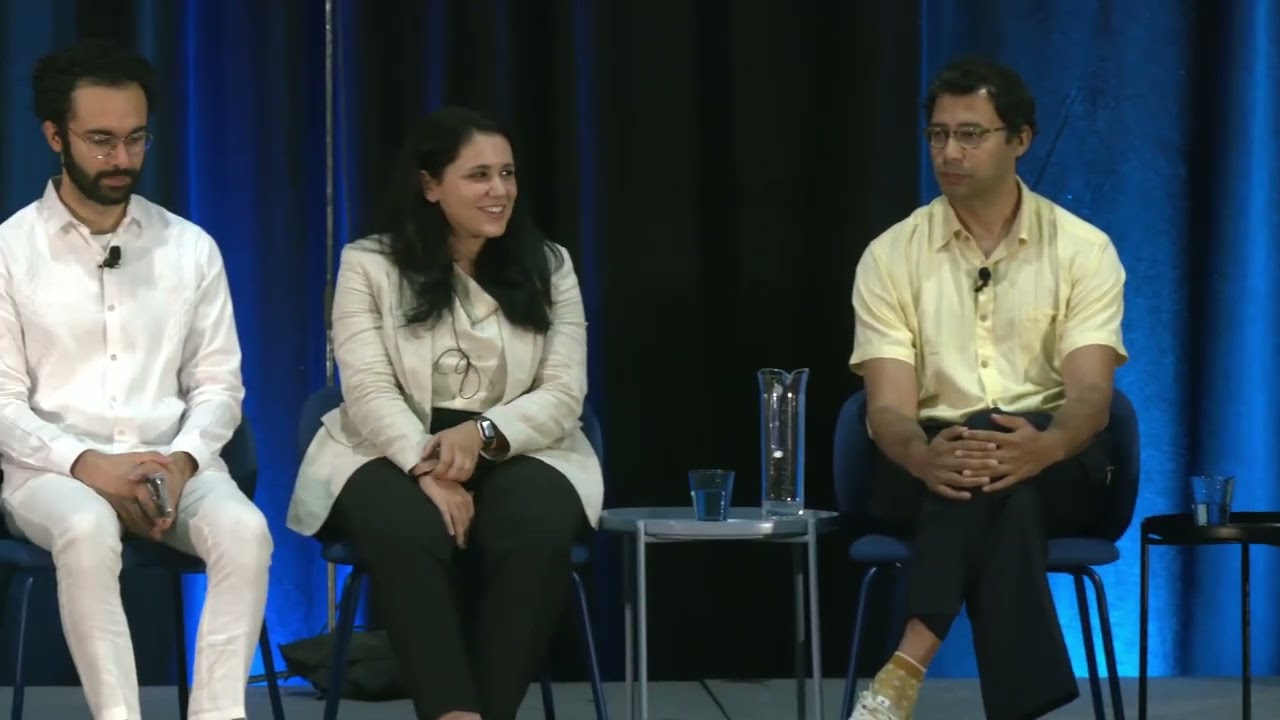
Cultivating Intellectual Life: Contributing to Discourse in the Biological Sciences
Watch on YouTubeVideo summary
The panel "Cultivating Intellectual Life" reflects upon three years of collaborative efforts designed to examine materialistic assumptions within the biological sciences from a Baha'i perspective, focusing specifically on seminars regarding evolution and consciousness. These initiatives aim to assist scientists in navigating university environments that often promote physicalist worldviews while maintaining their allegiance to spiritual principles. The discussion features diverse panelists including neuroscientists Yasmin Aman, Sujay Rejei, Tara Ram, Bayan Tuldi, and educator Dr. Jasmine Miller Kleinhens, who bring expertise ranging from cancer biology and social epigenomics to the neuroscience of learning and public health. They established these seminars to address a critical need for spaces where youth can resolve dissonances between reductionist scientific frameworks and Baha'i writings on evolution and consciousness, thereby helping students reconcile their academic studies with their spiritual identity without losing faith in materialistic academic settings.
Central themes explored include challenging unspoken metaphysical assertions such as the idea that evolution lacks direction or that human behavior is solely driven by biological survival impulses, contrasting these views with concepts of humanity's distinct nature and purpose. The panel also discusses redefining consciousness beyond a passive definition limited to sensory processing in animals, proposing instead an active form where humans are conscious of principles like the oneness of mankind and social realities; this reframing empowers youth to move from passivity toward shaping their environment through service. Originally held at the Annual Baha'i Assembly conference since 2019 or 2023, the program has expanded to local settings across North America, reaching approximately two hundred youth who might not attend the main event and fostering deeper community integration while allowing for organic interaction with academic spaces.
The seminar materials have iterated over time, currently on version thirteen, incorporating interdisciplinary insights from philosophy, psychology, and neuroscience while remaining accessible to those without advanced biology coursework. This evolution is evident in various contributions informed by the seminars, such as consciousness reading groups, an interdisciplinary think tank on intelligence studies, and mental health initiatives that integrate JYSEP's spiritual lens with neuroscience research. For instance, a researcher initially ignored evolutionary perspectives due to reductionism but was inspired to study neuro-evolution after discovering resonance between latent potentialities in neural circuits and Baha'i teachings on latency from Abdul-Bahá, leading to funded research across multiple species involving phenomena like convergent evolution that canonical theory struggles to explain.
In an undergraduate course at UC Berkeley, the speaker intentionally moved beyond a materialistic lens by weaving in philosophy and assigning students to reflect on whether the mind is fully reducible to the brain; contrary to expectations from engineering-major students who assumed reductionism, two-thirds argued that sources like linguistics, culture, society, and religion are necessary for a fuller understanding of the mind. This authentic integration allows participants to embrace their identity as both Baha'i ("Bahigh") and scientist without fear of losing credibility, receiving overwhelmingly positive feedback. Ultimately, these efforts help young people see coherence between their studies, service roles such as animators, and spiritual life, releasing society-building powers for social progress while enabling individuals like one participant who left a previous job to pursue work bridging academic interests with neighborhood engagement focused on building healthy communities through discourse analysis.
Read the full video transcript
This morning's second panel is called
cultivating intellectual life
contributing to discourse in biological
sciences.
This panel will reflect on three years
of collaborative effort to examine
materialistic assumptions in the
biological sciences and contribute to
discourses in this field from a Bahigh
perspective.
The panelists who are scientists,
educators, and community builders will
share their work developing seminars on
evolution and consciousness
accompanying youth in navigating
intellectually materialistic university
environments
and engaging broader discourses through
research, writing, teaching and
conferences.
The discussion will touch on both the
intellectual and spiritual dimensions of
this work, reflect on both the content
and process of the contributions
and imagine a path forward for
discourses in the biological sciences.
I have the pleasure of introducing
the moderator of our panel who will then
introduce the rest of our panel,
Dr. Dr. Jasmine Miller Kleinhens is an
assistant professor of population health
science.
She previously received a PhD in cancer
biology and was a post-doal fellow in
epidemiology.
Her research focuses on breast cancer
health disparities and social
epigenomics,
examining how factors like access to
health care and environmental exposure
beyond genetics shape breast cancer risk
and outcomes,
particularly for black women.
Dr. Miller Kleinh currently serves on
the Continental Board of Counselors for
the Americas.
[applause]
Thank you so much Andreas for that
introduction and we're so happy to be
with you today.
Amongst all the things that Andre said
about myself, I'm also one of the
facilitators of the evolution and
consciousness seminar. And so I sit with
my colleagues here today really for them
to share about this uh evolution of the
seminar. And um hopefully in a way
that's more conversational. We're really
inviting you into a conversation that we
often have with each other. Um and
instead of just five of us, it's now
2005.
Um, so just to to know that even though
it says it's about biological
assumptions and all these things, you
might be like, why is this happening?
Why are we all here? We're not
scientists. Maybe some of you are, but
maybe some of you don't consider
yourself to be so. But one, you all are
scientists. And two, you are all well
familiar with these topics of evolution
and consciousness. Who in this room has
heard the word evolution before?
It should be all of you because you all
went to Mr. Razby's talk and he spoke
about evolution last night. Who have all
heard about the word consciousness?
It should be all of you. It was also
mentioned last night. These words are
all around us and but also there's not
clarity sometime about the relationship
between these ideas and how the
revelation sheds light on them. So we're
going to spend some time talking about
the seminar and how it's been developed
as as Andreas mentioned. And but before
all that, I'm going to ask that my
colleagues share a little bit about
themselves, uh their names, where
they're from, their field of study, and
their relationship to this seminar. So,
we can start with
>> Hello everyone. Hopefully the mic is
working. My name is Yasmin Aman. I'm
coming from Boston. I'm a neuroscience
PhD student and I study the neuroscience
of learning and decision-making. Um, I
have a background in both neuroscience
and philosophy and I have been involved
with the seminar since its inception and
I've helped with the development of the
material and facilitating it both at ABS
and in local seminars and it's truly
such a joy to be here with this team and
the honor of presenting in this panel at
ABS.
>> Hi dear friends, my name is Sujay. I'm I
live in Montreal originally from Nepal.
I'm also a neuroscientist.
Uh today a little bit of nervous
neuroscientist [laughter]
reje I get nervous I'm going to look at
kudus calm me down um um I study
long-term memory uh bra bra bra bra bra
bra bra bra bra bra bra bra bra bra bra
bra bra bra bra brain processes and
neural circuits underlying long-term
memory from a very uh you know
reductionist approach. So it's a very
different experience to come into Bahigh
and talk about evolution and
consciousness from a different
perspective. So for me it has been a
very interesting learning experience. Um
I currently I work at a nonprofit that I
founded to that aims to raise resource
capacity among youth populations certain
populations in Nepal and Canada. Uh but
I still practice neuroscience.
Happy to be here.
>> Good morning everybody. My name is Tara
Ram. I am also a neuroscientist. Um,
common theme here. I am from Northern
California, the Bay Area of Northern
California. Um, I work at UC Berkeley. I
uh my research focuses on the
neurobiology of uh group dynamics,
social groups. Um, and I also teach
undergraduate coursework about uh the
mind, brain, and behavior.
um have also been involved with these
seminars for the past few years uh
alongside all of these friends and it's
really a joy to be here. Thank you.
>> Hi everybody. Good morning. Um my name
is Bayan Tuldi. I am not a
neuroscientist. Um actually two years
ago, not this ABS, not the past ABS, but
the one before that, I was a participant
in this seminar and now I also help to
facilitate. Um I live in Atlanta,
Georgia. I work um alongside youth and
families in my neighborhood. And then
also I'm about to start my graduate
studies in public health and my interest
in research have to do with how our
neighborhoods and our social environment
affect our our mental health and our
biological outcomes.
>> Very good. So maybe we can start by one
of you telling us how these seminars
came to be. Um but before these seminars
existed, what were you noticing in
yourselves or in the young people around
you that suggested a need for this type
of space?
>> Yeah. So I've been fortunate enough to
be attending ABS for 13 years now since
I was a junior youth. And although there
were so many intellectually riching uh
spaces to engage in, I was noticing two
needs as I was growing into my
profession as a neuroscientist.
One of them was a space for scientists
to come together and talk about what
does the harmony of science and religion
look like in practice. Not in
necessarily in abstract terms, but what
does it actually look like when we're
working in a lab and engaged in this
very materialistic sort of physicalist
framework but also are you know paying
allegiance to the spiritual very rich
spiritual lens that the writings can
offer. And then the other need I was
noticing was a space for youth who are
actively um trying to forge their own
path of service and their professions to
explore these tensions that they may be
um experiencing between these um social
forces around them or these materialist
frameworks and the Bahigh writings and
to explore that in a way that can
resolve any dissonances they have
throughout their studies. And so this is
also coinciding with um the start of
these seminars which many of you are
familiar with these spaces where um
participants can engage and can do deep
dives of topics um a few days preceding
the the annual conference. And so we
embarked on this journey to uh start a
seminar uh that explored key themes in
uh the topics in in in biological
sciences but that would also be broadly
accessible to uh the wider community
because these topics are so the topics
we chose of evolution and consciousness
really lie at the interface of science
and religion and I'm sure many of you
who have expressed that you're religious
in a setting um may have been asked so
what about evolution or what about you
know how what about the relation between
the brain and the mind and the soul and
so I similarly from stretching back from
uh high school I was asked how can you
be rational and spiritual or religious
how can you be a scientist and spiritual
and honestly when I'd get asked that
question um when I was younger I would
shudder it was like this chip on my
shoulder I would wear that I had these
views that I somehow you know believed
so deeply in the system of knowledge um
of the science of science and the
systems of knowledge of religion. But it
was hard for me to articulate in
concrete terms with that clarity of
thought and intellectual rigor that
Bahiser asked to think with what that
actually means. And so we so in
designing this seminar we wanted to
create material that explored these
topics in detail both the discourse at
large. So what does you know Darwinian
evolution or what does science have to
say about these topics and then what
does the revelation offer that can sort
of that can add and and enrich these
views and and one exercise I mean that
um that we do with our participants
through these materials is talk about
assumptions laden in these fields. So
these metaphysical assertions that are
not actually in the science themselves
but that the the discourse kind of has
accepted. So for example in the field of
evolution one metaphysical assertion is
that there's no teology no direction to
evolution. Um whereas the writings
obviously say that the fruit of
evolution is man is the fruit of
creation or the fruit of evolution. So
how do you reconcile those two? Um and I
think this panel will sort of get at um
get at sort of those those tensions
also. And then another idea for example
is this notion of the mind being fully
reducible to neural processing and the
mech the mechanisms of neuronal firing.
Um so similarly how do we reconcile that
with this idea of the human spirit that
Mr. Razavi spoke to us about yesterday
which is this highest expression of
commonality and uh loyalty among men.
And so yeah, so those were just two
ideas that we felt were very important
for Bahigh scientists and also the wider
community to gain familiarity and
clarity of thought with
that was so beautifully said. I don't I
feel [laughter]
um uncomfortable going after that. But I
wanted to also share a story. Um when I
was in graduate school also in Boston um
I was helping to support a number of
youth who were serving as animators and
children's classes in our in our
cluster. Um, and of course this is a
college town. The students are always
learning about, you know, how to balance
and and manage like their studies and
their service and whatnot. And there was
one youth who approached us at one
point. He'd been serving as an animator
for about a year uh while studying in an
engineering and AI based program. And he
said, I don't think I can be an animator
anymore. And uh, a few of us said, okay,
well, let's let's get coffee and let's
chat and and we'll talk about it. And I
fully expected him to just say, "I'm
really busy and my studies are really
overwhelming. I don't have time, you
know, whatever." And that was very, I
think, very common. We're all learning
about that. Um, but it was actually a
very different conversation. And what he
ended up saying was after taking these
classes for about a year uh and being
immersed in this university environment
that has a very pervasive
often unspoken accepted materialistic uh
world view that um as Yasmin was
mentioning kind of conceives of reality
as purely physical purely material. He
said, "I don't know if I believe in God
anymore, and I don't know if I believe
in the human soul, and I can't in good
confer
youth that they should rely on God for
confirmation when I'm not I'm not
certain of that myself." Um,
and I lacked the language at the time.
This was well over 10 years ago. Um, we
didn't have these seminars. We had other
spaces maybe, but we didn't have these
seminars. And I and I personally lacked
the the language and the depth to be
able to grapple with that with him and
help him explore um what it was that he
was he was grappling with. Um but it
left a really profound mark on me and it
helped me at least has helped me see the
relationship between these seminars and
like our work our the community building
work the nine-year plan. Like I think
that these forces of materialism can be
very paralyzing and if we're not
equipped with the intellectual and
spiritual capacity to analyze these
forces, they actually can sap the energy
of our youth and prevent them from
seeing themselves as protagonists in the
community building process. Um, and so I
think that these seminars, of course,
the, you know, the work of ABS is to
nurture the intellectual life of the
Bahai community, but I think these
seminars also play a role honestly a
little bit in protecting our youth and
equipping them with the skills that they
need to navigate um assumptions that are
often not explicitly stated, but um but
that carry really profound consequences
for their lives.
>> So maybe I can share another example
kind of contrastive example. So you know
as scientists we spend I spend a lot of
time in the lab. You just end up talking
to your colleagues late at night odd
hours. So what happened was once they
discovered I was religious and then
there was a shock for one week I could
not work. Every day I go to the lab I
would be grilled all day. How on earth
are you religious? So you know there was
several conversations and at the end of
the week my friend you know very close
dear friend like this is all internally
consistent
and then I'm like okay so are you a
bahigh now [laughter] so of course not
right the the word god is so
you know it provokes certain feelings
maybe but so but what happened
afterwards was they were extremely
attracted to the words of Bahala and
Abdul Bah so we started not a study
circle but we started reading words
directly from tablets and you know
tablet to the H for example. So they
would say comments like you know you're
speaking to the choir you know when you
think about one language and no borders
u and then even to the point that you
know one person points out what but what
Abdullah is saying is not exactly true
and the other person I get nervous
another person says hold on he's
actually making a rhetoric here so we
should not take this literally I'm like
oh perfect thank you I mean these are
these students at forefront of science
they've learned how to think
independently they're pushing boundaries
of science right and then they recognize
ize what Abdul Ba is saying. They're
saying, "Oh, yeah, we agree with this."
But then when it comes to taking action,
they're talking about social action.
There's a lens they're wearing and they
see everything from that lens. And
immediately there, they hit a wall.
Everyone says, you know, in that
specific circle, there was one phrase,
lizard brain. Anything anything that
comes up about social action, people
would say lizard brain and it's over.
What that means basically is all our
thoughts and action are ultimately
driven by our biological impulse to
survive and propagate our genes. So
everything is explained by that. So all
these altruism and you know contributing
society is just it's kind of like a
thing uh it just happens. So individual
action is just not in the picture. So I
found this glaring incoherence in
people's desire to learn and acquire new
knowledge
recognizing this internal consistency in
these arguments but participating and
taking action just seems so far removed
because of what you know Dar was saying
this materialistic view of human nature.
Uh we I actually ended up doing the
seminar with them when they visited me
in Montreal over over two nights and it
was amazing. I mean
they I mean you know some of the things
we cover in in in
the in the materials on evolution
it's it's a very well-known scientific
theory but many scientists are not aware
of different developments that has
happened in the field. So it was kind of
eye openening for you know those friends
they are still friends of the faith but
>> thank you all so much for sharing and I
think the last part you're making sujay
about these these materials that the the
seminar tries to cover. Um, Tara, you
mentioned 10 years ago you were trying
to have this conversation and you were
like, I actually don't really know what
to say to this youth who's having this
crisis of faith.
>> And this one youth isn't the only one.
There was many, many people who are
trying to grapple with this very this
world that is described as very
physical. It's just material. Only
things that you can observe with your
eyes exist. And everything else is
somehow, you know, you know, an
emotional appeal. It's logical. all
these things but we know that that's not
true. So then how do we describe that?
And at about five years ago
uh those who are serving ABS in various
ways were thinking about how to help um
undergraduate students with developing
this kind of language and mental
framework. And at the time there was a
seminar for called econ 101. So for
students who are starting to take uh
classes in economics, how might they
interact with those uh theories without
while also holding the revelation at the
same time? But then we noticed that
there's many bahayuk going into the
natural sciences but they didn't have
the same type of space to grapple with
these ideas and particularly with
evolution where again it's this
wellknown theory but it also there's
this wide um valley between those who
are creationist and those are purely
like physical materialists who believe
that humans are just animals. And we
know that neither side is is where we
really are at. And the the revelation
really shines a lot of light on the in
between. So yeah, around five years ago,
a friend from ABS, we said we wouldn't
say his name, but he's in the room,
started developing these materials so
that we could have this seminar uh
because this topic was very important.
But then also the topic of consciousness
kept coming up as well. And so the very
first seminar
uh we had a well-formed document on
evolution, but the one on consciousness
was primarily just some quotes. It was a
few pages. It wasn't really wellformed.
Um but maybe it'd be helpful if someone
here would want to share a little bit
about the creation of the consciousness
document and its iterations and maybe
also what's in the content itself, some
of the ideas. So maybe I can start and
you can fill in it will I'll say a
little bit about the content in the way
the way the evolutions there are two
documents we have in the seminar
evolution and consciousness and the way
evolution document unfolds is you go
through several theories of evolution
how he has evolved in last you know two
or 30 hund years especially last 50 to
70 years and the way it ends and then we
synthesize it in light of the writings
the way the document ends is we kind of
arrive at this conclusion that man is
the fruit of evolution and and one
characteristic of that fruit is being
aware of being conscious of the
existence of God and recognizing the
manifestation of the day. So this is
part of the evolutionary process that
has started many
many many years ago. Um so on the under
this view then rather than looking at
consciousness as a state or a noun form
that's how it's studied mostly in
neuroscience and other fields maybe it's
better to you know conceptualized as a
transitive form being conscious of
something in conscious of manifestation
conscious of your social reality
conscious of your capacity.
So the challenge to us was how do we
arrive at this conception logically by
synthesizing literature on consciousness
which is vast philosophy psychology now
even now neuroscience is really sort of
like a hot topic
uh so that's what our our document sort
of does try to arrive there but of
course we're still learning and you know
the document is evolving uh so maybe
someone can chime in.
Yeah. So when we first started working
on this document, as Suj was saying, it
was a daunting task and we're now on
version 13. So we've come a long way.
But it was um it was first, you know, a
group of us neuroscientists just trying
to survey everything neuroscience has to
say and then offer what the revelation
sort of can can, you know, um sort of
add and and how that it can enrich this
framework. And we realized that it's
such an interdisciplinary top uh field.
It you know there's psychology, there's
philosophy, there's these key sort of
other fields that also have a lot to say
on consciousness. And so one idea for
example is this idea of dualism. A lot
of the times when we talk about um
consciousness um you know to to
different populations they're like oh um
so the mind and body are separate. So
that's this dualism take that the mind
and body are separate and so then how do
they interact if they're separate? Um
and so that was an idea that really sort
of lended itself to an exploration from
both philosophy and um and neuroscience
and also the revelation because we know
that reality is one that's the spiritual
and material dimensions are part of one
reality and that's and one manifests
itself in the other and so um really you
know taking it upon ourselves to explore
um through these different fields and
then also to iterate and so every
version of the document was iterating on
what different participants felt was a
lens or a framework or a uh viewpoint
that they were seeing in their studies
that would be helpful for them to flesh
out further.
>> Yeah, I think another thing that we
tried to do also is to reframe and
expand on the concept of consciousness
entirely. So I think as we all were
reading like the literature on
consciousness and how neuroscientists
study consciousness, we realized um
there's a very particular way that
neuroscientists are thinking of what
consciousness is and more or less it's
sensory stimuli. So it's like um what is
it like to uh see like what is how do
you how does the brain see the color
red? How do you taste uh what an apple
tastes like? Right? like uh and to be
fair that on its own is quite complex
and so I can't really blame people for
trying to pick something simple to start
with. Um another way neuroscientists
might think of um consciousness is uh
states of awareness. Are you awake? Are
you asleep? Are you comeomaos? Are you
under anesthesia? Right? These are
different like states of wakefulness.
But more or less these are all animal
states. like you can study all those
things in mice, in uh fruitfly, in um
you know chimpanzeee. So like these
aren't things that are actually
particular about the human being. But
then some of these things that SUJ was
mentioning about like what does it mean
to be conscious of a principle actually
is something quite different than like
what does it mean to taste an apple,
right? So, uh, we were thinking a little
bit about the implications of this and
we were thinking about how the way
neuroscientists are thinking of
consciousness as the moment has a little
bit of passivity baked into it. Like
you're just a passive being. You're
either awake asleep or under anesthesia
and then you are responding to sensory
stimuli, right? Experiencing sensory
stimuli. But maybe like the highest
expression of our consciousness. If you
are conscious of the principle of the
oneness of mankind, if you are conscious
of injustices in your society, it's very
far from a passive state. Actually, you
then [clears throat] would be quite
active, I would hope, in response to
consciousness at that level. And so I
think we also try to elevate and reframe
um what like just what does this term
even mean? It's a very illdefined term,
frankly. And so I think there's a lot of
room for us to expand on it. Um, so that
was also one kind of I think in general
with discourses we want to ask ourselves
the question of like to what extent are
we reframing or expanding on some of the
concepts that already exist in the
field. Um, and I know Bayon you were
part of the first
>> cohort of people to study that document
in its first form. So I'm curious like
what was your experience as a
participant and then growing into now
facilitating the document multiple
times?
>> Yeah. Yeah. It's interesting because I
feel like at least for me a testament to
the work that was put into it. I think
hearing after the fact that actually the
field of neuroscience isn't so clear on
like a definition of consciousness
wasn't I mean it was apparent to me but
it also was not hard for me to begin
forming my own conception of what it
could look like to be conscious of an
idea especially like following this this
frame of thought of of how the processes
of evolution have actually brought forth
man in this unique form to be able to be
conscious of ideas to shape social
reality and I think that that work kind
of continues continues and as like you
were mentioning Tara as like our
conception of consciousness expands I
think it's also natural that the people
who would be able to interact with this
material the the population that it
serves would also expand um and earlier
yeah I think this idea of like being
aware or conscious of an idea and then
having the language for it and how it
shapes our reality around us is
something that became introduced into
like actually the material I think you
edited it after my first time taking it.
But then I remember facilitating it and
just like my mind was blown and I was
thinking like okay this relationship
between consciousness and and our own
language like what does it look like?
And it wasn't until like we actually
facilitated a local seminar where one of
the participants shared something that I
think helped to shed some light on this
and the question that we asked was like
what what's an example of an idea that
before you like once you got the
language to describe it it changed your
reality. [clears throat]
Excuse me. And it was confirmation that
they brought up and they mentioned how
this this word or this concept of
confirmation allowed for them to have
this framework of I will make effort
towards lofty goals and God will assist
and confirm me. And this and then this
example if you can extrapolate it out
further. Now imagine communities where
many many people in fact entire
populations are becoming increasingly
conscious of what it looks like to yeah
to be confirmed and to actually in an
essence like align their will with God's
will. And so then what will that
determine for the future of humanity as
we try to advance together? If we are
able to collectively more increase this
consciousness around the ideas and the
principles that will help to allow us to
advance.
>> Um thank you so much. It was really
helpful to hear not just the expansion
of the ideas over time which like Yasi
mentioned now on iteration 13
>> but also the expansion of those who can
experience the material. So we talked
about this is a seminar and it's also
it's offered at the conference but it's
also offered locally
>> and so it'd be nice to if someone could
maybe share a little bit about the
experience of offering local seminars,
what we're learning there, how it's
helping us to expand. Yeah, I can share
a little bit about that. So, we started
offering the seminar at the ABS annual
conference in 2023. So, this is now our
fourth year doing it here at the
conference. But I think as we were all
consulting, we also knew that there were
plenty of youth like in our communities,
in our clusters that would that would
want to study these materials, would
have a thirst for these materials,
university students who were studying in
the biological sciences or maybe in
adjacent fields, but would take a
biology class as part of their general
ed requirements and would confront some
of these um you know, these ideas in
their in their coursework. And so we
thought, well, you know, what's stopping
us from studying these materials? in in
a local setting or a subregional
regional or subregional setting. Um I
think you know generally the the
association is trying to learn about
bringing the work of the association
closer to the grassroots to make it more
accessible to more people. Um and to
ensure that you know the work of the
association is not uh restricted to one
annual conference every year as vital
and important as it is but that there's
a variety of spaces that people have
access to. Um and so at this point in
time, I think all of us and and a few
other of our f we're not the only
facilitators of this seminar. There are
others who've also been learning about
this process, but uh we've all been able
to facilitate at least one or two
sometimes more local seminars um across
North America in Boston, Montreal,
Ottawa, Northern and Southern
California, Atlanta, the Triangle,
Texas. Um I'm looking at a friend over
there. Um and so uh I think at this time
around 200 or so friends have been able
to study these materials through through
these settings. Um and I think what
we've been able to learn one is like the
local Bahigh community and the
institutions learn so much about what
ABS is when we offer these things
locally when we uh invite for example
our um auxiliary board members or um
members of a local assembly to come
visit to hear from the youth what
they're learning what implications it
has for their studies and their service.
I think we really saw that a lot of um
yeah just communities and institutions
were able to gain a deeper understanding
of what the work of ABS is and how vital
it is in the nine-year plan. Um I think
that we um we also found that um you
know the youth already know each other
in the local setting and many of them
are already studying the materials of
the institute together or going to ISGP
together. So they already have like a
rapport and relationships and so the
materials kind of um were very smooth
and easy to study and um yeah it just it
there was a vibrancy in the dynamic that
comes with studying in a local setting
and and our ability to reach youth that
um frankly might not ever make it to an
ABS conference because of limitations on
time or um distance and whatnot. Um and
so I think um this has been a really
fruitful learning process for us. I
don't know if others want to share some
of their experiences with local
seminars. Oh
>> yeah,
>> go ahead. You can you can talk to the
local the multi-sear. Yeah.
>> Yeah. We were so in Boston for example
and I believe you also did it in
California. We uh offered a few we had
like a seminar weekend where we offered
the mental health, economics, technology
and um the evolution consciousness
seminar all um sort of in one space over
a weekend in Boston and it was a very
special space because there are so many
universities in Boston. There are a lot
of Bahigh and um and friends of the
faith who are engaged in sort of their
academics um and are really thirsting
for this space and it was really
beautiful to see the synergies between
these groups um as we would meet
together after and discuss what we had
learned and you know obviously when it
comes to you know AI techn there's
synergies between technology and
consciousness um which we may talk about
later in the panel sort of our efforts
to to reconcile those two um and and it
was a very special place and also it was
it was an opportunity to seamlessly
integrate with those academic spaces. So
um I was able to actually talk about
this with some of my lab mates and one
of my labmates actually came and studied
some of the consciousness material with
us. So when you're in a local setting,
it's not like this isolated space um in
ABS, which is obviously such a haven for
us, but it's it's you're in sort of your
your environment, your um uh or
environment that can then organically
sort of interact with your contribution
to discourse.
>> Well, I'll just share one thing. I think
local seminars have a different dynamics
from annual seminar. people who have
been serving together and working
together in different ways come together
in this environment and it just creates
a very very rich learning environment. I
think local seminars complementing the
annual seminar has been really great.
Yeah, I think something that at least
for the local seminars for me it it
started another curiosity because I
think because like you were mentioning
the the population is different and many
of whom are like much younger and so the
population leans towards high school
early college age students who may not
have as much like field specific
familiarity
with neuroscience or with evolutionary
biology. But like many of us know these
are concepts that we're all aware of.
But then beyond that, it just seemed
like, at least initially, that the
concepts of evolution and consciousness
are also intimately related to just how
a young person will conceptualize their
own purpose and how they'll
conceptualize the actions that they
take. And like Tara was mentioning, like
moving beyond passivity, being a passive
recipient into actually trying to like
shape the world around them. And I think
some of those things that I mentioned
earlier started to crystallize like
during the the local seminars.
>> Thank you. And so I think just kind of
what you're saying towards the end where
it's we're no longer passive, it's
motivating people and thinking about the
aim of the nine-year plan to release the
society building powers of the faith in
ever greater measures. How how is the
seminar and these themes related to
that? How does it um release these these
powers?
>> Yeah.
>> Yeah,
>> I think that's a good question. Um
thanks. Uh it's it's it's also a
question that I have been thinking about
a lot and I also am curious to learn
about it. kind of connects to what we've
begun to see in some of these local
seminars of how these these ideas around
evolution and around consciousness help
to like stir something or release
something in young people in which they
see their yeah their role on this planet
a little bit differently and also begin
to connect it even to their yeah their
um their service in the institute and
say that it reminds them of of book one
and how like this is closely ly tied to
our purpose. At the same time, I've seen
like this question or like this initial
um curiosity and connection between my
involvement with the Institute for
Studies and Global Prosperity and also
working alongside youth in my
neighborhood. And in the conversations
that I've had, I've noticed that this
this question around human identity and
like both of these spaces are spaces
where young people come in to to try to
learn more about their identity and
shape it in light of um science and also
in light of the revelation. But then
this question emerges of like who are we
and like why are we distinct? Yeah.
>> And often times in ISGP or in the
context of like a neighborhood or a
study circle, there isn't maybe the
purpose of the space is not to be able
to adequately explore some of those
questions. But at the same time, if you
enter that space without being able to
explore, without having these
conceptions strengthened, then it can
also be hard to engage with the material
or to also form like rational thoughts
around religion. So this is I guess a
question for me and for I think many of
us as we continue to learn about the
seminar is like how is it that we can
broaden it further to allow for many
young people to interact with it but
also in such a way that it actually like
helps to strengthen their involvement in
the core activities in the institute
process in ISGP
[clears throat] excuse me and I think
just for me like it's also So
[clears throat]
something that yeah was very substantial
like just this idea excuse me
you know we're talking about rational
thinking it would be rational that I
should drink some water if I'm
[laughter]
but yeah I think the the thing that one
of the ideas that helped me at least in
my thinking and that helped me to start
to see that actually my belief in God,
my um belief in yeah the the idea that
this piece that we all envision that is
actually like a core fundamental like
conviction of ours is possible is that
it's rational and even having the space
to rationally explore it and I think
young people need more spaces to be able
to not only develop the capacity to like
think this way but also to articulate
this belief because in that articulation
And that confidence that comes from
being able to relay this idea I think
also for me came yeah the confidence in
the ability to structure my own beliefs
and also it strengthened my own faith
and I think resilience
>> I I find you know in terms of the
nine-year plan society releasing society
building power I find the concept of
human nature that is prevalent in
society that humans are you know result
of evolution again you the animal there
as I mentioned earlier selfish gene and
all those things these ideas are so
entrenched in our society I think it's
actually like a big dam blocking the
river of creativity and social action so
if we can even make a little bit of a
dent in this dam through the seminars
and you know rethinking evolution and
reconceptualizing consciousness I think
it will release powers you know we
cannot pinpoint what kind of powers but
it's sort of unblocking
what's stopping our society to progress.
Yeah, just building on that, we were in
our seminar this uh year talking about
what would it look like if we move
beyond this notion that we are just the
you know um our thoughts and actions are
uh this biological impulse to propagate
our genes or to survive and instead move
um towards sort of this this enriched um
view of human nature and our latent our
capacities to contribute to social
progress to be practic practitioners of
peace and how that can that is what it
will motivate social action and also
reframe how what we're capable of. And
so what might it look like if we adopted
that notion which is compatible with
scientific findings but just rest on a
different metaphysical assumption that
we are not just the product of neuronal
firing or the interaction between um you
know genes uh but rather um you know
have this sort of this distinct nature
and so yeah that was it's it's a I think
an important
step. It's an indispensable step to to
achieving that society building power.
I think um just to build and add to all
of that um I think that you know one way
that these seminars also um fit into the
constellation of activities within the
9-year plan is I think um you know I
think young people are all of us really
are appreciating that expansion and
consolidation is one very very critical
facet of the 9-year plan. uh arguably
it's central to the plan, but then there
are these these other areas, arenas of
activity. There's social action. There's
engaging in the discourses of society.
Um and that we need space like like we
have the training institute to train us
to engage in expansion and
consolidation. We need spaces that train
and accompany us to engage in the
discourses of society. And so I think
one way that you know broadly the work
of the association but these seminars in
particular is helping young people to um
see coherence in their lives and not to
see their studies as separate from their
service. I know that for me when I was a
university student I felt like my
service was being an animator or a
children's class teacher and then my
studies were something that competed
with that and like created an obstacle
for that. But I think spaces such as
these and variety of other spaces, the
Institute for Studies and Global
Prosperities was also mentioned are
helping young people to see that like
service is not a component of your life.
It's like an underlying principle that
gives expression in all the different
areas of our lives whether it's our
studies, our work, our family life, um
serving as an animator. Um and so I
think you know these spaces are helping
give coherence to the lives of youth and
and also these spaces are benefiting
from the other spaces of the plan. So I
know all of us have sort of reflected
and and noticed that the youth who were
able to grasp the concepts most clearly
and to contribute most effectively to
the discussions uh and who really got
the most out of the space were not
necessarily the ones who had like a ton
of experience with biology coursework.
They actually sometimes were the
youngest ones in the room. Some of them
actually had not even started university
yet. They were just finishing their year
of service after high school and they
had been immersed in the institute
really for you know especially that year
but even the years before it and they
developed a really remarkable capacity
to think clearly and to stick with a
concept and not get distracted into
tangential ideas and um to rely on the
guidance of the house of justice and
trust the guidance of the house of
justice. And I think that those
intellectual capacities that we are
developing in the spaces of the
institute are so critical to these other
arenas of activity that we are um
expanding into. And so I think that was
a really profound reflection I think for
all of us.
So you've shared a lot about um how this
seminar has shaped other the
participants who come about whether in
the conference or locally but maybe you
can also share how this seminar has
shaped your ability to contribute to
discourse or your own lives
>> because
>> yeah so it's it's hard to sort of
summarize how it has um impacted me
because I can't imagine sort of my
trajectory in neuroscience without these
spaces. Um but I would I feel like I
would have gotten so disillusioned or
discouraged but um yeah I think on an
abstract level having the courage to
challenge orthodoxies in a field and not
just um Dr. Arab in his um in his speech
at the 2016 um conference talks about
having the courage to um challenge
orthodoxies and also to not just label
what we don't like as materialism but to
actually have that clarity of thought to
articulate what it is that we the bahigh
are saying and and or what it what is
our understanding of the revelation and
and what is our understanding of the
discourse and how how does it um yeah
and and what are the sort of um
differences that that are ironed out
there and so having yeah that courage I
think is a more abstract thing that I've
gained u but more sort of specifically
um this uh a few things throughout um
especially my PhD studies I uh started a
consciousness reading group a few years
ago with my PhD um classmates uh where
we would meet every uh two weeks and
discuss sort of neuroscience articles
and discuss the shortcomings of the
neuroscience and offer different frames.
I'm also part of a think tank that
organizes interdisciplinary uh
conferences on the study of
intelligence. And so that was an a space
where we've invited I think this
conference really gave me the language
and also again the courage to invite and
welcome thinkers from different spaces
and different viewpoints to sort of to
you know um uh find these commonalities
and synergies across fields and and um
um conceptual frameworks. And then
finally also um mental health I think is
a topic that I'm very passionate about.
obviously neuroscience interfaces with
and I think is a really um key example
of these um mutually reinforcing uh
powers of uh discourse contributing to
discourse and social action because you
know the neuroscience and psychology can
describe sort of mental health and in in
you know all these very detailed and and
you know descriptive ways but then the
lens that for example the junior youth
spiritual empowerment program offers to
mental health and youth is is an example
of how we need these two um sort of
systems of knowledge to really move
forward. Um and so I think in those
three areas I've been this seminar has
really informed my my contributions. Um
but I'm sure sort of the energy that's
been infu that I've been infused in me
throughout these spaces and through
working with these um with my amazing
colleagues is has really in ways that I
can't describe I think invigorated me
and given me um yeah so much excitement
to I think be a scientist um be a bahigh
scientist in this this day and age.
>> So the evolution document particularly
has directly
influenced my research program in
neuroscience actually you know in
neuroscience
we've kind of internally hit a wall sort
of it's very reductionist
research program and the technology is
really advancing we have a lot of data
but the theories to synthesize those
data is impossible
and there's some voice that saying that
we should look at evolution uh but it's
a minority voice I was also ignoring
that for a long time. But then after
this document, it really led me into a
path to you know study neuro evolution a
little bit and see if you know it
started as a hobby after reading this
evolution document but then what
happened was you know it'll be a little
bit jargonistic. So if you look at any
animal or you know
any behavior or morphology of animal
most of this can be explained by what's
called common homology. You can look at
the history of the evolution and ask
okay these two animals had similar
traits. So most of the variants can be
explained like that. But there are these
other cases where very distant relatives
in animal kingdom in the tree of life
somehow they show similar traits. So
this you know canonical evolutionary
theory does not explain. So what is this
phenomenon and people have come up with
a with concept called convergent
evolution. So because of ecological
pressure or some other factors these two
distant animals show similar behavior.
So you know crow counting and humans
counting is one example. Insects and
birds and bats flying is another
example. These are very distant animals
in terms of their genetic makeup or
other things but they all fly. So how is
this possible? One answer is convergent
evolution but this is just a concept
right. uh so then you know people don't
really study underlying is there a
latent cause for this is there's
something special about the neural
circuits that is so general that these
potentialities can emerge given the
right conditions so this way of thinking
all of a sudden to me was very resonant
with what we had in the evolution
document of latency that you know the
concept of latency that Abdul Baha uses
uh so I started thinking and then you
know after two or three years it's
become part of my research program that
I put in my applications and you know
people are taking it seriously and I'm
going to pursue I've already started
pursuing some of the experiments across
multiple species and this is all traces
back to you know first time I read the
evolution document so thank you ABS
>> that's amazing um so um as I mentioned
earlier I teach undergraduate coursework
and um the chair of our department
approached me and said Tara do you want
to teach this class on mind, brain, and
behavior. And I said, I I would love to
teach that class, right? This is so
aligned with um you know, what I'm
learning in these spaces with ABS. And
so, as I was uh I was handed a bunch of
materials that somebody else had
developed uh for, you know, previous
years. Um but I was thinking, how do I
teach this class in a way that isn't
through this materialistic lens that
teaches the science? Like obviously they
have to learn the science, right? This
is a neuroscience course. Um, but I
wanted them to be able to ask certain
questions. So, as I was teaching, I
weaved in a lot of like philosophy, some
of the philosophers that we quote in the
consciousness document. Like, I weaved
them in. Um, so I kind of like actually
there was a Bahigh student who took the
course. So, I was able to reflect with
her about it after. But, um, I I tried
to weave in some of the elements of the
concepts that we, you know, that we were
exploring together in the consciousness
document. And um I had them do a series
of writing assignments throughout the
course. Um and their very last writing
assignment was on the last lecture, the
last day of the class. And I decided I
wanted it to be like a broad reflective
exercise. Um so I asked them, the
assignment was write, you know, a few
paragraphs about this idea that the mind
is fully reducible to the brain. Do you
agree or or do you disagree? And and I
actually told them I don't care your
answer. like you're free to take
whatever stance you want. I'm not
grading you on the what you say. I just
I want to see you, you know, think about
this and and make an argument about it.
And so, um, do you know, do you think
that the mind is fully reducible to the
brain? Why or why not? Um, and, you
know, what other sources of knowledge do
you think are necessary for us to have a
fuller understanding of um of the of the
mind? And yeah, this is UC Berkeley like
it's in the heart of the tech industry.
A lot of the students are like probably
engineering students who need to take
like a biology class to graduate. And so
I actually fully expected the majority
of my students to say, "Yeah, yeah, the
mind is fully reducible to the brain."
>> And what I ended up finding was I
actually was kind of shocked. Twothirds
of my students said, "No, the mind is
not fully reducible to the brain." And
here are all these other sources of
knowledge that we need to draw on. We
need philosophy. We need linguistics. We
need psychology. We need to understand
culture. We need to understand society.
uh a handful of them actually said we
need to understand religion which I was
really I didn't mention religion
actually I kind of stayed away I I
wasn't that courageous we need to have
courage as was mentioned but I wasn't
that courageous to talk about religion
in my class maybe maybe I'll develop
more courage over time um but some of
them did talk about the need for
religion um and so I was actually it
gave me a lot of hope in this next
generation of youth um I think they're
very perceptive I think they um are very
clearsighted and so I that was a very
encouraging um that was very encouraging
for me and it was funny because a couple
days before the lecture uh a colleague
in the department reached out to me very
senior colleague this is someone who's
been there for a couple decades and we
have this practice in our department of
uh peer feedback on teaching and all of
us are supposed to do one in the
semester to give each other attend a
lecture of your colleague and give
feedback and so he reached out and he
said I haven't done my peer feedback for
the semester yet can I come to your last
lecture and watch I was like oh god
>> [laughter]
>> because I didn't know what he would
think of this assignment, right? Like he
may have a very materialistic view
himself. Um, and so but I decided to
just I'm going to go through with it,
you know, whatever. This is my teaching
style and you know, he can think what he
thinks. And he came and then we
reflected together afterwards. And
actually the most positive feedback I
got from him was I loved that assignment
at the very end.
>> Like I think that's a really excellent
question. These are exactly the
questions our students should be asking.
And so I think um you know this space
that we're in um together and the
conversations we've had, the materials
themselves have helped me
see that there are ways to express these
ideas that are scientifically rigorous
and that will be wellreceived by maybe
not everybody but a lot of people will
be appreciative and receptive to these
ideas. Um, you know, I know a few of us
have talked with each other over time
about like having a little bit of
anxiety of how we're perceived by our
colleagues and like what will somebody
think if I, you know, talk about this?
What will someone think if I publish an
essay or an article and it's on Google
and they Google me and then they find
this thing and it talks about the beh
like I I think we all had a little bit
of nervousness about um being taken
seriously in our fields. Um, and I think
for me at least like being part of this
space has helped me see that I can be
exactly who I am, be a bahigh, be a
scientist, do both of those things
together and that I can still be taken
seriously. And I don't know, maybe there
are people who don't take me seriously
and they just don't tell me to my face.
But I think the feedback I've gotten on
a whole has been overwhelmingly
positive. Um, so I think I'm very
appreciative of these spaces. I mean,
the process of co-creating them together
has given me um yeah, just like a
confidence and a courage to to um be a
bit more bold in the way that I um
express these ideas in a more open way.
>> Yeah. So um when I first was a
participant in the seminar, it was kind
of at a moment in my life where I was
just thinking and questioning my field,
what I was contributing to society just
at the level of like the intellectual
life like recently I started animating a
junior youth group. I was becoming more
like intimately involved with like what
was happening in my neighborhood. But
you know a study of book seven kind of
brought me to this ide just the thought
that I need to also intellectually like
advance and this will also has to be
related to the intellectual advancement
of my community. And so the the seminar
kind of like started it was very much so
like the the beginning point of a
process that now has kind of led to me
yeah I actually in December I I stopped
working at the job that I was working at
and I'm now pursuing like a a pretty it
could be seen as like a drastic shift
but I think for me it has always been
what my interests are and just I think
yeah like people were saying the courage
to be able to do that but also the
clarity of like yeah one other thing is
okay like if I'm one thing that comes up
as we think about contributing to
discourse is like what are people around
me actually talking about like the first
step in analyzing discourse is to
actually familiarize yourself with the
social spaces that you exist in and I
was just finding that for my field that
I was in I I couldn't see that nor could
I see like that curiosity and so this
seminar really helped with that and I
think in the future a lot of now like my
the bridging of of where my education is
headed, but also my my work in in my
neighborhood and in my community is like
just this curiosity of like what what
does it take to build like healthy,
safe, vibrant communities and also
healthy, safe, vibrant people and like
how can we analyze these things? How can
we understand like what contributes to
their unfoldment so that we are able to
to continue to support um our friends
and our families and yeah
>> thank you all so much. I hope you all
enjoyed this rich discussion and that's
the end of our panel.
>> Thank you guys.
[applause]