YouTube Transcript Downloader and AI Video Summaries
Paste a YouTube video URL to extract its English transcript, download the subtitles as text, or create a concise AI summary.
1. Paste link
Enter a YouTube video URL.
2. Find subtitles
Automatic English subtitles are detected.
3. Download
Save clean subtitles as a TXT file.
Recent summaries
2593 videos · Page 58 of 87
Bjarne Stroustrup: Journey to C++ from Fortran, Algol, Simula, and C
Lex Fridman
Bjarne Stroustrup recounts his early journey through programming languages, beginning with Algol 60 and Fortran before finding himself drawn to Pascal's simplicity and microcode for efficiency. His path led him to Simula in the late 1960s while he was a visiting professor at Aarhus University, where he studied under Ole-Johan Dahl and Kristen Nygaard.…
EN
Jul 30

Michael Kearns: Algorithmic Fairness, Privacy & Ethics | Lex Fridman Podcast #50
Lex Fridman
In this episode of the Lex Fridman Podcast, Michael Kearns, a professor at the University of Pennsylvania and co-author of *Ethical Algorithms*, explores the intersection of machine learning theory with deep philosophical questions regarding fairness, privacy, and ethics. The conversation begins by distinguishing between algorithmic efficiency, which can be measured using Big O notation like running time or memory usage, and ethical metrics such as fairness.…
EN
Jul 30

Michael Kearns: Game Theory and Machine Learning
Lex Fridman
In his discussion of markets and collective outcomes, Michael Kearns highlights how game theory serves as a mathematical framework for analyzing systems where individual interactions shape overall results. While originating in economics, this field has evolved into algorithmic game theory over the past two decades, particularly within computer science.…
EN
Jul 30

Michael Kearns: Differential Privacy
Lex Fridman
Michael Kearns introduces differential privacy as a robust technical framework designed to offer genuine hope for individual privacy in an era where data aggregation can easily identify specific users. Unlike weaker anonymization methods, this approach establishes a rigorous definition by comparing two alternate worlds: one where a researcher includes your medical record in a database and another where it is excluded.…
EN
Jul 30

Sean Carroll: Time Travel in Many-Worlds
Lex Fridman
Sean Carroll addresses how Many-Worlds Interpretation (MWI) clarifies our specific branch of reality, emphasizing that this framework was not invented for its imaginative appeal but to solve a fundamental problem in quantum mechanics: the measurement issue. In standard observations, particles like electrons appear spread out as wavefunctions before being measured and found at a definite location.…
EN
Jul 30

Dava Newman: Space Exploration, Space Suits, and Life on Mars | Lex Fridman Podcast #51
Lex Fridman
Dava Newman, an Apollo program professor at MIT and former deputy administrator of NASA, joins the discussion to explore her extensive background in aerospace biomedical engineering and human performance in varying gravity environments. Her research focuses on designing advanced spacesuits, specifically the BioSuit, which utilizes mechanical counter-pressure technology rather than traditional gas pressurization to maximize mobility for astronauts exploring planetary surfaces like Mars.…
EN
Jul 30

Dava Newman: Life on Mars and Beyond
Lex Fridman
Dava Newman opens her discussion with a reflection on humanity's place in the cosmos, emphasizing the importance of viewing Earth as merely a small blue dot within a vast universe containing at least one hundred billion stars in our own Milky Way galaxy.…
EN
Jul 30
Dava Newman: Reusable Rockets
Lex Fridman
Dava Newman expresses profound excitement regarding the recent advancements in reusable rocket technology, particularly highlighting the achievements of SpaceX over the last few years. She contrasts this modern innovation with NASA's Space Shuttle program, acknowledging that while the Shuttle was indeed a reusable vehicle and represented an amazing aerospace engineering feat with its gorgeous and elegant design, it ultimately failed to be affordable for sustained operations.…
EN
Jul 30

Dava Newman: Role of AI in Space Travel
Lex Fridman
Dava Newman addresses the philosophical implications of artificial intelligence in space exploration, specifically referencing the famous scenario from *2001: A Space Odyssey* where HAL 9000 prioritizes mission objectives over astronaut safety.…
EN
Jul 30
Gilbert Strang: Linear Algebra, Teaching, and MIT OpenCourseWare | Lex Fridman Podcast #52
Lex Fridman
Gilbert Strang, a renowned professor of mathematics at MIT and creator of millions-viewed OpenCourseWare lectures on linear algebra, reflects on his role in making advanced mathematical concepts accessible to undergraduates worldwide. He notes that while he does not feel like a "rock star," the widespread adoption of his 2006 lecture series demonstrates the enduring power of clear teaching combined with the subject's growing relevance.…
EN
Jul 30
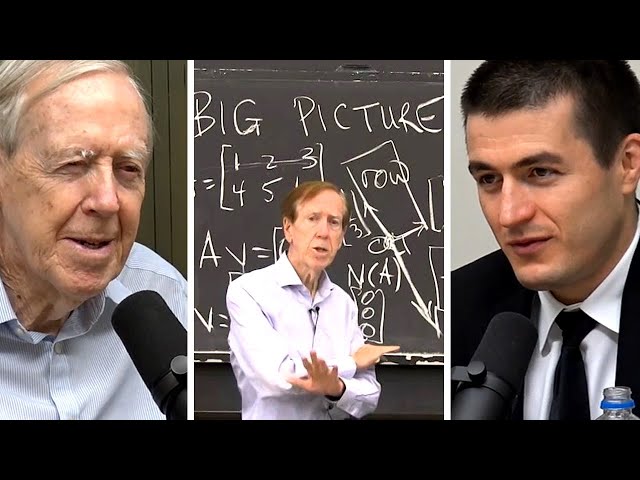
Gilbert Strang: Four Fundamental Subspaces of Linear Algebra
Lex Fridman
Gilbert Strang introduces linear algebra as a powerful and beautiful subfield of mathematics, highlighting his particular pride in teaching the concept of the four fundamental subspaces. Although these spaces were known long before he named them collectively this way, they form a cohesive framework for understanding matrices. A matrix is defined by its structure containing $n$ columns and $m$ rows filled with numbers that represent connections between dimensions.…
EN
Jul 30

Gilbert Strang: Linear Algebra vs Calculus
Lex Fridman
In this discussion regarding the pedagogical order of mathematics, Gilbert Strang reflects on the intuitive difficulty students face when visualizing planes in multi-dimensional spaces compared to concepts from calculus. He acknowledges that while mathematically sound, imagining these higher dimensions is not immediately intuitive for learners.…
EN
Jul 30

Gilbert Strang: MIT OpenCourseWare (OCW)
Lex Fridman
Gilbert Strang reflects on the profound impact of MIT OpenCourseWare, noting that hundreds of thousands to millions of people watching these lectures demonstrates a truly powerful reach for higher education. He recounts how this initiative originated from a committee appointed by then-President Vest, whose original mandate was simply to determine if MIT could market its courses like other universities do.…
EN
Jul 30

Gilbert Strang: Teaching Math by Example
Lex Fridman
In the context of teaching mathematics and introducing new concepts, a central debate emerges regarding whether it is more effective to begin with abstract theory or to start by plugging in numbers. The discussion highlights that many educators prefer showing examples first because they help students grasp complex ideas before diving into formal proofs.…
EN
Jul 30

Gilbert Strang: Singular Value Decomposition
Lex Fridman
Gilbert Strang opens his discussion on linear algebra by highlighting its profound beauty and deep connections between ideas that may initially appear unrelated to one another. He emphasizes that while mathematics is an amazing subject, it becomes particularly powerful when applied to real-world data structures like matrices. In the context of data science, a matrix often represents complex datasets where columns might correspond to variables such as drugs in a study and rows represent subjects like patients.…
EN
Jul 30

Noam Chomsky: Language, Cognition, and Deep Learning | Lex Fridman Podcast #53
Lex Fridman
In this conversation, Noam Chomsky addresses the possibility of establishing a universal communication protocol with an alien species, drawing on Marvin Minsky's experiments with simple Turing machines that demonstrated arithmetic as a baseline for intelligence.…
EN
Jul 30

Noam Chomsky: Deepest Property of Language
Lex Fridman
In this discussion, Noam Chomsky identifies structure dependence as one of the most profound and puzzling properties discovered in linguistics and cognitive science over a lifetime of studying language and the human mind. This concept refers to the universal ability humans possess to interpret sentences based on their underlying grammatical hierarchy rather than simply processing words in the order they are heard.…
EN
Jul 30

Noam Chomsky: Meaning of Life
Lex Fridman
Noam Chomsky begins his reflection on human existence by highlighting a peculiar and defining characteristic of our species: mortality. He references Ernest Becker's exploration of this theme, noting that while he once pondered the value of death at around twelve years old, his concerns were not about personal cessation but rather the terrifying prospect that if consciousness vanished, so too would the entire universe.…
EN
Jul 30

Ray Dalio: Principles, the Economic Machine, AI & the Arc of Life | Lex Fridman Podcast #54
Lex Fridman
Ray Dalio, founder and co-chairman of Bridgewater Associates, argues in this conversation with Lex Fridman that truth is best discovered through a rigorous five-step process: identifying goals, diagnosing problems to their root causes, designing solutions based on reality rather than convention, following through, and constantly experimenting.…
EN
Jul 30

Ray Dalio: What is Money?
Lex Fridman
Ray Dalio addresses the fundamental nature of money, defining it primarily through two essential functions: serving as a medium of exchange and acting as a store of wealth. He emphasizes that these roles rely entirely on collective human perception; currency possesses value only because society agrees to recognize it as such.…
EN
Jul 30

Ray Dalio: Can Money Buy Happiness? | AI Podcast Clips
Lex Fridman
Ray Dalio, one of the world's wealthiest individuals, addresses whether money can buy happiness with a definitive no, citing extensive research that shows little to no correlation between income levels and personal well-being once basic needs are met. According to his analysis, true happiness is most strongly linked to high-quality relationships with others and a strong sense of community rather than financial accumulation.…
EN
Jul 30

Ray Dalio: Artificial Intelligence Principles | AI Podcast Clips
Lex Fridman
Ray Dalio outlines a comprehensive framework for integrating artificial intelligence into analysis and decision-making, emphasizing a critical distinction between two types of algorithms: those derived from human principles and those generated through machine learning. He argues that while AI systems are powerful tools for processing vast amounts of data, they should not be relied upon when the future differs significantly from the past without a deep understanding of cause-and-effect relationships.…
EN
Jul 30

Whitney Cummings: Comedy, Robotics, Neurology, and Love | Lex Fridman Podcast #55
Lex Fridman
In this episode of Lex Fridman Podcast #55, comedian and neurology enthusiast Whitney Cummings explores her recent Netflix special *Can I Touch It?*, which features a robot named Bear Claw—a life-sized replica of herself designed to examine societal fears regarding artificial intelligence.…
EN
Jul 30
Ray Dalio: Idea Meritocracy | AI Podcast Clips
Lex Fridman
Ray Dalio attributes his company's success to a specific organizational culture known as an idea meritocracy, a decision-making process designed to surface and refine the best possible ideas by fostering collaboration within teams. This concept is particularly notable for its rarity in both corporate environments and broader society, where individuals often remain entrenched in their existing belief sets regarding politics, public discourse, or social issues.…
EN
Jul 30

Whitney Cummings: Neurology and Mind over Matter | AI Podcast Clips
Lex Fridman
The provided text appears to be a collection of fragmented audio artifacts, background noise markers, and unintelligible utterances rather than a coherent spoken discussion or lecture. There are no clear speakers identified by name beyond the title reference to Whitney Cummings, nor is there any substantive dialogue regarding neurology, mind over matter concepts, or specific arguments presented in an interview format.…
EN
Jul 30

Whitney Cummings: Compassion Toward Robots | AI Podcast Clips
Lex Fridman
Whitney Cummings opens her discussion with a striking observation regarding the unique compassion people extend toward robots compared to humans or animals, noting that she has rarely witnessed such tenderness directed at non-sentient entities in her life. Drawing on her experience managing robot owner chat boards for eight months, she highlights several emotional benefits of interacting with these machines: they never cheat, hurt, lie, judge, or require social performance from their users.…
EN
Jul 30

Ray Dalio: Work-Life Balance and the Arc of Life | AI Podcast Clips
Lex Fridman
Ray Dalio addresses the modern concept of work-life balance, challenging the notion that one must choose between professional duties and personal passions. He advocates for a principle where work and passion are unified rather than separated, suggesting that when an individual's career aligns with their true interests, life naturally flows better.…
EN
Jul 30

Michio Kaku: Space Travel and Colonization of Mars | AI Podcast Clips
Lex Fridman
Michio Kaku posits that human arrival on Mars in the 2030s is a matter of engineering rather than physics, presenting significant challenges but no fundamental barriers to achieving this goal within decades. Looking further into the future, he speculates that by the end of the century, humanity will likely possess its first starships capable of interstellar travel.…
EN
Jul 30

Bjarne Stroustrup: C++ Standards - C++03, C++11, C++14, C++17, C++20
Lex Fridman
Bjarne Stroustrup explains that the standardization of C++ began in 1989 when representatives from IBM and HP approached him to formalize the language under ISO rules, a move necessitated by concerns over corporate ownership and competition. Although initially skeptical because the language was not yet finished, Stroustrup agreed after realizing that without his involvement, other organizations might standardize it themselves or rely on proprietary versions owned by competitors.…
EN
Jul 30

Ray Dalio: Is Credit Good for Society? | AI Podcast Clips
Lex Fridman
Ray Dalio presents a compelling perspective on the economy, describing it not merely as random transactions but as a complex machine driven by three fundamental forces: productivity growth, short-term debt cycles, and long-term debt cycles. He emphasizes that while most people view money simply as currency, in reality, the vast majority of economic activity is based on credit; for instance, total credit in the U.S.…
EN
Jul 30