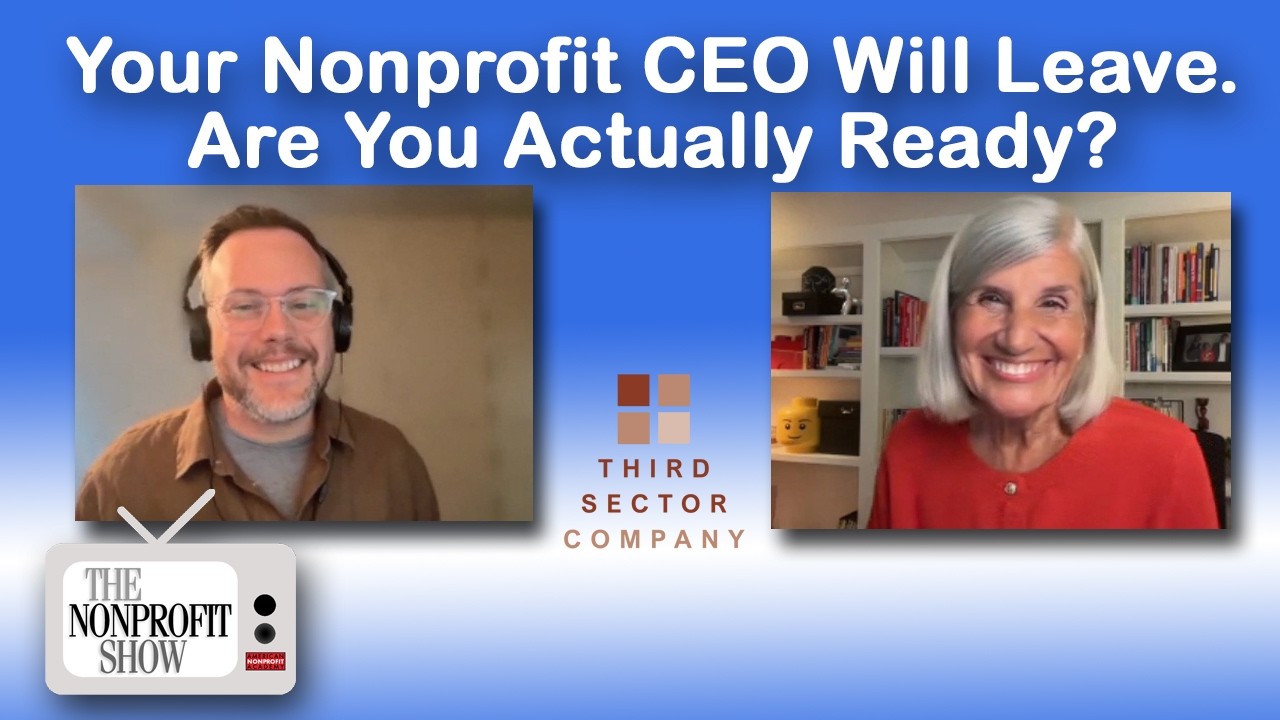
Video summary
The video addresses a critical yet often overlooked topic within the nonprofit sector: interim leadership during executive transitions. The hosts discuss how many organizations mistakenly view hiring an interim leader as a sign of crisis or poor planning, creating a stigma that delays adoption of this best practice. Drawing parallels to religious congregations where interim pastors have been used for centuries to ensure smooth succession and allow communities time to settle, the speakers argue that nonprofits should normalize these transitions rather than treating them as emergencies. They emphasize that since every leader eventually leaves—whether due to retirement, burnout, or other reasons—it is essential to treat leadership continuity as a core part of governance strategy rather than reacting only when someone unexpectedly departs.
A significant portion of the conversation focuses on shifting the mindset from reactive crisis management to proactive succession planning. The hosts highlight that meaningful discussions about interim roles should happen early and often, ideally before any emotional attachment or panic sets in. They note that founders and long-serving leaders who prioritize mission continuity over personal ego are more likely to initiate these conversations voluntarily. By framing interim leadership as a tool for organizational health rather than a failure of the board's ability to retain staff, nonprofits can reduce fear and open dialogue about options such as Sabbaticals or planned departures. This approach allows boards to maintain their focus on governance while ensuring that operations remain stable during transitions.
The discussion also tackles practical barriers like cost misconceptions and lack of awareness regarding what interim leaders actually do. While corporate interims may command high fees, nonprofit-specific roles are often more affordable and provide unique value through objective assessments, forensic reviews of organizational health, and preparation for future hires. An effective interim leader does not merely "keep the lights on" but helps clarify gaps in policies, HR records, and culture before bringing in a permanent successor. The hosts encourage boards to engage with training programs or audit sessions to better understand these processes, noting that even short-term exposure can generate valuable conversations within volunteer groups and staff teams who are already stretched thin.
Ultimately, the episode concludes by envisioning a future where interim leadership becomes standard practice across large national organizations and is supported by funders as part of responsible stewardship. Success will be evident when nonprofits consistently make strong next hires that retain talent and sustain morale after transitions. The speakers urge leaders to embrace this concept now before demographic shifts force them into reactive modes, warning that failing to plan for inevitable departures could jeopardize an organization's mission and stability. By normalizing these conversations at kitchen tables and board meetings alike, the nonprofit sector can build resilience against leadership churn and ensure its enduring impact on communities worldwide.
Read the full video transcript
[music]
Hey, welcome back everybody. It's
another episode of the nonprofit show
and we're really going to dig into this
issue of interim leadership and we're
going to talk about communications and
how to explain it. I have Aaron Roden
Biker with us. He's a senior creative
strategist um marketing and
communications with s third sector and
then we have Joan Brown our fave chief
operating officer from third sector as
well. Hey, welcome you two. Thank you.
>> Hey, nice to be here.
>> It's going to be really great, great
conversation because this is a super
important topic. Um, and we have a lot
of important topics on the nonprofit
show. On Friday, we celebrated our
1,600th episode, and we would not be
here without our partners. They include
Bloomerang, American Nonprofit Academy,
Staffing Boutique, JMT Consulting, Third
Sector Company, Your Parttime
Controller, and Intuitit QuickBooks. I'm
Julia C. Patrick, CEO of the American
Nonprofit Academy.
And really quickly, we were uh uh
awarded number one best podcast in
philanthropy. I told our producer I
wasn't going to talk about it this
morning, but it slipped in there. So,
sorry, Kevin. Hey, Erin. Okay, you you
get the prize for the most interesting
guest location of the day. Tell us where
you're coming to us from.
>> Yeah, I'm in Copenhagen, Denmark.
Wow. Okay. So,
>> across the world, I think from where
both of you are.
>> And what time is it there? Dinner time.
>> Uh, it's dinner time, past dinner time.
So, yeah, I'm not Danish. I'm originally
from the West Coast from Seattle. Uh,
and that's where I started with Third
Sector Company and been able to keep
going all the way across the world. Um,
even here in Copenhagen. Yeah.
>> Amazing. Amazing. Well, Erin, it's great
to finally meet you. Um, you and I
correspond quite a bit through email or
we're just copied on things and uh, so
it's super awesome to to get to see you.
Um, Joan Brown. Okay. Where are you
coming to us from?
>> Well, not nearly as exciting as
Copenhagen, Denmark, but I'm in Fort
Wayne, Indiana.
>> Pretty cool. Pretty cool.
>> Pretty cool. Yeah, I would say pretty
cool. Well, this is a great part of uh
interim leadership, working with people
from different places around the world.
I was going to say country, but it's
really more global than that. And uh so
this is a fun way to really dig into
that and explain the the beginning of
our conversation because I want to know
why we are so unfamiliar with this. And
maybe Joan, I'll start with you because
it seems to me the interim leadership is
such a basic concept, especially now
with an aging workforce. We're moving
through our leadership at alarming
rates. Um,
talk to us about this word in the
process.
One of the reasons that
I think there's been a slow adoption,
we'll say that, of interim leadership is
just a long time feeling that this is
sort of like emergency crisis. You only
need an interim if you haven't planned.
You only need an interim if you're
caught off guard and that there's almost
has been almost a stigma that having an
interim signaled some lack of leadership
on the board's part. Perhaps we know
that's not true. One of the things that
we've seen through hundreds of years is
that congregations
have practiced interim leadership for
all of this time because they figured
out this is the best way for a smooth
transition is put some space between the
departing leader, the pastor, the rabbi,
the priest, and the incoming to give
everyone a time to settle and have a
vision for where you're going. So, it's
not a new idea. We're just a little slow
in accepting it for our nonprofits as a
best practice.
>> Well, Erin, it's fascinating to hear
Joan's perspective because the thing
that stuck out to me was like crisis
communication.
>> I mean, holy moly, when you are talking
about something and you have to to even
put those glasses on and say these are
the lens that we're looking through.
Oof, that's a tough cell.
>> Yeah, I think most of my my work with
third sector company is really thinking
about uh sort of the digital billboards
and digital spaces where, you know, uh a
nonprofit that's facing a transition,
there's a board member who's probably
sitting on their phone at 10 p.m. at
night on their sofa going, "What do we
do? What are our options?" Um, and and
so I think about, you know, what are the
search terms and what are the tools and
guides that might work, but in reality,
you know, these tools can only get you
so far. You you need a person. And it
would be great if someone from inside
the organization could fill in uh or a
board member could step in, but I think
you used the example of the religious
communities earlier. Not everybody can
teach, not everybody can preach. um you
know in those communities two 200 300
years ago you you know you needed
someone a special person to come in and
do those things and we kind of have the
problem where boards and search
committees think oh yeah we could
probably we could probably weather this
storm until we get a permanent person
but you know we know the methods and we
know kind of the emotional intelligence
that it takes to be a leader in
transition. uh we know 800 people who
can do it and so we're kind of always
trying to reach people in those moments
of crisis uh to say what their options
are.
>> Right. So thinking about that then
I hear you say something really
interesting and that is is that you can
you can actually plan for this. Sure,
there's going to be a crisis at some
point where your leader leaves, but for
the most part, it seems like we know
that these transitions are happening.
Um, and I'd love to get your opinions
about thinking about interim leadership
so that we're not just saying it's a
crisis situation, right, Joan? I mean,
is that appropriate? I mean, should we
be talking on the board level about
this? We should be talking at the board
level at all levels of the organization
because the truth is everybody leaves.
Everybody leaves one way or another. You
are going to have a leadership
transition within your organization. And
so why not have those conversations?
They're best had when you don't need
them,
>> when no one is emotionally involved,
when no one thinks that conversation is
targeted at them. um when it's just part
of the organizational
healthy succession planning. This is
where we think interim leadership should
be introduced to every organization.
When you are thinking about oh perhaps
our leader will leave. It's not perhaps
your leader will leave. Let's have a
plan for that. So we're not in crisis
mode. So it's not an emergency. And part
of that succession planning discussion
should be under what circumstances will
we consider an interim a professional
interim leader.
[clears throat]
>> It's it's really interesting because
Erin, going back to your your first
point, if you don't know what this
means, how do you make these decisions
or how do you have these discussions?
And and I'm going to throw it to you
like how do you even have the language?
because I think you're right about this.
You know, I always say it's 2:00 in the
morning and you're, you know, you're
surfing your phone trying to solve a
problem. [laughter]
You were kind. You were like sitting on
the sofa at 10, but I'm like, it's it
seems to me that that um we don't even
have the correct language to understand
what this looks like.
>> Yeah, I think that's that's totally
right. And you know what comes to mind
is is uh just this summer as I was
visiting family, I was talking to my
aunt and we're sitting at the kitchen
table and she's a board member and she
was telling me all about how their
executive who is kind of burning out,
needs a sbatical uh and they're a
founder. So that means every board
member has a very special relationship
to this executive and their family. And
I just started telling her about what I
do and what we do at Third Sector
Company. And it is that moment where you
start talking about succession planning
and you know you have to kind of warn
people. It doesn't mean you're you're
getting you're letting somebody go. You
know it's not like this scary dirty
word. It's there are methods and
processes that we talk about in interim
leadership that are about the entire
leadership continuity to prepare before
there's ever a crisis mode or you know
someone has departed. So it's it is
sitting at those kitchen tables and and
kind of connecting the dots to say
you're already kind of frustrated or
you're kind of burnt out. You're running
out of options of what to do. Have you
thought about and I just started talking
about the tools and the conversations
that we have in succession planning and
leadership continuity.
>> Wow. So Joan,
you said something kind of chilling but
spoton. Everybody leaves. Um this
conversation should be a rolling
conversation
um in general. But if you do have
somebody that could identify, I'm out of
here when I turn 65 in
two years, 2 months, 20 days, whatever,
how do we back this up? Like like how
far in advance should we re really be
leaning in on this?
>> I think that that we should lean into it
the moment somebody has that thought,
>> right? the moment somebody in the
organization says, "You know what? I I
think there's going to be something
different here." Um I we see founders,
legacy leaders, people who have been in
place for a long time that have a deep
concern for the continuity of the
mission. Not we're not always so worried
about the structure of the organization,
but how do we continue the mission?
>> And they will give a long runway.
>> Yeah. And that is a great time to say,
you know, this person's been in place
for 27 years.
>> This is not going to be an easy
transition.
>> It's going to be hard to follow then.
And we do in fact see that when the next
hire is made after a founder or legacy
leader, that's often a short-term hire.
>> Um whether you plan for it that way or
not because they're so wonderful and so
hard to follow. So, organizations that
begin to say, "We don't know when this
is going to happen, but let's start to
explore all of our options. So, maybe
we're not doing it at 2 in the morning
or 10 at night, but we've got a plan in
place so that whenever this happens,
>> we're all set. We know what we're going
to do."
>> Yeah. I I It's interesting to hear the
way you phrase this, the both of you.
And it seems like you're giving everyone
permission to think about this while
deescalating the fear and dare I say the
ego involved um in somebody saying
I'm going to be leaving. Um Erin, I love
that you said that continuity of
mission. Joan, you mentioned true
leaders that worry more about the
organization
than themselves are more likely to lean
in. And that's something to look for,
don't you think?
>> Absolutely.
>> Yeah. Really, really interesting. So,
let's talk about this a little bit more
in in terms of using interim leadership,
understanding how we get um our board to
to understand this. We were chatting in
the green room. My observation is
in my own community, interim leadership
is not well known, but it's starting to
be known within certain sectors
um of the nonprofit world. And it seems
to me here um it's health and human
services that they've leaned into it.
Um, and I'd just love to kind of get
your feedback and maybe we can start
with you, Erin, because selling the
board on understanding this, it's
it's a cell.
>> Yeah, I think, you know, I think it's
boards want to act quickly uh to solve a
problem, especially if they're looking
at an executive is retiring or leaving.
And and of course you want somebody
who's in charge of the ship, but I think
back to, you know, the story that I
shared about, you know, being at the
kitchen table and talking to family
member who's sitting on a board.
>> And I think most boards, you know, they
know that this is a conversation that
that needs to take place. Most boards
are stretching out and doing more than
they should. They're taking on certain
leadership functions. if if someone's
kind of on their way out or burning out
or something like this that
it's another piece of the agenda item
conversation that needs to take place.
It's not quite where's our funding
coming from. It's not quite, you know,
have we uh hit every deadline for what
we're doing, but it is a part of the
governance responsibilities. You know, I
think of my aunt who was like, "Yeah, we
do need to be talking about that. You're
so right." You know, you know it when
you you know that it needs to be done
and it would be so freeing and opening
for the board to keep doing what it's
doing and for volunteers to do the
things that they enjoy that at least
from where I sit you know uh with third
sector companies the selling is
you know you it sells itself you know
it's it's just the emptiness of not
having prepared for it
>> point out yeah Yeah. Um Joan, it seems
to me that there's some logistics with
this and I'd love to know uh with your
illustrious career and the placements
that you've seen. Does this conversation
start with like an HR community uh
committee or executive committee or is
it opened up to everybody or like what
what's the organic maybe it's not
organic is not the right word but what's
the structured process whereby these
decisions get put forward or does it go
to the full board immediately and then
it gets hashed out there? It depends um
on the organization and how they're
structured and how active. Very often
when an organization comes to us for an
interim executive director or interim
CEO position, it's the board chair or
the executive committee that have sort
of been tasked with figuring out how the
organization's going to handle this
leadership transition. So they come to
us very often in exploration mode where
I found you at 2 am in the morning when
I was, you know, looking on my phone and
I just wonder what can you tell me about
this? We don't know anything about
interim leadership. And a lot of my job
is sort of talking them through
the
reasons not to hire an interim that they
have in their head. The sort of cons
without thinking so much about the pros.
Um
>> many of them are corporate leaders.
That's how they come to board
leadership.
>> Sure. And so their experience is often
rooted in what interimship looks like at
the corporate level. And that is a very
different animal than what we see in the
nonprofit world. We recently looked at
an article where someone was saying why
corporations should never hire an
interim. And part of their reasoning was
they're so expensive. And it gave the
quote of corporate interims are often
charging between 50 and $100,000 per
month.
>> And I'm like, where where are those
jobs? [laughter] Because many of us
would find those jobs.
>> Yeah.
>> And wow,
>> in the nonprofit world, it's such a
different story. But we do sometimes
have to sell the board on the fact that
yes, you can't. money is not should not
be the deterrent here from getting the
leadership that you need. So a lot of my
job is sort of combating myths
>> around interim leadership and then it
often goes to the full board for um
ratification that yes we will hire an
interim.
>> Let me ask you this. Is it appropriate
or does this ever happen where a leader
themselves
comes back to you or comes towards you
and says, "I'm going to make this
decision
um but I think our our team needs help."
Does that ever happen?
>> Yes.
>> And is that okay? because I know the
board is technically responsible for the
the employment of the the chief
executive officer, but if you don't know
about this, you know, it seems like
that's the responsible thing to do. Or
is it?
>> Oh, I think it's a very responsible
thing to do. And we're the outgoing CEO
is not the one doing the hiring. they
are very often the scout sort of looking
for options and that's usually the
language that they use when they contact
us um is that I want to present options
for my board. I don't want them to
panic. I want them to know that there's
a good road ahead.
>> Wow. I love that. And I've never heard
anyone articulate it like that. I think
that's brilliant because that's got to
just lower the temperature of the room
immediately.
um when
somebody can can make the job of the
board easier, right? I mean, Erin, does
that make sense to you?
>> Yeah, absolutely. And you know I'm
always kind of in our marketing
hypothesis trying to figure out who is
coming to third sector company who's
thinking about interim leadership that
isn't somebody already in the club you
know and and it it is the thoughtful
executive that is planning ahead or is
thinking okay what happens if I'm not
here um and I always think that you can
provide the right keyword tools or you
can provide the right guides um and that
sometimes is enough just to add it into
the conversation of a board agenda item.
But, you know, we we then really have to
make our case that it takes a person to
really operationalize or drive uh the
succession plan into action. And and
that's where we as a training academy as
well through interim executives academy
can say well you know actually we know
800 people spread out across the country
who are trained to do this and who are
interested in leading through transition
in a short-term basis. Um, and so that's
kind of the two-pronged approach is, you
know, you you are educating that this
this kind of transition science and
management takes place.
>> But then you really do have to connect
the dots that there are people who are
really good at this and they probably
don't already sit on your board and they
probably aren't just on your staff
already with all the roles and
responsibilities they already hold. So,
we're both trying to pitch the science
and the community of trained
professionals who have the skills and
the emotional intelligence to work
through what is a very specific and
difficult time in the nonprofit's life
cycle, leadership life cycle, if you
will.
>> So, then let's have you walk us through
that. I love the way you phrase that.
Um, a lot of boards they might only meet
quarterly or once a month. How long
should we be thinking about this? Is it
like a, you know, attend a meeting or
have a discussion and boom boom, you're
done, or is this going to be something
that we need to really be um, working on
for a while, whether it's a crisis or
not? I'm wondering what the two of you
have seen because it I asked this
question because it's such a new concept
for so many people.
Yeah, I think uh what I would recommend
is that you know there are you have to
kind of tap into the workforce. You have
to tap into the knowledge base of
interim leadership that already exists
around the country and in different
local you know regional capacities. And
I mean really when it comes to if you
want to learn more about this a board
leader should really come and kind of
audit interim executives academy. you
know, we have uh three open
introductions to our academy in
September and throughout the year. And
even though those are sort of designed
for people who are looking to join the
academy, who are nonprofit professionals
or consultants who are interested in
this line of work, that's a great
opportunity for a board or a couple
board members three different times in
September and again throughout the year
to kind of sit in and learn how we talk
about it and learn uh what our methods
and our processes are. Uh that should in
my my estimation that should be enough
to kind of generate some conversations
and some thoughts around this uh without
you know making a big sign up and a big
cohort learning module for over a year
and trying to get everybody on the same
page.
>> Well, Jones got me coming in um in uh
October, I believe, um for some training
because I I just think it's a
fascinating thing, Joan. It's it seems
like it's cultural, it's emotional,
there's language, um understanding the
tasks. I mean, they're not just holding
the keys and and keeping the lights on,
right? That's a really important part of
educating folks about interim leadership
that this is a uh in best case scenario
a trained, experienced, competent leader
that isn't just going to keep the lights
on bringing the mail as we often say,
but is going to help the organization
prepare for its next leader. A a
successful interim engagement to me is
measured by the fact that the
organization makes a good next hire,
that they've attracted good candidates,
they've hired someone wonderful, and
they retain them. Then the interims done
their job of saying, "How do we get from
point A to point B, which is an
organization that's in great alignment
and ready for the next leader?" That's
what an interim is there to do. And um
when it works well, and it usually does,
it's an amazing thing for an
organization.
>> Yeah. It it seems like you're asking
that interim to come in um and do almost
like forensic work to look at what
things are going on. And is that is that
true or is that just something that I
picked up from you um over our different
chats?
>> I think that's really true. And the
depth of that depends on the
organization and the situation they're
in at the moment. But we believe every
interim engagement should start with an
assessment
>> which helps everyone get on the same
page like where are we really
>> because then we know what things we need
to do to get prepared for this next
leader. So yes, forensics often has a
hint of criminality around it and
not that but it is that idea of
understanding
do we have gaps? Do we have needs um in
things as simple as are our policies all
in order? Do we have good HR records?
Just the kind of things that really
qualified candidates for the permanent
role are going to want to know about.
>> It's interesting. I I'm just thinking
about, you know, we started this
conversation about how emotional it is
and especially if you've had um a legacy
leader, a founder, somebody who's kind
of, dare I say, bullied their way
through the decades and they're a force
of character. Um I can see where there's
been there's probably along the the road
in that journey some hesitancy to speak
truth to power. But with an interim, I
would imagine if they're going in and
doing that assessment, there's an
opportunity maybe for the the folks
around that organization throughout the
community and even in internally, the
staff to be more transparent, to be more
honest. I mean, is is that ever
something that you see?
>> Absolutely. It's one of the great
benefits of an outsider coming into the
interim role as opposed to a board
member or a staff member because
sometimes the things that need to come
forward
sort of fall back on the board or on
staff members. And this is a way to with
compassion and empathy and respect to
bring forward some things that we might
want to shift the direction before we
bring someone new on. And it really
speaks to the term that we hear so often
where we've always done it that way
>> and a good interim can help shift that
conversation to but how do we want to do
it going forward,
>> right? Yeah, that's an amazing thing.
Well, we don't have a lot of time left
and this is like um I could talk for
such a long time about this because I'm
fascinated by this work and and just
this this approach to leadership and
what we need to be thinking about. Erin,
I'm going to ask you this question first
and that is like where do you see the
future of of this uh concept of interim
leadership and when and how will we know
that this is working?
>> Yeah, I think there is there there's
that old saying, you know, you know it
when you see it. Um I think I know where
that that originally stems from uh in a
court case a judgment. But uh when you
see it in action and you see it working
um that's when you know more
opportunities for interim leadership and
interim engagements will happen. But,
you know, a lot of us uh I think anyone
who's involved in a nonprofit uh service
at any level, whether you're a
volunteer, you're on the board, you're
on the staff, we've all kind of
experienced, I know I have when I worked
uh in volunteered for nonprofits, when
someone's gone, when when a leader is
away, there is just a lack of direction.
There's a lack of purpose. There's
morale can really fall down. And that's
not fun because and we're not like Joan
brought up earlier, we're not corporate
uh entity where everyone has this clear
chain of command that or organizational
chart to say what we're going to be
doing in these situations. It's
volunteers using their time and their
their their passion. And so when that
leader is is not there, I think it
really, you know, we can talk about the
interim science, we talk about the role
uh an interim plays, but it is about
connecting an organization with the
right person on a short-term basis.
Someone on the inside knows everything
that's going on, board member or staff,
but they're already stretched out.
they're already feeling the same sort of
um maybe lack of lack of certainty that
everyone else is feeling in the
organization. So to come in and have a
right person who is able to lead in
those moments uh for 6 to9 months or
whatever it might be
that's when I think people in boards and
organizations will know it when they
know more interrums when they see them.
So, I think that's why I also think
>> the the invite to one of our
introductions at the academy where a
bunch of nonprofit professionals will be
getting together to learn more about uh
the academy. That's a great opportunity
for anybody volunteer, staff, board uh
in the nonprofit sector to come see it
in action.
>> Right. It's such an interesting thing,
Joan, because it's uh when I talk with
you, it's so logical and I'm like,
"Yeah, I get it." But I can see there's
like such a huge gap between getting it
and then putting it into practice. And
so um the future seems to me like it's
only only going up, right?
>> Yeah. I think we'll know that we've been
successful when we start to see large
national organizations make interim part
of their work. Make it the norm, not the
exception, as churches have done. And
when we see funders start to ask
organizations about their succession
plan and support interim leadership,
that that will be success to me.
>> Yeah, I love it. Well, as always, time
with uh with you all goes by far too
quickly. Um Erin, I'm going to challenge
you to say you're going to be forever
the most popular person at family
Thanksgiving dinners now that your aunt
knows that [laughter]
you have this connection point. I mean,
you're gonna have to get yourself back
to the States for Thanksgiving, but she
might be putting you on Zoom supervisor.
>> It crossed my mind that I wasn't going
to overshare too many details about her
organization, and maybe this uh this
this link I'm not going to be sending to
her, but hopefully there's more good
work still to be done around kitchen
tables. Yeah.
>> No, I love it. Yeah. I I think all of us
in the nonprofit sector can can relate
to disclosing what we do and then people
just glom on to you, you know, and and
just like, can I pick your brain? Can I
pick your brain? But anyway, it's been
fun to pick both of your brains today.
Really amazing. Aaron Roden Biker, he is
coming to us today from Copenhagen and
uh it has been just a joy to have his
wisdom along with the amazing Joan
Brown. We always love John when you get
to come on and share your thoughts and
your leadership with us. It's a
fascinating topic and one that we really
need to dig in uh to. I always say that
this concept of leadership and
transition is really one of my top three
to five issues that I see across the
nonprofit sector. Um and I would say
it's even more important than
fundraising right now. I know. I can't
believe I said that. But because of
changes in demography, um this is
something that your organization can
really get ahead on or not. And it's
going to be perilous if uh as Joan says,
everyone leaves. [laughter]
So lean into that. It's a little scary,
but it's just been a joy to have both of
you on. Um we have these amazing
conversations because we have amazing
partners. One of them is Third Sector
Company and the others include
Bloomerang, American Nonprofit Academy,
Staffing Boutique, your part-time
controller, JMT Consulting, and Inuit
QuickBooks. These are the folks that are
with us day in and day out. As we leave
each episode of the nonprofit show, we
leave with this message and it goes like
this. To stay well so you can do well.
>> [music]