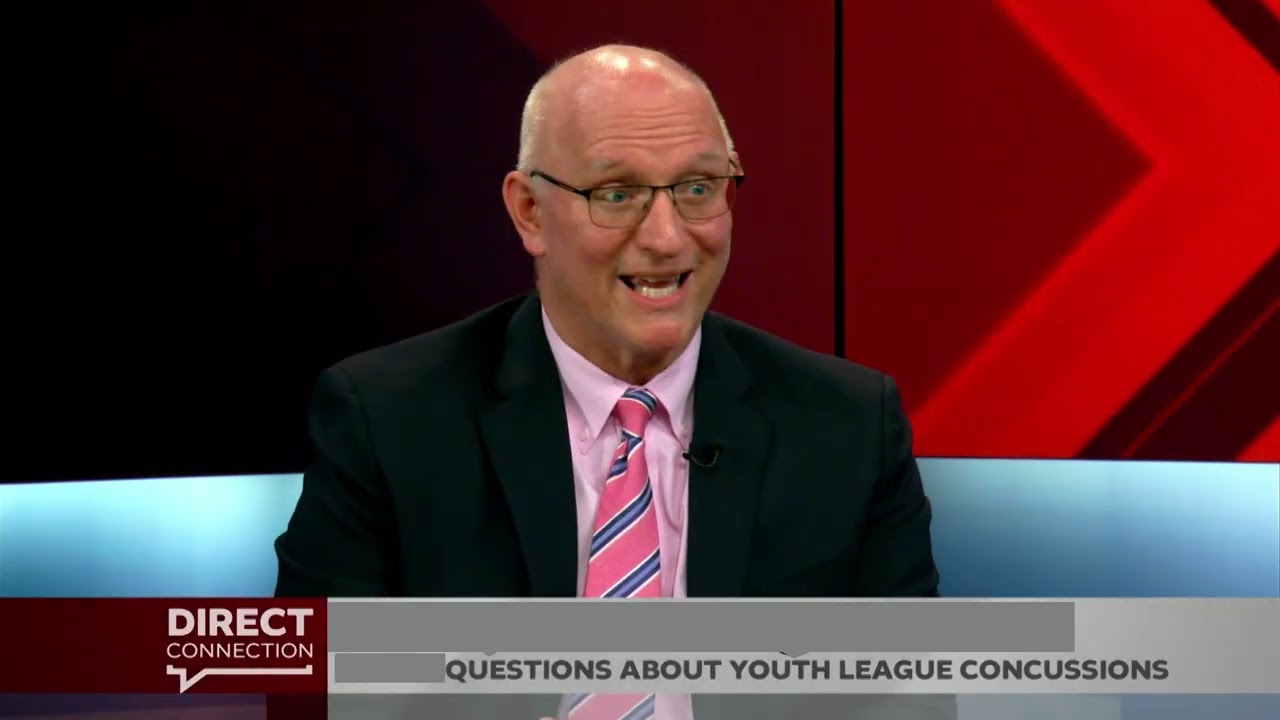
Video summary
The video features Dr. Gary Schwartzbauer from the University of Maryland discussing the prevalence and dangers of concussions in sports, with a specific focus on soccer headers during events like the World Cup. While collisions between players are significant, the act of heading the ball itself is identified as a major cause of head injuries, accounting for approximately 8 to 10% of total soccer-related emergency department visits in the US. Dr. Schwartzbauer explains that a concussion is essentially a mechanical dysfunction of the brain caused by sudden movement; unlike a simple bruise which might be visible on an MRI or CT scan, this injury involves the brain shaking within its fluid-filled skull like a cork in a bottle, potentially leading to swelling and severe complications if not managed correctly.
Prevention strategies heavily emphasize proper technique and neck muscle tension to minimize head rotation upon impact, as rotational forces are particularly damaging due to the natural wobble of the human head supported by a relatively thin neck. This issue is even more pronounced in children who lack fully developed shoulder and neck muscles compared to adults. To address this risk at younger ages, the US Soccer Federation implemented rules starting in 2016 that prohibit heading for players under ten years old while limiting practice time for those aged eleven to thirteen. Furthermore, a strict six-step recovery protocol is now enforced once an injury occurs, beginning with immediate recognition of symptoms—ranging from headaches and nausea to disorientation—and requiring at least twenty-four hours of complete rest before gradually returning to activity over the course of about a week.
The discussion also highlights critical long-term risks associated with repetitive head injuries, such as Chronic Traumatic Encephalopathy (CTE), which can manifest even in athletes under thirty years old and may be lethal if a second concussion occurs while the brain is still healing from an initial injury. There are notable differences between male and female youth sports regarding reporting rates; girls tend to report symptoms more readily than boys, who often adhere to a "gut it out" culture that discourages admitting vulnerability. Additionally, Dr. Schwartzbauer notes that despite similar rules in soccer, football has the highest incidence of concussions among all youth sports, partly due to neck development differences and underreporting issues. The segment concludes with an urgent appeal for safety beyond organized sports, urging parents and athletes to drive carefully during summer road trips, wear helmets while biking or diving feet-first, and prioritize preventing accidents that could lead to catastrophic brain or spinal injuries.
Read the full video transcript
We begin tonight [music] talking about
your health. Joining us is Dr. Gary
Schwartzbauer, medical director of
neurotrauma critical care at the
University of Maryland R Adams Cowley
Shock Trauma Center, also associate
professor of neurosurgery at the
University of Maryland School of
Medicine. Doctor, thank you for joining
us.
>> Thanks for having me.
>> So, I've been watching too much of the
the World Cup soccer matches and seen so
many people going up for headers.
Players will see two guys at the same
time go for the ball. They tend to knock
heads.
As an expert on neuro injuries,
concerned by that?
>> Yeah, you know, very much so. That
that's probably the biggest cause of
these kinds of injuries in soccer. Um
in fact, it's the collisions. As you
just pointed out, there's [snorts] the
collision part of it from body to body,
head to head, but there's also hitting
the ball with a head and heading in the
in the first place, the reason to
elevate and go up in the stack of
people.
So, a lot of things about that. Um it's
about 8 or 10% of total soccer injuries
that present to our emergency
departments in in the US.
Um so, there are ways to limit those
kinds of injuries and
>> Those So, we're talking concussions?
>> That's right. And so, concussion has a
very simple definition. We've probably
all heard them
uh someone have a concussion, especially
in football or boxing and certainly now
soccer. We're talking about [snorts]
It simply is a mechanical cause for
brain dysfunction. That's it.
>> I'd heard it described as a brain
bruise. Similar?
>> Yeah, that's probably a little more
severe version of a concussion. The
brain can actually bruise, something
called a contusion. We can usually see
them on CT scans, so-called CAT scans,
um or MRI that are a little bit more
detailed, take a little more time. So,
they can actually see that bruising.
And the brain, just like your thumb if
you hit it with a hammer, can swell up
and cause problems.
>> I'd also heard that um
um in discussion of NFL football, which
we can talk about, that
you know, the head-on collision was one
thing, the slightly off-angle one that
causes some torsion or twisting was was
somehow worse.
>> That's right. And so, um
what we see at Shock Trauma and what's
seen, you know, all over the world in
these kinds of injuries,
is a rotational kind of injury to the
head. You know, you think about it, we
have this big wobbly head with a little
thin neck. And in children, it's even
worse. That balance is even more askew.
They don't have the neck muscles that
are developed, the shoulder muscles, or
even the techniques to avoid these kinds
of collisions. And so, when something
hits the head, whether it's a ball or
another player or even the ground,
there's less resistance to really shake
the head. And the brain sits in a fluid
that sort of shakes around like a cork.
And so, if you can prevent that sudden
movement by either tensing the neck,
proper hit in anticipation, like heading
a soccer ball, it can eliminate some of
these injuries.
>> Is there proper technique in in soccer?
You want to hit the ball with this part
of your head or this part to to minimize
if if it's just your head hitting the
ball, not another player. Is there a way
to do it right?
>> There is. There's a way to teach that,
to anticipate, keep the eyes open um
because when we're hitting a [laughter]
head, you know, someone comes up to your
face, our natural reflex is to close the
eyes. But, um kids should be taught to
keep the eye on the ball, classic uh
saying, and they hit the sort of crown
of the forehead and they tense the neck
muscles so the head doesn't immediately
jerk back.
>> Reminder viewers, if you have a question
for the doctor her head injuries in all
kinds of sports, uh send us an email.
We'll have the email address up on the
the screen.
Levels of concern at different levels at
the the local rec league, uh maybe even
high school soccer, do do you see
serious injuries?
>> Yeah, great question. We we tend to in
the past concentrate on the adults
because we see things
like uh something we've talked about in
the past, chronic traumatic
encephalopathy.
That's a mouthful,
um but it's the kind of injury we see in
older athletes that's after repetitive
head injuries. Whether that's from
sports, whether that's from repeated car
accidents and trauma, um but we're
finding in fact there's a landmark study
a couple of years ago out of Boston that
even folks under 30, athletes that have
had repetitive head injuries can start
to show signs of this of permanent
neurologic injury that can actually be
seen in the brain itself. That's the big
concern.
The other big concern is if someone has
a concussion
and they're not recognized and the the
player goes back to the field, for
example,
um in too short a time and the brain
hasn't had time to heal,
it can amplify. Um in fact, a second
concussion can actually cause a brain
swelling that can even be lethal in its
most extreme cases.
And so various sports organizations, um
FIFA included for the adults,
have tried to come up with pathways.
We've heard of concussion pathways for
NFL players and things.
Um but similar things exist across
sports.
So starting with prevention, you
mentioned, is it different among ages?
The um
US Soccer Federation back in 2016
instituted new rules for those under 10,
no heading the ball.
That's it. It's restricted. Those that
are 11 to 13, they can maybe practice it
for 30 minutes a week. And then over
that, of course, watched and monitored
accordingly. And so trying to prevent
that injury when it happens in youth.
And when it does happen, there's a
six-step concussion protocol.
First step is recognizing it.
And so you mentioned what is a
concussion?
First thing is to recognize it on the
field immediately.
There are
so-called, don't worry about the terms,
but so-called soft signs.
Player may not feel right. May complain
of a headache. Maybe a little nauseous.
Little as they used to say, got their
bell rung.
That's unfortunate because usually folks
will try to shake it off and go back.
>> Well, in the old days of the NFL, it was
smelling salts, right? Get back in
there.
>> Oh, yeah. You know, and and then there's
the hard signs, which are even more
concerning. We've seen it happen too in
the past.
Hard signs are when the patient loses
consciousness. They have continuous
nausea. They're throwing up. They're
really disoriented. They don't even know
what day or time it is.
Those are ones to recognize immediately.
Get the player off the field. Um and
there's a great saying that I've seen
recently is like, when in doubt, sit it
out. And once they get into that
concussion protocol,
and it's recognized they have a
concussion, 24-hour rest. Not doing
anything. And then they enter into a
six-step slow escalation that's 24 hours
at a time to slowly get back to play. So
you're looking at a little over a week
just to go back. That's the way it
should be.
>> For the benefit of parents of young
athletes where maybe there was some sort
of contact, it wasn't immediately picked
up as being serious, Um, over the course
of the next day or two or that night,
what should they be looking out for?
>> Um, it's almost anything and that's
that's a great question. I'm glad you
asked that because it doesn't
necessarily have to happen, at least the
signs and symptoms, right then and
there. It can be delayed even a day or
two after the impact. And so you're
exactly right for the parents that to
keep watch.
If they are
irritable even, if they're complaining
of a headache, if they're complaining of
ringing in their ears.
Often they just don't feel right. As to
feel even sick in their tummy, those
kinds of things.
Look out for them and watch them over
those first couple of days if there's a
suspicion for a for a collision.
>> And I I guess the red flags would be
obvious if there's a little bit of
suspicion. I'm thinking in terms of a
you know, parent, do you do you go to
urgent care? Do you go to the
pediatrician?
Um,
and how how do you decide?
>> Great question. If it's available, local
emergency department or urgent care and
hopefully they could be able to refer
the child to further care. Certainly at
shock trauma,
we see folks who have very serious
injuries, but there are others who have
other kinds of injuries, but also have a
concussion that may not be as severe as
an outright brain injury might be.
>> NFL training camp starts at the end of
this week already. They waited for the
the soccer to be done and now real
football starts. Um, there have been
some changes in the in the game. You see
people certainly in practice at training
camp, especially linemen, which is
interesting,
wearing added protection on the outside
of the the helmet. What what
[clears throat] do you think of those?
>> Yeah, I think they're great. I mean,
we can make fun of them. They have those
giant helmets in the NFL and things.
>> If you're old enough, you remember the
Great Gazoo from the Flintstones,
[laughter]
I think.
>> I am old enough to uh
to remember that. You're right. My dad
played in the '50s, you know, and so he
had the leather helmet with no face
guard, those kinds of things.
And you can see how much it's evolved
with better knowledge um and better
recognition of the need to protect the
athlete. Um because what you don't want
is that first concussion, among other
injuries,
but even more so, even more critically
important, you don't want that second
concussion to happen in rapid
succession.
>> And they're in a a business where a lot
of money's on the line if you can play
or or not play. And we're increasingly
hearing about possible
connections to uh repeated uh head
injuries to something called CTE and uh
maybe uh Lou Gehrig's.
>> That's right. Um so as more and more
detailed studies are done um of the
athletes and the recognition of this,
we're trying to determine when
and what time this kind of process sets
in.
And we uh from the work at the group in
in Boston, uh Ann McKee, who's
phenomenal, studies this, the CTE, found
that it can happen in those that are
even in their 20s um from those who had
repetitive head injuries.
Um and so as further data comes out,
further studies come out, um the
recognition of this is that something we
do have to worry about.
>> Is there any difference in the in the
world of youth sports between boys and
girls? Just um
>> Yeah.
>> react differently, respond differently.
But certainly different sports are
treated a little bit I'm thinking about
lacrosse, and the rules are slightly
different, but you know, girls running
around with uh just little eye shields
and and guys with these big helmets.
>> Yeah. I um I can say from treating some
female um
players,
that's that should be changed because of
getting hit in the head.
>> real helmets.
>> Yeah, absolutely. And that's a great
point. And even using soccer as a
discussion point, right? So, for youth
sports, boys football has the highest
incidence. It's about 10 per every
thousand or 10,000 exposures. That is a
practice or a game.
For girls soccer, number two um for all
uh boys and girls sports say it about
eight. So, not too far off.
>> Wow.
>> Boys soccer um depending on the study is
anywhere from fifth to ninth in that.
And so, what's the difference? Their
rules are the same.
Um yet one has a higher incidence of
concussion.
Um there are various theories. One is is
that um
the the girl players will tend to report
their symptoms. Guys traditionally a
culture of gutting it out. We talked
about that. So, maybe underreported. But
also, there's physicality of it. Uh the
neck development may not be as much in
younger girls to prevent that excessive
motion uh of the head to cause a
concussion.
>> I just have uh half a minute.
>> Mhm.
>> Um when you're working at Shock Trauma
where you spend most of your time, this
is the time of year people are going on
road trips, driving, bad accidents
happen. They just happen. And they wind
up at your doorstep. In just a sentence,
>> Yeah.
>> remind everybody why they need to drive
carefully this summer.
>> Oh my gosh. It's been the biggest impact
for the [clears throat] last 30 to 40
years when there's been better speed
limits, safety standards built into
cars, we've seen a precipitous drop in
the number of injuries, both brain
injuries, spine injuries, and overall
injuries and mortalities. Please,
please, please be safe. Feet first in
diving,
helmet when you're wear riding a bike or
out on the road.
>> Very good, doctor. We appreciate your
time. Thank [music] you so much.
>> Thank you.
>> Our health segments are a co-production
of Maryland Public Television and the
University of Maryland Medical System.