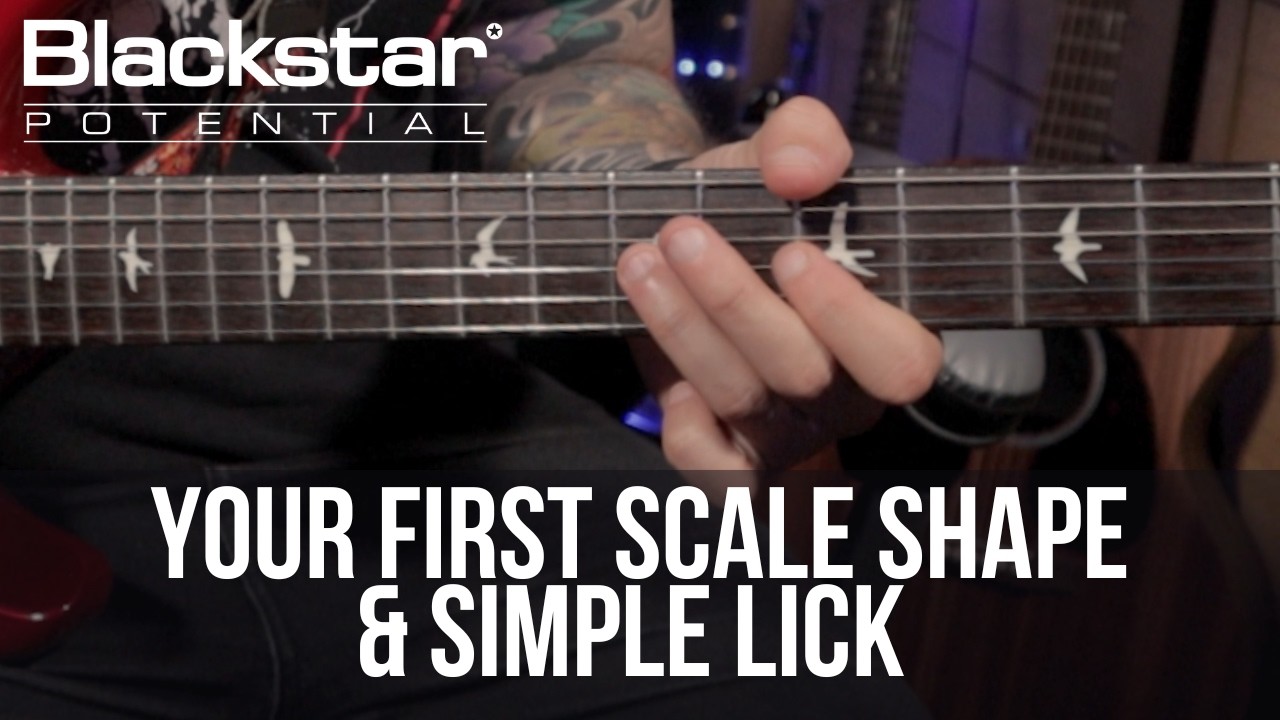
Your First Scale Shape & Simple Lick | Blackstar Potential Lesson
Watch on YouTubeVideo summary
In this introductory lesson focused on becoming a lead guitar player, the instructor introduces the minor pentatonic scale as an essential tool for blues and rock music. Using a Blackstar Debut 15 amplifier set to a low-gain, bluesy overdrive channel, the tutorial demonstrates how to play this fundamental scale in the key of A minor. The lesson emphasizes that this specific shape is transposable, meaning it can be moved across the entire fretboard; by changing which note serves as the root, the player instantly changes the key without needing to learn new patterns. This flexibility allows musicians to apply the same logical structure to any part of the neck, making it a versatile foundation for improvisation and soloing.
The core of the lesson involves breaking down a simple yet effective guitar lick that utilizes the A minor pentatonic shape. The instructor guides viewers through the specific finger placements and techniques required to execute the phrase, starting with a slide from the fifth to the seventh fret on the D string using the third finger. This is followed by an index finger movement to the G string, where a bend is performed at the seventh fret while the first finger supports the string for stability. The lick concludes with a quick return to lower notes and a hammer-on pull-off sequence, teaching players how to articulate phrases with clarity and rhythmic precision rather than letting notes drag down in pitch unintentionally.
Once the specific scale shape and the initial lick are mastered, the video explains how to expand these skills by applying the same pattern logic to different positions on the guitar. The instructor demonstrates that the exact same melodic idea can be played on the B and high E strings or shifted to other areas of the fretboard simply by adjusting the root note position. This approach reinforces the concept that learning one scale shape unlocks infinite possibilities for creating variations and licks throughout the instrument. Ultimately, the lesson concludes by encouraging students to internalize these patterns and have fun experimenting with them, marking a significant step toward developing their own voice as a lead guitarist.
Read the full video transcript
[music]
>> So today we're going to be learning your
very first scale and [clears throat] a
simple guitar lick to get you started
with becoming a lead player. So I'm
using the Blackstar Debut 15 for the
tones today, which I've got set on the
drive channel with a very low gain
bluesy overdrive. So the scale we're
going to learn is called a minor
pentatonic scale and this is probably
the most definitive scale in all of
blues and rock music. So if you're
learning how to be a lead guitar player,
this scale is pretty much essential
learning. So we're going to do this in
the key of A minor, but this is known as
a transposable shape. What that means is
we can move this all over the guitar and
the key that we play in is determined by
the position of the first note. So if
you reference back to the videos where I
talked about learning the notes on the
fretboard, you can start this scale from
whatever one of those notes you want and
that then becomes the key that you're
in. So I'm going to be doing this in A
minor. So if you remember back to those
videos, A was the fifth fret of the low
E string.
So that's my starting point for my scale
shape, which is this.
>> [music]
>> So to play that, I played the fifth and
eighth frets on the low E string,
>> [music]
>> the fifth and seventh frets on the A, D
and G,
>> [music]
>> and the fifth and eighth on the B and E.
So this is the A minor pentatonic scale.
That's the scale you're going to be
using a lot if you're playing blues and
rock music. The lick I'm going to show
you is the lick I actually opened this
video with. So here's the lick again and
then we'll break it down.
So to play this lick, we're going to be
starting out with a slide from the five
to the seven on the D string. You want
to do this with your third finger
because the next thing we're doing is
going to the of the G with the index
finger and then we're bending the
seventh of the G. So you want that first
finger in place to support the string
bend as well.
Once the bend is up, you're then picking
it again and bringing it down.
Bring it down quite quick because you
don't want to hear that descending
motion.
>> [music]
>> Then I'm playing the five once more,
hammering onto the seventh fret, and
pulling back off to the fifth.
>> [music]
>> And then we're landing once again then
on the seventh fret of the D string with
third finger.
>> [music]
>> Now once you know that scale shape and
once you know that lick, you can then
move that all around. So the cool thing
with knowing a scale shape is you can
actually apply that logic to other note
groupings. So anywhere across that
entire scale, you can play that same
lick. You're just playing the notes from
the scale. So I could actually do it on
the fifth and eighth frets of the B and
E string.
Or if I'm playing it on the G and B, I'm
going to use the fifth and seventh on
the G and the fifth and eighth on the B.
>> [music]
>> But the logic is exactly the same. We're
basically taking a pattern and we're
applying it to a scale shape. So learn
that scale shape, learn that lick, and
have some fun with that because you are
now on the way to being a lead guitar
player.