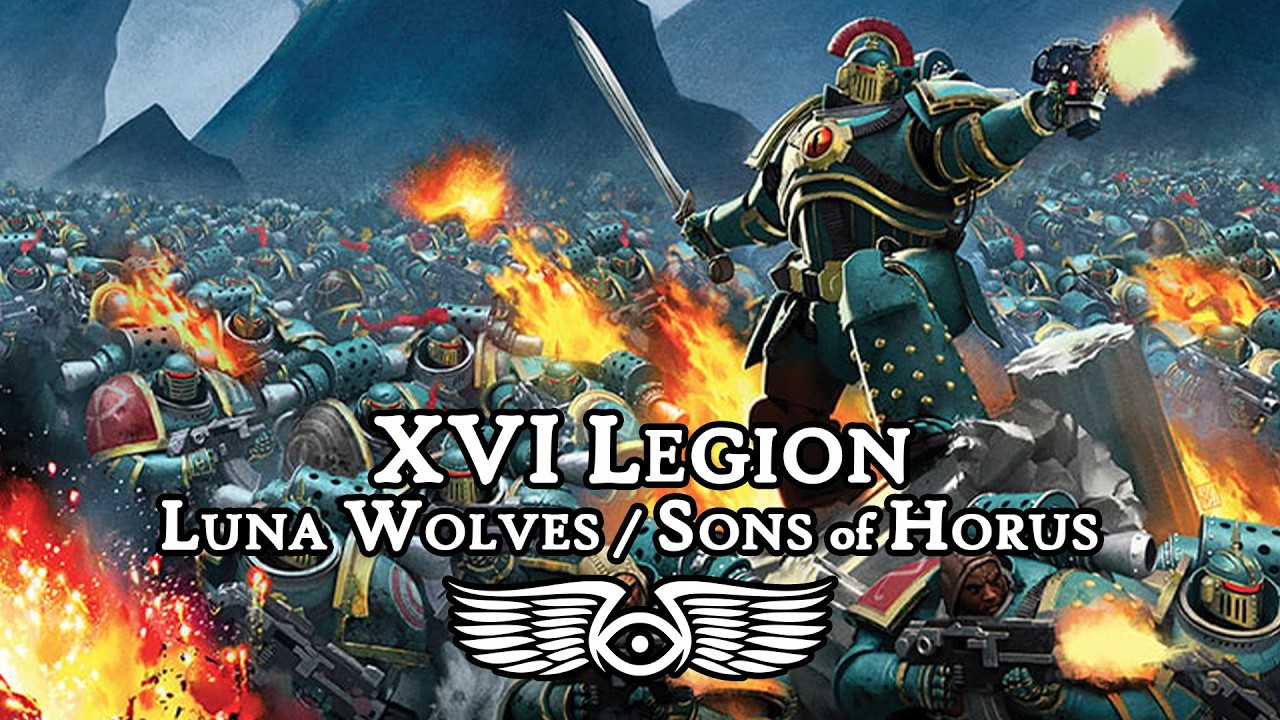
XVI Legion Luna Wolves/Sons of Horus: Origins & History (Warhammer 40,000 & Horus Heresy Lore)
Watch on YouTubeVideo summary
The Sixteenth Legion, known initially as the Luna Wolves under their Primarch Horus Lupercal, emerged from Saturn's harsh subplate slums where they were recruited for an aggressive, preemptive combat style synonymous with shock assaults. Their reputation was solidified early on when Captain Lirkon Hearn pacified Soman Prime and the legion successfully captured Luna in 703 M31 by breaching its defenses undetected to seize vital Selinar gene looms; this victory earned them their first epithet, "Luna Wolves." Led by Horus, who was raised as an outcast named Nurgi on the mining world of Cathonia before joining Space Marines after killing his father, the legion merged Terran discipline with Cathonian ferocity. This unique fusion allowed them to utilize diverse armaments and varied squad compositions for overwhelming victory through efficient brutality rather than senseless butchery, while Horus's preternatural charisma enabled him to unite rival legions during the Great Crusade.
As the Great Crusade progressed into its second century, the Luna Wolves maintained their dominance despite competition from other forces, highlighted by a pivotal victory at Ulanor against a massive Orc Empire that led Emperor Terra to elevate Horus as War Master in M30. However, following operations on Davin and involvement with secretive Warrior Lodges influenced by the Word Bearers, the legion began adopting esoteric rituals, coded phrases, and occult symbols like Cathonian mirror coins within these lodges which suspended military rank to foster brotherhood. Although initially devoid of religious elements, this secrecy contradicted Imperial atheism but was tolerated until it facilitated corruption; during Horus's entry into the Serpent Lodge on Davin, he fell to Dark Gods, transforming the legion from loyal Luna Wolves into traitorous Sons of Horus who embraced Cathonian gang culture and runic sigils.
The rapid spread of this corruption through the lodges' social influence turned many loyalist commanders into traitors, culminating in horrific atrocities such as the burning of Prospero in M31, where Chieftain Boris Karna oversaw a force of 5,000 Sons kidnapping civilians for genetic experimentation and psyker weaponization. The legion's descent continued during the Istvan III campaign when four legions gathered to purge loyalists from Horus's ranks, resulting in approximately 60,000 deaths among traitor forces before the subsequent massacre on Istvan V scattered any remaining survivors of the corrupted faction. Ultimately, despite a few remnants persisting into the Age of Darkness, the legion as a whole was doomed by its corruption and perished alongside its Primarch Horus during the Heresy, leaving behind only the legacy of their fall from grace.
Read the full video transcript
Do the sins of the father truly damn his
children?
Are the iniquities of our sires passed
along to us down the generations casting
us as inheritors of foul deeds burdened
with consequence we ourselves did not
choose.
philosophants and rhetoricists a plenty
have rendered many an opinion therein
citing with the concept of free will and
individual determinism quite often
pleasant fictions of ages by gone from
the perspective of your most humble
servant insconced within this librarium
never to see the sun behind the ashen
skies of holy terror committed to a life
of scholarship and collared by hands
that claim to hide themselves.
We are born into stories already being
told. We are destined
doomed to repeat cyclical horrors,
progenies of the crushing weight of
history and time and deed.
We are shaped and molded by our creators
and our circumstances. both products of
lineages ephemeral [music] and all too
monstrously real.
Subjects of this chronicle are
inextricable in memory from the sins of
their father. They occupy a space
identical in what historical record we
retain and are permitted to parse.
They were not the first betrayers,
but they were the most vicious, the most
fervent, the most viperously quick to
follow their sire into a damn nation
beyond imagination.
One extended to the rest of our sorry
souls.
Know then that this is a record of the
legion of the selenic wolf, the once
paragonss, the rancerous get of Cathonia
and of the wararm master.
A record of the 16th legion lunar wolves
and later sons of Horus.
As with each of their contemporaries,
the origins of the 16th Legion lie
within that ancient crucible, the
unification wars.
Seeking to unite the human home world
for the first time in millennia, the
emergent emperor of humanity battled the
horrors of the age of strife upon the
wastess of war torn terror. At his side
were the Thunder Warriors of the Legio
Catagius, his first genetically enhanced
super soldiery, as well as the mortal
hosts of the naent Imperial Army and
other sundry organizations, clans, and
tribes that made up the great human
tapestry of the benited home world. As
has been covered by your humble servant
in other records, the Thunder Warriors
were a stop gap measure for the Lord of
Lightning. He required finer, more
stable, and more lethal soldiers to
bring his plans to fruition. And so
labored in the development of the Legion
Austard, the first of which saw
deployment in the waning years of the
unification's centuries long struggle.
The numerical designations of the
legions do not necessarily correspond
with their deployment. All were
developed roughly contemporaneously and
deployed for their first combat
operations within a similar time span
with the exception of course being the
first legion dark angels whose
deployment during the palace coup of the
late 600s of M30 marked the first tread
of the space marine upon terror's soil.
We have little in the way of accurate
information on early Aart's deployments
and certainly nothing approximating
accurate dates. But we can surmise that
there was an almost 40-year period from
approximately 670 M30 to Unity's
declaration in 712 M30 where a
startardis of the Legion were active
upon Terra and in her near orbital space
with the 16th Legion quite verifiably
amongst them.
Recruitment for the earliest Aardis
legions was drawn from a myriad of
population bases. With the benefit of
historical hindsight, one considers it a
safe conclusion to surmise that the gene
stock for the each legion was seemingly
tailored to correspond to the emperor's
wishes for the eventual character of
that legion and their respective
primarchs. A supposition supported by
the work of the posth heresy scholar
Diamadan of Luna.
This certainly tracks in the case of the
16th. Gene Smith findings state that the
first population bases subjected to
recruitment tides for the legion with
the hunter clans of the Sam Satan
subplate slums as well as a jutrian
bowl. Having endured for millennia in
lives of ceaseless privation and
conflict, these clans possessed the
ruthlessness and independence only those
who forever dwell upon the margins of
survival are quite capable of.
The abrasive aggression translated
almost immediately over to the Legion.
While an estartis loses nigh all their
memories of lives before ascension, they
still retain some measure of their
baseline human character.
Such were the number of clanners and
tribesmen inducted into the legion that
it developed a fighting force of
merciless, efficient killers who rapidly
became synonymous with shock assaults
and brutally brief engagements.
Theirs were attacks more preemptive than
not, vicious targeted strikes authored
to bring the foe to a swift and wholly
conclusive destruction. They acted in
large part as the scum gangs and waste
clans they were drawn from. When such
groups fought their rivals, they cared
only for the fastest possible victory.
The quick shank blade to the neck, for
they have little in the way of resources
to spare, and such conditions breed a
rugged practicality out of absolute
necessity.
The battles of the Fire Winter and the
breaking of the Corololis enclaves are
counted amongst the 16th Legion's
earliest honors. And while we know
little about these conflicts, their
passage left a distinct mark upon the
psyches of the populations that endured
them or beheld them. It is in these wars
that the term wolf first began to swirl
around the Legion. itself a mytho analog
scarred into humanity by historical
imaginings of a long extinct cannid
predator.
Even thousands of years later, the
gambling dens of the Capridian sinks
upon Terra still referred to the number
16 as the counting of the wolf. And
indeed, the term was apt. The 16th
Legion operated much in the same way as
the pack of ancient long-lost predators
once did. hunting in the shadows and
only attacking when victory could be
seized. Per an oft remarked adage at the
time, the 16th were unleashed to fight
wars their opponents did not even know
were being fought. Flights of Stormbbird
and Storm Eagle gunship transports
flanked by lightning crow attack
fighters, plunging into the midst of an
enemy to discourage power armored
Darties.
These battles were conducted wholly in
keeping with the reputation of those
that fought them. Aggressive and
vicious, yes, but controlled and
tempered, given over to neither ritual,
bravado, or senseless butchery. In many
ways, they were the ideal soldiers of
the age. All the fury and lethality
needed to wage wars against mutant
nightmares and technological
abominations, but wholly reliable. A
bellacosity chained by disciplined
minds.
Perhaps the best example of this lies in
the tales that spun out of the
pacification of Soman, a network of
suborbital principalities that had for
decades resisted diplomatic intreaties
made to them by the emperor and his
officients.
Soman Prime, a thin needle-like space
station in the global south, yet dained
to receive the Emperor's final
delegation. Though all joining it, knew
what lay before them would simply be
receiving the invective of the ruler,
the Panarch. Despite knowing this, the
delegation had for months petitioned the
Legionnaire estates for a representative
to best display the wonders of imperial
science and the benefits of joining the
burgeoning regime. In addition to the
unsuttle threat a space marine would
clearly represent.
Captain Lirkon Hearn of the 16th
Legion's third company was granted this
dubious honor and when seated at the
diplomatic table became the obvious
target for the panarch's relentless diet
tribe. For more than an hour, the
imperial delegation sat in awkward
silence as the ruler hurled insult,
denunciation, and abuse at the estartis,
listing their existence as one of the
Imperium's many, many manifest sins. Its
presence here the proof of the emperor's
peridity.
Bearing no armaments, Captain Hearn
clearly did not wish to be there.
Indeed, it is a staggering rarity of the
time that Anartis would be present
anywhere other than the battlefield.
Hearn appeared wholly bored with the
proceedings, paying the panarch
absolutely no heed, driving the
demagogue, of course, into greater
heights of impotent fury. In a final
attempt to get some sort of rise from
the estates, the panarch spat upon his
armor and struck it with his jeweled
scepter, again to no response.
It was only after the ruler had
collapsed into his chair from the sheer
exhaustion of speaking so much that
Hearn did act. He slew the panarch's
bodyguards in two single blows of his
bare hands and subsequently tore the
despot's head from his shoulders.
Suffice it to say, the negotiations with
the remaining principalities were
swiftly concluded following this,
delivering Son into the Imperium at the
mere cost of three lives.
It is, of course, the first pacification
of Luna that truly defines the 16th
Legion in those early days. Even besides
its status as one of Unity's most
important campaigns,
despite taking place in the waning years
of the wars in 703 M30, it was far from
unification's final battle. The wretched
cardinal Tang yet held fast within the
forces of the Indonesic block and
several other intransited enclaves
remained besides.
Yet upon Luna did the Emperor set his
sights. Fater's sole natural satellite
held one of the keys to his grand
designs.
The moon was a domain of gene cults,
collectively known as the Selinar.
Though in truth a conglomeration of
cults and varying lineages, the Selinar
were united by their matriarchal ruling
cast of resurrectionists and bound by a
shared belief that human nature was
fractured, fractal, and transcendent.
Humanity to the Salinar was wrought in
the flesh and mind of the individual,
yes, but that individual was an echo of
those that had come before them. How
this was expressed varied from subcult
to subcult. Some defined themselves by
cultural mimemetic archetypes, others by
numerology, others by sunundry other
forms of symbolism. In the matriarchal
cast were often combined idea forms. For
example, the personage of Andromeda 17,
17th of her line, 17th iteration of the
original human she had ever been.
Gancraft was of course central to this.
A human mind shephered through dozens,
even hundreds of iterations could only
do so with the finest of dark age
science.
Resurrected in body again and again,
each cult member was an iterative
attempt at embodying the truest essence
of their archetype. Simultaneously,
person, idea, and experiment in one.
Despite the air of occultism that
pervaded these cults, their ideology was
firmly rooted in the scientific. And
despite this, still their opposition to
the Imperium was absolute. The Emperor,
in the eyes of the matriarchs, was yet
another petty warlord, another man with
an ego that surpassed his capabilities.
Just another in a long line of absurd
despots who could bring only death and
devastation to the species. They
courteously but steadfastly refused all
intreaties from terror and many were
those intreaties for the Selinar
possessed everything the burgeoning
Imperium desperately needed.
The lunar gene looms and the scientist
lineages that wielded them were
unequaled in all respects saved by those
insconced within the Emperor's own
laboratoria.
With Terra approaching unity and the
galaxy beyond beckoning, the Emperor
required the genetic might of Luna to
scale up his Aart's production to the
degree the upcoming crusade demanded.
Terra alone could not meet these demands
in time, and time was ever the essence
for the master of mankind.
Luna must be captured, and it must be
captured intact.
This the Selinar knew, as for millennia,
they had held at bay Terran warlords and
Martian magi both. The looming threat of
the Imperium had united the normally
factional cults under the matriarchs
like never before. As Terran unity drew
closer, and the missives from the
emperor turned to threats over offers of
kinship, the Selinar prepared for a war
inevitable. When the final Terran
ambassador delivered the emperor's
ultimatum, the Selinar returned them to
their lege as a still screaming soup of
liquefied flesh.
Thus did the emperor order his legions
to pacify the moon. But the undertaking
demanded precision and tact for the
precious gene looms could not be risked,
nor could the accumulated lore and
expertise of the gene witches
themselves.
The 16th Legion were selected for the
Vanguard, operating in their full Legion
strength for the first time and
supplemented by forces from the 7th and
13th. Once free from Terara's
atmosphere, the attack ships of the
Estartis were powered down, exposed to
the hard void, and set to drift into
lunar injection.
Only Estartis in sealed power armor
could ever have accomplished such a
maneuver, but it allowed them to seize
upon the moon wholly undetected.
The 16th breached the habitats of Luna
as the other legions launched a showy
diversionary assault. Striking at
predefined targets assessed by Imperial
agents embedded into previous
ambassadorial delegations, the 16th
comported themselves precisely as
demanded. Shock assaults that left no
defenders alive and all objectives
brutally achieved. One by one, the
Salonar's defense systems failed,
allowing the remaining estates to affect
landings in force. The capitulation of
the moon was delivered in a mere 6 hours
with the Salinar Gene Witches delivering
their surrender to the emperor by
begging him to call off his wolves.
Thus did the 16th Legion earn its first
epithet, the Luna Wolves. While some
consider the message of the Selinar to
be apocryphal, it's verifiable in Disio
Militarus records that after years of
informally being known as the Emperor's
Wolves, the name formally stuck
following the first pacification of
Luna, earning the 16th their official
title even before unification had been
achieved upon Terra.
The wolf's head, superimposed upon a
crescent moon, became the symbol of the
legion, appropriate in many ways, as
what remained of the cannids legacy were
in mere jeantocks reserved for the
breeding of attack cyborgs. The 16th
embraced this with relish. Within scant
months, the wearing of pelts drawn from
said clone beasts became commonplace
amongst its officer class. They were the
first legion to be granted the honor of
a name and an identity beyond their
numerical designation and preferred
combat doctrine. Others would soon
follow, of course, but the 16th were
foremost amongst them, a primacy that
would continue to define them for the
decades to come. Indeed, for the honor
of their taking of the genetic forges of
the Selinar, the Luna Wolves were
granted the greater part of said forg's
initial output of Terran estartis,
doubling their number in a very short
span and contributing heavily to their
nigh omniresence in the many battles and
campaigns fought to bring unification to
the rest of the Saul system. A period of
history immediately following the wars
upon the home world entered into annals
as the solar reclamation.
There is a figure looming large over
this record and one must admit the
introduction of which proves difficult
both from a basic point of
historioggraphy and from the sheer
potency of his presence.
Horus Lupercal,
primarch of the 16th Legion, first
found, brightest star, favored son,
arch traitor, user, foulest of the
emperor's demagog progeny, an individual
who cast down the Imperium, betrayed his
brothers, his father, his species,
falling into pitiles damnation and
tearing us down with him.
And it must be noted a man who perhaps
more than any other primarch by virtue
of both imperial propaganda and his own
sewing of personal myths is extremely
unevenly documented in historical
record.
While this is in a sense true of every
primarch to greater or lesser degrees,
Horus is a figure so titanic in the
history of the Imperium. A being of such
profoundly seismic impact that
contradiction, omission, redaction,
mythologizing, demagoguery, and so much
more. Dog his every biography,
nay, his very mention.
What facts can be established across all
accounts of the primarchs are thus? He
was officially the first found of that
scattered brood by the emperor of
mankind. He served alongside his 16th
legion, his lunar wolves, earlier in the
great crusade than any of his brothers.
Beyond these two cornerstones of record,
nigh everything is impossible to
accurately establish.
Some accounts claim that Horus never
left the emperor's side to begin with.
The sole primarch not scattered by the
calamitous incident that tore the
gestating infants from the laboratoria
upon terror and flung them through the
warp to all corners of the galaxy.
Others say that though his incubation
pod was still lost, it was only depaced
in time, not location, plummeting back
to terror as the unification wars were
finally finishing. Yet others, credible
sources all, claim he was found upon
Luna or elsewhere in the Saul system or
in Saul's nearpace volume, Scarasen, for
example, to quote one account. The
commonality between these versions of
the Horusian myth is that the primarch
learned the arts of war makingaking at
the emperor's side, being embedded
within the growing imperium at its very
beginning and evolving as it did,
forging some of its early alliances and
being at the right hand of his lord
father at all times. These accounts are
mirrored in some ways and disputed in
others by the word of the primarch
Alfarius who in the cognto hazardous
tome the transit of the human soul
through strife claims that he not Horus
was first found and upon Luna a secret
that was buried by the emperor for the
sake of both Horus's legend and
Alfarius's better utilization.
Alfarius, as he is want to do, also
states that this account is in and of
itself a lie.
This indeed is not even as fancible as
yet other accounts, some of which state
Horus returned to the Imperium at the
head of a vast fleet, having already
conquered a stellar empire of his own.
But others state that the emperor
clasped the infant's hand as he fell
through the war portal that consumed his
brethren. or a soul story that tells of
Horus stepping out of that portal, fully
adult, onto the bridge of the Emperor's
own starship.
Many other credible sources, indeed
perhaps the majority, state that Horus
Lupal was scattered alongside his
Primark brethren, but fell to the n
feral mining world of Cathonia, located
very close to the Saul system in
galactic terms.
A planet of rock burning under the
baleful light of a blue star. Cathonia
was a carcass world. Being so close to
terror, it had for long millennia of
human progress been subjected to all the
most advanced resource extraction
technology mankind could develop. In
harvesting the planet's mineral wealth,
humanity of thousands of years had
delved deeper and deeper into its crust,
devouring ores, crystals, gemstones, and
every scrap of useful mineral that could
be found. Vast subterranean archies
emerged, protecting inhabitants from the
radiation of the angry star, while above
them, hive spires reached into the
choking atmosphere.
Whole warren of slums emerged in the
underground to house itinerant workers
and indentured surfs. Cathonia's long
history had by the time of the coming of
the Imperium left it a gutted husk. Even
the mighty processing hives that dotted
the surface were crumbling. Many being
consumed by the crust itself. The absurd
levels of geological torment inflicted
by humanity now returning the favor by
eating what remained of our cities.
Humanity, as is our want, yet endured in
those sump warren, in the mining
tunnels, in the corroding carcasses of
dark age extraction machines.
These deeps were echoes of the
underworlds that had earned the planet
its name. places of heat and sulfur, of
rocks warmed by the life magma of the
world itself.
Even during Cathonia's prime, the mines
were places where death came easily.
Short lives lived in lightless depths.
Humans untold claimed by earthquakes,
cave-ins, poisonous gases, and a myriad
of other fates.
Whomsoever had been this world's masters
were long, long gone, with little in the
way of record that would allow us to
even establish who they were.
Cathonia was an orphan, as with so many
human worlds following the passage of
old knight. Yet still, against whatever
odds there were, humanity persisted in
its infernal Naders.
By the coming of the great crusade that
Cathonia remained inhabited was a matter
of imperial record. Given its proximity
to the Saul system, the world had been
visited by occasional mining or salvage
expeditions from both Terra and Mars
during the age of strife.
Entrepreneurial or suicidal ship
captains reasoning that even the risk of
a short warp jump would be worth the
spoils of that seemingly abandoned
world.
Many of these expeditions simply
vanished as soon as they made planet
fall, only to be discovered by future
expeditions, by the presence of a single
corpse with curious mirror-like tokens
upon their eyes, or more commonly by
smears of blood upon tunnel walls.
Over the years, and after disastrous
intreaties had been made to the
uncommonly encountered humanity of
Cathonia, a picture emerged of a world
dominated by gang clans that that
swarmed like vermin through the world's
abandoned tunnels. The scavenging
remnants of the original workforce
reduced to barbarity by circumstance.
The lives of these people were brief,
violent, and filled with the vicious
urgency such a planet would turn a human
to. Their only concerns were survival.
No law governed them, save for that of
the knife. There was nothing
approximating a regime of government or
even centralized authority. Every gang
was a nation unto itself in perpetual
conflict with the others. Some were
extremely territorial. Others made their
existence nomadic, weaving through the
shadows of the mining tunnels. Some
gangs were deeply hierarchical, almost
petty monarchies or feudal kingdoms in
aspect, demanding tribute from smaller
ones they subdued, however briefly.
Other gangs simply reaped supplies from
all those they encountered.
The status quo, such as it was,
fluctuated constantly, a shifting web of
uneasy alliances, vendettas, and
conquests, with blocks forming and
dissolving in often in mere solar weeks.
Somehow, the murderous humanity of
Cathonia endured, the strong shing the
weak, reeving their spoils and
propagating in the sulfurous depths.
By far the most established and accepted
account of the life of Horus Lupercal is
that unto this hell his capsule plunged.
Indeed, it is the one that the wararm
master was oft fond of repeating both to
his own legion and to Imperial
remembrancers who were granted
interviews.
In this account, the infant was
discovered by the Cathonian ganglord
Kagodon and granted the no-name of
Nurgi, a Cathonian slur readil of a
person's worthlessness.
The boy was raised in Kagadon's kill
gang, serving the warlord's constantly
shifting ambitions, but wholly unable to
be anything more than the proverbial
runt of the litter.
It is unclear if the infant Horus in
this telling displayed the same
prodigious growth or mental acuity as
his siblings did. Indeed, aside from
phenomenal regenerative capabilities,
his body was apparently stunted and
weak, even by the standards of the
malnourished Cathonians.
Nurgi is routinely assailed by vision
dreams of a world beyond the tunnels of
a destiny he will one day achieve but is
punished for expressing these beaten
cruy by his adoptive father.
According to the tale, the boy's life
took a seismic turn when, fleeing from
the cruelty of his gang, he discovered
the pod he had been found in being
examined by strange cybernetic figures
clad in robes of red.
Despite earning his first kill by
murdering one, the others did not attack
him, instead beckoning for him to join
them. Nui instead rushed back to his
gang, believing the kill he had just
made will finally earn him the respect
he deserves.
He is instead beaten publicly by his
father, who declaims that these
individuals were clearly off-worlders
and that the boy has doomed the clan to
their fury.
Unable to withstand any more mockery and
abuse, Narui, channeling his years of
torment into the blow, plunged his
dagger into Kagodon's heart.
In doing so, the boy's body was overcome
by an incredible transformation. Every
cell ripping itself apart and reforging
itself a new, a human form ferociously
becoming what it was meant to be.
Nurgi was gone and in his place stood
the adult Horus, Primarch, 16th son,
emperor maid, now ascendant.
This is certainly the most narratively
fulfilling of Horus Lupal's foundling
myths and was apparently the one most
commonly repeated by the primarch
himself. Certainly to the point that it
entered established imperial record as
canonical. It bears several curious
outliers that to one's mind cast doubt
upon its veracity. The infant Horus not
possessing his brother's physical or
mental strengths from the time of his
emergence is deeply curious, as in no
other account of primarch rediscovery is
this the case. It must be noted, of
course, that the primarchs were alike in
many ways, yet differed in others,
possessing often extreme genetic
idiosyncrasies that granted them uncanny
abilities, such as Vulcan's regenerative
capabilities, or Corax's powers of
passing unseen by mortal sight, or even
Magnus the Red's prodigious psychic
talent,
one cannot help but suspect that the
means by which Horus came to be where
his genetic gifts activated
to be apocryphal. The slaying of the
father figure, given Horus's eventual
fate, it rings with a narrative
symbolism that somewhat beggars belief.
That also being said, it has been noted
by scholar Alente that the warp wrought
nature of the primarchs and the
abominable nature of their creation tied
them to the immaterium in ways we will
simply never understand. And the
immaterium is after all a place where
ideas where narrative has tangible
power.
The tale of Nurgi must be considered for
if not its veracity than its primacy
within the myth of Horus Lupal.
Clearly, it was the Primark's preference
to make it known. But Horus spread other
tales about himself with a certain glee
that one must now consider to be the 16
sons idea of a grand joke. His past was
a mystery seemingly known only to
himself and the emperor and Luprical was
clearly quite happy with that particular
arrangement.
The historical fact remains that Haurus
was indeed the first primarch publicly
announced and Cathonia, a planet
associated with him through reality or
propaganda, was granted to his legion,
the 16th Luna Wolves, as their F. Having
distinguished themselves so admirably
during the Solar Reclamation, their
successes were marked enough that the
Devisio Militaris and the Emperor wished
to build upon them by introducing to the
Legion the vast Gantock of Cathonia.
Its close proximity to Terra had marked
it as a target for the very first
expeditionary fleets, but the assessment
by Imperial adepts was less than
promising, at least initially. The
Imperium desired easy victories, worlds
that could join the burgeoning empire
with minimal fuss, providing it with new
population and industrial bases and new
resources to fuel the ramping up of its
military juggernaut. Cathonia was barely
any of these things. The planet was
effectively stripped of everything of
value by untold millennia of human
greed, leaving behind what one
description called, quote, "A nest of
serpents coiling in the dark that we
would be better to destroy."
The human population was considered
beyond the possibility of civilizing.
But perhaps, thankfully for them, the
Imperium did not need them to be.
Cathonia had one resource left. its
youth. Adolescents were harvested on
mass for induction into the Legion,
while young adults were impressed into
the service of the Imperial Army,
forming such regiments as the infamous
Cathonian head hunters.
Cathonians proved perfect specimens for
Estart's ascension. Hardened, vicious
killers, even as children, all having
been put through the trials of a life in
niteral hell. Much of what the Imperium
had learned through recruitment upon
Terra was writ large upon the Cathonian
intake. The ruthlessness of their
existence, preparing them for the rigors
of organ implantation and psycho
conditioning.
They were also the test bed for how a
new population can shape the legion they
had been brought into, for they were the
first populace outside of the light of
Saul to be inducted. So the Cathonians
remade the 16th Legion. however
unconsciously bringing with them
customs, traditions, and attitudes
wholly foreign.
Generations of violence they were grim
inheritors of could be tempered by
Estart's mental conditioning, but not
bred out. This was in all likelihood the
point. The Luna Wolves had since their
induction been gangers at their heart,
ruthless killers with a street smart
pragmatism.
Cathonian culture was in many ways this
exact sentiment but on a planetary
scale. And this is almost certainly why
the subsumation of Terran customs
happened more rapidly with the 16th than
almost any other legion. The orderly
traditions of the home world codified
within the Principia Bellosa were
replaced by those of a distinctly
Cathonian hue.
Never one for decoration, the lunar
wolves subtly shifted towards a vulgar
ostentation.
Mohawks and topnots became common
hairstyles amongst its aartis,
eventually in the case of the latter
becoming a status symbol for senior
officers to wear as accutrants above
their power armor. Particularly
impressive kills in battle were recorded
upon ceramite plate, an affectation that
would have been seen wasteful by
terrorist artis. The cathonian term for
the slitting of the throat, athan became
used as terminology for the completion
of a campaign. And perhaps most
tellingly, personality and charisma
became the hallmark of the legion's
officers and a key factor in their
ascension through the ranks, flowing, of
course, from the very peak with the
overwhelming presence of Horus Lupal.
It was, of course, Horus that guided and
shaped and merged the Cathonian
transformation of his legion.
Regardless of the nature of his origin
and recovery, or precisely even when it
occurred, Horus was present for every
moment of his legion's profound cultural
shift. His Cathonian itself, the rough
barbarian language of the mining
tunnels, was immediately perfect,
although many Cathonian-born officers
would note that it was so perfect as to
lack any subtleties of accent or
regional dialect, as if it had been
learned from a book.
Others demured, saying that such a thing
was a deliberate choice by the primarch
to not favor any one gang lineage over
another, or even any geographical
region. Given that, as the story of
Nurgi demonstrated, Horus would have
held no special love or attachment to
the clan of his upbringing.
The primarch oversaw a merging of the
two cultures to produce one singular
united legion crafted upon Cathonian
principles. Yes, but retaining the
discipline of the terrans that had
preceded it. The rough vulgarity of the
16th new f did not break down the
coherency of command and authority that
it had possessed before. Rather, it
reinforced it. Officers now seeking to
become compatriots and brothers of those
under their charge rather than simple
fonts for a commander's authority.
The vicious ferocity of the underworld
gangs was channeled into the legion's
already impressive bellacosity, further
augmented by the sheer tactical genius
of Horus Lupau.
Reunited with Primark, unique in culture
and possessing more estates than any
other legion, the Luna Wolves were
ascendant, the bannerbearers for the
early Imperium during the initial decade
of Crusade.
Overwhelming application of force
remained their hallmark. The deployment
an inevitable victory earning the
Imperium dozens of systems that were
previously feared to have required
massively costly campaigns to take.
The Legion's approach to the Crusade was
direct, inelegant, conducted with the
swagger of a gangland killer in a
drinking den, but it was undeniably
effective.
Though never ones to engage in senseless
butchery, the Luna Wolves would not bulk
at unleashing massive orbital
bombardments and tens of thousands of
Aardies upon heavily populated cities if
it meant the destruction of an enemy's
command network. Fleeing or surrendering
foes would likely be destroyed without
mercy if the order was given, as would
the annihilation of civilian populations
deemed unsparingly weward.
The goal in all cases was victory by the
quickest and most efficient means
possible. Sometimes, as one officer
noted, you had to gut and string up a
gang lord's family to convince him to
give into your demands.
The main distinction for the lunar
wolves over, say, the the sadists of the
eighth legion was that such violence was
only ever unleashed by the word of their
primarch or his legion commanders. The
Luna Wolves had honed their instincts
for the application of force
relentlessly, as they were keenly aware,
especially in the earliest days, that
the human worlds of the galaxy were a
resource the Imperium dearly needed.
Wastefulness in that regard was to
dereliction of duty.
16th Legion deployments, followed
through upon by Exertus Imperialis and
the Imperium civilian administrators,
often found populations in states of
numbed shock. the brutality they had
just witnessed wholly cowing them to the
rule of terror, but delivering them
alive nonetheless.
Expeditionary fleets with Lunar Wolves
elements made rapid and bloody progress
through the galaxy. War became a matter
of identifying their enem strengths and
following through with a knife to the
throat as quickly as possible.
To accomplish this, the 16th Legion
strove to maintain a large degree of
tactical flexibility.
This was no mean feat, as it essentially
demanded the Luna Wolves maintain an
armory and a methodology that would
allow them to apply their doctrine of
overwhelming force to almost any enemy,
either known or unknown.
Horus's status as first found son
alongside the legion's sterling record
of victories were crucial in allowing
them to achieve this. Beyond the secret
vaults of the first legion dark angels,
the 16th maintained perhaps the most
diverse and welltoed armory of any of
the legion estates. Having brought many
forge worlds into compliance in the
early crusade years, the lunar wolves
were on excellent terms with the
mechanicum of Mars in general and many
individual forges that sought their
influence besides, allowing their supply
lines to extend far beyond any other
legions, and ensuring their primacy of
place in accessing new arms and
armaments developed by enterprising
magi. Horus likewise ensured that the
legion never rested on its proverbial
laurels or became too hidebound by any
means of war makingaking that risked
becoming tradition.
Lupal akin to an ancient Terran Aavian
would pick and choose formations,
tactics, and means of warfare from other
legions. having seen their efficacy
firsthand in battle. For example,
following the Latrical onslaught, the
prowess of the breacher squads of the
Seventh Legion, Imperial Fists, [music]
impressed Horus so much that their
presence in the Lunar Wolves quadrupled
in short order. The primarch was a vocal
advocate for the advancement of the
tactical dreadnot armor project,
throwing the full force of his political
weight behind it and ensuring that his
connections within the divisio militaris
and mechanicum secured for his legion a
large proportion of the first terminator
armor suits that rolled off the
production lines.
If Horus rested his faith in any one
constant, it was the Legion tactical
squad, the standard division of Aartis
numbering from 10 to 20, all armed with
standard bolter weaponry.
Horus was known to appine on many an
occasion that he was confident there was
no challenge the great crusade could
present that could not be overcome by a
lunar wolf and his tactical squad
brethren.
This remark certainly made for excellent
fodder for the propaganda reels. And
while one could list a hundred examples
of it being actively disproven in the
field, the primarch was not incorrect in
his faith in the tactical squad's sheer
ubiquity. Even if a battle could not be
carried upon their backs alone, the
tactical squad was never an unwelcome
addition to the line of battle.
The Luna Wolves were often known to hold
such squads in reserve and unleash them
upon the enemy where torrents of bolter
fire could reap the most devastation.
These so-called despoiler squads were
effectively 16th Legion variants of the
tactical squad, made unique by their
training in fire saturation and stated
battlefield roles more than any unique
armor or armorament patterns. The Luna
Wolves likewise is assued all restraint
on destroyer type weaponry, specialized
arms or ammunition that utilized
chemical, biological, or radiological
means of destruction.
While not committed to the reckless
application of such annihilation
munitions as their cousins in the Death
Guard, the Lunar Wolves scoffed at the
moral high ground taken by legions like
the 13th Ultramarines in their
employment, ensuring to keep significant
number of destroyer Estartis trained and
capable to ensure readiness if their
skills were needed.
Flexibility also came to define the
legion's disposition when on campaign.
The lunar wolves were rarely deployed in
the same configuration twice. Their
order of battle even appearing to
outsiders to be chaotic or disorganized.
The company nominally the standard
military division amongst the legion
could number anywhere from a historic
high of 972 aartis to a historic low of
just 36. all depending on factors like
casualty attrition, deployment demands,
and the vagaries of a campaign or
battle's tactical outlook.
The requirements of the campaign and the
will of Horus were all that counted. The
Primarch was known to avoid the usage of
further military subdivisions such as
the battalion, cohort, or chapter in
order to provide maximum flexibility and
the shortest, most robust chain of
command possible. companies and even
individual squads, tactical support or
otherwise could be grouped together as
demand necessitated, supplemented by
armored divisions or special weapon
batteries, or even other imperial allies
where needed. A captain of the Lunar
Wolves would be appointed to lead this
formation, and if the formation was
especially large, other captains could
be appointed to serve as effective left
tenants. Quite how this layer of command
was arranged was entirely dependent on
the personalities of the captains at
hand. In many cases, simple seniority
would win out, but in others Horus
vested his trust in the abilities of
much junior captains, and by the will of
the primarch, the veteran leaders below
him would accept their standing, albeit
with some goodnatured ribbing of their
new field commander.
It is a testament to the tactical
brilliance of Horus and his nleendary
judge of character that this almost ad
hoc approach to warfare and legion
organization never once seemed to fail
the Luna Wolves, continuing to deliver
them victory after victory with scarcely
any blemish upon their honor roles.
The legion was present for the entire
two centuries of the great crusade.
Building upon their initial success and
close kinship with their primarch to
deliver a staggering tally of victories
in the Imperium's name. Their white
ceramite and lupine emblem were
ubiquitous across the front lines with
the 16th becoming nigh emblematic of
what imperial estarties should aspire to
be. Their manifold successes and near
omniresence in so many of the Imperium's
expanding frontier war zones allowed
them to reap experience and laurels from
an untold number of campaigns and
battles. Seeing them fight arm-in- arm
with every single Astartis legion and
almost every other armed force of the
Imperium besides in one form or another.
Their size, especially in the early
crusade years, led to them taking on a
sort of mentorship role with several
fledgling legions, notably the third,
later the Emperor's Children and 19th,
later the Raven Guard, effectively
utilizing fellow legions as auxiliaries
to their main force. Such was their
prestige and preeminence.
The respect earned by their cousins was
in some cases inevitable. For all their
barbarian vulgarity, the Luna Wolves
ever had a friendly ease to them that
rarely ever hove into the egotistical.
Despite their position as the peak of
the imperial war machine, their esties
remained affable and brotherly to their
cousins, winning them friends even
amongst quite insular legions. These
selfsame legions, hostile to others of
the vast kindred that was the
leadionist,
almost always requested and prioritized
Luna Wolf support over others, and were
readily granted it in kind.
Much of this reputation can also be
attributed to Horus Lupal and his
unequaled
preternatural charisma.
Combined with a record of victory that
only the lion could rival, Horus's
ability to tap into, understand, and
utilize the talents of his brothers and
their legions placed him as the fulcrum
around which that fractious family
revolved.
Students of one's records well know the
shifting web of rivalries and conflicts
that the primarchs dwelled within. Horus
somehow was able to rise above it and
seemingly with ease. Ever the diplomat,
the 16th Primark, could navigate the
humors of his brothers, deafly,
negotiating, cajoling, and befriending,
never once appearing to do so with
anything other than the deepest
sincerity. He was the only one of his
brethren who could be said to command
the respect, indeed love, of every one
of the emperor's offspring.
Others possess skills beyond his,
insights Horus could never hold,
specializations he could hope to rival.
But none could thread that middle ground
such as he. Horus alone could see every
perspective should it be explained to
him, consider every viewpoint presented
to him, and arrive at a solution that
would merge all to solve the problem,
that could deliver victory, that would
crush the enemy.
It is easy to see how magnetic a figure
like this could be and why to be the son
of such a primarch commanded an
immediate respect in and of itself
[music]
due to their very nature. It is unclear
when the practice of the warrior lodges
first emerged within the lunar wolves.
Most chronicers will state that the
lodges were adopted following the
compliance operation on the planet Davin
and its moons following contact between
the 16th Legion and their brethren in
the 17th Legion wordbearers with the
world's close-knit communities of
barbarian tribes. Both that world and
the wordbearers are infamous cancers
within the broader history of the
Imperium. And if Davenin itself was not
the source, it is almost certain that
the 17th Legion spread the lodges into
others.
Practice within the warrior lodges were
deeply idiosyncratic, dependent on
Legion. Yet all were veiled in secrecy,
exhibiting many aspects in common with
mystery cults and esoteric brotherhoods
throughout human history.
All of which obviously was in deep
contradiction to the emperor's atheistic
imperial truth philosophy making the
existence of the lodges a closely
guarded secret by their members. The
largest commonality between the lodges
and certainly the defining feature for
them within the lunar wolves was their
suspension of rank and seniority behind
closed doors. A captain could share
frank conversation with the most junior
of line estartis, while a sergeant may
count themselves more experienced as an
inductee within the lodge than a member
of the primark's own inner circle.
This subversion of the established
legion chain of command was only
possible due to the secrecy of both the
lodg's existence and their meeting
points. A single chamber in the bowels
of a legion starship. coded phrases,
ritual symbology, and even the use of a
special version of Cathonian mirror
coins were used to gain entry. In some
prospective inductees were suggested by
all members, while in others, only the
most innermost cabal would provide those
selections.
These inductees would sometimes enter
the chamber blindfolded until inducted,
whereas others were guided personally by
their sponsor. Induction often took
place with the embibing of a cup of
water or soured wine or even blood. From
there, the inductee would be a full and
equal member of the lodge with the only
remaining decision for them to be
whether to rise within the lodge's own
specific ranks, themselves utterly
separated from the mundane legion's
chain of command. In the Luna Wolves,
and indeed all other legions save one,
there was no religious element to the
lodge. No god was venerated within their
chambers.
Brotherhood defined the meetings,
removing the impediment of hierarchy in
the frank exchange of views between a
starties of all stations.
Their occult trappings did of course
provoke suspicion, being frowned upon as
a propaganda disaster waiting to happen,
but they were ultimately tolerated as
harmless for their promotion of
fellowship between brother Estartis.
This catastrophic misjudgment would have
consequences beyond imagining for the
Imperium, but not until it was far too
late.
As the Great Crusade entered its second
century, the ascendancy of the Luna
Wolves continued unabated.
They had, of course, benefited from much
that came from their early head start,
so to speak. One has explored much of
this already, but events within the
great crusades long march conspired to
allow them to retain their lead. The
Rangdan Xenocides, for instance,
savagely wounded the first legion dark
angels, consuming an almost catastrophic
number of their Aardies, and it has been
said, depriving the Lion of hoping to
match Horus' victory tally. Given the
nature of the Dark Angel's role in the
early years of the Crusade, a great
number of the First Legion's victories
were wholly expuned from Imperial record
or never even recorded in the first
place, likely placing their actual tally
much closer to the Luna Wolves than in
public reality. One should note that
that while this is important to bear in
mind, it has little bearing on what
became popular official imagination at
the time. Other legions by the turn of
M31 were approaching or had eclipsed the
Luna Wolves in sheer disposition such as
the 13th Ultramarines, fourth Iron
Warriors, 17th Wordbearers, and quite
plausibly 20th Alpha Legion. Yet all
were legions whose skills were
altogether more specialized, commanders
less capable or nature's more insular.
None could be at the forefront of as
many theaters of war as the peerless
Luna Wolves and deliver the same
results.
It was in this environment at the
turning of the second crusade century
that the Lunar Wolves delivered to the
Imperium a victory that would forever
change it. And they themselves.
Upon the fields of the planet Ulanor did
the Legion play a pivotal role in the
breaking of the largest orc empire ever
encountered.
The Xenos realm had long stood as an
existential level threat to the Imperium
and by the coming of the Pgation
campaign was considered by Strategos to
be the last final challenge to mankind's
undisputed rule of the galaxy.
It is perhaps difficult to imagine in
this era of ceaseless mortal threats to
our very existence that the galaxy could
ever possibly be on the verge of such a
status quo. But it was indeed thus.
The importance of the campaign is thus
equally difficult to grasp. Its impact
profound beyond our ability to
understand. With the destruction of this
orc empire, the Imperium would never
could never be destroyed.
Threatened, yes, wounded, of course, but
never wiped from the galaxy.
Not since the Rangdan Xenocides had such
a campaign been mounted. And not since
the Xenocides had such a foe even
emerged. Horus himself slew the warlord
Ulak Urg as his legion and others he led
burned the empire of the tyrant to the
ground. The victory was seized upon by
the emperor himself as an opportunity
for a radical shift in the Imperium
status quo. A grand celebration was
declared, a triumph as of old. The magi
of Mars flattened an entire continent
into a perfectly level parade ground,
erecting a mighty deis for the emperor
and his sons to gather upon. Before the
lord of lightning, and fully nine
primarchs, forces of the legion estates,
the exertus Imperialis, the collegia
titanica, the qutorious households, and
the mechanicum tagmata marched in
exaltation. But even this unprecedented
display of marshall might was not the
apex of celebration.
Before the assembled hosts of his
Imperium, the Emperor presented Horus
Lupal with the title of war masteraster,
announcing that his time at the
forefront of the Imperium had ended.
After two centuries, the Emperor would
return to Terror to work upon the
Imperium's future. Horus was invested
with full strategic command of the great
crusade and its continued prosecution.
As war master, the primarch was elevated
above all other beings in the Imperium,
even his brothers. Second now only to
the master of mankind himself. When
fleets sailed, when armies marched, when
worlds burned, they did so now by the
will of Horus Lupal alone.
The immediate, by extension, elevation
of the Luna Wolves above their peers
resulted in a bizarre interim period for
the Warm Masters Legion. Horus was ill
at ease with this new title. While he of
course accepted immediately and without
protest, in private, the Primark
remained introspective, feeling the
weight of this new responsibility quite
keenly. As he pondered upon this new and
unclear future, he drove his legion back
to campaign, unwilling to waste precious
time upon personal meditation, resolving
to conduct internal debates within the
fires of the crusade. The conquest of
6319 was one of many battles fought by
the Legion during this period, as was
the extermination of the Xenos, native
to the planet known only as murder.
campaigns during which the Luna Wolves
conducted themselves with the same
admirable dedication to their slaughter
craft as ever.
It was not until the conclusion of the
Interex debacle that Horus truly settled
into his new mantle of war masteraster.
The calamity covered by your most humble
servant in a separate chronicle
accessible within this archive
profoundly affected Horus' view of his
role and of the Imperium's mission.
This was symbolically reflected by his
assession to the Emperor's soul
remaining bequeathment, a gift or
demand, depending on one's point of
view. The Luna Wolves were no more. The
galaxy would never again, but for one
extremely potent instance, see the pale
gray white of their plate. Now in their
place stood the seag green estarties of
the 16th legion, sons of Horus.
A second time reborn, a second time
recast, the legion rose alongside their
genansire to now unparalleled heights.
This renaming and recoloring led to
other pronounced shifts in the legion's
presentation and character.
always a legion typified and proud of
its barbarian vulgarity. The culture of
Cathonian gangers became more profoundly
visible following the interrex debacle
and certainly following the primarch's
fall upon the moon of Davenin to the
cursed blade of the traitor governor
Yoyen Timber.
The Luna Wolves and laterally the Sons
of Horus had always adopted honorific
titles for their squads or formations
over simple numerical designations,
typically ones associated with an
especially capable sergeant or a means
of war making. Examples would include
Jerox Reavers, the Death Makers, the
First Sons, the Weted Blade,
Gregorodon's Delvers, and Sundry others.
This obviously Cathonian tradition grew
steadily with the legion's intake from
the world. But upon their renaming to
the sons of Horus, it became equally
associated with the use of Cathonian
gang sigils,
a sort of runic script or scrimshaw
argo. The sigils were carved onto Legion
power armor to mark especially famous
displays of prowess, becoming a means
for a warrior to boast his reputation
upon the skin of his very battle plate.
The transition marked a cultural shift
in the legion that coincided with the
seismic events in the life of the
primarch. The interex incident had
shaken Horus' resolve with the course of
the crusade and his fall upon Davin and
subsequent recuperation was marked by
many historian as the moment his true
fall to the depradations of the dark
gods occurred. As the influence of
terror bled away, the influence of
Cathonia rose in its place. With the
restrained brutality of the Sons of
Horus becoming more open and taking on
an altogether more merciless edge,
the fall of the 16th Legion is
inextricably bound up with the fall of
their father, the arch traitor himself.
And as to why the Primarch fell, a
librarian of theorizing alone would be
needed. What we do know is, as
mentioned, that Horus fell to a
rebellious governor upon the moons of
Davenin, and that he was born to the
Davanite tribes, his legion, had years
before made compliant for healing, as
some form of infection or sickness
beyond the ken of the legion's
apothecaries, and indeed all
conventional Imperial medical science
had taken hold.
Horus entered the Serpent Lodge on Davin
and emerged days later. And as to what
occurred within, we will simply never
know.
What has been placed within the realm of
near certainty, at least in the
historical sense, is that some manner of
ritual was conducted, beseeching the
greater intelligences of primordial
annihilation, the so-called dark gods of
chaos, to enter the primarch's mind and
user it.
This was to certainly the moment of
Horus's fall, its beginning.
Although the tendrils of doubt could
have been present within the primarch's
mind for many years beforehand,
that this was accomplished as a part of
a grand conspiracy is equally near
certain. The presence of damnable
Arabus, first chaplain of the
wordbearers, is nearly proof of that he
and his father, Lorgar, having fallen to
worship of the warp decades beforehand.
From here it was simply a matter of time
and loyalty to exert themselves upon the
sons of Horus to damn the estarties of
the legion alongside their primarch.
Horus following Davin was set upon the
path of heresy and rebellion and worked
his plans accordingly. The warrior
lodges were the perfect vector for the
sins of perod to enter the legion's
bloodstream and for it to spread
outwards.
They became hubs of poisonous ideology,
spread first as discontent and becoming
quickly treasonous, a social force of
peer pressure and fellowship, proving
incredibly effective at turning loyalist
astartises to the war master's new
faction.
Likewise, the culture of Cathonia
perfectly usurped by chaotic influences
within the legion being so rooted in
bloodletting and interissan warfare.
Legion commanders, ever the charismatic
leaders of men, were turned, focused
upon by the heretic faction, the forces
of their personalities made work upon
the souls of their men.
This was not, nor ever could have been,
a total success. The sons of Horus
reckoned quite early with the certainty
of a loyalist branch of their legion
that would never turn from obedience to
terror and the emperor and worked to
identify this element with as much
certainty as possible. Acolytes are
welcome to produce one's record upon the
Istvan 3 atrocity for a full chronicle
as to how this would occur, but it has
only been through updated study and the
discovery of sealed records that an even
more wholesome picture of the 16th
Legion's rot can be discerned.
A crucial example of this is the
presence of a 16th Legion detachment at
the burning of Prospero in 005 M31,
demonstrating that the wararm master's
plans had already advanced significantly
in the space of a mere four years Terran
standard. This has been taken by other
chroniclers of good standing indeed as
proof of the war master's fall upon
Davin as being merely a precipitating
incident for a rebellion that had been
within Horus's mind long beforehand,
perhaps even before the triumph of
Yulanor. Others have argued that he and
the sons of Horus had merely moved with
astonishing rapidity once the mind of
their primarch had been turned.
Regardless, the burning of Prospero has
long been regarded in historical
thinking as a situation that though long
gestating was hijacked by Horus's own
ends. Namely, the maming of the Sixth
Legion Space Wolves and the destruction
of the 15th,000 Sons. The former having
been deemed impossible to sway to
Horus's side, and the latter having been
considered too much of an uncertain
factor.
Horus's commitment to the event, or at
least he and his legion's attempt to
prosper from it, are evident in the
presence of 5,000 sons of Horus during
the burning, led by Chieftain Boris
Karna. While destruction raged across
Prospero's capital, Tiska, Karna and his
legionaries were responsible for the
wholesale kidnapping and abduction of a
significant number of civilians, as well
as the brutal harrowing of the mortal
Prosperine Spireg Guard auxiliaries.
It has largely been agreed upon in
record that these poor civilians were,
given the high degree of psychic gene
presence in the population, utilized as
genetic livestock for experimentation,
demonic usurppation, and weaponization
as throlled battle psykers.
Although often considered a historical
footnote, one considers the sons upon
Prospero as having demonstrated
foresight
significant enough to be a damnable
indicator of how far they had already
fallen.
Prior to the events of the heresy, the
sons of Horus counted among their number
between 130,000 and 170,000 estarties
based on various estimates compiled by
the Devisio Militarus.
This number places them in the upper
third of legions by numerical scale, but
their victory tally, experience, and
armory all provided the sons with a
potent force multiplier.
As many of this number as could be
mustered were gathered by Horus for the
Istvanthri campaign, ostensibly an
unheard of show of force to punish
through annihilation a recidivist
Imperial world. Four legions, the 16th,
3rd Emperor's Children, 12th
Worldeaters, and 14th Death Guard had
been gathered for the task, more esties
than had even broken the orcs at
Yulanor.
It was at face value intended to be a
public relations exercise, a
demonstration by the war master of the
price of defying terror and the emperor.
It was of course anything but in reality
a scheme most vile to allow these
traitor legions to purge their ranks of
loyal estates. [music]
This has of course been covered by your
most humble servant, but suffices to say
that the atrocity cost the sons of Horus
some 30,000 estartis. both enslain
loyalists and those traitors that had
perished in accomplishing such foul
peridity.
As many as 60,000 traitor sons of Horus
were present for the subsequent drop
site massacre on Istvan 5, leading
historians to postulate that a large
number of them had already been
dispatched across the galaxy by the war
master as the retribution feat was
gathered and on route to bring him to
Imperial justice.
There were, of course, scattered
remnants of the Loyalist 16th that had
survived throughout the age of darkness.
All their individual tales, triumphsome
tragedies manifest. And for the Legion
as a whole, the path had been set to
damnation.
It is likely that none who first cast
their lot behind their corrupted genes
sire could possibly comprehend what
awaited them. But they did so with the
same hunger for animal victory that had
ever dwelt within their twin hearts.
So perished the 16th Legion. All that
remained was a tale of its long slow
death.
Until such a time as one may elucidate
your fine selves further.
A imperator
Gloria in excelsis terror.
This video and this channel were made
possible thanks to the very kind
donations and support from my Patreon
subscribers. If you'd like to help
support the channel, head on over to
patreon.com/occulousimperia.
If you'd like to receive more updates
about the channel and any future videos,
you can contact me or follow me on
Twitter @ Oculusmperia.
Otherwise, please like, subscribe,
comment, let me know your feedback. And
as ever, thank you very much for
watching.
[music]
>> [music]
[music]
>> King.
[music]
>> [music]
[music]
>> speech. Speech. Speech.
[music]
>> [music]
[music]
>> He was
>> [music]
>> to
[music]
Everlut.
[music]
>> [music]
[music]
>> She
>> [singing and music]
>> We
>> [music]