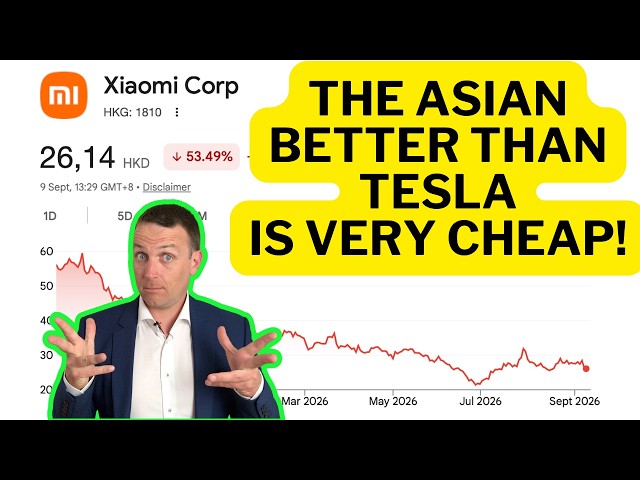
Xiaomi Stock Analysis Tells Many Interesting Stories!
Watch on YouTubeVideo summary
The video presents a critical analysis of Xiaomi's stock performance, highlighting a significant disconnect between the company's diverse business operations and its current market valuation. Although Xiaomi is a major player in smartphones, artificial intelligence, electric vehicles, and robotics, its stock price has plummeted by approximately 50%. The narrator draws parallels between Xiaomi and Tesla, noting that while both companies invest heavily in future technologies like AI and autonomous driving, their valuations differ drastically; if Xiaomi were priced similarly to Tesla based on its potential in gadgets, robots, and EVs, its market capitalization could theoretically reach several trillion dollars. However, the current reality shows a company with a $32 billion market cap struggling against intense competition, rising memory costs for smartphones, and a narrative that suggests an overhyped investment bubble rather than a technological one.
Despite facing revenue declines in its core smartphone segment due to increased component costs and fierce market competition, Xiaomi has managed to maintain its position as a global leader by expanding into other categories such as wearables, tablets, and electric vehicle delivery. The company has successfully raised average selling prices by 25% to offset inflationary pressures, yet sales volumes remain under pressure. A key point of contention discussed is the rapid depreciation of electric vehicles, with the narrator noting that some cars lose up to 50% of their value within three years, which casts doubt on the long-term profitability and consumer appeal of this sector. While analysts project continued growth and suggest buying opportunities based on projected PE ratios around 25, the narrator warns that these optimistic forecasts may not materialize given the saturated nature of the market and the high risk associated with Asian equities during potential regional crises.
From a value investing perspective, the transcript emphasizes the importance of being selective about which companies to own and at what price, rather than chasing growth narratives blindly. The narrator contrasts Xiaomi's current PE ratio of 19 with Apple's higher multiple of 36 and historical low multiples seen in other tech giants like Tencent or Process at nine, arguing that investors should wait for more attractive entry points before committing capital. The analysis suggests that while the AI and EV sectors are promising, the current environment is characterized by a price war that will likely erode returns, turning potential investments into bubbles. Consequently, the recommended strategy is to stay on the sidelines, avoiding promises of future growth in favor of purchasing companies with proven real cash flows when their valuations align with traditional metrics, such as a PE ratio near nine or ten.
In conclusion, the video serves as a cautionary tale about the risks of investing in high-growth sectors like AI and electric vehicles without considering the underlying fundamentals and valuation safety margins. The narrator argues that Xiaomi, despite its impressive scale and global presence, is currently priced fairly rather than being an absolute bargain, and that investors should be prepared for the possibility that growth may stall due to overwhelming competition from players like Tesla and various AI startups. The overarching message is that while the technology and business models are sound, the investment climate in Asia carries specific risks that require patience and discipline. Investors are advised to wait for market corrections or crises that drive PE ratios down to more reasonable levels before entering positions, ensuring that their portfolios are built on sustainable cash flows rather than speculative hype.
Read the full video transcript
Now, I was researching some Asian stocks
and you cannot not look at Xiaomi. The
company is in everything, smartphones,
artificial intelligence of things,
electric vehicles, but the stock is down
50%. So, we have to look at it from an
investing perspective, but there is also
very interesting narrative related to it
because it's connected to everything, to
Asia, electric vehicles, artificial
intelligence, smartphones, the way we
live, the market, the price, the risk
and reward. So, it's a very interesting
story. If we look at the business,
everything looks okay. They have their
place in the world. They have been hit a
little bit by increasing memory prices
for their smartphone devices. However,
they are investing for them big money,
40 billion renminbi, approximately 6
billion US dollars. And keep in mind,
this is an Asian company that invests
similarly to what Tesla invests and has
also similar business model to Tesla. Of
course, Xiaomi has a market cap of 32
billion dollars. The stock is down 50%.
If it would be priced like Tesla,
electric cars, devices, robots, gadgets,
that has a market cap of 1.1 trillion,
Xiaomi would be priced at approximately
3 to 5 trillion if Elon Musk would buy
this. So, that would be a way for Elon
to make a few trillion. He can buy
Xiaomi at 30 billion, get it revalued to
3 trillion. And Elon, I just made you 3
trillion. If he gives me a few billion
for this advice, you know where to find
me, on this YouTube channel, Elon.
Anyway, they're also into AI models,
token usage. They are doing well. They
are competing with all the other
players. However, that's exactly the key
message here when it comes to AI
competition. When I look at all the
opportunities that I can use for AI,
there will be a price war. The return on
investments will likely be terrible. We
will be using AI. It will change the way
we are living, but the investments will
make it a bubble. Not technological
bubble, investing bubble. That will have
terrible repercussions. And we see it
here. The confirmation is here. With a
30 billion market cap, they are doing
well. Other players don't even get to 30
billion of revenues, have market caps of
trillions. Everybody has an AI agent. In
the recent bets discussion, we discussed
Caspy. Even they have a Casper new AI
agent. Everybody has one. Maybe I should
make one, too. Yeah. Embodied
intelligence, Xiaomi robotics, very much
applicable, things like that. So, we'll
see where it will go. They are scaling,
integrating, increasing the number of
stores where they will be able to sell
you everything. Smartphones, not cheap
anymore as they had to increase their
prices because of memory cost increases,
but they still have their position
number two, number three, number four.
So, still doing well. They managed to
increase average sales prices
significantly by 25%.
That has helped a bit, but sales are
still down. Their global user base is
growing. Tablets also, wearables.
However, they are not Apple. As much as
they try to be, they are not. And we see
that in the decline in revenues from
smartphones and the impact of memory
prices hitting them. But, there is more.
There is EV, AI. They are growing into
delivery of cars. However, when it comes
to electric cars, my car is now getting
old, 250,000 km. I'm looking a little
bit. And if they say that this is good,
25% value loss after a year of owning a
pure electric vehicle, that's not good.
I'm looking at some cars 3 years old,
minus 50% with 20,000 km on them. That
might be true value investing. We'll see
what car will I buy. Anyway, the Xiaomi
situation is one the competition is high
in each of their segments. And they are
not Apple to
be capable to price a premium. If
something is a commodity, it gets ugly.
By the way, Apple, yes, everything
great, but it also has a P ratio 46. And
perhaps another interesting story, I did
analyze Apple on March of 2016,
discussed it for the next 40 years, said
it was a buy. I did buy it in March
2016.
And the key factor there was the the P
ratio was nine. And then I assumed the P
ratio of 15 going forward on much higher
earnings per share. Uh
stock price was different then because
of the splits later.
But, the message here is that even great
companies do trade at P ratios of nine
here and there. And that's another story
to discuss here. Xiaomi, Apple, as value
investors, we don't need to own
everything all the time. We can be
selective about owning what we want to
own at the right price. So, P/E ratio of
36 for Apple, P/E ratio of 19 for
Xiaomi. Yes, it's relatively cheaper,
but do I need to own it? No, I can
simply wait for a P/E ratio of nine.
Tencent is at a P/E ratio of 15, Process
at nine. So, you can always wait for
these opportunities, and then the risk
and reward of investing is much
different, and that's it. That's the key
story. Xiaomi can go up when it comes to
the stock, can go down, but the P/E
ratio of 19, let's say fairly priced,
it's not tend to be an absolute bargain.
If we look a little bit at the revenues,
first, decline in revenues after a lot
of years of growth, and now the market
is worried. Nevertheless, net income
down significantly.
They even issued common stocks to likely
invest into their AI narrative. Revenues
by category down on the smartphones,
growing on the other things, somewhere
stable. However, net profit down
significantly, and that's what we are
seeing trickling down. So, all else
equal, another quarter, the P/E ratio
will be 25 and not 19 when this Q3 goes
to normal. Nevertheless, they are doing
buybacks. Okay, then issuing shares, not
okay. But, Xiaomi is the Asian player.
It is investing in everything. They will
be competitive globally. Again, it says
more about the general environment of
AI, electric vehicles, autonomous
vehicles, even robotics. What is it
priced for? If I look at DBS's
projections, they are just projecting
growth, growth, growth, no matter what.
So, this is just a pause year, and then
we go back to 20% growth. They put a PE
ratio of 25 for their price target in
the future, and then yes, the stock is
cheap, you should buy it, and we just
keep on partying along. That works until
it doesn't, until there is a proper
crisis, an Asian crisis. We haven't had
those for a while, but when those come,
then we come in and look for PE ratios
of nine. It is priced as it is. Will it
be revalued on growth? Everyone is
banking on AI growth. From where it will
come, that's something we still have to
see. We don't like to invest in green
bananas. Shift towards GPUs, cool looks
in revenue will lift margins, everything
will look great. That's what analysts
are saying, but it might also not
happen. To me, it doesn't really look
like the profits are still coming. Might
be coming, but it might also not happen.
And then you have another revaluation
ugliness, and that's something, trust
me, I learned over the years. You don't
want to be in when it comes to Asian
stocks. The key question is, what if the
growth stalls? Then we get to this
situation, PE ratio of nine. And it
might grow, but it also might not
because of the huge competition that we
have seen now when discussing Xiaomi.
That's related to all the companies, to
the Teslas, to the AI, Open AIs,
everyone, which is very interesting. But
for us value investors, we will just
watch from the sidelines, wait for those
PE ratios of 10, not buying promises,
buying real cash flows. Until then,
there will be something else for us.
Thanks for watching.