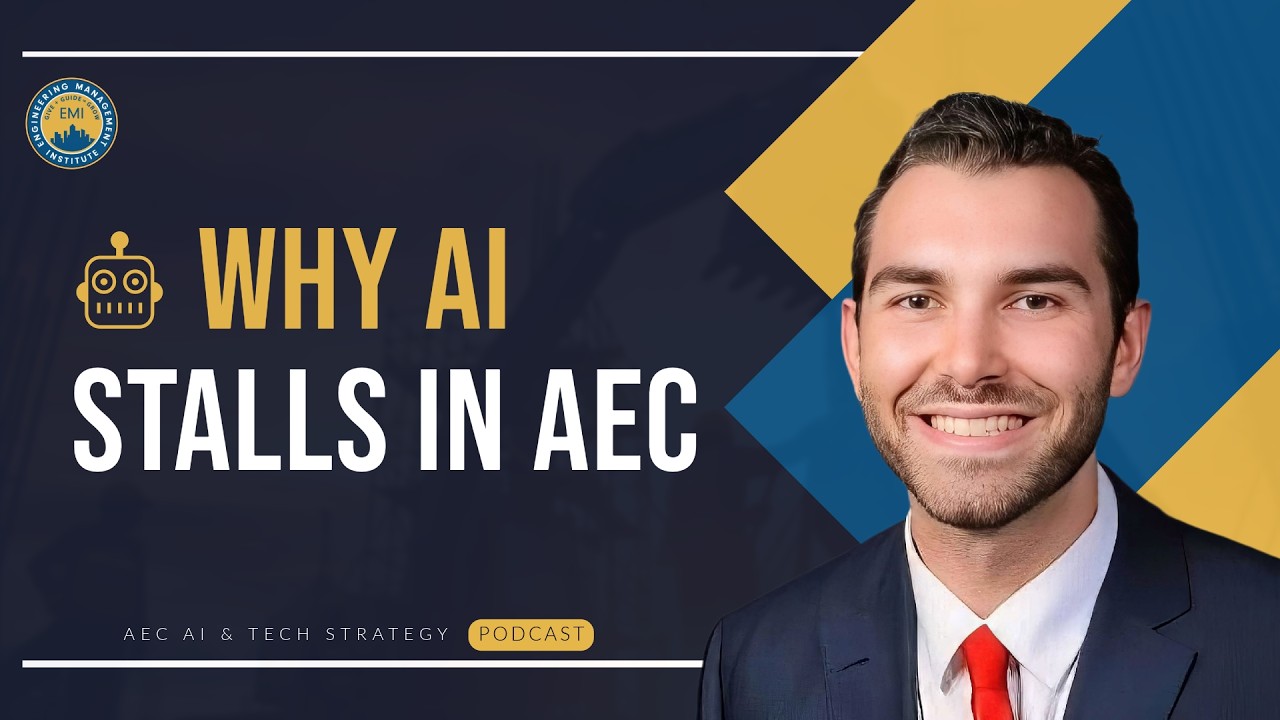
Why Your Firm’s AI Adoption is Failing (And How to Fix It)
Watch on YouTubeVideo summary
The primary obstacle preventing many firms in the AEC industry from successfully adopting AI lies not in the technology itself, but in the significant gap between creating a proof of concept and achieving full-scale implementation. While organizations often have access to promising tools and pilot programs, momentum frequently stalls due to fragmented data systems that are siloed and lack interoperability. This technical fragmentation makes it difficult to find or access necessary information across different platforms. However, the speaker emphasizes that even when these technical hurdles are addressed, the more challenging aspect is change management. Many initiatives fail because they are prototyped by small teams without securing buy-in from leadership or champions within the wider organization, leading to resistance when the new tools are pushed for enterprise-wide adoption.
To overcome these barriers and move AI from concept to real-world impact, firms must prioritize a culture that supports experimentation while investing in professional engineering practices rather than relying solely on "vibe coding." The discussion highlights that while artificial intelligence can accelerate the translation of business logic into code, it cannot replace the need for skilled professionals who understand scalability, operations, and debugging. A successful strategy involves using AI to augment human capabilities rather than replacing them, ensuring that systems are robust enough to handle hundreds of thousands of users without sacrificing quality. Furthermore, organizations should leverage data-driven insights to guide their roadmaps, utilizing metrics on user behavior to optimize features and ensure that the technology actually solves real problems for end-users rather than just serving as a novelty.
Looking toward the future, the industry is shifting towards architectural patterns like the "conduit" and "observer" models, which allow systems to act as bridges between multiple sources of truth rather than trying to consolidate all data into a single silo. This approach is complemented by the emerging concept of "agentic farming," where multiple specialized agents collaborate with a sense of discovery to complete complex tasks autonomously. Additionally, the potential for monetizing decades of accumulated project data remains largely untapped, though advancements in clean room technologies offer a way for competitors to share anonymized insights without compromising proprietary secrets. As the field evolves, security and governance will become increasingly critical as organizations build these expansive, self-augmenting networks of agents.
Ultimately, successful AI adoption requires leadership that is willing to walk the talk by actively learning alongside their teams and providing dedicated time for experimentation and play. Leaders should avoid relying solely on their most technically gifted individuals as teachers and instead identify those who excel at communication and mentorship to drive cultural change. By giving engineers space to explore new tools, sharing knowledge openly, and fostering an environment where failure is part of the learning process, firms can build a sustainable path forward. The key takeaway is that while AI moves quickly, true adoption depends on human-centric strategies that combine technical depth with strong change management, ensuring that technology serves to enhance productivity and decision-making across the entire organization.
Read the full video transcript
I I we see this [music] every day. It's
stalls between okay, here's the proof of
concept. This is great. This is what it
can do.
Between there and implementation [music]
where you have, you know, a good portion
of any firm or group or company using
the technology.
>> [music]
>> What gets in the way in that that gap
that we see?
>> The fact that
>> [music]
>> systems are, you know, siloed or they've
got disparate or fragmented data is
something that is usually a big
showstopper [music] inside of this. You
get to a spot where we just don't have
access to the data or we just can't find
the data or where the system hasn't been
indexed or not interoperable.
>> [music]
>> The change management aspect of getting
this adopted afterwards, that part is
the tough part.
>> Many firms in the AEC industry are
experimenting with AI. Right? Pilots,
testing tools, and exploring what's
possible. But somewhere between proofs
of concept and implementation, momentum
stalls. Technology is there, interest is
there. So, what is getting in the way?
Today's guest has a front row seat to
that question. Benjamin Massa is the
chief technology officer at Newforma, a
SaaS platform serving over 500,000 users
across the global AECO industry. With 15
years of engineering and technology
leadership spanning startups,
mid-market, and enterprise
organizations, Benjamin brings a rare
combination of technical depth and
business acumen to every decision he
makes. In this episode, we're getting
into what it takes to move AI from
concept to real-world impact, how to
scale engineering teams without
sacrificing culture or delivery quality,
and what the future of driven
decision-making looks like when project
information is no longer siloed. If
you're leading a firm, managing
projects, or thinking about where
technology fits into your growth
strategy, this episode is for you. But
before we jump in, I want to tell you
about AECPM Connect, a series of
in-person events we created at EMI for
AEC project managers and leaders who
develop them. You want to stay on top of
PM trends, elevate your team, and
deliver stronger project results? These
full-day events are built for you. We're
coming to Kansas City this October.
Learn more and register at
aecpmconnect.com.
I'll be there and I hope to see you
there as well.
Now it's time for our conversation of
the week with Ben Bassoe. Ben, thank you
so much for taking the time to join the
show today. Welcome.
>> Pleasure to be here.
>> So, I think we have a we have a nice
interview set up, Ben. I know we were
just chatting a little bit earlier about
your unique perspective um coming from a
different viewpoint here in the
industry. So, we'll just get things
kicked right off. So, Ben, please tell
us a little bit about yourself, what
you're focused on in your role as CTO at
Newforma.
>> Okay, well, I'll start by getting a
little bit about who I am in a nutshell.
Um, you know, for me, very much so, I
come as a builder. I've been in the
software engineering space for about 26
years. I've had a couple of my own
startups. I've done a whole bunch of
different spaces in in the past,
everything from adtech to marine to
military. And I never really touched too
much into the construction technology
space, but I've been really enjoying
that space coming on board as the CTO
because it's been a space where I've
been able to take a lot of the tech that
we've, you know, that I've used in other
industries before and been able to see
opportunities for to be able to apply
that inside of the construction tech
space. And so, loosely, my role as
coming on board of CTO, which I've only
been at the organization now for about
10 months, has been taking a lot of what
I've learned over the last plus decade
or so in the AI space and taking that AI
knowledge and being able to apply that
to some of the workflows in the AEC
space to be able to optimize that, make
that a little bit better. So,
essentially, in a nutshell, taking AI,
translating that into the construction
technology space, and how can we use
that more effectively? And not just
building vaporware or building AI
for the sake of calling it AI, but
actually building stuff that is really
useful for real people, cuz that's where
I get a lot of delight in uh, bringing
smile to people's faces.
>> Excellent. So, I know, you know,
Newforma's, guys are pretty sizable
company. You have pretty sizable user
base, right? Over 500,000 users across
our industry, AEC EO. So, when you're
making decisions at that scale, so
how do you guys figure out what matters
to the end user? Um, because that's
really what this is all about, right?
>> That's, yeah, for sure. So, I think one
of the things that's been very good thus
far as an organization that I've seen,
uh, that we do particularly well is we
listen really well to our customers. And
so, even though we've got hundreds of
thousands of folks using our system, uh,
we we meet regularly, uh, doing what we
call a PAB or a PAB. So, it's a product
advisory board. And we do that at
multiple levels in multiple locations
around the world to be able to kind of
listen to our our customers about what's
working well, what's not working well.
Getting that as a as a as a, you know,
point of input to be able to understand
what we're doing, um, you know, so it's
kind of a sample set. Now, these are
champions and they usually have a lot of
influence on on in the industry. But
then, I'll flip that over. There's other
stuff that we do as well, too. So, we're
also a data-driven organization. We keep
metrics around how people are using our
applications and we use that to be able
to tailor, um, you know, the the
improvement over time. So, we see if
somebody's not or in users are not using
a particular feature inside of our
application or they're spending too long
on particular operations, we're
constantly tinkering with that to be
able to optimize that to make them
better. We do do a lot of interviews as
well, too, that are kind of with
individuals just to kind of see and and,
you know, kind of dig down. But then,
I'll flip that around, too, on the scale
side of thing. This is something that
speaks near and dear to my heart, uh,
where performance is really an important
um, um metric as well, too. So, this is
about actually us inside of the
engineering teams building things that
are highly performant. And so, even
though when we're building each
individual feature, we are iterating and
starting with a small little sample set,
we're also thinking big and being able
to build out the test suites and the
scalability around that where we're
testing and then hitting it with
hundreds of thousands of users to see,
does it actually meet our standards for,
you know, what would an acceptable
performance in terms of wait time would
be or being able to perform certain
operations.
>> Excellent, which is great because, I
mean, you guys, like anyone customer has
their own
vision or opinion, but you guys
literally see the activity of your
entire customer base, right? So, Ben,
you also own the AI product roadmap at
Newforma. So, I know, right, that
includes agentic workflows, smart
search, and any of those other
AI-oriented capabilities that we've
we've already discussed. So,
how do you translate like the idea
behind AI into something that people can
actually use?
>> Yeah, I mean, I think smart search is a
great starting point, right? And the
thing that I always say um to to folks
is that, you know, we we've, you know,
search has become commoditized in many
fronts where, you know, before it was
Google and you nowadays a lot of people
are using LLMs to just search what
they're looking for. And they've done so
very much and what's changed
dramatically is that allowed people ask
questions and they search for things not
in a keyword search, but they look for
things in a semantic search. So, like,
give me all the issues that have
occurred in the last 10 days at schools,
you know, in some in their system. And
they're like, okay, that it's smart
enough to be able to pull out that
information. Now, in order to do that
from a smart search point of view, you
can use AI uh to be able to, you know,
retrieve that information more
intelligently these days. So, even
though search has been, you know,
you know, people thought that this was a
done deal and this is something that
was, you know, we we you could actually
um it was it was already a solved
problem, it's continuously getting
better. Uh and when we come to this the
semantic search side of things, there's
still a lot of improvement to be had
there. Now, why do I start with the
smart search side of things and why do
we call it smart search? It's because
it's built on top of an agentic
framework that allows that that is
actually indexed differently inside of
the system so that it permits for you to
do those semantic searches. It's not
just a keyword search, it's not just by
category, it's allowing you to do things
where I'm speaking to it in almost
natural language, and giving it a
question and it's now being able to
retrieve that. Now, you're like, "Okay,
well, big deal, you know, this is a
solved problem, this is something that
our LLMs do already every day." But,
it's a
foundational element to be able to do
smart things inside of the AEC space.
Now, why do I say that? It's is because
before you can do anything intelligent
with the information, you need to be
able to find the information. So,
imagine and obviously right now, we do
we have demographics around how long
architects and engineers spend looking
for information inside of their system,
and it's it's actually it's really
surprising to see how much time they
waste actually just looking to be able
to retrieve the information that they
need to, you know, grapple together or
combine together from multiple systems
that are siloed and be able to bring
that into one spot.
But, now the fun part starts. Once
you've actually found that information,
then you can start building on top of
it. You can start building now, which
has become very popularized in the
industry around agents, right? You can
now start building smarter agents that
do things with the data that you've now
retrieved and automate a good portion of
those workflows. That's a huge that's a
great starting point, but that's
definitely something from the, you know,
AI roadmap that we're actively working
on right now and continuing to build and
augment on, but another good reason from
an engineering point of view as to why
this is a smart approach is because now
it gives you a lot of extensibility. So,
it's a good engineering practice to
build something that then you can extend
later, and this is where you come for
that agentic framework. Once you're able
to find information, now you're able to
build different types of agents on top
of that to be able to go and build. So,
an example of one in our space,
we have a submittal agent that we're
working on right now. And what that does
is really it automates a good portion of
the information from when you're
actually doing a submittal. We have
certain specification books inside of
our system that you must adhere to for
certain materials or certain building
codes that need to be respected
well when you're doing that submission.
What we're able to do with that is
automate that away. Not only just
retrieve the information that's
pertinent to the user, but automate the
fact that we're cross-checking the two.
Does this actually give us a thumbs up
and it meets the requirements or doesn't
it? And what that is end up what that
ends up doing is that we're not
replacing any of the users that are
there, we're just augmenting it so that
they can pass their judgment more
quickly and save them a significant
amount of time. So, these are the just
an example of the types of agents that
you can start to build on top of the
information once you're retrieving it in
this new way that I just mentioned.
>> And this story, of course, goes down the
down the line to adoption, which is one
of my one of my favorite topic. So, we I
we see this every day. It stalls between
okay, here's the proof of concept. This
is great. This is what it can do.
I we see this every day. It stalls
between okay, here's the proof of
concept. This is great. This is what it
can do.
Between there and implementation where
you have, you know, a good portion of
any firm or group or company using
the technology. What gets in the way in
that that gap that we see?
>> Yeah, okay. And this one's a very I
mean, I could probably talk for hours on
this one, Um, I'll I'll keep it short.
There's a bunch of ones that really, you
know, get in the way really quickly and
I'll leave those out because they're a
little bit less interesting to talk
about or a little bit more mainstream.
You know, the fact that systems are, you
know, siloed or they've got disparate or
fragmented data is something that is
usually a big showstopper inside of
this, meaning that they actually you get
to a spot where we just don't have
access to the data or we just can't find
the data or where the system hasn't been
indexed or they're they're not
interoperable. So, those are the kind of
things where I'll leave that one aside
because technology in the question that
you just mentioned is usually the easy
part.
The change management aspect of getting
this adopted afterwards, that part is
the tough part. And so, what I see often
stalls inside of these and I'll tell
just like a little small little quick
story to give an example of this.
Often times what happens is that you get
this smaller team inside of the
organization that are like, "Wow,
there's this really cool idea that we
should be doing. Let's prototype it."
They ended up prototyping and then using
an LLM, they built it fairly quickly and
they're like, "Wow, this thing is the
best thing since sliced bread. This is
really great. This is amazing. Everybody
should be using this. It's going to save
everybody time." They never went and got
a
a champion. They never got a a buy-in
from the rest of the organization. And
so, then they start taking this best
idea that they think ever and they start
pushing this into the organization and
they're like, "We don't need this." Or
"We're not ready for this now." Or "You
never talked to us about this before."
Or And so, you get the whole change
management 101 inside of an organization
that people start to push back on this,
right? And this Oh, that's a new way of
working. Why do I need to work this new
way? I've always done it this other way.
And so, this is those are the kind of
things that really push back hard on
that. And so, despite the fact that this
was really a genius idea, it's a great
thing for the organization, they get
pushback. And so, what I strongly
suggest often to getting over those
hurdles is really about getting that
awareness of what's going on as early as
possible, getting some champions, and
there's a lot of change management 101,
you know, I would say tactics to be able
to still get your AI through the door
and being getting it out there and so
you being used. Uh and often times, um
you know, that stems from the fact that,
you know, just getting more people on
board and actually seeing the benefit of
it is a great start.
>> Transform your technical experts into
impactful leaders with EMI's Engineering
Leadership Accelerator. [music] Tailored
for AEC professionals, this program
enhances communication, delegation, and
decision-making [music]
skills. Flexible, interactive, and
designed to fit your team's schedule.
Elevate your team's leadership
capabilities today. Visit
engineeringmanagementinstitute.org
and click on corporate training.
>> Excellent. And I really appreciate that
answer because, I mean, we've all have
that experience, right? You say you just
go build a very simple agent, people
love it, but there's so much more that
goes into getting that deployed
successfully to an entire department, an
entire company.
And and really it's often times the
leadership that needs to be on board who
may be like the least educated about
what's being built and the purpose that
it serves. So you have to get buy-in
from a couple of different parties.
>> Yeah, I definitely agree with that. I
mean, I think one of the other thing,
too, is that when your leadership is
already pushing back against it, it's
already going to be something that is
very, very difficult to to to overcome
inside of an organization. But I I
definitely think that
what's really helping though these days,
at least at the leadership side, is that
a lot of organizations have grown this
anxiety about AI taking over the world.
If we don't do it with AI right now,
you're going to be left behind. So there
is definitely is much more awareness and
openness to be trying these things.
Um but at the same time, there still is
a little bit of change management 101
that gets applied to whether or not
Okay, you know, these pilots succeed or
fail.
>> Absolutely. And uh again, it's often
times the leaders who
they may hear
all of this talk about artificial
intelligence, but less often are they
hands-on and trying it themselves.
Outside of, right, like engineering and
innovation technology space. So, it's
always great when they can gain that
first-hand experience for themselves,
cuz that it actually better guides their
decisions than something generic they
may have read in
online or heard from a peer.
>> Yeah, the other thing too, I think that
really helps in this is that, you know,
getting
um
getting a culture that adopts the idea
from the get-go that it's okay to start
pilots, it's okay to start little proofs
of concept. Um but the one thing that
I've noticed um through my experience is
that a lot of these people find it easy
to build a proof of concept, but then
coming back to your earlier question
around scale and enterprise grade, they
realize that, okay, it's easy to get
this proof of concept off the ground in
a day or two. I've I put something, but
then scaling it to a larger
organization,
creating enterprise grade software, or
sometimes just as simple, and I know
this will come across as funny, as soon
as they hit their first bug, they're
like,
uh I don't really know what to do
anymore. And they start Yeah.
>> This is a topic I love discussing
because I think so you, right, you know,
vibe coding, the idea behind anybody can
build software. So, for that first 10 to
20% that proof of concept is awesome.
But as soon as like you said, anything
in life, you hit that first wall, it's
like, uh-oh, what do I do? It's and I
have done this myself multiple times.
You spin up a quick proof of concept, it
takes a couple hours, but there's a
reason that there's a reason we still
have professional software developers.
It's It's In my opinion, it's different
when you have those, let's say, by going
tools, cloud code, whatever you want to
use, in the hands of a professional.
That's different. But, for the
layperson, right? Like, there's a reason
we're not professional developers. It's
not that you shouldn't try, just
understand the difference between a
pilot and a proof of concept and an
enterprise piece of software that has to
work for hundreds, thousands, tens of
thousands of users.
>> Yeah, definitely. And I I I think that
there's, you know,
you know, I had this debate the other
day. I was at a CTO, uh, you know, kind
of gathering, and we're around the
table, we asked these questions, right?
Are very much around the the notion of
when do you think the modern the the way
that the full-stack software developer
these days, when do you think that that
job will go away? And we had some people
answer across the table, and like the
the the the first one was 5 years, 2
years, 2 years, 5 years, never. Right?
And I was like, okay. Well, so so then
we started exploring that and talking
about that a little bit more. What do
you mean by that, right? And it was kind
of fascinating to see about the
different perspectives that people were
sharing at the table. But, to to your
point, there are certain portions of
that job that are definitely going away
these days, especially when it comes to
translating, let's say, business logic
into code, just purely. This part is
definitely going away faster and faster.
The coding agents are getting better and
better. And us internally at New Form
are we're using this right now. We're
using factories to be able, you know,
coding factories to be able to code our
our features in our applications. And it
it is definitely augmenting the speed at
which the the the team is able to go.
But, then there's the other aspect of
sides of things where it comes to scale,
and it comes to operations, and devops,
and the bugs, and things that get
introduced, you're still going to need
the judgment of what a good software
engineer can put in place as good
practices. And so this is very much and
you've heard a lot of folks talk about
this these days is investing inside of
your AI harness or investing inside of
your AI infrastructure, right? Around
that. And that's where I think if my
advice on that is very much about giving
organizations visibility of what you're
building with your AI is very key. So
for us in the example of this, you know,
leveraging on top of technologies like
something like LangGraph is it gives you
the ability to build agents, but it
gives you also the comprehension to
understand how they communicate with one
another. So that when things go wrong,
as a human, you can now jump in human in
the loop and debug it to be able to
understand, okay, this actually is
failing because of this. Let's optimize
that. Let's create a skill for this or
let's be able to modify this so that it
it knows next time not to do the same
error or it knows next time that it it
shouldn't do something. And so that and
that's how you grow your system to be
able to improve and get better over
time. But this is definitely something
that I see come back as a pattern again
and again. I love the the notion of
being able to iterate quickly with those
proof of concepts. That's definitely
helped a lot, especially on the product
discovery side of things. But at the
same time, bringing that into enterprise
grade that works for, you know, in our
case, 500,000 users, um those are the
kind of things where it's not as easy as
a problem sometimes to solve and you
definitely still need the skill set that
has been there for, you know, that you
master over years.
>> Yes, I don't Yeah, it probably that says
uh
please work, no bugs, 500,000 users.
Yeah. May maybe not as simple as it
seems.
>> Exactly. I agree.
>> And so, you know, going going back to
data-driven decision-making. So we
talked about how you guys use it
internally to prioritize feature sets,
maybe simplify some features. But for
the user side, we often find
come data silos, right? Across different
stakeholders at a project. So, I know A,
somebody else knows B, but I don't know
that they don't know what I know, and I
don't know what they know. Cuz I don't
know.
Um that little that little word soup
there, but essentially how does what you
guys what you guys are doing change
that?
>> The the thing is is that one of the the
patterns that I've been trying I mean
that we as adopted as our I don't know
as almost as our DNA inside of the
organization is that we're very we very
much adopt a conduit pattern. Okay, and
so the conduit pattern is something
where hey, you're just the conduit layer
between multiple
systems
that and so you the idea is you don't
try to consolidate it all in one system.
You don't try to go and suck in
everything and and be the one-stop shop
kind of what used to be the the trend in
the past around creating one data lake
or one source of truth. You now have
multiple sources of truth and you're a
conduit and you make it easier to be
able to go and probe and get the
information from the information where
they lie. That makes it more extensible.
It allows you to augment our time and
what you and it allows you to if you
don't know something out there
it the conduit pattern also allows you
to use something that's more you know,
I'll use the technical term, it's more
of an observer pattern and the observer
pattern is kind of you can broadcast
something out there and say, do you have
this information for me?
Do you are and so you can kind of build
the sense of awareness out there inside
of this pattern to be able to to be
used. Now, if you permit me, I'll go a
little bit really like where the future
is going with some of this stuff in
terms of the the the agent agentic
frameworks that are going to be used in
the future. There's something that's
becoming more and more popularized these
days around something called agentic
farming. And agentic farming is like
creating multiple agents that do one
specific task, but with them they've got
a sense of discovery between them. So
you basically broadcast like, "Hey, I'm
an agent. I can do this. I'm able to
have these capabilities. Here's how I
can communicate." and etc. and you're
giving a list of my what can I do? And
there and then if the and then you've
got hundreds, sometimes even thousands
of these inside of a farm. And at the
beginning of this farm you're saying,
"Complete for me this task."
And those those agents figure out
between themselves what should I need?
What do I need to be able to accomplish
those tasks? And at the output it's
spitting out the tasks that it's
completed. And you're like, "Wow, okay.
How does that work?" Well, you need to
have that level of discoverability built
into your framework when it comes to
your agentic farming and how they can
achieve something. And that's where the
trend is going because what's also
happening in there is that if ever you
don't have a capability inside of that
agentic farm, the farm builds itself. So
like, "I don't have an agent that does
this. Build me another agent that will
actually do this." And so as you can
imagine it's augmenting itself over
time. Now, there's a whole bunch of
security concerns and a whole bunch of a
well, is this going to go wild wild
west? Is this going to explode? And of
course it will. But if you've built the
proper sandboxes and enclaves around
your data, around what you can do with
it, and the governance on the security
side of things, and observab- and the
observability and monitoring, then it's
definitely the trend of where things are
going,
um you know, over time. And I know that
probably didn't exactly answer your
question, but it kind of gives you an
idea of um you know, of where my head is
at around some of that. You know, the
the whole notion of not knowing what
other people know. There's another
pattern as well, too, that's used quite
often out there and it's through the
notion of clean rooms. And so clean
rooms as a service is kind of this thing
where a lot of industries do this where
they're like, "Well, listen. You're kind
of my competitor or you're my you know,
you're somebody that we work in the same
industry. I don't want to share my
secret sauce with you. I don't want to
share, but I I to share some of my data
so you I can get insights and usually
they swap. So it's kind of like, "Hey,
you're architecture firm A and I'm
architecture firm B. I want to share
what I'm doing to learn from you, so
I'll swap you some of my data, but what
the clean rooms allow you to do is
anonymize that data." So it's the kind
of thing where it's not revealing
necessarily any of your secret sauce,
it's giving some of your data there,
it's anonymized data, but it's stuff for
them to learn from and vice versa. So
usually they're doing that in the form
of exchange and sometimes they're doing
that in terms of a a clean room where
they're actually selling their data to
be able to get insights. But on that
notion, the AEC space is still very, I
would say, new to the concept of trying
to think about how do they monetize the
data that they're sitting on top of cuz
they're often times sitting on
you know, 20, 30 years worth of data
that's just sitting there and it's not
really doing anything for them. Um and
so they haven't thought about how to
monetize that either internally or
externally yet. Now, most of them know
that it's there and they know that they
can do something with it, but they
usually have not quite gotten over that
hurdle yet to be able to get things in
motion.
>> Yeah, and I think
when it comes to the AEC space,
you know, any mature industry,
in my experience, we're pretty tight to
the chest with with our data and
sharing, you know, best practices beyond
what's already published industry guides
isn't really super common.
But to your point about not knowing what
to do with it, I mean, like if you don't
have somebody who's one thinking about
this on your staff, which a lot of
leadership teams are, but then how do I
execute and what does that look like?
But what's really cool and when I, you
know, talk to people about similar
topics is like you can go work with
off-the-shelf tools and with the right,
you know,
with the right setup, permissionings,
and adding the data that you're working
on in an accessible spot, you can build
yourself a little proof of concept. And
if you want to go hire a professional to
take it to the next level for you, well,
better than starting from scratch.
>> Yeah, I think one of the hurdles I've
noticed is that a lot of organizations
don't take the time to invest into, you
know, a role such as like a data
scientist. And I I say data scientist,
but that role's very, you know, I would
say it varies more enormously across
organizations. There's certain data
scientists that are very much into the
machine learning side of things and
they're doing but at the end of the day,
somebody who's taking a look at your
data and actually thinking about how can
we start to derive insights from it and
doing that in an intelligent way. I
think due to what you you mentioned as a
point, there's great tools out there to
be able to start to do that at a very
surface level and get going. Just that
investment to start to get going is
something I believe is fairly easy to do
and but
a lot of companies still just have not
quite taken, you know, bit the bullet
and and invested into that yet. And the
ones that have, every single one that
I've talked to that have, have hired
that for that role, have automatically
within, I want to say six months of the
within the first year, have rehired
another one of that roles just because
they've seen the value that it started
to bring for the organization almost
within a few months of return on
investment.
>> Yeah, or if, you know, if
you, right? Like like let's just say I
give an example, right? Like say you
have 20, 30 years of pricing data.
You're contractor and it's sitting all
over your SharePoint, your Dropbox,
wherever.
So, the way that I would I would tackle
it is like if you're if you've got it
off the shelf LLM, you can do some you
can do some search, get data or or a
segment of it in one place, start asking
questions about it. What is it that
you're trying to figure out? What's the
problem you're trying to solve?
You may be surprised at how far you get.
Then, if you realize that you're making
progress, but maybe there's something
more you want to get done, you're not
exactly sure how to do it. Hire somebody
fractionally. You don't have to start
out with a full-time data scientist. You
can go out, get some consulting done,
help them figure out your problem, and
take it at the pace that works for you
and your organization.
>> Yeah, the other thing I've seen work
fairly well as well, too, there's some
good off-the-shelf tools that, you know,
you can go the LLM approach, but if
you've got large amounts of data, your
context windows might end up filling up
very quickly, and so it might have a
difficult time, like, you know, you're
going to burn through a lot of tokens,
you're going to burn through, and it
won't be as efficient. So, there's some
tools that have been optimized for this,
and the the tools themselves allow you
to just get early-stage insights. So,
what I've kind of found that's a cool
hack around that is being able to have
external parties come in and do a little
mini proof of concept. Show and usually
they're doing them for free or for a
very minimal cost. Most of them are for
free cuz they want to showcase the value
of what they can bring to the table, and
often times what I've seen is if they've
able to showcase the proof of value
inside of their they're showcasing of
their product, usually that's enough to
get it off the ground, and the product
itself is usually cheaper than going off
and hiring somebody, but it's a good
starting point. And then once you get
there, then, you know, you start to
think about, okay, do I staff for, you
know, a project or a program around
this?
>> Oh, and that absolutely. And if and I
like I like the LLM approach because if
you already have one and it's general
enough to get you started, well, after
it takes a look at that sample set of
data, you can start asking it questions
about how do I take it to the next step?
Maybe it identifies one of those
providers. Maybe it finds an expert like
you that you end up reaching out to to
just ask a couple of questions. So, it's
cool cuz it it's it's kind of the
analogy to bike coding, right? Like, get
that proof of concept, get it off the
ground. When it comes time to bring in
the expert, well, you've already got a
couple steps in the right direction.
>> Exactly. And often times you discover
stuff there that you didn't even know
existed. And there's like see like I've
done broad things of like, "Can you give
me insights about what you're what you
learned about this data?" Right? And
just at the LLM level with, you know,
let's just say 1,000 plus documents, not
a huge amount, but they already came
back with patterns and you're like,
"Damn, I never even saw that." You know,
like and so it can see stuff that you
just don't process quite the same way.
>> Well, and what I love about keeping it
in the SME's hands and keeping the
tooling set simple is because like as
the SME writer business owner, you're
going to be able to sniff out BS better
than anyone.
>> Oh, yeah.
>> your business. You know
if an insight comes to you, right? You
could pretty quickly figure out if it's
plausible before you just start going
down rabbit holes that aren't realistic.
So, I love that because that it equips
you as the non-technical SME to get in,
start doing some work, and then better
educate yourself before you go say make
a more expensive purchasing decision.
>> Makes sense.
>> So.
>> It's and it's all right, there's never
been a better time, but there's also
there's always a place in time for the
Xbox, so just just remember that. Ben,
this has been this has been awesome.
Last question for you. So, if you're a
firm looking to adopt AI or any new
technology,
what do you tell leadership teams to
focus on to make the transition from
hey, like this is where we are today to
whatever vision they see enabled with
that new technology?
>> Yeah, okay. So, this one I would say
this is something that we've done at
Newforma
and it's also something that is near and
dear to my heart is that you really need
whenever you're doing these types of
transformations and starting to adopt
something, especially at the pace at
which AI is moving today, and especially
at, you know, I'd say that you need to
give your teams space to be able to take
the time to learn.
You need to be able to give them some
space to be able to So, what we do is we
give everybody on our engineering teams,
a you know, half a day to a day a week
just to be able to go and experiment. To
be able to go off there and learn. And
so, yes, we've put in place training
programs, but giving them the ability to
have time to actually apply that to real
use cases. And I call that play.
But the idea of being able to play with
the tech to be able to tape what you may
have to read or learned and apply it to
a real use case
is something that is is key. And it's
not just about hey, we're giving people
some free time off. There, you know, to
to just go and learn on their own. We
have it set up in a way where they're
sharing that information amongst
themselves as well, too. And that's
almost mandated. So, we want to be, you
know, share casing showcasing a little
bit of what we've actually learned so
other people can see some of the cool
stuff that's going on out there, learn
from it. What I've learned from this as
a piece of advice is that the champions
were the smart geniuses that are going
and leading the way on things are not
necessarily your best teachers. So, this
is the first thing that like they
actually want to just go faster and they
like somebody who's a little slower
trying to get adoption, it's not
necessarily hey, team them up with your
smartest person. There's so there's
certain people that are great at being
able to teach, so identify those and
make sure that they're kind of giving
back to the team. And the other thing
from the leadership side of things is
lead a little bit by example and spend a
little bit of your the portion of your
time as a leader actually teaching.
And that is actually key as well, too,
to getting some of this adoption because
it shows not only that you care, but it
also shows that you've got some of that
thought leadership. It's moving so
quickly, you're never going to be able
to be a leader in all spaces, but what I
do especially in my space, even though
I've been branded as an AI expert, I'd
say that these these are the kind of
things where I know that that doesn't
really exist anymore. It's moving so
quickly, but you want to be able to
learn certain things to be able to teach
that back to the team and be able to
provide some guidance on it. So, take
the time to invest into being able to
teach the team. And in order to teach,
that means you need to learn it
yourself. And so, there are certain
things there where that's really key and
important inside of the from a
leadership standpoint, that you're not
just talking the talk, but you're
actually walking the walk as well, too.
>> Absolutely. And right with as broad as
this space is, there's just right just
like human expertise in any area, right?
There's we've only we only have so many
hours in the day. There's only really so
much of that narrow band that you can
focus on and become an expert. Just
kind of is impossible, unless you're
like one of those cool polymath people
who could just do it all, right? But I
know I'm not, so. But it's really been a
pleasure to get to to speak with you,
get to know you better, and I'm sure the
audience got a lot out of this episode.
So, if they'd like to reach out to you,
ask you additional questions, or just
chat, what's the best way for them to
reach you?
>> I mean, I'm somebody who's pretty open
and transparent. Reach out to me on
LinkedIn or
my my email. Happy to share that,
you know, on side of on this side as
well, too.
You know, so and you know, those are the
kind of things where I love to talk
shop, as well. So, if there's folks that
want to reach out and, you know, dive a
little deeper in some of what we've
talked about today, happy to do so. It's
something that, you know, it gives me a
lot of joy. I I organize, you know, some
of the CTO meetups in my area and so
forth. I love to give back to the
community and kind of give back as a as
a whole, just as a technologist in
general. So, happy to share with my
email as well, too.
>> And thank you so much for taking the
time to join us.
>> Thank you very much for having me.
>> Absolutely. Take care. Bye-bye. Please
remember, you can find the show notes
for this episode at aectechpodcast.com.
There, you'll find a summary of the key
points discussed in today's episode, as
well as links to any of the resources,
websites, or books mentioned during this
episode. Until next time, I wish you the
best in all your engineering and
technology endeavors.
>> Mhm.