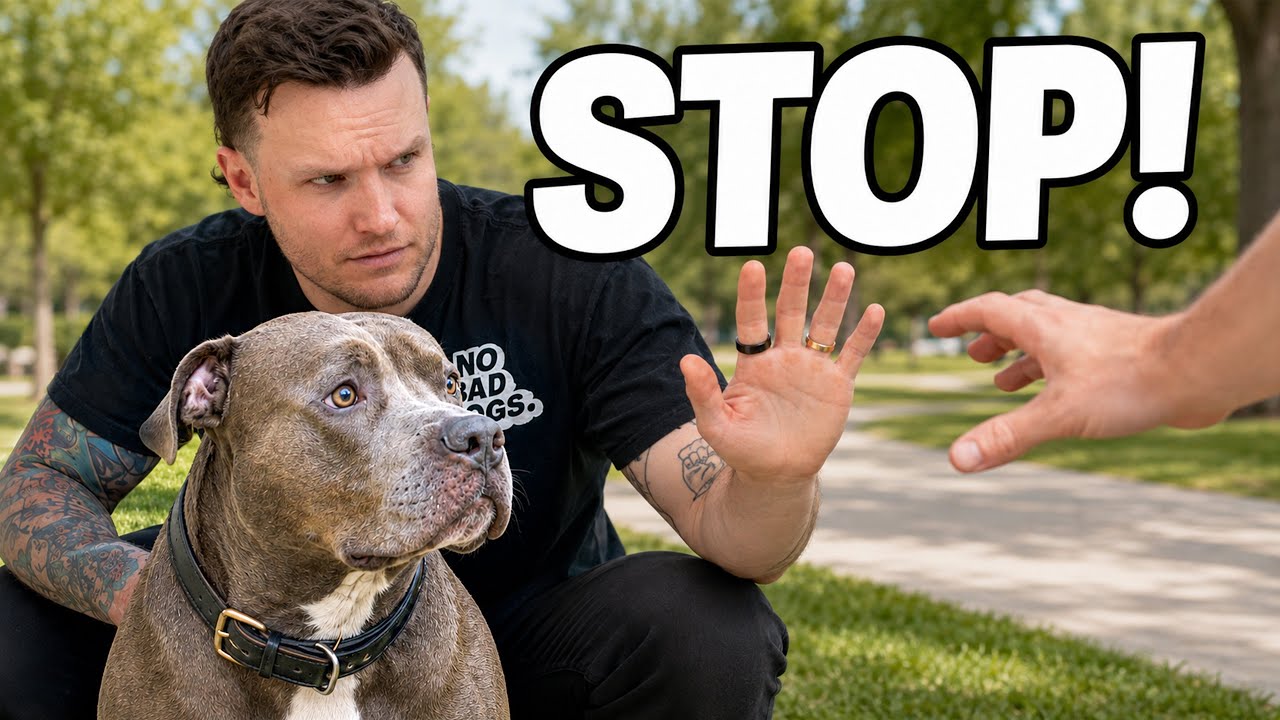
Video summary
The most critical lesson regarding dog safety is that allowing strangers to pet your animal without prior consent can silently transform a well-meaning companion into a significant liability. Many owners mistakenly believe their dogs are universally friendly because they have not bitten anyone yet, failing to recognize the subtle warning signs of fear and discomfort such as lip licking, yawning, or turning away. When these signals are ignored by both passersby and guardians, fearful dogs often feel trapped with no choice but to defend themselves, leading to bites that stem from anxiety rather than inherent aggression. This dynamic not only endangers others but also severely damages the trust between owner and pet, creating a cycle of reactivity where the dog eventually explodes after being pushed repeatedly past its emotional threshold.
The problem is particularly acute for puppy owners who allow unstructured social interactions without any guidance or commands from their handler. By letting every passerby approach freely, owners inadvertently teach puppies that strangers are opportunities to greet rather than potential stressors, which can lead to dogs dragging them down the street and becoming uncontrollable on walks. Even confident adult dogs require boundaries; if a dog is allowed to run wild saying hello without engagement or direction from its owner, it loses focus and respect for leadership. The solution lies in establishing clear structure where the dog must wait for permission before interacting with anyone else, ensuring that the animal remains calm by your side while waiting for you to decide when an approach is appropriate.
To foster a healthy relationship and prevent behavioral issues, owners should actively advocate for their dogs' comfort levels rather than forcing them into overwhelming social situations under the guise of "socialization." Pushing a nervous dog past its limits does not build confidence; instead, it teaches the animal that the world is unpredictable and scary, often escalating mild fear into growling or biting. The correct approach involves protecting fearful dogs from excessive stimuli initially, allowing them to choose when they feel safe enough to engage, and using positive reinforcement like treats only after a stranger approaches calmly. This method builds genuine confidence at the dog's own pace while reinforcing the owner's role as a protector who understands their pet's unique emotional state through body language and energy.
Ultimately, responsible ownership goes beyond basic obedience commands; it is about deep communication and understanding your dog's non-verbal cues to make smart decisions on their behalf. A well-trained dog trusts its handler enough to wait patiently for permission before greeting others, knowing that the owner will always prioritize safety over social pressure. This foundation of trust ensures that interactions remain positive for everyone involved and prevents the escalation of stress signals into dangerous behaviors. By learning to read your dog's subtle communications and intervening when necessary, you become an effective advocate who safeguards both their physical well-being and mental health against the risks posed by unregulated public encounters.
Read the full video transcript
What if I told you that one of the most
dangerous things you can do with your
dog is allow anyone and everyone to come
up and pet them? Now, I know that that
sounds absolutely crazy, Tom. [music]
What are you talking about? My dog loves
people. My dog loves everybody. Because
what most dog owners don't realize is
that this one habit that we're talking
about, this thing that feels completely
harmless is silently causing damage that
can turn even the sweetest dog into a
gigantic liability. So stick with me
because by the end of this video, you
are going to completely see things
differently after I explain in detail.
Let's start with the most important
thing that you have to understand.
Before you ever allow a stranger to come
and pet your dog, you need to ask
yourself this question. Does my dog
actually want to be pet by this stranger
right now? Now, I know that that sounds
simple, but you'd be amazed how many
people completely skip this step. A lot
of people selfishly come up and pet a
dog just because they love dogs and we
see that cute dog in the street and we
want to reach out and we want to touch
it and we just do. No questions asked.
And dog owners of course are guilty of
this too. We assume our dog is okay with
it because they haven't bitten anybody
yet and they haven't been giving you
clear signs of like I need to get out of
here. But here's the truth that nobody
is talking about. Dogs communicate with
body language long before they ever use
their teeth. And if we're not paying
close enough attention, we miss every
single warning sign. I mean, guys, just
imagine. You're just sitting there and
somebody comes up and just starts
petting you. How weird is that? And
what's most heartbreaking is that most
of these fearful dogs got that way
because their owners unknowingly put
them in those situations that they were
not ready for or that they did not want
to happen. And the dog can potentially
start to feel like they have no choice
but to defend themselves or most
importantly this whole video guys is it
starts to ruin your relationship. They
can't trust you anymore. And that's when
bites happen. That's when anxiety starts
to be created. That's when reactivity
and even aggression. Now, stay with me
here because this next part is something
you have to really understand. The
number of dogs that I've personally
worked with that have ended up biting
someone. And not because that they're
really mean or they're really aggressive
or they hated that person. These aren't
those dogs. But it's mainly because they
were scared. It's absolutely staggering,
guys. We are talking about family dogs.
dogs, sweet dogs, dogs that live in
homes with families and little kids. But
here's what happens. Those dogs were
pushed way past their freaking threshold
over and over and over again. And every
time a stranger approached, they showed
all these little tiny signs that you
weren't thinking about or watching for.
They were lip licking, yawning, turning
their head, tucking their tail. They
were trying to actively get away from
this person and nobody noticed. the
number one person that they lean on the
most literally for everything and that
they trust the most didn't notice. They
brushed it off. Oh, he's fine. He just
needs to get used to people as a dog is
like trying to get away. But the dog
didn't get used to this. The dog doesn't
want to get used to this. The dog
actually got worse. And eventually those
suppressed feelings over and over and
over again exploded and it exploded into
an actual bite. And that's why
understanding your dog's emotional state
before you allow any interaction with
strangers is absolutely non-negotiable,
guys. That's why I have my No Bad Dogs
podcast. I have my No Bad Dogs brand.
You see it everywhere is because these
bites happen and people call me and they
bring them to court and I'm like, "Yeah,
this wasn't the dog's fault." You need
to be your dog's advocate. You need to
be the one that says, "Hey, hey, hey,
hey, my dog is not comfortable right
now. Let's not do this." Or, "Hey, could
you please get away from my dog?" That's
great ownership. A lot of people feel
uncomfortable with that. They feel even
rude. And look, it's not it's not an
awful thing if a dog is sitting there
going, "Pet me." And you pet your dog.
We're not talking about that. But let's
just flip this around because I know a
lot of you are watching this thinking,
"Tom, my dog is super confident. My dog
loves dogs. My dog loves people. He
loves all the things you're talking
about." And that's awesome. And I love
that for you. Truly, I do. A confident,
social dog is a joy to have and a joy to
be around. I love those dogs myself. But
even with a confident dog, there are
still rules that you should follow. And
this is where a lot of puppy owners,
especially puppy owners, get into
serious trouble. Now, if you have a
young dog and you're just allowing
everyone and anyone to come up and pet
your dog without any structure, right,
any release command, it's just
willy-nilly. Yeah, sure. Anybody can
come. Yeah, come. It's just a It's just
an open door. At any time, anything can
happen without any engagement from you.
This is going to come back and bite you.
I promise you. And I mean that literally
and figuratively sometimes [music] cuz
here's what happens. Your puppy learns
that every single person that they see
on the street is an opportunity to go
say hi because you've been reinforcing
that by letting it happen over and over
again. And again, it's like I get it,
right? I love people. But when you need
your dog to walk calmly on a leash, now
you've got a dog completely out of
control with zero engagement and zero
drive [music] to focus on you. And we've
created it. We literally were like, "Oh,
isn't my dog cute? Bang, bang, bang,
bang, bang, bang, bang, bang, bang. That
walk becomes an absolute nightmare. And
people call me, they go, "Tom, my dog's
dragging me all over town, and I just
don't know what to do, and my wife won't
walk the dog. My kids won't walk the
dog." And it's, "Yeah, because you've
allowed that to happen." Those little
puppies are going to grow up to be a big
dog. Now, we're going to keep going in
just a second, but before I do, I want
to take a moment to talk about something
that is absolutely going to massively
level up your dog training and your
understanding with your dog. Whether
you're dealing with a fearful dog,
you're dealing with a reactive dog, a
dog that pulls you on the leash like we
just talked about. I have personally
built courses [music] just to help you
guys out at home. We cover everything
from puppy foundation to advanced
obedience to [music] reactivity on the
leash to the master the walk course,
which is literally teaching your dog how
to walk nicely on the leash. A lot of
people are like, I want to stop my dog
from pulling. I'm like, you got to teach
your dog how to walk nicely in the first
[music] place. We have the Kickstarter
course. We have the off leash course.
with everything designed by me based on
years of working with professionally
with dogs all over the world, any age,
[music] any temperament. And the best
part, guys, you guys can work through
them all at your own pace in the comfort
of your own home. Click the link below
to get all the information about all my
courses and of course all my equipment
that we sell as well. Leashes, collars,
treat pouches, [music] tug toys, treats,
etc. Check it out. So, now that we've
talked about these fearful dogs and the
problems with allowing too much
unstructured interaction with puppies,
let's talk about what you should be
doing instead. Cuz people are home
going, "Okay, what should I do instead?"
The first thing you need to do is read
your dog. Let's just start with that.
Every time that you're out in public and
someone wants to go out and pet your
dog, take two seconds to check in with
your dog. Just, it's okay, like, yeah,
you can pet my dog. That's fine. But
look at your dog. Are they loose? Are
they relaxed? Is their tail wagging
naturally? Are they making eye contact
with that person? Are they moving toward
them voluntarily? These are all green
lights. [music] Typically, guys, your
dog is always going to tell you, "I'm
good. I want to say hi." That's when you
can absolutely allow the interaction.
That's fine. But if you see any of these
signs, like the tail talk, body
lowering, ears pinned all the way back,
turning their head away, whailing,
looking at them like this like some sort
of crazy freaking villain, that's your
dog saying, "Mm- mm- I am not
comfortable right now." And your job is
to advocate. That moment is when you
step in [music] between you and your dog
and say, "Oh, I'm sorry. We got to." You
don't even have to say like, "Oh, he's
going to bite you." You just say, "Oh, I
got to go." That's all you have to say.
It's as simple as that. Here's the other
thing. Structure matters considerably.
When I teach dog owners and even dog
trainers how to handle social
interactions on walks, I always teach
them to use the release command or the
break command. Now, what does that mean?
You might be thinking, hm, what's that
mean? It simply means that your dog
doesn't go to say hi to someone unless
you give them permission. Your dog is in
a sit, they're in a heel, they're in a
down, whatever position that they're in,
right? They're holding that position
while the person approaches and they're
probably doing this if they're a
friendly dog. Then you decide when the
time is right, break. And you can
release your dog and allow them to
greet. Now, why does this matter? You
might be asking yourself, well, what's
the point of that? Because it keeps you
in control of the interaction. Guys, it
builds an incredible bit of foundation,
impulse control that your dog is going
to use, and it's going to help in every
single area of their life. Think about
how different that picture looks.
Instead of your dog dragging you across
the street to say hi to their favorite
dog, their best friend, a stranger, or
your neighbor or whatever, your dog is
calmly by your side, looking at you
going,
"Can I go now? Is it time? Can I go?"
Waiting for your signal break. That's
not just a well-trained dog, guys.
That's a dog that trusts you to make
good decisions [music] and just
decisions in general for them. And that
trust, guys, that's the foundation of
everything. Now guys, let's go deeper on
the fearful dog side of things because I
think that this is where most damage is
done by well-meaning owners, you guys
who love your dog, and you know, of
course, of course, we all love our dogs,
but a lot of times when people find out
that their dog is a little nervous or
maybe even shy, their instinct is to
flood them with social experience.
Everyone online says, "Oh, you just need
to socialize them. He's scared of
people, so let him get around as many
people as possible so he gets used to
it." Now, I understand that concept and
it feels a little logical, I guess, but
in reality, that approach can make
things so much worse. I'm afraid of
spiders. Fear factor. When you push a
fearful dog past their comfort zone
repeatedly over and over, you're not
building their confidence, guys. You're
teaching them that the world is an
unpredictable, scary place. And anything
you're afraid of, I'm going to rush you
to. I'm afraid of people. Here's more
people. Right? Dogs that feel like they
have no control tend to escalate.
[music] That's where all the dogs in my
reactivity course come from. What starts
as subtle stress signals can turn into
growling, snapping, biting. Classic
reactivity, dog doesn't hate people or
other dogs, but they go crazy on the
leash. Why? It's cuz they're insecure.
You haven't created a safe place for you
and your dog. Your relationship is off.
The right approach is counterintuitive.
You actually need to protect your
fearful dog from those overwhelming
interactions at first. Let them decide
when they want to approach somebody. Let
it like I always tell like my kids,
build positive associations with a dog.
Let a dog come up to you. Don't go up to
a dog. Pet them here, not here, right?
Use use food if you want. Use calm, good
experiences, like all positive
reinforcement. Like we talk about all
the time, let your dog's confidence grow
at their own pace. And with the right
training and the right support, many
fearful dogs, many insecure dogs all of
a sudden start to become comfortable
around strangers. They go, "You know
what? Every time I'm here, everybody
ignores me and I get paid in cookies and
it's it seems pretty good. But here's
something else that I want you guys to
really take to your heart. And I say
this with all the love in the world
because I know most of you are guys are
doing your absolute best that you can
for your dogs. Being a good dog owner
isn't just about feeding them or giving
them belly rubs like that. We feed raw,
I feed my dogs, which my dogs absolutely
love, right? A lot of you guys are on it
now. And it's about advocacy. It's about
communication. It's about learning to
understand what your dog is telling you
even when you can't use words. I swear
my dog Lakota can read my mind. I swear
like I'm going to do a test someday.
Your dog is talking to you every single
day through their body language, their
behavior, their energy, and so are you.
If I go outside to walk my dog without
saying anything or doing anything, I go
upstairs, my energy and the way I move,
my dog goes, "Yep, it's time." That's
what training is really all about. It's
not just sit, stay, come, basic
obedience. It's about building a
relationship where you and your dog
understand each other on a deep level.
Where your dog knows you're going to
protect them. They know when you're
going to go for a walk. They know that
you're going to pick up their poop when
you go outside. And where you know your
dog well enough to make smart decisions
on their behalf. Guys, I love dogs. I
know that you do, too. I put videos out
like this every single week, twice a
week. I have [music] my podcast, which
is the number one dog podcast in the
world. You can check it out. All my
courses, my equipment, my treat pouches,
my treats, everything is listed below if
you guys want to support me and my
family business here that we've created
at No Bad Dogs and the whole media that
we're doing. So, thank you guys for
listening. Consider subscribing to my
channel and we'll see you on the next
one. Peace.