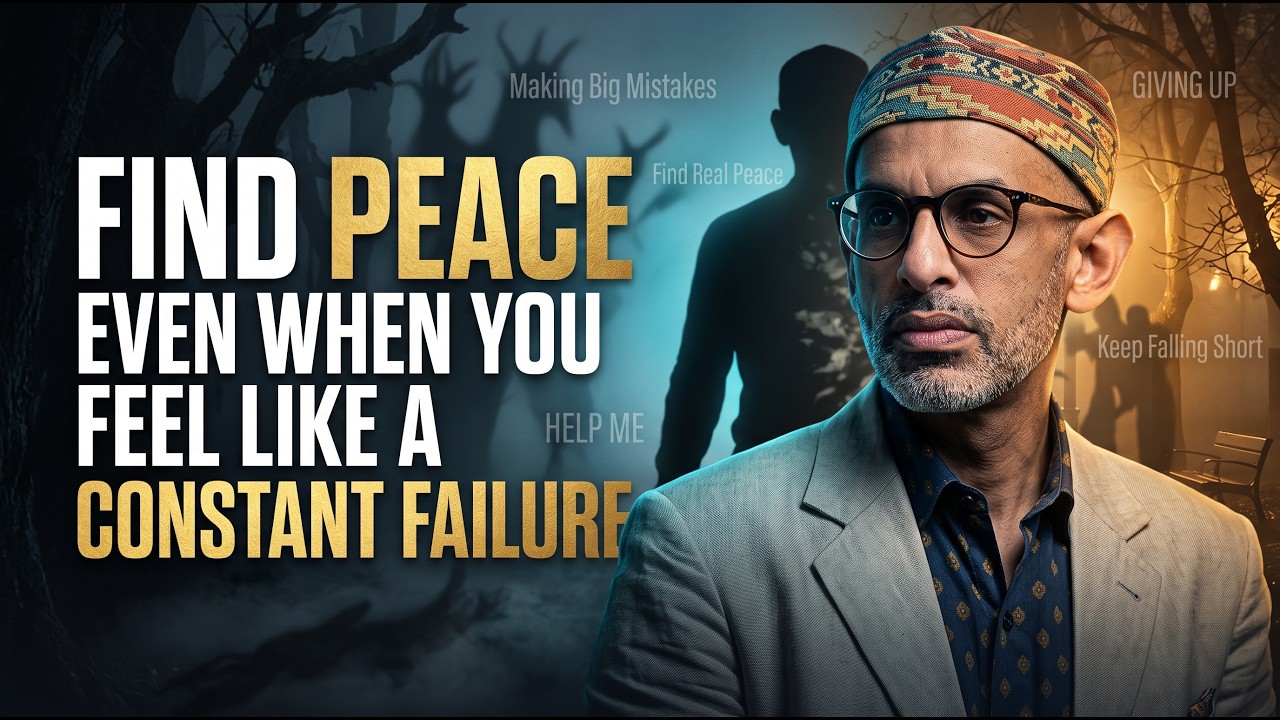
Why You Can't Find Peace After Making Big Mistakes - Ustadh Pervez Ahmed
Watch on YouTubeVideo summary
The speaker begins by reflecting on a specific verse from Surah Al-Isra in the Quran, where Allah commands the Prophet Muhammad to convey that if the earth were populated solely by angels, He would have sent an angel as a messenger. This implicit comparison highlights a fundamental truth about humanity: unlike angels, who are created with an innate nature of obedience and do not require guidance, humans are fallible beings sent prophets who are also human. The core argument presented is that Allah recognizes our humanity and does not expect us to be perfect or infallible. A significant part of the human condition involves limitations, weaknesses, and the capacity for error, which distinguishes us from the divine nature of angels. Therefore, holding ourselves up to impossible standards of perfection ignores the reality of how we were created.
Despite these inherent flaws, the Quran describes humans as being created in the best of modes with tremendous potentiality. This dual nature means that while humans possess great capabilities and are blessed by Allah, they also have the potential to degrade themselves. At the very core of every human being lies a pure inclination known as *fitrah*, which is an innate desire to worship Allah and live righteously. However, this natural state can be corrupted by environmental circumstances, societal pressures, and internal struggles such as self-doubt or the whispers of Satan that tell individuals they are unworthy. The objective of Islam and the teachings of the Prophet is to provide the tools and resources necessary to preserve this *fitrah* against these corrosive forces, allowing individuals to live up to their God-given potential rather than succumbing to their limitations.
The speaker emphasizes that communities and families must serve as nurturing ecosystems designed to protect and cultivate this human potential. Instead of being spaces where people merely survive, communal environments should be built to uplift individuals, foster brotherhood, and provide meaningful engagement for those struggling with trials and tribulations. This involves creating welcoming atmospheres where people can seek counsel, find support, and overcome their difficulties without fear of judgment. By treating children, elders, and neighbors with dignity and respect, society can prevent the corruption of the *fitrah* and ensure that every member has the opportunity to thrive. The goal is to institutionalize programs and interactions that help individuals navigate their imperfections and achieve greatness within the bounds of their humanity.
Ultimately, accepting human frailty is not a sign of defeat but a necessary step toward genuine peace and spiritual growth. When we acknowledge that we are not destined to be angels and that perfection is beyond our reach, we can approach life with empathy and humility. This acceptance allows us to utilize the guidance provided by Allah and the example of the Prophet to overcome our limitations rather than being paralyzed by them. By building communities that understand and support these human realities, we create an environment where people can heal from mistakes, find peace after errors, and collectively strive to preserve their innate nature as servants of Allah. The conclusion is that true success lies in embracing our imperfections while actively working within the framework provided by faith to nurture our potential and uplift one another.
Read the full video transcript
I want to reflect on a verse in the
Quran today uh in particular to anchor
what I hope to discuss for the today
wherein Allah subhanana wa ta'ala
tells us or commands the prophet
sallallahu alaihi wasallam to tell us
or to convey
say oh Messenger of Allah say oh prophet
Muhammad
Allah subhana wa tala this is surah is
the 17th chapter of the Quran
and Allah subhana wa ta'ala is telling
the prophet to convey that had the earth
been populated
with angels
Then assuredly indeed Allah would send
an angel as a messenger as a rasool.
So what is equally interesting is what
the verse says as what it does not say
or what it implies
inextricably
or implicitly. Excuse me.
Allah subhana wa ta'ala says that had
the ang had the earth been populated
with angels
living in peace and tranquility
that assuredly indeed with certitude
that Allah would send an angel as a
messenger. Now we know that the a the
earth is not populated
exclusively by angels.
And this is why I said what I said
earlier which is that it is also
interesting to reflect on what the verse
is saying implicitly.
Because what the verse is telling us
implicitly is the nature of the
relationship between
a prophet or prophets and humanity.
Because we as human beings
have been sent prophets
that are also human, that are not
angels.
Right?
If the earth had been populated by
angels, then Allah would have sent a
kind similar to them to guide them. Not
that angels are in need of guidance
because they are created with only the
ability to worship Allah subhana wa
ta'ala and be in obedience.
So an angels or a world populated by
angels would not need a prophet to
reform them or to teach them because
that is their divine that is their
nature. by which Allah has created them
to be obedient
cannot disobey. And so that is why what
is implied is also of importance here or
is of importance
which is that Allah subhanahu wa ta'ala
sends us messengers and prophets that
are human beings because we are human.
And what is also implied here in this
verse
is that Allah subhanahu wa ta'ala
recognizes God our creator recognizes
our humanity
that we are only human
and we are not destined or we will not
be measured
to being angels,
perfect creatures because a part of the
human experience and a part of the human
condition
is that we are infallible. We are sorry,
excuse me, fallible. We are creatures
who will error, who will make mistakes,
who have limitations.
our humanity.
Part and parcel of being human is the
fact that we will have frailties and
weaknesses and limitations and
deficiencies
but also we have tremendous
capabilities.
And this is why in the Quran we find if
we explore how the Quran defines human
beings we find a range of qualities
a plethora of qualities and a range is
more specific
because on the one hand we find verses
of the Quran that describe human beings
right as being created
as being created
We have created human beings in the best
of modes, in the best of fashion. Our
composition, our constitution is that we
are created with this tremendous
potentiality.
But they are also capable of debasing
themselves to the lowest of the low.
Right? This is a range. It is a
potentiality.
Right?
Allah says elsewhere in the Quran that
indeed we have created, we have blessed
the progeny of Adamu.
We have blessed them in their creation,
in their constitution, in their
potential, in their capabilities.
that is also part of the human condition
and the human experience.
And I say all of this because it may
seem sort of obvious, but I think
although on the one hand it seems
obvious to us, but we often hold
ourselves up to standards that bely the
fact that we are human beings, that we
are deficient creatures, that we have
limitations,
and that we are not going to be perfect.
We are not going to be infallible.
That is also a part of accepting our
humanity. How Allah has created us. How
Allah subhanana wa ta'ala has created
us. And this goes to the nature
of or this goes to the the the the
foundation of our nature by which Allah
has created us. And what do I mean by
that?
a concept or a term that is discussed in
the Quran extensively as well which is
and also echoed in the teachings of the
prophet sallallahu alaihi wasallam right
Allah subhanahu wa ta'ala says
that indeed Allah has created us with
this
with this nature this primordial nature
to use fancy word but Allah has created
us in fra
in this state that is pure
that is inclined
to being pure and being perfect
that is the nature at the very core of
how Allah subhanana wa ta'ala has also
created us and this is why and this kind
of explains to us why the Quran uses
that range of terms on the one hand
right we are creat creative,
but we are also described as and weak
and neglectful and given to error and
given to straying away from the path of
Allah. It's that entire potentiality.
But at our very core, right, as the
prophet even tells us
that indeed every child is born in this
state of this God-given pure inclination
to
worshiping Allah subhana wa tala to be
in servitude to Allah to being that
potential,
right, to living up to being created
in the best of modes and the best of
fashions.
That is how we are intrinsically
created. How Allah subhana wa ta'ala has
created us. Now often times people
understand fra to mean that we are
Muslim by birth and of course
linguistically that is a possibility of
an interpretation that we are created
with this inclination to submit to
Allah. Right? But the hadith continues
and it says that it is the parent of the
child then right although the child is
created in this fra of Allah in this fra
that Allah has created us with that it
is the parents or broadly speaking
environmental
societal circumstances that make that
child a Jew or a Christian or a magi of
you know Zorasht
modern day terms but that. So it is
environmental circumstances that can
corrupt the human nature that Allah has
created us with.
And so the objective
all of Islam,
all of our teachings that the prophet
taught us, what Islam gives us is to
preserve and to keep intact that fra
that Allah has created us with. So
you've created this creature that has
the potentiality to do great things,
to live up to its potential.
Right? And so Islam then gives us the
wherewithal, the resources, the tools if
you will, by which you can
preserve and keep intact that fyra,
right? And it is sins and disobedience
and environmental and societal
circumstances that can corrupt the human
nature that can uh be a corrosive force
to that fra that Allah subhanahu wa
ta'ala has created us with.
And so and in the in the language of the
Quran
when we examine or when we talk about or
we look at those environmental or
societal circumstances
that corrupt the human soul that corrupt
that human fraed
us with
those in the Quranic language in the
language of the Quran are the fittan or
the fitnas the trials and tribulations
of the world.
And so if the objective of Islam
and the objective of our societies and
communities is to sustain and to nurture
that fyra,
then it is also in the nature or in the
service of that preservation
that we should prevent
those trials and tribulations or give
human beings the tools and resources
needed to overcome those trials. trials
and tribulations that at its very core
at their very core they corrode that
human fraed us with.
So and these fa these trials and
tribulations come in various forms. They
are external
and at times they are internal
because as we are also while we are
created in this potentiality we also
have those limitations and defects that
tell us we're not good enough that
whatever we're doing like these are the
tricks of shaitan as well. This is the
tricks that the devil plays on us
telling us that we're not worthy of
Allah's mercy that we're not worthy of
Allah's forgiveness that we are not
worthy of doing good.
These are the tricks of shaitan as well.
These are those corrosive forces that
seek to destroy and seek to corrode the
fra that Allah subhanana wa ta'ala has
created us with created us with. So we
have been created with this fyra and it
is our duty to try our best to preserve
that fyra and by the ful and the mercy
of Allah subhana wa ta'ala Allah God
almighty gives us like I said the
resources and the tools that we need to
try and preserve our fra and to achieve
that potential that potentiality that we
are created with. So our mode, our
modalities of worship, the way we
worship Allah, the way we reflect on
Allah subhanahu wa ta'ala and remember
him, remember God,
worship God. These are all methods by
which we can preserve and keep intact
that human nature, that human fyra that
Allah subhana wa ta'ala has created us
with. So it's an entire ecosystem
that Allah has given us by which he
creates us with this potentiality and
the capabilities that we have but also
our human weaknesses and frailties and
weaknesses and limitations
but then gives us the tools that we need
gives us a playbook by which we can
achieve and preserve and keep intact
that God-given nature. and fra that
Allah subhana wa ta'ala has given us.
And so it not only is an obligation that
Allah subhana wa ta'ala places upon us
as human beings
but also as individuals but also as a on
a societal and communal level that our
communities are meant to be spaces
where these where this potentiality of
the human being can be achieved.
Do we institutionalize in our
communities
programs, content, meaningful
engagement, a sense of community and
brotherhood and sisterhood that allows
that God-given nature to be nurtured,
not to be limited, not to be corrupted,
but rather to be nurtured and preserved.
Right? That is the very purpose of our
communal spaces. That is why we get
together as community to to uplift
ourselves individually and collectively.
So that goes to how we treat one another
in our communal spaces. That goes to how
we interact with one another in our in
our communal spaces.
Are we creating communities that are
welcoming,
that are uplifting,
that are nurturing,
that allow human beings to live their
best and potential lives?
That is what we have to examine and that
is what we have to consider when we look
at and reflect on our own communal
spaces, our own communities that we
create. are these spaces in which people
and human beings can thrive,
not just survive, not just live, but
really uh uh uplift themselves and
create opportunities for that to happen.
And this at its very core goes to how we
engage with one another, how we treat
one another, how we treat one another,
not only in our communal spaces, but in
our families, in our domestic life.
Do we treat our children with the
respect and the dignity that they need
to live lives of potential and
greatness? Right? How do we treat our
elders? Right? We if we define human
beings by their worth and what they give
back to society
in material terms alone,
then we have limited ourselves. We have
deprived ourselves of the wisdom and the
lessons that we can derive and learn
from our elders in our community.
And so each and every one of us has been
given that potentiality. But Allah
subhana wa ta'ala has also given us the
potential by which we can create
societal and communal spaces that allow
that human being to thrive that allow
that potential to be achieved that allow
that god-given fyra to be preserved and
to be kept intact
and to limit those coro those corrosive
forces those fa those trials and
tribulations that people are struggling
ling with.
And before I leave, I want to leave us
with this idea or those I when we talk
about communal spaces and we talk about
families
that we have to also recognize
that people may be suffering and may
have trials and tribulations that
they're that they are suffering through
and going through, but they don't have
the support system that they need. They
don't have the abilities, they don't
have the the options to talk to people,
to benefit from other human beings and
the struggles that they've gone through.
And this is why having a sense of
community is so important and a sense of
domestic life that nurtures and creates
possibilities where our children uh and
people who are suffering and struggling
can come to these communal spaces and
derive benefit.
and
have the or are given the ability to
overcome the limitations and overcome
the struggles that they have. This is
again a part of that project of
nurturing and preserving the god-given
nature of the thera that Allah subhana
wa ta'ala has given us to create those
spaces and those opportunities and those
occasions by which people who may be
struggling who may be suffering who may
be undergoing trials and tribulations
that we don't even know about can create
can can come and can can seek help can
can can seek counsel, can seek
opportunities and content and meaningful
engagement that allows them to overcome
those limitations.
Right? This goes to mental health and
this goes to creating again those
communal programming and content and
meaningful engagement on a collective
level that allows those who may be
struggling to seek help and seek counsel
and get the help that they need. These
are all part of creating that societal
space and communal space that enriches
the human being that gives the human
being the ability to achieve the
greatness that Allah subhana wa tala the
potential by which Allah subhanana wa
ta'ala has created all of us with and so
to understand our limitations to
understand the fact that we are only
human to accept the fact that we are
going to not be perfect that we are
imperfect beings. If we approach life,
if we approach the way we measure
ourselves, if we approach the way we
gauge how communities uh uh provide
meaningful engagement to to individuals
with this lens,
then we will achieve famili domestic
spaces and communal spaces and and
measure ourselves even individually
with that empathy and with the ability
to understand that we are that
potentiality that we have those human
imperfections that we are not created to
be to being angels. We're not capable of
perfection. We're not capable of uh
being perfect because we are only human.
And accepting those human frailties and
weaknesses and limitations is the way in
which Allah subhana wa ta'ala has
nurtured us in the Quran and with the
message and the teachings of the prophet
sallallahu alaihi wasallam to allow us
to not only understand that but giving
us the tools and the resources that we
need to preserve and keep intact that
also god-given nature to being true and
worshippers of Allah subhana wa ta'ala
and at least have the ability to achieve
our potential
to achieve the range with which Allah
subhanahu wa ta'ala has created us with.
I pray that Allah subhana wa ta'ala
gives us the ti and the ability to
understand that understand our
limitations but also to overcome those
limitations with the with what Allah
subhana wa ta'ala has given us by way of
guidance by way of the prophetic model
and by which and and also by creating
communities that uplift the human being
and uplift ourselves individually and
collectively.
Alhamdulillah.