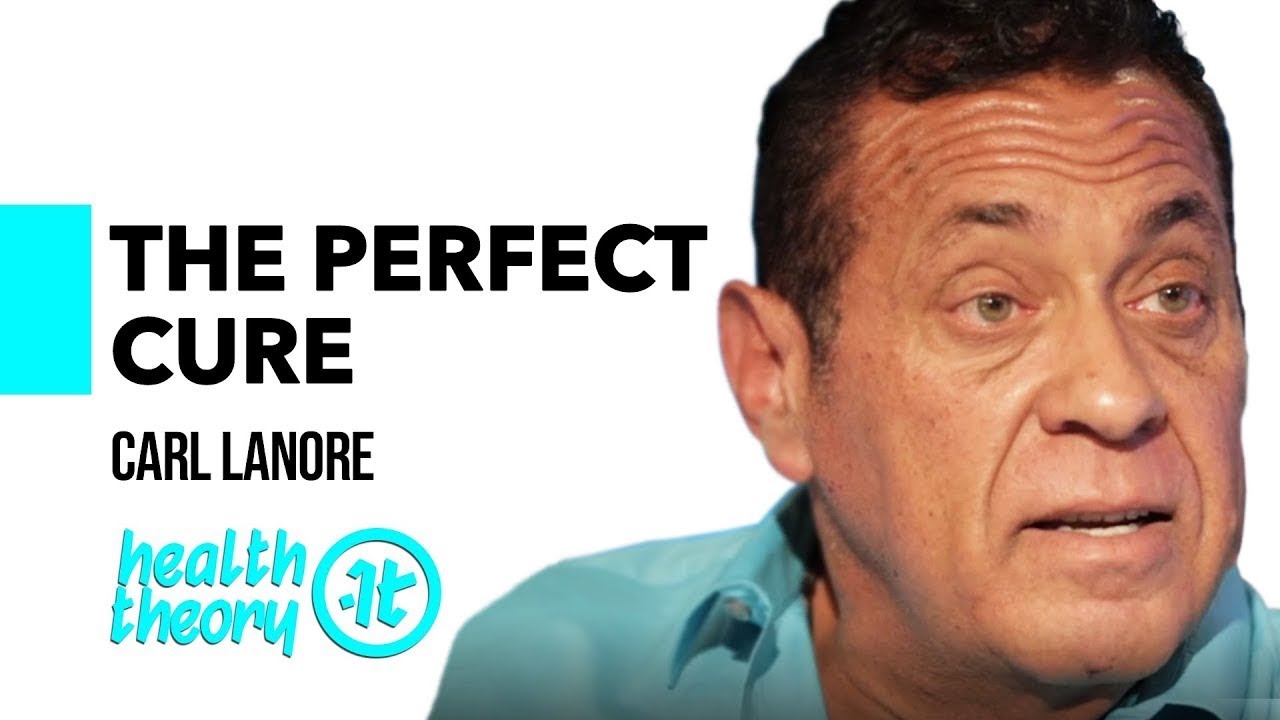
Video summary
In this episode of Health Theory, host Carl Lenore shares his personal journey from a 39-year-old sedentary individual weighing 330 pounds and suffering from heart arrhythmia to becoming an advocate for self-directed health research. His transformation began after reading Deepak Chopra's *Ageless Beauty*, which highlighted that cells turn over every six weeks to six months, prompting him to investigate how lifestyle changes could promote healthy cell regeneration. Lenore discovered through PubMed research that weightlifting induces significant cardiac tissue remodeling and decided to "remodel" his own heart by lifting weights and changing his diet. This approach allowed him to lose 100 pounds and eventually wean himself off medications for his condition, leading him to distrust the medical establishment after witnessing his father die from polypharmacy-induced organ failure. He emphasizes that Baby Boomers often possess a skepticism toward authoritative opinions, which fueled his determination to seek truth rather than blindly follow advice or accept aging as inevitable. Lenore outlines a rigorous process for evaluating health information rooted in critical thinking and evolutionary biology. His primary filter is evolution: he asks whether current medical trends make sense given the 1.8 million years of selection pressure that shaped human physiology, noting that many modern practices contradict our ancestral needs. For instance, while ketosis was an adaptive response to famine, maintaining high levels of ketones chronically signals starvation to the body, potentially causing metabolic shutdown and imprinting obesity genes on offspring if a mother is in such a state during pregnancy. He also stresses the importance of avoiding research agendas; one must be willing to accept contradictory evidence rather than cherry-picking studies that confirm pre-existing beliefs. Furthermore, he argues against relying solely on probiotics or fecal transplants for gut health without first addressing underlying issues like Small Intestinal Bacterial Overgrowth (SIBO), which affects an estimated 76% of the U.S. population due to starches fermenting in the small intestine rather than the large one. The core of Lenore's health philosophy revolves around his "Three Ss": Sun, Sex, and Sleep, which he considers evolutionary edicts essential for longevity and disease prevention. Regarding sun exposure, he advocates getting direct sunlight daily or using Melanotan 2 supplements to mimic its effects when natural light is unavailable, citing the melanocortin system's role in regulating libido and overall health beyond just Vitamin D production. For sleep hygiene, he recommends a strict three-hour fasting window before bed to allow for autophagy—the cellular process of cleaning out metabolic debris—and preventing heart strain from digestion during rest. He also suggests using blue-blocking glasses after 7:00 p.m., avoiding late meals, and taking glycine supplements if nighttime hypoglycemia causes early waking. Additionally, he strongly promotes nasal breathing over mouth breathing to ensure adequate nitric oxide intake and deep sleep, often advising listeners to tape their mouths shut at night unless there are specific anatomical contraindications like a deviated septum or severe obstruction risk. Lenore concludes by emphasizing that individuality dictates what works for each person, urging audiences not to blindly follow trends but to experiment with diet based on indigenous food availability and seasonal cycles while monitoring how their bodies respond. He warns against the pharmaceutical industry's push for immediate symptom relief, noting that patience is often required; if a dietary change worsens symptoms initially, it may indicate one is moving in the wrong direction or has an underlying issue like SIBO requiring specific interventions such as grapefruit seed extract or apple cider vinegar to restore stomach acidity. Ultimately, he believes that addressing diet and sleep constitutes 90% of optimal health maintenance, with sex serving as a crucial evolutionary driver for reproductive fitness and vitality. By facing mortality directly—much like recognizing the inevitability of death after his father's passing—one can prioritize what truly matters in life, shifting focus from minutiae to meaningful experiences and fostering vulnerability rather than fear-based living.
Read the full video transcript
In today's episode of Health Theory with
Carl Lenore, we discuss why you
shouldn't listen to health experts, how
to actually do research for yourself,
the importance of looking at evolution,
and why sun, sex, and sleep are the most
important things for your health.
Everybody, welcome to Health Theory.
Today's guest is Carl Lenore. He's a
radio host and podcaster with millions
of listeners and a burning desire to
educate the world on the realities of
today's food system. He's a
self-proclaimed physical culturalist and
crusader, and he's hell-bent to use his
own innate curiosities to uncover what's
really going on at the cutting edge of
the health sciences. And Carl, the part
of your story that I love the most is
that this all started for you with a bit
of pain and probably a significant
dollop of fear. Uh walk us through what
sent you down this path.
Uh when I was 39 years old, I was
diagnosed with a kind of unusual
arrhythmia where the left side and right
side of my heart was beating out of
sync.
And I was 330 lb
and I was the average American. And I
was eating and eating and eating and I
wasn't active.
Uh I was running a business that didn't
require me to be active. I sat at a desk
all day long and I just turned into this
sick human being.
Uh my ex-wife bought me the book by
Deepak Chopra, Ageless Beauty, Timeless
Mind.
And I couldn't tell you anything I read
in that book except one passage. And
that was that every cell in your body
turns over anywhere from 6 weeks to 6
months. Mhm. You know, bone slower,
tissue faster.
And I thought, if this is true, how do I
best put myself in a position for those
new cells to be healthy as opposed to
the sick ones that are in my heart? And
I started to read PubMed. I found PubMed
like a lot of people. I thought, you
know what? I'm going to read the
research. And what I discovered was that
uh weightlifters had the greatest
remodeling effect of cardiac tissue.
And I thought, remodeling, that's what I
need. You know, you remodel a house when
it's all beat up, so I'm going to
remodel my heart. And so, I started
weightlifting uh specifically,
and I changed my diet. And as I lost
weight, I got better. I ended up not
needing the medications. Uh I was on
them for a short time, and then my
doctor agreed to wean them off uh me off
of them.
And
I discovered that, wow, like
you
you don't have to get sick. And if you
get sick, you can actually do things to
fix yourself. This was a novel idea. I
thought, you know, only doctors could do
that for you in hospitals and stuff like
that. Have you read the book Change Your
Diet?
No, I haven't.
So, the punchline of the book Change
Your Diet is that when given the choice,
"Hey, you have a heart condition, and if
you don't change, you're going to die."
It's some absurd percent. I don't
remember the exact percent, but call it
north of 80. It might be north of 90. Um
even if all they have to do is take one
pill a day, they fail to comply.
And I thought, how is that possible? So,
what is it about you that makes you so
capable to hear that message? Cuz not
only did you say, "I'm going to change,"
and then put in the work and lose 100
lb, you had the more fascinating journey
of immediately having distrust for the
medical establishment, and even having
to do that work on your own. So, you you
first had to figure out what to do, and
then actually do it. So, what is it in
your upbringing, or just the way that
you think, that made that possible for
you? And I I got to tell you, I think
part of it is my generation.
I think we baby boomers, we were part of
the the the dropout,
you know, generation. We didn't trust
the man.
We didn't trust organized uh groups that
seem to try to apply
authoritative opinions over on us. My
father died of polypharmacy. He died
from taking all the medications. They
destroyed his liver and his kidneys and
he died.
Me, when my doctor told me something, I
thought, "Mhm,
I don't know if that's true. I think I
want to go find out." So, just that
nuance that I didn't take what the
authority said to me as gospel and
followed it is is is probably a hallmark
of baby boomers.
I also felt
like I was very depressed. I wouldn't
want it I wasn't ready to die. I wasn't
willing to accept go quietly. Oh, this
is part of aging. I was like, "No, it's
not part of my aging. This isn't how I
end my story."
And so, I think that those two things
combined gave me the courage
to seek other information. But, then I
had to sort through the information and
pick what was good and what wasn't. How
sort of early in the internet was this?
Yeah, internet was really brand new. I
mean, really really brand new. So, like
'98. Wow. So, then you have a an
unnatural ability to do research. Walk
us through what What's your process?
Like, how did you find PubMed? Now, it'd
be easy. You go and you just drop in the
search box, but back then it wasn't that
simple.
Back then, they weren't really like
websites, right? There was a message
board for doctors.
And I lied and said I was a doctor.
And then once I got in there, that's
when I was able to start digging around
and asking people for research and stuff
and getting it sent to me, actually
emailed to me. And that started it. And
then slowly but surely, the internet
became a lot easier to manage and uh and
doing research on your own became more
possible because there were more people
actually putting their databases out
there. So, whenever you encounter a new
idea, I'll go start with YouTube videos
and I'll just drop in the search term,
see what comes up. I try to learn the
lexicon, then I find the experts and
then I read in swarms, meaning I read a
bunch of books from different people on
one topic. What does your process look
like? When it's something brand new,
you've just like heard something, oh,
that's interesting.
Okay, so the way I do things now after
13 years of interviewing some of the
most brilliant people in in in
individual spaces
is I apply critical thinking first.
And the first element of my critical
thinking
is evolution.
So interesting.
I can tell you look you call this show
health theory. That's brilliant and
here's why.
Because everything going forward is a
guess. Right.
But everything behind us isn't a guess.
So we don't pay attention to 1.8 million
years of the selection pressure that
molded us into what we are today, but we
put all of our faith in science du jour.
So the first thing I do is I look at
things and say
why would evolution have endowed us with
that? We have one job and that is to
keep proliferation of the species.
That's it. We talk about reproductive
fitness. Reproductive fitness holds you
together and well until you pass the
reproductive ages and you fall apart
because you should have done your job by
then.
Uh so I apply
uh evolutionary edicts to everything
that I look at and I go does this hold
true? Would evolution have endowed us
with this?
And if I can't answer that question
without saying, yeah, I can see why this
would be a value to us, then I
immediately discount.
Like like for instance, right now we
have a keto craze going on.
Um from an evolutionary perspective
uh ketosis would have served us only
during starvation.
So, when people tell me, "Oh, the way to
eat all the time is keto." I go,
"Absolutely not."
1.8 million years have proven that, but
if you don't believe it, look at Look at
the research being done right now on
hunter-gatherer civilizations that are
still intact. Now, when I talk about
ketosis, I'm not talking about half a
millimole, cuz most of us wake up in the
morning with half a millimole of
ketones. I'm talking about this
absurdity of shooting for two and three
millimoles of ketones, unless you're
battling brain cancer, right?
This is actually not a good idea,
because it actually shifts mRNA and DNA
to think that you're in a starvation
state. If you're eating 90% fat all the
time, your body thinks, "Wow, this
person sucks at finding food. So, we
need to put this body in like in in in
DEFCON 4 mode, because this idiot's
going to die. So, we'll shut down the
thyroid, like do all these things to
preserve until we can get out of this
jam we're in." And And proof of that is
if
if if two people are into keto,
husband and wife,
and they're both into They're posting
their keto pictures. "Oh, I'm 1.2
millimoles, and my wife is 2.6." And
they And she gets pregnant, that baby
will be imprinted with obesity genes.
Because that baby is being formed under
the guise, from an evolutionary
perspective, that mom and dad suck at
finding food. So, we have to make this
baby so efficient that it turns
everything into fat.
And this has been proven. When I look at
these things, I look at them from
evolution. I say, "Okay, where would
ketosis have really come Okay, famine.
It would have got us through the famine.
Would it because we're metabolically
flexible?" I look at everything that way
first. Why is this important? Why would
we be endowed with it? Where did it come
from? And then I do my research from
there.
That's really, really interesting. I
think that's super smart. All right, so
you start with that evolutionary lens. I
think that's insanely powerful as a
backstop of does this make sense? Then
what do you do? The next thing is that
you cannot have an agenda when you're
reading research. Many people,
whether they realize it or not, are
coming
to find something to support their
opinion.
And you can't have an agenda. You have
to accept the good with the bad. Because
if you're truly in search of the truth,
an agenda could skew
the way you look at things. So, I would
say the most powerful
thing that you could have when you're
doing research of this type
is not to come with an agenda. Or if you
do have an agenda,
acknowledge it
so that you can then discount it when
you feel giddy about finding this study.
All right,
like let me see if I can find the study
that contradicts this.
And be open to the fact that you want
the truth. You don't want to be right.
That's really good.
That's really good. Yeah, I totally
agree with that. So, once you have that
and you've got your sort of bias in
checks in place, you've got your
critical thinking, how do you know what
experts to listen to and which to
ignore? And I ask that in the context of
in this arena, even on this show, you'll
get people that are like, "Keto's
amazing. Live there forever." And then
keto is like only for famine, cycle in,
cycle out. So, people get lost. So, what
I love is that you're somebody who forms
their own opinion and tells people to do
the same. Now I'm saying, how do people
like how do they know whether to listen
to you or somebody else or somebody
else?
I say don't listen to me or somebody
else.
I say that you have to make the decision
for you. We're all very unique um
because of our individual evolutionary
journeys. And so where somebody can eat
a food that they thrive on, maybe I
can't. Information is overwhelming
today.
And people don't know what to do and
they actually become numb after a while.
Like, I can't eat this, I can't eat
that. Like, what the hell can I do? Mhm.
I say to people, look, go back a few
hundred years. Where did your people
come from? What foods were indigenously
available and and during what seasons?
And start there to build your foundation
of what you do well with.
Um
but I think that the reality is that you
can't just take anything anyone says
and hitch your wagon to it. You've got
to You've got to let it ruminate in your
head and you got to think about it and
you got to keep challenging it because
there's so much information out there
today and so much of it is wrong. It's
scary. I mean, I fall prey to this when
I'm reading studies.
And I think to myself,
this just doesn't sound right. Like, I I
need to dig deeper and then I find out,
oh, I can see why they have this
opinion.
People are protecting their own little
fiefdoms
uh by you know, sticking to their to
their guns when they really should
change their opinion and move forward.
You talked about individuality which is
something that I'm really obsessed with.
So, any long-time listener of this show
knows. So, Lisa had has um
digestive issues. It used to be
catastrophic. I think she's getting it
way in line now, but we've really had to
ask not work what works for other
people, but what works for Lisa. It has
to be an an equals one experiment. What
works for somebody doesn't necessarily
work for you.
And the only way to know if it's working
for you is are you getting better? The
problem is it takes a long time to get
better because by the time you've got
symptoms, you could be 2 years down that
rabbit hole.
And And this is where the pharmaceutical
industry thrives cuz we want we want to
feel better now. We want it now. Like I
give me something, doc. I don't like the
way I feel. Well,
you may need to be patient and do one
thing for two or three weeks and see if
that's working. And quite
frankly, if it gets worse, feel good
because you're on the right path. You're
just going the wrong way. That's I like
that. So So if you get something that
makes you sicker, go, "Oh, man."
Like
if I eat a lot of fiber,
I wake up in the morning with brain fog.
Really?
Yeah, because because
fiber is supposed to be fermented in the
large intestine, Mhm. right? Yeah.
If the fiber is is being fermented in
the small intestine, then you're getting
bloated after a meal because it's
fermenting here and not down there.
You're not farting it out. You're
burping it back up.
Right. That's the first sign that you
got microbes and and stuff inside your
small intestine. When you start to to
see these foods making you feel that
way,
it's time for you to say,
"Stop." My mother used to say, "If
you're lost, don't run."
Cuz you could be running the wrong
direction. It's good advice. So when you
feel like, "I don't understand but why
when I eat pizza, I just get so
bloated." Okay, first thing, don't eat
pizza. Now, what else makes you bloated?
Get those things out of your diet. If
you're one of these people as a
distended stomach, you belch all the
time, you wake up you haven't eaten in
in 12 hours, you're burping in the
morning.
Mhm. You have small intestinal bacterial
overgrowth. In fact, I predict that 76%
of the population has SIBO today. That
is very specific. Yeah. Why 76?
Because 76% of the people in the United
States claim that they have a gut
problem. Mhm.
They're bloated, they're gassy, certain
foods don't agree with them. Most of the
time it's starches and sugars and and
digestion resistance starches that don't
agree with them because they're being
metabolized in the small intestine where
they shouldn't be.
Now I want to go back
really thinking about that number.
That's terrifying that 76%
report having gut issues.
That's pure insanity. So, okay, the
solution there is You may need a very
specific antibiotic, but it's it's
always it's always going to be diet.
Mhm. It's always going to be All right,
well then what cuz I'm so terrified of
antibiotics? I will tell you because I
think that's almost certainly what
caused Lisa's problem.
Um
so walk me through non-antibiotic
things to try.
From a supplement standpoint, grape
fruit seed extract.
Um there's a
a free fatty acid
and I'm going to get the name wrong, but
it starts with a U. It's like it's you
like you cyclic acid.
They they
permeate the microbes'
cell wall and make it burst. The other
thing is like coconut oil. I know
everybody's like, "Oh, coconut." I'm not
saying
pound it down, but on an empty stomach
first thing in the morning, a
teaspoonful of coconut oil because
coconut oil helps to destroy those
microbes.
The reason the small intestine becomes
inhabited in the first place is because
the acid level in your stomach
is becoming too neutral. You need to
drop the pH and make it more acidic
because if the acidity in the small
intestine was appropriate, they would
never live there. They have they would
only live when they got to the large
intestine. So, clearly you have an issue
with your small intestine and the
acidity level. So, by you know, a lot of
people say
"I got better when I started taking
apple cider vinegar three times." Yeah,
because that apple cider of is washing
down into the small intestine and it's
killing that bacteria that shouldn't be
there in the first place.
Interesting.
So, those kind of things work very well.
Diet works really well. Starve them.
Starve them. If they If they want
starches, don't eat starches. Now, I'm
not saying be keto. Eat vegetables. Be
sensible. Eat broccoli. Eat spinach. You
know,
don't eat 90% fat and say, "Oh, it's
working." Yeah, it'll work, but you have
you're going to have other problems. But
But just stay away from the the pasta
and the pizza
and the bread and the white potatoes and
really even yams. Just stay away from
starches for a while. A good 6 months
and you'll find out your stomach is less
distended. If you look at the number of
people today that stomachs pop out
underneath their chest and tuck back in
at their pelvis, you you think these
have What is it? It's gas.
It's the small intestine has become a
fermenting factory and you're loaded
with gas.
And when you have gas constantly, it's
pushing up against the esophageal
sphincter and finally it breaches it and
it blows some
stomach acid up. Some stomach acid up.
Some stomach acid up. And these people
inevitably are always belching and
burping and they're always bloated and
they got distended stomachs.
If we can get that under control, they
get better. And And let's remember
something.
This is the immune system.
This? What do you mean this?
The gut. Right. It is the immune system.
I mean, we now know that that
Parkinson's disease starts in the
stomach. We now know that that
intraocular pressure glaucoma starts in
the stomach. It's an autoimmune disease.
Everybody's got autoimmune diseases
today. We can all agree that
inflammation is the root of all disease
today, right? We've been saying that for
what? A decade now?
Well, inflammation
is what the immune system does.
That's how it mounts an attack on
something. That's how if there's a
foreign something in your body, it sends
out macrophages. it sends out
inflammatory responses to go and and to
to destroy that and kill it. If you work
out, that's your immune system making
you recover. You have inflammation and
it goes in and resolves the
inflammation. That's all That's all
coming from here.
When when when your gut is bad, your
body is bad and you you are more prone
to developing a widespread group of
diseases.
So, what do you know about fecal
transplant? My mother had one when she
was in nursing
Really? Oh my god, tell me more.
I I asked for it. So, my mother got a
real bad case of C. diff. Woah.
And she had really bad diarrhea and she
was like they were saying like we can't
keep her hydrated, she's going to die.
And
uh my niece Kelly, cuz it's best if it's
from a family member,
went and donated a little poop
and they they inserted it in my mom and
she lived. She got better. That's
insane. So, now I need to know how much
she got better. Like what are we talking
here? Like slight improvement enough for
80s and she was like on death's door and
she didn't die for another 4 or 5 years,
I think it was.
Wow, that's uh that's really incredible.
What I find really distressing about gut
issues is how hard it is to rebalance.
Yeah. And so, I was you know, to your
point about just sort of process through
it a critical thinking level, I was
thinking through, okay, why would that
be? So, it's really hard to just take a
probiotic and hope that it you know,
rebalances. And I'm guessing this is how
somebody tried a fecal transplant the
first time, obliterate through
antibiotics so that you're starting from
scratch and then repopulate. Cuz I was I
literally had the thought, could I be re
like vaginally swabbed? Like if you're
So, a child is born with no immune
system, it gets it through the vaginal
birth and that they swallow it and it
gets crazy and then I thought, but that
you can't do that as an adult. So, why?
And then that led me down that Have you
ever No, and I I've had exactly that
same train of thought. You know, I've
asked scientists that I've interviewed,
like I kill my lawn and reseed, why
can't I do that with my gut?
And they all agree, you can, but the
problem is
that the vast number of microbes you've
picked up in your life can't be replaced
by
something in a capsule. Our gut is kind
of like the universe. Like we know where
the planets are, right? But we really
don't know everything about the universe
there is to know.
Every day they're discovering new
microbes that inhabit our gut and the
things that they
impart upon us. So
you'd have you'd have a a very
monolithic microbiome if you had to use
what we have available to us. But you're
absolutely right.
The reality is that
you if you if you kind of take a
scorched earth approach and kill
everything, you could reseed then.
But
you'd have to have everything right in
the reseeding and we just don't know
enough about it yet. It also sounds like
a pretty dangerous process to do the
obliteration first.
All right, on a totally different topic,
talk to me about your routines. I know
that you use a lot of supplementation.
You're very vocal about the things that
you've used or tried. What are some
things that are just an absolute
standard part of your day? I have the
three S's. The most important
evolutionary edicts that if you practice
these regularly, you will live a long
healthy life and they're the three S's.
Sun
sex and sleep.
Okay? The sun will make you want to have
more sex. The sun will improve the
quality of your sleep if you'll get out
there getting sun all day long. If you
do those three things regularly, you
will live longer. You won't get prostate
cancer.
There's evidence that women who have sex
more often and their partner actually
ejaculates in them don't get fibroids.
They don't get uterine cancer. I mean,
guys who have more more um um
orgasms are protected against prostate
cancer.
When you when you do the things that
evolution put you here to do,
which is
be in the sun, have sex, and sleep well.
You you That That's 90% of the job right
there.
I use Melanotan 2 25 micrograms a day
because uh
the
What we attribute the sun to doing for
us is vitamin D.
Oh, vitamin D, vitamin D. So, they get
that because of epidemiological studies
show that people who live closer to the
equator don't get heart disease, they
don't get this, they don't get cancer,
they don't get it. So, we just say, "Oh,
it's it's the sun. It's vitamin D." But,
a lot of research has let us down. It's
like vitamin D doesn't play out when you
supplement it, it doesn't seem to confer
those same benefits. Well, the most
overlooked thing about your skin is
something called the melanocortin
system.
It produces
five different hormones.
And every cell in your body has a
melanocortin receptor on it. And the
melanocortin system is responsible for
libido. That's a big one cuz anything
that improves libido, you're getting
healthier. Right. Because that's that's
evolutionary edict number one, have lots
of sex and lots of children before you
die. And the really the rest of it is
diet and sleep.
It really is.
Uh I do everything I can to protect and
improve the quality of my sleep.
And uh I'm I'm almost militant about my
diet. But, I I come to the conclusion
that in order to be healthy today, you
almost have to be militant about it.
Because there's so many people pulling
on you, "Oh, come on. Come on, you can
have pizza. Come on, you can go out and
have a few drinks. Come on." And I
almost think that they want me to do it
not because they think I'm missing out,
but then it kind of makes them feel less
guilty for what they're doing. Yeah, of
course. You know, so.
All right, let's go deep into those, the
three S's. That's really strong. So, how
much sun are you getting?
Um, I lay in the sun as often as
possible. Sometimes just for 20 or 30
minutes. When we we talk about sun,
everybody thinks it's like it's got to
be like Tahiti weather. No, the sun
coming through the clouds confers a
benefit. And I always get out there and
take my shirt off. I just make sure that
I get that light on me.
Uh, and then of course I use Melanotan 2
to fill in for when the sun isn't there
for months at a time. Okay. So,
um, how do you protect your sleep?
Well, first of all, in order to manage
it, you have to measure it. Get some
sort of an app.
I use a product called Sleep Cycle. And
if you use it with like a Fitbit, you
can actually see how low your heart rate
I mean, my low my heart rate goes down
to 40 beats per minute in in deep sleep.
I mean, I when I the first time I saw
that, I was shocked. And so, once you
get one of these sleep apps and you see
how you're sleeping, then you can start
to do things uh that improve sleep. I'm
a big believer in any type of blue
blocking glasses late at night, usually
about 7:00 p.m.
Don't eat 3 hours before bedtime. That's
a big one.
Dr. Dale Bredesen, who just did some
groundbreaking studies here at UCLA and
which led to the book The End of
Alzheimer's.
Uh, he is uh responsible for
telling people who have Alzheimer's
disease to have 3-hour window between
their last meal and when they go to bed.
And that helped a lot resolving brain
inflammation. Yeah.
Yes.
know the mechanism behind that? Yeah,
autophagy. Explain for people what
autophagy is.
Okay, well, so so let me let me back up.
If your body is playing host
to digesting food,
Mhm.
the factory is open.
You're not sleeping well.
It's busy. It's doing things, right? If
the food is past the initial digestive
phases and moving into the small
intestine and soon the large intestine,
which is what happens within that 3-hour
window.
Right. Your body is now on coast. It's
not working as hard.
You could get into deep sleep. In fact,
if I have a meal
late at night for whatever reason, you
know, I'm being sociable, and I go to
sleep an hour and a half, I don't get
into the deep sleep that I normally do.
And you see that cuz you're tracking it.
In fact, my heart rate never goes down
into the 40s. It stays up high all night
long.
That's really interesting.
Well, this leads to heart attacks. You
know, older people who are not in good
shape, they have big meals, they go to
bed, they die in their sleep because
your heart needs that rest at night. It
needs to like slow the hell down.
And if you have food, the factory is
open. The heart is moving stuff around.
It can't slow down.
Um so,
the other thing is that uh the cellular
waste management system is autophagy.
And this is when organelles go around
the cells and clean up metabolic debris
and turn them into things that can be
you know, carried out of the body.
Autophagy shuts off when your body's
digesting food. Autophagy is ramped up
when you're fasting. Uh like they did a
study that showed that during fasting,
the autophagy in the brain starts to
clean up the plaque
that accumulates in some of these
neurological disorders, Parkinson's and
Alzheimer's. Um so, that doesn't happen
if you're eating before bed. Uh another
secret that I found is as you get older,
blood sugar management seems to become
more of a challenge for the body.
If you're one of these people who wakes
up at 2:00 a.m. in the morning all the
time,
99% of the time, if you had a glucometer
and checked your blood, you'd find out
that you just went into a hypoglycemic
state. The blood dropped really low. The
brain goes, "Oh, [ __ ] I I need sugar."
And so, what the brain does is it wakes
up the the adrenals and says, "Hey, get
me you know." And you have to wake up
for the adrenals to do their job. So, if
you're are of these people who wakes up
at 2:00 or 3:00 a.m. in the morning all
the time,
3 to 5 g of an amino acid called
glycine, g l y c i n e. If you take
glycine right before bed, you'll sleep
all night. Why? Because glycine is a
glucogenic amino acid. It can convert to
glucose
through gluconeogenesis.
But, it doesn't do it quickly. It won't
kick you out of ketosis if you're one of
these people who wants to stay in
ketosis. It'll only do it on demand, and
it'll only raise blood sugar enough to
keep you sleeping. It won't send you
into a spike like you just had a meal.
If you take 3 to 5 g of glycine before
bed, you'll sleep all night. You'll go,
"Oh my god, I can't believe it. That was
the answer." It was because you're going
into hypoglycemia at night. That's
interesting.
And obviously, if you snore,
I don't care if you have obstructive
sleep apnea or not, snoring is not
normal.
Okay? If you're breathing through your
mouth at night,
that's not good. Why? Why is that not
good?
There are There is There are nerve
bundles in your nostrils that go right
to the brain to give it immediate
information like, "Oh, we're not getting
enough air. What to do?"
If you're breathing through your mouth,
you bypass that entirely. The brain
really has no real knowledge of how much
nitric oxide is coming in or blood
managing oxygen and carbon dioxide. If
you're not breathing through your nose,
you won't get into deep sleep.
So, I'm a huge proponent of taping your
mouth shut. If you are somebody who your
partner says is you snore, but it's not
bad,
uh and you don't have a deviated septum
or something to worry about like you're
going to smother if you tape your mouth
shut,
uh or you are a full-blown snorer, start
taping your mouth shut. Just get
surgical tape. Put a couple strips You
got to shave cuz it won't stick
otherwise. Put a couple strips across
your mouth and try sleeping. You'll find
out that once you get past the fear of
sleeping with your mouth taped, you
sleep so much deeper.
Think about it. Babies, right? Young
kids, they fall asleep on picket fences.
Right? As we get older, it's like sleep
becomes more elusive. It's like, man, I
just wish I could get a good night's
sleep. I wish I could wake up and feel
good in the morning.
So, sleep is a big, big, big one. Yeah.
Uh I love that.
You posted on your Instagram something
that stopped me dead in my tracks. I
loved it so much, and it was, "I just
turned 60, the best is in front of me."
What do you mean by that?
I'm so much wiser now.
Like even when I look at the show and
the way I approach the show and the
things that I've learned.
But also,
I'm a lot more willing
um
I'm a lot more willing to be vulnerable
now.
You know, I grew up in an environment
where
vulnerability was equated to weakness.
We used to have a saying, "Oh, he took
kindness for weakness." You did
something nice to somebody, and then
they were going to try to screw you
because they thought that you were easy
to screw.
And so, I grew up in an environment
where you you weren't kind to people,
and people respected
fear.
Watching my father pass away, that that
was
a game-changer for me. I No no man
recognizes his own mortality until his
father passes away.
It just doesn't work otherwise. I
watched my father in that bed, and I saw
myself.
I thought, "Holy [ __ ] that's going to
be me. I'm not ready for that."
And that opened up
my ability to be more vulnerable because
I felt like, "You know what? I just
don't want to be that guy anymore. I
don't want to be hard. I don't want to
be
angry. I want to be more forgiving. I
want to be more loving."
I'm a firm believer that you cannot live
until you have addressed your own death.
I'm a huge believer of that. Right?
We're all on this We're all on this car
ride.
Right? We're starting on the East Coast,
and we're heading to the West Coast, but
we don't want to talk about the fact
that we're going to be in California
eventually.
We're driving and driving. It's like,
"Hey, where are we going?" Oh, I don't
want to talk about that. That's how we
treat death. Like, we're all going to
die. Why not make peace with it? And all
of a sudden, you look at the things that
you must do in your life, and the rest
of the stuff is just minutia.
And I think that I recognize my own
death. I realize I'm going to die.
I don't want to die soon. I have
longevity in my genes,
but I've actually
sat and imagined.
So, what am I going to do when I'm on
that bed, and I know this is it? And I
call it snow day. When I die, I want it
to be like snow day.
When I had young kids,
and it snowed, nobody expected me to go
to work. Nobody expected me to take the
kids to school. Nobody It's snow day.
We're going to stay home. We're going to
eat pizza. We're going to watch
television. We're going to have fun,
because nobody expects me to do
anything. That's how you should feel
about your life when you're ready to
die. You shouldn't feel like,
"I need more time. I didn't do this. I
didn't do that." And the only way that
you can figure that [ __ ] out is to sit
down and think about what's it going to
feel like when I'm dying. Like, when I
This is it. Time is out.
I I There's nothing else that I can do.
What am I going to feel like? And then
all of a sudden, it crystallizes the
really important things
that are that that in your life, and you
you can be more focused on those things.
I absolutely love that. That was
amazing.
Before I ask my last question, tell
these guys where they can find you
online.
superhumanradio.net
superhumanradio.net. We have great
articles and shows. I I do four shows a
week.
It's a lot, so no problem.
Yeah.
All right.
What if people could change one thing,
what would you have them change for the
biggest impact on their health?
You know,
that really is a tie.
It is diet and it's sleep. It's those
two things.
That That's the wheelhouse for optimal
health. Mhm. It really is. I mean, when
it comes down to health, the things that
either you erode health or support it is
what you put in your mouth and how well
you sleep. That's really it. You should
eat a diet that's appropriate for the
human condition.
That's That's not
something that's subject to
to deviate from. Now, you can live a
long time and eat crap food, yeah, sure.
But your your life is your health span
isn't going to match your life span.
But I would say I would say for sure
diet and sleep. But and sex.
Sex is really big. I know it I It sounds
corny, but it's the evolutionary edict.
It's the one reason you're on this
planet, and the more you do it, the more
your body will reward you.
The three S's. There you go. I love
Sun, sex, and sleep. Works for me. Carl,
thank you so much for coming on
Thanks for having me, man. It was a
pleasure.
Guys, I've known this man for years, and
I'm telling you he is a wealth of
information, but the thing that I want
you to pay most close attention to is
the way that he doesn't just take
information at face value. He wants to
understand it, and I love I was not
actually expecting the answer he gave me
when I was asking about research, but it
really tells you who he is, and that is
to start with that backstop of just
critical thinking, of understanding the
process by which you're going to think
through this so that you can identify
what works and what doesn't, what's real
that you can begin to understand who's
an authority you should pay attention
to, and who's somebody that you should
ignore, and taking ownership of your own
health, and going out and exploring,
being inquisitive, having fun with it. I
think that is one of the most like
amazing things you're going to take away
from his content.
His radio show is absolutely incredible.
He brings on a wide swath of the world
to talk about a wide range of topics,
all related to all of the things around
physical culture. It's an amazing show
that has been around longer than just
about anybody else. I think 13 years.
It's absolutely insane and you can
imagine how good you get at something
after doing it for 13 years. It's
really, really extraordinary.
Trust me, if you dive into his world,
you will be richly rewarded. Rewarded.
All right, if you haven't already, be
sure to subscribe and until next time,
my friends, be legendary. Take care.
Carl, thank you, man.
Thank you, guys, so much for watching
and being a part of this community. If
you haven't already, be sure to
subscribe. You're going to get weekly
videos on building a growth mindset,
cultivating grit, and unlocking your
full potential.