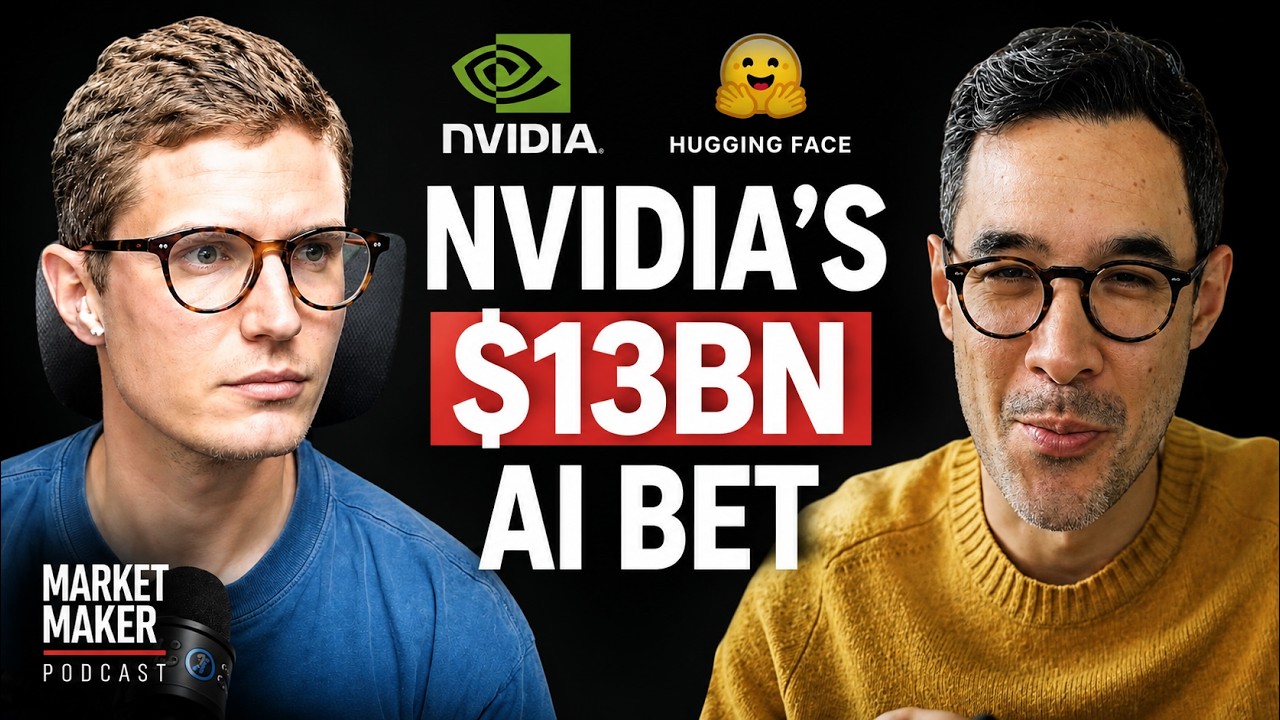
Video summary
Nvidia has agreed to acquire Hugging Face for approximately $12.93 billion, a valuation that represents an 86 times multiple of the company's annualized revenue of roughly $150 million. While this figure appears astronomical given that Hugging Face is not yet fully profitable, the deal price includes a playful "Easter egg" added by the founders to represent the Unicode point for their logo emoji and a specific shade of green associated with Nvidia. The acquisition marks a significant shift in the AI landscape, moving from a period where Hugging Face was valued at $4.5 billion just three years prior to becoming one of the largest transactions in the sector's history. This move underscores Nvidia's strategy to secure dominance not just in hardware manufacturing but also in the software ecosystem that powers open-weight models, effectively controlling the gateway between its chips and the vast community of developers and researchers.
The strategic rationale behind this purchase centers on vertical integration and risk diversification for Nvidia. Currently, a significant portion of Nvidia's revenue comes from selling chips to large entities like OpenAI and major tech labs, creating a concentration risk if these clients develop their own proprietary hardware or reduce spending. By acquiring Hugging Face, the world's leading platform for open-source AI models—often described as the "GitHub of AI"—Nvidia secures a distribution pathway that allows it to capture high-margin software fees similar to Apple's App Store model. This approach enables Nvidia to monetize the usage of its hardware within the open-weight model ecosystem, ensuring that even when users download and run models locally or on other infrastructure, they are likely utilizing Nvidia GPUs for training and inference, thereby stabilizing revenue streams against reliance on a few massive clients.
However, the deal is not without potential risks, primarily concerning cultural friction and community backlash. Hugging Face was founded by French co-founders with a strong mission to democratize AI through collaboration and open access, whereas Nvidia is a commercial powerhouse driven by aggressive growth targets. There is a legitimate concern that integrating such a distinct, community-focused culture into a corporate giant could lead to friction or alienate the very developers who make the platform valuable. Furthermore, while regulatory hurdles regarding antitrust are likely minimal because this is a downstream acquisition rather than a horizontal merger of direct competitors, the deal inevitably signals the end of an era for pure open-source independence. As with Microsoft's successful acquisition of GitHub, there is hope that Hugging Face will retain its utility and community integrity under Nvidia's ownership, but the ultimate success depends on whether the new owners can balance commercial imperatives with the collaborative spirit that defined the platform's growth.
Beyond the corporate strategy, the transaction highlights the extreme wealth concentration inherent in the current AI boom, exemplified by early investor Kevin Durant, who reportedly achieved a 240x return on his seed investment. The podcast notes that while such returns are impressive, they also illustrate how capital acts as power, allowing well-advised investors to secure life-changing sums while potentially leaving smaller players behind. Ultimately, the acquisition reflects a broader trend where massive free cash flow allows tech giants to internalize their value chains and dictate the terms of the AI revolution. Whether this consolidation leads to a more robust, supported ecosystem or accelerates the formation of an AI monopoly remains to be seen, but it is clear that the era of decentralized, purely community-driven open-source development has been fundamentally altered by the arrival of Silicon Valley's most valuable hardware manufacturer.
Read the full video transcript
Hello and welcome back to the Market
Maker podcast. And on this week's
episode, we are talking all things
hugging face, which last week was
acquired by Nvidia for $12.9 billion, or
to be precise, $ 122.93.3
billion, which we're going to go back uh
and discuss in a little more time. might
be a little Easter egg in there for you.
But we're going to go deep into what
Hugging Face does because I think if
you're in the tech world, you're
probably fully familiar, but if not,
which is probably the majority of us, um
we're going to find out what exactly
that firm does, why Nvidia is willing to
pay a 86 times multiple for the company
and who the winners and losers might be.
And and Stephen, I was having a look at
this acquisition. I was just saying to
you offline um hugging face very much
known in the tech world for the the
smiley emoji uh with the company's logo
and I did see the press release Nvidia
put out with Nvidia's logo with a heart
emoji the hugging face emoji. I was like
have I woken up in some sort of parallel
universe or is this seriously a 12 13
billion deal with emojis uh involved or
you know what is going on here? Yeah.
Yeah. And the other thing that's
probably worth noting is that Nvidia,
the name Nvidia is based off of the
Latin for envy, Nvidia. And that is one
of the seven deadly sins. Not only is it
one of the seven deadly sins, but I
believe according to Thomas Aquinus, and
someone can correct me on this, I
believe it is the second worst of the
seven deadly sins. Maybe even the worst.
I need to kind of check my medieval
literature. So, a company based off the
second worst deadly deadly sin is
acquiring hugging face, which has got a
nice smiley emoji. If that doesn't says
it say all, I mean, I I might as well
just stop this episode. I've said what I
need to say. [laughter]
Well, with with this I saw there was
lots of um Bloomberg sources and there
was a lot of there's a lot of tech
followed websites right where they get
the scoops and the download on these
deals probably before they become a
public domain. So how did this one come
about? What were the initial headlines?
Yeah, absolutely. So last week, the
information the website announced that
Nvidia agreed to buy the open model
repository platform hugging face for
12.9
billion on $150 million of annualized
revenue. So that's the 86 times revenue
multiple that you mentioned. The
business is close to profitability, but
it's not yet profitable. This comes this
announcement and we'll talk about the
lovein between Jensen Hang and uh Clem
Dong, the CEO of Hugging Face in a
second. This comes a few days after
Hugging Face reported via Business
Insider that it's working with a bank to
evaluate bidders plural interest. So
Nvidia is not the only game in town. But
in the grand scheme of things, this
isn't Nvidia's first bid. So they first
invested in Hugging Face in August 2023,
series D raise of $235 million at a $4.5
billion valuation. So by the way, just
to put that in context with the
conversation that we had last week with
Stripe and Open Routter, August 2023, 3
years ago, Hugging Face had a valuation
of $4.5 billion. It has just been
acquired for close to $13 billion. So
that's still, you know, circa 3x return
over 3 years, which is great, but it's
not quite as parabolic as I don't even
think open router existed in August
2023. So this feels a little bit like
normal VC.
>> I love that normal VC. It's just what a
crazy crazy world we're we're living in.
>> At what point you look at some of these
and go, "Okay, yeah, this is getting a
little bit toppy." What what would be
flags or signals when you look at yeah
the open router the cursors the this is
it do you feel like I guess we're going
to dive into these numbers and look at
how much this makes sense but what are
those flags just top level I think the
flags are
if you are and and and the flags tend to
come from case history of the dot uh
bubble and then and then bust if you are
buying a company that doesn't have a
robust business model or route to
profitability and pay a lot of money for
it, then that's a a warning sign. If you
buy a company that may have, you know,
slightly more credibility or a route to
profitability, but the acquirer is in no
way a tech company or able to integrate
or benefit or get synergies from that
acquisition, then it's just seen as a
kind of adjacent hype acquisition. And
then thirdly, if you're acquiring a
company that is going to that is
considered to be what we would call in
the world of M&A a transformational
acquisition, i.e. you're putting your
company on the line because it is such a
large amount. You're having to raise
debt, you're having to issue new shares,
it becomes a massive burden. Those three
signals are what would concern me. Those
three signals are absolutely not the
case for this acquisition. You know,
we'll talk about it in a few minutes,
but Nvidia chucked off a hundred billion
dollars of free cash flow last year.
So, this is 13% of their annual free
cash flow. So, if this all goes to zero,
it doesn't matter. It really doesn't.
What what just with Nvidian strategy?
I'm not sure if we we'll get to this
already, but the with that amount of
money is that is that what you would
anticipate that they're not why are they
not more proactive in doing large scale
transactions? Is that cuz there's not
the specific targets that they they
require or it see because this is their
biggest one on record, right? Isn't that
is that right with Nvidia?
Yeah, it's it's it's all about so if I'm
a shareholder of Nvidia,
what do what do I want? And remember
from a kind of corporate finance 101
perspective, you get profit at the end
of the year, net income that is
effectively
at uh that is effectively the
shareholders,
but it is at the behest of the company
to choose what to do with that net
income. They can keep it as cash for a
rainy day. They can distribute it as
dividends or share repurchases or they
can invest it in the form of capital
expenditure or acquisitions or joint
ventures or whatever it might be. So
Nvidia, the board, the CFO, Jensen
Huang,
that hundred million hundred billion
dollars of free cash flow, they're going
to be sitting down and thinking to
themselves, all right, what combination
of things can we do with that 100
billion uh dollars, sorry, what
combination of things can we do to
maximize shareholder value? And that
will be and has been historically
a reinvestment,
b dividends and share repurchase which
is just coming online at the moment and
then c building out the AI ecosystem
through things like guarantees to open
AI and uh you know revenue guarantees
for uh for data centers and things like
that.
Therefore, there hasn't necessarily been
the need or the attractiveness of
potential AI targets in this space.
And timing wise, is there any like kind
of cues there that we could take out of
this? Cuz normally any M&A transaction
has a perfect moment to strike.
Yeah. So, it was it's quite interesting
because Nvidia has been making overtures
to Huggy Face for a while. And late in
November, uh 2025, December 2025, Nvidia
offered a $500 million investment at a
$7 billion valuation, which was rejected
by Hugging Face as, and I quote, "It
does not want a single dominant investor
that could sway decisions." This is 8
months ago. Think about moral integrity
here. Get the checkbook out, Stephen.
Get that checkbook out.
>> And I'm going back and I'm going to
reference this bloke Clem Dong and
there'll be hopefully there'll be some
comments. Maybe I'm a little bit too
cynical, but he said back in 2024, I
said it and I will say it again,
concentration of power is the biggest
risk in AI. So Nvidia buying Hugging
Face 8 months after the investment was
rejected because it doesn't want a
single dominant investor suggests that
there was a moment or there has been a
moment over the last month or so where
other potential buyers have come to the
table. And remember, and we'll talk
about hugging face, what it does in a m
in a minute, but remember, hugging face
is a is a community for opensource
uh AI models, you know, chats, free, you
know, a kind of GitHub, if anyone
remembers or knows GitHub, a GitHub for
AI. So it has this great kind of
democratic democratizing open-source
openweight thesis
and then and then but it also by the way
it also has for-profit venture capital
investors. So when the likes of maybe
Salesforce or when the likes of Nvidia
start sniffing around and saying we want
to take you guys off the market, we want
to buy you guys flat out. early
investors like Sequoia, they're not
going to be like, "Yeah, but we care
more about the community. We care more
about the mission. We care more about
the thesis." What they care about is the
fact that there's $13 billion on the
table, and this now sounds like, you
know, seems like the right time to
strike. I I guess in a way, if you're
very confident in the trajectory of your
business, isn't this just good
gamesmanship
to get to the point of getting a $13
billion valuation in the end? This is
just a tactics that you play. You don't
want to bend over too quickly. You want
to play hard to get. Isn't this just the
normal tango that companies do as they
go through these these relationships?
Yes, I I totally agree. I think it's the
it's the mission statement and the
mission
quote unquote alignment of the hugging
face team and, you know, concentration
of power and saying all of these things.
the smiley emoji face, the community
aspect, all of that stuff,
and then to sell to Nvidia. Now, we'll
get on to it. Nvidia may not be the
worst acquirer in terms of concentration
of power, but again, Latin for envy, $5
trillion company, $und00 billion of free
cash flow. There's a little bit of
concentration of power there, maybe.
>> Yeah. So, what what's Latin for greed
then?
>> Yeah. [laughter] Yeah. Yeah. Yeah.
You're testing me there.
>> Yeah. Yeah. So, okay. So this this this
transaction was not 12.9 billion. Uh and
so I don't know as a lame layman like me
and I read a number like 12.93 billion
I'm like okay so what is this out of a
model they've just created that
something's worth the extra little
30,300,000 within the billion figures.
So how on earth did that come about as
such a specific figure? Yeah, this is
where like [laughter] I don't want to
disparage the tech community too much,
but this is where tech nerds that are
about to become billionaires really
start to irk me.
So, the deal, the value of this deal,
the acquisition price tag, 12.930
billion. So 1 2 930 0 0 0 lots of zeros,
but a very confusing acquisition price.
This was an Easter egg that a load of,
you know, that was dangled out there by
the CEO um uh and co-founder Thomas Wolf
saying, "Look, here's an Easter egg. Try
and figure it out." So the hugging face
reference was easy. Supposedly the
number 129303
is the decimal representation of unic
code point U +1 F917. The emoji
officially named hugging face.
[laughter]
And then the color code 1293
is the vibrant shade of green that looks
a whole lot like Nvidia's classic color.
And then [laughter]
so that was why that was the number. and
Clem Clem Dong on on Twitter on X said
had to do it for the lols that was what
he said had to add an extra you know
$30.3 million onto the end of a 12.9
billion transaction for the lols ant for
the ls I mean you are just love these
guys you you are just bossing life if
you could be selling your firm for $13
billion and just doing and and making
statements like that. I mean, you are
the final boss basically.
>> Yeah. Again, they're not happy. None of
these guys are happy.
>> I was just having a quick look actually
Tom, you said Thomas Wolf, the
co-founder and chief science officer of
Hugging Face. I just had a quick look.
I'm always interested to know like
what's the background of these people
you know when we look at all of the
>> you know situational awareness or
whatever it might be these recent kind
of
>> uh topics. So this guy Thomas Warf. So
Echo Polytenique and Sir Bong
University, they're like the top two
target sort of quant schools if you like
math schools in France. Really highly
regarded. Nearly every quant hedge fund
will have uh people on the ground, you
know, doing that whole uh networking to
try and pick up talent. He then got a
law degree actually and then worked as a
physics researcher
and then a patent attorney for six
years. So yeah, quite quite an
interesting background.
Yeah. And again, this is part of the
story. So these founders are all French.
Um, and this this if you are generous
enough to France, this could be
considered to be a French success story
or even a French missed opportunity
because they've sold to a big American
company. But this isn't really a French
company. It's registered in the US. It's
got French founders, but all of the main
investors, as we've discussed, are
American investors. It's based there.
This is an American company to all
intents and purposes.
Well, I know we'll probably get into
that a bit more, but you just mentioned
there the investors.
Perhaps we can just touch a little bit
on that. So, who's, you know, who's been
involved to this point? Is it just these
the same names as ever, or is there some
um more niche ones in the mix?
>> Yeah, so there's some typical San
Francisco names, the likes of Lux
Capital, Sequoia, and we'll reference
those guys later on in the episode, and
Coo as well. Strategics like Google,
Salesforce, Amazon, Intel, AMD all piled
in a couple of years ago. And then some
slightly strange individual investors.
NBA player Kevin Durant. Now, Ant, I'm
going to keep you interested in this
episode by maybe laying an Easter egg or
whatever they call them. I'm probably
using that in the wrong term. Uh, and
waiting till the end of the episode to
go back to the world of NBA and Kevin
Durant. So anyway, he invested at the
seed stage and also open AAI co-founder
Greg Brockman. There's a lot of things
to say about Greg Brockman, but as of 2
hours ago, we were recording this on a
Friday, he has just declared with the
launch of chat GPT 6 Astra, the start of
the AGI, artificial general intelligence
era. So there you go. We're in it. Well,
it's got to do. I mean, someone's got to
do something cuz you know, I don't know
if how I know you're more of a clawed
kind of guy. Uh, but I still use chat
for certain things. And it went down for
half an hour yesterday.
>> Interesting.
>> Completely down. And you know where you
go to if you're like, is this my
internet connection? Is this just me?
Where do you go? Who you going to call?
Elon on X. You go on X and then you
could see just millions of people going,
what's going on? like freaking out. It
was down for like for me it was like
half an hour.
>> So So you were mid you were mid therapy
session with your mate chat GPT
>> and my girlfriend my second wife having
a chat and we were like
>> Yeah. Yeah. Having a nice coffee. Oh,
poor you. Yeah. Taking a relaxing
afternoon.
>> I mean I it just goes from bad to worse
it feels for Open AI. That's interesting
you said they've just done that new
launch. Maybe it was the transition of
the new model coming online. It just
something went wrong and But not a good
look obviously, so we might as well drop
the AGI statement at the same time.
Maybe
>> cover up the cracks.
>> But also the founders, they obviously
didn't invest in the company. Also the
founders uh each pocketed estimated
according to uh Bloomberg $1.8 billion
each. Again, just reference that number.
Reference I'm so interested in this
human story. [laughter]
So So hang about they've they've
massively outdone the open routter guys
then. M yeah bigger yachts, bigger
houses.
>> So they they they they're on the street
that's slightly closer to the the
beachfront than the open routed guys is
what we're saying.
>> Yeah, absolutely. Absolutely. [laughter]
>> Uh okay. Okay. Well, look, you you've
kind of given me a bit of a clue and I
kind of get it. It's top level of what
hugging face is, but perhaps just a
little bit more of a just dial it down a
little bit so we can all get our heads
around what makes this such a unique
platform. Yeah. So, hugging face for the
lay person like me and like you, Ant, is
the AI community building the future. I
took that directly off their website
with the little hugging face emoji. Um,
and when you want good analogies, go to
a website like pcmag.com.
You know, they explain it like the lay
person. So, pcmag.com
describes hugging face as the neutral
public square in the biggest boom town
of modern technology. So it is where
people come together to collaborate to
build models to share models to share um
open- source libraries data sets
diffusers transformers all of these
things that I don't really understand uh
and then PC Mag goes further just in
case we didn't understand it the hug if
hugging face is like the app store
about that analogy it's because Nvidia
is the iPhone in this analogy building
out the hardware ware that made the AI
boom possible. So hugging face is like
the front end software layer for this
opensource or for this kind of non I
wouldn't say non-enterprise level but
non-closed weight open AI uh clawed type
offering and then finally they said that
hugging face is the github of AI which
is definitely my preferred analogy. So
it's got the hub where researchers and
companies publish and discover openw
weight models. Just as a reminder, we
spoke about this a few weeks ago. Open
weight models are models where the
trained parameters or the weights are
released publicly so that anyone can
download, trade, uh train and modify as
opposed to the closed weight models of
GPT and claude. Um so once you have
those weights, you can run the model
locally. Importantly for Nvidia,
they don't care. They don't care whether
you they don't really care whether you
use an openweight model or closed weight
model as long as they're as long as
you're using Nvidia chips to power those
models. So this in terms of kind of
basic strategy 101, this is Nvidia
owning a distribution pathway, right? So
they've got the relationships, the
embedded relationships with the open AIS
of this world, with the claws of this
world, with the big closed weight
models. It wants to open and own the
interface between its chips and the
openweight models that are being
created, shared, collaborated upon on
HuggingFace, which has been that forum
over 300 million models or three million
models, sorry. Is there ever like a
regulatory layer to this though? I mean,
when you explain what you've just said,
to me it makes complete strategic sense
from Nvidia.
But
yeah, is there any kind of regulatory
concern that would come about by them
just acquiring almost like the vertical?
Yeah, it's really hard when it comes to
antitrust and regulatory issues relating
to mergers and acquisitions.
What tends to happen is if it's
considered to be a vertical integration.
So vert a vertically integrated company
owns their entire value creation chain,
right? So the best example is always oil
and gas. Big oil and gas majors. They
own the exploration and production. Uh
they own the transportation. They own
the refining. They own the selling and
the trading. So if you are a company
like Nvidia and you buy
an element of your value creation chain
either downstream or upstream and
hugging um uh and this one is downstream
as opposed to upstream. It's more clo
it's closer to the end consumer or the
end buyer then these tend to face less
regulatory concern or constraints
because it's much more about market
share and this is not necessarily
increasing market share which is what
the antitrust guys get quite concerned
about because you are buying a company
in a different part of that uh of that
market vertical. So to me and you, this
does seem a little bit like, hey, you
know what the heck is going on? Nvidia
powers is the picks and shovels of the
world of AI and it's now owning a key
gateway to massive volumes of consumers
of and purchases and um experimenters of
AI. But will it get blocked from a
regulatory perspective? No, because
GitHub didn't get blocked and this is a
kinder regulatory environment than it
was back in 2016.
Sorry, you got my brain thinking now. So
with hedge funds, a recent shift due to
regulatory change in the market space
was instead of them paying sellside
firms for research, they would build out
their own internal research function.
So to save costs and have more
productivity internally for their
investment decision processes and so on.
At what point does Nvidia go hang about
we're paying Morgan Stanley or Goldman
Sachs, JP Morgan, whomever hundreds and
hundreds of millions of fees to do lots
of different things.
At what point do you kind of build out
your own almost M&A crack squad which
are just canvasing the market and
modeling and doing everything all of the
time where of course on the probably
sharp end of the transaction you need
the bankers involved
but you know what I mean like you should
kind of bring it in house some of that
talent because you need it. It's almost
like a perma acquisition scene when
you've got that type of capital to
deploy.
>> Yeah. So there's probably two answers to
that or two responses to that. One, the
big acquirers or companies that have an
acquisition strategy or even any very
very large company that does
acquisitions will have their in-house
corporate finance team and will do quite
a lot of the work that the investment
bankers will do and maybe they'll be
able to kind of pony up with the
investment banks and get a slightly
cheaper fee. the investment banks are
still very much in the loop. But one of
the my my kind of second thing that that
sparked was do you remember General
Electric? Obviously remember General
Electric, but General Electric is a
brilliant case study in moving from
being a manufacturing and engineering
powerhouse, a little bit like what we
were talking about with Boeing a few
weeks ago to being
basically a financial institution.
They moved under
there's a great book called I was just
looking it up just now. They move um a
great book called Lights Out, Pride,
Delusion, and the Fall of General
Electric. And this is under the CEOship
of Jack Welsh, who basically turned the
company into a into a kind of financial
engineering company.
Um using its strong balance sheet, using
its credit rating to go out and
basically become an investment bank or a
quai investment bank. So, it didn't end
well, by the way, and I wouldn't
recommend that Nvidia does that. But,
yeah, there are there are um examples in
the past where a very very large company
with great free cash flow and a very
good credit rating goes, "Wait a second,
we can be the bank. We don't have to
rely on the banks. We can we can be the
finance year. We can be the bank."
you you're just dropping Easter eggs
left, right, and center here because
that's the connection to the Boeing
episode where Jack Welch's strategy,
that profit management style of one
pursuit was exactly the downfall of the
the Boeing quality scenario we were
talking about.
>> Yeah, I would say that we had all
prepared this in advance, but we
definitely haven't.
>> All right. Well, look, I know we touched
on it briefly, but may maybe just a
little bit more cuz the the chap I
mentioned, uh, Mr. Wolf was just a
co-founder. So, who is who are the other
people involved in this business? And I
don't think we've even touched on it
yet. How old is this business and how
did it come to fruition in its first
instance? Yeah, so Hugging Face was
founded in uh July 2016 by three
co-founders, Clement Dong, Julian
Shamon, and Thomas Wolf. Uh it was
originally founded as an AI chatbot and
again if you read the backstories as you
as you alluded to with Thomas Wolf these
three guys are very very impressive. Um
I think uh Julian Shamant had an MSE in
computer science from Stanford Thomas
Wolf as you mentioned quantum physics
PhD
etc. So the AI chatbot idea launched in
2016, didn't really work, didn't really
click and then by 2019 they had pivoted
out and they the big hit came when
Google and I remember this from my
startup when I was working for uh
working as founder of of of util my
machine learning startup when Google
first released BERT. So Bert's
birectional encoder representations from
Transformers model um on its TensorFlow
platform and any techies will remember
that very very well. Hugging face didn't
really like the idea thinking that a
powerful model like BERT should be more
widely accessible. So they recreated
BERT but using PyTorch which I remember
again very very well and released it on
GitHub which achieved more than 5,000
stars likes in under 3 months. And so
this is how the initial idea for the
current hugging face emerged. They asked
themselves what if sharing LLMs would be
as easy as sharing code on GitHub. So
this is this kind of community
opensource these things these powerful
models shouldn't all be centralized by
the likes of Google. And then what we
now know as hugging face today kind of
came online in late 2020 and expanded
from the proliferation of large language
models and the the breakthroughs in
technologies that we've seen over the
last 5 or 6 years.
So the big question in my mind then if
this is so contingent on community and
being open source,
how do you arrive at the 13 billion
figure? Like is there how does this
business make money? I mean normally
you're looking at the balance sheet
looking at all the different metrics to
calculate some kind of value
proposition. How does that work here if
it's all open source?
>> Yeah, absolutely. So they have a the
classic premium subscription model. So a
lot of what you can get or a lot of the
initial bits that you can get a little
bit like Spotify uh premium model a lot
of what you can get is free to start out
with and then the more powerful models
or the more complex things that you can
do you have to pay a monthly fee which
is exactly like GitHub monetized as
well. And by the way, we'll speak about
GitHub in a second. That business is now
generating well over a billion dollars a
year. So it's been a kind of relative
success within the framework of
Microsoft. But it also does things like
renting compute uh not necessarily like
uh open router more maybe like a
corewave um which has uh an agency again
for for Nvidia there. And then they have
uh inference endpoints essentially
managing the process of actually
deploying the machine learning model and
keeping it alive so that you uh users
can utilize that model that's been
uploaded and put out there to the
community. So all of that comes together
in a $150 million a year revenue amount
which is growing not at the light speed
that we've seen with previous startups
but it's getting there. And it's again,
it's this concept of ecosystem control
that is why Nvidia has paid $13 billion.
There's obviously
the fact that Nvidia probably doesn't
want other players to be the owner of
this gateway to a massive massive total
total addressable market of
users that want openweight models as
opposed to closed weight models. So it's
like I got to get my hands on this. And
quite frankly, whether it's $13 billion
or $8 billion or $20 billion for the
founders, obviously life-changing money
for Nvidia.
[laughter]
Oh man. Yeah. Not Jensen Wang's uh
territory quite yet, but um you
mentioned there [clears throat]
Microsoft,
excuse me, you mentioned Microsoft and
GitHub. Am I right? Microsoft didn't
create GitHub, they bought GitHub. So is
this a similar sort of scenario? Is
there parallels there
>> in the ration why Microsoft did that and
why video are doing this?
>> It's super interesting. So in 2018, June
2018, Microsoft announced the
acquisition of GitHub for $7.5 billion.
And again, that was when I was in my
machine learning phase. I remember this
being a massive furore, you know, so
this open this collaborative great
community of code sharing, code
collaboration,
uh, repository that basically everyone
used was being bought by this kind of
stodgy
bureaucratic
monopolizer
in Microsoft. And I remember everyone
going, "Oh, this is an absolutely
terrible thing."
Um, but just looking retrospectively,
and I haven't done a great deal of work
on this, but it seems like this
acquisition has been successful
not only from a Microsoft perspective. I
mentioned that it now generates over a
billion dollars in ARR and it also is
the uh it is the go-to point or it is
the host for GitHub copilot which is the
equivalent of the kind of clawed code or
the codeex um for Microsoft but also it
seems to have been a kind of net
positive for the users as well. So, I've
just kind of looked on the Reddit forums
um and I can see a couple of negative
comments, but you know, it it feels like
I'm just going to quote a couple. The
GitHub acquisition hasn't really
negatively affected me, and some of the
additions have been downright useful. Uh
I'm not saying they're perfect, but
they're actually providing me with lots
more a lot more products and a lot more
optionality. So, GitHub's kind of
remained independent, maintained its use
case and its value for the developer
community. So if you can do something
like that where you've got Nvidia as the
owner but Hugging Face remains useful
and is just backed by availability
and access to Nvidia chips for model
training and for running models as a
kind of order of priority because they
now are owned by Nvidia.
Maybe, you know, read the Reddit
comments and you wouldn't agree. You
wouldn't you wouldn't believe that this
could be a good thing. But maybe, yeah,
maybe there's some sense here.
Yeah, that makes that makes great deal
of sense. And what what about the
the users of this? I'm assuming there's
a lot of like GitHub BTOC users. I'm
assuming that Nvidia is what's the
concentration do we know of Nvidia's
revenue that's B2B?
Is it all of it or but in a sense of can
they start to open up a new revenue
stream here to that community audience?
Yeah. And this is where the kind of B2B
and BTOC distinction gets a little bit
fuzzy. So Nvidia again I've always
thought all right who buys from Nvidia?
Okay. Well, it's OpenAI and it's it's
the big labs that are spending billions
and billions of dollars on these
frontier models, training them and then
running them. Tens and tens of billions
of dollars. And there's obviously a B2B
concentration risk. If your main clients
are buying the m, you know, are buying
billions of dollars worth of these
chips, you're going to want to, you
know, move a little bit away from that.
So, you've got the big labs that are
buying the chips. Obviously, you've got
um you know, the large corporates, you
know, the large tech companies that are
buying billions of dollars worth of
NVIDIA chips. Um, but then you've also
got the I wouldn't call it the BTOC
community, but certainly the more hacker
community, the more um, you know, we're
going to collaborate over a model and
we're going to use it on a smaller use
case that is not maybe enterprise level.
It might be a business purpose. It might
still be B2B, but it's more of a
individual contributor type relationship
than it is all right, I've got $30
billion a year, you know, relationship
with OpenAI. So, it is just another
and quite quickly growing market to sell
Nvidia chips. And we know, having
covered openweight models a little bit
on the podcast before, we know that
openweight models are becoming more
popular because they're more
customizable. You can host them locally,
uh, and they're potentially cheaper. So,
Huang, you know, he's very good at
reading the tea leaves and sensing where
the direction of travel is, and he sees
it very clearly, and he said as much. he
sees it going more into the openweight
side and reducing the concentration risk
that maybe they've had with the likes of
OpenAI who are developing their own
chips, right? And are having some quite
signific significant success with those
chips. So yeah, it's interesting
strategically. Yeah. Talk to me a little
bit more about that that point you just
mentioned there about the u Nvidia's
newfound belief in in open weight and
reducing this concentration risk. I saw
in your notes something about margins
from app store fees. Sounds rather
Appleesque. So what's that in reference
to?
Yeah, absolutely. So again, there's lots
of different ways that Nvidia makes
money and it doesn't want to be reliant
upon just selling to the Googles, the
anthropics, the open AIs, etc. So this
app store analogy where it takes a cut
of the revenue that is generated through
something like the models created on
hugging face using Nvidia chips is that
is that very very high margin business
that is going to continue to boost the
gross profit margins of a company that
already has 75 plus percent gross profit
margins. So again, when you look at a
company like Apple, by far the highest
margin part of the business is the app
store is is not it's not the hardware.
So considering the gross profit margins
for the hardware part of Nvidia is 75%.
If if it can get 90 plus% on the kind of
software
layer, that's pretty insane.
And then from the hugging face side, I'm
just looking at the rationale for them.
Is it the normal
uh you know the actual specifics aside,
the normal sort of tech challenges? Like
I always remember when the documentary
in Deep Mind got bought by Google for
like 400 million was it something
ridiculous like that probably the steal
of the century but that was to get
access purely at the time for the
compute power that they needed for the
mission of what they wanted to
accomplish. So is this is that the kind
of basis of the rationale of hugging
face in this instance? Yeah, I mean the
basis the rationale is the fact that it
was $13 billion.
[laughter]
You can't get beyond that. Yeah.
>> I don't care what Clem says. 10 10 years
after starting, this is his uh tweet. 10
years after starting Hugging Face, open
source AI is at an inflection point.
Thanks to the community, we've shown
that this can be that it can be a
compliment and even a an alternative to
closed sourced APIs. But for it to
happen at a larger scale, it needs more
compute, more support, more
collaboration, and more visibility.
That's why we went to talk to Jensen. So
obviously, that's the party line. I need
to get acquired in order to scale up
what I'm doing, which is perfectly I I I
definitely buy it, but I also buy the
fact that they're now billionaires.
And ju just quickly on the the risks to
this then is it what you said the the
template of success seems to be just do
what Microsoft did with GitHub let them
kind of run their own thing uh keep the
integrity of the the community and
you've acted as a block then to stop
other competing places uh forces get
hold of that downstream vertical on the
on the supply chain if you like. Is that
the risk though if Jensen goes I mean
culturally how do you think these firms
would be like I' I've looking at Zoom
graphics of this it feels a bit bromancy
and there's like holding up of emoji
signs and like is this all part of the
Jensen Wang like um he loves putting a
show on but I imagine he's a pretty
intense ambitious guy and you're going
from a community kind of inspired
and quite techy geeky orientated space
where Nvidia is a commercial beast. So
how is that the risk there of friction?
Do you think
>> I don't I wouldn't see that to be a
particularly big risk and I don't know
the internal culture of either of these
two companies but they they are both
drinking the Kool-Aid of
of the unlimited potential of AI and
they both believe that they are doing
something transformational from a global
you know upside perspective you know
abundance whatever it might be called uh
and obviously at the same time they're
getting fantastically fantastically rich
off the back of it. So this lovein is a
mutually beneficial lovein [laughter]
from the both from both end. The biggest
risk is that the community that are
currently on uh hugging face move to
another platform
maybe a model scope which is like
hugging face but mainly for the Asian
market. And if you just look at the
again the Reddit comments, it's just a
classic, isn't it? You know, so few days
ago, big money buying out open source.
The people that lose out in this uh in
this transaction are only dot dot dot
everybody. A tail as old as time. The
last nail in the coffin for an AI
monopoly. What a shame. Everyone, this
is a great one, which I totally agree
with. Everyone is committed to open
source, collaboration, freedom, etc.
until the offer sheet comes in. You say
12.9 with a B.
Bleep. Yeah, brother. I'm in. [laughter]
So, like, you know, these guys are both
drinking the Kool-Aid. They're both
getting fantastically rich. They both
love, you know, they they both love the
concept that they're changing the world
and in this ecosystem, an echo chamber
where Jensen Huang's leather jackets are
actually cool and a hugging face emoji
is legitimate and everyone else in the
world is just going, "What the hell is
going on?" You did also mention someone
else who I'm assuming has come out of
this in a very positive way was an NBA
player called Kevin Durant. So, how on
earth is Kevin Durant linked to this
deal?
>> All right, let's finish with this. Yeah,
Kevin Durant, and many people will know
Kevin Durant. You certainly will. Ant
NBA superstar. Uh, so he has got he's
sitting on he was an early seed investor
in 2017 at a $60 million valuation for
Hugging Face. 24,000%
return.
200 240x
return.
>> Oh my goodness. Me.
>> Wow.
>> What a ball. What a baller.
>> Hall of Famer. That's what that is.
>> Okay. Well, look, this is not his only
VC investment. He's also got an 80x
return on his investment in Whoop, a 30x
return on his investment in Coinbase.
>> Oh, he got in a good time on Coinbase.
>> That's It's unbelievable. Well, he got
at $1.6 billion valuation.
>> Oh, man. Uh 77x on Robin Hood, 52x on
Mercury. I don't know that company, but
my gosh, this guy's got a future. Hang
about though. Hang about. These are
what, six you've just described. How
many shots is he taking? What's his
shooting percentage here
>> to get massive payouts?
>> You don't talk about the shots. You only
talk about
>> No, we go. Here we go. [laughter] The
stat sheet here because I don't know
what he's shooting. fill gold percentage
these days, 45%.
[laughter] Honestly, 240x on Hugging
Face. My gosh. Again, again, if you if
you have capital, I mean, this might be
one of the concluding points. If you
have capital, you get access to better
deals. And if you're in the right place
and you've got money and you've alerted
the ecosystem that you're up for
investing and you're a big name, which
you know, Durant certainly is then and
you're potentially quite well advised
because there's plenty of NBA players
that have not been well advised and have
lost a lot of money, but uh Durant's not
one of them.
>> Yeah, there's a famous one. any NBA fans
out there, Vin Baker, he's like a
regional manager of Starbucks, and he
got paid a hund00 million contract, I
think, back in the day. Um, God,
>> I'm sure he's a superb,
>> uh, manager of Starbucks. Little that,
but um, all right, good stuff. Look, I
would love actually if people have made
it to this point in the episode, you're
probably quite plugged in to sort of
tech and the intersection with finance.
And I'd love to know your thoughts about
what do you think? Let's bring some of
that Reddit vibes to the comment
section, particularly on YouTube. I know
it tends to fire up if we hit the right
spots. So, what do you think about this
deal? And where do you stand? Uh, are
you a wave the right dollar bill sign in
your face and I'll sign kind of guy or
are you more of a the community
community wall street bets till I die
kind of vibes? I'll leave you.
>> Yeah, I just, you know, I'll leave you
with my final thought. Go read or go go
investigate capital as power sasp is
what it's known for short. Um, so this
is a theory that was posited about 15 20
years ago, but it's it's come into the
limelight very recently. The more
capital you have, the more power you
have, the more ownership you have.
Obviously, money is power, but we're
seeing it in ever more concentrated
ways. And
the outcomes aren't always positive.
>> Quote that unfamous person on Reddit
that you just read out, it's tale of
oldest time.
>> Exactly. [laughter]
Exactly.
>> All right. Thanks, Stephen. See you next
time.