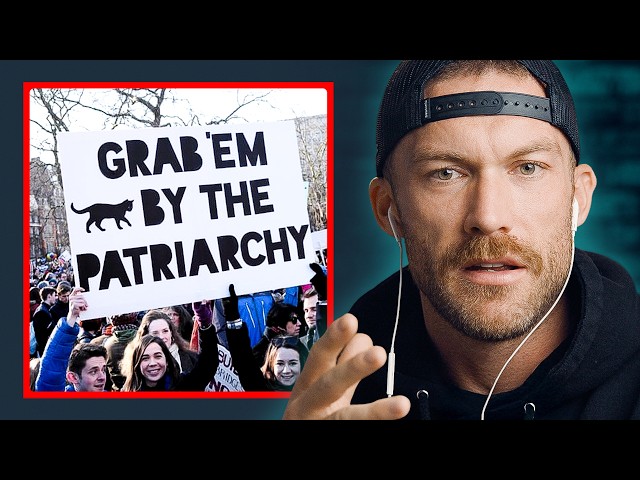
Video summary
The podcast explores the complex phenomenon of men being blamed for societal issues they did not create, framing this dynamic as a reaction to a perceived lack of sympathy and denial regarding male pain. The speakers argue that no demographic group has declined faster than men in recent times, citing Richard Reeves' observation from *American Institute of Boys and Men* that if there were alternative places to go, fewer men would turn to the internet for community. This digital migration creates an opening in the market but also highlights a crisis where traditional male role models are scarce or absent. The conversation identifies figures like Gareth Southgate, known for his dignity as England's former manager, and David Attenborough, celebrated as a sensitive naturalist adventurer, as positive examples of masculinity that boys should emulate. These individuals represent realms where men still dominate the extremes—such as in football, rap, grime, drill music, and comedy—even if these fields contain lingering taboos regarding homosexuality. However, a significant distinction is drawn between those who rise to the top and the average man's trajectory. While men may occupy high-status positions like Premier League players or successful comedians, the speakers contend that the "average" male is increasingly slipping away from university education, high-paying jobs, and stable employment. Instead of rising through traditional linear career paths, many are facing addiction issues related to drugs, video games, pornography, or weed. The dialogue suggests that while men dominate certain cultural extremes, society often ignores this reality by focusing on the decline of the average worker rather than celebrating success stories. This creates a narrative where struggling men feel their plight is invisible because they do not fit the image of the successful elite like CEOs or world-famous athletes, leading to feelings of despair and suicide that go unaddressed due to a lack of empathetic listening spaces. The discussion further delves into how rapid technological and economic shifts have upended traditional structures without providing adequate support systems for men navigating these changes. Factors such as the decline in manufacturing jobs, globalization moving work overseas, women entering the workforce, access to birth control, and the looming threat of AI eliminating screen-based roles are presented as massive social crises that will reshape how men and women interrelate. The speakers posit that male mental health struggles might eventually be subsumed by these broader economic disruptions if society does not offer sympathy during this transition. There is a strong emphasis on the need for empathy, arguing that without it, young men feel forced to pay for the sins of their fathers' privileges while simultaneously being accused of embodying a patriarchy they no longer identify with or belong to. A central theme regarding male identity is the feeling that worth must be earned through achievement rather than inherent existence. One speaker articulates the sentiment often heard in certain circles: "life as a man you're born without value." This contrasts sharply with the perceived love, belonging, and pedestalization afforded to women and girls, creating an environment where men feel they are only special if they make themselves big or impressive through success. The conversation critiques the casual disparagement of men and rejects the idea that boys inherit an "original sin" simply by virtue of their gender; instead, it advocates for a world where young children do not have to navigate frivolous denigration of maleness from childhood. Ultimately, the speakers conclude that as technology accelerates change and displaces portions of the workforce, meaninglessness will become widespread, making sympathy even more critical than ever before to prevent further societal fragmentation.
Read the full video transcript
I think, again, it's it's really strange
for me to be thinking about sort of
talking about this from the outside
given that so much of my content crosses
over, but
I think that uh
much of the hunger for what I I'm
talking about and these guys, too,
is a sort of reaction to a felt lack of
sympathy and sort of denial of male
pain. And I think if there were if there
was more of an acceptance of guys are
having a tough time of it at the moment
through pretty much any objective
metric. I don't think that any group has
fallen further faster than men. That's
Richard Reeves' line from the American
Institute of Boys and Men. Uh
if it wasn't for the fact that there was
there were no places to go, I think
fewer guys would go to the internet. Um
and that
creates both kind of the cause
uh it it creates an opening in the
market. What's that line about um
if there is if there are no role models,
if you can't propose any, and I think
that this is a really great question.
Uh in fact, for you, who do you think
are some good examples of of sort of
genuine positive role models that you
would say to your boys you should
th- this would be the sort of man that
you should emulate.
Uh well, I mean, the answer that gets
banded around a lot over here in the UK
is Gareth Southgate, like the former
England manager.
Um I think he embodies a certain uh
sort of
dignity and and and and so so that's a
fair play with and and obviously in a in
a in a in a in a pursuit that many boys
aspire to excel in, many many girls,
too. Mhm. Um uh
I mean, how long I mean, should I come
up with a couple more? Like, you know,
there's clearly in the pantheon of
program makers, my field, David
Attenborough, you know, an adventurer, a
world-bestriding colossus of of
naturalism, a sensitive human being.
I mean, I think it is worth saying in
that in that scenario that you've
depicted of um
kind of male failure, if you like, like
you know, it's it's it's um men
despairing, like
that thing of deaths of despair, like
suicides and drug overdoses, we should
also like as a father of boys,
I I often remind myself that, you know,
the two things that matter most
to my kids at various times have been
football,
English football, obviously, Premier
League football, and rap, grime, and
drill. And those are both worlds in
which most of the preeminent,
world-famous, highest-paid,
highest-achieving
exponents are men. And worlds in which,
in fact, homosexuality is considered
still rather questionable and taboo.
Like not many openly gay footballers,
not that many openly gay rap artists.
So, there are I I I guess I'm pushing
back ever so slightly in the sense that
there are still realms in which um you
know, most of the most successful
comedians are probably still men. Like
there are still realms in which
uh not just men, but a kind of
traditionally masculine-presenting man
is still ascendant. No, I I I would
agree. I think the difference is between
where do the guys who rise to the top
and where does the mean, the average man
end up sitting? Because the average man
is not going to become a Premier League
footballer or Ricky Gervais. Uh the
average man is increasingly slipping
away from going to university,
increasingly slipping away from getting
a high-paying job, increasingly more
likely to be addicted to drugs or video
games or porn or weed or whatever. And
um
you're right. You're right to say that
men dominate the
uh
the extremes, but they dominate the
extremes at both ends. And uh it's a
denial of the slipping back. I think
that it it this this is my read that if
it wasn't for the case that I am
struggling as a man, well, look at your
privilege. Look at all of these CEOs.
Look at all of the football players.
Look at how well and he's goes, "Yeah,
but
but I'm I'm struggling and and maybe
many of my friends are, too, and there
doesn't seem to be a sympathetic place
to land for that." Yeah, I totally agree
and I think I'm not a fan of like the
casual disparagement of men and I think
very occasionally, maybe more than
occasionally, that happens. Like
typical man or uh
you know, step back as a man, um
check your privilege. Especially as a
father to boys, like boys
I I never want to be in a world in which
boys have kind of inherited an original
sin by dint of being boys. You know,
it's like, "Oh, well,
you have to
you know, as a boy, you've you've
somehow your bequest is the fact that
men have tended to run society for
hundreds of years." Like, "No, he's like
5 years old, like 7 years old." Like,
"Don't
>> [laughter]
>> talk about him." Do you know what I
mean?
I know, I was joking the other day.
Like, I remember growing up and there
were like, "You remember that nursery
rhyme
what are little girls made of?" And it's
all like, "Sugar and spice and all
things nice." And what are little boys
made of? Like, "Pigs and puppy dogs'
tails." I remember I was like 7 years
old. I'm like, "Why am I made of puppy
dogs' tails?" Yeah. You know what I
mean? And then that's kind of trivial,
but I don't like that sort of
like frivolous denigrating of
maleness. And then maybe I'm being
oversensitive, but I think it kind of
it it's a little unfair.
So, maybe I'm agreeing with that. But
and I think you I think the other thing
I'd say is if I wanted to say I'm really
apocalyptic, uh we are all, both men and
women,
but
now
inhabiting a world in which technology
has upended so much and promises to
upend even more because God knows when
you know, in a world where I know a lot
of it's traced back to the decline of
traditional manufacturing, also birth
control, women entering the workplace,
uh globalization of the economy, you you
know, and the fact that a lot of like
you know, traditional manufacturing jobs
moving to places like China and then
what actually most of the jobs like now
can be done equally well or better by
women, but in a world where AI is going
to eliminate most of the jobs uh that
involve sitting in front of a screen as
is sometimes promised, there's going to
be this whole other ruction. Like it's
going to play out really interestingly,
I think, to say the least, in terms of
how how men and women interrelate. Like
whether you know, the how sustainable I
don't know. I I know I'm taking this a
bit off tangent, but
um
I sometimes think like the
you know,
male mental health versus you know, and
how it figures in wider society
will be subsumed by some vastly bigger
uh social crisis.
>> Wow. Yeah, I Do you know what it is? I
hadn't
I hadn't drawn that part of the
path down the circles of hell, but
you're probably right that
it's all well and good talking about the
issues that both men and boys and women
and girls are facing,
but when 50% of the workforce is
displaced by AI, I don't know whether
that's going to happen. When some
percentage of the workforce is displaced
by AI and people don't have meaning and
certain jobs have jobs and other people
don't feel like they've got a path
forward, but it does loop back to what I
said before, which is
that if anything, if it requires
anything, it requires sympathy.
Like it needs you need to be
sympathetic. Wow, the world changed
really [ __ ] far, really [ __ ] fast.
That's hard to navigate. That's hard to
navigate, but because
at least in this iteration of it, the
men were part of a previously
beneficial group, they were part of one
that seemed to be afforded privileges
in certain domains, not the privileges
to go to war and die and etc. but, you
know,
opportunities that weren't afforded to
the women. It
it felt and I think it feels to a lot of
young men now like they are being made
to pay
for the sins of the advantages that
their fathers and grandfathers had. Like
they they they're accused of being part
of a patriarchy that they no longer feel
a member of.
Um you know, when they're looking around
and saying, "Well, where is my
privilege?" And I think that it ties in
with
you talk to these two guys
and there's a line that they say in life
as a man you're born without value.
And I think what they mean with that is
it feels to me like there is a kind of
love and belonging and acceptance and
pedestalization that's given to
women and girls
that I haven't felt has been afforded to
me. I haven't felt as special, I haven't
felt as cared for unless I do something,
unless I sell make myself big and
impressive. And again with that
sympathy to go [ __ ] yeah, you know,
previously it probably there would have
been a pretty linear progression for you
to have found a place in society and
done these things and cost of living and
and and uncertain times and all of these
different stimulus that can cause you to
be addicted.
And if you believe in life as a man
you're born without value, that that
probably requires some sympathy, too.
A quick aside, if you've noticed your
energy isn't quite what it used to be
even though you eat well and stay
active, there might be a reason for
that. As we age, our mitochondria, which
is the parts of ourselves that produce
energy, become weaker and make less
energy, which is why I'm such a huge fan
of Timeline. They developed this pill
right here that helps clear out damaged
mitochondria so your cells can actually
renew themselves. And this isn't just
theory. In clinical trials, people saw
mitochondrial renewal increase by more
than 40% in just 16 weeks along with
improvements in their overall energy.
Timeline is backed by over a decade of
research, has more than 50 patents, and
is the number one doctor-recommended
mitochondrial supplement on the planet.
I started taking it nearly 2 years ago
because it was recommended to me by my
doctor, and that is why I've used it for
so long. Since way before I knew who
made the product, and that is why I
partnered with them. Best of all,
there's a 30-day money-back guarantee
plus free shipping in the US, and they
ship internationally. So, right now you
can get up to 20% off and that 30-day
money-back guarantee by going to the
link in the description below or heading
to timelinenutrition.com/modernwisdom.
That's
timelinenutrition.com/modernwisdom.
Congratulations for making it to the end
of a clip. Your brain has not been fried
by TikTok.
Watch the full episode here.