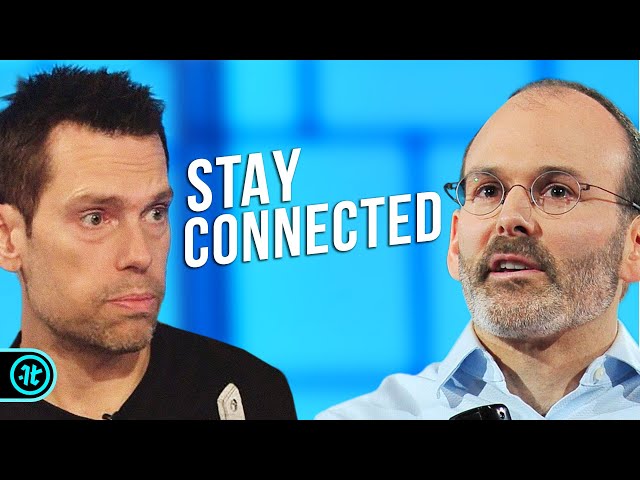
Why Human Connection Matters Now More Than Ever | Jud Brewer on Impact Theory
Watch on YouTubeVideo summary
Jud Brewer opens his discussion on Impact Theory by highlighting the devastating psychological toll of isolation, noting that it can fracture a human psyche more severely than any other punishment. He cites evidence from solitary confinement cases where individuals would prefer to be around dangerous criminals rather than face complete silence and lack of contact with others. This profound need for connection underscores why social interaction is vital for mental health, especially during times when physical distancing might become necessary due to global crises like pandemics. Brewer emphasizes that while isolation forces the brain to turn inward on itself without external input, it creates a state of torture that challenges our fundamental nature as social beings. The conversation then shifts to potential alternatives and tools for maintaining connection in an increasingly digital world. Brewer describes the internet as a "double-edged sword" capable of spreading negative social contagion or acting as a form of brain sanitizer by facilitating positive interactions through texting, calling, and video conferencing platforms like Skype and Zoom. He stresses that face-to-face interaction remains superior to phone calls because a significant portion of communication is non-verbal; nodding heads and smiling convey meaning that audio alone cannot capture. Despite the limitations of technology compared to in-person meetings, tools like Zoom allow people from different continents to interact virtually, bridging gaps for those who might otherwise be separated by distance or circumstance. For individuals struggling with social isolation due to introversion or a lack of existing networks, Brewer suggests engaging deeply with literature as a viable strategy to foster connection and empathy. He shares his own experience of feeling more comfortable in books than among people later in life, noting that reading high-quality novels allows readers to project themselves into characters' shoes, activating the same brain systems used for understanding others. This immersive quality creates an intimacy unique to storytelling, offering a way to combat loneliness without requiring immediate physical presence with other humans. Even those who prefer movies can find solace and connection through these narrative experiences, which help ground individuals in shared human emotions rather than leaving them adrift in their own imaginations. To manage the anxiety that often accompanies uncertainty about the future—such as fears of economic collapse or health crises—Brewer advocates for a mindfulness-based approach to staying grounded in the present moment. He explains how worrying excessively spirals thoughts into an indefinite, unmanageable future where certainty is low, whereas focusing on actionable steps within the current hour or minute restores function to the prefrontal cortex. By asking simple questions about immediate needs like eating, drinking, relaxing, or cuddling a pet, individuals can break free from catastrophic thinking patterns and address what they know for sure right now rather than speculating about six months down the line. This method of taking things one moment at once serves as an equalizer against fear-based paralysis, allowing people to navigate difficult times with clarity and purpose while maintaining essential emotional connections through available resources like books or digital communication tools.
Read the full video transcript
the worst punishment that a human being
can have is to be isolated you actually
see fractures and people's psyches if
they're isolated long enough which I
cannot believe is true but does seem to
be actually true
even people in solitary confinement in
prison would rather be around murderous
rapists than to be completely isolated I
legitimately that just seems shocking to
me so what is it about isolation what's
going on in the brain that would
actually be really interesting and then
in this time period I think that the pet
thing is huge fostering for anybody that
didn't hear the distinction between
adopting and fostering fostering would
be a temporary replacement of course if
you end up falling in love of your dog's
as much as I love mine then maybe it
does become a permanent home but that
that's really interesting are there
things beyond that that we can do to get
out of that so just a recap isolation
what's going on in the brain and then
beyond pets is there anything that we
can do to feel more connected over the
internet I don't know anything yeah so
it's interesting you mentioned solitary
confinement because to really kind of
torture and I really feel like it's
torture for solitary confinement to work
to fracture people's psyche they can't
have any contact right so no you know
they they try to you know talk to people
through the cells and all this they it's
just like complete silence they have to
be with themselves so in the brain I
don't know all of the specific ins and
outs of that I'm not sure that people
have done fMRI studies if people have
been in solitary confinement but what I
what I can say is it's you know it's
pretty clear that as you're pointing out
the social isolation is really
challenging the nice thing here is we
have this thing this double-edged sword
called the internet and so on one hand
it can spread social contagion in a
negative way on another hand it can
spread social Purell so to speak or
brain sanitizer in a positive way so we
can stay connected with others through
texting each other calling each other on
the phone getting on skype like we're
doing and just having these face-to-face
interactions and I think the
face-to-face is really key here there's
something really different about having
a conversation with somebody on the
phone then having it with them face to
face a lot of that probably has to do
with most communication actually happens
non-verbally your your nodding your head
right now so I've just
you've just communicated with me
non-verbally right now you're smiling so
all this stuff so the fact that we've
got Skype and zoom and all these
teleconferencing and videoconferencing
pieces is really helpful I actually run
a live group every week for the people
using our apps and we use zoom to tell
it to videoconference and it's really
connecting people connect from all over
the world and to be able to answer
questions and interact with people
literally face to face even if they're
in Europe or in Australia or whatever is
really really helpful yeah so I've
always been shocked when my wife and I
first got together obviously boyfriend
and girlfriend at the time she was
living in London I was here in LA and
all we had was phone call and email and
this is in the days of long-distance and
I was poor so doing phone calls was we
did it rarely so it was mostly email and
when Skype and video calls came out I
was like I can't believe how impactful
this is makes a huge difference if I'm
able to see her or anybody for that
matter or just hear them it's really
interesting have you done VR with other
people I have not but I would do now
you're peeking my curiosity I'm telling
you right now do it it is crazy so I did
a version with just like a Samsung phone
so it was really low quality but it was
it was filming I think oh one of the the
Cirque de Soleil and so there was this
character from oh and they start really
far away in the background and they just
keep walking closer and closer and
closer to the camera until they're you
literally feel like you need to back up
because the sense of presence is so real
I was really surprised by how impactful
that was I think that's a really good
piece of advice for people is just if
you've got somebody that you can video
with do it I'm gonna ask you a curveball
question so let's say that somebody
unfortunately finds himself in this
position they are sort of social
isolationist they because they're
bumping into people
the time they don't even think about it
so they they don't have a network of
friends they don't have somebody that
they call and hang out with on a video
call just reading help that's a great
question thank you for the curveball
let's see how I do so there I would say
if we can connect with the characters in
the book like if it's a really good
novel it's a there's a feeling of
connection there where it's like oh and
I don't know about you but when I read a
really good book feels pretty darn good
so that that's the first thing I would
say is you know if you're reading a book
don't read a book about kovat 19 because
there probably isn't one because
nobody's written the book yet but I
would say read a really good book where
you can really relate to the characters
and in that sense we're gonna start to
fire off these brain systems that are
around you know really around like being
able to put ourselves in other people's
shoes and I'm good I would guess that
that absolutely can foster connection as
well but it's an experiment that people
can try for themselves yeah it's one
that so I was thinking about this like
I've often thought about because I don't
feel compelled to be around people which
I think would surprise people but I find
especially it I don't know call the last
10 or 15 years of my life I have felt
very introverted which wasn't
necessarily true when I was growing up I
definitely would have identified as an
extrovert as a kid but as I got older I
found myself retreating more and more
into my imagination and so I thought
like what I really like Raik if i were
isolated long enough and I've I've I
don't know why but like thought what if
I were like Tom Hanks in how men I'm
blanking on the movie lost I know where
he he is the island lost on the desert
island we're yes blanking on the name of
this believe it I've seen this movie so
many times it's so good but anyway he's
on the desert island by himself and
would I overtime break would I be able
to talk to an inanimate object or
something like that I thought I really
feel like I would because when I'm
reading a book I get so
first in that world and I am it really
makes me want to know why isolation is
so hard is it what you're talking about
is it projecting yourself into somebody
else's shoes you know what what are the
mechanisms is it the emotional change
because there are things from the
outside that are taking you on this
emotional roller coaster because you're
getting input from the outside I don't
know but for me reading books even more
even though I am definitely a movie guy
over books I would say reading has an
intimacy that nothing else has and so
the good news is if you have even if you
don't have books in your house if you
have an internet connection you'd be
able to get into a book and I have a
feeling at least in the short term that
it would be a pre viable way to solve
whatever that pain is that's created
through isolation which is my big
concern so when I think about like
what's gonna freak people out and this
admittedly is probably just a blindness
that I have I don't get freaked out by
the disease itself there's even though
we don't know a lot about it there just
seems way too much data like I would say
most people probably pay get at one to
one and a half percent fatality rate you
see some people saying even lower even
if it was insane and it was five percent
which it is not but if it was ninety
five percent survival rate right so I
that one doesn't freak me out but the
thought of people having to isolate
themselves the thought of like the
economic disaster that could happen from
that that's where I worry about people
I'm really beginning to wind themselves
up as you're saying and having a hard
time and so going back to that pleasure
loop of having some way to emotionally
connect with something as a way to lower
that book seem like the sort of great
equalizer absolutely absolutely and I
and I think there's one other piece that
we can even add to that and I love your
idea about books I didn't thought about
that's brilliant
this fear of the future anxiety is about
fear of the future and so if we think
about you know you brought up a couple
of things like Oh what about economic
collapse what about this you know in our
spiral out of control right they wind up
more and more and more the more out in
the future we get because the lesson
less certainty we have so the idea
there's this comes I learned so much
from my patients one day at a time
right if we notice that our mind
spiraling out and say hey take a deep
breath
ground yourself in your experience you
know use a short mindfulness practice
let your prefrontal cortex come back
online and say hey do I need to worry
about six months right now I don't know
what six months are gonna look like
let's start with today and if today even
seems overwhelming let's start with what
needs to happen this next hour so we can
take or this next minute or this next
moment right so we can take it moment by
moment and that will help us stay
grounded in actionable stuff because we
have accurate information for this
moment like do I need to eat something
do I need to drink something do I need
to relax do I need to cuddle my pet you
know what do I need right now we know
that and we can say okay let's take it
this moment let's take it this hour
let's take it today and then we'll worry
about tomorrow tomorrow or not worry
about tomorrow we'll plan for tomorrow
as tomorrow comes