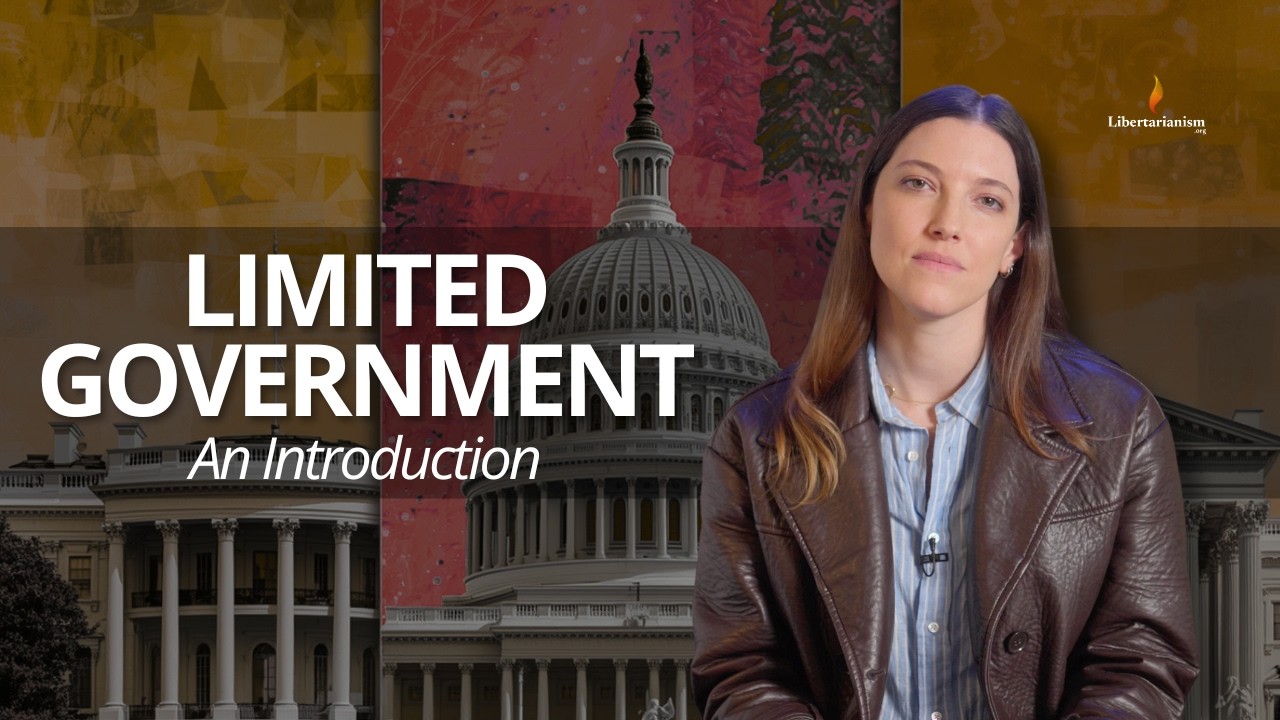
Video summary
The core argument presented is that government authority must be strictly restricted rather than expanded based on the belief that "good people" will use it wisely. History demonstrates that political power rarely remains in the hands of allies forever; eventually, those same powers are wielded by individuals or groups with whom one disagrees. Once a state acquires new authorities, historical precedent shows they almost never relinquish them voluntarily. Therefore, the critical question is not merely who holds office, but how much total power any government should possess to begin with. This philosophy forms the foundation of limited government, which aims to prevent the dangerous concentration and arbitrary use of coercive force against individual rights like life, liberty, and property.
The concept does not imply an anti-government stance; rather, it recognizes that the state has a delegated role specifically for protecting these fundamental rights without ever becoming powerful enough to negate them. While early discussions on limiting power appeared in ancient civilizations, formal institutions emerged during medieval Europe following the decentralization caused by the fall of Rome and the resulting competition between secular and religious authorities. In pre-modern times, both monarchs claiming divine right and powerful church entities held immense sway over life, law, and taxation without accountability. Over centuries, these unchecked powers clashed with emerging principles that rulers must also be subject to the law, a struggle culminating in documents like England's Magna Carta, which forced even kings to accept limits on their ability to seize property or punish subjects arbitrarily.
In establishing an independent nation, American founders studied this history carefully and designed a system of delegated, enumerated powers specifically to avoid accumulating unchecked authority again. This experiment generated unprecedented freedom and prosperity by preserving the concept of limited government through three key institutions: the rule of law ensures equal application of clear rules for everyone; separation of powers with checks and balances prevents any single branch from dominating others; and federalism disperses power further by reserving certain functions to local levels or individuals. Although modern societies may no longer debate divine right or church-state separation, they still face the ongoing challenge of defining these boundaries because unlimited power remains attractive to those in authority who seek to impose their will on others.
Ultimately, limited government is not a partisan philosophy but the most effective tool available to secure individual liberty and societal prosperity. Free societies have never been built by benevolent dictators but by limiting institutions that hinder people from thinking, speaking, and acting according to their conscience and needs. The transcript concludes with a stark warning: freedom survives only when power itself is restrained, because once authority expands beyond necessary limits, reversing the trend becomes incredibly difficult even for well-intentioned citizens who may have initially supported it.
Read the full video transcript
Have you ever thought to yourself,
"If only the right people were in power,
we could fix everything."
Most people don't support big government
because they love tyranny.
They support it because they believe
their side will use it wisely.
>> [cheering]
>> Thankfully, government power [music]
never stays in the same hands forever.
The powers you give to your allies today
will eventually belong to people you
disagree with tomorrow.
And once governments [music] take on new
powers, history shows us they rarely
give them back. The question isn't then
who [snorts] is in power, [music]
but how much power should the government
hold at all?
That's the foundation for the idea of
limited government.
Welcome to libertarianism.org,
learn [music] more.
An introduction to limited government.
Limited government is a political system
in which the power of the state is
restricted, typically through a
constitution that establishes its scope
and structure.
Its purpose [music] is to prevent the
concentration of coercive power and
especially its arbitrary use against
individual rights.
Limited government does not mean
anti-government.
The state has one main role, protecting
our individual rights such as life,
liberty, and property. In other words,
government has been given delegated
authority to [music] protect our rights,
but it should never be powerful enough
to negate them. Limited government is
one of the greatest accomplishments of
humanity and the struggle to achieve it
was a battle of liberty against power.
Even though these ideas were discussed
back in Imperial China and Ancient
Greece, for example, a A
of the limits to political power and its
embodiment in formal institutions
emerged during the Middle Ages in
Europe.
This was not a product of mere
philosophy, but the result of the
decentralization
of political power after the fall of the
Roman Empire.
Competing secular and religious
authorities ensured that no single power
could fully dominate society,
helping give rise to the separation of
church and state and the idea [music]
that even monarchs should face limits to
their power.
In pre-modern Europe, the church was
incredibly powerful and affected most
aspects of life.
Church offices had political and social
prerogatives enforced by law.
They were immune to taxation while being
beneficiaries of their own compulsory
taxes.
They had courts that could punish
religious law crimes, and they could
expel from [music] the territory those
who did not share the state religion.
They could also arrest, imprison,
torture, and execute religious
dissidents.
During these changes, the authority of
the monarch was also questioned. For
centuries, kings claimed to rule by
divine right, which meant royal power
could not be limited or challenged.
Over time, this came into conflict with
an emerging principle, that rulers, too,
should be subject to the law.
In England, in 1215, the Magna Carta
forced [music] King John to accept
limits on his authority, including the
idea that even the king could not
arbitrarily seize property or punish
subjects outside the law.
Although originally a political
settlement between the crown and the
nobility, it became one of the clearest
symbols of the idea that political power
must be constrained.
In the United States, the founders were
careful students of history.
When establishing a government
independent [music]
from the British rule, they decided on
one with delegated, enumerated, and thus
limited powers.
Their goal was not simply to create a
new government, but to ensure that no
government could accumulate that kind of
[music] unchecked authority they had
just escaped.
The American [music] experiment in
limited government generated an
unprecedented level of freedom and
prosperity. [music]
Today, this system of limits is
preserved through several key
institutions.
For example, the rule of law ensures
that power is bound by clear and general
rules that apply equally to everyone.
Separation of powers and checks and
balances divide authority among
different branches of government [music]
so that no single institution can
dominate the rest, which in turn are
meant to hold each other accountable.
Finally, federalism [music]
further disperses power by limiting what
the federal government can do,
leaving the rest to local institutions
or the people themselves.
In this series of Learning Curve videos,
we'll explain [music]
each of them. Subscribe so you don't
miss any. Now, even though modern free
societies usually no longer fight for
the separation of church and state or
argue about the divine right of
monarchs,
>> [music]
>> they still struggle to define the limits
of government power.
History repeatedly shows us how easily
even well-intentioned people can support
greater concentration of authority and
how difficult it is to reverse once it
happens.
Unlimited power will always be
attractive to those in authority or
those who seek to impose their will.
However, we must remember the power you
give to your allies today will
eventually belong to the people you
disagree with tomorrow.
Limited government is not a philosophy
of one political faction or another.
It is the best tool at our disposal
[music] to ensure liberty for the
individual and prosperity for the
society.
Free and flourishing societies [music]
have never been built on the backs of
good dictators, but on limiting the
institutions [music]
that hinder our ability to think, speak,
and act according to our conscience,
wants,
>> [music]
>> and needs.
Freedom survives only when power itself
is restrained.