Video summary
The speaker, a cancer survivor who faced melanoma while training as a resident, shares his personal motivation for creating transparent medical content to demystify complex topics like kidney cancer treatment. He highlights that before 2005, surgery was the primary management strategy because earlier therapies involving cytokines carried high risks of death with limited cure rates, and conventional chemotherapy or radiation had largely failed. The landscape shifted significantly between 2005 and 2015 with the introduction of vascular endothelial growth factor inhibitors that blocked tumor blood vessel formation, followed by the advent of immunotherapy which harnesses the body's immune system to fight cancer cells.
Immunotherapy works through a complex interplay between the innate and adaptive immune systems, where various cell types like neutrophils, macrophages, T-cells, and B-cells communicate via chemical signals to either attack or suppress threats. A critical mechanism involves checkpoint inhibitors such as anti-CTLA4 and anti-PD1/PDL1 drugs that prevent cancer cells from "hiding" by suppressing the immune response; however, these treatments do not work for everyone because tumors can evolve multiple defense strategies, including recruiting regulatory T-cells to create an immunosuppressive environment or losing their ability to present antigens. Furthermore, factors like high levels of VEGF in the tumor microenvironment and specific genetic mutations such as lost VHL genes contribute to a unique biology where cancer cells thrive despite immune surveillance.
Predicting which patients will respond remains challenging because biomarkers are not static; for instance, PD-L1 positivity can change dynamically based on treatment or environmental factors within the body, leading to confusion when different companies use varying thresholds to define "positive" results. While early studies suggested that PD-L1 status was a reliable predictor of success in kidney cancer, later research revealed inconsistencies across different cancers like melanoma and testicular cancer, where some patients with positive markers did not respond while others without them did. Despite these complexities, there are documented cases of long-term survival and potential cures through combination therapies involving immunotherapy agents alongside targeted drugs or radiation that induce immune-stimulating cell death.
The future of treating kidney cancer relies on overcoming tumor plasticity where cancers adapt by building fortresses against the immune system using various checkpoints and hiding mechanisms in specific organs like the liver or brain. Researchers are actively exploring new pathways, blood-based assays to reduce reliance on biopsies, and combination strategies that might restore exhausted T-cell function while addressing why certain tumors fail to respond initially. Although long-term data is still needed to confirm if deep responders achieve permanent cures without relapse, the speaker emphasizes a collaborative approach involving patients, caregivers, physicians, and industry partners to drive progress through clinical trials and advocacy, maintaining an optimistic outlook for continued advancements in fighting this disease.
Read the full video transcript
thank you and so you know as I get
started I just wanted to share a quick
story with everyone that I myself am a
cancer survivor I had a melanoma that
was diagnosed on my face when I was a
resident and my wife had just given
birth to our first daughter and it was
just an absolutely terrifying process I
met with several different surgeons had
several different consultations and
while I spoke the medical language it
was still all confusing and overwhelming
and I really wanted to base this talk
and I really created a brand new slide
deck for this individual meeting with
the hope of just making everything as
transparent as possible try to remove as
much doctor speak as I possibly could
and if questions are emerging either
during the talk or after I'm happy to
take any questions that come out so it
really is my honor to be here today this
is a complex topic because I believe we
really are just scratching the surface
of immunotherapy and amino oncology
there are a lot of agents that are
coming down that are very exciting that
by themselves may not have a huge role
but in combinations may prove to be
tremendous game changers so the title of
my talk why does the immunotherapy not
work for everyone
what are predictors of success can
patients be cured
disclosures and so as we've discussed
and you've heard so far prior to 2005
our surgeons played the biggest role by
far in managing of this cancer and they
still very much do from the medical
oncologist perspective what could we add
with cytokine based therapy and these
are basically therapies that made people
feel like they had the flu and they
really were an all-or-none phenomenon
they work for some about five to seven
percent of patients who received
high-dose interleukin 2 with metastatic
disease would never relapse again and
they were cured with a very intensive
but short period of time however during
the initial studies 1% of patients who
were treated died from being treated and
so when you think about 5 to 7 percent
cure with 1 percent risk of death that's
a very very narrow window chemotherapy
have been tried and deemed a failure
radiation had been tried and at the time
conventional radiation had not shown any
effect and this is one of the slides and
I'm going to show very few of these
kaplan-meier curves but basically if you
look at the y-axis which is the one that
goes from top to bottom a hundred
percent of people are alive when you
start is your percent and this is for a
continuing of response so a hundred
percent of patients are at the top 0
percent of patients are responding and
then duration on the x-axis at the
bottom is in months and what you can see
here is the patients that have the
complete response many of these patients
are never going to have recurrence of
disease up to ten years after however I
caution everybody in the room including
the medical oncologists in the room and
the surgeons you can see that patients
even in complete response there were
patients that relapsed and while we are
very excited about the complete response
that's being seen with the combinations
of immunotherapy until we have longer
term follow-up we can't call all of
those patients cure and that's important
so clear cell renal so others have shown
this but this is a me she and I when we
have patients come into clinic we draw
this out and I think about this in very
simplistic terms so if you look at a
clear cell cancer cell VHL and so VHL
basically is a gene and this gene was
discovered in the 1980s and was named
after two famous scientists that were
working on kidney cancer this gene
produces a protein also called VHL and
this controls and regulates hip hip is
your oxygen sensor in cells so in ninety
percent of clear cell renal cell
carcinoma VHL is lost these are both the
film the familial type which is the VHL
syndrome and then in also sporadic cases
and it can be lost in a variety of ways
it can be silenced the the protein
itself can be malformed there's a lot of
different ways that this can be impacted
but when it's lost what happens if
starts building up and so your basically
your cell is signaling I don't have
enough oxygen so it goes into the
nucleus and it spits out growth factors
and so I think about these like
fertilizer for where the tumor lives and
so one of the most famous is veg F and
veg F seems for vascular which are blood
vessels endothelial which are blood
vessel lining cells and growth factor
again is fertilizer on all these blood
vessel cells they have receptors that
are looking for this signal and this
causes these blood vessels to
continually sprout and form new blood
vessels which is why clear cell kidney
cancer is an extremely vascular tumor we
can block veg F with Bevis is a map we
can block these with a variety of
different DK eyes and so in the era of
2005 to 2015 this was where the real
progress was made so the immune system
is incredibly complex
but trying to break this down into more
simplistic terms we have an innate
immune system and so if you go all the
way back to flies & insects and then
earlier lizards you're gonna see an
eight immune system and then in more
advanced species including humans you
begin having the adaptive immune system
so the innate immune system neutrophils
these are your first responders anytime
there's some a bad looking you cell the
neutrophils rush in they release a lot
of chemicals and this is why when you
get a cold
your initial days are pretty miserable
as they're secreting everything trying
to control it macrophages these are the
eaters of damaged cells eosinophils they
help you target parasites and allergies
the reason why I think we have so many
allergies these days is we live in a
world where we disinfect everything we
no longer have parasites so aureus nfl's
don't know what to do with themselves
dendritic cells these are cool cells
these basically help pick up dying cells
and debris and their goal is to show off
to t-cells what they found in between we
have these natural killer cells and
there's a lot of really exciting
research looking at these their goal is
to recognize self versus alien and so if
you're a cell that's not supposed to be
there their goal is to take care of it
the adaptive immune system these are B
cells and the B cells when they're
triggered produce plasma cells which are
antibody factories and then we have T
cells and these are the smart killers
there's a very delicate balance because
you can have malfunction on both sides
over activation and so I think about
tuberculosis tuberculosis kills people
because you have an infection that the
body is trying to control and contain
and just cannot but the reason why it
was called consumption for many years
was because you would consume everything
in your body all of your energy stores
trying to get
rid of it overactive can also be due to
inflammatory conditions like autoimmune
diseases such as rheumatoid arthritis
and lupus we also see inflammatory
conditions lead the cancer so Austria of
colitis has a very high write rate of
colorectal cancer under active death due
to infections inability to heal wounds
and also potential development of cancer
so there is this how do we achieve this
balance there is an incredibly complex
communication that occurs between cells
tissues organs chemical signals are
constantly being sent out trying to make
sure that everything is is in status quo
some of these signals stimulate the
immune systems while others will knock
it down some of the immune cells are
active in targeting cells and others
actually suppress cells the amazing
thing is everything is plastic and so
cells can change from one to another
depending on their environment and so
part of our issue with all of this is
when we get a sample even if it's a
tissue biopsy we're seeing a window of
time we're not seeing the evolution when
I'm showing at the bottom where it's
just M that's again the macrophage and
this is way over simplified because as
we continue to explore we continue to
find more and more subtypes or
macrophages but in simple terms m1 tend
to be good macrophages that you want to
have around m2 our negative regulators
of the immune system t-cells there's a
variety of T cells T cells became very
imprinted in everyone's mind during the
age during the HIV epidemic and we think
about t1 these are cd8 T cells and t2
these are cd4 T cells cd4 are the ones
that are targeted by HIV we also think
about these t1 cells as being our T
effector cells and then we can have T
regulatory cells again these are ones
trying to help suppress the immune
response which is good because you don't
want to have
immune system that's again always turned
on the cancer finds a way to cause these
regulatory cells yet help keep away the
good immune cells from targeting the
cancer cells all right so let's briefly
talk about t-cells and so when we're all
growing up in our very early stages
after we're born
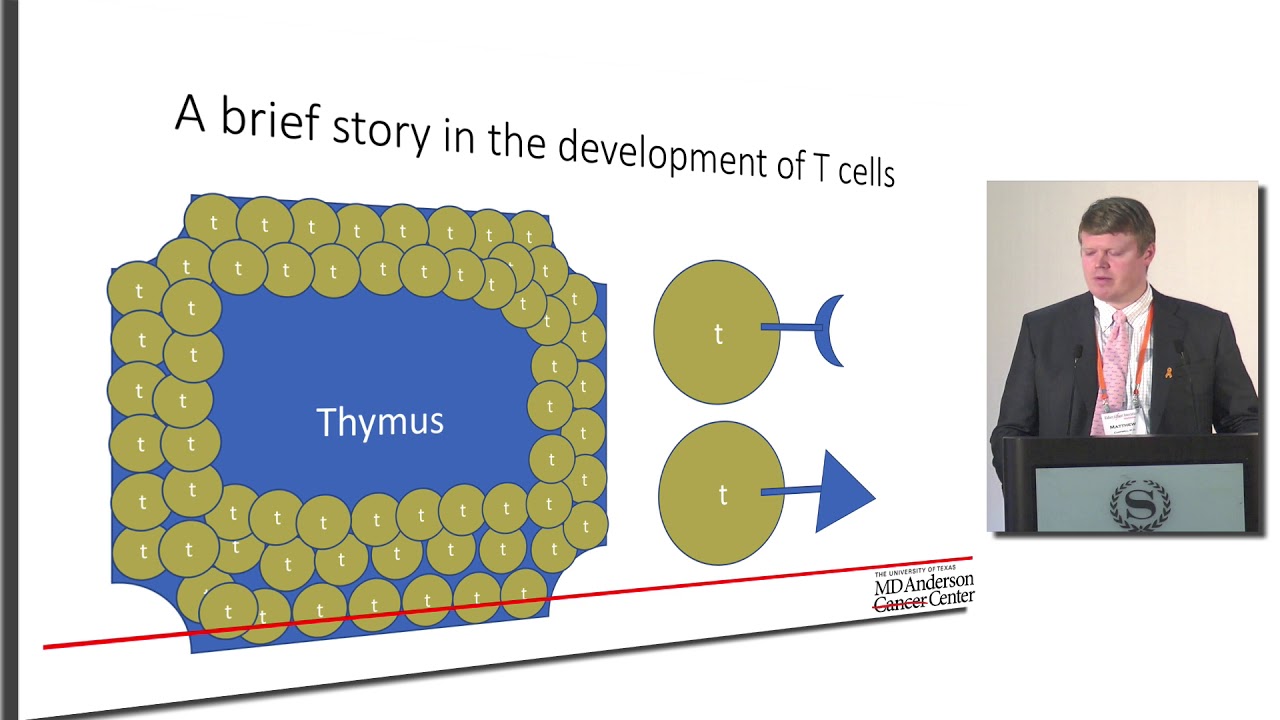
we're born with a thymus and most of us
have had our thymus disappear by
adulthood but during the time in the
thymus these baby t-cells and I made
them a little tea are constantly being
exposed to self antigens and if they
react to self antigens they're removed
because you do not want to attack
yourself you want to attack things that
are foreign and we literally have
millions of t-cells that then eventually
are able to make their way doubt most of
these t-cells are either at times in
circulation
we have t-cells that end up in the gut
those are a little different than the
standard t-cells we also have T cells
that make it into lymph nodes so let's
think about the common cold so the
common cold
we have infected cells that are virally
infected and these cells are trying to
figure out ways to get a flag up that
says help me and so what happens you get
this Russian of the innate immune system
shown here in purple and yellow these
are some of the antigens that are inside
these virally infected cells and what
this flag at the top is is one of these
antigens that's being brought up to the
surface so you get this Russian of these
killers or these neutrophils and these
cells can die in a variety of ways these
cells can die by something that's called
apoptosis which is a shrinking of these
cells which then can be munched up by
the macrophages you can also die from
necrosis and necrosis is the split
opening of these cells which is much
more immune stimulating dendritic cells
can pick up debris there's a release of
cytokines and chemokines these are
chemicals that help sound the alarm
we have learned over time and Jim
Allison did a lot of this work at during
his time at a variety of places he's now
the chair of our immunology department
at MD Anderson but these signals are the
dendritic cell has to present its
antigen to the t-cell there also has to
be a second signal that allows these T
cells to activate and this signal is
between cd28 on T cells and cd8 T on
these dendritic cells or what's known as
professional antigen presenting cells if
the signal occurs this rusting T cell
can turn into a effector T cell and have
some of these then go kill the virus and
then there's a potential to generate
memory and if you generate memory this
is why if you're exposed to the same
infection again you're unlikely to get
it and that's why vaccines in general
have been the greatest thing that has
ever come out to help protect the
population as a whole against things
like polio and measles and other
infections that killed many many
patients and children however when cd28
comes up ctla-4 comes up soon after and
it blunts that immune response because
again you want to be sure that this is
worth going after we can block ctla4 and
this is your paluma map which has been
discussed earlier and other agents that
have been in testing as well
and when this is blocked again you have
the better chance to then generate these
T effector cells and potentially that
immune response as well
the pd-1 PDL one which has been talked
about pd-1 is programmed death like our
program death receptor 1 and program
death ligand 1 and so these are mostly
in the tumor micro-environment
the ctla4 is more on lymph nodes and so
it's considered an earlier earlier event
and so I really liked Mike slide earlier
today with the police officer
because I think that's really true you
really help get more of those police
officers in with ctla4 but the police
officers that are there are helped by
this PD one PDL one interaction so I
think about the PDL one as a camouflage
for the tumour the other thing and I'll
show this a little bit later is PDL one
can also be on effector T cells or also
on other immune cells in its environment
and those are basically a sleepy
exhausted signal so kidney cancer still
is a little bit simpler because we have
Nivola map here but I also treat
patients with bladder cancer and in
bladder cancer we have five agents that
all are attacking the same pathway so we
have PD one and then we have PDL one
antibodies all of these there's a
variety of these that are also currently
in testing in renal cell and there's a
good chance that some of these drugs may
come online in the not-too-distant
future so where do we stand with Amino
therapy in 2018 for kidney cancer so
opdivo or Nivola map approved in 2016 it
improves survival as compared to
patients who are treated with everolimus
which is an mTOR inhibitor in patients
with metastatic clear cell kidney cancer
22% of patients had response I don't
think that's the whole story because I
really believe that more patients and
22% have benefit the issue with response
is when we think about response on
cancer trials that means that patients
have to have a 30% reduction in their
cancer burden measurements when we take
measurements this was developed in the
era of chemotherapy and it doesn't apply
as well to immunotherapy the side effect
profile of nivolumab was very reasonable
8% of patients had to stop therapy due
to major side effects and when they
looked at tolerance has compared to
everolimus who was much better tolerated
so nivolumab plus apple of a map was
approved earlier this year and I was
actually a typo it's 2018 not 2017 and
it's based on the checkmate - one for
study and so patients on this study were
given either Nivola mAb a nipple in the
map or given sunitinib 42% of patients
had response however when you compare
the rate of patients that had major
events 22% of patients had to stop
therapy due to the serious immune
related toxicities we are very excited
about a lot of the combinations that are
quickly coming down the pike that are
combining the veg F tki therapies with
immunotherapy their response rates that
we have seen in phase one and two
studies have been very high and multiple
phase three studies are soon to be
reporting and there are going to be some
that will be reported at a conference in
October which is the Europe the asthma
or European European Society of medical
oncology so can we predict response the
answer really is no we're still having a
major problem here it seemed really
simple this study led by dr. T'Pol Ian
it seemed that if you had PDL positivity
in cancer cells your chance of
responding was was real and we saw this
across a variety of cancer types this
included melanoma kidney cancer and lung
cancer if you are negative on this
initial study no response we have
learned over time though that that's
just not the case we're struggling in
some ways because every company has a
different companion biomarker everyone
has a different antibody everyone is
testing different things some companies
are only testing tumor cells other
companies are only testing the
infiltrate for PBL positivity and others
are testing both even when the same
company is testing and different or
doing trials and different tumors
they're using different cut points and
even sometimes in the same type of
cancer they use different cut points and
when I say cut point what does that mean
that means that a patient is considered
positive if they have a 1% staining and
what I can tell you is if you sneeze on
a slide it can look at it's 1 percent
positive some companies are using 5
percent some are using 10 percent some
are using 25 percent so it's all very
confusing
so the PDL status in kidney cancer so
this had been shown for a while that
patients that have PDL positive tumors
and this is really in the era of the TK
i's prior to the introduction of the
mean checkpoints bill is felt to be a
negative prognostic marker so what does
that mean patients that were positive
here were less likely to do well with
treatment or were it meant that they
basically had a worse overall outcome if
they had this as part of their initial
diagnosis on staining when the checkmate
su-25 was tested which was again to
volum a versus everolimus patients in
both groups did worse if they were PDL
positive it did not impact their
likelihood to respond and Nivola map
still did a little better than ever
limas on that side of things so it was
not decided that we should need to check
patients for PDL positivity
checkmate 2 & 4 looked encouraging
because patients who had PDL positivity
did better with immunotherapy as
compared to submit nib and patients
appeared to have a higher rate of
complete response if they were positive
as compared to those who are negative so
perhaps we're overcoming the negative
prognostic marker of the
yell positivity this is so confusing to
me because in melanoma it's the exact
opposite conclusion
if PDL positivity was simple all
positive positive patients would respond
and all negatives would not but it's not
so and part of the reason why and this
is a very nice illustration by Pam
Sharma and Jim Allison from MD Anderson
his PDL positivity is dynamic and what
does that mean it means based on what a
patient is receiving at that given time
or based on what's going on in their
body at that time PDL can be positive or
negative so a patient can flip their
status as being positive or negative it
is not static the other thing that is so
interesting is even if you sample
multiple areas in the same patient at
the same time you may get a different
result what they're showing on the
figure to the right is a tumor that is
invaded by multiple different immune
cells these are called the hot tumors
and then at the top these are considered
cold tumors and again the cold tumors
are felt to be less likely suitable for
just targeting pd-1 or PDL one I also
treat patients with testicular cancer
and they're a huge number of patients
will be PDL positive but we're not
seeing any responses using pd-1 or PDL
one agents in us because they have no
immune cells they're always like this
slide so this is an example in melanoma
melanoma and kidney cancer have been
cousins for a long time due to the use
of high-tech high-dose interleukin 2 so
I always like to keep track of what's
going on in melanoma so in melanoma
about 50% of patients who have cutaneous
melanoma will have a beer a few tation
and the first breakthrough drug that
came out for metastatic melanoma was
targeting b-raf and what you can see
here is in the top two slides
you see cd8 positive and cd4 positive
and the pink are the immune cells that
have infiltrated into this tumor six
weeks into treatment with this drug
which is a b-raf inhibitor you see this
massive influx of immune cells and then
when you see when the patient's cancer
grows because patients will eventually
lose the response with these drugs all
those immune cells are gone
and that tells you that you have a
window to see what actually is going on
with within these tumors and if a biopsy
is done that progression you may not
learn why the patient is progressing so
I mentioned earlier that PDL can cause
exhaustion and T cells and so if we are
able to target this again we're able
we're able to potentially restore their
functionality but interestingly what a
tumor is secreting into its environment
also is influencing PDL status and we've
there's been some very nice modeling
that's come out this showing the high
levels of bad Jeff can cause effector T
cells to produce PDL so why do patients
maybe not respond well we've seen that
effector T cells can malfunction we need
these t cells to be able to secrete
they're killing basically their kill
function and one of their main kill
functions is producing something that's
called interferon gamma and there's been
some very nice work that has shown that
these T cells can have a malfunction in
that pathway so that they can't do their
job mi a means that they're missing in
action they're just not present we've
also found that there's many many more
checkpoints than just ctla4 and pd1 and
PDL one from a tumor standpoint what are
we seeing tumors can evolve they can
figure out ways to get around and to
bring up other immune checkpoints
Houdini they can hide it can do a better
job of not showing off antigens that
they may have
and they can continually work on
camouflaging with other immune
checkpoints they can build up a fortress
they can bring in a lot of negative
immune cells to help keep good and mean
cells out and there's a potential that
some organs in their environment may be
worse and we think this may be the case
with potentially liver and bone and
potentially brain so what else is going
on so we're exploring if we can kill
cells through various mechanisms
freezing and cooking high-dose radiation
to help cause some of this necrotic cell
death to be more immune stimulating or
exploring additional pathways that may
be important to kidney cancer and we're
trying to work on blood based assays to
hopefully try and limit biopsies as we
move forward so do we cure patients with
modern immunotherapy I'm gonna give a
couple of cases where I think the answer
to this question is yes so this is one
of my patients 66 year old male who came
in with fatigue weight loss not feeling
well very rapidly growing breast mass I
don't know if my right here this is a
tumor they actually at the outside
Hospital a diagnosed him with triple
negative breast cancer so male breast
cancer is something that we see quite
commonly at MD Anderson 90 Oh somewhere
around 95 to 99 percent is hormonal E+
so you're taking a rare cancer and even
making it more rare
so who's referred to our breast group
they did additional work of yet bone
metastases large kidney mass he had
tumor within the liver
so when I saw him you was not feeling
well he had lost nearly 20 pounds poor
appetite coughing pain having worsening
anemia
he had elevated neutrophil count he
clearly had pooris disease we did a
kidney biopsy extensive necrosis with
clear cell features and that looked the
same as the breast biopsy so we actually
put them on one of the clinical trials
and so this is a patient's breast mass
you can see it here and then see it
melting away you can see his baseline
scan and what I want you to look at here
is see how in this tumor there's this
white area and then this very dark area
this area right here to keep an eye on
because that's what these tumors often
look like centrally necrotic but when
you look at it over time that now just
looks all the same it looks very cystic
in nature
he underwent surgery and sure enough
that entire large tumor there was no
viable tumor remaining after just six
weeks of treatment so that patient
remained on therapy for a while we
eventually took him off because he had
elevated pancreas enzymes and was
developing some symptoms he's been off
of all therapy now for over 18 months
and is doing remarkably well back to
work full-time this is a second patient
patient presented with hoarseness not
feeling well very very big burden of
pulmonary metastasis large kidney
primary in place yet anemia his calcium
was quite high not feeling well at all
he's also put on trial he gets two doses
of Nivola mab and that paluma mab his
lung metastases mouth his kidney again
becomes more cystic in nature my new
focus of residual cancer with therapy
effect at the time of surgery resumes
Nivola map we can virtually see no sign
of his cancer he's feeling great so are
these patients cured we're very hopeful
long-term data is lacking and so we
really want to be convinced
as a community that these systems these
patients will continue these responses
for a long time and I think many
questions remain
how long did treat the great responders
are complete responders the same as the
deep par 4 responders and how do we
select the best treatment for each
patient so the evolution of treatment
since 2005 has been clearly astounding
and how do we learn and continue to
improve we have to trust each other we
have to partner together we have to
advocate we have to fight every patient
is an individual you are not a stat and
we have to fight as a community and
what's the community its patients it's
their caregivers its physicians its
nurses its pharmacists it's everybody in
the team it's also our government it's
industry everybody plays an important
role and we make progress with
government funding industry and
philanthropy all agents that have been
approved to date only made it by
participation in clinical trials and
there remain substantial work to be done
but I feel that the future is truly
bright and the fight against this cancer
and with that I'll thank you and I'm
happy to take any questions
[Applause]