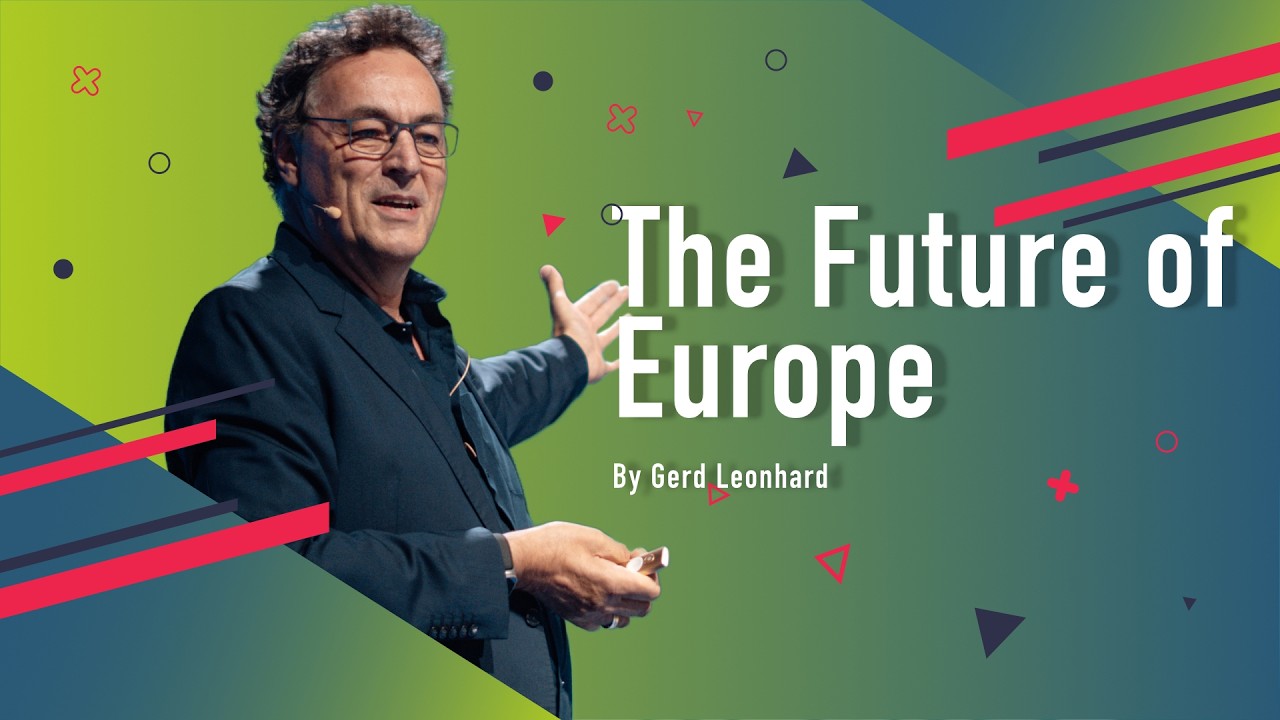
Why and How Europe must Take Back Tomorrow: Innovation + Humanity! Gerd Leonhard 2026 Keynote Topic
Watch on YouTubeVideo summary
The video argues that Europe must stop viewing the future as a product generated by Silicon Valley or China and instead recognize its own agency in shaping what comes next. The speaker highlights a troubling trend where the traditional American model of progress is fading, giving way to what is described as a "bad future" characterized by decline and inequality. In this context, Europe faces a demographic crisis with shrinking populations, as a significant portion of young people between 25 and 35 choose not to have children because they perceive their future prospects as bleak. This situation underscores the urgent need for Europe to reclaim ownership of its destiny rather than leaving it to external powers or accepting a trajectory defined by winner-takes-all dynamics that discard norms and laws.
A central theme of the discussion is the evolving relationship between Europe and the United States, which the speaker describes as an amicable divorce rather than a hostile conflict. While this separation is painful, it presents an opportunity for Europe to establish itself as the moral center of tomorrow's developments. The transcript notes that 96% of Europe's IT budget currently flows to America, creating a dependency that threatens European sovereignty and humanistic values. To become truly sovereign, Europe must pivot away from this reliance and foster a pan-European vision where human flourishing is prioritized over the technological dominance seen in other regions. This shift requires acknowledging that while Americans may also be humanists, their emphasis differs significantly, and Europe needs to define its own path forward independently.
The speaker emphasizes that the future is not something we merely observe but something we actively create through our actions, echoing the wisdom of futurist Barbara Hubbard. As Europe navigates this transition, it risks becoming a fragmented collection of nations resembling the "United States of Europe," a process driven by the changing tides in America and the internal realities of European decline. Despite the challenges and the illusion that others might solve these problems, the conclusion is clear: if Europe does not take back tomorrow today, no one else will. The call to action is for immediate engagement with innovation and humanity, ensuring that Europe leads the way in creating a future that serves its people rather than succumbing to external influences or internal despair.
Read the full video transcript
[music]
>> We need to stop asking this question,
what will the future bring? As if the
future was generated in Silicon Valley
or in China. And this is the amazing
thing that we have to learn in Europe
that we are actually in charge of our
future.
>> The American future no longer exists. At
least not as a global reference point.
What we are witnessing right now, it's
the rapid emergence of what I call the
bad future.
>> In in Europe, the numbers are shrinking.
All the All the countries are declining,
right?
And that is because most people between
25 and 35 70% are now saying they will
not have children because their future
does not look good.
>> The future is owned, not shared, and
it's winner takes all. Recently, the
secret to the world became simple. If
the most powerful democracy in the world
can discard norms, laws, and order, why
shouldn't everyone else?
>> Europe is getting divorced with the
United States. But as an amicable
divorce, it's really interesting. We can
still talk afterwards. We can still be
friends. We don't have to fight. In some
divorces, people actually get back
together. So, this process is painful,
but it's good for us in many ways,
probably overdue.
>> It was a great futurist, uh, Barbara
Hubbard, who said that as we see the
future, so we act, and as we act, so we
become.
>> Can we create a pan-European view of the
future? Can we claim the future and not
leave it to Silicon Valley or to China
or to Russia?
>> In Europe, we are humanists. I mean, we
care mostly that there should be human
flourishing. Not to say that Americans
aren't humanists, but
there's a different emphasis there. And
now we're discussing this to be
independent. Did you know 96% 258
billion euros per year of our IT budget
goes to America? Everything we use is
American.
How can we be sovereign, well, I
Yeah. Good luck.
>> We are becoming the United States of
Europe. This is inevitable. I mean, it's
happening all around us and this is the
way forward. It is painful for many. It
is an illusion for others. But, on top
of that, this whole process is being
driven by what is happening in America,
the sort of pivoting of America.
>> It's time for Europe to take back
tomorrow in 2026. It will be made
everywhere else, but it's moral center
must be Europe. Take back tomorrow
today.
Because if Europe doesn't do it, no one
will.