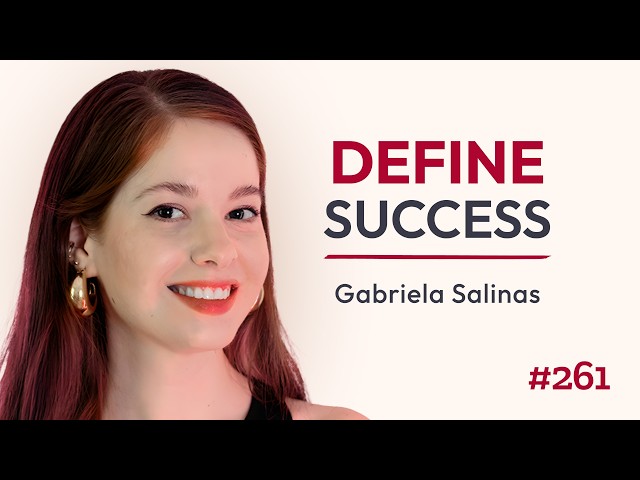
Who Are You Without Your Job Title / Gabriela Salinas / Episode #261
Watch on YouTubeVideo summary
Gabriella Salinas, a seasoned service design professional with over fifteen years of experience in finance, challenges the dangerous habit of tying one's self-worth to a job title, especially in an era where layoffs are common. She shares her personal journey of facing significant rejection despite holding previous leadership roles and active community involvement; after reaching the final rounds for seven positions, she landed none due to intense competition from Latin American talent pools and shifting hiring freezes. Rather than succumbing to silence, which she identifies as riskier than being visible, Salinas overcame her reluctance to "brag" by leveraging consulting projects, mentoring, and social media visibility, a strategy inspired in part by the book *Stop Being Humble*, to generate income and build meaningful connections.
The core advice offered is to move away from indiscriminately applying for jobs and instead engage in intentional career planning that explores hobbies and childhood passions to uncover transferable skills beyond traditional design roles. Salinas encourages professionals to embrace imperfect roles as stepping stones rather than fixating on specific titles, urging them to evolve their skills to match market needs such as behavioral design. She points out emerging opportunities where companies like Lovable and H&M are actively hiring for research and future-focused roles, signaling a growing recognition of design's value in solving complex challenges like sustainability and AI innovation, thereby countering the prevailing "doom and gloom" narrative that suggests all service design roles are disappearing.
Ultimately, the discussion concludes with a powerful reframing of success: individuals should define their own "purest idea of success" rather than inheriting external definitions based solely on titles or salary, and they must plan for multiple career scenarios to navigate market shifts. Salinas directs interested parties to her LinkedIn profile under "Gabriella Selenas," her Instagram account "design with 11 eyes" where she shares reels with subtitles, and her upcoming startup, Hybrid Personas, which offers AI-enhanced user personas based on actual research. The host, Mark Fontine, reinforces this takeaway by reminding viewers that market changes are not personal failures and urges everyone to calibrate their internal compass regarding what truly makes them proud, ensuring they remain resilient regardless of external circumstances.
Read the full video transcript
Hi, I'm Gabriella Selenas and this is
the service design [music] show episode
261.
There's a lie a lot of us in design have
quietly bought into that good work
speaks for itself and putting yourself
out there is just bragging.
But here's a twist. What if staying
silent is actually the riskier move?
That's exactly what we're digging into
in this episode. Hi, my name is Mark
Fontine and this is the Service Design
Show. Our goal here is simple, to figure
out how we design services that actually
resonate with people, push businesses
forward, and do some good for our
planet. Our guest today is Gabriella
Selenas. She's been designing services
for over 15 years, mostly in finance
with an entrepreneurial streak that goes
back to when she was a kid. She ran the
service design chapter in Mterrey,
Mexico. And now she's building a startup
focused on AI augmented personas
grounded in real research, not synthetic
users. What's interesting about
Gabriella's story isn't really the
resume. She'll tell you honestly that
the best thing that happened to her last
year was actually getting laid off. We
get into what she learned from reaching
the final round of seven applications
and landing none of them. Why she tells
her mentees to stop applying to
everything. and why some of the
designers she knows are now opening taco
shops because that turns out might be a
kind of success, too. I asked Gabriella
to just share her story and let us in on
what she's been learning the hard way
over the last years.
So, in today's conversation, we get into
how to stop tying your self-worth to
your job title and how to take rejection
less personally instead of letting
anxiety ruin your decisions. We also
talk about what you can actually do now
to prepare for your next move, including
a career futures exercise and how to
read what the market is quietly telling
you about where your skills are still
wanted. I went into this conversation
expecting a layoff story. But the moment
that stuck with me most was the
rejections, not the layoff. And the way
Gabriella worked through those hard nos
is generally useful whether you're job
hunting right now or not. So, let's get
into the conversation with Gabriella.
Stick around for the end because I'll be
back with a few closing thoughts. My
name is Mark Fontine and you are
listening to the service design show.
Welcome to the show, Gabriella.
>> Thank you, Mark. So happy to be here.
>> I feel like we've been connected on uh
LinkedIn at least forever. Uh and I've
been following your work, the work
you've been doing in the service design
community in Mexico for a very long
time. Uh I think a lot of people have
known about you, have seen you,
hopefully they've even met you. So it's
it's a pleasure to to have you on. Um we
are going to explore a topic that I feel
is very relevant and it's very actual
and it has come up a few times in the
past episodes. So that tells us
something and that is the fact that I
think uh a lot of professionals a lot of
service design professionals uh somehow
tie up a lot of their personal value and
a lot of their personal worth into their
work. We are very passionate about the
things that we do. We care about the
things that we do. Um but so much that
um when that falls away um it has a huge
impact on us on our identity on our
well-being and um that's not something
that uh yeah it's it's not an ideal
situation and now where our industry is
going through a tough time at least in
some places where people are getting
laid off or reorgarchs are happening and
people are struggling to find new ways
uh new new positions, new jobs. Uh we
need to we need to make sure that we are
in a good mental healthy condition. Now
you told me that you've been working in
the finance space as a design
professional for 15 years, but last year
you were also part of uh bigger wave of
people who lost their job because of uh
of a layoff. So, I'm really curious,
jumping straight in, could you take us
back to that moment and talk us through
what you feel was maybe the biggest lie
you were telling yourself about
your self-worth and how that was tied up
in your work.
>> Yeah.
So this is such a a close to my heart
topic because I've been working as you
said for over 15 years in the financial
sector and my last role I was there for
almost four years. I was leading a
strategic design and user research team
and just during the four years that I
was there this company transformed so
much. they came from having like big
rounds of investment and becoming a
unicorn. Uh so just like these companies
that really grow very fast this the
startup in the crypto space and when I
just joined the team was so big just in
general like the design team I think we
were like 30 people like doing product
design uh content and the research team.
I inherited the research team and there
were around eight people in the team and
then just shortly after that a couple
months later I I received the news that
they were doing a big layoff in the
company. Obviously the design team was
heavily impacted and then things were a
bit stable for several years and then
just like last year um the company was
struggling. They had a lot of changes
also in the leadership and then one day
they just cut a lot of people. They cut
the VP of design. They cut me and they
cut all of the research team. So this is
like something that I've seen happening
a lot as well. Um uh I'm doing coaching
and mentoring a lot of designers and
most of them that come to me they have
also experienced this and I I seen the
news. izing the linking post like this
is happening all over. So I thought it's
besides being personal, it's also
something that I worry what could happen
long term for design for designers uh
and for the companies as well
>> and u therefore it is a very important
topic to explore even if you're
listening right now and not impacted by
layoffs I hope you're not like this
might give you um a preemptive a sort of
a pre pro proactive
um advice tips ideas, suggestions, but
Gabriella, you sort of um quickly jumped
over the fact that you were let go. Now,
that might have come as a surprise or
not, but like how did you what was going
through your mind in like the week after
this? How were you looking at yourself
as a person, as a professional, as a
designer? It was funny actually because
I was living in Montter in the north of
Mexico and the it the layoff was on
Friday and on Monday I was supposed to
travel to Mexico City for a company
offsite and I already had planned a lot
of things for that week because it was
also my birthday week. Uh, and it was
like, you know what? I'm still going to
Mexico City. Let me book my own ticket
and just go there and speak with people,
network, see what what is going on, like
just reconnect with my community that I
had in Mexico City. Now I actually moved
back to Mexico City because I used to
live here. And those weeks, those
following weeks were very interesting
because for one side I was also
connecting with the other team members
that they live here in Mexico City. We
had free time. We were just going to
museums and stuff like that. But also
talking a lot about what do we want to
do next? Uh what do we see the market
moving towards? Uh and this was last
year. I think last year we were very
worried about AI but I I know especially
like this year this is more like
connected to what's happening to to the
playoffs. uh but just talking about the
potential of what we can do with all of
these tools maybe if we want to apply to
roles or to teach or just thinking about
a lot of possibilities but I was also
thinking to myself like I don't want to
rush I don't want to feel scared and to
make decisions like to just start
applying the next day like I want to
really take a moment to reflect to
disconnect to rest. Um I think I was
definitely having some burnout. So, this
was also part of the conversation like
how can we just try to enjoy life and
it's hard because you're I'm anxious
like maybe if I waste my time uh there's
probably going to be a role or something
that I might miss but just making sure
that uh on the personal side I'm I'm
grounded and I'm I'm connected to myself
and then just uh exploring the
possibilities.
>> You're making uh big leaps. So, we need
to unpack a lot of things. uh
>> being grounded and sort of connected to
yourself. Those are really important. I
want to understand a little bit more
about that. But but first
when you are let go and I'm I'm thinking
if I was ever fired, I don't think I
have been so I I haven't gone through
the experience but um so you'll have to
help me here.
Losing your role
maybe says something about the value
people put on design. So, the company
isn't quote unquote valuing design
enough to keep you and you're a design
professional.
How do you how did you deal with that?
Was that even a thought that was going
through your mind at that moment?
>> For sure. It was also my first time uh
getting fired and I think that there's
definitely this feeling of like who am I
now that I'm not there like I think
like having a role like in in my case
like being a manager and having like
this respected role in in in my design
community here in Mexico and also
because I'm very involved in in
community building like what are they
going to think is this does this has to
do with me like how much of this was my
fault or not that there were definitely
thoughts on my mind
um but at the same time you know since
I've been in community and teaching a
lot and mentoring as well um very
informally in the past but like
mentoring my students or people from the
community or even people that were let
go from a team my team in in the early
years just knowing that this is
something that is happening everywhere.
Um it's not exactly tied to to you and
especially when the entire team is let
go. It's more of an organizational
uh situation. Uh it was something that I
think give me a little bit of peace of
mind and also it was especially
mentoring like a mirror and a little bit
therapeutical talking with people that
were going through that because I was
trying to give advice to them but I was
at the same time like listening to my
advice like I think I'm giving advice to
myself uh on all of this and and making
sure that I understand that it's just
something that happens sometimes.
And were you doing that mentoring all
while you were still in that role?
>> Not really. I mean uh I will say yes
like informally but actually like
becoming a business and having like like
a website and everything came out
actually after the layoff. So okay, you
had a let's say a prestigious role, a
leadership role. People were uh you were
doing things that people valued that
your teammates valued and suddenly you
you lose that that it's not there
anymore. Now looking back on that
experience, did you feel
well prepared to go through that or is
there anything that you feel ah I wish
while I still had that role I would have
done XYZ?
>> Yeah, I mean not really like I think for
one side like I think the most typical
thing is that designers they never have
their portfolio ready. Uh it's always a
work in progress. It's definitely true
for me. Um, I'm actually still working
on that. Um, but I think that for sure I
would have liked to to document my
projects better while I was still within
the projects and be ready for that. And
then the other thing is
this is something that I say a lot to my
mentees but doing like some uh personal
futures exercise just thinking about
what can happen with your career in 20
or 30 years from now and exploring like
as you will do with a consulting project
for design futures like what could be
all of the scenarios that you could
experiment the good and the and the
[clears throat] bad ones and what would
you like to be doing? I think this is
something that I I tend to think because
I think I I've had an entrepreneurial
spirit since a young age and I've done
several like attempts of building
companies but like I think at that point
at that point I did not have like a
specific idea or something that I wanted
to build. So I think that when it was
definitely a surprise when I had the
layoff is like okay but what should I be
working on right now this something that
I I was not prepared for.
>> Yeah. And I can imagine that this
[clears throat] when you have a
quoteunquote stable job and things are
running and you're mostly busy
making sure that you're productive that
like there's an endless list of to-do
items. Like where do you find the time
to actually do conscious career planning
and scenario planning and think about
the future and like you're just happy
that you are in a position, right?
>> Yeah. You know what? It's funny because
I used to think that I never had time to
do any of this. But now, I mean, at
least in my current situation that I'm
working independently, I'm so extremely
busy compared to those times and was
like, you know, I should have made space
to work more on this.
>> And what would that look like? So, you
are now uh talking to other design
professionals. What do you tell them
like make space? What does that mean?
And what do you tell them to actually
do?
>> Yeah. So, I think that I have a lot of
recommendations.
For one, it's like I know that when when
your day is done, you're probably super
tired and you just want to lay on the
couch and watch a movie or something.
But just being intentional of for for
once like just recognizing the things
that you've done well because they will
translate into your portfolio or or the
stories you tell during uh any
interview. And then also like connecting
with people. I think networking and
community is super important right now.
I don't think like current jobs are
being found just on LinkedIn. I actually
know like so many of the people that
come to my mentoring sessions, they say
I applied to 50 jobs. It's like uh I
don't think that's going to be fruitful
for you. Like I see so many people just
not getting anything out of that process
but getting a job from a friend or a
colleague or just being visible. And
that's also something else that I say is
like I know a lot of people probably
dislike like this culture on LinkedIn of
like posting every week or every couple
of weeks or just being there and
especially I know because like we are
probably fed up with everything being
like AI writing but visibility it's also
something that is key to landing
whatever ever is next for you or just
exploring your even if it's h going to a
job or being entrepreneur or whatever
you want to do probably people will have
you in your mind if you're visible if
you're doing something if you're sharing
your thoughts so I think those those are
key like um I I will al also say like
explore like taking time to explore
hobbies
um in parallel. I think now we have the
the amazing tools that can help us
launch and make stuff like very fast and
exploring things even if it's just for
fun. But you never know if any of these
could ever be like a seed to something
for your future.
>> Uh yeah. No, absolutely. Uh, and when
you say explore hobbies, like I I
already I hear the resistance of
everybody who I don't know, they have a
busy job, they have uh a family. Uh so
um but I'm [clears throat] always
thinking like what's the price you'll
pay by not doing that, right? Shortterm
you might gain something, but long term
that's uh that's a challenge. you were
talking about uh applying to 50 jobs and
finding roles to uh via LinkedIn.
I'm very curious, did you eventually end
up applying for new positions after you
lost your previous role or did you
immediately go into uh the stuff that
you're doing right now? you know, it was
also I think a typical I would say, but
I didn't had actually the time to apply
to anything yet when I was getting
approached by companies. So, a lot of
companies just realized that I was free
and then they were like, "Oh, you know,
we have like this uh director of design
role or a lot of like service design
principal roles." Like, okay, this
sounds interesting. And I was open to
it. I always believe in like
you sometimes have to open doors, but
sometimes also open doors open for you
and you have to peek and see what's in
there. So I was very open at the time.
It's like I'm going to say yes to
everything and see where that leads me.
And so for all of these and there were
at least seven that I can think of or at
least that that I was really excited
about uh in different parts of last
year. Um so I did went and I had some
interviews and in all of them I will say
all of them I went on to the last
interview like sometimes it was four
rounds sometimes it was five h
presenting cases or uh doing some
challenges you know all of these things
that they require of you and all of them
they were always like oh we're so happy
that you came to this like you're
perfect for this role I even had some
colleagues in some of these companies
probably recommended me. I was so happy
about that. But the interesting thing is
like I landed none of those. Um and I
think that reflecting like why there's
going to be a lot of um things that I
know like for for some of them for
example I know that the roles were
landed by other people in Latin America.
So roles in Mexico, a lot of them are
still remote and a lot of them are
hiring in Latin America as opposed to
like for example being Mexican trying to
apply to other countries. They are all
almost all of them trying to get you to
the country where they at and that's not
always feasible. But Mexico there's
still some of these. So a lot of people
from Latin America applying. So the
talent pool is huge. So I know for sure
like for two roles, one was uh gotten by
a an Argentinian and another by a
Colombian. So that also makes it uh
really hard. A couple of those roles
didn't open which was also interesting
to like later talking with the
colleagues that just recommended me
there. It's like you know the company's
also struggling and then during the
process they realize they need to just
don't don't open roles. maybe they're
not laying off, but then they're
freezing hiring.
Uh so interesting uh um I don't know
findings or insights there of like not
really pushing towards these uh goals
like it was not something that I look
for. I still got I think at some point
excited about all of this and then also
going through like oh the heartbreak of
like uh maybe didn't happen for a
reason. Um I I empathize now a lot with
my mentees that come and they just say
like the same thing happening to them
over and over for a year. It's
definitely hard also on
your motivation and your worth.
>> Yeah. Yeah. Yeah. Yeah. Because if you
get rejected once like that, most people
can handle that two, three times. But
like getting to the final round seven
times and then not getting the role and
getting your hopes up and your
excitement and you've put in like
there's the sunk cost fallacy where
you've put in time, energy,
and now you're you're you're talking
about this in a very calm and
rationalized manner where you've sort of
looked at
why this might be happening. But at that
point, like how do you not let this get
personal? How do you what did you do or
or were you able to not make it
personal? Um, I think that maybe a
little part of me was making it very
personal, but I think that there's also
something else that I haven't touched on
and is that I was also being approached
to do consulting projects and those they
were closing. I was like this uh I don't
know it was like very very amazing for
me but it was like really flourishing.
uh started having a lot of projects for
mostly research which is interesting. Uh
I really love doing research and a lot
of like startups or small companies that
they don't have an internal team to do
this. They they needed this and then
also like some big companies as well
like some banks.
>> So hold on. So when you say I was
approached to consulting what does that
mean? Were people reaching out to you on
LinkedIn or sending you filling out the
form on your website for a new project?
Was like what was happening
specifically?
>> Yes. So I I mean the the very first ones
they were acquaintances that had me on
WhatsApp. So they just wrote to me on
WhatsApp like, "Hey, I just saw that you
were laid off. What are you doing? Uh do
you want to help me with this project?"
And then I just jumped into you know
like pitching the project and getting
the project and doing the whole project.
But eventually I think that uh over the
months maybe like by the six month uh I
was also working on being more visible
and just sharing like oh I'm doing this
workshop or I'm teaching here or just
sharing more things on LinkedIn. So then
I started to get more messages on
LinkedIn as well. But you told me uh
before that when you're not running
workshops, you are sort of more
introverted. How did that how did you
manage to do that? Because a lot of
people and I totally understand sort of
don't want to I don't know sell
themselves, be out there, promote their
work like they're we're as a design
community, we're often quite humble and
we don't like to brag. Um
>> yeah. How did you find emotes, Nar?
>> Ah, this is such a great topic because I
also think that
um when you are either building a
business or just trying to to get to
some place, you don't get the privilege
of being silent. You need to really brag
uh so so to speak. And it it was like a
big shift inside of me because uh
several years ago and this is 2016 to
2020 I had an educational company. It
was called Service Design Mexico. It's
probably why a lot of people know me on
the service design world. And during
that period I was really involved in
social media. So I used to post a lot
about this everywhere. I had a on on
LinkedIn, on Twitter, on Instagram. I
used to like everything that you saw
from that period, it was always about
that. And then when I came back to
corporate for this last role, for the
four years that I was there, I was just
sick of social media. It's like I want
to be a person on social media. I don't
want to be an advertisement for my work.
And it got has to do as well with these
questions about your identity. and like
I don't want to tie myself to that. And
for four years I abandoned everything
and I rarely spoke about service design
was just me leaving my life. I even
forgot my password for for LinkedIn. Uh
but then like now it's like okay I
definitely cannot afford being silent. I
need to be there. I need to be showing
myself my thoughts, my work. So, I open
an Instagram account that's designed
with several eyes and started doing
Instagram res, which at first was like
so cringy. It was like so hard to to do
and to see myself doing that.
But it's it's the same as like as
teaching or as facilitation as you were
saying being an introverted you have to
really do that several times until you
start enjoying it and and lose I also
get very nervous like for example giving
a talk uh I used to like sweat a lot and
my stomach will get upset and after
doing a lot of that it's like okay no
I'm I think I'm comfortable like being
here for example in this podcast I think
I'm comfortable that has to do with
exposure for sure like putting yourself
there like doing these reals and I'm not
saying everyone has to do this there's
so many platforms and ways like if you
want to write there's substack or if
doing a newsletter doing whatever
there's a lot of ways to get yourself
out there and be visible but for me it
was definitely like pushing myself to be
there and then realizing that there's
definitely fruits to gather from doing
that effort
>> now and when you share that you were
basically off social media for 4 years
and then you
figured out or said to yourself, I can't
afford sort of not to be visible.
What what made what changed? What
clicked? Like did you read a book? Was
there an experience or because that's a
big shift.
>> Yeah, there's actually a book. It's
called Stop Being Humble. Um I I read it
a while ago and I think I don't know if
it clicked until this point, but I don't
know like for me it's like I need to pay
rent. I need to do something uh to get
money. Um the
I I had savings but they're not going to
last forever. So while I was exploring
like what what will I do all of these
passions that I have, all of the things
that I want to explore, let me just
start getting out there and just be
there. I think probably that was like my
my biggest motivation was like I need to
make some money.
>> Sure. Yeah. And and I feel that there is
such a stigma around that, but like we
should be unapologetic about that. And
if you're like if you're earning money
by helping people honestly helping to
get them to where they need to be, for
example, by teaching or by being a
mentor, like you're doing something
hopefully good for the world and people
are paying you for that. Good for you.
Like that's a win-win. And I feel that
that's like a difficult conversation we
often have in our uh community. And
again, there's still a stigma around
that. Um
was there anything else you wanted to
add about this otherwise I'll have a
different ex thing that I want to
explore with you? Yeah, I mean something
also related to this is that
while I was doing all of this, I think I
was doing consulting. So consulting just
came out naturally to me and then I also
wanted to explore mentoring. So I just
started like posting like hey I have
these mentoring sessions if you want to
come. I did not expect a response
honestly like for a year now. It's more
than a year now since I launched this. I
had 90 people come to my sessions. So
that's around seven per month was really
really really interesting and eye
opening. And this definitely has to do
with the same situation like designers
getting laid off, designers unhappy with
their current job and trying to find
something else. they all wanted to just
take a look at for me to take a look at
their portfolio or their their CV and uh
also several universities and
educational companies reach out for me
to teach there. Uh and then just going
back to doing community events also we
have the the service design network
chapter in Montter Mexico City. So
definitely I could say like this super
um busy time for me. Uh but also like
interesting because in paper I will say
I don't have a job. So I don't I don't I
don't have this thing that I used to
value so much like this huge role on a
company and yet I'm doing so much things
and meeting so much people and just
being so happy about it. M and when you
when you talk to these uh 90 folks uh
which some of them are maybe struggling
to keep their job or have already lost
their job and they are feeling depleted
or sort of lost their sense of
contribution of value. um somehow you
managed to
I'm looking for the right words but lift
yourself up or find a sort of positive
narrative around that. Do you also see a
difference between the people who are
maybe able to
quicker get back on the feet and those
who sort of need more time? like is can
you can you identify some I don't know
character threads or signals?
>> I'm not sure if there's a character
trait.
I think that
it's more of how how I will say this is
something that I've seen like how
passionate are you really about what
you're doing? because I think that
there's a lot of people that are very
unhappy right now at their jobs. And I'm
not going to say that the companies are
not to blame. I know that there's in
Mexico for for sure. I don't know in
other places like uh very toxic
environments, very hard to sell the
value of design. I think this is making
it like harder and harder for designers
to believe in design and to to do
something about it. And I think also the
fear h this fear of losing your income
of and if you have family, if you have
people to care for all of these
compounds and makes it like very hard
for designers to be these people that
the they need to be and the companies
need them to be of being someone that
pushes back, that stands up for what
what the user needs for um just, you
know, like making sure we are not just
building stuff that someone ups
tell you tells you to do and
how can we like be sure that you want to
stay there because probably changing
companies is not going to change like
probably all of the companies are on the
same situation right now so I think
that's uh to me it's something that it's
been interesting on this process is like
if you really love design, you need to
stop fearing, stop being on this mindset
of being afraid and start doing your job
like your actual job of of raising your
hand, of pushing to do research, of uh
doing the things that we should be doing
properly. Uh and if not, then really
think about what you want to be doing.
Uh maybe it's not design, but that's
fine. also like I think there's a lot of
transferable skills from service
designers that can be applied to other
things and and this is something that
I've seen like becoming entrepreneurs uh
going to art uh doing different things
like uh I was telling you before this
like even like some people have open
taco shops so it's like there's stuff
that you can do that comes from being a
good designer that can be transferred to
something else that might also be your
passion and it's not within the
constraints of like current corporate
culture and you might be enjoying that
as well. as as we're listening to this,
there are there are really tough
subjects because how do we know that
we're passionate enough and how do we
know that um we should say goodbye to
this company and open a taco shop or if
we should push further for change within
this environment? Like how would you
respond to that? Like how do how do how
do I know if I'm passionate enough about
design? I don't know if there's just a
single way to know if you're passionate.
I know that if you're like really burned
out and and unhappy with the situation,
you might uh lose faith in design
doesn't really mean that you're not
passionate. Uh
but also I think that something that has
helped me and other people that I've
spoken with about this topic is maybe
trying to connect with whatever you were
feeling when you were a child and you
were thinking like what do I want I want
to do when I grow up. There's probably
some uh clues there of like what types
of work or things do you enjoy the most?
Is it like talking with people? Is it
building things? Is it thinking about
stuff? Like what are the essence? It's
not like you're going to be a
veterinarian, but it's like uh what
about that? Uh do you think it's the
essence of this and how can it be
transferred to current professions and
maybe there's something else there that
is not exactly doing design but could be
similar and you can also enjoy that
>> we might be stuck in some limiting
beliefs thinking that this is the box
that we need to be in because I don't
know we did the education or our
surrounding is expecting it from us or
we want this to actually succeed while
if we let go and sort of what happens
then we we open the box we start
exploring again we can still use a lot
of the skills and qualities that we have
but in areas that we wouldn't call
design like a taco shop is that what
you're saying
>> yeah I think that just breaking probably
your idea of of success
also like I think depending on like your
environment if you grew up also in a
family that was just pushing for certain
type of success as well that can have a
huge impact in why a lot of people are
afraid of also leaving uh for example a
highpaying job in the corporate world.
Um
sometimes it's about the title,
sometimes it's about the money. Um, I
think that's also something you need to
break up a little bit.
>> So, did did that change for you? Did
your notion of success change
when you look back for 3 years compared
to now?
>> Definitely, but it's still also a
process. It's not something that I will
say like, oh, I'm completely cured of my
ideas of what success looks like. I mean
for example just being independent
definitely shows up as having very
variable income and that can be very
scary for a lot of people um managing
through that. Uh but at the same time
you get so much of other things like in
my case for example freedom with my time
being able to do other things to enjoy
more of my family and other friends and
life. So it's just reformulating what
what do you gain from something and if
you are fine with losing something and
how big will it be to lose something? So
I don't think it's as scary for me now
to say like what if I never go back to
having like this high job or high high
role uh I never got to be a BP. Will it
really suck? Will it really matter if I
never get to there if I if like the
market was telling me like there's
there's something here about being
independent and like so many
opportunities open opening up. So
I don't know this it's not probably not
the worst thing that could happen.
>> And do you see that people are having
this conversation with themselves enough
and defining what success looks like and
why that is important to them?
>> Not enough. I think that the
conversation is probably around like all
of this disruption with AI and the
roles. Like a lot of people I know that
they were studying for example graphic
design still and they just came out of
college and it's like okay now I can
just do a lot of stuff with these tools
and also my clients will be doing all of
these. So a lot of concern of like these
roles are changing. You go into LinkedIn
and you see all of these roles with new
names that you've never heard of related
to AI. So there's a lot of that but just
looking beyond these uh grounds of like
corporate world and all of the roles
opening there's other possibilities and
I don't think that we're pushing beyond
what we see just as open roles
>> like could you give some examples where
where are where aren't we pushing
enough? Yeah. I mean just looking at for
example like this taco shop situation I
know a lot of um friends or or close
people they are like you know what I
actually never want to go back to
corporate. I was reading to this story
of a person that just became a butcher.
It's like so different to what they were
expecting. Or even people like moving to
the countryside or to the beaches and
raising uh animals or having a farm, you
know, that that probably wouldn't sound
as something you will be doing if you
were a designer, but there's also
success there if you apply your uh all
of your skills. So, I don't know like
those those things are not on LinkedIn
that you're not going to get to that
those places if you just look for open
roles.
>> But what if we really really want to
succeed as a service design
professional? What if we sort of say my
vision of success is to help
organizations design and deliver more
humane services. for that. I think that
there's so many things that that go in
there. I think that for designers it
thinking about designers that got
layoffs or thinking about designers that
want to move into service design if they
are not there yet or want to change
companies as well. Something that I say
is that you need to be intentional about
what you want
because I see like this mistake of
people just applying to everything but
they never reflected on for example what
industry do you want to be? Um what type
of company is it a startup? Is it a
familyowned? Is it really big
international company? Um exactly what
do you want to do there as well? if you
want to become a manager or you want to
be an IC. Uh are you more inclined to to
research or to facilitation or to
futures design like really really
understanding
where you're at? what do you want to do
and being intentional and then also
working on building the new skills that
you see. I I've been tracking also a lot
of these open roles. Um see like what
are they looking for? I know that roles
in Mexico are not asking for the same
things as roles in Europe.
Uh for example, I've seen here a lot of
behavioral design. So is is if this is
not something that you've worked on and
you see this pattern like a lot of
companies are looking for that then you
have to work on building or
strengthening those skills um probably
while you are at your current role
because they're going to ask like show
us a project or show us how how did you
do this uh take courses or learn more
about this. So I think uh if you're
really passionate and you love this, you
need to to evolve with the what the
market is also asking for these roles.
>> Yeah, I I like the word evolving. Uh
that sounds good. Uh and you said you
have to be intentional.
It's sort of a it feels almost like a I
don't know if it's a paradox, but at at
some point you might feel so hopeless
that you just apply to anything and
everything because you feel that you
don't have the position to be picky, for
example, and you just need to find a job
and you'll apply to anything that
remotely relates. But what you're saying
is that
if you are more intentional, actually
lending something
might not just something, not just
lending something, but something that
actually works for you increases your
chances instead of sort of trying
everything and every anything and
everything.
>> Yeah, for sure. I mean, I'm a probably a
little bit
esoteric thinking. means like not the
same as manifestation. I'm not going to
get there. But if you really write what
you want and you look for what's open uh
that fits this like um I don't know like
if you want really want to work in
healthcare for example because it's an
industry that really calls for on your
purpose then don't apply to fintech or
other things like really look for the
companies that you would love to work
see what they do the type of people that
work there, what are their skills, even
talk with these people. Some some people
are really open like uh knock on their
door, not to ask for a job, but just to
interview them and to see like what will
be really valuable for this company and
be be intentional on building upon that.
What I'm also hearing throughout your
story, and you haven't made this
explicit yet, so I just want to validate
if this is true, you don't have to find
the perfect job right away. You can see
uh you can think about stepping stones.
And if you find a position that sort of
has 20% of what you're looking for, that
doesn't mean that that's the end goal
and that you'll ever forever and ever be
here. um use that 20% and then figure
out what the next step is. Right? I can
also imagine that that's something that
limits a lot of folks out there of
actually taking the step because this
isn't the perfect role. So
>> I'm not going the industry doesn't match
with what I'm passionate about like how
do you feel how do you think about this?
This is so true and also I will connect
it with what they feel about the title
because I I know a lot of designers for
example they are senior and they want to
get maybe a principal role or or or
remain senior but they they maybe come
from a smaller company or they've been
senior like really fast and they don't
have a lot of experience and they want
to be there but then they want to apply
to I don't know like jobs in Silicon
Valley or jobs in like very fastpaced
environments
that's not going to transfer like you're
not going to be senior there. Uh don't
be afraid of losing that title. But
getting your feet on these companies
that you really love and that you
connect with there, you will grow
inside. I think that that's something
that really scares a lot of people and
then they don't take a job just because
it's not exactly the title that they
were expecting.
>> Yeah. It feels like taking a step back
while sometimes taking a step back is
actually a step in the right direction.
>> Yeah.
Now if you look into the future and sort
of project um and listening to everybody
who you've spoken to
where do you feel this is a very broad
question but where do you feel design is
heading and like yeah no let let me
pause there where do you feel design is
heading? Ah, okay. You know, while I'm
also looking for like through LinkedIn,
and this is not because I'm applying to
any job like because I already decided
I'm going to be an entrepreneur for a
while, but I still do this for my
mentees and for my students. I am
constantly looking at LinkedIn and
trying to to identify signals of what
will happen with all of these. It's very
easy to just get stuck on this narrative
of you know all of the companies are
laying off uh designers and researchers
and all of these which is true um but
I've also seen a couple of things that
made me hopeful and it's like there's
something there and the first one is
that I saw from lovable they are hiring
a UX researcher it's the first one for
this role and they are just at 200
or something uh employees on this
company. It's very for me it was very
interesting to see how for a very small
company but also like this uh hot uh
company in AI they are looking for a
researcher because they are not thinking
that AI will tell them what to do next.
they are probably saying like oh okay we
need to innovate and see what's going to
be next for our company and that's going
to be a researcher that's going to help
us for me but that was amazing to see
and then also I saw this role they are
all in Sweden for some reason something
happening there hope that becomes a
trend on the rest of the world but for
H&M
uh so also interesting like huge uh
fashion retailer they are hiring for a
design future
So they are also like trying to see if
the methodologies that designers have
could help them uh figure out how to
deal with and they were saying on on
this job posting like dealing with
sustainability issues like uh huge
demand and globalization and all of the
like very big questions that companies
have maybe designers could help them
solve this. I was really excited to see
this and I hope that's a direction that
other companies at some point they will
realize like you know what we actually
do need designers to talk with people
and to realize like what we can do
instead of just asking Chad GPT to tell
us what's next.
>> Yeah, it's good that you sort of
highlight this. I um I I like the
strategy of actually applying to some of
those roles. Um I'm seeing on the back
end uh what's happening with job
positions because we're indexing service
design jobs for the last five six years
and yes there are layoffs for sure. Uh I
know a lot of people who have been
affected by this but I'm also seeing
like new companies posting job listings
that companies haven't posted before. So
yes, some companies are firing design
professionals, but there are new
companies looking into hiring their
first, second, third service design
professionals. I would I wouldn't like
it's it's very easy if you go to
LinkedIn and sort of look at all those
messages to be doom and gloom about the
state of design. Um, but like if you
sort of dig underneath it, something
else in a different place seems to be
emerging, growing, bubbling, and it's
not as visible yet, but um, some
something's happening for sure. Yeah.
Now, um,
we like to sort of wrap these
conversations up with better questions
than we started with. Answers are easy,
good questions are hard. So, what's
something that you would like to
ask us? Something that we should think
about when we're walking the dog, taking
a shower. Uh, what is a valuable
question?
>> I think that good good questions have to
do with
uh what are you really good at?
um like the essence of this and how can
this be transferred to to skills that
companies might like?
Um
and also what is what is your purest
idea of success? like how how will you
really if you look back at at your life
after it's done like what will make you
proud and if it's like landing the
highest role or landing getting the
highest salary that's fine but just to
to really make time to to to think about
that and if it's something else uh how
can you get there like how can you plan
and and identify scenarios of maybe it's
not just one one path to get there.
Maybe there's different ways to get
there. So, how can you uh plan for
different scenarios and getting there?
>> Calibrating our internal compass. That
is the thing that sort of
>> emerged uh with me. Awesome. Now, you
are more active again on social media.
So, if people want to learn more about
your work, the stuff that you do, who
knows, maybe even hire you for a
research project, where should they go?
What's the best place to find you?
>> Yeah, so I'm in a couple of places. You
can find me just as Gabriella Selenas on
LinkedIn. Um, I have uh my Instagram
platform where I share these reals that
I was talking about. Uh, that's design
with 11 eyes.
>> Why 11?
It was actually just the the the one
that was open, but you know that that
the actual branding for it is five eyes.
And for me, it was like a personal
exploration of all of the things that I
value as design, so research, service
design, strategic design. Uh it's so to
me it's like expanding the idea or the
definition of design to fit all of these
uh ideas. But on Instagram, it's just
that the one that was available. So
there's actually nothing with the other
eyes except for design with one eye
which is for the Instagram design team
and other the others are abandoned.
[laughter]
But yeah, so I'm there and then I'm also
working on my own startup as hope to
launch soon. It's called Hybrid
Personas. You can also find it on
LinkedIn and on Instagram. And it's like
a repository of user personas enhanced
by AI with actual research. So it's not
synthetic users.
>> We'll make sure to add all the links in
their design with 11 eyes.
>> Something else, Mark. Sorry, just to say
like probably if you follow me on any of
these, you might see a lot of posts in
Spanish, but I also tend to have
subtitles. So I hope for the more uh
international folks they might not mind
of having like the spanglish uh context.
>> Nice. Good to know. No, I've I've
watched some of the reels and there are
good to follow with with the subtitles.
So for sure check them out. Nice.
Gabriella, thanks for giving us a little
bit of hope and sort of u uh
perspective. I think that's the word I
was looking for. Um, we need that right
now, especially right now. So, u,
thanks, thanks for coming on, sharing
your journey and, uh, yeah, being here.
>> No, thank you, Mark.
>> Before you head off, I want to leave you
with one thing that is still sitting
with me. Near the end, Gabriella asked
this question. What's your purest idea
of success? And I think most of us have
never actually sat with it. At best, we
often just inherit a definition, the
title, the salary, the prestige, and
then we wonder why a layoff feels like
it has broken us. Her other reminder
stuck too. So often it's not about you
or your talent. [music] As we've heard,
roles get frozen, teams get cut, the
whole market shifts. Taking it
personally is almost always the wrong
read. So, here's my takeaway. Run the
scenarios for your career the way you'd
run them for a client and get honest
about what success looks like for you
before somebody else decides it for you.
Huge thanks to Gabriella for being so
open about all of this. If you've
enjoyed today's conversation, you can do
me one big favor. Click the like button
in this video and leave a short comment
if you haven't done so already. Not to
feed the algorithm, but to let me know
whether or not we are on the right track
by addressing topics like this. Finally,
[music]
thanks for hanging out with me today. I
know you have a million things you could
be doing, so I appreciate you spending
your time here. I am Mark Fontine and
I'll see you in the next one. Take care.