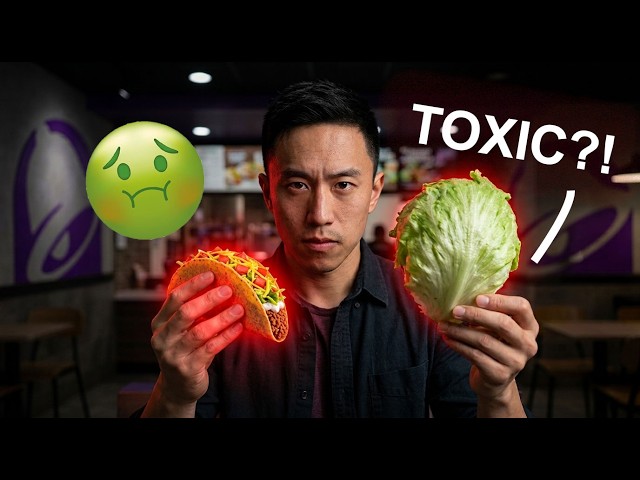
What The Taco Bell Outbreak Should Teach Every Restaurant Owner
Watch on YouTubeVideo summary
The video explores a critical lesson for restaurant owners drawn from two major outbreaks associated with Taco Bell, highlighting that the greatest risks in food service often stem not from what is prepared in-house but from external supply chains. In 2006 and again in 2026, massive illnesses occurred due to contaminated iceberg lettuce sourced from outside suppliers, yet the restaurant itself played no role in creating the contamination. Despite Taco Bell's innocence in these specific incidents, the brand absorbed the public blame, suffering reputational damage because customers care only about their own health when dining at a specific location, regardless of where the ingredients originated. This recurring pattern underscores a harsh reality for any business owner: a brand is only as safe as its dirtiest field, and relying on a single supplier for critical items can be as dangerous as having an uncontrolled kitchen.
The narrative traces Taco Bell's evolution from a small stand in 1962 to a global empire with over 7,000 locations, noting how the company successfully systemized fast-food Mexican cuisine before facing these supply chain vulnerabilities. The first crisis in December 2006 involved green onions and later lettuce, leading to a slow response that dragged on for weeks as the company investigated the source. By the time of the second outbreak in summer 2026 involving the parasite *Cyclospora* from supplier Taylor Farms, the numbers were even more staggering with over 10,000 sick people and two deaths across 17 states. However, this time Taco Bell acted swiftly to cut ties with the contaminated supplier within days of the issue surfacing, demonstrating that the difference between a manageable crisis and a brand-destroying scandal often lies in the speed of the response rather than the initial error itself.
From these events, the speaker distills three essential strategies for managing supply chain risks effectively. First, owners must recognize that they own their suppliers' mistakes just as much as their own kitchen errors, necessitating a thorough mapping of farms, distributors, and vendors behind every top menu item. Second, businesses should never rely on a single source for critical ingredients; having a dual-sourcing strategy ensures that one contaminated field or supplier failure does not shut down the entire operation like a fuse blowing. Finally, the most important takeaway is that hesitation kills brands more than outbreaks do, so owners must have written recall and response plans ready before any crisis occurs. Ultimately, the video concludes that while you cannot control every external factor, you can control your reaction time and preparedness, ensuring that trust is maintained even when things go wrong in the walk-in cooler or beyond.
Read the full video transcript
In the summer of 2026, a parasite that
most people cannot even pronounce is
spreading through 17 states. Over 10,000
people sick, hundreds hospitalized, two
found dead, and the name attached to
every headline in the country is Taco
Bell. But here's the part that doesn't
make the headlines. Taco Bell didn't
actually cook this. It didn't grow it.
This whole thing traces back to a bag of
shredded iceberg lettuce from an outside
supplier. The same kind of supplier that
supplies for half the industry. Taco
Bell's restaurant did nothing wrong.
Yet, Taco Bell still took the blame. And
if you run a restaurant, this is a
nightmare that you never think about
until it's your logo in the headlines.
Because here's a twist, friends. This
isn't the second time it has happened to
them. Almost 20 years ago, same story,
same vegetable. Now, I'm speaking from
running different restaurants for the
last two decades and across seven
locations of my own dessert chain, 720
Sweets, and I promise you the scariest
risk in food is not the thing that you
make, but rather it's the thing that you
buy. So, let me show you how one chain
got blamed twice for produce that it
never even touched and what it should
teach you about your own suppliers. Now,
let's dive right in. 1962 in California,
a guy named Glenn Bell is running hot
dog and hamburger stand and he's getting
crushed by the McDonald brothers down
the road. Everybody is selling the same
burger for less than he can. But across
the street from one of his stands is a
little Mexican restaurant and it has a
lineup out the door for hard shell
tacos. So Glenn does something sneaky.
He becomes a regular. He studies how
they were making them and he cracks down
the one problem stopping tacos from ever
going fast food route. It is the shell.
He then figures out how to pref taco
shells so then they hold their shape so
a teenager can build one in seconds in
the exact same way that McDonald's had
systemized the burger. And in 1962, he
opens up the first Taco Bell in Downey.
Fast American Mexican food, dirt cheap,
built for the drive-thru era. And by
1964, he started franchising. This
entire bet was simple. friends, take a
food nobody thought could be a chain and
systemize it until anyone can run it.
And it worked. And in 1978, Pepsi Co
buys out Taco Bell for a reported $125
million. And Pepsi pours it straight
into the value game. The 5979
menu exploded in popularity. Taco Bell
becomes the default cheap meal for an
entire generation. The one place you
could eat like a king for pocket change.
But the moment that changed everything
came in 2012. Taco Bell takes his plain
taco shell and remakes the entire thing
out of nacho cheese Doritos. The Doritos
Locos Taco. Friends, this became a
countrywide phenomenon. Reportedly one
of the most successful fast food
launches in history. Hundreds of
millions of them sold in the first year
alone. And that same year they retired
the old slogan and go live m live more.
turning a cheap taco stand into a
lifestyle brand that teenagers can
actually brag about. By now, Taco Bell
is a machine. Over 7,000 locations, the
biggest Mexican inspired chain on Earth.
Untouchable. Except the one quiet
weakness sitting in the walk-in cooler.
And the one weakness is about to take
this entire empire down. Not once, but
twice. Real quick, friends, if you find
any value in this, make sure you smash
that like button. It shows me that this
is the type of content that you enjoy.
Otherwise, let's dive right back in.
December of 2006, people on the east
coast is starting to get violently sick.
Equali, the cases climbed fast. Around
75 people across five states, more than
50 of them hospitalized, some of them
children in serious condition. And every
single one of them had eaten at Taco
Bells. Put yourself in that seat for a
second. Your name is on every single
headline in America. Total panic. And
here's a gut punch. It wasn't even your
own cooking. Investigators first blamed
Green onions, so Taco Bell rips Green
onion out of 5800 of its locations,
basically overnight. Then the trail
quietly moves to the lettuce,
contaminated somewhere out in the field
long before it ever reached the single
store. Now, this is the darkest truth of
this entire business, friends. A brand
that sells cheap, fresh produce and
massive scale is only ever as good as
its dirtiest field that it buys from.
And Tackle Bell didn't even own any of
those fields. It just owned the blame.
They took the hit, cleaned it up, and
most people forgot. Which is exactly why
what happens next is so brutal. Now,
fast forward in the summer of 2026. It
happens today again. This time is cycles
pora. And it traced it back to shredded
iceberg lettuce from one supplier,
Taylor Farms, the Mexico. And the
numbers dwarfed 2006, guys. Reportedly,
over 10,000 people got sick across 17
states. Hundreds hospitalized and two
deaths. Same brand, same vegetable,
almost 20 years apart. And once again,
Taco Bell's Kitchen did absolutely
nothing wrong. But watch what they did
differently this time. They did not
argue. By the middle of July, Taco Bell
had to cut that supplier's lettuce fast.
And they said so publicly because after
2006, they learned it the hard way. When
it is your name on the door, the
customers don't care whose field the
lettuce came from. They just know that
they got sick at your restaurant. So,
the one thing that you can actually
control is how fast you move. In 2006,
the story dragged on for weeks. Yet, in
20126, they pulled the supplier and got
ahead of it. Same wound, a very
different response. So, what can we
learn from this friends? Three things.
Number one is that you own your
supplers's mistake. Whether you cooked
it or not, most owners obsess over their
own kitchen and never once think about
the 10 vendors standing behind their
menu. Map it all out. Know the farm, the
plan, and the distributor behind your
top three items. At 720 Suites, one bad
ingredient shipment could turn every
single dessert on my shelf into a
problem that I didn't really create.
Your supply chain is your kitchen.
Number two, dual source anything that is
critical. Taco Bell's entire menu leaned
on the same lettuce pipeline, so one
contaminated field could go off like a
bomb across thousands of stores at once.
If a single vendor can shut down your
entire operation, that is not a
supplier, friends. That is just a fuse.
Have a backup for the things that you
cannot run without. Number three, the
breakout is not what kills the brand.
It's the hesitation. Write down your
recall plan, your response plan before
you even need them. Because on the worst
day of your business, you are following
a checklist instead of panicking because
speed is the only part of it that you
really own. Friends, once again, take
this as a reference, not as a Bible. But
the thing that takes you down is almost
never the thing that you make. It's the
thing that you trusted somebody else to.
Friends, if you find any value in this,
make sure you guys subscribe along the
journey and hit that like button. It
shows me this is the type of content
that you enjoy and we can make more of
these for you. Otherwise, we'll see you
in the next video.