What novel therapies are on the horizon for metastatic renal cell carcinoma? 2019 and beyond
Watch on YouTubeVideo summary
The speaker emphasizes that while general risk factors like the number of prior treatments significantly influence patient outcomes, individual molecular details often dictate which specific therapies are most effective. A key argument presented is that treating all kidney cancers uniformly ignores critical histological and anatomical differences; for instance, some tumors spread irregularly or remain dormant in areas like the brain without causing immediate harm, suggesting that strategic local therapy can sometimes be more beneficial than systemic drugs alone. The presentation highlights how trial data often applies to specific subsets of patients based on these biological markers, meaning real-world application requires careful judgment when extrapolating results from clinical trials to diverse patient populations who may not fit neatly into those categories.
A major focus for 2019 and beyond is the evolution of Interleukin-2 (IL-2) therapies, particularly through engineering its receptor or modifying the protein itself to improve efficacy and tolerability. The speaker explains that native IL-2 binds weakly due to a specific alpha subunit on the receptor, but engineered versions with this subunit pre-attached can stabilize binding and enhance immune cell activation without causing severe toxicity. Various innovative approaches are discussed, including PEGylation to create prodrugs that release active drug over time and custom designs that target only desired lymphocyte populations while sparing regulatory cells. These advancements aim to revitalize IL-2 as a potent partner in combination immunotherapies rather than relying solely on it as a single agent or using older dosing schedules that patients often struggle to tolerate.
In addition to refining immune checkpoint inhibitors and cytokine therapies, the talk introduces emerging classes of drugs such as histone deacetylase (HDAC) inhibitors like entinostat and panobinostat, which offer a novel mechanism by altering gene expression within tumors to stimulate an anti-cancer immune response. These agents are being explored in combination with radiation therapy or other immunotherapies to enhance tumor destruction and immune recognition. The speaker notes that while some of these trials will take several years to mature, they represent important new angles for treating metastatic disease, especially in non-clear cell subtypes where targeted options have been historically limited. Ultimately, the conclusion is that success lies not just in discovering new drugs but in precisely selecting patients based on molecular profiles and combining therapies strategically to overcome resistance and improve survival outcomes.
Read the full video transcript
thanks Philippe and thanks everybody for
staying it's a familiar role the last
speaker usually after the hotel check
out anyway the biz it'll be on the
Internet I guess they don't get a lot of
jokes on that so what's on the like we
can make a separate bloopers so what's
on the horizon for next year I'm going
to have some kind of forward-looking
statements in the SEC sense of the word
and let's let's have a look and come
back next year see if I'm right
sometimes I'm right and anyway here's a
couple slides in a way we have a firm
6:00 p.m. commitment you can move that
clock I'm gonna I'm gonna win it so so
here's anyway thanks for staying there's
a picture of my my grandmother and my
great grandparents from about 90 years
ago there so that's some staying power
that's in we visited Moldova so that's
in Moldova they did not stay in Moldova
so that was like the last I work with
drug companies I like drug companies
they've got good medicines as they've
brought us here today so there's some of
the ones we work with details matter
I've been preceded by many excellent
speakers and will not go over some of
their good points but the details matter
here's some of the histology differences
here's some of the anatomic differences
that we might find and knowing that it
almost seems unfair to just say well
here we are at the kidney cancer
Association you know it started in the
same location in the kidney so we should
treat it the same well they're not the
same here's some of the risk factors we
know the patients with more problems
there have a disease with a different
natural history a faster natural history
our versus a slower one molecular
details matter sometimes there's a drug
which exactly fits on to a particular
target well if the targets there you
have a chance this targets not even
there then time to move on and try
something else
sometimes we like talking about
medicines but we had good presentations
about the local therapy
local therapies can make all the
difference clear cell kidney cancer in
particular sometimes will have a very
irregular pattern of spread there might
be a one problem area you fix that
problem area and you're done you don't
really have to do anything I have a
patient ten years out presented with the
tumor it is in his leg and in the kidney
took care of both of those and nothing
happened since then other times there
are brain lesions kidney cancer can
spread to brain but it just sits there
sometimes it's much worse other times
it's just sits there you take it out
move on and very early on one of the
trials though just looking at an
open-access program for sarandon
identified that people with brain
pattern and spread they track just along
with people with no brain pattern of
spread I I have patients who had
interleukin 2 treatment who are a decade
out after having had brain pattern of
spread and there's no disease left so
it's a pretty different in that sense
that sometimes you just you don't need a
drug at all just a strategy sort of the
talk about what happens in a trial
versus what happens to a patient and I
know with my colleagues of many
remaining still in the back we're
interested in in general concepts but as
soon as we step into the room really
only interested in one person so it's it
can be a little bit of a different
experience so here's a cartoon with a
bunch of colored spots and you average
them together and it looks something
like that but you know you can't go back
and make little mini minimis out of the
trial here's some of these risk factors
which we're going to go over now just to
say this this figure which we all saw
before shows that more risk factors is
worse and it's embarrassing to say we're
making some progress with it but the
dominant factor on how well people do is
whatever they walked in the door with
we're changing that but these are some
of the risk factors which we've had
experience with how many prior
treatments as the patient has well
pharmaceutical companies love this
the FDA loves this and long times you'll
see one L or two L first line or second
line or immune therapy naive or
checkpoint naive well guess what cancer
doesn't care it just depends what you
have walking in the door so it's a good
way to organize things but it's not
quite biologic here's here's a nice
diagram of looking at the two factors
prior treatment or not at a good risk or
high risk or low risk and the trial says
they come along they kind of carve out
subsets of patients and we reach some
conclusions and they're good conclusions
they're a good conclusion for the
patients within that set and as they get
a little bit outside the set you might
be extrapolating a little bit but you
can still say well it looks like this
drug is better than then that one and
then a real life comes along you say
we're gonna use this trial and your next
three patients they're not in the group
so there's a bit of judgment involved
and this is not special to kidney cancer
but just something to remember of EGF
receptors I think you've had a good
schooling on this the B jefra Thep
receptor pathway what's ahead for that
well the old role was a lot of single
agent treatments and some sequencing
strategies intermittent strategies
Sennett nib the dominant drug for a
decade was a mostly prescribed at 28
days on or 14 days off turns out that's
hard to tolerate and many patients
wouldn't complete the whole 28 days and
then they'd stop and wait a couple weeks
and get started again but actually more
rapid cycling 14 days on a 7 days off
seems to be better tolerated and
probably works better and make it more
drug into the patient so many of the
trials that used us in it nib as a
comparison they may have actually
handicapped us in it nib arm and in real
life this didn't matter that much but on
the trials you might have had this in it
nip send in losing by a bigger margin
than it otherwise would have why
wouldn't it it matter in real life your
oncologist probably knows this already
and would adjust your schedule if you
were on a regular on a regular treatment
adjust your schedule to make it meet you
this is not unique to Senate nip many
other of these medications
some schedule adjustments here's another
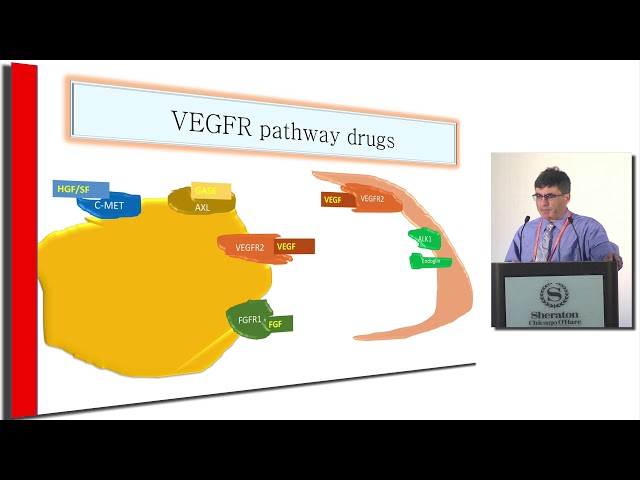
cartoon with a VEGF receptor pathway
there's a tumor cell and there's some of
the VEGF drugs blocking the VEGF
receptor the money is probably on the
endothelial cell or the tumor cells
themselves have some of that here is len
vat nib also blocked so this the fgfr
receptor not all cancers have this not
all clear cell kidney cancers have this
but it may matter for some here's a
Cabos antenna it blocks a seemeth and
axial and those are actually more
dominant targets on the tumor cell so
there is some sense that blocking the
VEGF with a VEGF drug may be something
that could be salvaged with kappa
xanthine if so we're seeing a lot more
kappa's ant ative in 2019 talking about
immune therapy we had a good good
education on that here as well on the
immune therapy the pd-1 pathway was used
mostly in isolation and il-2 and
interleukin 2 another one also used in
isolation these are proteins on the
white blood cell surface also ctla4 and
the drug in this case so it works on the
immune cell and the immune cell has to
do what it was born to do which is
attack something but the drug isn't
really attacking the cancer directly so
let's talk about one partner which i
think is gonna be a big partner in 2019
and beyond to use the catchphrase and
that's the il-2 receptor and it's not
choice to say that the how to receptor
is gonna be a big deal in the future
because it was a big deal in the past
you know Lucan - i mean it's got a
really low number
- is one of the proteins that white
blood cells make to communicate with
each other and there is a receptor on
the lymphocytes T lymphocytes s cd4 T
lymphocytes cd8 T lymphocytes natural
killer lymphocytes il-2 receptor and it
gets the il-2 and it changes its
behavior it divides more it goes to
attack more interleukin-2 receptor is
used in a lot of lymphocyte based
treatments we talked for a minute about
car T cells so the car T cells are the
patient's own T cells taken out of the
body expanded expanded with what with
interleukin 2 and
Riaan fused back in after the patient's
own white blood cells have been kind of
wiped out to clear the stables and and
the patient gets a few doses of what of
interleukin 2 to help those lymphocytes
to expand now we don't have car t-cells
that are available for kidney cancer
therapy the antigen matters a solid
tumor car t-cells have been slow to
develop as the technology but that
interleukin-2 receptor is what's on
those cells
similarly till cells tumor infiltrating
lymphocytes this was initially tested in
kidney cancer the tumor is taken out
interleukin 2 is put on there it grows
out the lymphocytes and they have a
population of lymphocytes which were at
least smart enough to get into the tumor
then those re-infused back into the
patient and at the point they're put
back in their given interleukin 2 so
interleukin-2 receptor is something that
helps support lymphocyte activity which
is what we're interested in we have some
combinations of medications that use
interleukin-2 receptor and pd1 receptor
at the same time they're listed here so
member lizardom ad with high-dose il-2
that was a single arm study we're
finishing that up at the Moffitt Cancer
Center next are in Nivola map neck cards
were in the engineered aisle to drugs
I'll show you that that together with
Nivola map and epi luma map as well
that's also in initial testing and ALK s
42:30 an engineered il-2 also in early
testing with the PD one so here's a
native il-2 it's just a small protein
it's got a three-part receptor
illustrated there with the blue green
and red which is beta gamma and alpha
and il-2 little oval there attaches on
there the alpha parts a special part it
doesn't really stick into the cell but
it stabilizes the il-2 on to the other
part of the Howell 2 receptor there's
two kinds of il-2 receptors just the
beta gamma or what the Alpha also the
cells we think are attacking the cancer
have just a beta gamma one called the
intermediate receptor here's a cartoon
showing the native il-2 which is now
pink in this illustration and you can
see either binds the two the two part
one or the three part one with the
alfa attached so it stays on longer
here's one of these Alchemy's 42:30
this is a completed it's a single agent
testing and man and now it's going to be
doing combination testing so it's a
phase 1 trial phase 1 trial but you're
kind of getting a good deal on both
drugs you get the ALK s42 which is an
engineered il-2 it's got a il-2 receptor
alpha pre attached onto it in a single
chain and this is how they did it with a
little permutation of the protein
sequence which is pretty interesting if
you have a PhD in biochemistry but
otherwise it's just a cartoon there and
then that trials being given together
with the preamble is a map which we know
already is active in kidney cancer
here's another one a necked are hectares
the company next are to 14 so the
sequence of interleukin 2 which is a
small protein has some different amino
acids six of them are a con called
lysine and lysine is particularly good
for attaching things to it so in this
case they've attached a thing called PEG
polyethylene glycol so polyethylene
glycol is a big long molecule you may
recall it seeing it on your ice cream
ingredients it's used as a thickener
anyway it's not it's not toxic it just
sits there
however it's so big that the il-2 is
effectively a prodrug it's like the drug
is in there but it's got these extra
pieces the attachments are not
particularly stable and they pop off and
then when it's down to one or two that's
good enough and it can fit onto the
receptor so this is in a trial with a
dozen different diagnoses kidney cancer
included and there's been several
complete responses already reported with
that the frequency of complete responses
we don't want to especially speculate on
that is a low number of patients but
they're definitely out there I have one
one patient who's done quite well with
that there at least a dozen other ways
to engineer il-2 here's one which has
only been tested in the test tube it
hasn't even made it to Mouse testing and
what they do is they take the
lymphocytes out give them an il-2
receptor which doesn't fit il-2 it only
fits this special aisle to then they
give them a special il-2 it only fits on
to there and what's the advantage of
that
you could take your lymphocytes out and
only have the population that you want
to respond to that so maybe their cd4
cells which we have a regulatory
function you don't want them to see il-2
well you could use this special
engineered combination we'll see if that
comes out that won't be in 2019 however
so as far as on lymphocyte targets and
you've seen most of this before just
highlighting the aisle to receptor there
with the il-2 and the other engineer
dial to is on the left side of the slide
and on the right side the pd-1 and PDL
one those are ones we've talked about
before what those are kind of the brakes
and then I'm the right lower corner
there's the tremor loom a band epi luma
map which box ctla-4 which is part of
the priming response so looking at PD
one happily for me and the time these
are the same slides you've seen before
this is the same key paper here with
initial therapy of those two medications
together versus a Sinitta nib and just
going through it briefly we see that the
balloon map Nivola map combination was
better with some complete responses
observed on the other hand in the favor
of favorable risk subsets which was a
smaller subset it was planned to be a
smaller subset but the senate nip
appears to be better for those patients
especially if they don't have the PDL
one protein so anyway as I said the
details matter the evolution of how to
pick patients for which of these drugs
and the reality is really we're just
picking which drug first because if one
doesn't work we're going to take a step
back and try the other and there's a
graphic there and here's the same lines
that we saw before with the blue map
d'Avola map graphs on the right there
again a trial we've already seen the
emotion 151 with a Tesla the Matt Bevin
is a map the PDL 1 and the VEGF receptor
sorry Jeff antibody versus an endeavor
again with the combination
doing relatively well here's another one
we've seen as well with AXA to nip the
VEGF antagonist pill with Pemberley zoo
map and just a striking number of
proportion of patients who really get
their tumors to get smaller as Jolie
just mentioned we get a lot of graphs
with tumors getting smaller and we have
to take a step back Mike talked about
this Mike Harrison about what do
patients really want a paper which I
didn't put in here we BMS and I worked
with them and they took a survey to ask
patients what they really wanted and it
was a little bit anticlimactic
turns out patients really want to live
longer and you get a graph like this and
it becomes like an ironic question says
the patient's want to live longer
how come from the day they're diagnosed
till the day they die all they talk
about is how big is the tumor well
that's the only accessible thing we have
there so they did with that that's again
one of those graphs graphs there here's
a big question here is a Juventus and it
Nibin now Omaha stalked about this trial
the S track trial the single positive
adjuvant trial we see the blue line the
patients who got synonym had a lower
rate of reoccurrence as compared to the
patients who didn't get to knit nib but
the overall survival is about the same
on both arms they've updated it it's a
few patients ahead on the Sutent upfront
arm as opposed to the placebo upfront
arm but still not a significant
difference
so is this 2009 technology playing out
or is this 2019 well there might be some
subsets that do particularly better
where it makes a big difference so this
has been looked at at a few different
ways the first was just a generally easy
answer which is that whether was a t32
more a24 tumor patient had symptoms or
no symptoms or high-grade Fermin or not
it came out to be about the same so that
didn't add much information but two of
the other subsets analyses give some
hints so in this one from dr. Rainey
as the main author here we see that
there's a this 16 gene recurrence score
and they didn't have that many patients
on it but you can see that at least in
the placebo group it really matters
which what your score is on the other
hand in the treatment group the lines
are closer together so where do you know
that the treatment group had a better
progression free survival but also that
the lines get closer together so at
least for the worst group which would be
the red line on the on the left panel it
probably makes a bigger difference so
the people in the worst group it makes
it looks like it makes a bigger
difference that they should really be on
something besides observation now this
is a secondary analysis on a fraction of
the patients but that's at least a hint
on that and then similarly looking at
markers in the tumor we already knew
that PDL one seems to be a marker for
patients with a higher progression rate
and looking at this here we can see one
line standing out which is the placebo
patients that had PDL one on their tumor
that blue line on the right graph there
so well that's a hint maybe to help us
out on adjuvant selection patient
selection there's three large very large
very slow adjuvant studies accruing now
check again this won't be in 2019 this
will be in the 2023 24 of them make it a
read out whether starting those immune
therapies very early helps I have a
trial here and this is just for a
general interest on how there are we had
set up that trial there it's finished
accrual and we wanted to get at least
45% major response rate we've got a lock
on 60% so it does look again that
putting those two types of immune
therapies together seems to be better
than one now as a single agent sorry a
single arm trial we don't want to really
make any comparison statements and we
know that picking the patients carefully
is probably the best way to could get a
good response here's some art from my
trip to Moldova clinical trials.gov
clinical trials.gov I guess at least one
person in the room thinks it's hard to
use I use it all the time but I think
we'll work with KCA maybe get some
tutorials on that it's true I can't know
all the trials there are if you look on
this here it says there are 280 4824
research studies in 204 countries so
yeah you'd have a pretty psychotic
doctor who had a really working
knowledge of this but you can use it to
look up some things here's one we can
look up this is a CB 839 that Calif
era's product the glute amination
inhibitor we had a good presentation on
that and a couple trials we've combined
with that or open the first two are open
I think the third one is just a planned
trial their epic sino stat that's an H
stack inhibitor H stack inhibitors
probably 20 H that trials have been
coming on in oncology a couple have
approvals and hematologic malignancies
but they're all still waiting to hit the
big time for solid tumors so this is a
combination that everybody gets pies
open if it's a face retrial but it
either get positive and nothing or they
get positive with the new drug added on
so that the is a registration or trial
and it should be a couple years to
accrue the exciting thing is it's an H
stack inhibitor which has nothing to do
with all the other things we were
talking about so kind of a new angle on
this
here's another H stack inhibitor called
atenist and you might remember antenna
status a partner drug with il-2 this was
a single arm trial which did relatively
well and antenna stat only blocks H
stack one coordinate with radiation
therapy and other destruction destroying
stuff that really gets the attention of
the immune system changes of a lot of
things in the tumor and in the immune
response and there's about eight
different trials in kidney cancer
probably another 20 and other diagnoses
as well so I think those will mature
we'll get some more standardized
protocols
that some of the thinking is that
getting to a higher dose with a lower
number of fractions maybe something that
really makes the immune system sit up
and get stimulated but those are details
that we need to work out the ID the idea
of using them combinations with the PD
one drug and something else so at least
a two-part two immune therapy that's
going to be something we see a lot of
not clear cell type cancers I hate to
always give the not clear cell type
cancers kind of a quick wrap-up but we
at least for the first time in many
years have several trials these are
directed at cement and these are gonna
be slow trials that come around but we
may actually get some targeted drugs
which really focus on that so what's the
target a year for 2013 do we do a defect
it's order on there but I think it'll
pop down there it is so I think il-2
receptor
it's on every lymphocyte in your in your
body he's got il-2 receptor we've got
the PD we're kind of you know running
strong in the age of the PD one type
trial and I think that aisle two
receptor we've been using it as a single
agent we used it in till therapy and
cartee therapy and I think that we're
gonna see it have a resurgent not just
as a single agent il-2 but aisle to
receptor as a partner for these other
immune therapies as the immune the
immune area kind of overtakes everything
so anyway thanks very much and thanks
for the kidney cancer Association for
organizing this I want to encourage all
of you you know in your own health but
also to the extent you can you can
advocate and work with the Association
is it's here for you and you can be here
for it and I think jeans gonna give us a
couple genes outside good thanks thanks
to gene bureau for organizing and
Gretchen will give us some closing
remarks thanks
[Applause]