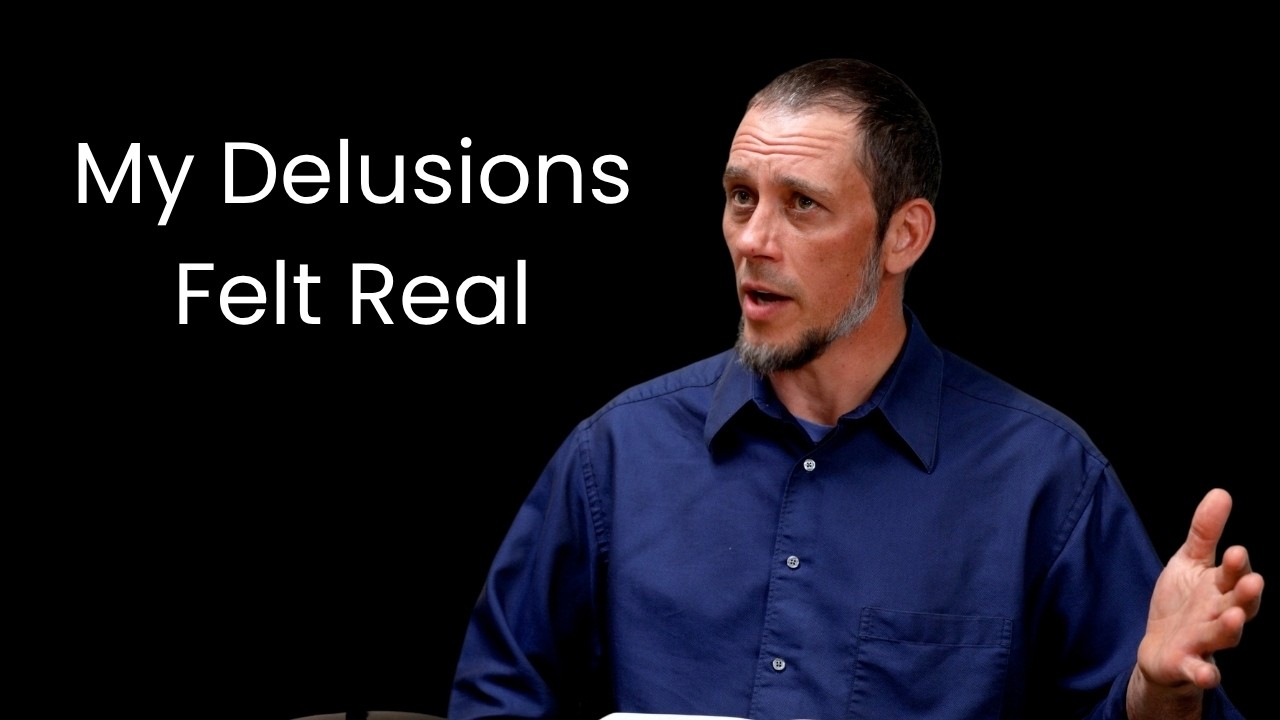
What It Actually Feels Like to Live with Bipolar Disorder - Arlyn Kauffman
Watch on YouTubeVideo summary
Harlon Arlyn Kauffman describes his lifelong journey with bipolar disorder as navigating between intense, distinct states of mania and depression that feel undeniably real yet remain difficult for others to understand. His earliest signs emerged around age twelve or thirteen, characterized by sadness over minor material losses and a sudden inability to focus on reading in ninth grade after previously finding it easy. By his late teens, he experienced chronic fatigue during family trips, a pattern of low energy that persisted into adulthood and made mornings difficult without the stabilizing effects of medication. During an episode at eighteen while attending Bible school, Harlon entered a manic phase marked by little need for sleep, excessive talkativeness, grandiosity, and delusional ideas about God's messages involving conspiracy theories; he initially refused prescribed lithium due to these beliefs but was eventually persuaded to take it, which helped blur his psychotic thoughts and stabilize his neurotransmitter imbalances.
The contrast between his high and low states is stark: during manic highs, decisions are made instantly but often poorly, while depressive lows make even small choices feel impossible due to overwhelming fatigue and anhedonia. These cycles typically last three to six months for Harlon, though the duration can vary significantly among individuals; the "high" brings unpredictability and exhaustion to those around him through risk-taking behavior and dominating conversations, whereas the "low" makes his condition more predictable but deeply isolating. Despite these challenges, faith has been central to his life, with Harlon crediting God's grace for keeping him alive during suicidal thoughts in past episodes and viewing his condition not as a sin or purely spiritual problem, but as an opportunity to develop humility and empathy through shared suffering. He acknowledges that while psychiatrists cannot yet cure bipolar disorder, mood stabilizers like lithium can effectively manage symptoms under medical guidance, even though he desires less dependence on them.
To complement medication management, Harlyn avoids antidepressants due to safety risks instead focusing on functional medicine approaches that target root causes rather than just symptoms. Her regimen includes a diet emphasizing proteins such as beans, hormone therapy with supplements like niacin and vitamin B3, and testosterone, alongside exploring other supports like hair and blood analysis. She stresses the importance of accountability within faith communities, noting clearly that having mental illness does not excuse sinful behavior or laziness, and highlights key coping strategies such as prayer, maintaining daily routines, and seeking support from friends, family, mentors, church groups, and organizations like NAMI to help navigate medical decisions. Ultimately, Harlon reflects on the expectation that following Jesus would eliminate suffering, realizing instead that discipleship involves taking up one's cross and finding joy even in hardship, while holding onto hope for a future cure or ultimate redemption where a perfect nervous system will be restored after earthly life ends.
Read the full video transcript
It's so real and it's so true that it
doesn't really bother you or didn't
bother me. It didn't I didn't sit there
and think, "Oh, my life is coming to an
end as I know it." You know, this is
terrible. I'm losing my mind. No, it's
not like that. the things that I was
thinking seemed real
>> and seemed like I just need to get
everyone else up to speed with with what
I am thinking because they don't know
and they need to know.
Well, [music]
Harlon, as you look back across your
life,
when did you start seeing patterns that
something was a little different for
you?
>> Yeah, that's a good question. So at the
time I wouldn't have thought about it so
much but looking back I think around the
time I was
12 or 13 um I did begin to experience
some some bouts with depression. There
were certain things that bothered me
that made me sad. not serious things
just like maybe this part of the farm
wasn't very tidy or this or that just
didn't seem to be quite right material
things usually and it made me sad and so
I would didn't didn't really have a way
to process that. Uh I would I would
spend time alone and and and just uh you
know I would go down to the pond and
fish by myself sometimes and think
through these things. Mh.
>> So that's kind of the earliest. Before
that I had very uh very happy childhood
uh a stable family and and just just a
lot of very good experiences, good
friends. I was a happy person. Uh
pictures from my childhood, you know,
almost always will show me with a a big
smile. So anyway, from from 13 on then,
uh, some of those patterns started to
come in and I didn't think about them as
being abnormal at the time. I just
thought, well, this is this is how life
is. Uh, sometimes when I was 14,
I had a time where in I was in ninth
grade and I had a very I I went through
a period of time was very difficult to
study. It just kind of hit me all at
once and I couldn't focus
>> and it was it was totally unusual for
me. School had always come easily and
being able to to focus on study and
reading and comprehending what I was
reading and you know writing back down
you know answers in detail of what I'd
read. That was that was natural for me.
And and all at once I couldn't I
couldn't focus. I couldn't think
clearly. I would sit down and try to do
my work. It would take me, you know,
easily twice as long.
>> And the quality of my work just wasn't
wasn't as good. I had to read and reread
and reread. It seemed I could read a
whole page and then not really have
comprehended it. And if like my my brain
wasn't it wasn't processing the
information in the same way that I had
been used to. And that was that was kind
of scary or it was disorienting for me.
>> Uh and that went on for for several
months and I kind of struggled through
that.
>> Uh and then kind of got better.
>> So like it just that just kind of faded
away and you were back to what you would
have considered normal then. It just
kind of
>> Yeah, it it faded away over over a
period of several months and and things
kind of went on like they had been.
>> Must have been a little disorienting
where it's just, oh, something's a
little something changed and then oh,
okay, now we're back to what you were
used to, if you know what I mean. Right.
>> Yes. Right. And it was kind of a a big
thing at at the time, but then it it
faded away and and soon kind of out of
my memory.
>> Uh
and then when I was
17, we went on a western trip and I just
remember
I slept most of the time during the day
while we were traveling. I was I just
felt tired a lot. And when we would get
somewhere and take a hike or go look at
something, then I would get up and go do
it and I felt pretty decent.
>> But get back in the motor home and and
and go on and I would just fall asleep
even if it was nice scenery and and so
on. And that was I think the first time
my parents kind of remarked that you
know what something seems a little
unusual or or off about that. And but I
I think it had come kind of gradually
and that kind of fatigue Yeah. had had
kind of come on gradually and and it
didn't seem terrible to me. It just
seemed well this is kind of how life
was. I don't remember feeling sad or
depressed. I was just tired
uh a lot without
>> physically like in your body or like
brain tired if you if you know
>> more more more in my body or like
>> Yeah.
>> just just didn't feel energetic.
>> Yeah.
>> Or like really I would go along with the
things that my family was doing and
enjoy them,
>> but I wouldn't have been sitting up
saying, "Oh, hey, let's stop here or
let's do this."
>> Yeah. just kind of a little bit numb and
along for the ride.
>> Did that last for a while? That feeling
of the tiredness and
lack of energy, I guess you could call
it.
>> I would say that that that did last for
a while. Back home then, when when I was
working working on the farm, I worked
with my uncles
>> uh quite a bit on the farm. As long as I
kept moving, it wasn't too noticeable.
Uh but but kind of from from then on
throughout my life I could fall asleep
very easily.
>> Yeah. Even up up to this day it's very
difficult for me to get through a Sunday
morning or even uh any kind of a meeting
without dozing off momentarily.
>> Uh
unless I'm in a a more an elevated side
of the of the bipolar.
Yeah. How did your how did your family
and friends and so forth um respond to
this? You said your parents started
noticing right on that trip.
>> Mhm. So, it wasn't it wasn't a big
concern to me at that point and I don't
think it was a big concern to them.
>> Uh but but they they did notice.
But it wasn't until I was 18
that I got a formal diagnosis of bipolar
disorder. Well, back at that time they
call it manic depressive disorder. And
then they they upgraded the
>> the um the lingo, I guess, to bipolar
disorder.
>> That's what they call it now.
[clears throat]
Uh that happened when I was at Bible
school in Arkansas.
And I began to
feel like I didn't need much sleep.
And I would I would stay up late
studying and I would get up early and
study or do things. Maybe I would go go
out running.
>> It just felt like sleep was
was kind of a waste of time.
>> That's a 180 though of what you've been
describing about needing lots of sleep
before that. Okay.
>> Yeah. And that's where the bipolar
disorder diagnosis comes in because
>> with bipolar you have you have these
>> these periods of of high where you feel
energetic,
motivated,
um powerful
and like why would you bother sleeping
when you could be doing these things?
and then
>> and then it goes down on the low side
where it's the exact opposite. That's
why it's called bipolar. Uh but I had I
had a manic or a high episode there. So
it went from feeling like I didn't need
sleep to being very talkative and then I
began to say things that were
delusional. Uh, so I had ideas about
Bible prophecies and I was trying to
make connections with current events
>> and I started to say these things which
seemed totally logical to me. But the
people around me soon recognized that
this this was not logical and something
something had gone arry. Something was
going ary. And so eventually they agreed
with with the staff and my my uh my
parents were actually there. My dad was
a teacher during that term. They agreed
that I should be taken in for an
evaluation.
And so somehow they persuaded me to to
go into the local hospital where there
there was not a psychiatrist there but
the local family practitioner, the
medical doctor, he listened to what I
had to say
and then he said he gave me the
diagnosis of manic depressive disorder
which has been confirmed by by
numbers of of doctors since then,
especially psychiatrists. Medical
doctors typically will not offer that
diagnosis because that's that's out
maybe a little outside of of their
training. But
>> he felt confident enough about about it
that he was willing to go ahead and give
that diagnosis and then prescribe the
medication
that he felt that I needed. So he he was
prescribed lithium which is commonly
used for for patients with bipolar
disorder. And we went back to the Bible
school and I refused to take the
medication.
>> And this is all during the the usual
Bible school term.
>> That's right. Mhm.
>> That
>> things are going on. Ooh, that must have
felt very what odd or something to be
like the staff are pulling you aside and
your family is like, "Hey, let's we
should go to the hospital." Basically,
>> right? Like how did you handle that? I
mean, you agreed to do it, but
>> yes. So, you c only people who who have
experienced a high like this will will
really be able to understand this. But
it it's so real and it's so true that it
doesn't really bother you or didn't
bother me. It didn't I didn't sit there
and think, "Oh, my life is coming to an
end as I know it. You know, this is
terrible. I'm losing my mind." No, it's
not like that. the things that I was
thinking seemed real
>> and seemed like I just need to get
everyone else up to speed with with what
I am thinking because they don't know
and they need to know. So I had at that
time Al Gore was vice president and I
had this idea that because of of the
messages that God was giving me that
needed to get out there then he was
opposing that he was going to come after
me and and try to get get rid of me. And
so when we came out of the clinic with
with that uh prescription,
I was having a I saw a person going into
the pharmacy and I knew that that was
someone who he had sent to to put poison
in place of those pills that I was about
to pick up. And that's why.
>> And so when we get back to the Bible
school, I said, "Well, I could take
these pills, but if I do, I'm dead
because of this, this, and this," which
was totally clear in my mind, but of
course recognized as delusional
>> uh by by the people around me.
>> But then why did you agree to go to the
clinic to begin with? How did they
convince you to do that? If you know
what I mean, to go get the diagnosis and
and so
>> I don't remember wrestling with with
that. I just thought, well, this is part
of that's part of what I'm going to have
to go through to
>> for this for this whatever this process.
This is part of the the martyr's journey
or whatever.
>> That that makes a little more sense then
because it's like you're sure you're
right. And so it's kind of like, okay, I
know I'm right. These people want me to
do this. I guess I'll go along with it,
but just kind of maybe to humor them or
something
>> eventually. Why they'll get the drift?
>> Yeah.
>> So, you did so you go you get the
diagnosis, you get the medication.
Two questions with that. Then, how does
your family respond to the diagnosis?
And then if you didn't take the
medication, then what?
>> That's right. So it was it was far more
difficult for my parents than it was for
me
>> because I was essentially on a trip. Uh
the the way I felt and my thought
processes are are similar to what I I
hear or read of people describing as you
know an episode they might get from a
from a drug.
>> The mind is sharp.
it's uh it's fast or or you know
thoughts are just tumbling through one
after another and there's not
there's there's everything you think
seems real. It's kind of like I lost my
ability to discern
reality from uh from from a thought. And
so
that that wasn't
it didn't feel terrible to me because
it's it's a trip.
>> That's right.
>> But for my parents, it was was very
difficult for them to know what to do
and you know what is happening to our
son and and how do we
how do we help him? Uh what's going on
here? So, they couldn't get me to take
the pills.
And later on, that same
I can't remember the timeline. Was it
early the next day or within 24 hours?
Anyway, I was back to the clinic. And
so, they
they managed to
>> persuade me to to go back to the talk to
the doctor. And this time they loaded up
six of the biggest guys
of the school term. Six of the biggest
students
and they were they were prepared to
for me to be hospitalized if if
necessary
>> really
>> until I would take these pills. So your
your parents were seeing this as a
pretty serious
>> Yeah. It was it was unlike anything
they'd ever seen before. Yeah.
>> In in me.
>> Uh very offthe-wall.
>> That
strikes me as a really good thing that
they were there at the Bible school
because they would have been able to
see,
>> wait, this isn't you. Like something is
very wrong here,
>> you know? I think,
>> oh man, that must have been hard for
them though.
>> I think it having them there helped to
just keep that process going that we
need we need to get Arland some help.
>> Yeah.
>> Sooner rather than later.
>> Well, that must have been tough though
for
>> Yes. I can I can only imagine. Uh it was
>> So, so you go in a vehicle with six of
the biggest guys.
Did did you know that that surely they
that you didn't know that their plan was
like we're going to hospitalize you if
if it comes to that if if we have to do
that.
>> It seems like maybe I kind of caught on
but then again I don't know. It didn't
really bother me. It was just like well
let's see what happens. Um
>> okay
>> this is all going to work out because
these thoughts that I'm having are are
true thoughts. So
>> So what what didn't happen?
>> So we got there and we went back in to
see the doctor. same doctor and and I
sat down and I explained to him my
hallucination with, you know, with
seeing the person
that I thought poisoned the pills and
and so on. And he just asked questions
and let me talk and and he just kept
saying, "I think I think you should go
ahead and take these pills. I think
you'll be okay." And eventually I did.
Right there. I took the first dose and
they put me on a double or triple dose
of of lithium for the first 24 hours. I
think
>> you say lithium.
>> Lithium.
>> Is that like the lithium that's in the
battery of a smartphone or something?
Like it's an element element lithium.
It's very inexpensive. Uh it's very
commonly used for for bipolar patients.
It's a mood stabilizer. It's not an
anti-depressant,
but it's a mood stabilizer. So, if
you're in a low, it helps to moderate
you up a little bit, and if you're on a
high, it helps to
>> reduce that. So,
>> so the psychotic thoughts
um began to blur like my clarity once I
began to take those then I started to
get
some confusion
>> in my thoughts. And now these things
that I imagined to be true no longer
quite lined up anymore.
>> Oh, did that okay? I've never thought of
this, but like if Yeah. If you're riding
this big high and these things are
totally certain in your mind and you
take the that pill, that medication, and
it kind of evens it out, maybe low
lower, I don't know if I'm sure I'm not
using the right words here, but kind of
lower Yeah. lowers it or whatever. Then
suddenly these things that you were sure
were bedrock reality are like I'm not
sure if they're true. And so did it feel
like reality just kind of fracturing
around you? Like you're not sure what's
real? Like am I tracking with you
correctly? Is that kind of how this
works
>> as far as my energy level and my my
mental clarity? It kind of went
together. uh right
>> during the time when I was on the high.
I had a tremendous amount of energy and
and ability to play. Volleyball was one
of the games we played there. And I
could I could just kill it in ways that
I could never before or after. And one
of the first things I noticed when they
put me on lithium was,
>> "Oh, I can't I can't jump as high
anymore. And I can't
>> really
>> I can't uh I just can't get it together
to
>> to nail it like I had been.
>> So this affects not just
how your mind is perceiving thoughts and
saying this thing is real. It's not just
changing that it this is having effects
on your energy.
>> It does
>> like your actual physical energy and
abilities.
>> I didn't know that.
>> Yes. Which is which is mysterious, you
know.
>> Yeah. Yeah,
>> bipolar is is essentially a
neurotransmitter dysfunction.
So, so the the chemicals that that
regulate the the flow of uh of nerve
impulses.
>> Mhm.
>> Those are there's a there are a number
of them. And if those aren't in the
right balance,
you know, in
in our bodies, in our nervous system,
then
then we don't we don't function well.
And that can result in a
>> in a high or or a low.
>> But it actually affecting not just how
the mind perceives information, etc.,
but like how your body functions too.
that that that's new to me.
>> Yeah. So the brain I mean the nervous
system isn't limited to just the brain
but but nerve
>> nerves are throughout our body. And so
>> uh when when the neurotransmitters are
are really
working or maybe overworking then
then the muscle movement and so on is is
just very um intense.
and
>> clarified like
>> if I if I would get on a high, I would
want to go jogging.
>> It's like you have to burn this energy
out. It's got to be expended or
something.
>> Yeah. And if I'm in a low, then that is
the last thing I want to do. It's just
like, oh, that is so much work. I do
not. Why would I spend any of the little
energy that I do have
>> going on a run?
>> This sounds like it could be at least
the high that you're describing could be
pretty hard on the body actually.
>> Is that true?
>> It is. It cannot be sustained. M
>> so
so people with with extreme bipolar
which you know I I've I've had
uh I've I've dealt with this now for
for more than half of my life since my
late teens and I'm in my middle upper
middle to upper 40s.
I have had a number of of cycles up and
down. But people some of the some some
people that have experienced it with
more [clears throat] severe symptoms,
they might they might have six months
where they hardly sleep at all and they
just work and knock out mountains of
work and then maybe hardly show up for
another six months or more while their
body recovers. Oh,
>> and so uh
>> the the body cannot sustain
uh the kind of activity mentally or
physically that that a high brings. And
so there there's then this this decline
into
into the low side or the depressive
side. And that
>> it seems like if if the high the higher
the high was, the lower and longer the
low will be.
I think as as time goes on, I experience
it seems like I experience shorter highs
and and longer lows. Uh but only only
time will tell. I don't know how it will
play out, but
most people that have had a bipolar
diagnosis will
will tend to struggle more with the low.
But people see
what they see mostly is the high
reoccurring. The low is is much less
obvious to to the people around them.
>> So
yeah, like coming into this interview, I
knew absolutely nothing about bipolar at
all. So this is all news to me. Um, so
one of my next questions then out like
from what you're describing,
this time at Bible school, you're on a
high, you start taking those pills, the
medication, does that put you into a
low? Does that put you into an average
of the two? Do were you able to stay at
Bible school,
finish out the term? Like, how did it
affect your life? Like again, I'm just
trying to imagine this happening at a
term of Bible school because like now
everybody knows and it would be like
this. It would feel strange. It had to
be tough on your family like
>> Yeah. What a what an interesting
experience just kind of how that all
kind of came together, you know, for
you.
>> Yes. So, it did not put me into a low
quickly. Uh it stabilized me so that I
could finish the term, you know, I
finished my studies, took the tests and
and went home. I would say finished
fairly average and then went back to
work on the farm and then as as spring
gave way to summer then I went into a
low which was my body trying to recover
from from what
>> I had spent all the all that I had taken
out of the bank
>> or that yeah a lot of times that's the
way I think of it if If I if I spend
down those resources of whatever that is
>> in in my physical body,
>> then then it's going to be I'll feel
bankrupted at at some point. And so then
I went into very severe depression that
summer to where it was it was difficult
to to keep working. But my parents
encouraged me to to try to keep my
routines, which was which was very good
that they did. uh they encouraged me to
keep my routines and and I did stay on
the lithium then for for a couple of
years.
>> So you're on it over that time while
you're having this slow.
>> Yeah, they they they put me back on a on
a normal dose. I don't remember what the
milligrams were, but
>> more of a normal dose then after about
six days
>> to kind of once I was down off of that
extreme high, then went on a
>> normal dose then after that.
>> So tell me about the low. So you were
telling here's what it was like during
the high, you come home the low.
What was that like?
>> Yeah. So that's I think I want to take
some time here to try to explain or or
just talk about the contrast so that
>> yes
>> so the people
>> uh kind of get a sense of of what it
what it might feel like or or be like
>> uh to to experience it. So
uh in
in a high or or even regular for me what
whatever normal is uh especially
as the way I remembered it before my
diagnosis
uh
I I would be glad for challenges.
I would enjoy
uh embracing
opportunities that that might seem
pretty big.
Whereas in a in a low then any little
thing can feel overwhelming
and decision making is is very
difficult. It it just seems like my mind
doesn't it doesn't want to make
decisions. It wants to avoid decision
making. It it's just
It's it's hard to describe as contrasted
to to a high where decision- making is
just snap snap snap. It's just it comes
and you might not make good decisions,
but they're easy to make. You don't you
don't feel this, oh, I don't know if I
should do this. It's just it just comes.
So like when it's hard to make the
decision, is that do you feel that as a
sense of this takes too much energy to
make this decision so I'll just
procrastinate? Is it kind of like that?
>> It often results in procrastination
to where it it's so easy to just avoid
>> big decisions or even little decisions
and and hope that if I just wait maybe I
won't have to make them.
uh which you know doesn't make any sense
when when I'm on a high. I think well
that is dumb to put off decisions. You
just make them and and you go. Um
another thing would be buying and
spending. So on a high uh I I tend to to
spend or or make financial decisions
that that involve putting money out
there. And when I'm in a low, then I
don't want to spend money. I don't want
to take any risks. Let's just keep keep
everything kind of as it is. Uh so that
that's a common thing for people that
struggle with bipolar uh spending
sprees. tend to go with the high side,
you know, not being careful about
>> where the money's going.
When I feel well, then I'm glad that I'm
self-employed. And there's a lot of
decision making needs to be done. If
you're self-employed
uh and we we have a farm which which
involves, you know, daily decisions and
and seasonal decisions related to crops
and and so on. It's it's normal. It's uh
takes a lot of decision- making. When I
feel great, then that feels like a great
fit and I'm glad that I'm doing that.
When I don't feel well, then I wish I
would be in a job where I would just go
somewhere and they would tell me what to
do and I would do those tasks and then I
would go home and I wouldn't have to
think about it because that decision
making would be on someone else and not
on me. So there's that there's that
contrast which which can make
identity around work and you know what
should I be doing with my life it can
make that difficult because
>> you know one year I might be thriving as
a farmer and the next I might I don't
why in the world am I doing this and it
may or may not have anything to do with
whether it's succeeding financially.
It's that's not really the what drives
the the feelings about it. It's it's the
way my brain is
processing. A couple of other areas. Uh
I already mentioned sleep, but when when
I feel great, it's not unusual for me to
wake up at 4 in the morning and
want to get up. I might know that I
should stay in bed and go back to sleep,
but I would have to discipline myself to
stay in bed
>> because I know that would be better for
my body.
>> Uh when I'm in a low, then waking up is
the worst the worst thing in my day. I
just wish I didn't have to wake up. I
could just because there are going to be
decisions that have to be made. there
are things to face and
it's just I would rather avoid that. So
the contrast there is something that
is just very stark and when when I'm
when I'm in a high
uh I think well I will never want to to
sleep long again. I mean, that's so
silly to want to stay in bed when I
could be up doing something
uh whether it's writing email or
organizing things or
working on a project.
So,
it's just it's just interesting how how
both of those realities can be [snorts]
>> so,
yes, for lack of better words, so real
uh in in the same person, but not at the
same time, but over time it switches
from one to the other.
>> How long is the switch?
>> That's a good question. So, it varies in
people. Uh for me I would say it's it's
usually months
like maybe three to six months.
>> Oh, okay. So this isn't something that
happens in a couple of days or whatever.
>> Not usually for me.
>> Yeah.
>> Once in a while I'll go from a low to a
high pretty quickly. Like I'll wake up
one morning and I'll feel adrenaline
and I'll feel like I want to get up and
I know that something has changed.
>> U sometimes that's pretty pretty fast,
but usually it's more gradual.
>> For some people with bipolar, it's often
very fast, but but not not so much with
me. if it would happen quick that man
that would be rough when I'm thinking
even on your body too like that switch
seems like it'd be pretty hard on you
you know
>> yes for for for you for sure and then of
course even more so for the people that
live with you wait
>> so Sue will say sometimes
>> you know and and Sue is is such a
blessing in my journey has been such a
blessing
>> she will say sometimes times. Well, she
has to readjust because
now I'm not the same as I was, you know,
three weeks ago. Who Oh, yeah. She has
to
>> kind of reorient that I'm going to be
this way now for for maybe several
months. Uh so that
>> that can be difficult for her. Uh, it
takes a special person to live with
someone that
that deals with bipolar.
>> I hadn't even thought of that angle yet.
You know, that all the people in your
life
having to adjust to those, I don't know,
rhythms, patterns, changes.
>> Yes. You know,
>> in some in many ways, the the low is the
most difficult for me. Uh but the high
is the most difficult for the people
around me.
>> Okay. Tell me more.
>> So with the low, I'll be predictable.
Uh I'm not Sue wouldn't have to worry
about me going out and making an
investment or spending money.
>> Uh
>> okay. Yeah.
>> And and I'll I'll probably just stick
around home. I'll show up at normal
times and maybe I won't be talkative,
but
>> but I won't be hard to live with.
Whereas the the high, you know, the
unpredictability of that maybe
overexited,
um kind of kind of rootless, um
>> shifty. Uh some of those things
are what makes the high more difficult
and you know conversations
for me when I'm when I'm on a high
conversation is comes easier
because I have lots of thoughts.
Just for example, coming to this
convention once a year as part of
Anabaptist perspectives.
>> Mhm.
If if I'm on a little bit of a high, I
will have to work very hard to restrain
myself from from
dominating the conversation
because I will constantly be having
thoughts that I think are worthy of
being heard and they may or may not be.
>> Yeah. If I'm in a low, then I'll wonder,
well, why am I even here?
>> Like, I don't belong on this board. I
don't even have anything to say.
>> And I'll sit here and try to think,
well, is there something I could say
that would be helpful? And it'll be just
feeling like work. And then I might doze
off.
>> You know, what good is a board member
that sleeps through a third of the
meeting? I mean, this is silly. Mhm.
>> So, so those those two realities can
that's how it would maybe play out in in
this sort of a setting.
>> Yeah.
>> Yeah. I love when I'm when I'm on a high
or feeling good, I love to do things. I
love to work. I love to play. I love to
go here and go there. Um it's it's like
I'm getting neur what they call neuro
feedback. when we when we do things and
we feel enjoyment from them, we want to
do them more. And that is that is the
way that we were designed.
Uh but it's like I get maybe too much of
that.
>> And so
>> the dial has been turned up almost like
the sensory dial.
>> Yes. Somehow. And so I love to work and
I want to work more. I love to play and
do things. I want to do more. Well, it
should be
>> just calm down and and live
>> um faithfully with with your wife and
family.
>> In contrast to that, then when I'm in a
in depression, in a low, I get almost no
neuro feedback. So I can go do something
which I used to really enjoy
>> and I just do it and I it just feels
I don't really feel anything. I don't
really enjoy it. I just did it.
>> And you don't think about
how much that neuro feedback
actually
works or is motivating until that's
stripped away. Mhm.
>> Uh we get neuro feedback from from
working, from playing, from being with
people, uh from prayers,
uh
just a lot of different areas of our
life. And when that is taken away,
it it can make it difficult to want to
live.
>> It's like that like that sensory dial,
but instead dialed all the way up, it's
like dialed way
>> way back, you know? So whether that's
serotonin or
>> GABA or some of the other
neurotransmitters, you know, that's
still fairly mysterious
even even to the best scientists
>> exactly why this is
happening. But it the reality is it's
not it's not there
in the same way we were used to.
you you've had this for enough time may
maybe in a way you you can kind of
recognize it and so forth but like it's
got to feel disorienting
I would think every time right because
it's like this was who I was
>> and now few weeks few months later it's
like it's now flipped and then again and
then it just kind of keeps happening
>> is is that the right word disorienting
or confusing or just like oh boy here it
comes again like
yeah what what's that part Like
I think the the word that comes to my
mind or or the the thought of of
identity or who am I becomes more
difficult
because if if if God created me this one
way
then then I should pursue
vocation
and and things kind of around that. But
if but if it's this other way where I
hardly have energy to make decisions
then
then it wouldn't be good for me to to
make commitments that that require a lot
of
you know emotional energy. Something
like teaching school. while I taught
school for nine years and that
was good for me to do that, but there
were there were times when it just I
just didn't felt like I didn't have
enough emotional energy to go on
>> and and to be able to to keep going on
without kind of putting that on the
students or
>> or
causing them to suffer with me, you
know, could could be very difficult.
So
yeah, I don't know if disorienting is
the is the right word, but
maybe maybe it is. It it can be can be
difficult to know, well, who am I
really?
>> Yeah. Wow. Yeah. I mean, yeah. Because
it would feel like it's a moving target
almost, you know?
So,
and and we'll get we'll get to to more
of this in a bit, but but I have to come
back to the the reality that the core of
who I am is I I am a child of God. and
and my feelings the the way my brain is
functioning
uh whether it feels great or whether it
feels terrible
is is not what is not the core of what
defines me as a person and that no
matter how I feel we can
by God's grace we can press on we can
take the next little up [clears throat]
>> and you mentioned teaching school in
there just from what you're describing.
I can imagine that was challenging at
points and I I I can't imagine having to
teach school with with the dynamics that
you've been describing, right? That must
have been very hard at times. But then
you also just said how, you know, having
the perseverance to just take that next
small step. Was that kind of what it was
like for you for those nine years?
You know, I didn't have a lot of times
when
when it just felt like daily survival. I
just could hardly make it through the
day.
>> It seemed like I had grace for those
years. And for a lot of them, I I think
I felt fairly normal,
but but there were there were times when
it became very difficult. And that's
that's probably why I'm not in the
classroom right now. Uh
it's a it's a challenging question. I I
would
I would hope
to to re-engage with that at some point.
the the desire the desire to teach and
and to pass on something that is in my
heart and mind to someone else is is a
is something that I think I was born
with
>> and and right now it feels like that's
kind of idled
but yet it's still there but in order
for for that to flourish it takes
there's there's a desire to to teach and
and to pass something good on to another
person, but that takes emotional energy.
And so I might have the desire
>> I I want to give someone else what I
feel or what I think, but I lack the
emotional energy
>> to carry that out. And so it can make it
more likely that I will say no to things
like teaching opportunities.
>> I'm 48. That's old and that's not old.
So I don't know what I don't know what
will be in store yet. Uh God can still
bring that back to life if he if he if
he wants to. Uh I want to be open to
that.
But that that feels like a part of me
that is
not thriving.
>> Another way that I
describe the the difference between the
high and the low.
The high is kind of like attending your
own graduation day after day. A
graduation is when you you kind of sense
you have this sense of accomplishment
>> and then you look forward and you think,
"Wow, there's going to be great things
ahead." Uh it's kind of like the
possibilities are wide open.
That's what a high feels like. Uh or as
Alo
kind of feels like attending your own
funeral
because
the the the way that you experience
life, the the the joys that come from
just living, working, and playing, and
being with people just kind of are gone.
>> And it's like I'm this shell kind of
walking around going through the
motions, but
Who am I? I'm not. The real me isn't
there.
And that sounds a little morbid. Um, but
I know that
>> some people I I've I've listened to some
people describe grief
around losing a person that was very
close to them and those feelings of
grief and how it affects them
emotionally and and and physically and
so on. I can I can relate to that as it
in in in my own experience. Not that I
have never lost someone through death
very close to me, but it kind of feels
that same way.
>> Wow.
>> With with well, where where did the
Arland go that I used to know?
>> Is he ever going to come back?
And and those kinds of of feelings.
So to go back a bit when the diagnosis
happens and kind of beginning the the
journey as as you were describing there
earlier, how did your church community
respond to this and
like like for example, it seems like it
could be easy to turn something like
this. Well, this is a spiritual problem
or maybe you know mental health things
can be maybe a little hush- husher, you
know what I mean? like and there's maybe
a bit of a taboo around some of this
stuff depending on where you go of
course I know there's a lot of variety
in how people respond to these things
but in your experience
>> what happened next for the people around
you for your community.
>> Yeah that's that's a good question. I
feel like
uh I cannot I cannot think of any
any times when I felt judged or
>> uh
you know sidelined. Uh
I feel like my community was
was trying to to understand. I think it
was since the main episode happened away
from my home community.
I think it was maybe hard for some some
of the local people to really understand
how how lifealtering that was for me and
and for my family. and and maybe maybe
they would just kind of hope that it
would go away,
not not being able to to comprehend
and and empathize. But but that's that's
normal. It it's kind of like for me,
like I said, I I haven't experienced
the loss of a person very close to me.
And so, I don't really know what to say
to someone who is going through that.
And and I wish I could do something to
help them, but I can't really think of
anything. And so, I might just not talk
to them about it. And maybe that's kind
of the way it was for me. Uh I didn't
feel
I didn't feel judged. I think most
people just hoped that would
would take care of itself.
Uh as far as yeah, how the church
uh should look at it or or what does the
church
is it a spiritual issue? You know, some
some groups it seems like kind of air on
the side of it's it's just all a
spiritual problem.
>> Yeah.
>> And then others, well,
it you you need to get a psychiatrist to
to fix you or a therapist.
>> Um and and I don't I don't know the
answer. I I doubt that there's any such
thing as a correct or perfected official
position for a church to take on mental
health. Uh it's just it's so nuanced.
Um, and is it a physical or a spiritual
problem? The answer is yes.
It has physical and spiritual
um components and and it's really
difficult to separate those. I'm not
sure how much we should try to separate
those.
So maybe
it's God's way of of helping me learn
uh not to be
narcissistic.
uh to be maybe a spiritual
thing for me to learn was humility
and compassion.
You know, if if I had for all my life
had just felt very good mentally,
>> then how would I empathize with people
that
can hardly get out of bed or that don't
feel motivated or that feel very sad
about things and I just wouldn't get it.
So, in a sense, it's a it's a spiritual
it's an opportunity for me to grow
spiritually. I once heard a preacher say
that bipolar is a
it's a it's a generational sin.
And I thought, well, I don't know.
That's that's kind of a stretch. Um
maybe it is. Uh I didn't really feel
offended by that, but I don't you know,
so far we we haven't identified that. Uh
but at the same time,
um I'm always open. And I want to be
open to whatever God wants to do. There
is there is always
spiritual growth for Arlin
to to be called to to
uh to accept and and to embrace. And if
if a bipolar diagnosis
includes
Yeah. should include spiritual growth.
Uh
it it's not just a spiritual problem. Uh
neurotransmitters
not functioning correctly.
It it it is a physical problem,
>> but it's it's not only a physical
problem.
>> So where would your faith be in all of
this? like how does the um the spiritual
or or what you believe intersect with
the topic of mental health in your
specific case?
>> You know, I think that's that's one of
the most important questions.
Uh
except for faith, I I wouldn't be here.
I mean, I wouldn't be here having this
conversation with you.
Uh but I don't know if I would even be
alive.
Severe mental health sometimes results
in suicide.
And there have been times there have
been multiple times when I when I would
much rather have been dead than been
alive.
Um, I can remember times when, you know,
driving down the road and just wishing,
you know, a truck would hit me so that I
could just be done with life.
But
somehow faith that that God
God is real, God is good
and and he is bigger than these these
feelings that I'm having and he will
make a way. Um that faith
that was I would say exemplified by my
parents by my church community. I think
the biggest contribution of my church
community and my family is simply
faith. Faith in God and and knowing and
believing and trusting in him when when
I cannot make sense of it, when it
doesn't feel right, [clears throat]
>> but still clinging to God in faith. And
Jesus to me is is a rock. He's an
anchor. He's the one
that keeps my soul
safe when when when I don't feel
the way that I think people should feel
or that feels right or good.
Another part of of the faith journey has
been like I mentioned earlier seeing God
working in my heart to develop
compassion
and empathy.
Uh like some somebody said, empathy has
an expiration date and and it is I'm I'm
surprised how quickly I can forget how
it feels
when I when I go back onto a maybe
normal or or a little higher than
normal. Uh but it's it's good for me.
It's it's humbling and it helps me get
in line with with the reality of what
God sees and feels to to have to walk
through
some of the difficult lows
and and has helped me become I have a
long ways to go but but people that are
close to me will acknowledge this also
that it has helped me to become an
empathetic more of an empathetic person
and I want to keep growing in that and
but I do I do see how God has used this
uh to grow that that compassion and
empathy in my soul.
So this is a
still a current thing for you. Like are
you still it is
>> seeking for help looking for options?
Like I mean what what does that look
like for you like today?
>> Yes. So, I I always keep uh a bottle of
lithium on hand [clears throat]
>> and especially for for the highs and I
will I will use that mostly according to
to Sue's direction or encouragement.
I would not like to be dependent
[clears throat] on lithium, but it it
does still work. It does still stabilize
my mood. If I'm really low, it'll help
bring me up a little. If I'm really
high, it will help bring me down a
little. So, it's there in the toolbox.
Uh
>> I have there are a number of things that
I have
done over the years and most of these at
the direction or encouragement of
others.
>> So, those of us with bipolar disorder
are not great at self-treating.
So, we we have to learn to to listen.
But we've we've done things like hair
analysis, blood analysis,
um you know, the traditional psychiatry.
Uh but my psychiatrist admitted that,
you know, she really does not have a
cure for me. She's not even allowed to
to prescribe an anti-depressant because
I am at risk for the high which an
anti-depressant can bring on.
>> Oh yeah. So, I've never taken an
anti-depressant even when I'm very low.
It would be
>> too risky.
>> It would too too risky. Yeah.
>> I didn't think of that. Yeah. So, you
that that kind of limits some some
options there for sure. You know,
>> uh diet, you know, working with
working with it through diet is is
important. Eat good proteins, uh meat
and eggs, and then a good uh veg based
proteins as well. I eat a lot of beans
>> and beans are good for the brain.
>> Is some of that like when we're looking
at the nutrition route trying to find
things that Yeah. are good for the brain
like keeping the brain strong and
healthy.
>> Yes.
>> Is that the idea?
>> The idea for the nervous system in
general, the brain in particular and
this isn't again this isn't rocket
scientists almost.
>> Yeah. A lot of doctors will agree on
this. some of the
the lowhanging fruit. It's It's not
It's It's hard because
It's hard because it's it's not easy,
right? Uh uh
>> Oh, man.
>> So much you have to alter what's normal
or what's normal in our in our culture.
>> Yeah.
>> Uh as far as food goes, but it's not
>> it's not mysterious that
that it that it does help. M
>> uh
>> we haven't found it to be a cure, but it
it does help.
>> Uh I've also
pursued functional medicine, which is,
you know, doctors that try to get to the
root of things rather than just
prescribing something that takes care of
the symptoms.
>> Yeah.
>> Um and I'm currently on a thyroid
medication,
um which we thought was was having was
helping some. I think it does help some.
I don't I don't think it'll end up being
a cure.
>> Um but you know, some help is better
than than nothing. Um also take niacin
or vitamin B3. That's an
anti-inflammatory.
Uh and it's an over-the-counter vitamin
that that does seem to have a positive
effect on the brain
>> uh over time. And then I also have taken
testosterone supplements. Uh and now I'm
on a on a supplement that is supposed to
to help with testosterone levels. So
horm essentially hormone therapy through
>> through vitamins.
So those are some of the things and and
I am I'm willing and and open to other
uh interventions. Uh I don't know if if
I'll ever be well I do know one day I
will be cured
>> when we when we receive a new body. Uh
that will be that will be a a special a
very special thing uh for me.
>> Yeah. And and I think that's the piece
that struck me with this story is we're
kind of dialoguing back and forth about
this interview beforehand. Mhm.
>> Often with these interviews, you know,
I'm looking for the part of the story
where we're like, and then I got better
or then everything was fixed and that's
the,
you know, yay, everything's good now.
Your story isn't that.
>> And the part about that that intrigues
me though is still your um your
patience, your faithfulness, and like
you kind of mentioned earlier that at
least can take that next step even if
it's small.
>> Talk to me about that though. I'm sure
that's not always easy. Um, and
especially the fact that like you just
said, you haven't been cured yet. You
haven't found a magic solution,
>> etc.
>> Talk to me about that.
>> Yes. Uh, that is that is part of the
journey where where faith I think makes
such a a big difference.
So
with the the mental illness,
I it's good for me, it's good for us to
remember that that that never having a
diagnos diagnosis of a mental illness
never excuses or makes sinful actions or
behaviors
acceptable.
Uh, and it would be it would be
terrible
if the church would say, "Well, okay,
Arlland's doing this or that." But, you
know, it's because he has bipolar and
and not hold him accountable. And and
I'm glad that
>> that I don't I don't have people around
me that excuse or or that would excuse
anything.
uh
you know when
when I don't feel like getting up it is
still good to remember
that
laziness
is
not going to bring is is is not going to
help is not going to be the answer. Uh,
and and sometimes I need I need people
to to encourage me in that.
It it can be it can be hard to get up
and and and press forward. Some
sometimes
when when I'm, you know, working, doing
my chores or or getting ready to go do
something, I just I I find myself
praying like over and over. God, help me
to be faithful. Help me to do the next
thing. I don't feel like doing this, but
I'm going to trust you and I'm going to
keep going
anyway.
that that confidence
that
that God is near
and he can help me to go on uh even when
I feel so weak and small.
I don't I don't think that would be
possible without faith.
I don't I don't know how it would be.
So, so a lot is really just sticking
with
the
the things that
that I have have been taught and have
known as,
you know, through through God's work and
and and pressing on in that, not knowing
what the outcome is going to be or
whether whether I'm going to struggle
more or less for the rest of my life. I
don't know. But but there
God knows and and he he can make a way
and and and he will.
And
if if it's my lot to continue to suffer
uh in this way, you know,
we're promised that in this life we will
have trouble.
uh and and if this is the suffering that
that I am called to so that the work of
God, the name of God can be lifted up,
um then I want to walk in this in
faithfulness. If if tomorrow
he sends a a cure or maybe maybe someone
listening to this will say, "Oh, this is
what Arla needs." and they'll contact me
and and I'll do that and and then I'll
be better if if God wants it to be that
way then I'm willing and uh I'll be glad
for that as well.
>> What would you say to someone who's
listening to this
who might be quietly struggling with
something like this? um and maybe
they're scared or ashamed and they're
not telling anyone.
What would you say to someone like that?
I think that it is good
for us to
to talk about
these things to each other.
Uh it might we might not think that we
can express ourselves or no one is going
to understand
uh or it it might be shameful but to be
able to just to share with those around
us whether it's one or two people or or
more is is so important. So
the the stigma of of well that's a
mental illness and I don't want to be in
that category. I think we we just need
to learn to receive the grace that God
wants to bring to us. And that receiving
that grace is includes
just saying
what what we're thinking and feeling. uh
I will from time to time I will request
prayer for my mental health in our
church meeting
and and so then people who care can can
pray for me and maybe someone will come
and ask me how I'm doing.
I'm also I've joined uh NAMI which is
the national association on mental
illness I think. So there's a support
group that uh and I've just I've just
joined so I haven't really experienced
this much yet but to get together in a
in an online meeting twice a month and
talk to people in my local area who are
also facing mental health challenges.
Uh that's a good thing. And then, you
know, just talk to my wife to be able to
talk to her. And if if someone's not
married, to to have a a friend or a
parent or a mentor
uh to talk to is is a big key. It's not
going to make
it's not going to make it go away. Uh
but it's it's it's the way that God
wants us to
>> uh to help each other.
God wants us to receive help and
encouragement from our brothers and
sisters. And if they don't know that
we're struggling, how are they supposed
to to help us? Will there be times when
they might say or do something that's
not helpful? Probably so. Uh but but we
we were not created to live in isolation
or or to silently deal with these things
are we simply we simply cannot live like
that.
>> Having having routines is is important.
So
things that we do regularly and daily
that we don't have to decide or make a
decision about uh those kinds of of
things are healthy for us that struggle
with with our mental health.
Prayer is is essential for me. Uh I I
pray in private some but I also pray
with people. So I pray with Sue
regularly and then there's a couple
fellows from our congregation that I
meet with regularly
>> early mornings
uh to pray with them and and that is has
been very helpful and supportive. Again,
it doesn't make the suffering go away,
uh, but it it makes a path through the
suffering, and it's a way for God to
minister to me through the people that
he's put around me.
And and I would encourage Yeah. beyond,
you know, telling people, like I said,
it's it's difficult for those of us who
have mental health issues to self treat
or to know which doctor to go to or and
so so in in seeking help, it's it's so
important to have people around us that
can help us navigate those decisions.
uh we we might not want to get help when
we should or we might feel so
overwhelmed with our situation that
making a decision about what doctor to
go to or how to find one just seems so
big that we'll just we'll just neglect
to do it.
And so having having people to help us
make a decision like that is important.
Arlland, in this conversation, we've
covered a lot of things, but was there
anything in particular you wanted to
discuss that we didn't get to? Not sure
how to best say this, but you ask about,
you know, how does the church
help or what is this? What ought to be
the church's response? And I think one
thing that I have have learned and I I
wonder how
how it came to be that I I kind of
believed this,
but
Jesus promised that
that following him would would not be
easy
and that that we should expect
challenges and and difficulties
and and I think I when I when I chose to
follow Jesus
and and be a part of the body of Christ,
the church,
I think somehow I expected that
uh that I would feel blessed
for doing that or for for following God
and that blessing would somehow
translate into less suffering
>> and that there would be people who
follow God experience less suffering
>> and and that is something that that's a
kind of a deeply held belief that that
I've had to come to
uh acknowledge and and accept rather the
the truth of what Jesus said
>> that that to follow him will be
suffering and that
to lay down our life and to take up our
cross and follow him. Uh that will be
that will be normal
and and to learn
to learn that there is there is joy in
suffering.
Uh suffering is not something to be
avoided or to be eradicated.
If if the church tries to portray that
following God is going to take care of
suffering, then how are we going to
learn to embrace uh the way of Jesus?
It it's not our our calling to take away
our own suffering or other people's
suffering.
It is it is our calling to embrace what
God brings and and to learn uh to follow
him
in that and and to to be open to the joy
like one one one of the poets said uh to
the joy which will come when he sees it
meet
and that that can be
sometimes look like a long ways off for
those of us who suffer in this way.
But it will come.
Uh
our our life on earth is is very short
and and our suffering
will soon be done.
And we we look forward that this is this
is not a cliche but but we look we look
forward
to redemption
when our our lives will be made perfect
for those of us who who suffer in this
way. you know, the joy of that new life
uh that perfect nervous system uh will
be
just that much sweeter.
And so I look forward in hope
no matter what may come yet in this
life. I look forward in hope and faith
uh trusting that his promises
will come true.
Thank you for being willing to share
about this. This is something we at
least for myself
I didn't know anything about. I didn't
didn't understand and feels like you've
opened a bit of a door for me try to
understand a little bit more and um wow
this has been yeah I just I really thank
you for your openness and willingness to
share about these things today.
>> Yes.
Thank you for the opportunity and I hope
that it can be it can be bring hope
>> uh to to someone who may be struggling
or hope to people who are trying to help
those
>> who are struggling.
>> Thanks for listening to this episode
with Arlland. We did another one with
Michael where he describes how
communities can better support those in
need along some of the similar lines of
what Arlland was saying. You can find
that episode linked in the description
below. Thanks so much for listening and
we'll catch you in the next episode.
[music]