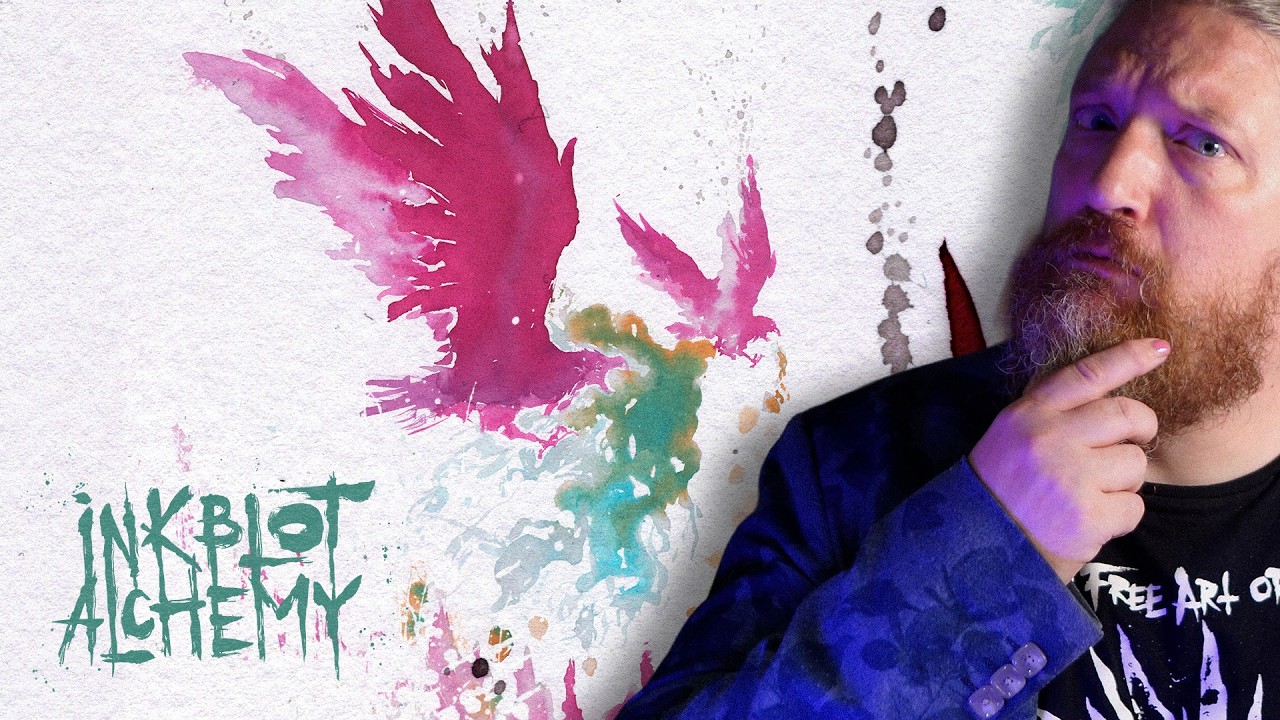
Video summary
The video begins with an introduction to the creator's "Inkplot Alchemy" series, where he transforms random ink blots into finished artworks through an unscripted and spontaneous creative process. While drawing wings and feathers from an abstract ink stain, the artist addresses a recurring theme in his comments: the contentious distinction between "high art" and "low art." He argues that this binary classification is fundamentally flawed and often rooted in racism or classism rather than artistic merit. Instead of categorizing art based on its cultural origin, the level of refinement, or the institution it appears in, he proposes a simpler framework where art is only divided into "good" and "bad," or simply into pieces that resonate with the viewer versus those that do not.
To illustrate why these distinctions are problematic, the speaker uses two powerful examples involving historical context and unintended artistic evolution. He discusses how African folk art was historically dismissed as inferior until European artists like Picasso appropriated its styles to create what is now celebrated as "fine art," a hierarchy built on colonialist and racist biases. Furthermore, he analyzes the works of H.P. Lovecraft, noting that despite the author's deeply held racist views and fear of racial mixing in his early stories, his later fiction evolved to suggest that human civilization was corrupt and that alien beings represented true intellect and goodness. The artist uses these cases to demonstrate that art often communicates complex truths and shifts in perspective that transcend the creator's original intent or societal prejudices, proving that value cannot be determined by the background of the artist or the class of the audience.
The video concludes with a humorous retelling of Norse mythology regarding the Mead of Poetry, which explains how different types of poets emerge depending on where the mead falls after Odin poops it out to escape a giant. This story serves as a metaphor for his final conclusion: there is no such thing as "real" art versus fake art, nor high versus low art; there is only good art and shitty art, a judgment that ultimately rests with the individual viewer's taste. The creator emphasizes that even if some contemporary art markets are driven by money laundering schemes, the vast majority of artists create work out of a genuine desire to communicate something meaningful, regardless of whether they ever receive financial reward. He invites viewers to support his work if they find it valuable, while encouraging others to simply enjoy the freedom of creating their own art without worrying about labels or hierarchies.
Read the full video transcript
Hi there. I'm Kim Diaz Holm and this is
Inkplot Alchemy where we use our
creativity to make art from out of
chaos. Now, what will we find in today's
ink blot? I have no idea. But I think
whatever we find, it will become art.
What art will this be? I I don't know. I
have no idea.
What do you see?
Let's just keep looking and seeing the
possibility. And while we do that, allow
me to explain briefly what inkplot
alchemy is all about. Two times every
week, I draw something from a random ink
plot and release the full video of the
entire process, unedited and unscripted,
except for this tiny little intro
script.
The I may bring some ideas to the table.
I sometimes do, but the ink always
decides the direction. It might get
dark, it might get silly, it might get
personal, it might get political. If you
want to skip the whole process, then you
are free to do so. The final image will
be marked in the video. But if you want
to come along for the journey, then
random ink drawings is more than just
drawing. It's fun. It's play. It's
magic. It's inkplot alchemy.
Now, do you see anything in the ink
plot? comment below and I will start
talking about art and what art is while
arting around
with with this thing.
And I think, you know,
I've done this a ton of times before,
but making some wings
and feathers out of
this type of ink blot.
And I I I'm not I don't have anything
planned now. I don't have
anything that I see
yet, but I can find something.
A and while I find this winged thing,
allow me to explain what I'm thinking
about art because [snorts] I get a lot
of comments about art. And it's
I got this shitty comment the other day.
I usually get
I usually
get um mostly nice comments, but you
remember the shitty ones for some
strange reason.
And
the shitty comment read something like
uh [sighs]
uh
I I love art, but this ain't it or
something like that. And that's okay.
You're entitled to your opinion.
But it reminded me of some nice comments
I get that are
shitty
in the same
sort of way.
A and
those nice comments are all the comments
that says, "Oh, this is real art."
Unlike that modern crap. Unlike those
artists who are just randomly splashing
paint around or or
[clears throat]
or literally sitting on a canvas or or
taping bananas to to to
walls or or anything like that. And it
always bothers me
when you have to
uh put down other art in order to lift
up what you like.
because
art is art. I I I don't like
the exclusive
definitions of art that people seem
married to. And and
one of those is
very prevalent in the contemporary art,
the high art, the fine art
world.
And that is those who think that
there is this distinction
between
low art
a and high art. And I'm here to tell you
that there is no distinction between low
art and high art.
The only
distinction
is good art and bad art or art you like
and art and you don't like.
And
when people try to define
good art or bad art or high art or
different classes of art, it always goes
back to
either racism or classism.
So, so
in the view of the fine art world,
fine art is that art that has been
plucked out from
the plebs from the the the lower classes
and put into these fine established
institutions.
So, so
as an example, um, [snorts]
uh, African folk art
isn't fine art
until
it's displayed together with
the
Picasso rip ripoffs where Picasso
stole a lot of things from
African folk art and made it his own,
appropriated it. And I'm not here to
criticize
um
Picasso.
I'm not necessarily a fan or not a fan
or anything. I I have very few opinions
on Picasso except that he, you know,
It's strange that we put
misogynists and abusers on pedestals
like
he was definitely
an abuser of
of women and probably of more. [snorts]
But
there isn't any
real distinction
between
that art
and uh and the African art he steals
from. Both of them are reactions to
impulses around them to tradition to c
to culture through to new ways of seeing
to old ways of seeing it's all
the same.
And when you try to classify one as real
and the other as not real, you you can
only do that through looking through
lenses of classism. This is high art
because it's cultured, it's schooled,
it's uh
um
made by the right class of people
or racism that that this is art coming
from a good proper culture, a civilized
culture and the other is not.
And in the same way
you can't really put that
distinction the other way around and
saying that oh [sighs]
real art is only
the art that's being made
by the true people by by the working
class by by the peasants,
by the the the indigenous people,
because that's another way of just
locking it down and saying that one is
real and the other is
not.
A and I I simply don't like it. Never
have liked it.
Both seem like art to me because both
are
humans trying to communicate
in artistic ways with the tools that
they have available to them.
And uh
sometimes those tools are
coming from long
uh um
long traditions and from
indigenous cultures or from
um
uh places in the world that that are
uh exploited.
Sometimes they come from
uh
the places of of the world that are
exploiters.
So a a and both being
in this machine that exploits
a and being the victim of the machine
that exploits is
they are both
reflections of human experience. And
[sighs]
I I don't see
it's not that I don't see the
difference, but but but they can both
tell
communicate artistic things that are
beyond
what
what we can say with mere words.
A and even I I don't know enough about
Picasso but you know one of the things
that I find so
fascinating about HP Lovecraft is that
he
as a writer he had some as a person he
had some definitely awful views both for
his day a and even worse
how these views are looked at
today.
And
one of the interesting things about
Lovecraft as a writer is how these
things
find echo in his art.
So, so you might have heard things like
uh um there is a lot of racism in
Lovecraft work and there is
uh and there is a lot of fear of
crossbreeding interbreeding of uh
tainting the racial purity and that's uh
that's um what's interesting with the
story shadow over inmouth is that it's
all about this uh evil city of [snorts]
uh fish people that have crossbread with
the deep ones and the they are evil and
different and awful and people should
stay away and all of that. [snorts]
All of these basically thinly veiled
racist tropes.
And
[snorts]
I need to find another color. I think I
want No, I know what I want to do.
Let's really do this.
Yeah. So, the interesting thing about
uh Lovecraft's art is that even though
Lovecraft was still a racist at when he
died and he was still invested in his
utterly unscientific
awful racial views.
there crept in interesting elements in
his art and his art that's often based
on dreams. And one of those interesting
things is that while in his early
stories, the horror of crossbreeding of
different races, breeding was
there might be some tainted blood in my
family line. Oh god, what a nightmare.
And then the story ends like um the
story of the case of Arthur German.
But
in
the shadow over inmouth there is a new
tendency
that happens in Lovecraft.
That is
that it turns out that the main
character is of Fishman blood of Deep
One blood. But instead of that being
horrible,
he ends up spoilers
going to live with the fish people
because by the end of
uh Lovecraft's life in his literature,
the human civilization and society
was
The
evil was the bad, was the un
evolved, the undeveloped.
And the strange aliens were
the symbols of
civilization, of intellectual effort, of
good in some way.
Okay. So, so, so that and I don't think
Lovecraft even thought about it this
way. Maybe it did, but in his
reflections on
on his own fears and on his own
nightmares and on his own intellect,
which was what he was doing with this
art all his life.
He comes to a surprising conclusion that
maybe he didn't even realize himself. He
told things he communicated things with
his stories
that are
in opposition
to where he was intellectually at the
time when he died that was had further
evolved as thoughts. Okay. So that
that's one of the aspects
that makes me think that that that
this distinction between fine art and
low art is bogus.
Is you find these things that
communicate more
than what anyone intended to put into
it. And you find these in all sorts of
art. You don't always find it, but you
find it in all sorts of art if you look.
So that's one of the things that I think
is interesting is looking at not what
class of art is it, not what
uh what
level of
culture or class or
refinement or anything like that. I it's
about looking at what is what is this
art saying and is it saying something
interesting and something more and
something [snorts]
worth thinking about whether or not the
author were [snorts]
aware of everything
they put in their work. I find that
really interesting.
The other thing is that
there is this tendency when people
comment my work on my work and say, "Oh,
this is real art, not like those taping
a banana to
uh wall."
There is this tendency to look a and see
[snorts] the the contemporary art world
as somehow lesser than the more
classical or illustratorly
or storytelling art because uh the
commercial contemporary art world is all
about money and they're just u money
laundering a and
all of that which is
true.
The contemporary art world is the top of
it is a money laundering scheme.
There's very little doubt about that.
But that money laundering scheme,
paying millions for
bananas
or for
other art just for
the the brand
of that art.
That's not the fault of the artist.
That's the fault of the system of
capitalism.
And most artists who work within
contemporary art
never see any of that money. They are
people who
dedicate their lives to doing something
very weird and nerdy a and [snorts]
maybe it's art that maybe no one will
understand it. or maybe just five people
or or they're doing performance art in
for audience of 20 or 100 or if they're
successful a couple of hundred.
A and
the thing that makes the artist want to
make the art is almost always this need
to try to communicate something.
And then
in the contemporary art world,
a very tiny percentage of those who
dedicate their life to their weird nerdy
circumstances,
to their art projects.
get
they they get uh rewarded
by
insane amounts of money. That is a tiny
tiny tiny tiny. It's not even a
percentage.
It's the very very few.
Most
contemporary artists just make art
because they want try to communicate
something in the way
that they can and that they want and
that that that their life has led them
to.
And
I guess just to try to sum up all these
rambling thoughts because the drawing is
going way quicker than I I I
thought when I I started and not knowing
what it was going to be and now I know
what it is. And some of you may may not
know what it is. So I have to explain it
to you as well. Now [snorts] the
the the thing is
with these types of comments saying that
no this isn't art this is art or uh this
is real art but that isn't art. I it's
like saying
no no no no you're not doing sport. Only
people playing chess against Magnus
Carlson is uh uh doing sport. And then
then someone else say, "No, no, no, no,
no. People playing chess on TV, that's
not sport. Real sport is uh the little
leaguers. Uh the the the
kids playing soccer at school." No, no,
no. That's not real sport. Real sport is
mountain climbing. And it's No, no. All
of those things are sports.
It's just
different
ways to do it at different levels for
different people.
And
the story that I'm trying to illustrate
here is the story of Sutung Mur, the me
of Sutung, where
um
I've drawn this story before, but
perhaps not quite as beautifully as
here.
Udin uh goes to
this is from Norse mythology. Udin goes
to
uh Utenheim to the land of the Utans,
the giants or whatever you want to call
them
to get back the me of poetry which is
the blood of a
wise being called. And it's a very long
story. So I should probably set out do a
story time for that story on its own.
And
[snorts]
and uh in the end
Odin manages Odin manages to get the me
of poetry, the the drink that can make
you a good poet by drinking it all and
then transforming
in the shape of a hawk And then the utin
that uh owns the meid discovers him and
sets after him in the shape of an eagle.
And then when they are flying above
Valhalla
and Midgard
above the home of humans and of the home
of the gods.
[sighs]
Uh Odin disposes of
the mead by starting to puke it out. And
the gods
on the ground, they they they start
carrying uh they start collecting the
mead in buckets as he's puking it out.
But in order to get away from the uh the
giant from Sutung the eagle,
Odin lets out
a [ __ ]
in the face of the
eagle that's after him. So he poops the
mead of poetry into the face
of uh the eagle that's chasing him.
And the punchline of the story because a
lot of Norse stories have punchlines.
The punchline of the story is
that
uh only only artists,
poets
are the ones who have drunk the me of
suting, the me of poetry. So if someone
is has the artistic spirit in them, it's
because they have had some drops from
the me of
poetry.
But when Udin shot in the face of
his pursuer,
some of those drops also fell down on
the earth.
And those artists who drink of that,
that that's the that's the me of shitty
poetry.
And I think that's I think
I I really think that's all you need.
There's no high art,
no low art.
There's no real art and unreal art.
[ __ ] a art by by the way for other
reasons.
There is only
good art and shitty art. And
who decides?
That's you based on your taste.
Let's see if the gods allow this art or
if it's shitty art.
The gods have accepted [snorts]
my offering.
So that means this work is
finished.
Woohoo.
And I even remembered to press record on
the video, so that's a plus.
And
we'll call it [sighs]
the me of shitty poets.
the me of shitty poetry. And that is
inkplot alchemy number 25.
We sign it
and that means the me of shitty poetry
is done. Inkplot alchemy number 25. And
if you like this art, if you think that
this art is not shitty art but good art,
then that might be some art you want to
support. And you can support it by going
to denongadhome.com
where this original will be for sale. It
will also be for sale as print. And if
you're saying, "Oh no, the prices are
way too high." Then maybe they are for
you. That's why I release all my art for
free use under a creative common
attribution license. So you can use it
for free. You can print it. You can uh
change it. You can even sell it as long
as you attribute me. Because art like
speech should be free. And if you want
to support that, buy
something from denong home.com.
If you think it's good, if you think
it's shitty, then
go make some good art yourself and have
fun and uh take care. And uh I'm very
happy with [snorts]
this one. And I need to tell the story
of Sutungard, the me of bad poetry
someday.
See you in a few days.