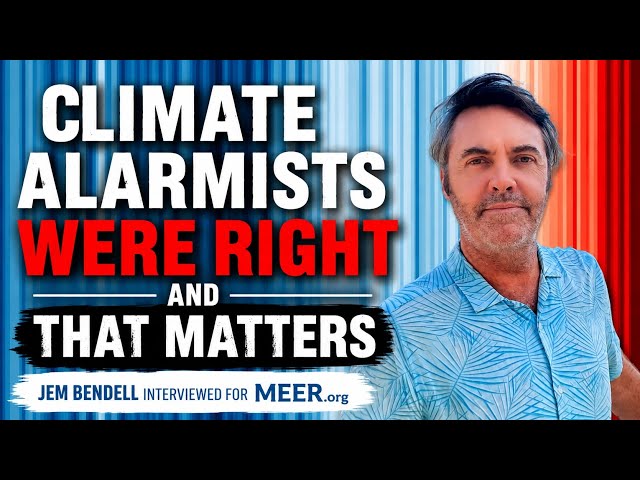
What If Climate Alarmists Were Right? Jem Bendell interviewed for MEER.org
Watch on YouTubeVideo summary
Professor Jem Bendell argues that his 2018 "Deep Adaptation" framework was initially dismissed as alarmist but has since been validated by accelerating reality and a shifting scientific consensus. He identifies that sea-level rise is speeding up faster than previously acknowledged, while climate change is driven not only by carbon emissions but also by the loss of Earth's albedo due to deforestation and ocean degradation. This reduction in planetary reflectivity means less sunlight is bounced back into space, causing more heat absorption. Furthermore, natural carbon sinks are increasingly becoming sources of CO2, a critical factor often overlooked because of institutional dynamics like siloed specialization and a modernist culture focused on "fixing" problems rather than adapting to them.
Bendell emphasizes that the current crisis requires a "pancological" approach that recognizes the vital roles ecosystems play in both carbon and hydrological cycles, particularly through phytoplankton which naturally seed clouds via dimethyl sulfide emissions. He warns that toxic pollution and microplastics are damaging these organisms, leading to reduced cloud formation over oceans where 90% of sunlight is now absorbed as heat instead of being reflected. While some propose ocean fertilization or mixing to restore phytoplankton populations, Bendell criticizes the dismissal of necessary geoengineering by elites who prioritize profit over survival, urging instead for pollution reduction through fungi and bacteria without reliance on capitalist venture capital. He asserts that individual tree planting has negligible global impact compared to the destruction of large forests driven by an expansionist economic system seeking metals for batteries under the guise of a "green transition."
The central subject of his work is addressing the "meta crisis," defined as a deep crisis of meaning and purpose underlying various societal collapses, which forces humanity to rely on risky geoengineering solutions rather than meaningful adaptation. Bendell proposes a framework based on six guiding questions that encourage communities to identify what to value, what to let go of, how to reclaim local power, and how to regenerate nature locally through practical ecological actions like permaculture. He advocates moving away from fear-based individualism toward collaborative adaptation and community resilience, distinguishing his work from forums focused solely on emotional processing by offering a peer-mentoring framework for thriving rather than merely coping with the inevitable changes ahead.
Ultimately, Bendell admits that the weight of this science causes personal depression but finds nourishment in connecting with like-minded communities living harmoniously with nature. His conclusion is that previous climate alarmists were partially right about the crisis but too focused on carbon, missing the broader need to transform the expansionist economy which prevents meaningful adaptation. By shifting focus from technological fixes and individual guilt to local regeneration and collective resilience, he offers a path forward that acknowledges the severity of the situation while fostering hope through community connection and practical ecological stewardship.
Read the full video transcript
Welcome to the Mir podcast. Our aim is
to bring thoughtful conversations that
help prepare people to better understand
climate change, environmental
challenges, and the choices facing
society. Today, I am delighted to
welcome Professor Jim Bendell. Jim is a
British scholar, author, and
sustainability expert whose 2018 paper,
Deep Adaptation, sparked an
international conversation about how
societies prepare for the realities of
accelerating climate disruption. While
somewhat controversial at the time, many
of the questions it raised about
environmental risk, institutional
preparedness, and societal resilience
have become increasingly relevant in the
years since its publication. His work
has since expanded beyond climate change
alone to explore what he describes as
the meta crisis, the interconnected
environmental, political, economic, and
societal challenges shaping our future.
More recently, he has also redeveloped
the deep adaptation framework from four
guiding principles to six, placing
greater emphasis on practical community
action, regeneration, and resilience.
Jem, welcome to the Mir podcast.
>> Yeah, thank you for inviting me, Kathy.
>> So, when Deep Adaptation was published
in 2018,
many people described it as too
pessimistic, too alarmist, or simply too
radical. But looking back now, which of
the concerns you raised do you feel have
borne out by events?
>> Yeah, looking back eight years now, um I
had pretty much forgotten what the
specifics in the deep adaptation paper
on the climate science were. And so this
year I decided to actually go back to
the paper uh and actually isolate the
claims that I was making then and
compare them to what is actually now
observable uh like measured aspects of
our climate system and also what the the
the best science in the top
peer-reviewed journals uh is now saying
about uh the climate situation and
climate futures And I realized that um I
wasn't all that crazy. I wasn't actually
all that unusual.
Um and so I identified a dozen claims
I'd made. Uh and went through them all
and thought, well, now, yeah, sure, they
were disputed at the time, but now
they're demonstrated by reality.
um and they've actually become uh uh
pretty much near consensus in current
climatology.
Now that's not to boast. It's horrible
news. Um sadly uh my assessment of the
climate science 8 years ago as a
independent like researcher not within
climatology but analyzing the
climatology from outside um
unfortunately I was able to identify
what was most salient for knowing what
was happening and um so it's actually
all been proven to be true and
I mean that's that's also why I accepted
your invitation. to come on this podcast
because I know people who listen to the
mere podcast are fairly unusual. Uh the
audience um paying close attention to
climate issues, climate news, climate
science, climate data uh unusual in
terms of the majority of the population.
So obviously must be feeling some some
dread and sadness and annoyance like all
of us. Um and of course that needs to go
somewhere. It does in me. Um and so
yeah, it kind of kind of galvanized me
into action as you say to upgrade the
the deep adaptation framework to go back
to the original climate science and to
say ah okay so
myself and people like me the so-called
climate alarmists were right our critics
were wrong and that matters now more
than ever it matters because we need
those uh past institutional and
psychological dynamics which led to
mistakes in under estimating and
underpredicting the the climate
situation and how messy it would become.
Those same dynamics exist today and will
be leading to new mistakes. And so we
need to look at that together. Um it's
not about blaming or boasting. We just
need to look at it together and see how
do we um not make those mistakes now.
And I think there are blind spots with
climatology and what we do about it. So,
um, so yeah, that's that was how I've
sort of tried to do something with my
own u dread, anxiety, grief, annoyance
is to try and find useful ways of of
metabolizing that.
>> Yes. When you did look back at at the
claims that you had made, were did
anything surprise you, even you, about
how quickly some of the changes have
unfolded
in the climate space? It some of the the
worries that you had um that have borne
out and and why they've become much more
accepted in those eight years.
So um you know when I about eight years
ago when I was making the claims I was
making which were um more alarming than
establishment climatology as for example
represented by IPCC reports. Um I wasn't
making those claims based on nothing. I
was making those claims based on
peer-reviewed science and also
observational data in 2017. and um just
um previous years um that were coming
from top institutions. So it's no
surprise to me that
um mainstream climatology or
establishment climatology has caught up
with those more alarming interpretations
of the climate situation from 8 years
ago. Um,
but you also asked a question of of how
the climate's changing now and whether
it's surprising to me. Um,
yes. Uh the pace of climate change is a
little bit faster than what I
anticipated
and I think I know why which is maybe
something we we could come to later. is
to do with uh carbon emissions only
being half the story for man-made
nearterm climate change. And that some
of what's happened is to do with the
loss of the Earth's reflectivity, also
known as albido. And that isn't just
because of either greenhouse gases or
the um knock-on effects, the amplifying
effects of those gases in the
atmosphere. It's also to do with what
humans have done to large forests and
healthy oceans to diminish their ability
to naturally seed clouds which are very
crucial over oceans and reflecting sun
because otherwise if that sun arrives at
the ocean surface 90% is absorbed and
turned into heat and transported around
the world eventually. So something we
could get back to, but I think maybe
what might be helpful is to just mention
at least maybe a couple of those core
claims in the deep adaptation paper that
seem to be um so annoying to some uh
climate scientists eight years ago, but
are actually completely uh unc
unontroversial now. Um yeah so the first
one is simply that sea level rise is
accelerating worldwide.
So I made that claim based on the
satellite data that was available at the
time. And so in the uh few years like 5
years prior to uh the end of 2017 when I
was doing and early 2018 when I was
doing the research
um that's what you know we had these
satellite measurements from the '90s and
uh unfortunately sea level rise was
accelerating. Now the intergovernmental
panel on climate change their assessment
report uh number five in 2013 and then
concluded 2014 it was cautious on this.
It noted that the rate of rise detected
during the satellite era so from the
'90s onwards was higher than the overall
20th century average.
But it didn't make that headline
finding. It didn't then confirm it. It
just said there's this data. it didn't
confirm it as consensus um and didn't
prioritize it in terms of what it what
it was was indicating.
Right? So a new study now in 2026 has
confirmed not just an accelerating rise
but a doubling of the global uh of the
rate of global sea level rise. Now the
other crucial thing is that I was
looking for what was most salient. So
there is a immense amount of climatology
published in the past and published all
the time. There are thousands and
thousands of scientists who are now
doing research which uh is added to this
field we now call climatology. um and
it's um
in that it's difficult to spot what is
the signal amidst the noise. Now my
critics
uh many of them said oh her gem is
cherrypicking the data and that is uh
sort of a porative framing of salience
picking from a mass of data and that is
what we need to do if we're not
interested in simply what's the next
question what is it that we don't know
on our narrow specialism we're actually
looking at this information to think
well what to the best of our knowledge
is actually happening in the world
that's most important. So the problem
becomes when if you work in a specialist
field naturally you're trying to get
ever better at your narrow area and you
need to be very good at it and that's
great but obviously you're thinking so
what still don't we know in this narrow
area that's how science is done and
that's different from trying to
interpret what do we need to know now to
manage risk to actually inform society
now of course climatologists get
together and try and do that but they
are not habitually trained or skilled or
supported to do that to actually look at
all different fields and identify what's
most salient significant to know. So
coming from the outside as a researcher
as a research analyst who had done
climatology in the past um I had a
different attitude. So I looked at that
data on on sea level rise and I thought
well why would that be happening unless
global climate change is also
accelerating because um mainly sea level
rise is driven by thermal expansion of
uh the seas of water and melting of ice
from the land entering the ocean.
And so there may be some delays. For
example,
uh the heating that then takes time to
be transferred lower down into the
depths of the ocean. But on average, in
the end, it is an indicator of what's
happening the whole system. And so if cl
if if sea level rise is accelerating,
that's a massive indicator for climate
change accelerating.
And if it is then it means that either a
lot of um uh self-amplifying feedbacks
um uh have already started so that the
the planet is heating itself because of
anthropogenic emissions of carbon
or there are additional
additional things going on here to
carbon
and um not just cyclical like because
this is all all the all the minor
variations would be sort of evened out
in sea level rise over years. So
yeah, I didn't dive into that second
implication
because I was a bit carbon fixated like
everybody else perhaps in uh in 2018
2017 2018. But that was my second claim
major claim in the paper. Climate change
is probably accelerating now.
We also uh now speaking in 2026 uh it's
uncontroversial now to say that climate
change is probably accelerating. It's
not even controversial to say climate
change is definitely accelerating
and there are and there are then debates
about um how fast uh how long do we wait
before we agree where we're at? Like
should we say we're at 1.5 now because
we had a year already over 1.5 or we
going to frame that as a temporary
overshoot and when do we just stop
pretending that it's a temporary
overshoot? um like what statistical
thing should we use to agree that and
and there are debates about why it's
happening but there's only a few
outliers fascinatingly some of the most
famous most senior most quoted
climatologists who are still saying oh
well maybe it's not accelerating or we
can't be sure or nothing's happening
outside the projections of our best
computer models but there's
peer-reviewed science from the world's
best climat matologists as I see them um
that are just confirming that it's
absolutely accelerating and it could
even be exponentially accelerating
uh which would be ridiculously bad news
but we're not certain on that. So
there's a couple of of claims. I mean I
could go on like for example the third
claim I made in the deep adaptation
paper was that our natural carbon sinks
so forests, oceans, soils will probably
decline and become some of them if not
altogether net sources of carbon rather
than syncs of carbon. So natural
emissions will increase and this will be
a selfamplifying
feedback whether or not at the level of
a so-called tipping point still there'll
be massive self-amplifying feedback. So
the planet will be heating itself no
matter what we do with emissions. Uh
again the consensus of IPCC
back in um the AR5 which was the latest
one at the time of my research in 2018
uh was that the carbon fertilization
effect where carbon increases plant
growth um that would actually increase
because there'd be more CO2 in the
atmosphere so plants would take up more
of it and so that would moderate uh
warming and only in a very high warming
scenario would that be damaged and
therefore we might see uh these um
current carbon sinks turning to carbon
sources. Well, that's nonsense. Uh now
we found that um what the the biggest
study from last year found that um
natural sinks turning to sources already
accounts for about 8% of the observed
increase in atmospheric CO2. So 8% of
carbon ppm in the atmosphere is because
of anthropogenic um damage to the biome
the biosphere uh leading to more CO2
release. So I could go on. There are a
dozen I've actually now produced an
essay um so I recommend uh people check
it out. a dozen claims in a dozen
climate claims in the deep adaptation
paper which were disputed but are now
near consensus or demonstrated by by um
by actual measurements our thermometers
our our sensors um and so it was
interesting at the time some of the
critics said ah but it wasn't peer
reviewed said yes I know um it was peer-
reviewviewed and they didn't want me to
conclude what I concluded um and I said
well I I can't not and so um was it the
editor of the ecologist magazine when
publishing ing a critique of it said
when I wrote to him saying there are so
many holes in that critique here here's
a list of them all and he said oh well
it wasn't peer reviewed so we're now
doing the peer review in public like
well we've the deep adaptation pap's
being peer reviewed by reality now and
sadly it passed
>> yes
indeed well and as you were talking
about carbon sinks turning to carbon
sources I mean we've seen the fires too
which is
above and beyond just the failure to be
able to draw down as much. But um we're
we're also seeing that aspect of things.
I I yeah
>> that's a particular thing for me because
um
so I did geography at Cambridge
University between 92 and 1995 and
already I was fascin I was an
environmentalist and I was fascinated by
um the possibilities of climate change
back then and in 1993 I did a I chose
you could choose like modules and I they
called them papers and I chose
oceanography and tropical
ecology because I was obsessed with
these issues and
um
yeah the um
I I was really upset with getting a bad
mark on my um tropical ecology paper
because it was a question about climate
change and how deforestation might
contribute to climate change. And I
wrote the first half of the essay like
all the normal stuff that we' all been
taught. And I wrote the second half of
the essay was actually things could get
so bad particular if we look at the
paleo record. It was like what might
happen here? Oh so actually forests
might burn because of future warming.
And I was given a 22 like a bad mark on
that. Um because obviously I was I was
too much of a alarming extremist doomist
back then wasn't I in 1993.
So,
>> oh,
>> the reason why I know that is because it
brought my grade down. I see. I don't I
see. I don't It must sound like I I I
carry grudges. Oh, well.
>> No, but it's from 93. I've been thinking
every time I see a forest fire and
people say, "Oh, it's cuz the forests
are more stressed or drying out, more
diseased because of climate." It's like,
yeah, that was kind of obvious even to
an undergraduate in 1993.
>> Yes. Yes. Sadly,
I think I heard more about climate back
in the 80s than than I did until
recently. I mean, now it's hard to not
it's hard to ignore as we
>> Yeah, that's interesting you say that.
So, yes, it was kind of like news as in
new stuff to talk about in the 80s,
wasn't it? And it finally we heard about
it and
uh Yeah. Yeah. So, so yeah, I heard it
at the end of the 80s, but also as sort
of a
back then it was connected to a broader
critique of capitalism, industrialism,
growth society, maybe we need to shift
our values, wake up to the fact we're
part of nature, not separate from it.
Um, and it was kind of like it was kind
of like a nice philosophical thing. It
was like this this threat that would
come real in 2100. So you could talk
about it in an interesting way at a
conference and be relaxed or a retreat.
It wasn't oh It was this more of a
interesting addition to a philosophical
conversation about redirecting society
and our values.
>> Yes.
>> Now it's more in the realm of I don't
know if you can have in your podcast but
anyway.
Um well on now that we are talking about
you know the the gravity of the
situation
you know let's let's talk about climate
professionals themselves
have been reluctant to discuss the full
scale of the risks. Um can can you kind
of delve back a little bit from before
and now? you know, why why do you think
that happened? And do you think those
same pressures still influence
environmental discussions today and
discuss that that piece of the puzzle
and the problem?
>> Yeah. So, um
that's why I've written the essay
um for for ages,
partly because I didn't want to exhaust
myself and uh put myself back into an
emotional funk. I didn't look at the
climatology again. I mean, we're all
seeing the bad news across our screens,
but I didn't want to actually sit down
and read all the climate science again
or check all the latest data.
Um, I didn't want to do it also because
I thought what's the point
like mainstream or establishment
climatology
and even the establishment environmental
profession doesn't want to hear from me
on this. Um so a lot of people reacted
amazingly to the deep adaptation paper
in 2018 and quit their jobs and became
activists or set up projects. I mean uh
the founder of the MIA project read my
paper and started questioning what he
was doing as working in MRI health uh
scanning machines and stuff and um
decided to set up MIA wrote to me about
it and and and um and it's amazing to
see what what Dr. Yayo and colleagues
have done since. But he wasn't unusual.
Lots of people um were shocked by this
uh framing of climate change as uh a
tragedy already and a threat to humanity
rather than some kind of sad thing about
polar bears. And so it was a massive
massive shift and it shook people up and
a lot of people have done amazing
things.
>> Wow. Uh, and I'd also got quite a few
climatologists
supporting me, writing to me in private.
Um, and that's interesting because like
17 years ago, the Guardian did a a
survey of climatologists and I think I
think it was 90% that they surveyed says
privately thought we would never stay
below 2° above pre-industrial.
Uh, but they didn't say any of that
publicly. And so I think there really
needs to be some introspection
within climatology uh the people who
work in that field and also amongst
journalists who report on that field and
environmental nos who then uh determine
their strategies priorities on the basis
of that information. There needs to be
an introspection across the board. Um
and yeah, because in public I was um
people, not just me, but people like me
who were considered uh too alarming or
too alarmist or then framed as so-called
doomists or soft doomists or whatever
the phrasing was. Um yeah they uh yeah
they they not only dismissed the
research and views as unscientific.
They also
um then said they were unhelpful even
though they themselves weren't
psychologists or social movement
theorists or political theorists or um
and they also then some of them uh
attacked the character of the people
involved. um and our motivations. So
there was something very deep going on.
Uh and so yeah, I don't wish to blame so
I don't wish to talk about the
individuals. Um but there are really
some important things here to look at.
So the I would say
the reason why
establishment climatology as represented
by I mean that term refers to
the IPCC and the the the scientists who
then would contribute to that and would
be most quoted about
uh what is consensus climatology. Um, so
those people were mostly publicly
against alarming readings like mine 8
years ago. Not because of complacency,
not because of conspiracy, not because
of corruption, not because of stupidity,
none of that. Um, not because of
cowardice. It was the normal dynamics
that are so well known in the sociology
of professions and also the history of
philosophy of science. Normal dynamics
whenever you get an institutionalized
field of knowledge there are these
dynamics. Um and the first is you you
define the the field you you therefore
what's in and what's not and that
creates specialisms which creates siloed
thinking.
And so um that's and and you need to be
really good and specialist. So if you
but if you silo your thinking and your
scientific endeavor then that can create
a lack of skill and support for the
scientists to have lateral thinking and
integrative thinking and sal and the
capabilities for salience
identification. So that means you need
to be able to see well what are we
assuming here and what is that excluding
from our inquiry and uh also you need to
be able to take a step back or like have
a helicopter view and say well what is
most significant to tell us what's going
on and what is most important to know to
quickly understand to the best of our
knowledge what is reality and what is
risk right now. Um so there's that. Then
the second area is the psychological and
institutional dynamics that affect
knowledge production and dissemination
and that's occupational closure,
occupational expansion and interest in
peer esteem. So uh if you've worked
really hard to get your PhD and worked
20 years to get to the top and then
you've got this whole system around you
then understandably
you need to have uh gone through
processes where you have met certain
standards and that's great and you want
to uphold those standards which is great
but the shadow of that is you really
don't like somebody who's not gone
through that then bringing something
new. So it's a dynamic of occupational
closure and we kind of need that. It's
good. I want to go to a dentist who has
gone through all that and knows what
they're doing with my teeth. I don't
want to go to some person who's a wacko.
The problem is not everyone who has a
view on my teeth will be wacko if
they're earnest and they've got the
right research skills and they've really
read all the science. So in climatology
this is a process that happens. Also
occupational expansion naturally you'll
be as a manager of a research institute
interested in well where can we get the
the multi-million grants over multiple
years and guess what happened? It was
all in the field of modeling. So huge
amounts of modeling is done because
that's where you get masses of money. Um
and then peer esteem in any field it's
peer esteem. You want to associate with
the the people who are uh high up in
your field and you want to avoid any
possibilities of being dismissed or
shamed. I mean because once you're a
career scientist belonging to that uh
that profession becomes more important
on a daily basis than actually knowing
the truth
and the problem is people don't want to
admit that because the story of a
scientist is I work to discover the
truth. A third factor uh and I write
about it in my my essay uh on on this um
is the broad culture of mod modernism
within which we've learned to be humans.
So
um we are deeply taught without
realizing it to believe in human
supremacy and progress uh and that any
problem is something that can be fixed.
Um
and and we know that we are very good at
that. You know, if we have a headache,
we take a paracetamol. Um, we might look
a bit deeper at what the stresses we're
going through or the way we position our
neck in front of the computer, but we
kind of think we can fix things. So
therefore, there's this expectation that
we'll all tell each other how we fix it.
There'll always be a happy ending at the
end of the disastrous study. Um, and we
find that even in like like even today
there'll be all these publications come
out which are just bad news. these
scientific peerreview journals, bad
news. And there'll always be two
conclusions at the end, which is that we
need to know more information, more
research, more money, please. And
secondly, um uh we we need to do more
before it's too late. It's kind of like
it's almost like you're not allowed to
exist as a professional unless you say
those things. Um
of course, there's an understandable
concern about communicating bad news to
the public. Um but in that case if
climatologists were really concerned
about that rather than that just being
an excuse they should look at how to
bring bad news to the public. Um and uh
I wrote about that a lot in the past um
because it's a real issue. I don't want
to just upset people. We've got to think
about how to help people with this bad
news. And a fourth factor I talk about
in the essay um is the scientific
difference and time constraints of uh
journalists.
Um, so they'll just report what is the
standard story coming from establishment
climatology. Um, they'll keep quoting
the top scientists even if data and
science has proven them to be in wrong
in the past and others right. Um, you
know, if climate and environment
journalism was doing its job, they would
be banging down the doors of people like
Yaya, myself, and others who have been
proven right by reality. Um, and what's
worse is the opposite happens, which is
that those journalists that are
interested in that, they see that as a
story, they have to cope with the
ideological police who are their
editors. So loads of times
uh editors have cancelled stories that
would have argued that deep adaptation
science was um credible. The biggest one
was NPR the the big radio in the US
where one of their top journalists did a
whole documentary on me. It went through
all all it went through everything was
edited was about to be released and then
one of the senior editors said no we
just can't put that out. So the ideology
of editors as well. So all these
dynamics as I say it's not a conspiracy,
it's not corruption, it's nothing. It's
it's just like that. It's just these
dynamics occur. They're known about.
There's a huge amount of scholarship on
them in the sociology and professions
and the history and philosophy of
science. And those dynamics exist today.
The psychological and institutional
dynamics in science and in science
reporting exist today. And so new
mistakes will be made now unless there's
a little bit of introspection amongst
the people involved. And that's why I've
written the essay is I'm inviting us to
look at those dynamics and one and ask
well what's being overlooked today that
could be really really important.
And I've got views on that. Other people
may have too. I'm I'm going to be
sharing
my views in a second essay. um just
compiling what I've already said
elsewhere.
>> Um
you know, you're talking about the from
kind of the the large view, how do you
tell the public about bad news? Um you
also you've also spent a lot of time
creating a forum for individuals to
process this bad news. So, can you talk
a little bit about about that about how
an individual
can communicate? I and I'll make it
personal. I have trouble telling close
friends and family what I know about the
climate emergency
because I know that I went through
incredible anxiety and grief in my
journey of learning. And so nobody wants
to I mean you know we don't want to to
put that on somebody else. You know
they've got other things going on in
their lives. they've got they've got but
at the same time we it's important that
people know and and who better to tell
than the people we're close to who who
trust us and and that's part of getting
the word out. And so if you could talk a
little bit about your work with people,
individuals,
and
processing this this news, this this
reality.
Yeah. So the first thing to say is to
clarify what this this reality
is and what we do and don't know. So
quite a few people assume
that this reality means
uh
the the um early death of themselves,
those they know and love
and the end of anything, any legacy,
anything they can contribute to.
So there's this sort of totalizing
uh assumption.
So the first thing to say is
if we're talking about catastrophic
environmental disruption because of
climate change and how it's going to
disrupt, degrade, break, and ultimately
collapse modern industrial societies
probably everywhere
over time and that we are already in
that process. and here are the signs.
That doesn't mean the
end of human existence. It doesn't mean
that you're uh necessarily in danger
right now or even next year or the year
after. It doesn't mean there will be
forms of life and forms of beautiful
ways of life. Um and it doesn't mean
that there's nothing still to do or to
try to contribute to. Um in fact the
opposite
waking up to this procarity and the un
the the the certainty that the way of
life we know is breaking down. But the
and the and and the certainty of the
procarity like that it's looking really
bad and could could speed up and things
could fall apart much quicker um soon.
Um realizing those two things can can
wake us up and mean that we drop um all
kinds of things which we have
assumptions like well we'll just we're
safe, we'll work hard, things that we
don't like will go away. um we we don't
want to make any major decisions. It's
okay to postpone our dreams. It's okay
not to make up with somebody who we fell
out with. You know, there's all these
sort of this sense almost like we live
forever which is just there and so we
delay so many important decisions in our
life. So waking up to this um situation
can really open the heart and bring us
back to the present and make us realize
that oh we don't know how long we've got
and so let's get on with what's in our
hearts. And um so the first thing is to
talk about about that and that and a lot
of people will relate to that. It's like
yeah of course of course yeah we're
always we're all going to die. Oh yeah I
was always going to die. Oh everyone I
loved was always going to die. Oh, I
suppose everything that I care about was
always going to disappear. It's kind of
impermanence. It's like they'll be they
may not use that word. Um but kind of
there's that. Oh, yeah. Okay. Yeah, I
knew this. Oh, thanks for reminding me.
So, that's um
yeah, and so you can talk about it at
that point. Um you can also
and that that might be them coming to us
with their concerns. This is the other
thing I used to worry about and didn't
really bring this to people. I had
enough people reading my stuff and
coming to me. So I didn't really go
about
I didn't I didn't promote these ideas. I
didn't I didn't do media back in 2018
1920.
Uh and I didn't demand my friends listen
to me on this. Um I was there ready to
talk about it if they were. But now what
I realize is
another aspect of this is
even people who don't talk about climate
change know that their lives are getting
um in many cases worse or not better.
They know that the friends and family's
lives are getting worse not better in
various ways. It might be loneliness, it
might be health, it might be just
generalized anxiety. Um
and so
they look for stories to explain that
and then you've got all these
opportunists coming along to say blame
the immigrants or blame Trump or blame
whoever. It's a blame, you know, it's
just whoever wants to come along and say
blame them, blame that. And um and
people are
um really attaching themselves to
stories of blame if it helps them feel
self-righteous. So you're because
there's this wish to somehow be better
than the mess and um or think that the
mess can be defeated
um
and that's natural and it's completely
wrong and counterproductive. So now I'm
thinking
uh so I have over the last few years
been pointing that to how there is a
general anxiety and that there's not
that much logic in what people are
saying
and I've realized that doesn't work.
Um it doesn't work. So I don't really
don't quite know what to do. Um so for
example there are people who are
intelligent people who have heard about
climate change and
have
chosen recently
because of the information that they've
been given to think that their country
is under attack under attack by brown
people
and they've just gone for that story.
And so they all they ever talk about is
more brown people and we got to stop
them. Uh and variations on that. So um
it's and it's not logical because uh
blaming brown people is is working at a
deep psychological level that there's
some kind of good situation we can go
back to uh where we can be safe again.
uh and that there's a specific enemy
that can be done something, you know,
about. Um and so yeah, anxiety has to go
somewhere. And if people don't find
community and real action on real issues
that we are right to be worried about,
they will just sort of become these
stressed, angry people in front of their
devices retweeting or reposting racist
I don't know what to do about it once
people have gone that way. And so maybe
that's a reason for maybe we should talk
about this
like
>> um for our listeners who who haven't
read Deep Adaptation or or know anything
about your forum and so forth, could you
take us through the
the guiding principles, the original
four and now the six and and
this the way that you have chosen to to
frame this because I think I think
that's a really nice way to look at it
and a really nice way to communicate
to to process this information.
>> Sure. So the deep adaptation paper in
2018 was only a third of it was climate
science, a third of it was on denial and
then a third of it was uh mapping out a
new ethos for a positive response to a
collapsing society. So and I realized we
needed ways to talk about it. So I
thought well let's have some questions
as starters for conversations.
Um,
so yeah, the the the I've expanded that
now to six and so it's probably just
I'll just race through the questions.
Um, faced with this information that
things are disrupted and falling apart
and probably it's going to continue that
way. Uh, what do we most value that we
want to keep? We should start talking
about that. It's the obvious starter. Um
secondly, oh what should we probably
therefore let go of in terms of
conveniences, habits, uh hopes for the
future. What should we let go of?
Otherwise, we might make matters worse
if we hold on to them, if we prioritize
them, if they can be let go of. Um
thirdly,
well,
we didn't used to live in such high
consumption, high energy lifestyles. So,
you know, what what is it that we could
bring back from the past that might help
us get through what's ahead? Um,
and that's all sorts. Uh, fourth one is,
oh, okay. So, we can do all those
things, but
we have to exist in a situation where we
don't know what's going to work. We
don't know
uh how much of societyy's going to pull
be last and how many of us will pull
through and what comes next. So we have
to make peace with that. So with what
and with whom
uh could we make peace with as we become
aware of essentially we are reminded of
our mortality and our lack of omn
omniscience as a species. And then I
added yeah I added two extras. Um,
in my book, Breaking Together, which was
inviting the discussions around what a
political agenda for a collapsing world
might look like, um, I I I
wanted to include how people are
responding often to this to this
awareness by trying to
uh effectively have more sovereignty in
their lives and their communities.
um uh and seeing the the losing of that
into a globalized system as meaning
we're losing power to control the future
and create opportunities. So I what what
do we need to reclaim? What forms of
power could we start to reclaim in our
lives to give us options uh for the
future if if like big government and big
markets and corporations will break down
or become unavailable to us or
unaffordable? what can we reclaim?
Uh and then the sixth one which I issued
earlier this year
um
is uh yeah I realized that a lot of
people are responding to this awareness
by becoming involved in uh regenerating
nature locally.
Um, and so I thought, yeah, that's
that's important to because there hadn't
been anything really explicit about
ecological work in the original
framework. So, it's a question of how
can I nurture life? Um, and that is in
in any kind of way at any kind of scale.
Um and
um and it's how can I nurture life
because
because it's coherent for me to do that
it's authentic cuz like why am I
bothered about this in the first place
isn't it because I love respect honor
and wonder at the mystery and of life.
So how can I affirm that value as well
in um so it connects back to the first
one uh the first question. So um that
that's the framework. Um
and also that final one on regeneration
is also relevant to the climate
predicament which is um how can we
nurture and restore nature's own climate
modulating processes.
So large forests and healthy oceans
which together massively seed clouds
globally not just locally or regionally.
So it's also bringing us back to that
aspect of the uh climate agenda which
has been lost by the dominance of uh
climate research and thinking by people
who like to play with numbers in
computer models and people who want to
use the climate crisis to get a new
series of funding for their renewable
energy. So they just want to keep it
laser focused on carbon emissions and
nothing else.
Can you would you talk just a tad more
about that cloud seating and and the and
the loss of albido globally and how that
is contributing um to warm to the
accelerated warming that we're seeing.
if you could maybe just talk a bit more
about that and and
>> um
>> because in the vein of what can we do um
and maybe even just
>> from if you'll start with the the big
picture and then maybe even down to what
you were talking about nurturing life
>> as an individual like through
permaculture because you're intimately
involved in that too. So maybe if you
could give us a big picture and then
bring it down to what each of us can do
in our own backyards.
>> Sure. So um just to loop back to what we
talked about earlier about um
if this the the the dynamics
psychological institutional which led to
uh past mistaken
views and communicate conclusions,
views, communications from climatology
and those reporting on it. Those
dynamics we talked about earlier um
those still exist and will make new
mistakes. Well, I think they are making
new mistakes and they're overlooking
areas or or if not overlooking, not
prioritizing
crucial areas for uh understanding
what's happening and what's needed to
reduce harm uh to the natural world,
reduce harm for humans, and to give the
natural world and humans a better
chance.
uh not fixing things but to give us and
wider life a better chance. And so the
thing we've just talked about is one of
them. Um but just before I want to say
one of the most obvious ones is um we
need to talk more about adaptation to
the climate changes. And so obviously
the work that Mir is doing by thinking
creatively, innovatively
uh about how to adapt through uh
reflecting more of the incoming uh solar
energy and in ways that are in our own
hands rather than just billionaire hands
or government hands and ways that are
are going to be safe as well and in our
control rather than something like risky
with the upper atmosphere. I think
that's very important. Um, and we can
also adapt more by having the kind of
conversations using the ethos and
framework of deep adaptation, which is
let's try and be our best selves in this
tragic mess rather than despite it or
run away from people and situations.
Let's not just hide. Let's try and yeah,
let's let's just accept it and get on
and and see who we become because of
this situation. Um, and more recently
I've issued what I call a rainbow
prepping framework. Uh, so that's a
pneummonic for 15 areas. And there's a
rainbow prepping essay on my website,
jenbendelle.com. And it's because a lot
of people have started to talk about
prepping. Um, and I and it's kind of
always quite a fear-based uh, defensive
and individualistic uh, response. So,
you know, have I got enough tin food?
Have I got enough ammunition? You know,
all that kind of stuff. And a lot of us
just get turned off by that. So
therefore, we don't really talk about
what we can do to prepare for
disruptions um whether that's
intermittent um
uh emergency disastrous events or more
generally more long-term. And so each of
those letters in the rainbow prepping
framework
refers to something. and I talk about is
like a brighter, creative, more
collaborative
fun way of thinking how to prepare. So I
won't go into that here today with you,
but I do recommend people check it out.
But then the the the the issue that we
talked on about so yeah the the the the
important recognition that carbon is
only half the story on near-term or or
more recent and
soon to come abrupt climate heating. Um
and that what it's not controversial
science now. It's proven that the our
planet has lost its brightness, its
ability to reflect the sun significantly
and much more so than what was
anticipated.
And
uh and it's it's it's super fundamental.
Um, so the issue isn't just how much
solar radiation that bounces off the
Earth's surface is captured by the
blanket of greenhouse gases. It's also
how much gets to the surface. So the
brightness of the Earth matters and like
this is really elementary stuff and
unfortunately it's not looked at as much
as it could be in terms of the
implications. So yeah, large forests
through um the processes of evapot
transanspiration where they basically
suck up water from the ground and then
it evaporates off them and it creates
this this upflow that actually then puts
into the atmosphere bacteria and pollen.
So that doesn't just seed clouds create
cloud condensation nuclei just over the
forest. It is transported around the
world. So you have snowflakes in Tibet
that were created because of uh pollen
or bacteria from the Amazon. It's a
global process. Um,
also other people who analyzed this um,
and this is slightly more controversial
about or not controversial, it's more
unconfirmed by science at the moment,
but there's good evidence for it, which
is that um, just that drawing up of air,
the movement of air pulls in air from
over the oceans, which then actually
therefore drives the hydraological
cycle. The hydraolog hydraological
cycles aren't just to do with um you
know the um the broad temperature
differentials across the planet and the
spin of the planet. It's actually also
what you could call biohydrarology. It's
the role of our ecosystems in those
processes too. So yes, we I believe what
I I we need more of what I'm calling a
pancological approach to climate change
that recognizes the role of ecosystems
in uh shaping the climate not just
through the carbon cycle but also the
hydraological cycle and another aspect
of that is um healthy oceans. So we have
um so a huge amount of uh cloud seeding
naturally is done by phytolanton a
certain kind of phytolankton that give
off dimethile sulfide that then uh seeds
clouds and that's there's debate over
whether clouds have a net benefit or not
um in terms of modulating the climate
but we want clouds over oceans um
because it's not like there's something
super reflective there unless it's
frozen If it's unfrozen ocean, 90% of
that is just absorbed as and turned into
heat. So,
um the problem is uh there it's it's
consensus science that there's been a
decrease in the the good phytolankton we
want. Um and that's all for all sorts of
reasons but a key reason is toxic
pollution and microplastics in the ocean
which then uh concentrate the toxic
pollution on the surface of the
microplastic which then is makes it
brings it to a concentration which is
damaging to to aquatic life and marine
life. So, um there's there's that.
Um but there's also some more worrying
research
uh by GEOS that have found much more of
a collapse of phytolanton.
So, yeah, it's un we're unsure about how
bad it is, but the crucial thing is we
could do something to help um on both of
those issues I've just described. So
we'll start with the oceans one.
There could be a role for some
fertilizing of the oceans and mixing of
ocean waters because there's the ocean
stratification that's happened with
terms of the the heating at the top and
there's less mixing. So you could
actually have some human interventions
to try and mix that and therefore help
phytoer plankton um grow again and
restore their cloud seeding effects. uh
that could be helped with some iron
fertilization. But these things can be
that the problem is you've got a very
stupid discussion on what's called
geoengineering where people just dismiss
all of this or and and if you dismiss
all of this, you just leave this whole
field to the billionaires with their
psycho plans which are all more about
just getting rich rather than solving
the problem. Um that's why I like MIA
because it's it's not like that. Um and
then you've got we could um and of
course we need to just reduce pollution
massively and we also need to think
about how to reduce microplastics in the
oceans. There are lots of interesting
ideas about how that could be done with
fungi and bacteria and things. So we
need more research urgently and ways of
rolling that out without having to rely
on capitalist uh venture capital
funding. We need these things to just
the best the best
uh solutions to uh be deployed, tested
and deployed. Um and then with large
forests, well, we know what to do. We
need to stop cutting them down and we
need to reforest around uh areas that
have been deforested to bring them to a
certain size which can create this cloud
seeding effect. So, this is the
disappointing news for those of us who
want to do something about these two
topics in our back garden. We can't.
Sorry. If you and I plant a tree, if you
and I plant a tree in our back garden or
reforest even a slight little little
patch, that might be nice for wildlife.
It might be nice for improving the
soils, uh, retaining water in the soils.
It might be nice, therefore also to
reduce carbon emissions from those
soils. It might be nice to capture a
little bit of carbon uh um and might be
nice shade for us and wildlife and it
might be a nice talking point about see
this tree. What happens if we had a
trillion of those all together? What
happens is they can seed clouds. So the
only real difference that us planting a
few trees nearby where we live will make
sorry people won't like this is if it is
part of that political conversation
because if you just wouldn't it be nice
if this happened. It's like, well, no,
it's not happening that way. And
currently, our savings, our pensions,
superanuation,
um, the stocks and shares we own, the
products we buy are all contributing to
the opposite of
having large forests in the world.
They're contributing to the destruction
of forest. And guess what? A lot of us
who are talking about the climate or
working professionally on the climate
are also part of the problem because
we're encouraging the destruction of the
world's last remaining forests to try
and get the metals from underneath them
in order to wire up the planet and have
batteries uh and uh in the name of a
green transition which is a fake uh
story. Um so yeah um yeah the the I I
this is this is why I say I suppose this
is maybe the third point uh the third
thing that's being overlooked because of
the the new mistake because of the old
dynamics is um
is that uh yeah we we we have an
expansionist economic system that
militates against anything we need for
climate mitigation an adaptation at any
significant scale.
And those of us who were alarmists in
the past, considered to be alarmists
because of our alarming readings of the
climate situation, were not only right
about the climate situation,
mostly right. Maybe we did, we were too
carbon fixated. Um we didn't see the
broader thing. But we were also right in
thinking about the implication which is
that um
we're not going to we're not going to
reduce the problem, reduce the
catastrophe, adapt well or create
opportunities for future generations if
we are beholden to global capitalism.
We're not. And therefore, anything other
than a revolutionary environmental
agenda is a
convenient self-serving lie.
And so most of the environmental
profession is engaged in that convenient
self-serving lie of there's a techno
managerial fix or even a techno
managerial remedy to try and make it
less bad. There's neither. We have to
change everything. We have to change
this expansionist economic system
because otherwise it will choose the
most risky geoengineering. It will
choose the most stupid carbon capture
machines which are just useless and not
going to have a proper impact. It will
choose um the so-called nonsense green
transition which will just dig up the
last remaining pristine wildernesses
just so a few more people can drive some
Teslas. Yeah. So the um the people who
were accused of being too ideological
like me, no, we were just sane and we
had science and facts on our side. And
more than that, we knew that there is
ideology involved everywhere. And so the
people who criticized us were
ideological in a different way. the
ideology of expansionist economics and
deference to power and um yeah
conformity within that system. And
that's an ideology too.
Yet in
it's a it's a bleak picture in in many
ways. Yet
you continue to be motivated. You
continue to write. You continue to do
your own permaculture. I believe
what
would be a a message to listeners today
about what we can do, about what still
gives you hope, um what still motivates
you. And
as a wrap-up,
>> yes. So, we're all different and we have
different capabilities
uh intellectual and also emotional. So,
um, I admire the people
who bring the kind of message I've
covered with you in this past hour,
who bring that message to the public.
And for me, I couldn't live in this
space. I I've I've I've really um not
enjoyed my last two months as I was
spending much more time reading the
climate science again and and checking
the climate data. Uh it's heavy
and and so so I may have sound like I
was dissing climatologists in this hour
and I'm not. They need to keep doing
what they're doing and increasingly
they're courageous to keep doing it. Uh
it's depressing. Um, but I guess that
many of them are a bit numb to it and
also wouldn't necessarily welcome
criticism and so they have to be even
more courageous. They have to listen to
the criticism
uh in order not to contribute to new
mistakes in the ways we've just
discussed. So um so yeah, it's heavy. So
so so there's work still to be done to
do the science and keep going and work
to be done. the the Roger Hallams of the
world who get very angry at liberal
media as well as conservative media and
say you're all rubbish. You're all just
lying to us. Abs I'm so impressed they
keep doing it. That's not for me. Um
I I've been yeah I'm focusing on
something called the Meta Crisis
Initiative which I set up a year ago
which provides monthly salons for people
who already get this or some part of it
to get together and learn uh how and
share ideas on how to
uh navigate the situation and live their
lives with this uh this idea this
outlook.
>> Do you mind defining the meta crisis as
the way you see it just for our
listeners? We haven't really talked
about them. We haven't really used the
term metacar crisis yet.
>> Sure. So many people are aware that
there are crises, all kinds of crises.
And some of those are real and some of
those are just cooked up for our
distraction. And um
and uh so some people talk about them as
multiple or multi crisis. Some people
talk about poly. But for me, metacar
crisis is a is a better framing because
it's basically saying um there are all
these crises that re that that relate to
a a deeper crisis and a crisis in our
way of making meaning of our life,
finding purpose and living our lives. So
it's a a meta meaning above and beyond
or it also often suggests deeper. So um
as a when it's used as a prefix. So uh
so I'm not talking about a crisis in
Facebook. I'm talking about a crisis in
us and our society. That's what I mean
by metacar crisis. And so yeah, I use it
as a an invitation to go deeper into
what's at the root cause of this mess we
got ourselves in and why we haven't been
able to realize it and try and fix it or
why we're so reluctant to learn from it.
Um, I find it a more inviting framing to
go deep uh and be curious than talking
about collapse. I find a lot of people,
even if you tell them that collapse is a
process, not an event, and we're in it.
It's an unfolding process, not some
thing that just suddenly breaks
everything at some uncertain future
point, most people still think of
collapse as that sudden future horrific
allending event. And so I decided to use
meta crisis as a more generative
framing. So we meet once a month salons
online suitable for different time zones
but also the really crucial thing for me
is the peer mentoring. So we create you
have the option to join a group of um
six to 10 people and you meet and you
support each other with this and this is
using my old work as a professor of
leadership and running a leadership
institute. I brought bringing that into
the mentoring frameworks
uh and so people can support each other
in working out what to do um with this
awareness and it's different from the
deep adaptation forum that I set up in
2019 which does something similar but
it's more focused on emotional coping um
like uh there are some people who who do
more than that within the framework of
the deep adaptation forum but most
people who go there and most people who
volunteer there are focusing on just the
emotional processing And that's very
valuable work because it's very
troubling
information to live with. Um, but the
meta crisis initiative is different.
It's about how can we even thrive? How
can we live purposeful lives because of
our understanding of metacrisis and
collapse, not despite it. We're actually
going to say, okay, this is happening.
This is reality. And this reminds me how
incredible it is to be alive. like I'm
not going to be alive forever. Uh humans
won't be around forever. The planet
won't be around forever. It's absolutely
wonderful and mysterious and beautiful
and oh wow, I've been reminded of that
and I want to live as as fully and as
beautifully and as purposefully as
possible in that context. Um so that's
the vibe. It's a little bit more sort of
um
uh out there rather than just coping.
It's beyond coping. That's the idea. Um,
so yeah, you you Oh, yeah. How do I keep
going? Yes. Okay. Um, so I was saying
there I'm more suited to that which is
to work with people who already get it.
I I get very depressed if like I have
done. I've just felt I got a bad sleep
really the last two months. And yeah,
it's cuz also working on this kind of
science and scholarship just crowds out
everything else for me. I can't just pop
it away and get on get on my guitar and
it just it's just I can but it but
there's a lot less guitar music fun
sport. It just disappears. I become this
awful person just staring at computers
reading reading research. So uh yeah
what uh how to cope permaculture. Yeah I
mean this is I'm wearing see this
t-shirt. This is a got this t-shirt last
week from the Alia Eco Lodge. Um,
I find nourishment through connecting
with people who are who get it. They
don't need to read books. They don't
need to read my new essay on uh who was
right on climate, who wasn't, and why it
matters. Um, they can just um they just
they get it anyway. They want to live in
harmony with nature and community and
they don't want to they don't want to
live so far away from the land in an
urban setting where you depend on
supermarkets and everything. I mean I
depend on the supermarket even with my
permaculture but but but
um but I have an inclination towards a
more wholesome
life more connected to nature more in
harmonious
with with wider nature. So I want to
hang out with people who get that and
that for me that's what I want to do. It
doesn't mean everyone should do it. I
mean, if nobody was going out there on
mainstream media and getting angry, um,
then I would feel like, oh, maybe I
should do a bit of it. But, yeah.
>> Yeah, we each we each have our role to
play. No, that's a nice place to to
leave it on um community and living life
to its fullest with purpose. Um so thank
you very much for joining us today and
for sharing your reflections on
resilience community how we might
respond more with more honesty and more
constructively to an increasingly
complex world. So
>> yeah and thank you Kathy for the work
you're doing in uh yeah staying paying
close attention to the climate
predicament. Um it's it's it's not easy.
I mean many people think of me as
someone who is associated with that. But
I need to put it down and do other
things in order to cope. Even though the
rest of my life is shaped by this
understanding,
I can't go back to the darkness all the
time. I have to get on with what's
bright and fun.
But yeah, thanks for what you're doing
and everyone else at MI because um yeah,
it's important stuff you're doing.
>> Thank you, Jim. And thank you to
everyone listening. If you'd like to
learn more about Mir's work, visit
mir.org where you'll find previous
podcast episodes, information about our
research, and updates on projects taking
place around the world. Until next time,
thank you for listening to the Mir
podcast.