What do everyday items from the 19th century reveal about American slavery?
Watch on YouTubeVideo summary
The video explores how mundane artifacts from the 19th century, particularly shoes and clothing, reveal a deep economic synergy between New England's Industrial Revolution and American slavery rather than an antagonistic relationship. Professor Seth Rockman argues that while the North pursued gradual emancipation and industrial innovation, it simultaneously outsourced its reliance on enslaved labor by producing essential plantation infrastructure such as axes, hoes, textiles, and shoes for slaveholders in the Deep South. Manufacturers, including Quaker entrepreneurs like the Hazard brothers in Rhode Island, conducted "plantation R&D" by traveling to the South to ensure their products were durable and fitted for enslaved workers, marketing these goods specifically as "negro cloth" to protect human property and increase labor efficiency. This industry transformed the material lives of impoverished New England families, allowing them to escape debtors' prison and improve their standard of living through piecework sewing, while global supply chains involving wool from Smyrna and Buenos Aires ultimately impacted the clothing availability for enslaved people across the nation.
By the 1830s, entrepreneurs Tyler and Ezra Batchelder transformed Central and Western Massachusetts into a massive shoe production hub where hundreds of families worked without centralized factories to produce approximately 400,000 pairs of shoes annually in towns like North Brookfield. These "Russert brogans" became standard footwear for enslaved people and were frequently cited in fugitive slave advertisements as key identifiers, such as specific sizes, used to recapture escapees. The manufacturers implemented planned obsolescence by replacing hand-stitching with wooden pegs and nails, limiting the shoes' lifespan to six months; this strategy allowed them to sell twice yearly while framing frequent distribution as benevolent care, even though it enabled coerced laborers to maintain the mobility necessary for escapes or religious gatherings. The industry's connection to slavery extended into cultural realms, where minstrel shows and terms like "negro cloth" reinforced racial hierarchies among Northern manufacturers who often viewed themselves as fulfilling biblical mandates by clothing the enslaved.
Following the Civil War, New England firms initially shifted production to Union Army uniforms but later sought to sell their goods to freed people as a new consumer market, a vision that ultimately failed due to Reconstruction violence and a lack of economic opportunity for formerly enslaved individuals. Many firms eventually went bankrupt or moved due to deindustrialization, highlighting the fragility of an economy built on such specific historical complicity. The speaker concludes that understanding this history is not about proving guilt but examining how people rationalized their entanglement in oppressive systems, a dilemma that remains relevant to modern issues regarding global supply chains and environmental impact. Ultimately, the material basis of slavery was a national project deeply connected to everyday manufacturing, demonstrating that the prosperity of one region was inextricably linked to the exploitation of another.
Read the full video transcript
You can take a fairly mundane material
artifact like this shoe and connect it
to the larger political project of
enslaved people's quest for liberation.
The shoe is crucial in this regard. For
example, no one is able to run away to
the north without shoes. People who in
fact come across the Mason-Dixon line
and escape to freedom often say, "I
couldn't have done it without footwear.
No one is on the record of having made
it without shoes."
>> [applause]
>> Hi everyone. Thanks for coming out to
the Charles River Museum of Industry and
Innovation. My name is Steve Guerrero
and I'm the director of education here.
So I'm in charge of everything you learn
from now on.
Um I'm really pleased to see a good
crowd out here even on a rainy night.
It's really important especially now to
support our local cultural institutions
like museums. We are places where we can
build community, we can learn, we can um
be faithful to an accurate telling of
history and so this is an important um
part of the story that we're going to
hear tonight. I also um am just really
interested and excited to have uh Seth
Rockman here tonight because we are at
the site of the Boston Manufacturing
Company.
Uh that was the first modern factory. It
was started by Francis Cabot Lowell in
18 It was opened in 1814 and it produced
cotton textiles at scale. Uh this is the
first place where mill girls were a
workforce and everything you know about
the cities of like Lawrence and Lowell
especially and Holyoke, Manchester, New
Hampshire. The systems that they used of
manufacturing started right here on this
site. It was the first large successful
private company in America and it
essentially fulfilled Hamilton's warning
to us that it wasn't enough to be
politically independent. We want to be
commercially and economically
independent and of course what we're
going to hear tonight is how that came
at some cost that we should reckon with
as historians.
Um
I'll leave it at that, but I'm very
excited and um, proud to welcome uh,
Professor Seth Rockman. Seth's a
professor at Brown University and his
book Plantation Goods was a Pulitzer
finalist, um, rightly. And uh, we're
proud to welcome him here without
further ado, Seth.
>> [applause]
>> Thank you, Steve, for the introduction
and for organizing this entire event.
Thanks to all of you for coming out this
evening. It's really nice to see so many
of you here. I also want to thank you
for bearing with my voice, which
hopefully will make it through the
course of the evening, uh, but a uh,
history department uh, holiday party
last night has left me a little
gravelly.
My goal tonight is to talk to you about
my book Plantation Goods, a material
history of American slavery, which uh,
just celebrated its year birthday. And
over the last 12 months, it's been a
pleasure for me to get to share this
book, uh, with audiences,
uh, here in New England, in the American
South, Midwest, the West,
uh, and it seems time after time people
are genuinely surprised by the stories
that I'm able to tell here because they
often run against many of the standard
versions of American history,
uh, that one learns in elementary school
and that are part of our national
mythology.
So, I'll start by telling you a little
bit about how the book came into being
and it's very much in conversation with
with something that was happening at my
university, Brown University, when I
first arrived there more than 20 years
ago. About 20 years ago,
um, reparations activists, uh,
particularly people like Charles
Ogletree at Harvard University, were
looking for a defendant to name in a
reparations lawsuit. Some kind of uh,
ongoing concern that was, you know, uh,
around in the time of the transatlantic
slave trade and where it could plausibly
be argued that the wealth that was
sustaining that institution today was
built on that dirty money.
So, our president, Ruth Simmons, the
first black president of an Ivy League
university, uh initiated what she called
the Slavery and Justice Initiative and
put us to work trying to figure out what
exactly had happened. She was very clear
that it would not be a very good thing
if this all came out in a court
discovery phase and that rather as a
university we should do what
universities do best, which is try to
tell the truth, try to figure out
actually the accurate history. So,
digging into the archives of the Brown
family and looking at the commercial
world that these four brothers built
during the last years of the British
Empire and the first years of the United
States, one of the things we found is
that they were profoundly unsuccessful
slave traders. They did not make money
by sending voyages to West Africa. In
fact, those voyages lost the money. But,
we did not think this was particularly
exculpatory. They tried to get dirty
money, they just weren't very good at
it. But, what we did find is that they
made almost all of their money as the
provisioners of the British Empire's
Caribbean sugar empire. That is to say,
the part of the British Empire that
actually was valuable, the place where
the most crucial commodity of the 18th
century was being produced. Places like
Jamaica, Barbados, places that enslaved
laborers were being fed [clears throat]
by the hard work of New England
families. Uh places where the barrels
were being made out of hardwoods from
New England forests. Places where the
horses that were turning the gears of
the sugar engines were being raised on
Rhode Island farms. And so, this
provisioning trade
very much uh sort of clued me into the
ways in which
locations that are not directly involved
in the buying, selling, beating of other
human beings, nonetheless are profoundly
tied to a broader slave economy. One
that could be national in scale, one
that could be hemispheric in scale, one
that it could even be global in scale.
And so, it clued me into some kind of
story that might be told around New
England's role as a provisioner.
But the slavery and justice report that
Brown University uh then published in
2006 told a very tidy story.
The relationship of New England and
Rhode Island in particular to slavery
seemed to come to an end at the moment
in 1807, 1808 when the United States
left the transatlantic slave trade. Uh
the law said now no longer uh could
American boats participate in carrying
enslaved captives from West Africa to
the Americas, and thus supposedly
everyone had clean hands.
And you think to yourself, well, I'm not
quite sure about that because having uh
you know, being uh a stone's throw from
Pawtucket, a place that might make a
comparable claim, Steve, to the
birthplace of the American Industrial
Revolution.
Uh in Pawtucket, Rhode Island, they
would tell you that yes, this was where
uh the spinning of cotton really got
going at the end of the 1780s and the
beginning of the 1790s thanks to Samuel
Slater, and there was no source of this
cotton other than through the exploited
labor of enslaved men and women, first
in the Caribbean and eventually in the
American South.
So, how do you tell a story of a New
England Industrial Revolution that
somehow seems to be a departure from
slavery rather than uh a deepening of a
set of relationships to slavery? And
that's something I tried to explore in
this book, asking how did New England's
Industrial Revolution continue to be in
conversation with a massive expansion of
slavery as really the driving engine of
the American economy. And one way to
think about this is with a map. Uh this
is a historical map. You may not be able
to recognize that because it just looks
like a Google map, but you'll notice at
the very bottom
Gulf of Mexico.
We're sticking with this, people.
Um
And you'll notice two parts of the
United States that are circled. The part
that of course we're in in New England,
uh a place that as museums like this
will tell us,
uh innovation, uh enterprise, created a
new way of being in the world. Uh
opportunities for people through hard
work to uh receive rewards for their
innovation, the transformation of a good
deal of non-market labor into wage
labor, and the massive increase in
industrial output that ex- that it
significantly improved the material
standard of living for countless
families, including working class
families, over the first and middle
decades of the 19th century.
But then you'll also see the other part
of the map, the the the ovular circle or
the oval running from uh the Carolinas
all the way through Alabama and
Mississippi to Louisiana, uh places that
at the beginning of the United States
did not belong to the United States, but
were a number of indigenous
uh sovereign lands of of groups like the
the Cherokee and the Creeks, but over
the course of
uh of several decades as the United
States expropriated these lands, they
became the heart of the American cotton
industry. Uh
and this expansion of the cotton
frontier
went hand in hand with the rise of the
Industrial Revolution in New England.
Now, these are stories that
[clears throat] are typically told
separately in American history for good
reason. And and for those of you who are
in your Civil War class, you'll know
exactly what I'm talking about, right?
We tell a story of how New England
underwent this transformation to become
a free labor society, how New England
made a set of commitments to the dignity
of labor and the idea that people should
get to earn
uh their their bread and to keep those
earnings,
uh and this was in fact what would come
to define freedom. So New England is on
a trajectory going this way. On the
other hand, the cotton South becomes
ever more invested in the production of
agricultural commodities for global
markets, ever more committed to the
lifetime bondage and hereditary bondage
of enslaved African descended men,
women, and children. And it has a whole
other set of commandments, and it seems
to be going that way. So, if you have
one part of the country going this way,
one part of the country going that way,
excuse me, the center cannot hold, and
voila, 1861, it falls apart, and you get
the Civil War.
That is the typical story. The story
that I try to tell in my book is
somewhat different. It suggests that for
most of the period, the 1810s, 20s, 30s,
40s, even through much of the 1850s,
these regions were not antagonistic so
much as synergistic, and that their
economies had a great deal to do with
one another, and that we can't, in fact,
understand New England's industrial
transformation without putting it in the
same conversation as the transformation
of of Creek hunting grounds into
uh Alabama slave plantations. At the
same time, we can't understand the
experience of those places, we can't
understand the experiences of enslaved
men and women and children working in
those spaces without having some sense
of the tools that they were using, the
shoes that they were wearing, uh and
their other sort of uh material lives,
which tied directly to the kind of work
that was taking place in numerous small
communities across New England.
So, if you think synergy rather than
antagonism, you can put these two
regions together. And to do so in the
book, I use two concepts that are fairly
anachronistic, two terms that people
don't generally think about as 19th
century terms because they are so
consistent with our more recent economic
history. So, one term that I use is
outsourcing, right? And I talk about the
ways in which southern slaveholders who
moved from the eastern seaboard, from
places like Virginia and Maryland, to be
build new plantation societies uh in
what was then called the Southwest, they
made a crucial decision to outsource the
production of some of their key
infrastructure.
If we were to look at the lives of of
plantations in places like Maryland or
Virginia at the beginning of the 19th
century, places like Monticello for
example, a good deal of enslaved labor
was devoted to making textiles and
making tools. But the enslaved
blacksmith who might have been
responsible for making shovels and hoes
and the enslaved weaver who might have
been responsible for turning out the
yards and yards of cloth that would
dress her fellow enslaved men and women
on a plantation like Monticello, when
that woman or that man is is forcibly
removed to a brand new plantation in
Mississippi by a slaveholder whose
investment is in growing as much cotton
as possible as quickly as possible
because that is where the greatest
return on investment is because cotton
is the most valuable commodity in the
global economy at this moment,
the decision to reallocate labor follows
very quickly. And so that rather than
having some enslaved workers doing
things like weaving or blacksmithing,
having every single person in the fields
for as much time as possible becomes the
economic imperative that drives these
slaveholders. And so they look for new
sources of the kinds of basic things you
need to run a slave plantation. And so
they outsource this production to New
England.
New England becomes the key provider of
their plantation goods. The title of the
book in fact refers to this term that
would have been known to Americans
north, south, black, white, enslaved,
free as that constellation of very
boring things, axes and shovels and
shoes and hats and boots and coats and
dresses that were part of the material
basis of plantation labor.
So these plantation goods are
outsourced.
Meanwhile, if we tell the story from New
England, I can use another fairly
inaccurate anachronistic term. And
that's offshoring.
New England functionally offshores its
slavery. You know the term offshoring,
right? Today, when people look to park
their money in regimes across the world
with different kinds of tax laws that
allowed them to hide their wealth, or
when people try to move factories to
places that have lower labor standards
so that they're not responsible for uh
for for meeting
uh unionized workers in the marketplace,
or for meeting government standards for
the work day, this kind of offshoring is
also a way we might think about New
England's relationship to slavery.
At the moment when they are engaging in
gradual emancipation, at a moment when
the practice of legal bondages is ending
in places like Massachusetts, Rhode
Island, and Connecticut, these places
nonetheless remain very much invested in
enslavement.
People who are living in New England
come to have as much of an interest in
the price of cotton as does any
slaveholder, because it is indeed by the
price of that cotton that they may be
repaid for the axes that they have
produced, or the shoes that they have
made, or the textiles uh that have come
off their looms. So, again, if we're
thinking about a broader framework that
is about the synergy of these regional
economies over the first decades of the
19th century, it is by thinking about
outsourcing and offshoring that we can
see the ways that north and south
function together.
The book starts uh in New England, and
it is very attentive to a number of
small communities where virtually every
family is involved somehow in making
things for slave plantations over the
first decades of the 19th century. I'm
about to show you a map identifying some
of those small communities, but before I
do, I simply want to acknowledge the
disappointment that is inevitably going
to fall over this room.
Which is to say, this small community is
not on that map.
And you might say, but we came here to
find out about our small community. And
I'm sorry about that. It does not figure
in this book. But there's a very
specific reason for that, and it's one
I'll simply tell you at the outset. As I
was surveying plantation goods, I was
very interested in New England
entrepreneurs who were looking develop
to develop specific products for
enslaved people to wear and use. They
did field testing. They did what I call
in the book plantation R&D. They
traveled through the South. They
gathered a great deal of information
trying to produce products that could
then market to slaveholders as crucial
to increasing productivity or crucial to
protecting the health of enslaved
workers whose bodies were highly
capitalized in the slave market.
In this sense, the textile industry that
is so crucial to the plantation goods
sort of project is the woolens industry,
and it is manufacturers of woolens both
along the Blackstone River between
Pawtucket and Worcester, but also in the
southern part of Rhode Island
running from from North Kingstown to
Stonington and Mystic, Connecticut
really where the woolens industry is
most robust. Now, places like this
produced a vast amount of cotton cloth
made with slave-grown cotton, and much
of that cloth returned to be part of the
world of enslaved people's clothing and
bedding and all of this kind of stuff.
But very few, if any, of the
entrepreneurs who were involved in the
cotton industry tried to develop
specific weaves of cotton or specific
weights of cotton or specific varieties
of cotton cloth that they could then
turn around and sell as made explicitly
and designed explicitly to increase
production on the plantation.
This is really only true in the woolens
industry, and that is why the woolens
industry occupies the heart of the book.
But if you take a look at this map of a
region that I'm sure is all familiar to
you, we can identify a constellation of
locales that in the 19th century
would have been known as, for example,
Collinsville,
Connecticut, about
15 miles to the west of Hartford, as the
leading site for the manufacture of the
axes and machetes that enslaved workers
would use to clear the lands of the
Southwest and ultimately then to
cultivate sugar in places like western
Louisiana. Or we could look about 20
miles to the west of Worcester
in North Brookfield, Massachusetts,
acknowledged to be at the time the slave
shoe capital of the United States, a
place where virtually every family,
families that own their own land,
families that are engaged in subsistence
agriculture, nonetheless devote
significant amount of their time in the
evenings and in the winters to producing
shoes that will end up on the feet of
enslaved people. We can talk about
Haddam, Connecticut, down the
Connecticut River,
where
the Scoville Hoe Company comes to
develop what they call the planters hoe,
and they go to the they go to Alabama
and they do tests and they bring
information back and they roll out hoe
2.0 and they send it to their
slave-holding friends there and say,
"Try this out and if this is not the
greatest hoe that your slaves have ever
used, we'll give you your money back."
Right? Aggressive marketing, aggressive
design.
We can look in Stonington, Connecticut,
a place
where numerous local families had
household looms in which they produced
plaid cloth that slaveholders in places
like Tennessee might recognize simply by
sight as coming directly from
Stonington. And a place like South
Kingstown, Rhode Island, in the southern
part of my state,
where two entrepreneurs who are really
at the heart of my book, a man named
Rowland Gibson Hazard and Isaac Peace
Hazard,
pretty much transformed the southern
Rhode Island countryside into the
workshop of the plantate plantation
clothing industry,
activating numerous farming families to
devote women's labor, daughters labor,
mothers labor into the production of
clothing that enslaved people will wear
and use.
So, let me show you a little bit about
what that looks like from the
perspective of the archive and give you
a sense of what that research is. And as
I explain this to you, then we can come
back to uh the broader picture and the
broader takeaway from this integrated
national economy of slavery. So, much of
my research in this looks like the kind
of research that any ordinary social
historian would do, or frankly any
genealogist would do. So, many of this
much of this may be familiar to you. So,
for example, you might end up with a
book from the payroll
of the Hazards who are paying families
in Southern Rhode Island for the
manufacturing here in 1838 of ready-made
clothing for enslaved people to wear.
Enslaved people become some of the first
Americans, in fact, who will wear
clothing that has been manufactured in
standardized sizes by people who live
hundreds, if not thousands, of miles
away. It's really a remarkable
transformation in the larger history of
the American clothing industry. But
here, in June of 1838, we see people
like Daniel Gould's wife and William
Davis's wife and James Wilson's wife and
Hannah Rodman being paid for making uh
in that week six pairs of pants and six
shirts, or for Hannah Rodman, 12 pairs
of pants and 12 shirts.
And with these kinds of account books,
what's fascinating is the way in which
they connect to what these families do
with the money that they earn. Because
almost all of these women who are doing
this piecework sewing are paid in store
credits.
Which means that we can then open up
those registers and see what it is that
the Davis family bought with Mrs.
Davis's work, or that the Gould family
bought with Mrs. Gould's labor. Uh the
fact that the women are largely not
named on this is a testament to the
legal practice of coverture, still
robust in the 19th century, that hides
most women married women's labor and
earnings under the name of their
husband. But once we go in the other
books we into the other kinds of books,
we see some remarkable things. We might
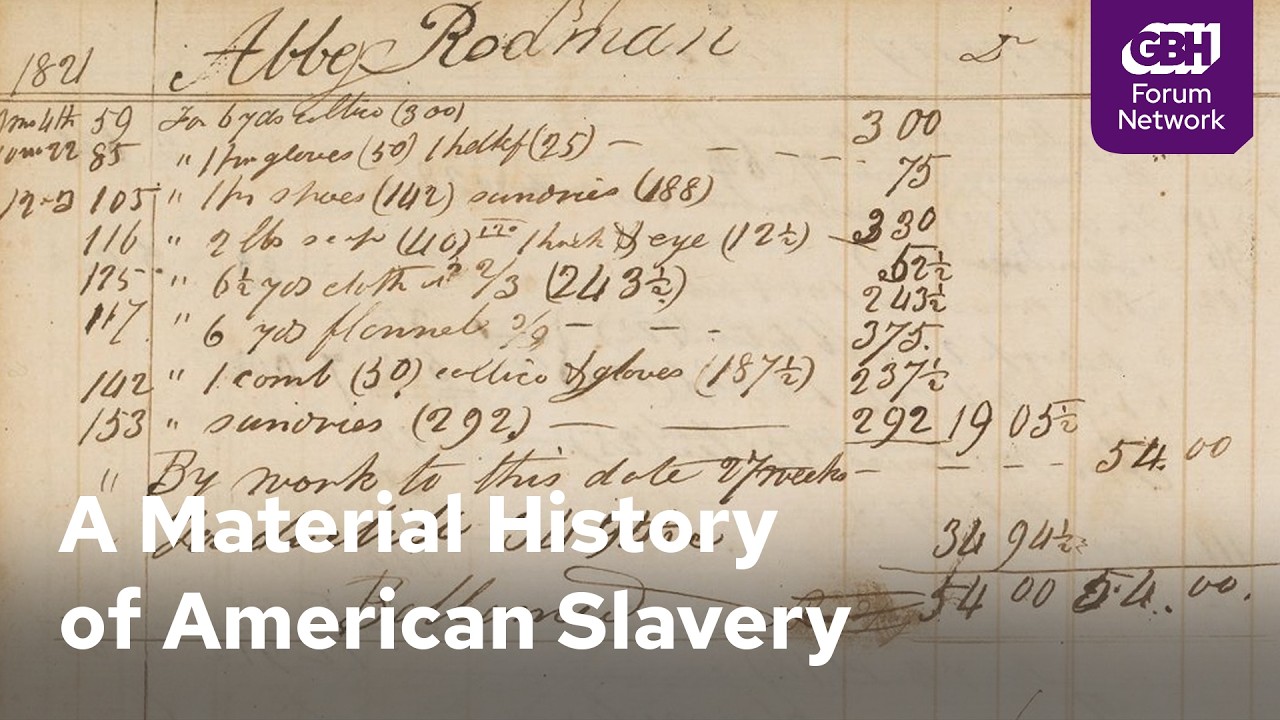
see, for example, a record for Abby
Rodman here in 1821, recognizing, if you
look at the bottom of this, that for 27
weeks of labor she's been paid $54.
But, much of that $54 has been spent on
all sorts of things. A pair of gloves, a
handkerchief, a pair of shoes, sundries,
2 lb of soap, 6 yd of cloth, 6 yd of
flannel, a comb, calico, gloves.
And by putting these kinds of records
together, it becomes very, very clear
that the material standard of living for
impoverished New England families was,
in fact, transformed by access to this
opportunity. That families that were
really making sort of eking out the most
hardscrabble existence, by being able to
allocate additional labor within the
context of subsistence farming, were
able to acquire that second pair of
shoes, that third pair of shoes. They
were able to acquire kinds of fabrics
that were far more uh or of of a far
higher quality than the very fabrics
that they were producing. And this
becomes a really crucial story for
understanding what this industry does
for small uh farming families uh
throughout New England. I spend a lot of
time in the book talking about someone
named Penelope Rodman, and this is her
tombstone that you might be able to make
out on the left side uh of this image.
Born in 1807, died in 1857. She's
married to a man named Daniel Gould, and
may remember Daniel Gould's wife on the
previous uh payroll, that's Penelope
Rodman. And Penelope Rodman is a
remarkable story for thinking about this
kind of material transformation of New
England lives through this industry. So,
again, like a good genealogist, you
could start with the uh the the the
census of 1810, find Robert Rodman, uh
see that Robert Rodman has uh a number
of children, like eight children. He and
his wife are trying to raise them in
Southern Rhode Island, but then you
might also on the left side discover
that in 1814, Robert Rodman has been
incarcerated in debtors prison because
he's unable to pay his bills. And this
is a fairly common predicament for
people living on the economic margins of
this period. When you can't pay your
bills, your creditors are entitled to
put you in jail.
When Robert Rodman is put into jail, a
number of his neighbors come and they
they issue uh statements that give
testimony to uh the state legislature
that is empowered to provide a discharge
for an incarcerated debtor. And at the
bottom of this testimony, a neighbor
tells a remarkable story. He says, "I
had a son who uh wanted to start a
school here in Southern Rhode Island,
and I knew that the Rodmans had like
seven kids. So, I went over to tell
Robert Rodman that I could give him a
discount on this school that my son
would be more than happy to educate his
kids, and Robert Rodman says, 'I can't.
My children have no clothing to wear.
They would be naked, and I cannot send
them, and thus the answer is no.'" So,
here's a family again who is so poor
that the children are wearing tattered
rags, and the father ends up in debtors
prison. But what happens at the end of
the 1810s and the early 1820s is quite
remarkable. And what happens is that the
leading entrepreneur in South Kingstown,
Rhode Island, uh a man named Isaac uh or
two men, Isaac Gibson Hazard and and and
Rowland uh
uh Rowland Gibson Hazard and Isaac Peace
Hazard, they begin producing textiles
for plantation markets, and they come to
create opportunity for families like the
Rodmans to pull themselves out of this
poverty. So, by 1821 or 1822, we can see
Robert Rodman's account book, and we can
see at the bottom here on the right, by
his children's work uh on his account,
$225.
And if you go through this ledger, you
see that in fact, the children's labor
has paid their house rent, has paid for
virtually all of their food, has paid
for virtually everything that has
sustained this family and brought them
back to solvency.
And we can see the ways in which it's
not just buying basic things like
molasses or butter or sugar or pork, but
also buying larger quantities of cloth,
additional pairs of shoes, and again we
can see that that robust rising standard
of living.
If we trace Penelope Rodman who's doing
this as a 12-year-old and then as a
15-year-old, we can see that she'll be
spending time then signing contracts to
weave for the Hazards in 1822, again in
1825, earning more money than her
brothers can potentially earn because
they're not able to do this work right
away, certainly more money than her
mother and father can earn because
they're not the desired labor force for
this, and we can trace someone like
Penelope Rodman all the way then through
as she becomes a married woman to doing
that piecework stitching of clothing
that enslaved people will soon be
wearing.
So again, you can put this all together
and tell a fairly remarkable story. But
the archive contains some other kinds of
records that have to sit alongside
these. And these are lists that look
more like this. This is a list that
comes into the Hazards in 1839 from a
Louisiana slaveholder whose plantation
is called Providence Plantation. And on
this list he he includes the names of
Kitty and Tom and Cuffee and Henry and
Henry Middleton and Fountain and Jim and
Charles and Isaac and Daniel with their
ages, with their heights, with their
foot measurements, sometimes with bodily
descriptions like heavy built, and sends
these with orders that say, I need to
buy
plantation suits for all of my people.
And the term plantation suit will come
up a great deal.
This does not mean that enslaved people
were receiving custom-made clothing,
anything but the sort.
New England manufacturers like the
Hazards quickly took these bodily
measurements and reduced them to
standardized sizes in which height was
usually the only metric so that a man
who is 5'6" and weighs 120 lb and a man
who is 5'6" and weighs 220 lb would
receive the same garment, which would
then require a good deal of additional
labor in plantation spaces by enslaved
seamstresses to enlarge these clothes or
to create trades so that people could
finally get ready-to-wear clothing
because when it arrived it was anything
but that.
So, one of my goals in this book was to
try to see if I could say here in 1839
someone like Sarah Brooks or someone
like Sarah Craig was wearing a dress
that someone like Penelope Rodman had
made back in New England. Could I follow
a specific single garment from the hands
of a New England farm woman to the body
of an enslaved field worker in Louisiana
and through that movement talk about
these lives that are often very much
removed from one another that not are
not often thought to be part of the same
story, but by that material artifact
tied profoundly together. I can't quite
get you that close, but I can get you
pretty close. I can, for example, use a
list like this, like the one you saw
before,
to see in the left-hand column that
people like Leonard Williams or Robert
Gardner's wife in the left-hand column
were producing for J.B. Goldsby. And
Goldsby is a Louisiana slaveholder. So,
I can then find his records, which might
exist in an archive in Louisiana, and I
can say, "Well, who are the enslaved men
and women on that plantation in 1839?
Who, if there's a record, are is
receiving cloth or receiving clothing in
that season?" And I can come pretty
close to tell you that a woman on that
plantation might be wearing something
that Mrs. Gardner made or Mrs. Greenman
made or Mrs. Williams made. And again,
that makes it pretty pretty close.
And again, we can then, if we think
about the lives of the enslaved, someone
like Solomon Northup, the New England or
the New York man who is who is kidnapped
and who spends 12 years in slavery, this
is the frontispiece of his book, Solomon
in his plantation suit. That plantation
suit is a Rhode Island garment, right?
This notion that there is an open collar
shirt with a matching pair of pants, put
those together, call it a plantation
suit, and we see these Rhode Island
women making these time and time again.
The book ultimately comes to spend much
of its final chapters in plantation
space, thinking about the ways in which
these New England manufactured goods
shape the material lives of enslaved
people, how their fit, how their motion,
how their affordances ultimately create
political possibilities and shape the
texture of work itself on the
plantation. And when I bring the talk to
a conclusion today, I'll share exactly
what that means. But before I do, I want
to spend another minute on sort of these
New England manufacturers because they
are largely the prime movers and the
kind of people who were whose lives
could be documented in a museum like
this one. So, again, someone like
Rowland Gibson Hazard of Peace Dale,
Rhode Island. This is his business card
as he does plantation-to-plantation
sales in the South in the 1830s,
specializing in coarse woolens, cottons,
brogans, which are kind of high-top
boot, and hats.
Hazard is born in in in early the early
1800s in 1801. His older brother Isaac
is born in 1793. The two of them have a
very fine Quaker upbringing. In fact,
they're sent from Rhode Island to be
educated at the Westtown Friends School
in Pennsylvania. Their family has a long
history of testimony against slavery,
but by the time their coming of age in
the 1810s, they're pretty much not too
concerned about that. So, you end up
with these incredibly powerful artifacts
in the letters in the archive where it's
dotted with the these and thous and
thines of Quaker diction, and yet it's,
you know, "Thou art to make 200 yards of
negro cloth."
Right? And you come to think like that's
that's kind of a remarkable thing that
one confronts in these kinds of records.
But the Hazards uh they they take over
their father's mill, they begin
producing low-quality uh woolen
textiles,
but they do so before they actually have
a market. And so they send them to
Boston. Hey, Boston merchants, can you
sell these to say uh will ship captains
who might want garments to go in the
slop chest? Eh, not so much. They send
them to New York. Can you sell these to
uh canal diggers working in the western
part of the state who are digging the
Erie? Might they want these fabrics? Eh,
not so much. They send them to
Philadelphia and they get a really
remarkable response. "Many slaveholders
in our in our market at this moment and
they seem interested in these fabrics
thinking that they will make ideal
clothing for slaves." And with that tip,
the Hazards really come to devote almost
all of their energies to breaking into
the southern market. They begin to write
to slaveholders in South Carolina and
Georgia asking for advice. They travel
to the south to meet slaveholders and
ultimately to talk to enslaved people
about what are the desired qualities of
a fabric. There's testimony that comes
from the letters when one brother is
traveling through Georgia back to the
brother in Rhode Island saying, "I
talked to the men and women on the
so-and-so plantation and they said 42
inches
uh fabric is much more desirable than 28
inches or 36 inches. They say 16 oz or
17 oz to the yard is more desirable than
12 to 13. They say twill woven is more
desirable than plain woven. They say
that the wool cotton blend holds up
better than the all wool uh fabric. So
there's a huge amount of in essence we
might call consumer feedback coming from
slaveholders, coming from southern march
merchants, but also coming from the
enslaved that will shape New England's
manufacturing practices.
The Hazards very quickly come to develop
a fairly robust presence in this market,
and already by the end of the 1820s,
their fabrics are being marketed by
named brand.
But a remarkable thing happens as these
fabrics move into Southern markets, and
that is that they come to have a new
name that is not one that would be
prevalent in Rhode Island and well-known
in Rhode Island until they make it so.
And so you'll see this, and it's a bit
jarring, but I've already tipped you off
to what it is on this advertisement from
a Charleston, South Carolina dry good
merchant, William Ripley,
whose store on King Street will offer
the Hazards negro cloths.
So what makes a cloth negro cloth?
Right? That's a really interesting
question, and it's a remarkable sort of
process by which an inanimate object can
be part of the larger history of making
race in the United States.
The term negro cloth is a thing, and it
is also not a thing. And here's what I
mean by that. People in the north and
people in the south, people who are
black, people who are white, people who
are enslaved, and people who are free
would know this term by the late 1820s,
1830s, and 1840s. They could talk about
it as though it was a distinct material
object. And at the same time, the same
fabric when it rolls off of a mill in
Rhode Island and is sent to the Erie
Canal might be called Kentucky jeans.
When it rolls off a factory in in Rhode
Island and is sent to
a whale ship in Nantucket, might be
called kersey or Welsh plains. But when
it's sent to the south to be worn by
enslaved men and women, it is
transformed into this magical thing
called negro cloth. There is no
difference in the textile. It is
functionally be same textile that
working class people across the United
States are wearing in the 1820s and
1830s, but it is thus weighted with a
kind of racial stigmatization.
And it is sold to slave holders in a
kind of clever marketing as something
that will help you extract labor more
efficiently and will protect your
investment in human property. The
Hazards become through this label of
Negro cloth keen marketers to slave
holders and they make claims. This is
not just fabric, this is performance
fabric. Your people, they will say, can
pick faster by wearing our cloth. Your
people can protect their health during
the cold mornings from respiratory
diseases because this fabric will
breathe and keep the moisture off of
their bodies. There's a whole discourse
that emerges that draws on racist ideas
of bodily difference
uh to create a claim that these are
performance fabrics that will be
necessary for enslaved people.
And the Hazards are really at the
forefront of the of this market. But at
the same time,
as we see from one of their price lists
and one of their merchandising
advertisements from New Orleans by the
middle of the 1830s, it is not just one
thing.
That there are dozens of different
fabrics of different width, of different
weight, of different weave, of different
composition, of different color, of
different price points that can all be
marketed under the label of Negro cloth.
So, if you were to walk into a store in
in New Orleans or a store in Mobile or a
store in Charleston in 1840 and say,
"Please show me some Negro cloth." They
would say, "Well, do you want the twill
woven or the plain woven? Do you want
the 32-in or the 36-in? Do you want the
all wool or do you want the wool cotton
blend? Do you know, on and on and on."
And so, it allows slave holders also and
enslaved people too to engage in a
conversation around sort of
differentiation and a conversation about
a kind of expertise where slaveholder
Jones will say the best fabric is this
and slaveholder Smith will say the best
fabric is that and the enslaved man Jim
will say well actually the best fabric
is this and the enslaved seamstress
Martha will say I know better than the
rest of you because I'm the one cutting
it and sewing it that this is in fact
the best fabric and that creates a
dialogue that involves people north and
south about what fabric actually needs
to look like. We learn more about the
fabric itself through some remarkable
records that the United States
government prepared in the context of
trying to impose tariffs on British
imports. When I started this research I
thought tariffs this is the most boring
subject on earth. Little did I know that
we would now be obsessed with tariffs.
So
maybe some of you remember from high
school history the most boring part
really was the tariff debates of the
1820s and 1830s.
It's it's mind-numbingly boring except
if you get into the weeds it's almost
all about the question of who is going
to dress the slaves. Will it be weavers
in Wales and Scotland and England or
will it be weavers and seamstresses in
Rhode Island, Massachusetts and
Connecticut. So in order to sort of
figure this out the government sends a
bunch of surveys to manufacturers and so
here from 1832 they inquire from the
Rocky Brook factory in South Kingstown,
Rhode Island
what do you make and what is your your
business look like and there are a
couple things I wanted to identify for
you on this record that speak to some of
the challenges but also some of the
opportunities of this research. So
number two the question is what do you
make?
Oh we make negro cloth, right? This is
not something that is unspoken. This is
not something that people are hiding.
This is a term that the federal
government recognizes. And indeed if you
look at the congressional debates over
tariffs the term negro cloth comes up
time and time again in the congressional
record. Again in this sense it becomes a
very real thing.
Question number 16 at the very bottom is
where's your primary market? And this
would be the place where any reasonable
historian who wanted to get a sense of
the scale of this industry would go,
hoping that in fact you would say
shipped to New Orleans, shipped to
Mobile, shipped to Charleston, and that
we could see the ways in which this
interregional trade would function.
Unfortunately, virtually every
manufacturer of clothing for slaves says
what these people say, shipped to New
York.
Already by the 1820s, New York is the
major wholesale market of the United
States. It is the place where
uh southern slaveholders do most of
their purchasing, and to that extent the
records don't give us much sense of a
quantifiable
uh amount of this business. So, it's
hard to say, did the production of
clothing for slaves account for 6% of
northern GDP or 7% of the New England
textile industry? You can't use these
records to come up with a reasonable
quantitative estimate, and that is
somewhat disappointing.
Number 10 also points out something
quite interesting about this, and this
is about the supply chain. The question
is, where do you source your raw
materials? And the the people in Rocky
Brook say, we get 20,000 lb of wool at
35 cents from Smyrna. Not Smyrna,
Georgia, not Smyrna, New York, Smyrna in
the Eastern Mediterranean in the Ottoman
Empire. And when not when they're not
importing uh coarse wool from Smyrna,
they're importing it from Buenos Aires.
So, it is a global supply chain, which
has all sorts of implications, right? If
the British are blockading Argentina,
the price of this wool goes up
dramatically. New England manufacturers
can't afford to purchase it, and
enslaved people don't get clothing the
following year, right? The people who
were on the end of this global supply
chain are the enslaved, and they are
often the most exposed. But, it also
means that if we're trying to create
more complicated stories that might
weave together the lives of a New
England seamstress and a
uh an an enslaved uh field worker, we
might also now need to have an Ottoman
goat herder or or an Argentine sheep
rancher as part of this much broader
space.
Again, though, in the book, I really
want us to pay attention to enslaved
people as as the folks wearing and using
these goods. And this is a detail from
an 1848
uh fairly famous painting called War
News from Mexico by Richard Caton
Woodville. Uh at the center of this
scene that these two figures are looking
up at, a group of white men are standing
on the porch of a hotel holding a giant
newspaper reading about the United
States' military victories over Mexico.
But, in the bottom right-hand corner in
the most American part of this image,
the people who are dressed in red,
white, and blue, uh we see an enslaved
man and an enslaved child who are
functionally modeling the range of
textiles in which enslaved people might
find themselves in this period, ranging
from the tattered rags that leaves the
child exposed to the elements and and
without really any privacy at all to the
fairly substantial red woolen shirt,
blue woolen patched pants, and
ankle-height brogans uh that festoon
this man. And if we're to look closely
at his clothing, it is very much
possible to trace almost all of it back
to New England communities where these
goods would have been made. So, as I
bring this talk to conclusion, I want to
talk about his shoes.
Uh and his shoes, as I hinted at
earlier, would have come from North
Brookfield, Massachusetts. Again, the
slave shoe capital of New England in
this period. Two entrepreneurs there by
the 1830s, Tyler and Ezra Batchelder,
have transformed this region into a mass
uh factory of shoe production without
actually ever building a factory at all.
They don't have a centralized workspace
other than for cutting leather. But, the
leather that they cut is then
distributed to hundreds, if not
thousands, of families in Central and
Western Massachusetts. And at the end of
a season, those families turn back
shoes, turn back boots, are paid in
store credits, and the town of North
Brookfield is credited with something
making something like 400,000 pairs of
these shoes in any given year. It is
enormous and these all end up as sort of
on the feet of enslaved people. The
russert brogan becomes a particular
marker of the enslaved and these shoes
are referenced for example in fugitive
slave advertisements as the standard
footwear that you would expect to find
on an enslaved man or an enslaved woman
in flight.
The shoes have a couple of interesting
functions and features. One and this is
if we get to look at their design, this
is the sole of the shoe
and there's a kind of planned
obsolescence built into this because one
of the innovations that the bachelor
that that the bachelors bring to this
industry is to move away from hand
stitching the sole to the upper
which is fairly time-consuming and
instead using wooden pegs and nails to
attach the upper to the sole and in
doing so these shoes have a clear life
expectancy of six months, no more than
six months. This is actually something
that works well for virtually everyone,
right? The slaveholders can say the
price point of this is quite low.
But also by getting to give out these
goods twice a year rather than just once
a year, we can pretend as though we are
benevolent caregivers and in fact they
develop a huge number of rituals around
these distributions so that shoes that
people need to do coerced labor
ultimately are re-conceptualized in the
minds of slaveholders as gifts.
Northern manufacturers of course like
this because with the planned
obsolescence built into the shoe, they
can sell twice as many shoes because
they go out twice a year rather than
once a year.
And enslaved people would say we would
always rather have shoes twice a year
than once a year because you would give
us no guarantee that a once a year shoe
would actually last once a year would
actually be better and that by a more
regular distribution uh can do a great
deal more.
But thinking more about the shoe
actually tells us uh a few other
interesting things about the lives of
enslaved people. And this is where you
can take a fairly mundane material
artifact like the shoe and connect it to
the larger political project of enslaved
people's quest for liberation. The shoe
is crucial in this regard. For example,
no one is able to run away to the north
without shoes. People who in fact come
across the Mason-Dixon line and escape
to freedom often say, "I couldn't have
done it without footwear." No one is on
the record of having made it without
shoes.
But it's not just for the the daring
escapes. If you need, for example, to go
see your wife on a neighboring
plantation overnight and make it back by
5:00 a.m. the next morning before the
horn blows to be in the fields before
you are whipped for being late, shoes
are crucial for this. If you need to go
meet several plantations away with your
co-religionists in order to have a
prayer ceremony that sustains your soul,
you need shoes to get there and get back
in time.
Shoes create these larger kinds of
communities, right? Shoes allow people
on different plantations to come to see
themselves as part of a broader
collective, to maintain kin groups
across space, to maintain religious
identities across space, to maintain
political identities across space, to
meet about what's going to be done about
this particular patroller, what's going
to be done about this particular abusive
overseer. And one of the things I argue
in this book is that shoes basically
create a political network that is
latent until finally the moment comes in
1861 when it is activated and allows for
enslaved people when the Union Army
comes on the horizon to engage in this
process of self-liberation.
So it is a really important thing here.
But what the shoe giveth, I would argue
the shoe also taketh away. And so here
is a fugitive slave advertisement from
1841 that notes something else quite
interesting. So here when Marriott has
has fled,
uh he is sought to be recaptured because
of his blue cloth coat, his white uh
pants, his small fur hat, and his black
brogan shoes number 13.
New England industry has standardized
sizes. And by standardized sizes, you
now have a shoe size. You don't have big
feet, you don't have small feet, you
have number 13s. And so, this man can
now be recaptured if someone gets him
and looks at his shoes and says, "You
meet this description." Not because
maybe you talk like this or maybe you
look like that, but because you have
these number 13s. So, again, the
standardization of this has real
consequences. But, the story of North
Brookfield is a very interesting one.
And again, I'll just remind you just a
little bit to the west of Worcester.
And as I begin to sort of wrap up my
talk, I'll tell you exactly what I mean
by this.
In 1854, the town's congregational
minister, a man named Thomas Snell,
writes a town history. He's been the
congregational minister in North
Brookfield since 1798.
So, he has spent a long time there.
And what he writes in the town history
is this.
When I came to North Brookfield in 1798,
this was the worst place on Earth.
People here were dirt poor, people here
were barbaric, no one went to church,
everyone was drunk, we couldn't go
outside because we were dressed so
poorly, our streets were covered in in
dirt and rocks. It was horrible.
Horrible.
He says, "Okay, here we are. It's 1854.
Look at us now. We have 16 benevolent
organizations, four temperance groups,
six Bible societies, seven lyceums. Uh
each Sunday, the churches are their pews
are full. Our children are beautifully
dressed, they're well educated. We don't
have any drunk people, we don't have any
vagrant people. We are a thriving
community. Why?"
And then Snell says it.
He says, we all know why. Not $1.50
passes through our community from a
source other than slave shoes.
So again, this is not a secret and Snell
is not an abolitionist. He is someone
who actually finds William Lloyd
Garrison and the other radical
abolitionists to be a far greater threat
to the future of the United States than
the continuation of slavery. Uh, he has
no sympathy for those folks. But he does
think that people in his community
should at least acknowledge what they're
doing. He says, "This fact does not make
slavery right and it doesn't make shoe
making wrong. It simply compels us to
recognize that this is the source of our
prosperity."
And it's that kind of recognition that
Snell provides that ultimately is the
larger point that I want to make with
this book. And I'm going to end with a
conversation by basically
suggesting where I want people to take
this. If you are interested in 19th
century American history, this could
very much be a book for you. You will
learn about New England entrepreneurs.
You will learn about New England
workers. You will learn about the
networks of credit and debt that tie
north and south together in the history
of advertising. You'll learn about
southern slaveholders and their
aspirations for mastery and dominance
through goods like axes and shoes. And
you'll learn about the resistance
strategies of enslaved people deploying
these in their struggle for liberation.
But ultimately, I don't think you can
read this book without thinking about
our present moment. Without thinking
about the kinds of dilemmas that
confront us virtually every single day
about our economic connectedness to
forms of oppression across the globe.
And this is again something that I think
we confront all the time. Whether we're
thinking about our carbon footprints,
whether we're thinking about our desire
to purchase fair trade coffee as opposed
to unfair trade coffee, whether we're
thinking about the label on our college
bookstore sweatshirts that says
"sweatshop free sweatshirts", whether
we're thinking about paper straws,
whether we're thinking about whether the
electric vehicle that we're driving has
a battery that is made with rare earth
materials that require at the present
moment
hideous labor exploitation of children
in West Central African mines. Right,
every turn we make, every place we look,
we are confronted with these kinds of
entanglements. And this quest for clean
hands does organize much of modern
political life.
It is something that people are acutely
aware of and that we talk about a great
deal.
We are not the first, and that's one of
the things I hope people take away from
this book. To recognize that
globalization did not begin in the 1990s
and that the dilemmas of globalization
have in fact as long of a history as
globalization itself, several centuries
now if not more. And then the kind of
dilemmas about, yes, I would like to put
this sugar in my tea, but yes, I need to
recognize that this sugar only comes
through the violence that produces it on
places like Jamaica or Barbados. And
that someone else's suffering is
sweetening my drink. Right, that is
crucial to the abolition movement in
Britain in the 1790s.
But these dilemmas come up again and
again and again, and I try to think
about the ways in which people in the
1830s and 1840s might have encountered
them. Take someone like Penelope Rodman
sitting at her loom, who I mentioned at
the beginning of this talk. As she's
throwing that shuttle back and forth, is
she thinking
I'm doing God's work?
Is she thinking I'm fulfilling the
biblical call to clothe the naked and
that in fact I am a good Samaritan by
making low-quality textiles for enslaved
people to wear?
Is she humming a minstrel tune because
in a racist popular culture in New
England at this moment of time this
would be very much available. And the
kind of degradation of black people in
the popular culture could be very much
woven into the very fabric that she's
making. We don't know, but what we do
know is that people in the 1830s, 1840s,
and 1850s thought about it all the time.
And the conclusions that they drew were
not necessarily the conclusions that we
would like to draw, but I think it is
useful and helpful to be reminded
that we are not alone and we are not the
first, and that we are in fact entering
this conversation about the way we want
to engage a globalized economy
uh in conversation and in the wake of
these people.
One of the terms that so often comes up
around this, and I think a lot about it
in this book, is complicity.
Right? As a description of the condition
of being entangled with someone else's
exploitation. We are complicit in global
warming because we take two flights a
year to California. We are complicit in
uh someone else's exploitation because
we really can't get rid rid of our
iPhone, and our iPhone requires these
rare earth minerals, or we simply know
that it's being assembled in a in a
factory in China that doesn't adhere to
the same labor standards that we might
want to. We are complicit.
So much of the history about slavery and
New England industry has been organized
around complicity for a very long time,
as though this is something that we
would find a smoking gun for, right? As
though aha, we can definitively prove
that New England was complicit.
We are at a point now though in our
scholarship that this is not enough,
that complicity is the starting point
rather than the end point. And I try to
use this in this book to say, let's not
say that complicity is the thing that we
must prove, let us take complicity as
the thing that is for granted, that we
assume that complicity is simply part of
modernity, it is part of the lives that
people have lived in countries like the
United States for hundreds of years, and
the more interesting question is not
whether people were or weren't
complicit, but rather what did people do
with that complicity? How did they make
sense of it? How did they attempt to
square those circles? How did they blind
themselves to certain kinds of
connections, but how did they come to
see themselves as good people for other
kinds of work that they did? And I think
in thinking about beyond complicity, we
do ourselves the best service in trying
to figure out not only the world that we
inhabit today, but the world we might
hope to inhabit in the future. So, with
that, I thank you so much for your
attention and look forward to your
questions tonight.
>> [applause]
>> Thank you, Seth. Um, we will take some
questions from the audience. Please wait
till I come to you with the microphone
so we can record it even if we can hear
you in the room.
>> So, thank you for your, um,
triggering, traumatizing lecture for me
as a black American.
Um, my question is
in the last sort of pending comment that
you made, complicity, how do you, how
are you looking at the current
conversation about reparations for
American freedmen and black Americans?
>> Yeah, no, this is this is a very a very
important question. And as as you know,
my my talk began with, uh, this research
coming out of the reparations activism
of the 1990s and the likelihood that my
own institution, Brown University, was
going to be named the defendant in in a
suit.
I think as we come to recognize that the
United States' economy doesn't make any
sense without recognizing slavery as its
driving engine, uh, the ability to deny,
uh, the agenda of reparatory justice
stops making sense.
And I think there is an incredibly
strong, not in merely moral claim, but
empirical claim based on the fact that
there is no American prosperity
that doesn't have its origins here in
this national economy of slavery. But
the question then becomes how do we
mobilize that? How do we institute that
into public spending, into public
policy, into a project that draws not
necessarily on
a given set of
perpetrators, but rather on the
collective of the United States itself.
And I think frankly that is where our
best chance for any kind of repertory
justice is going to come is not
identifying this family and this family
and this family and and and and
identifying the need to reallocate their
wealth from some from some funds into
other funds, but rather to say
collectively as the United States, can
we choose to redress this part of our
history? Can we make ourselves whole as
a society? And can we do so with active
and robust public policy that seeks to
create true equality and to remedy the
racial wealth gap?
I'm not quite sure how to do that and
I'm certainly not sure how to do that at
this moment in our political lives.
>> Tony, uh thanks for your presentation.
Um I'm just kind of curious um as we get
into the tail end of the period you're
talking, so into the '50s and then into
the 1860s and then immediate post-war uh
post-Civil War, um what is happening
with the structuring of these plantation
goods manufacturers and then like my
general assumption from my general
understanding of like New England
economic manufacturing histories of a
lot of these things just become much
more mechanized and then those
industries move, but like what's the
impact um both from the war but also
with changing manufacturing processes uh
on these places that have become so
economically based in slavery.
>> Now, wonderful question. So, I would
have thought when I started this
research that the entrepreneurs at the
heart of the plantation goods industry
would be dragged kicking and screaming
into the Civil War, right? And this is
one of the things that that their
Southern customers say.
>> [clears throat]
>> They They say the north will never kill
its golden goose. They're not going to
do anything about slavery cuz it's going
to simply cost them too much. But it
turns out people like the Hazards,
people like the Bachelors, people like
the brothers running Collinsville rush
headlong into the Civil War. They
embrace the Republican Party not
necessarily because of the Republican
Party's position on slavery, which is a
very very small part of their platform,
but because of the Republican Party's
far bigger platform commitments to
economic development. If you are a
businessman in New England and a
political party comes along and says,
"You want a central bank? You want a
protective tariff? You want federal
spending on infrastructure to allow you
to have greater market efficiencies?"
Sign me up. And indeed Rowland Gibson
Hazard himself is a delegate at the 1856
Republican convention and again in 1860.
They are not sad to see the South go in
this sense.
However, their
their loss is cushioned by a really
crucial fact.
Once the war breaks out, the factory
that last week was making negro cloth,
this week is making Union Army
uniforms.
The boots that are on the feet
of Union infantryman had been the boots
that were on the feet of enslaved field
workers
two or three years earlier. The hoe
factories retool to make rifle ramrods.
Basically, government contracts ease the
loss of the southern market for many of
these firms.
Now, for some of these firms, this is in
fact exactly what they're looking for
and on the other side of the Civil War,
they seek to then spend the capital that
they've gained in
advancing their mechanization and
ultimately being able to produce far
more
and to produce better products for a
national market instead. But others of
these firms are very keen to re-enter
the southern market through the logic
that they speak about explicitly as 4
million liberated consumers. They look
at the southern landscape and they see
the cash register, you know, cha-ching,
cha-ching, cha-ching. Because while they
could sell a significant amount of cloth
or a significant number of shoes to
southern slaveholders, they thoroughly
believe that liberated and now free
black men, women, and children organized
in nuclear families will spend far more
on consumer goods. That a husband as a
good patriarch will be providing his
wife with three or four pairs of shoes a
year, not the one pair of shoes that the
stingy slaveholder provides. That the
family that is basically producing its
own cotton for market and ganding to
keep its earnings will buy calico and
flannel and other kinds of fabrics that
the slave owners did not distribute to
them. They're very, very keen to enter
the south again, and their vision is
ultimately demolished by the fact that
economic prosperity does not return for
the freed people and that the violence
of reconstruction and
post-reconstruction ultimately
obliterates the kind of consumer
marketplace
that they had fantasized about.
Many of these firms, I should add,
precisely for this reason, carry on into
the 1880s, 1890s, but many of them are
bankrupt by the first decades of the
1900s. Many of them suffered through the
same sort of processes of
deindustrialization that affects so much
of the New England countryside as
textile manufacturing picks up and moves
to places like North Carolina. Uh so,
it's also hard to say that any of these
firms have successor firms or legacy
firms that continue to bear their main
their names, and that's another way that
we could have answered uh the previous
question, right? There isn't a Hazard
Manufacturing Company that is a straight
line from Rowland and Isaac Hazard in
the 1810s to a company today that is
capitalized in a certain amount. Same
with the shoes, same with the axes, so
on and so forth. And so that makes it
very difficult to identify specific
beneficiaries in the present day of this
specific industry.
>> The work that I do has to do right now
with the
aspect of the minstrel shows
here in Boston put on by many of the
bicycling clubs
in the 1890s.
Uh so that's a long ways away from
your mentioning of the minstrel shows in
the
1810s, I guess. Could you say a little
bit more about the
history of minstrelsy and [snorts] how
it relate to certainly ideologically
uh to support uh
slavery and the institutions beyond
slavery.
>> Yeah.
So, the the the minstrel show as an
American invention is is usually traced
to the late 1820s and the early 1830s.
And indeed, this is where many of the
stock characters with names like Jim
Crow actually emerge on the stage of New
York. Uh and then they come to travel in
in in in and do performances uh
throughout New England, throughout the
Mid-Atlantic, and into the Midwest as
well. They build on the much longer
tradition of mocking black people in
print that is part of New England's
literary culture from the Revolution
onwards. And scholars have talked about
the ways in which once gradual
emancipation comes in 1780s and 1790s,
white popular culture really really
really invest itself in trying to make
black people stock characters, to
degrade them through mockery, and that
this is pretty much in the air that
white New Englanders are breathing.
So, to that extent, uh this is something
that would be available
uh in the process of white New
Englanders coming to think about, well,
what makes them white and what makes
them different from the people for whom
they are producing these goods.
And what that thought about difference
is
can we can maybe imagine it as part of
the good itself. Oh, I don't have to
make this well because it's just for
this person who I don't care about, who
I hate, who I think is inferior to me,
right? We can think about the way in
which quality and white supremacy might
affect the nature of the shoes
themselves. But we can also think about
the ways in which white people
throughout New England who don't know
any black people, who've never seen any
black people, who are unlikely to talk
to any black people, nonetheless come to
have real strong opinions about black
people.
And opinions about whiteness as as as as
a benefit and as blackness as a stigma
because they spend a lot of time talking
about the kind of shoes that black
people wear rather than the kind of
shoes that they wear cuz they're
spending their time making those shoes.
And in an industry in which they are
making axes and Kentucky axes, and the
term Kentucky is serving as a synonym
for south, or where they're making cloth
and negro cloth, or where they're making
uh brogans and negro brogans, right?
This creates a conversation, and it's a
conversation that white Americans,
again, who live far from the plantation
and who don't have day-to-day experience
with black people, nonetheless come to
think a lot about race through these
goods. And that's one of the things I
try to explore in this book is the ways
in which these goods fit not only into
an economic relationship, but also into
the nationalization of white supremacy,
if you will.
>> Um this is a contemporary question,
which is with all the talk now about
redoing museums and cutting of grants um
to give a more positive view of American
history, are you starting to feel that
or do you sense that um that the way in
which museums or books may describe, you
know, avoid the complexity that you're
describing? Um and is there any effort
to push back at that? What's that going
to look like over the next few years?
>> Yeah, it's it's it's a wonderful
question. And I think the landscape is
very unstable right now.
As a
a person
with a tenured professorship at a fairly
wealthy institution, I don't worry for
my job. I don't worry that when I get up
and teach a class that says that slavery
is really important to American history,
that I'm going to be carted off to the
camps next week. I say that jokingly and
and and probably with a degree of of
mockery, but I also know that that's
very real. And I know that there are
other people on campuses who don't have
tenure or who by virtue of their subject
position or their immigration status are
in fact vulnerable to exactly that. And
we've seen that with the kind of
deportations here in in New England of
of students through their speech and so
on and so forth. So, this is very much
real.
Um,
in light of that, I think that our
professional organizations need to
stand tall and try to declare the
urgency of a full and truthful American
history. And the major organizations of
of the historians have tried to do that.
Um,
but I think it also is very much then
tied up in federal funding. And if in
fact the federal government is going to
tie every suit future NEH grant to
declaring only the positive things of
American prosperity, then institutions
that have long relied on federal funding
are need to get going to need to find
other sources. And so, does that mean
that private philanthropy is the thing
that will carry a true American history
forward? Perhaps. Is it the kind of
thing where simply
people going about their business and
demanding a truthful history will be
important? Absolutely. So, I mean, I
think as say installations in the
Smithsonian change in the next couple of
years, right? People who visit these
institutions need to say absolutely not.
Need to say this is inaccurate. Need to
say this is inadequate. Need to say this
is a fiction that we grew up learning
about the kind of propagandistic regimes
in Eastern Europe and in the Soviet
Union and we were not that and yet here
we are. And how do we stop that? So, I
think it requires
uh uh
not just sort of institutions and
leaders, but everyday people demanding a
truthful history and calling out the
places where we're being denied it.
>> I'd like to know how wool is a good
fabric in the South.
>> That is a great question and and
initially you would say like, "Oh my
goodness, is this just an additional
layer of torture that is part of the
slave regime?"
Um but in actuality when slaveholders
tried to stop giving woolen textiles to
enslaved people, enslaved people was
like, "No.
You're you're stinting. You're holding
back. You're not giving us the good
stuff."
How could wool be the good stuff? Well,
and many of us actually have the
experience of performance wool today.
Uh wool does things that cotton can't do
in terms of wicking, uh in terms of
pulling moisture off the body and
keeping moisture off the body, in having
particularly when it is uh woven uh
twill woven as having greater kinds of
potential for mobility and dexterity and
flexibility than say a cotton cloth. If
you've ever tried to work in a
long-sleeve cotton shirt that's all wet,
you recognize how that fabric doesn't
have any give. You recognize how it in
fact impedes your mobility. And if
you're a person who is trying to produce
a quota of cotton a day
and if you don't, you're going to be
beaten, that mobility matters a great
deal to you. And so, it is largely the
case that cotton or that wool does serve
the kind of performance needs of field
laborers, does protect their arms and
legs from the rough stems of cotton
plants, does last longer than cotton
cloth, and does allow people's arms and
legs to move with more ease and more
speed. Um so, it does become quite
desirable. Is it scratchy and horrible?
Yes. But, the other thing about wool is
that it felts, and that the combination
of sweat and sunlight and uh the
mordants that are part of the dyes do
create, over the course of a month or 2
month, a worn-in fabric that in many
cases is softer
than cotton. And many slaveholders and
enslaved people will talk about this
process of wearing in clothing. But,
it's a weird thing because at the very
moment it is worn in and becomes
comfortable, it's precisely the moment
that it gives out, and then the next
provision comes. There's a kind of
planned obsolescence built into this, as
well. But, there are many, many reasons
to think about wool as actually a
desired textile rather than
uh an imposed textile in this setting.
>> Um I have a two-parter. In your looking
through the archives, is there any
record of either North Brookfield or the
Hazards trying to build retail
relationships with plantations and
plantation owners in New England, like
the Royals in Medford and um their
plantation in Medford, but also the one
in Antigua.
Um and then my second question is that
the original colonizers of Hawaii were
from Massachusetts with uh James Dole,
who is
a Harvard industrialist. And is have you
read of any connections maybe that
translated from the plantation goods and
their productions here in the
Continental US pre-Civil War to then
developing plantation goods in Hawaii or
elsewhere around the world?
>> Right.
No, these are both really good
questions, and I'll and I'll take the
second one first. Uh this was not
something that I saw in my particular
research, but it is exactly the kind of
research question that I hope my book
can inspire.
Uh I hope that the Yes, sorry.
No one wants that answer.
Um
It It is the case that by thinking more
broadly about these long-distance
economic connections, by thinking about
the ways in which New England industry
over its its crucial
first years in the 19th century is tied
to global processes of colonialism and
imperialism, and that looking to find
out exactly how would be time very well
spent. But it might be that we find that
these industrialists are putting a huge
amount of money into Bible societies to
trying to send Bibles to natives in
Hawaii. And if you ask them, "Are you
doing horrible things?" they would say,
"No, we're in fact doing wonderful
things." And indeed, one of the things
that I confronted in this book thinking
about this Rowland Gibson Hazard figure
in particular is if we could go back and
time travel and interview him and say,
"Mr. Hazard, were you in fact skimming
profits atop a corrupt system of human
exploitation?"
What are you talking about?
I'm a philanthropist.
And you're like, "A what? Excuse me? A
philanthropist?"
And here's what he would say. He would
say, "Because I have organized this
business, families like the Rodmans are
not in debtors' prison anymore, and
people like Penelope Rodman have homes
and prosperity because I have created
this world in a small corner of New
England just like the people in Central
Massachusetts have with benevolent
societies, with temperance
organizations. The quality of life has
increased. And at the same time" this is
the one that's the clincher
"if I didn't make warm and durable
clothing for the slaves, the slaves
would go naked, and that would be worse.
I am indeed fulfilling a biblical
command to clothe the unclothed, and
that makes me doing God's work rather
than someone who is engaged in a
criminal
you know,
uh form of exploitation. And I think
that logic is on the one hand
self-delusional and on the other hand
totally real in the world that these
people have created. And I think the
more time we spend with New England
industrialists in the 1840s, 1850s, and
1860s and beyond, we will find exactly
this kind of self-justification.
But we have to I think look at it not as
exculpatory,
but simply we have to understand these
people as full of contradictions and
able to maintain a notion of themselves
as doing really good work even as we see
what they've done is contribute to this
system in the case of Hawaii of
colonialism and so forth.
But that work remains to be done and
whether it's the connection there,
whether it's a connection to parts of of
Latin and Central America,
I think scholars in the future can
follow this in any number of other
directions.
The Hazards do maintain any number of
deep personal relationships with
Southern slave holders. They invite many
of them to Newport in the summer so that
they can then come across the bay in
order to see what factory labor looks
like in South Kingstown. They visit
them. They attend their daughters'
weddings. They send operatives from New
England to help some of these for some
of these slave holders begin their own
industrial projects in the 1840s and
1850s. This is a social world and it is
an American elite north and south that
may be divided by whether it's slave
owning or not, but which shares a whole
set of assumptions about the kind of
stewardship that wealthy people are
supposed to provide for poor people and
there's a kind of class solidarity that
far exceeds the kind of regional
division that we might otherwise expect.
>> Thank you everybody. Thanks, Seth.
>> Thank you. [applause]
>> Mhm.