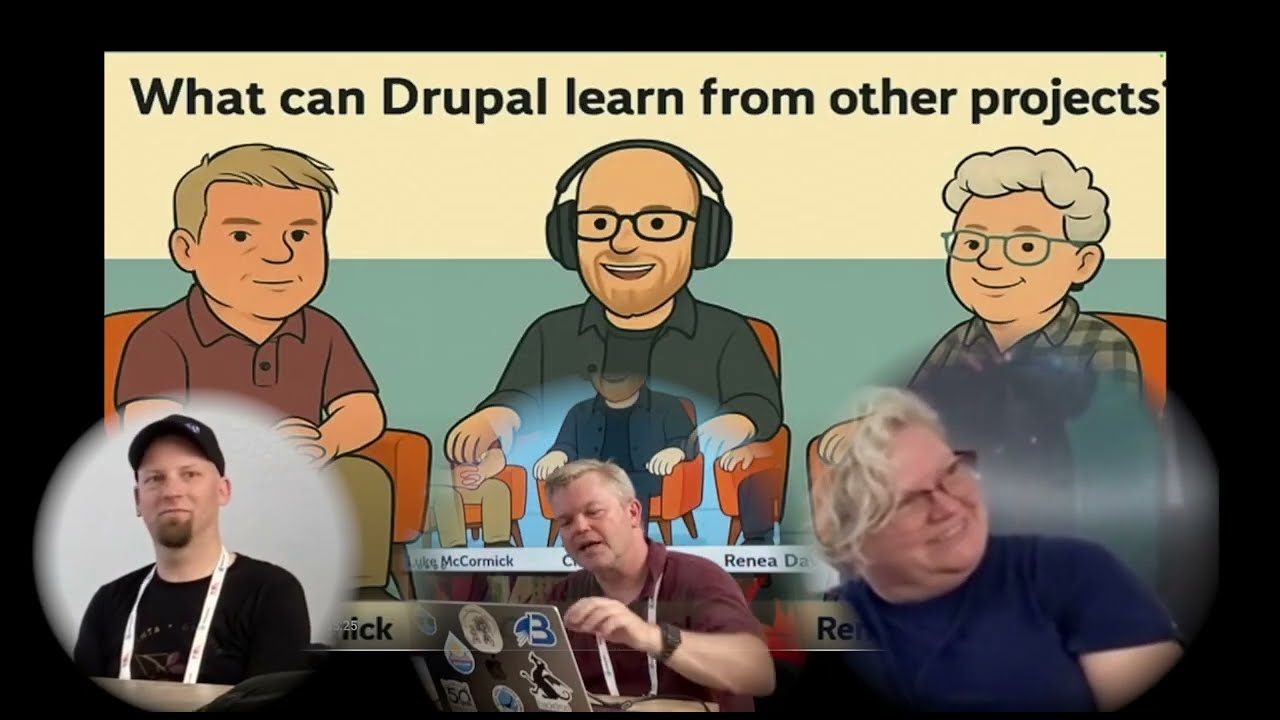
Video summary
The video features an interactive panel discussion hosted by Ruby Farmer with experts from Drupal, WordPress, and Joomla exploring what lessons other Content Management Systems can offer the open-source project. The conversation covers critical areas such as user adoption strategies, monetization models, the balance between developer needs and site builder experiences, community dynamics, and the evolving hosting landscape. A key takeaway regarding user acquisition is that younger generations often avoid platforms perceived as difficult or outdated due to concerns over content ownership, preferring simpler third-party services like Wix or Shopify; consequently, early education programs are essential for retaining users before they migrate elsewhere. In terms of monetization, while WordPress faces consolidation where hosting giants absorb plugin creators, it maintains a robust ecosystem with "blessed" core plugins that serve as de facto standards, whereas Joomla has struggled with declining user numbers affecting extension support despite its earlier success in pioneering easy wizard-based setups for site builders.
A significant portion of the dialogue addresses the distinct philosophies driving each platform's architecture and usability. Drupal is rooted in rigorous computer science principles utilizing complex information architectures and object-oriented frameworks like Symfony, which can create barriers for non-developers but offers deep customization capabilities. In contrast, WordPress prioritizes ease of use with simpler structures yet has historically resisted adopting modern dependency management tools despite community efforts to bridge the gap through projects like Bedrock or Acorn. Joomla was explicitly designed as a rapid-deployment tool for site builders rather than developers, reflecting different goals that require tailored approaches instead of forcing one model onto all users. The discussion also highlights how Drupal's enterprise-focused perception following certain transitions contrasts with WordPress's user-centric culture fostered by its founder to emphasize backward compatibility and content ownership.
The panel further examines the challenges related to development pace and community resilience, noting that while rapid feature updates can be frustrating—as seen in the lengthy preparation for a CKEditor upgrade—other projects have faced backlash from premature changes like Gutenberg on WordPress. This has led some users toward alternatives like ClassicPress, illustrating how different communities react to shifts in core functionality. Beyond technical hurdles, the speakers identify a broader trend where social media drains talent and interest away from open web projects toward platforms offering immediate monetization, creating an opportunity for CMS leaders to build infrastructure that allows creators to thrive independently without selling personal data. Historical precedents such as Microsoft's antitrust issues sparking the open-source renaissance suggest that current crises should be viewed not merely as problems but as strategic opportunities for growth during times of significant change in the digital landscape.
Read the full video transcript
And we're live.
All right. Thank you all. If you are
looking for what can Google learn from
other projects, you're in the right
place.
If you're looking for probably a much
better presentation about AI, Mark's
gone right downstairs. But if you're
here, then then hopefully this is what
you're looking for.
Uh, my name is Ruby Farmer,
Chris Reynolds, and Renee Davis Le over
there, as you can see from our picture.
Um, you know, I I fed Chat GPT little
tiny head shot of us and and you know,
it did that.
Um, and then I actually stretched and
made it so that we're even fatter here
than than we are in real life. But in
any case, uh, this is kind of a
interactive
session, two ways around. First of all,
um it in that uh we we represent some
CMS's just you know that that we here
and we're prepared to talk about that
but if any of the audience members are
familiar with other CMS's and want to
bring in a perspective from that that
would be terrific that would be very
welcome.
Um and we have similarly
uh a few questions that we've
queued up to wrestle with in terms of uh
of
looking for pieces
um of knowledge
that you can just compare and I'll give
you space at the end. So I'm telling you
sort of in the beginning and I'll I'll
reflect this a couple times if you look
at our questions and you say ah well it
would have been more interesting if you
had asked you know something else is
cool. We'll give you a little time at
the end to uh to address that. Um,
all right.
So, this is the session description for
this thing that uh
>> Luke did not attend the accessibility
thing.
>> Yeah, that's a lot of words for one
slide there.
>> Yeah. Yeah. Yeah. That's So, moving on.
Moving on here. These are these are the
five initial questions that we're going
to wrestle with. Uh
why do young people choose or not choose
to get involved in the platform? You
know, how do what's the entrance
look like? Uh what are the options for
marketplace monetization?
You know, how do people make money?
What are the balances between the
developer experience and the site
builder experience? And that kind of
presumes that everybody cares about the
ultimate end user. You know, the people
actually visiting the websites these
things create. But, you know, that's
important too. If there are differences
there, that would actually be worth
highlighting.
Um, what do you like about your home
team here?
assuming I mean not really for for the
purpose of this discussion we're
pretending like we're you know
particularly partisan towards you know a
particular platform and
you know we'll we'll ask shortly coming
up any second now if there if there's
anybody that wants to you know is
familiar with other platforms that we'll
talk about
and market concentrations which the the
question we'll talk about that later so
Um, should we
should we do little intros?
>> I think so.
>> Yeah. Okay. Uh, because that'll that'll
sort of set it up where where we're
from. All right. So, I'll start to
nobody's surprise. Uh, my name's Luke
McCormack. Uh, I've been building
websites since 1993.
Uh, but I've been building Drupal
websites since about 2009. Uh so you
know six is that 18 years ago I guess I
started looking towards Drupal.
Um and
I'll I'll give like I've got maybe a
slightly different story from a lot of
Drupal people that I think is relevant
to this and in that I came into Drupal
not so much as a developer but as as a
business person. I I worked for the
Drupal Association
uh selling sponsorships for Drupalcon
and
uh served as a business analyst and
project manager and you know I I'm kind
of an ex-coder and I I know code. I've
always looked at the code but that's not
really like my focus. I I'm definitely
interested in sort of the uh the
business side of it and I'll maybe work
some things.
>> My name is Chris Reynolds. Uh, I've been
in the WordPress ecosystem for about 20
years. I also started making websites
sometime in the 90s. Um, I've done a
bunch of worn a bunch of different hats
in the WordPress ecosystem. Um, I had
started off just building stuff for
myself and then I started freelancing
and then I started working for a plug-in
development uh company. Uh and then I
got into uh making online developer
training uh about WordPress and then I
did agency stuff and then I went to
Plurals
Pantheon. I did work at Plite but that
was earlier uh Pantheon uh where I was a
software engineer uh with a WordPress
specific focus and then I uh moved over
to developer relations last year.
>> My name is Renee Davis Leathers. I am
currently a communication specialist at
uh at the University of California's
office of president. It's a mouthful. Um
I'm the same timeline as them, late 90s
for their first websites. And then um I
came into Jumla, which is what I'm going
to talk about today. From the um from
the agency side, I was a creative
director at the agency that I worked at,
and I was one of the more technical
people on the team back in the early
2000s. and we started spinning up large
portal based websites for our clients,
news aggregators, uh, cataloges, stuff
like that. And but Jula was just a a
shockingly cost-effective way for us to
recover money back from what it would
cost us to buy a CMS, particularly in
the 2000s. Um, at that point, after I'd
used it for a few successful times, I
joined user groups. I started running a
user group um, for a while. Um, team of
people and I ran the one out here in San
Francisco.
But around the late 2000, late 2010s, it
like it started to die off. Um, and my
needs were for something that was as
stable as it was, you know, able to do
the other things I needed, but I also
needed to stop doing tech maintenance.
Like I did not want to manage websites
anymore. That's a wonderful job for
youngsters. Um, and so that's why when
we moved up to Drupal, like I had to
hire people, which is great, but I also
learned where it where June's pain
points allowed me to thrive where Drupal
has impeded where I've not been able to
use that particular tool to thrive in
the same way. So, I'm just going to talk
today about sort of the differences in
community and I think um why Drupal
probably is doing better than Jumla does
and ever will, but why that's okay.
I I I should actually mention in that
early like before Drupal time that I was
in and this might be another story is
that before I I got into Drupal and
CMS's I I built a whole bunch of my own
content management systems like I I came
from from a world where um I would
construct a CMS in Cold Fusion in ASP in
JSP in Vignette Story Server. Uh there's
probably a couple of others that that
are in there too. So So and that's
actually how you know a lot of systems
are currently still. You know, there's a
I I looked at a market share map and of
the very biggest sites of the, you know,
sites that the top I think 10,000 sites
I looked at, you know, 25% of them are
customuilt CMSs that that aren't
anything off the shelf at all. Uh, so,
you know, that's that's a fact there.
All right. So anybody here this is the
first volunteer time. You know in my
description I in our description we
mentioned craft CMS which is a total
lie. None of us know craft CMS. So the
is there anybody that knows craft CMS
here because that that would
>> invite you.
>> Is there anything that
>> I've installed it?
>> Yeah.
>> Yeah. Yeah. I mean it kind of reminds me
a little bit of some of the uh the
attempts around doing uh static site
generation.
>> Yeah.
>> Um but it's
it's model I mean like it's not as
purely static site generation as
something like Hugo or Jackal but it's
that same sort of concept but with these
modules so that you can kind of expand
the ecosystem of what it can hook into.
>> Yeah. All right. All right. So going
once, going twice. Any other anyone want
to like defend a different CMS if it
comes to it? You you can you know
something curs you later, you can jump
in. So let's let's talk questions. And
again there's the five questions we
looked at and if if one occurs to you
feel free to
>> Can I just call in on one? So the other
people who users are not choosing the
platform because
>> here's you're jumping ahead here. We're
We're going to do that question right
now. Ready?
>> Yeah. I was I was going to jump.
>> Why were you asking me questions?
>> Oh, well, once we're done with those, if
there's any that
>> he was asking, are there any other CMSs
that anybody want to talk about?
>> Well, that was one if there's any qu but
the questions after we do these five.
>> Okay.
>> If there's time left.
>> Okay, sure.
>> We'll uh we'll try. So, let's talk the
first one. Young people, new users. Uh
I let me I guess read this for the
benefit of course stuff.
>> One issue that Drupal is wrestling with
these days is the perception that young
people or perhaps new people in general
are not choosing to learn about it as a
career choice. Are other projects
feeling the same thing? What steps are
the communities taking either
intentionally or organically to this?
Since I'm in Drupal, I I'll throw it to
these two to
>> Yes, the answer to the question is yes.
WordPress definitely has felt that for a
long time. We have uh have a
long-standing reputation on like uh
Stack Overflow and Stack Exchange and
things like that uh of being the CMS
that sucks. So, um, that I think affects
people like, uh, uh, not wanting to use
WordPress because they don't want to use
something that sucks. I mean, like I
mean, and I, yeah, it's it's been a it's
it's a long and doesn't really matter if
any of the the points that they that
they make are particularly still valid.
It still like has that reputation. And
also what you were saying, Eric, about
PHP, like, yes, for sure. Um, PHP also
much maligned in in the dev circles.
>> Yeah. Yet somehow you have 80% market
share.
>> Somehow we have a ton of market share.
>> So something's working. What what what
is working here?
>> What is working is um I think we have a
long history of backwards compatibility.
So like you don't break stuff between
versions. Um
>> that's a big one.
>> Yeah. I mean I
>> I feel like I feel like that's worked in
our favor quite a bit quite a lot. Uh as
Drupal versions have have required uh
major refactors um uh WordPress really
hasn't. Um, and I think that there's
been um, a lot of
emphasis on trying to keep the user
interface, the admin as
intuitive as it can. And obviously I
think it is probably more complex than
it needs to be, especially in comparison
to things like Squarespace or Wix or
there's other things that people are are
moving forward that that aren't either
of any of these things that we're
talking about at this table. Um but uh
but that's also I mean certainly for me
when I was first uh coming into it I had
used I had looked at Jumla. I'd used
Jumla a little bit. Um I had used like
things like Zen Cart and Magento. Um,
and compared to that mess, WordPress was
a site for sore eyes.
>> Can I add
>> Go ahead. So, um, so here's what I
think. Uh, young people, uh, it's
struggling on the side. Well, we they
have way more options now. You mentioned
Wix, Shopify,
web.
>> You don't have to run your own web
server. Like there's a cost.
>> Yeah, exactly. They give you the whole
thing already already. But as far as
WordPress, I think WordPress is a great
platform and it provides a lot of tools
as a developer like coter blocks. You
can build a different ways of blocks.
Advanced custom fields is a nice tool to
have as a developer. It will help you a
lot. However, there are other things
that makes WordPress as web flow like
Elementor, DB and all these site
builders. I think those are affecting
the reputation of WordPress and the
WordPress uh community itself. Me as a
developer and the developer experience,
I don't like those.
>> Yeah, I was gonna say in a good way or a
bad way because I feel
>> you start saying that we're Yeah,
WordPress had a bad reputation in these
areas and I think it's because of that.
Uh it's time for anyway.
>> Why John people is not picking it? It's
because it's uh easier to go these other
ways and focus on other things. Uh and
right now we have headless everything.
So you can focus things like React and
Angular that you can uh learn and
together with the AI you can build a
really fast website or platform uh with
Shopify and React. Yep.
>> Right. Or Elementor. uh and those are
things that are you know it tastes easy
to build a website. If I can provide
like you as a business uh person if I
can tell you I can give you a website in
three days while this guy who is a great
developer is going to give you a website
in a month both doing the same while his
platform is well robust and it can
develop or add more value on your goal
mine is faster and cheaper.
>> Yeah. So those are the points uh easier
and cheaper. I think I think uh another
thing that has that plays into the idea
of why
young people don't want to use WordPress
is there a big part of why people would
choose WordPress and a big part of sort
of one of the foundational ideologies
that Matt Mullen has put out since the
beginning is that it democratizes
publishing that you own your content and
increasingly as there are things like
Tik Tok and Twitter and Blue Sky and
Google Docs and all these other things
where your content lives in other places
and you don't actually own your content.
And like the kids that that grew up with
cell phones in their hands when they
were, you know, 10 years old or younger,
like they're used to not owning their
content.
>> So that's not that's not a a feature
feature for them.
>> Yeah. Um, and I think that's a really
important thing that I think probably
crosses all of the sort of CMS lines.
Um, because yeah, I mean that that's
that's a reason why I would want to own
like work uh like run my own WordPress
site or whatever, but that's not
necessarily like obviously Shopify,
you don't own that. You're you're going
to live on their platform uh and that
means that you're subject to their terms
and if they want to shut your site down
or whatever, like but like that's That's
just cost of doing business to to folks
that are, you know, a generation younger
than I am, I guess.
>> So, Randy, I want to give you a chance
for that first question.
>> So, the reason why is the same reason
they've all said if it's harder to do,
and I don't know if y'all remember being
young, then we did not do hard, you
know, you did easy. You just easy was
easy is what 20 year olds do and 30 year
olds do. And this is the most effort I
want to put in for this. You know, it's
like that's just that's just human. The
reason I think you while we're talking
about all of these symptoms like it's
it's because it's bad or it's because
you know no one likes it or it's because
they don't learn it's because it's too
hard. I don't think that's it. I think
that all of these CMS's don't snag you
users because they don't get new users
where new users live and where they get
engaged about doing this. High school
kids, junior high kids, they love this
They are into robotics. They want
their own websites. They don't want to
have to go to their parents and ask for
a credit card. They just want to spin it
up and do it. We're not catching them
when they're interested in being
self-sufficient with doing something on
their own. And that's in their early
teens until there's an education program
partnered with open source CMS and major
universities and major learning
institutions that catch the kids when
they're interested and wanting to have
their own autonomy and that's in their
teens. We It's like I hate to use this
analogy, but the reason that drug
dealers give you a free sample is to get
you hooked. If you give a teenage level,
I need dopamine in my brain kid this
this standup ability to have this thing
that is theirs that nobody else owns and
nobody else watches and nobody else
looks at. That's when they're interested
in being autonomous. By the time they've
gotten out of college, they've
exhausted. They had to get through
school. They had to get through learning
everything they were told to learn
before they could decide to think about
things that might interest them. And
that is an awful long time to let your
potential audience be ignored by you.
Neither.
>> And I think that's the thing.
>> Neither of my kids were interested in
having a website when they were in their
early teens,
>> right? Because yeah, admittedly, you
didn't catch them when they wanted it.
Which of your kids did robotics or STEM
or
>> Right. If you catch them when they're
interested. I absolutely assure you
medical companies do this. We never see
it because we never talk to doctors or
live in hospitals. But medical companies
will go to medical schools where the
residents are captive audiences and they
teach them for free how to use one
specific product, Striker Hips. And then
they have converted those residents into
lifong
Striker customers because they don't
want to have to bother to learn
something new. They learned how to do it
in their 20s when they were in school.
That is when you catch people to give
them these things that are harder than
just I push the button and I have a
website.
>> Well, to trying to catch the kids early,
I I bought my daughter's name as a
domain name on the day she was born,
>> right?
>> Uh so so it's uh it's registered.
>> It's not like she just wants that.
>> Oh, she she doesn't show any interest in
it.
>> She's going to want to have to have a
need for it. It's a time and a life when
a space online is important for me.
because they it's so important for them
to be on socials or it's so important
for them to be wherever it is that their
peers are. This where their peers are.
This is where the old people are. They
love us but old.
>> And I think that's why I think it's
because we do all of our marketing and
all of our education and all of our
training and we gear it towards people
in their late 20s and early 30s.
>> Okay. I'm going to actually touch on
something that you mentioned that isn't
in the questions, but I think it's kind
of interesting. It sort of fills these.
You mentioned Matt
>> Mullen. uh the the founder of of
WordPress and and Rene I'll I'll throw
this over to you in a second too because
I think it's actually an interesting
thing about comparing these and perhaps
other other systems is the way the
personality of the founder kind of
infects things
>> well you know
>> in in in Drupal's case for example Dre
um was a hot computer science science
case I I don't know if you guys ever
looked at this, but I I looked at Dre's
PhD thesis once and it it had nothing to
do with PHP or Drupal. It was a Java
thing and it was one of his advisors was
James Gosling, the founder of Java, like
the the guy that wrote Java. And so that
that was sort of like, oh, okay, you
know, if if you think that Dre doesn't
know Java, like yeah, you haven't picked
it up. So, so it the underpinnings of
Drupal are are very techy as the case
may be
>> whereas Mullwink has a different story,
right?
>> Yeah. He's a high school dropout.
>> Yeah.
>> Uh yeah, he uh he was just like a
16-year-old kid on the internet that uh
had a blog that was what V2 Cafe log.
And uh it was one of those things where
the primary contributor uh kind of
probably gets busy with life uh and
stops
committing to the the project and he's
like I want to fork this and he and a
British uh software engineer Mike Little
um who's actually a really amazing guy
um
uh said I'll help and they forked it and
wasn't even like it's it wasn't
foundationally built up from the ground
uh as its own thing. It was a fork of a
of another project. Um but it was forked
at a time when
some of the larger sort of proprietary
uh paid sort of uh blogging andor
content like publishing platforms like
TypeScript or Type type.
That's my model library.
>> Yeah. Yeah. Like that was that that was
where I went to. No, that's
>> movable type. There we go. Uh and and
other things that were like that started
like shutting down. Um and so it just
sort of serendipitously evolved um out
of out of you know um but like yeah, one
of the one of the things that I that he
was the idea that that you own your
stuff. Uh that's always been part of it.
And I think just I don't know if that
was an intentional thing or or or just
something that came along the way, but
like the idea of making sure that things
are always backwards compatible. Um
because that that has been a really big
uh driving force for I think um what's
kept WordPress in like we haven't lost
market share
>> because there there have been with with
WordPress updates. Well, I I I think
it's interesting the the head of the
project was a user, was a content editor
>> and and so you kind of see that as an
ongoing story that at every point if
anything gets in the way of that
experience that gets, you know, put you
know it it's focused on that. That's
really what it cares about. Now I this
will come to our next question. So Rene,
>> it was different for the Jumla team. and
they actually worked all at an agency
together and had spun up the CMS that
they liked and they had stood up a
foundation to make it open source but
their boss didn't want to do that. He
wanted to monetize it and so they forked
it. They all quit and they all spun up
the Jumla Foundation where their big
push was this will be open and free
forever. That was their giant push. Not
free as in beer but you like free as in
knowledge. So yeah, it it's a different
model. So it it really appealed to
different users.
>> Oh, those are interesting. So and Mango
pretty much died, right? The thing they
forked it from.
>> Mama died after they forked.
>> Um because nobody wanted to use what was
janky and broken about it. They wanted
what was coming next.
>> All right. Well, that actually leads us
into our second question and we
hopefully will speed up a little bit
because at this rate all afternoon,
let's talk about monetization. Let's
talk about the the money thing because
this is actually big news in Drupal
these days. Drupal is putting together a
marketplace.
Dre floated it in Atlanta and and it was
sort of you know I think he expected
more controversy than it he was
expecting to get shouted down.
>> Was a marketplace for just the news or a
marketplace for everything?
>> He pitched a marketplace for
>> for recipes.
>> It wasn't recipes. It was the thing that
was one
>> site templates
>> site templates. Right. Right. Right.
>> And when he said marketplace, market
implies you will sell this. People will
buy things from me in this market. So it
was a it's going to be a stand up. You
have to come to the Drupal website and
buy stuff.
>> He definitely he definitely framed it as
a commercial thing.
>> Yeah. I think that's where work I think
that's where WordPress and and even gymn
Excel was the marketplace because you
can find a solution to a problem
>> and then you can get you know in some
cases you could get excellent support
for that problem
>> whereas Drupal like I can't tell you how
many modules I go to their stupid page
>> and there's not a single line of
documentation anywhere and you're like
okay well I can't use this thing because
it's way
You get what you pay for,
>> huh?
>> You get what you pay for.
>> Exactly. You pay for it, right?
>> Yeah.
>> Serene, can you talk to the commercial
Jula?
>> So, ecosystem.
>> Jula was offered to purchase many many
times and turned it down and signed to
set up their foundation in a different
way. They
I'm not exactly certain what their
revenue model is, but I know it is not
single ownership. It never has been.
They keep getting offered. They're not
going to buy that. The way that the
Jumla people make money was generally
businesses that spun up that p that used
Jumla as a tool would be listed in the
directory of people who provide this
service. Then they would be listed in
the directory of all the things that get
made on the extension modules plugins
blah blah blah blah um and then they get
mentioned again like in a resources
section and then they get highlighted
sometimes like in their community
magazine.
So Jim's got a very good presence and
that they continuously market to their
base. Um but even with all of that in
the last 10 years the number of
dependable
people in that space who are still
making the thing they made 10 years ago
or some version of it is dramatically
reduced.
>> There's just not as many people using
Jumla anymore. So there's not enough
people to support the extensions and to
support the businesses that use those
extensions.
>> It's almost a softball uh issue about
WordPress commercialization. So So while
we talk about sort of the
the progression of that is it getting
more or less commercial is it getting
bigger or smaller in terms of size?
>> I think the the observation that all
yeah talking about the commercial
marketplace of WordPress is boring um uh
because it has always been a thing and
that's s sort of been a character
characteristic that has made it distinct
from specifically uh Drupal. Um but uh
what I see that the the observation that
I will make is that uh at one point in
time there were as many individual
uh producers of premium plugins and
themes as there were developers in the
space, right? Like everybody was doing
it and everybody was trying to make
money at it and then slowly over time
they've consolidated and many cases like
hosting company like WP Engine or uh
Bluehost or GoDaddy or whoever will like
swallow up like this large company that
has made a couple really good plugins or
this specific uh plugin and and do a
partnership or something. Um and so it's
it's
it's growing but it's shrinking I guess.
Like the money is still there but like
Yeah. Um, and it's and it there's less
of a sense of like me as an individual
developer, I can make money by, you
know, coming up with a plug-in idea and
then putting it out into the marketplace
and then make anything off of it. Um,
I'll also sort of say that like the
counterpoint to the um the the grand
like the WordPress is is the best thing
to model things off of is that
uh that I observed when I when I was um
talking to people at Drupalcon uh in
Atlanta this year for my first Drupal
con uh was that there's this idea that
if I have a really good if I have an SEO
module um and you have an SEO module and
yours is sort of the the canonical one
and I have like this different idea or a
different take on something um we would
be like in the Drupal space it's more
common for us to try to work together
and make the one SEO module the right
one and work for work the best and have
all of this stuff in the WordPress
space. If I have an SEO plugin and
someone else has an SEO plugin, I'm
probably not going to work with them.
I'm going to focus on my thing because
that's my IP and I might go ahead and
sell that. And that's one of the things
that like I really like the Drupal model
of like cooperation and collaboration
and things
>> which was not true when it comes to
Drush and the Drupal console if you
remember. No. Oh, did they they worked
together? No, they did not.
>> They didn't they didn't want to work
together. It was a big thing.
>> I I knew the people I didn't realize
they had
>> I just I I was not intend to bring drama
to the table, but it was like I was just
pointed out. Yeah. It's not always true
on Drupal, but I I get your point.
>> Yeah.
>> And there's downsides to large groups of
people collaborating. Everybody's got an
opinion. Sometimes it's nice to have a
guy who's in charge or a person who's in
charge.
>> When you don't have that, it's harder.
>> Yeah.
>> Um, so Chris, you were just giving the
example of like sort of the difference
in module collaboration, but how has
that also affected like some of the big
advancements in Drupal have been in like
really heavily used contrib stuff going
into core? How's that monetization of
the plug-in ecosystem like kind of how
has that affected like the ability to
actually have this open source core? Um
that's a very there's there's a really
there's an interesting like balance uh
which has
has to do with like where I don't know
the power sits um because uh Matt
Mullenig uh you probably maybe you don't
know but you probably know is also the
CEO of a company called automatic that
is a commercial uh entity that sells
WordPress as a hosting thing. So is in
charge of WordPress VIP which is a
platform. Uh they own Pressible which is
a uh also a smaller thing but they also
have a plug-in suite which is a one
plugin but has a million different
things uh in it called Jetack which
everybody on WordPress.com just gets out
of the box. And so like from a Matt
Mullen perspective, this is stuff that
is like core, but it's like core light
and making it available as a plugin is
like, oh, you can do this cool stuff
that you can only get here and you can
get it on your own self-hosted WordPress
site and get it, but then we're going to
sell you all the upsells and whatever.
Um, and it doesn't go into core. Uh but
it kind of it's like we don't have a
concept of like canonical plugins or
contrib uh uh plugins but like that's
sort of the idea is like this is like
blessed in some sort of way. Um and
what yeah it it creates a weird uh
dynamic of of like power and who to
trust and and what entities to trust.
Um,
yeah, it's it it gets I don't know, it
gets gross from like like a purely like
open-source like, you know, I want I
want things to be free kind of
perspective. Um,
>> and I think it feels gross because
that's where the money comes in. It's
not free. Like it's kind of free. It's
the concept.
>> Well, then you guys get when you get to
a module page that has no documentation,
right? Yeah. Oh, open like you you got
in the middle of uh being open source
where you fix your house and pay in
rent. Like same thing, you you either
rent a house or buy a house. If you buy
a house, either you hire a professional
that's going to fix your stuff or you
rent a house and your landlord is going
to take care of everything.
>> Yeah. Yeah.
>> Yeah. It's the same thing. So, you want
to rent a house.
>> Good analogy.
>> All right. Let's let's move on. We can
we can circle back to some of this when
we get there's a question coming up
about what you you know would cake or
did other organizations but let's talk
about uh the developer experience versus
the site builder
experience. Uh I I think here there
there's a you know vivid contrast
between Drupal and WordPress uh which
you know I alluded to before can be
traced to to the founders and leaders
you know where they come from. You know
Dre is very much a developer. Mullen is
closer to an end user right
>> I mean yeah he was using the thing
before he started building the thing or
working on the thing. Yeah. Yeah. So,
>> um it's also I think the to that point
too, I think that the way that WordPress
was written and built, uh is more from
the perspective of like it's always been
easy to learn like PHP development
through WordPress because it's not using
like it wasn't using classes for a long
time. It was not using like you know
namespace. It's not using these these
like computer science or technical like
you know concepts. It's like pretty much
just you know functional code like
Drupal.
>> Yeah. Right. Yeah. It's I mean it's it's
it's and that's that's not a bad thing.
It's been it's lasted this long and
things have been put in there to improve
things and it's got a I like I like the
the the hook system that's that
WordPress has. Um but but yeah it was
not it was not built from a computer
science
starting point. Well, let me and um this
will this will head over to you Renee. I
mean one one of the things that strikes
me from the internal users perspective
difference between Drupal and WordPress
is Drupal has this
depending on how you look at it
complicated rich set of of
>> you're right with the first word
>> of uh of
information architecture tools, you
know, the multiple content types, the
fields, things like views built in, um,
taxonomy.
So, it's sort of a complicated structure
there. Whereas WordPress traditionally
has had
>> everything's a post
>> or articles and posts, right?
>> Everything is a post. Everything is
post.
>> Everything's a post. And then there's
like advanced custom fields and
And so Rene what's what's happening in
in uh Jumbo world in terms of
information architecture
>> I don't know the developers so I can't
speak like but I have opinions I believe
having worked in that space for 10 years
and gone to a bunch of conferences Jumla
was built for people like me it was not
built for developers it was built for
site builders it was built for you were
technical enough to run a web server you
were technical enough to understand that
you probably need to put a firewall on
top of your like you are not technical
enough to go in and make swiping code
changes throughout
>> um
WordPress
wasn't quite secure enough and Drupal
was entirely
fast food home-cooked meal fancy
restaurant
>> steak. No, no, no, not steak. French
freaking food. steak broken down into a
puff of smoke,
>> right?
>> That's fancy food.
>> Tiki portions.
>> So,
>> so
>> back to the internet is
>> to site builder, right? So cyberware is
important and WordPress might might the
focus on WordPress might have been
hostive and all that but there's a
community trying to walk away from it
and create a better developer experience
such as bedrock
>> and acorn which by Drupal 8 we
introduced symfony on the back end.
acorn uh uh acorn philosophy is similar.
They trying to introduce Laravel into
the back end and and then you have
Timbert that you will use tweak. I'm
sorry. What are bedrock and
>> Yeah, I don't know these things.
>> No, I he probably
uh so there is a there's a a development
group called roots that does that has
been around for probably about 10 years.
Um, and yeah, they they have a number of
different open source projects. Bedrock
is a composer is a WordPress composer
based WordPress uh like starter. Uh,
Acorn is a way of implementing laral
concepts. They have a couple other
things that are like that that sort of
like work in their ecosystem that are
trying to bring a more highly technical
sort of computer sciencey like element
to developer focused
>> WordPress. But but even even to that
point like um WordPress has had a couple
opportunities uh over the years to adopt
Composer as a dependency management
system and has resisted and instead
persists in like you know the automatic
updates which work and whatever but like
from my developer perspective I would
much rather use comp a composer based
WordPress but that's a that's a very
small percentage of WordPress users that
use composer. That's that's my next
question. Is WordPress the tool that's
trying to be the developer tool or is
everyone like, "Oh, here's WordPress
now. Let's make it all things to all
people." And then getting mad when that
fails.
>> Well, well, I would point out I mean I I
think people might have missed at some
point, but you know, the giant
chasm between Drupal 7 and Drupal 8,
>> okay,
>> was was largely
>> and that's why backdrop exist. I was
gonna bring up background that's too
painful. You know, uh Larry Garfield who
is a very influential developer in in
the world Krell um really pushed for
acorn likes for you know composer and
that whole workflow and talked D
computer scientist into it.
>> So so the the people that would be
pushing against that
>> unfortunately
a quick side note is that that that's
turned Drupal into an enterpriseonly
product.
>> Well, that that was that was kind of the
point. You know, I I actually know know
pretty well the the people that forked
Backdrop at at the time for precisely
that reason. They were like, "Holy cow,
>> this is this is moving beyond where a
hobbyist can do it, right?" like as a
Drupal 8, you pretty much needed
multiple fulltime developers on staff to
keep the thing afloat and you're like in
a
>> Oh, well I mean I I had a related
thought which is just like
>> also the hosting landscape has changed
and how you run like a local environment
has changed
>> and some of that for us Drupal people is
due to those Drupal changes but some of
it is like
>> just like how the hosting architect
arctures and also like how secure things
need to be and stuff like that has
changed and I mean because yeah Drupal 8
makes this big embrace of
object-oriented programming and all
these like modern stuff and the symphony
framework and that made things harder
>> but also I think like some of the
documentation could be further along
because in some ways it's actually like
really easy now to spin up a local and
tinker with
>> Drupal. You can you can still run Drupal
on B. So that's still an option. There's
no reason to
>> still running that.
>> You can put like you can put like three
or four commands in your command line
and have Drupal running
>> if you walk through the right steps. But
I I'm just curious with the other ones
as well, like how you've seen the the
hosting landscape and the hosting
architecture
change
how people are using it, how people are
developing, how people are getting
started. I think it factors into this
site builder question, but also like I
mean WordPress clearly like how much of
that 80% is is not self-hosted, right?
Like how much of that 80% is WordPress
as a service?
>> Uh I mean it depends on how you define
WordPress as a service like if you're
talking about like.com specifically or
not because I don't think has the
majority of those sites. But what I will
say is that when I first started using
WordPress, there was the five minute
install, which was you upload your your
files and then you you know type in a
couple fields and you hit the button and
then you've got a WordPress. Um now like
if you go to like Blue Host or GoDaddy
or something, they have a button that's
install WordPress. And even in on
Pantheon, you can say I want a WordPress
site. Click a button and then there's
your WordPress. So the five minute
install is irrelevant at this point.
That's one thing that has changed in the
hosting landscape from, you know, over
the years is is like you used to like
have to know SFTP and now you can click
a button and have a WordPress.
>> Yeah.
>> Um and that's the thing about the
hosting. I we've talked about like the
companies that oversee it and in
Drupal's case um Dre's company is Aqua
and and it strikes me I mean I've had a
personal WordPress site on WordPress.com
since 2007 or so in the free one which
actually gives me quite a bit of
functionality like the only thing wrong
with it is I don't update it but like
you know it it does its job great and
Like I haven't I've never ever thought
to do an upgrade, but it runs the latest
thing and it runs fine
>> and it's free. If I wanted the fancy
features, I could pay 15 bucks a month
or 20.
>> I think you pay 10 bucks a month to just
put a domain on it and then it's done
atwordpress.com.
>> Where where's the cheapest, you know,
for the equivalent of Drupal
on Aquia?
the cheapest possible Aquia site and
nobody has anything cheap but like
cheapest possible one is like $150 a
month maybe like like you you can't have
you know what I get for free
>> with WordPress is over $1,000 a year
>> for Drupal and what is there do they do
the
>> very easy spin up tool I think the I
think where Jimla early grabbed on to
what WordPress was also were doing was
the installation process could not be
upload a bunch of nonsense to your
server via FTP and then do magic stuff.
It needed to be button button click
click here we go. So their installation
wizzywig their their wizard for that was
actually pretty impressive for its time.
Nothing else was as easy as spinning up
a dependable multilingual Jumla site in
15 minutes
>> and with with one of three site
templates right like I've I've installed
Juma just to see it and and it offers
like three be fully they look realized,
right?
>> Um
>> you'll have fully functional site out of
the box. You could with maybe a couple
of hours of work, you could have a fully
functional multilingual authenticated
site stood up.
>> I think balancing developers and it
depends on on the goal of your website,
>> right? If it's a simple website, one
developer, let's go for with a easy end
user experience site builder, one click
button. But if there's a huge platform,
let's create a uh developer experience
where you have you can integrate
composer,
good development, continuous
integration,
testing, all that. So you you can have a
robust platform. That's what I think. Uh
all right. So, so I'm realizing that
we're going to run out of time before we
like have too much things. So, so I
we're going to skip the last question
because I don't think we really care.
But this one's pretty good though. You
know, this question of of what's your
platform's biggest strength? I mean, you
know what?
And and you know, I'm I'm representing
Drupal here. So, so b b b b b b b b b b
b b b b b b b b b b b b b b b b b b b b
b b b b b b b b b basically, we're
asking Jumla and WordPress. That's
called WordPress, right?
>> All right. Uh, it might be called WB
regression.
>> What What should Drupal steal from you?
>> Uh, what are we not doing that you do
that we could do that we should do?
>> I would like an improved installation
experience to in a graphical way. I I
love the composer stuff. I really do. I
can do it. It's not hard. But I'm a
designer. I am not a developer. I'm a
communicator. My job is to talk to the
tech guy and then talk to the business
guy and since they for some reason don't
speak the same language, I translate.
So sometimes you don't want to go get
the developer involved. You're like, I
don't need a development conversation
about this. And in those cases, Jumla is
very powerful. Like it is very
empowering to be able to stand up things
quickly without having a lot of overhead
that comes with it.
>> That's why I love the Drupal CMS
installation.
>> Yes. Um because I don't know Drupal but
I install Drupal CMS and I feel like oh
I understand this
>> like I I get this. Yeah.
>> Let me ask you a question about that. Do
you
>> do you believe it? Like it it's telling
you it's doing things like like how how
confident do
>> I believe it because I've been trained
to believe it because installing
WordPress and Juma for a decade when
it's done if you see a website it
worked.
>> I trust that it's doing something. I
don't I don't like I see what I see it
giving me words. I'm like, okay, it's
probably doing that.
>> And I can turn on a debug because the
debug is delightful. You turn it on in
the back end and the front end at the
very bottom of your page, it just spits
out everything that happened.
>> Um, Juma's great for that.
>> I think I just wanted to make a a quick
comment on Jumla. um their development
cycle is extremely slow
>> painful
>> and that is actually I think a positive
thing
>> because it doesn't change that much
>> right right
>> and Drupal is moving so effing fast that
it's can be extremely frustrating the
the the the
amount of effort to go from CK editor 4
to five was just impossible hard to
believe it. And and we haven't even done
it yet because it's taking nine months
to get prepared for it.
>> Wow.
>> And um I just think that people on the
Drupal side, if they want to maintain a
a product, they need to learn to tamper
back a bit.
>> I know everyone goes fast with AI and
that's what we're like, oh my god, we
have to churn like little jokes all the
time.
>> But we really don't. WordPress was very
good at maintaining compatibility and
not breaking things.
>> Google was really bad at it.
>> I I want to ask you actually about
because because WordPress has had this
long history of backwards compatibility
except
>> for Gutenberg for Gutenberg was this
giant chain.
>> How did that go? Uh, I think that
Gutenberg was rushed into WordPress
before people were ready for it because
Matt wanted a big reveal at uh, Word
Camp US that year.
>> Um, it's nice to know that people are
crappy everywhere.
>> I mean, that's like and and that was
that was a marker that was a line in the
sand. We have a classic press which is
basically the WordPress equivalent of
backdrop which is WordPress without the
Gutenberg.
>> Um and uh there you can use it. It works
you can install plugins on it and
whatever. Um obviously it doesn't have
the Gutenberg editor. I think Gutenberg
is fine. Uh I think Gutenberg is is good
now but when it was dropped in um I
think there was a lot of resistance and
I think that a lot of that resistance
was was rightfully so.
in the classic editor plugin which is
like the most popular plugin.
>> Yeah, exactly.
>> That you cannot use Gutenberg. It's like
a plugin to use the old.
>> Has it just become norm in in the
development world for us to purposefully
put out software we know is not fake so
that we get free user testing with like
is that is that the thing now? It kind
of feels like the thing.
>> Yeah.
I wanted to I wanted to hearken back to
to the question about the you know young
people today and whatnot which is like
there's also been this trend lately uh
for people that are interested in
something outside I mean like there's a
whole conversation we could have about
like how social media and the sort of
platform content has sucked away both
developer talent and like people like
where people want to put their stuff and
and like you know versus the open web
but there is like this sort of rise
right now of things like Neo Cities and
this whole like indie web movement. I'm
curious what you think about how each uh
how each platform could appeal to to
that kind of growing segment of the web
and be like the next step for someone
that wants to actually create their own
thing.
>> All right, we're over time. So, so let
me just answer like
>> a sentence or two what you think about
that one and then let's uh call it a
day.
>> Okay.
I don't have an answer. No, I mean I I
think that's a really good point. Like I
I I think that um I I I think that it's
a thing that that that WordPress is I
mean the one of the one of the
realizations that I came to when I went
to Atlanta this last year and I went to
the community summit was oh Drupal has
this problem too because we've been
hearing this in the WordPress ecosystem
for
years and years that that there aren to
new people that are coming to to
WordPress um and have been trying to
figure it out and there's like uh
there's like now a college credit system
that's being put into some schools which
which is to your point um but yeah I
mean it's it's been something for a
while that we've been trying to to wrap
our brains around
>> and I just think it's an opportunity I I
don't there are a lot of reasons why
open source exists but if you ask me the
big reason open source as a concept is
so popular is because of the shift that
Microsoft did in the 90s where the
United States government went bam
antirust now you have to be responsible
for the open source movement Microsoft
and there was a shift there where we all
reacted to that
>> and I think that there's a shift coming
again where for ages the kids have been
like oh my content can be anywhere and
everywhere there's going to be a
backlash to having your life for sale
and I think as these kids get older and
when they have new kids they're going to
back off that I think that it's an
opportunity for Drupal Google and Jumla
and WordPress leadership to get in that
space now so that they're prepared for
it to help set up the infrastructure to
help set up the architecture so that
those people can thrive. I don't think
that's what's going to happen. I think
that these groups will likely see that
as a problem to be solved instead of an
opportunity to be taken advantage of.
But that's just making
>> I thought you were going to bring it
home with a positive
leg out there.
I think that this is a time of change
and you never waste a crisis. This is
opportunity and it's totally how you're
going to look at it. There will be big
change coming. It's what at what part of
that change do you want to jump in and
make noise? I I I I I love the the story
you just told about how
>> the the antirust
>> things of the the excesses in various
ways although it's kind of birthed
>> the open- source renaissance of CMS's
>> in the first part of this century. So
>> fingers crossed
>> happen in AI land.
>> Yeah.
>> All right. All right. Thank you all for
coming. We're over time.
[Applause]