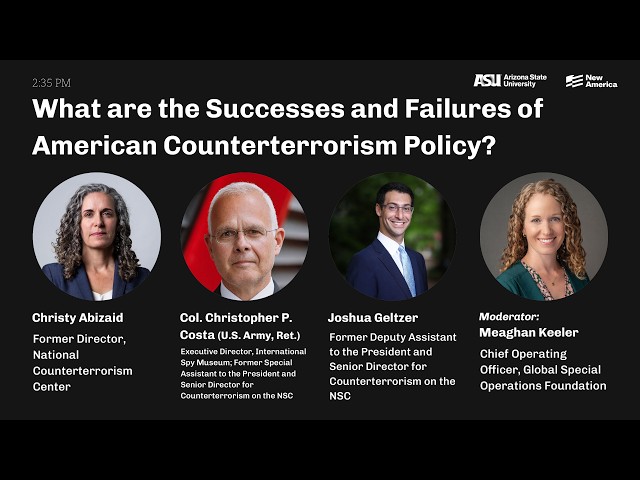
What are the Successes & Failures of American Counterterrorism Policy? (Future Security Forum 2026)
Watch on YouTubeVideo summary
The panel discussion centered on evaluating the successes and failures of American counterterrorism policy over the last 25 years, beginning with a significant achievement: the prevention of another catastrophic attack on U.S. soil comparable to September 11th. Experts highlighted that the immediate mobilization of military and intelligence communities following the 9/11 attacks successfully disrupted overseas terrorist networks and dismantled hierarchical organizations like al-Qaeda. However, the nature of the threat has evolved into a more complex landscape characterized by diffuse domestic terrorism, lone actors inspired by online ideologies, and state-sponsored aggression from nations like Iran. This shift means that while traditional intelligence methods focused on large networks remain effective, new challenges have emerged regarding low-signal threats where individuals act independently based on radicalized content found on social media.
A critical area of debate involved the adaptability of U.S. government policies to these changing dynamics and the necessity of improved information sharing across different levels of governance. While operational cooperation with international allies remains strong, domestic efforts face hurdles in connecting federal agencies with state, local, tribal, and territorial authorities who are often on the front lines of identifying emerging threats. The panelists noted that legal frameworks and authorization structures established post-9/11 are not always optimal for addressing modern threats, particularly as strategic priorities pivot toward great power competition with China and Russia. There is a recognized need to balance maintaining robust counterterrorism capabilities without allowing them to overdominate the national security agenda or become a weakness due to resource constraints in other regions.
Furthermore, the discussion addressed the concept of safe havens, concluding that physical territory alone does not guarantee safety from terrorist plots given the reach of encrypted communications and social media. The rise and fall of ISIS demonstrated a feedback loop where establishing physical control allowed for online propaganda that, in turn, enabled further territorial expansion, suggesting that eliminating physical bases remains relevant but must be paired with proactive intelligence monitoring. Ultimately, the consensus was that tactical successes often have profound strategic impacts, even if those connections are difficult to trace directly. The experts emphasized that while complacency is a risk, the counterterrorism community must remain agile, leveraging both high-value targeting operations and grassroots community collaboration to prevent violence in an ever-evolving threat environment.
Read the full video transcript
And now I want to introduce uh Megan
Keeler um who's the chief operating
officer of the global soft foundation.
We heard a little bit um Megan is uh the
yin to Stu Braden's Yang. Uh maybe I
don't know which one
>> they compliment each other. That's
right.
>> Just just a little a sentence about the
Global Special Operations Foundation.
Um, as as Stu mentioned, um, he they
asked me to be chairman 10 years ago and
I was like, I'm totally underqualified.
I'm not the right guy for this. Uh, but
has gone from basically Stu and Megan
into now running um the biggest global
special operations uh, meeting in the
world. 25,000 people take over downtown
Tampa and it's thank to Megan and to Sue
that that happens. So, over to you,
Megan.
>> Don't remind me of what's on my horizon,
Peter. Geez. Um well, it's my absolute
pleasure and privilege to moderate this
panel. Um what are the successes and
failures of American counterterrorism
policy? We have a stellar slate of
speakers. We are down one. You might
have noticed uh Javed could not be here,
but don't worry, we um we are fully
stocked. Um they also were very
fortunate in that they all know each
other and worked with each other. Um so
that's very nice and I think will lend
to a great conversation.
We're going to talk about the successes
first of the last 25 years. And Chris,
I'll I'll start with you. What do you
list among the most important successes
of American counterterrorism policy over
the last 25 years?
>> Megan, thanks thanks for the question
and thanks for uh for Arizona State New
America hosting us. Um it's a privilege
to be here with everyone and to open
this up talking about successes. I think
Peter Bergen's book I had an opportunity
to to read it early on when it was a
galley and he makes the point that uh we
certainly succeeded in terms of
preventing a 9/11 and we cannot forget
that uh the mobilization of the military
the mobilization there you are Peter the
mobilization of the intelligence
community and the way we came together
in the immediate aftermath of 9/11 was
significant and I think all of us here
sitting on the stage our ethos those was
to prevent a homeland
uh strike on the scale certainly any
strike any attack but certainly on the
scale of 9/11 so that's the biggest
success and also we got very very good
at disrupting terrorist networks
overseas very adept at that now we can
talk about some of the shortfalls later
but those were the major successes very
good at the tactics techniques and
procedures of dismantling terrorist
groups groups, breaking down some of the
organizational stove pipes, but most
importantly preventing an attack on the
scale of 9/11.
>> And Josh, just to touch on something
that we haven't yet really talked about
here today, what would you say are the
successes on the domestic
counterterrorism policy front?
I will echo uh Chris's thanks for the
chance to be part of this panel,
especially to be up here with three
tremendous uh public servants and
friends is is a great privilege. Christy
and I somehow got got the the short
straw off and together in briefing
Congress in the last administration and
the body language here is a lot more
more friendly. So,
>> and jeans this time. Yeah,
>> exactly. So, it's it's a treat to to to
get to be here. And um you know that
that word domestic is uh complicated and
and merits un unpacking in this context
because we can often mean in
counterterrorism uh two different both
very important things. We can mean
attacks that occur domestically. 9/11
itself occurred domestically. Things
like the Pulse nightclub attack occurred
domestically. But they are acts of
international terrorism according to our
laws. And then we can mean domestic
terrorism uh acts uh not connected to
international terrorist groups or
international terrorist ideologies. And
that in and of itself, the fact that 25
years after 9/11, your good question
requires that unpacking and that
division shows the complexity of of this
area. I mean, we have evolved to a point
at which uh we can look back after 25
years and say, as Chris rightly noted,
there has not been another 9/11 in the
subsequent 25 years, which I don't think
is how most Americans expected on the
morning of September 12th, 2001 the next
25 years to go. Product of extraordinary
sacrifices and efforts and strategy and
and vision. At the same time, um, we
have threats that are more diffuse on
the international front, including many
that would like to be domestic in their
incarnation. And we have an evolving,
percolating
uh, challenge of domestic terrorism,
actors whom we classify under our law
and policy as not connected to an
al-Qaeda or an ISIS, but who pose a
threat to um to use violence in the name
of some politics or some ideological
agenda. uh and that is something where
uh all of that is horrible when there's
violence, horrible when there are
victims. But in particular that that
second category I think is challenging
because by its definition, by its
overlap with domestic currents of
dialogue or even politics um can be
particularly polarizing, can lead to a
lot of fingerpointing and a lot of a lot
of less of the unity we saw after 9/11
about what the enemy or the adversary or
the threat was. And despite a lot of
efforts um including by folks sitting up
here to craft strategies tailored to the
sensitivities of that threat um it's not
one that I think we've formed consensus
on at least in public imagination how to
think about it let alone how to tackle
it.
>> Christy, how would you describe today's
terrorist threat? Sort of picking up on
some of the things that Josh was
alluding to there.
>> Yeah, it's a it's a mixed bag, right?
you've got um you you do have your
traditional uh terrorist threats as
posed by um a very different al-Qaeda
threat, but still aworked al-Qaeda
threat that is um present in lots of
different parts of the world from
Southeast Asia to West Africa, though um
uh less focused on the far enemy, less
focused on the United States. Um you
have ISIS and elements associated with
ISIS including the way that ISIS sort of
democratized
uh the terrorist threat first for the
first time really leveraging the
interconnectedness that uh the social
media environment that the internet
brought and finding ways to inspire
individuals to to attack in the name of
ISIS. Um, but you also have other
ideologies or other motivations that are
around racially or ethnically motivated
violent extremism. You have individuals
that um find themselves as lone
attackers but springing from sort of
these online communities that that spur
them to action in very sort of highly
individualized ways, very idiosyncratic
ways that I actually think make it a
much different sort of intelligence
problem than we faced on 911 when we
were dealing with the the need to
dismantle a very clear and somewhat
hierarchical terrorist organization as
presented by um as presented by
al-Qaeda. Uh you've got uh state
sponsored threats. You've got the
Iranian threat, the the Shia proxies um
and various individuals that Iranian
state agents are willing to work with to
meet out their um retribution aims or
other um other sort of uh ideals of
projecting power across the world. And
what it means is that um the
counterterrorism fight that we started
immediately most 9 post post 911 that I
think the Bush administration
deliberately framed as a global war on
terror to try and build as broad a
coalition as possible. um has actually
sort of morphed into a much more complex
uh landscape of threats that our
security institutions uh internationally
and domestically are asked to to stay on
top of. Um and the tools that we've
built for one are not necessarily the
best tools uh to use for another and it
requires an incredible amount of agility
and collaboration across the diverse set
of community actors. Just in reaction to
that,
do you think that the US government's
counterterrorism policy has sufficiently
adapted to this new landscape that you
just described?
>> Uh, I mean, I think um, in large part,
yes. If you look across successive
administrations from the Bush
administration to the Obama
administration, the first Trump
administration actually was um the first
to really name some of the domestic
terrorism aspects as well done Chris um
a as a major and emerging threat on the
scene um that presented a real um
challenge for Americans here in the
homeland. I mean, you see that we've
both held steady as a counterterrorism
community in a very sort of nonpartisan
objective way as we've traced the
threat. Um but but the way that the
threat presents when you're dealing with
individuals that um spring from very
sort of low signal environments means
that the intelligence problem of today's
terrorist threat of preventing every
individual from conducting a mass attack
versus the intelligence problem of
preventing an al-Qaeda from plotting
across multiple geography. freeze and
across a a wide network of individuals.
It's just a very different intelligence
problem. And and so what it requires is
a different toolkit that is less focused
uh for at least those individual threats
on what intelligence you can collect and
more focused on the kind of information
sharing that happens with state, local,
tribal, territorial, community leaders
who can kind of understand what's
happening in their own community and be
more preventative at their level of
intervention as opposed to the federal
level of intervention.
And Josh, given that change or
evolution, I should say, how um what did
you anticipate these various levels that
you know Chrissy just said it's more
than now federal? We've got local and
law enforcement, etc. What are the what
are the challenges that you would
anticipate that those various levels in
the toolkit would encounter?
>> Christy knows I'm going to talk about
the app, the the the brief, short-lived
uh
>> It's back. It's back. The National
Counterterrorism Center had an app which
I thought was uh wonderful because
people have their phones and if things
are able to be pushed at the
unclassified, maybe even law enforcement
sensitive or FOO levels, you got to get
that information to people where they
can utilize it. We use the phrase in the
field, but this was literally in the
field. Then at some point, the the app
uh got got canned. So, I'm delighted. Uh
the best news I've heard all day is that
the app is is back. But I use that as a
microcosm to to talk about uh
information sharing because if what you
need is you know cooperation between
federal agencies like uh CIA and FBI and
others there was a lot of good work done
post 911 to get right some things that
as the 911 commission report uh lays out
were not right beforehand and at least
contributed to uh an awful outcome. that
is as Christy rightly says um different
sized but also differently oriented with
different stakeholder problem from what
does it mean to help a beat cop in state
local territorial or tribal government
understand that what seems like an
assault or something still criminal and
still awful if you can recognize some
language you come across if you can
recognize a tattoo you see if you can
recognize a you know a manifesto left
behind is actually someone who is
undertaking violence or attempting or
conspiring to undertake violence in a
political or ideologically motivated
way. In other words, it might well
qualify as as domestic terrorism. And
that is a different kind of information
sharing and um one that really requires
it's hard enough to work across the
apparatus that is the national security
part of the federal government or the
executive branch alone. to figure out
how to do that across the state, local,
territorial, and tribal enterprise has
added degree of difficulty. Not not
trying to create a false contrast here.
That was also true for the international
terrorism threat. Hence, a lot of post
911 innovation in that area. But um I
think there is still um there is still
work to be done at least as as I last
saw it in getting actionable
intelligence especially not things that
you might have also read about in in the
media a week earlier but actionable
intelligence on some of these plots that
aren't months in the making but are
instead showing signs of sort of
hastening to action quite quickly to
those who can actually prevent that
violence.
Well, now you've got me wondering what
the icon would have looked like for that
app when you, you know, bought it from
the store from the app store.
>> You don't have to reveal it, but
>> it it was called act knowledge.
>> Act knowledge.
>> ACT knowledge.
>> Got it.
>> There was a lot of pun in there, but it
was high performance.
>> Hey, look, we're counterterrorism
professionals, not marketers. It was not
>> I like it.
>> Like,
>> but you could download it. I'm excited.
I I got something to Google later. Um
Chris, to take it back actually to the
international level and um
multilateral alliances cooperation,
especially drawing on your experience um
in special forces, how would you assess
the millill and you know partners and
allies? We've talked a lot about it on
different sessions today. How would you
assess that cooperation in the CT fight
today? Yeah, I appreciate that question
and and we already referenced Stu
Braden's here, a supporter of this uh
this platform and Stu could answer that
question very well, but I'm going to
take take a shot at it and tell you that
from working with foreign partners for
decades and even in the current in in
the current climate, partners will tell
you that at the operational level, we
continue to cooperate on
counterterrorism. It's never been
Republican, Democrat, and certainly our
international partners understand the
importance. It's a rich legacy that in
many ways goes back to the Second World
War. It's still out that out there. Um,
just in the last two weeks, I've
probably engaged in my role at the
International Spy Museum probably a
dozen foreign partners. And I knew we
were going to have this discussion. And
I would never betray confidences and
tell you which countries, but each one
of those countries I spoke to said the
operational coordination is still
happening that and uh certainly it
carried us through decades of of the
fight. We couldn't have done it without
Afghan partners. Couldn't have done it
without Iraqi partners. In many ways,
some of the actionable intelligence that
we did develop tactical, I attribute
that to our foreign partners that likely
save lives, perhaps my own. So, u I'm
very grateful for that and uh that was
an important aspect of the
counterterrorism fight and we don't want
to ignore that by with and through
partners is how we accomplished that
mission so well.
>> Thank you.
Christie, can you comment on how this is
something we hear a lot um that tactical
counterterrorism successes can have
strategic impact and is that still the
case when we are looking at these
smaller more ad hoc you know more
diffuse threats that we've been
discussing? Yeah, I mean uh if you think
about the success of a single operation
like the raid to try and capture and
that eventually killed Osama bin Laden,
that's a tactical operation um that is
incredibly strategically important for
the overall story arc of uh our post 911
fight. Same is true for the operation
that killed uh you know uh Abu Omar al-
Bbaghdadi or uh Iman al- Zawahari and
counterterrorism is this uh world where
uh the tactical is strategic. The single
operation or the single attack that you
stop or the single warning that you
provide that may have stopped the attack
but you may never know with certainty
that it was the intervention that
mattered. These small decisions end up
having a strategic impact over time and
uh it's often hard to tell exactly how
to how you can trace those. Some of the
big highv value uh targeting operations
are some of the easiest ones to sort of
demonstrate the the the that how much
tactical impact uh or how tactical
operations have strategic impact. But it
happens like in the dayto-day of
counterterrorism all the time. Um as an
intelligence professional professional
as an analyst there are so few fields
where um everyday decisions everyday
sort of analytic products everyday
warning um vehicles that you provide to
forward deployed forces or um the state
department or civilians overseas um that
where those can have a major impact on
saving lives and uh it's one of the I
think most rewarding ing things that
counterterror terrorism professionals
feel is this real connection to um a
mission that has impact every day.
>> This is a I think question for all three
of you. Um Josh, I'll I'll start with
you. Um moving from we there are many
successes. We started out with the with
the big one um preventing a a
catastrophic attack on the homeland. the
um penetration of enemy networks. Chris
went through quite a few things.
Technology capabilities um fusion
centers inter agency collaboration has
has improved a lot. I think that's
that's uh universally agreed. Um do you
do you worry uh that we in the US
government but also in the civilian
populace have we become complacent when
it comes to counterterrorism?
Oh, we're all worriers in the
counterterrorism business. It's our job
to worry. But I do worry, and as the the
lawyer on the panel, maybe I'll take an
angle in trying to answer that, which is
that, you know, we we've heard a lot, I
think rightly heard a lot about
cultural, social, and maybe political
unity in the immediate wake of 9/11. And
I and I think it's right to try to
remember that and as best we can recover
that. But in terms of putting in place
enduring legal structures that would
avoid showing complacency and would
instead allow this enterprise uh to
continue to do what it needs to do even
when focus of politicians of the public
of anyone moves on to other things. The
track record 25 years later is is not
superb. We rely on a authorization for
use of military force that was passed in
the uh immediate days after 9/11 to deal
with a range of threats that has
evolved. Uh I in working in the
executive branch been part of
interpretations that I think are quite
defensible to to deal with the threats
that have emerged since. But it's
certainly not optimal uh it certainly
wasn't crafted at the time. I think to
last 25 years in a world where the
terrorism threat has evolved as
dramatically as it has. We're sitting up
here uh talking about intelligence
gathering and intelligence sharing with
one of the post 911 creations FISA
section 702 having lapsed and whatever
one's view on that law as it existed or
that law as one might want to see it
reauthorized or not there's a range of
views on that. the idea that we haven't
figured out what it means for the US
government to have the benefit of a
court order to take to US companies when
non-Americans abroad exploit uh US-based
te telecommunications platforms to do
bad things. Um that's not great because
that problem very much still exists.
It's actually become bigger than just
terrorists. Um, we could say the same
about the parameters of the organization
Christie led very aly magnificently the
National Counterterrorism Center and
what role it plays in domestic terrorism
versus international terrorism threats.
These things are legally unsettled and
for an enterprise that unfortunately I
think needs to remain that's a bit of a
misfit.
>> Chrissy. Yeah. Um
there is uh when when I started as the
director of the National
Counterterrorism Center um you know the
the mandate was really how do you handle
the counterterrorism fight but do it
with significantly less you know and I
mean that is reasonable considering that
we were at that point 20 years after
9/11. Um it was reasonable considering
how much of our counterterrorism archite
our national security architecture had
been devoted to counterterrorism to at
the expense of things like uh a pivot to
Asia, our focus on China. You know, you
see the sort of dynamic that exists here
today uh around kind of the adversarial
nature and the strategic competition
that we have to be better armed to fight
in. And so making room in your
counterterrorism fight for other
national security priorities is actually
a really important national security
priority uh for us to manage as
counterterrorism professionals. How you
do that with while taking care of what
is a very diverse uh terrorism landscape
while trying to ensure that um the
architecture that you built that relies
on collaboration across communities uh
doesn't somehow uh become a weakness as
opposed to a strength because if all of
a sudden we don't have US military
reporting from the Middle East anymore
on counterterrorism priorities because
we only have deployed forces or focus of
intelligence resources in the
Asia-Pacific. You know, that has a
detrimental impact on DHS's ability or
FBI's ability to see into the homeland
and understand how those threats might
present here. And so the job of the
counterterrorism community in a time
when you are managing a threat
environment that is persistent but
shouldn't have to be at the top of your
national security agenda is to sort of
figure out what that appropriate balance
is between staying ahead of the threat,
getting the resources you need without
asking for everything and overdominating
a national security agenda that you know
frankly the threat doesn't require
today. and like doing that uh as a
community of leaders across CIA, NCTC,
Department of Homeland Security, FBI,
the National Security Council, the state
and local tribal territorial leaders,
the fusion centers, like this very
broad, you know, community that we built
over time. Like that's a hard thing to
do and it requires leaders in place that
are willing that understand the
complexity of what we built that know
how to make that complexity work when it
absolutely has to when you have a
strategic threat that must be dealt with
but also how to like how to be balanced
and objective about the threat today
that you're managing. Uh and and you
know continuing to invest in that but
not overinvest in that is the trick.
Christie or
>> Yeah, I'll be brief, but I I agree with
both what uh Josh and Christie just
said. I would just add as I was leaving
the White House in 2018, I did a lengthy
interview with CTC Sentinel, which was
my opportunity for the record really to
talk about some of the successes in the
first year of the first Trump
administration. And candidly, I could
see the writing on the wall. In some
ways, we were victims to our successes.
some of our successes during that year.
The physical caliphate went away from
ISIS work from previous administrations
as well as then the Trump
administration. It was a cooperative
effort. There was continuity and that's
a good takeaway from this conference.
There was excellent continuity, not only
friendships and colleagues, but uh
continuity, and that's important. But I
also recognize that we're going to start
to pivot to uh great power competition.
And what I argued then and I continue to
argue it, it's not an either or
proposition. We can do both. We
absolutely can do both. And I'll I'll
offer one vignette. Uh my concern was
over correction and Christy took a call
from me. I was outside of the government
and she graciously
uh listened to me expressed my concerns
on overcorrection and I appreciated
that. But we both had the same concerns.
That said, 2017, day one of the Trump
administration first one, we were
worried about a prevent pervasive threat
against commercial aviation from
non-state actors. All these years later,
the first day of the second Trump
administration, there was reporting that
the Russians were playing around with
the possibility of bringing down an
aircraft. So I have no details on on
that but that just underscores the
notion that the threat has evolved and
it is more uh dire today than it even
was 8 10 years ago.
How would and this is really any one of
you could answer um how would you
characterize the success or failure or
both of eliminating safe havens
over the last 25 years.
So um I think you guys have talked about
this in other conferences and other
panels. So I'm uh I I will I will um be
brief but what I would say is one you
have to be sensitive to the degree to
which a group who doesn't present a
threat to you today once given safe
haven may actually in the time and space
that that safe haven affords them um
gain a transnational
uh agenda in a way that presents a
threat to you in the future. So how you
monitor the safe havens and how you
manage safe havens I think is a really
important intelligence problem uh and if
you see where groups like al-Qaeda and
ISIS are finding a center of gravity
today it is not in the Middle East it is
in parts of East and West Africa where
um our relationships are not as strong
our intelligence infra infrastructure is
much different our investment in new
intelligence infrastructure I is is
quite different than in the past. And
so, um, you know, being very sensitive
to where the threat is metastasizing,
how local it is at any given moment, but
having an intelligence infrastructure
that allows you to see when that local
focus has actually become a
transnational one. That's the trick of
managing the threat and being put
putting yourself in a proactive footing.
And I think it it is fundamentally an
intelligence problem that we don't
always have the resources to go
everywhere all at once.
>> Ahead, Josh.
>> You're getting a lot of consensus on
this panel for better or or for worse.
But I'll just add to to Christiey's good
good reactions that, you know, I feel
like we've been those in the
counterterrorism community have been
hearing the argument for decade, decade
and a half now. sanctuary doesn't matter
in a world in which you can reach out
via social media and and encrypted apps
or both and and perpetuate attacks that
way. And I just this is another one
where I don't think it's an eitheror. I
mean, the rise of ISIS was uh an awful
vicious cycle type of feedback loop
between establishing some physical
entrenchment initially in Syria and then
into Iraq and touting it in these
bombastic and very glitzy and to some
people very appealing ways uh online and
then being able to take more physical
and geographic space because of the
intimidation factor and the recruitment
factor that enabled. And that just built
on itself until suddenly an entity
controlled effectively controlled and
legally controlled but effectively
controlled territory the size of the
United Kingdom. And it just seems to be
not a distinction but instead an
unfortunate type of feedback loop that
terrorist groups want to try to
perpetuate and then grow uh using. And
so that's a long way of saying I don't
think physical safe haven has gone into
irrelevance even in a world in which it
may not be a prerequisite for every
single plot because it also isn't that.
>> Do you have anything?
>> I'll just say that I advocated for CT
pressure any way we could apply it to
make sure terrorists couldn't plan, make
sure they couldn't sleep. That was the
conventional wisdom during my time at at
the NYSE. And I should say for this
audience in particular that I came into
the Trump administration with this idea
that I could focus more on counter
radicalization in some of the more uh
the softer side of CT, but it wasn't it
just wasn't the reality. I didn't want
uh terrorists to uh continue to be able
to plan in down aircraft, etc.
>> Well, somehow we got to the two-minute
warning. Uh, I'm going to Josh, you
mentioned there's been a lot of
consensus on this panel. So, here's my
attempt at some discord. If you are
going to host a movie night with your
friends that are not in the national
security arena that you're having them
over and you're going to screen one film
to talk about the last 25 years post 911
counterterrorism fight, what movie would
that be?
First of all, you're assuming we have
friends beyond this community, first of
all, but
>> big assumption on my part, but I I like
you, so you must have friends. Um,
>> come on.
>> I'll go with what I think is is a
classic. Um, not specifically about
terrorism or counterterrorism, but it
seems to me there is a lot to learn from
Doctor Strange Love. A lot to learn
about how to think about weapons, how to
think about one's adversaries knowledge
of your capacity, and I think it appeals
outside this. All right. With a classic,
Joshua with a classic, Dr. Strange Love,
Christie.
>> Oh, man. Um, I don't know how to follow
up on that. Um, so there's obviously
like Zero Dark 30, Hurt Locker. Yeah.
>> Was it good? I actually
>> Why I thought of this question is
because I watched Zero Dark 30 with my
teenage son over the weekend and it
provoked a lot of good discussion. So, I
thought I should ask these guys right
here.
>> Um, Hurt Locker is a really good one. um
and uh felt very familiar in certain
ways and outlandish in others. Um but I
I guess I would say um when I was in
London in my last like overseas trip for
NCTC, we went to go see Operation
Minsmeat, which is right so good. Um so
it it's basically about like a
intelligence operation to trick the
Germans in advance of the D-Day
operation. So if you if you care about
the intelligence role in anything, this
is a hilarious way of understanding the
importance of intelligence operations
from a human perspective and uh from a a
strategic bundling perspective as well.
>> Great.
>> So I finally get to outpace Josh
Guilter. I'll never outpace you,
Christie, but I will tell you I wrote a
u a syllabus for Georgetown,
Understanding Terrorism through Film. So
it's a little unfair. Wow. I did not
know the second.
>> My wife, my wife, if she was here, she
would attest to the fact that I've made
her life miserable. She's watched 40
films on terrorism since January. But I
will tell you, one of my favorite films
is a film uh from a lare a lare novel, A
Most Wanted Man. I don't know if
anybody's seen it. It's a pretty good
film. It's one of the few films that is
a nexus between spying and
counterterrorism. So, I really applauded
it when La Lare uh published it and of
course he's now deceased, but it's a
pretty good movie. So, that's my my
recommendation for august audience
>> for the nerdiest.
>> Yep. It's I have two things to Google
now. I don't I've never heard of that
movie. Uh but please join me in thanking
uh this illustrious panel.