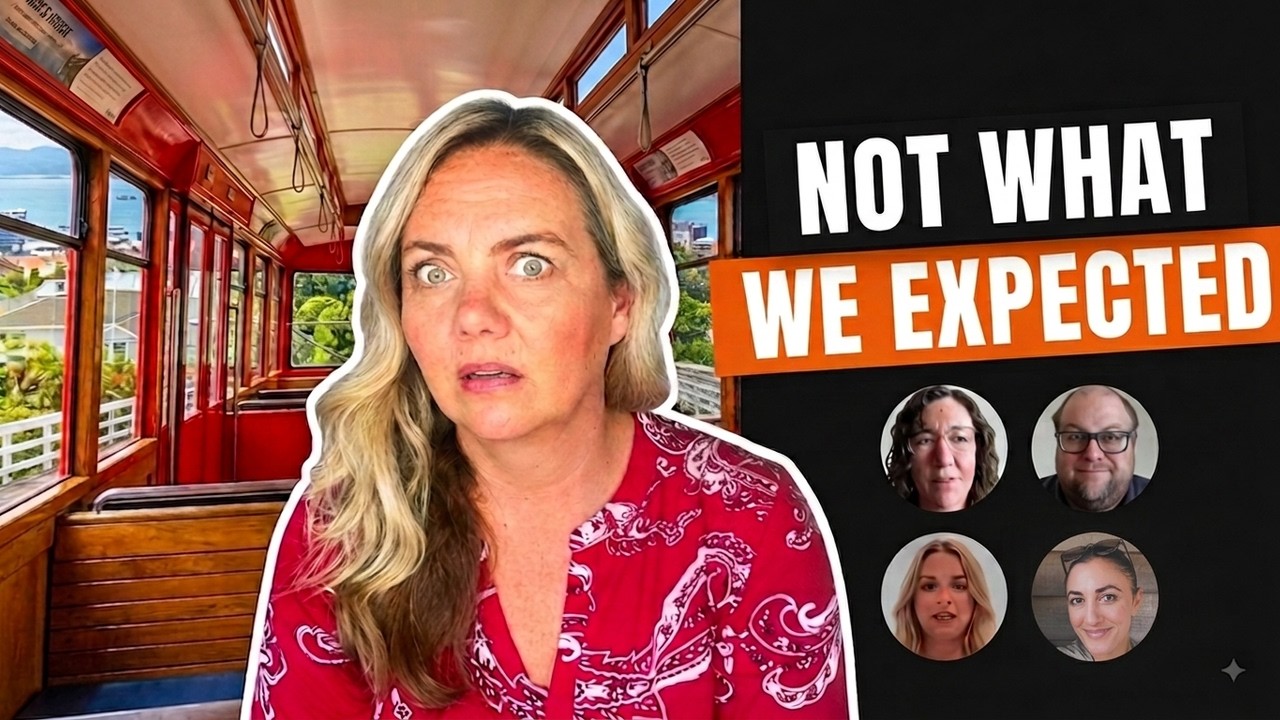
Video summary
New Zealand stands out as a place where Americans feel uniquely welcomed, offering a distinct cultural experience that differs significantly from life in the United States despite superficial similarities like language and currency. Upon arrival, visitors often notice an immediate sense of community and acceptance, exemplified by strangers at the airport who warmly greet newcomers with genuine curiosity rather than indifference. This welcoming atmosphere extends to daily interactions where people are less concerned with fashion or appearance and more focused on kindness and connection, creating an environment where individuals feel safe and included regardless of their background.
The cultural adjustments required for Americans moving to New Zealand involve learning new terminology in industries like construction and design, as well as adapting to a slower, more relaxed pace of life that prioritizes work-life balance over constant productivity. Unlike the fast-paced American lifestyle where businesses might close abruptly or meetings run without breaks, Kiwis embrace concepts like morning tea during work hours and handle social situations with a laid-back attitude that can initially confuse visitors from the States. This difference is further highlighted by the local approach to sports, which serves as a primary vehicle for building friendships and community bonds, contrasting sharply with the American tendency to form connections primarily through professional or religious networks.
Daily life in New Zealand reveals a society that is incredibly forgiving and adaptable, where minor inconveniences like being on the wrong side of the road result in gentle reminders rather than aggression, and where financial worries are alleviated by a community where everyone knows someone who can help. The weather allows for casual living with shorts and bare feet even when temperatures drop slightly, reflecting a general ease that permeates the culture. While some Americans might feel devastated by a sports loss, New Zealanders quickly move past such disappointments to enjoy social gatherings, demonstrating a resilience and optimism that makes the transition to this island nation both challenging in terms of adaptation but ultimately rewarding in terms of quality of life and belonging.
Read the full video transcript
Where we felt the most welcome in the
whole world, it's been New Zealand.
>> I was there 10 years and I what I
thought in the beginning is not what I
thought [music] at the end.
>> When you come here, you walk under that
beautiful arch at the airport and you
hear beautiful to lay on you hear this
music and you're like, oh my god, this
feels like a culture that's alive.
>> You spend your whole life living [music]
in America learning how to be an
American and you know how the systems
work [music] and you know where to find
things and you know what stores to go to
and you know what aisle they're on and
you know what shelf they're on and you
know what they're [music] called. All of
the little tiny things that you use in
your everyday life, you get to learn how
to do those again.
>> You can feel the most extreme
cultural differences and cultures that
are more adjacent to yours.
>> If it was a different language, it would
it's not that it would be easier, but it
would be easier to understand how
different it was.
>> As it seems so similar on the outside,
you're like, oh okay, they use dollars,
we use dollars, they speak English, we
speak English.
>> There will be that those first six
months of translating English to
English. The terminology,
the jargon we use in the planning and
construction and design industry here is
very different.
>> At the Auckland International Airport
and we were waiting when we were
delayed, we sat down, we had some lunch
with the boys and there were people
sitting next to us that just noticed us
obviously, but they just started talking
to us. Just, you know, and they were
asking about us and where we're going
and they said, welcome. We are so glad
you're here.
And that hit us right away.
>> They're very used to people coming and
going as a small country. So, I think
that they're just really used to
strangers and people from all over.
>> I find that they're just very curious
about like, [music] oh, why are you here
and where are you from?
>> They're really interested though, not
like, you know, fake.
>> Just things like
the hair and [music] the makeup and the
clothes. Like all of that, no one really
cares.
>> it's like literally doesn't care. Like
people wear the same thing every day.
Like I'm like, I've seen those pants all
week. You know? And I love that.
>> I love that the kids can like ride
[music] their scooters over there. Like
there's there'll be a pile of scooters
over there. There'll be a group of kids.
People treat it more like a restaurant
here than they do. It's like how the
States was, you know, 15 20 years ago.
It's like they treat it more like a
restaurant. They sit in and
>> eat.
>> Okay, quick break and we'll get right
back to it. If you've been watching this
and you've been thinking about moving to
New Zealand, I know where you're at.
You've been researching it for a while.
You actually don't really know where to
start. And I'm here to help because that
is exactly what I do. I moved my family
of six from the US to New Zealand in
2013. And for the last 6 years, I've
helped other Americans do the same
thing. So, most people go about it wrong
and I'm here to tell you that the first
step for you is to take a free
eligibility quiz. I have it on my
website, kiwiamericans.com. I'll put the
link in the description below. But
that's where you start. Number one,
let's find out if you're eligible. And
if we think that you might have a
pathway, I will then invite you to a
free webinar where you'll find out the
process to actually make [music] the
move to New Zealand. So, start there.
That is your best Stop researching. You
need to know, first of all, if you're
eligible and clarity around the process.
Let's get back to it.
>> Right now, this morning it's about 7° C,
but it's been getting up during the
daytime about 14 15° C.
So, right around that 55° to 58° F
mark.
And we're walking around in shorts and
t-shirts. And my sons are they're
walking barefooted all over.
>> Our 4-year-old's like, "No, I'm I'm just
I'm going to go barefoot."
>> I try to watch the evening news to sort
of become like more current with the
culture and with what's happening. And
the commercials are like kind of my
favorite part.
>> I know. It's so funny. So cute.
>> funny.
Like they have a it's about like toilet
paper and it's like a patriotic toilet
paper situation and it just makes me
laugh about Sorbent toilet paper.
I was dying laughing.
>> My husband went to work, he comes home.
I'm like, "What are you doing home?"
And he was like, "Well,
>> [music]
>> it's actually closed. Like I can't
actually work."
>> [laughter]
>> Like the whole place is closed for 3
weeks and I'm like, "And you didn't know
this?"
>> The CEO sent me a note going, "I loved,
you know, whatever you did just there.
Awesome mahi." And I was like googling
like mahi. Oh, work. Okay, awesome work.
>> I remember being in a meeting with
somebody and then all of a sudden it was
10:00 and they started to go like this
and get uncomfortable and I was like,
"Are you all right?"
They're like, "Well, it's morning tea
time." And I was like, "Oh, okay. Well,
we can take a break."
Like in the middle of the meeting we're
going to take a break cuz it's morning
tea. I was just like, "All right, well,
you are routined and I I can appreciate
that."
>> Two days ago I was on the wrong side of
Queen Street for a second there. But you
know what? I will tell you the bus just
gently like honked. It wasn't an
aggressive honk. It was like, "Hey,
dear, you're on the wrong side of the
road." honk. And [laughter] I I got over
and it was fine.
>> I've been on the train and didn't have
enough cash cuz I didn't have the card
cuz I barely went and I'm like, "Oh, I
forgot I have to have cash." The guy is
like, "How much you got?" He's like,
"We're good."
You know, like you just never have to
worry.
>> And everybody is just so kind in that
way.
>> I'm on an All Blacks game and we're
cheering, cheering, cheering and they
lost and we were like and everybody was
like, "Oh, okay. Let's go get a beer."
You know, and like just walking away and
I I'm like,
I'm like devastated. You know?
>> I mean, literally within the next 30
seconds everybody's fine and talking
normal.
>> Nothing will kill me here in New
Zealand. Everything will kill me in
Australia.
>> Everything.
>> I mean, if you're a coffee person, at
least the coffee here will be great.
That's the That way one thing I can
promise.
>> At very least.
>> At the very least, it's unbelievable.
>> It will ruin you. Every single person
I've met knows someone and that is kind
of my back My theory is this like this
beautiful island of kind of culture that
is just beautiful and accepting to
everyone. Everyone [music] is just so
invested and no ideas a bad idea and if
it's something's too much money, someone
knows someone where you can make it
happen.
>> A cultural thing that we really
discovered is their social networks are
through sports. When you're on a sports
team or your kids on a sports team,
they're very kind, they're very
welcoming.
Like when I have played on soccer teams,
like [music]
they have get-togethers, like they
maintain Facebook threads, and so
Americans might make more friends
through work or church.
I feel my sense is that people in New
Zealand make friends [music] through
sports.
>> New Plymouth, right? It's It's not as
big as Auckland or Wellington. I think
it's only about 80,000
>> [music]
>> people. So, it's not as large, but we
have now run into
other Kiwis just, you know, again, these
people are interested where we're from
because they hear us talking and so they
they ask us, you know, where the boys
going to school or are they? And I said,
yes, yes, they're going to the local
local school and our oldest is going to
one up here and
everybody we've talked to has had
nothing but great [music] things to talk
about.