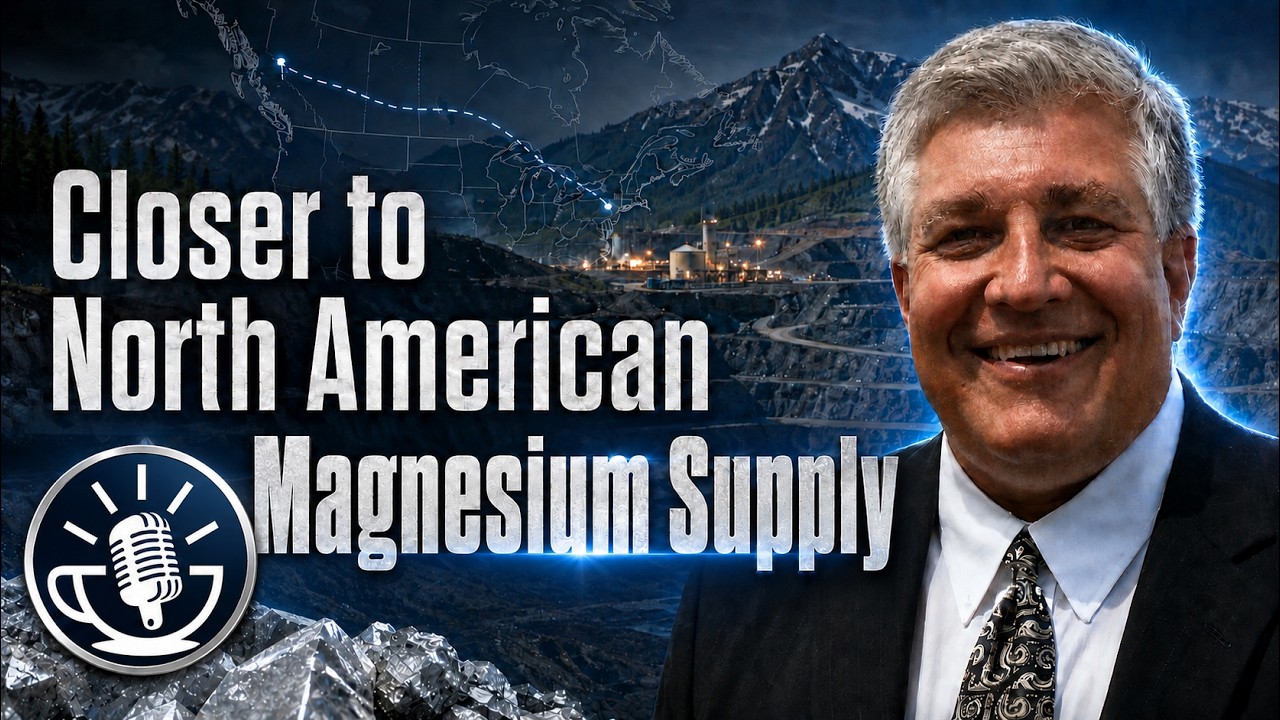
West High Yield Moves Record Ridge Closer to North American Magnesium Supply
Watch on YouTubeVideo summary
West High Yield Resources is positioning itself as the fastest-moving magnesium producer in North America by leveraging a massive 10.6 million ton identified resource in British Columbia. The company has successfully navigated years of development and recently secured its mining permit, with operations expected to commence in the fall. A key driver of this momentum is a definitive off-take agreement signed with Galaxy Magnesium, which guarantees the purchase of ore over the coming years. This partnership provides immediate financial stability, starting with a pre-purchase deposit once final authorizations are complete, and projects gross revenues exceeding 30 million dollars annually in the second year, potentially rising to over 100 million dollars by the third year as production volumes increase.
The strategic value of West High Yield's project extends beyond simple extraction due to the unique composition of its ore, which is 94% sellable magnesium and silica with trace amounts of nickel and iron. Unlike many other mining projects that require expensive on-site processing plants and create environmental liabilities like tailings ponds, this company can sell the raw ore directly or process it later based on market needs. This approach significantly reduces capital expenditure, as over a billion dollars in infrastructure is already in place, including rail lines, power access, and gas connections. Consequently, the cost to bring the mine online is estimated at only 30 million dollars, a fraction of what competitors might spend on basic road construction alone, allowing for a much faster path to profitability.
Magnesium represents a critical strategic asset for North America because China currently controls 95% of the global supply, creating significant security concerns for defense and industrial sectors. The metal is essential not only for pharmaceuticals and nutraceuticals but also for de-weighting vehicles in transportation and enhancing battery chemistry to reduce heat volatility and increase charging capacity. Furthermore, the high-purity silica found in the ore addresses surging demand driven by the artificial intelligence boom, which requires advanced computer chips and glass housings. By establishing a secure, domestic supply chain that utilizes an extraction process with a 94% success rate and minimal waste, West High Yield Resources aims to become the predominant magnesium supplier in North America while supporting broader government initiatives focused on critical mineral independence.
Read the full video transcript
[music]
>> Today I have the benefit of speaking
with Barry Bain from West High Yield
Resources. How are you today?
>> Bridget, I'm great. It's always a
pleasure to speak with you.
>> West High Yield Resources is the fastest
magnesium company to production in North
America. Do I have the competitive
element of why correct?
>> You do indeed. We have
a 10.6 million ton magnesium contained
resource already identified. We are well
along the permitting process. We spent
many years advancing this project in
British Columbia. We have the mining
permit that was received in October
2025. We have our other authorizations
that are currently in place and we're
looking forward to hitting the ground
running here in the fall.
>> Okay. And so when I was listening to
everyone talk earlier in investor talk,
they were very excited about the
valuation of the company as you move
forward and in particular in particular
your off-take partnership. Can you talk
a little bit more about that?
>> Yeah, I I sure can. So we have an
interested party Galaxy Magnesium and we
signed a definitive agreement with them.
That definitive agreement asks us to
deliver over the next couple of years
62,500 tons of ore which will generate
over 30 million dollars US in gross
revenue each year. The first year we
have some
development costs to pay for so it'll be
a a push year. Year two will be 30
million plus and then we will amend our
permit taking it to a higher volume and
we expect over 100 million in revenue in
three year three of mining alone. So
given the fact that
we have that definitive agreement in
place, the the off-take partner will be
putting forth a 5 million dollar
pre-purchase deposit once all the final
authorizations are in. It shows that
we've de-risked this project
substantially and we're on the cusp of
cash flow and commercialization.
>> Okay, well we were talking at PDAC. I
was just looking back at an old news
release and discussion that we had and
you have not only magnesium, you have
silica, nickel, and iron. Is that
correct?
>> Yes, so the beauty of this resource is
that,
um,
we don't have to process it on site and
we can sell the ore and process it as we
are, in this case to an off-take
customer, or we have plans to future
build a value-added processing onshore.
And the reason that is is 94% of the ore
is sellable, primarily the magnesium and
silica, and then we have trace credits
of nickel and iron. What this allows us
to do is have extremely profitable ore,
um, not have a tailings pond or
processing plant on site, and add value
to, uh,
uh, obviously the demand profile for the
critical minerals in North America. This
will make us, this project as we move
forward, at least to as our
understanding is in the current
marketplace, the predominant magnesium
supplier in North America.
>> Okay, and for those of you that may not
be aware of it, uh, China controls 95%
of the world's magnesium
and, um, of course a lot of people think
that magnesium is just something that
you a vitamin supplement that you take,
but actually the Defense Department is
looking at magnesium. Can you tell our
audience a little bit more about the
competitive reasons why,
uh, magnesium may be the most exciting
critical mineral in the fall market.
>> Well, magnesium is important in so many
ways. You mentioned earlier the
nutraceutical piece and pharma
component. That's very important for
human physiology and society.
But the industrial base needs it for the
de-weighting of vehicles,
transportation,
um,
you're you're battery chemistry is
changing where magnesium now is a core
component of future battery chemistry
that makes it less volatile to any kind
of uh heat uh heat fires, and also gives
it higher capacity in charging. So, that
reduces range anxiety for for uh
manufacturers. The other piece is the
defense department. There's no doubt
that they have a a large demand for
lightweight strong material such as
magnesium. And as you mentioned earlier,
Tracy, again, we're China controlling
95% of the magnesium supply globally.
There is a huge safe, secure supply
issue that we can help solve for North
America.
>> And of course, there's all kinds of
investment bankers and everyone racing
into the critical minerals corral to
take a be a part and take a piece of the
government investments that they are
making currently. But you guys have been
around since 2003, so you're making this
look
almost magical in your timeline, but
you've been doing this for a while.
>> You know, we're fortunate. We've got a
tailwind now. Uh
a lot of people probably looked at the
uh the front end of this process and
said, "What is magnesium? Where is it
going to be used?" Had no idea. So, the
persistence of of what's happened here
with the founder and the company is that
we've been visual to take it a place
where the high demand profile analysis
for
silica, magnesium, nickel, and iron, all
of the critical minerals, and that
supply piece base needs to be built in
North America. For years, the company
was primarily advancing, you know, a
mineral project through exploration,
engineering, and permitting. But
today we have like our mines act permit,
we have our transportation permit, we
have a good indigenous strong indigenous
relationship, we have an off-take
agreement, uh and we have a demand
profile uh tailwind ahead of us that
will spray for the uh you know, next 10
to 20 years.
>> Uh speaking of tailwind, you also have
an extraction technology process. We
talk about that all the time on Investor
News that
uh has a 94%
success rate. Did I read that properly?
>> 94% extraction rate. So, that's why it
gets back to value to work. We have only
6% waste. Where a copper mine might only
get a a percent a percent and a half of
copper out of ton of ore, we're getting
94% of the value out of that ton of ore.
Again, primarily with magnesium and
silica, both in huge demand. Silica,
obviously, with the with the advent of
AI and how it's evolving and all of the
computer trend uh needs for
uh better chips, the housings, the the
uh glass, silica is is another big
demand product of high purity onshore
silica.
>> In this race towards production and of
course maintaining your leadership
position in the magnesium market, which
is a a high-level critical minerals
sector.
What do we have to do next at West High
Yield Resources?
>> The next uh the next thing is we've gone
through, obviously, everything to
permitting, pretty much. We'll have
those in place.
Get on the ground and start start
disturbance in the uh the mine. So,
that'll be
removing the trees, that'll be starting
the construction access. I've mentioned
this once before and I'll do it again
that we have over a billion dollars of
infrastructure in place. So, that
requirement to build our mine, to get it
up and running, is very small in the in
the range of 30 million. Where there's
some mines that have to build 100
million dollars worth of roads just to
get to their mine site. We have
approximate labor force, we come from a
jurisdiction that is known for mining.
We're 2 km north of the US border. We
have rail in place, we have power
through our property, gas. So,
therefore, our costs uh to get the mine
up and running is very low relative to
other projects.
Um we're we're excited. That's where
we're going next.
>> Westwater Yield Resources or WHY
Resources, WHY.
For more information, please go to the
following website. And Barry, thank you
so much for the update.
>> Uh Tracy, it's always a pleasure. Thanks
for your time, and we'll look forward to
our next opportunity to visit.