Video summary
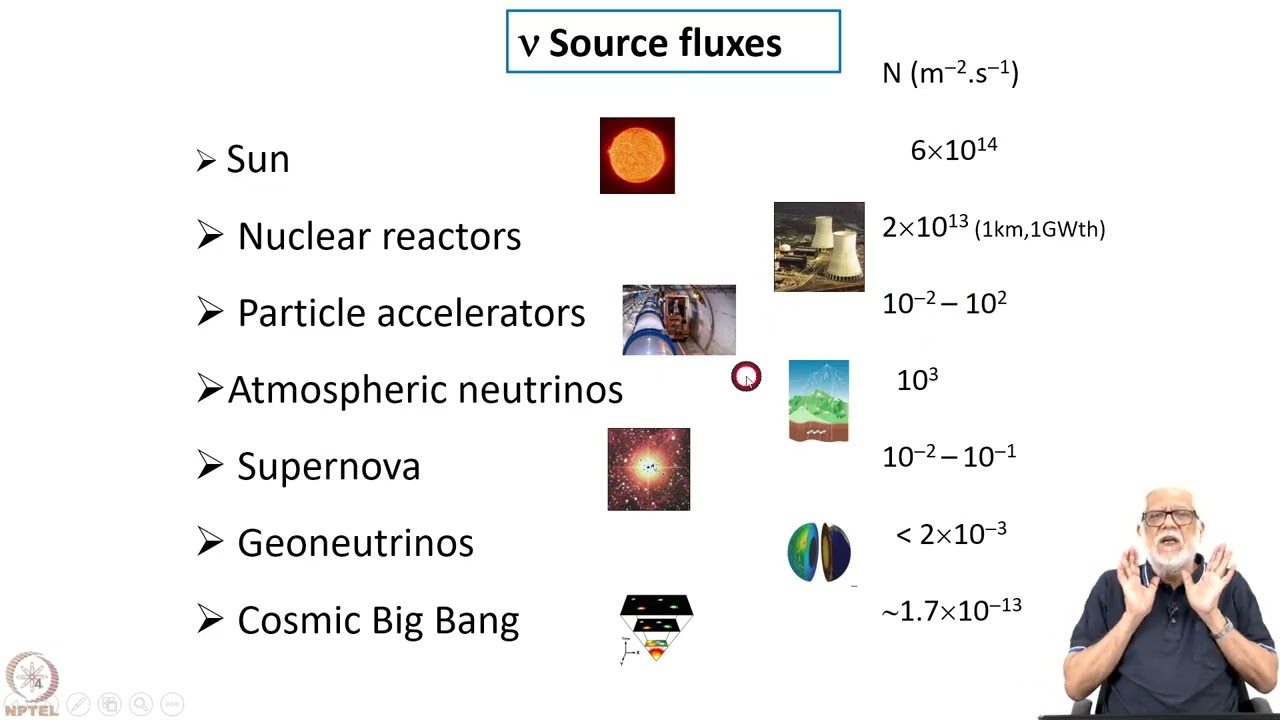
This lecture introduces the concept of neutrino oscillations within the leptonic sector, following previous discussions on meson oscillations in the hadronic sector. The presentation begins by reviewing fundamental properties of neutrinos, noting that they are spin-half particles with zero electric charge and extremely small magnetic dipole moments. Experimental data from reactor and solar observations indicate that neutrinos have a mean life significantly longer than 300 seconds, while precision measurements from the LEP collider suggest there are exactly three types of light neutrinos with masses below half the Z-boson mass. The lecture also details various sources of neutrinos, ranging from the sun and nuclear reactors to atmospheric interactions, supernovae, and the elusive cosmic background, highlighting the vast differences in their energy spectra and fluxes.
The core of the discussion focuses on experimental evidence for flavor change, starting with the historical solar neutrino problem where early radiochemical experiments detected only about one-third of the predicted electron neutrinos. This discrepancy was further confirmed by water Cherenkov detectors like Super-Kamiokande and heavy water detectors like SNO, which revealed a deficit in electron neutrinos but accounted for the total flux when all flavors were considered. A similar phenomenon was observed in atmospheric neutrinos produced by cosmic rays, where the ratio of muon to electron neutrinos depended on whether they traveled through the Earth or came directly from above. These consistent shortfalls across different experiments provided the definitive proof that neutrinos change flavor as they propagate, a discovery that earned the Nobel Prize for its architects.
The theoretical framework explaining these observations involves mixing between flavor states and mass eigenstates, described by the PMNS matrix. The lecture derives the probability formulas for two-flavor oscillations, showing how the survival probability depends on the mixing angle, the difference in squared masses, and the distance traveled relative to the neutrino's energy. It further explains that matter effects, first proposed by Wolfenstein and Mikheev-Smirnov, significantly influence electron neutrinos traveling through the dense solar core, effectively enhancing oscillations and resolving the solar neutrino deficit. The presentation concludes by outlining major open questions in the field, such as the possibility of a fourth generation of sterile neutrinos, whether neutrinos are their own antiparticles (Majorana particles), and the determination of their absolute mass scale, which oscillation experiments alone cannot provide.
Read the full video transcript
This lecture we will talk about uh
oscillations in a different sector in
lepttonic sector. uh in the last uh uh
or last to last we looked at uh the
oscillations in the hydronic sector
where we looked at K and neutral B
meons. Uh here we'll look at neutrino
oscillations. So first of all we'll
recap some recapitulate some of the
properties of the neutrino. Then we'll
look at the experimental data that
pointed towards the possibility of
neutrinos changing flavor. Uh then we
will talk about two generation mixing,
three generation mixing. Uh
and then finally we'll also see is there
a possibility of a fourth generation and
what are the some of the open problems
in nutrinos
in the field of nutrinos.
Okay. So uh summarizing some of the
properties of nutrinos, it is a spin
half entity uh like the electron
or muon or the tow particle tow. It has
an electric charge which is as far as we
know consistent with zero. But
experimental limits uh terrestrial
experimental limits put the electric
charge the upper bound as 4 into 10us4
of a electronic charge and
cosmological
uh bounds are much more stringent says 2
10us 15 of electron. The magnetic dipole
moment uh is less than uh 28 into 10us
10 * a bore magneton. The bore magnet of
course is crossed by 2me C.
Uh the mean life by the mass is greater
than 300 seconds by EV from a reactor
experiment
and 7 10^ the 9 second by EV from uh
looking at solar neutrinos.
So of course the solar neutrino bound is
much more stringent as compared to the
reactor experiment because the distances
are much smaller in terrestrial
experiments as compared to if you look
at nutrinos coming from the sun. The
total number of nutrinos with mass less
than about half the uh Z0ero mass which
means nutrinos which have less than 45
GV by C^² then if you look at the number
of such nutrinos uh from the width of
the uh Z0 resonance and uh the partial
width to unseen particles uh such as the
neutrino uh then you can infer
this number to be 2.9963
plus -.074.
So this is like seven parts in 3,00
which means about two per mill. Uh with
two per mill accuracy we can say that is
consistent with three the number of
neutrinos with masses less than 45 GP by
C² is three. the effective masses of uh
the electron neutrino is now pushed to
less than 0.45 45 EV by C^² mainly
because of the Kine experiment. Then the
the limits on new mu and new toao are
given here. They are much much higher
than the
they have not changed over so many years
because it would be very difficult to
decrease that bound.
Okay. So what are the sources of
nutrinos
which is important if you want to study
nutrino properties including nutrino
oscillations. So the sun is of course a
source of nutrinos. The average energy
is uh of the order of less than on the
average 10 to the 10 me or so. Nuclear
reactors similar less than about 10 m.
Particle accelerators of course can go
from low energies 10 the minus 2 GV to
10 the 2 GV
uh atmospheric nutrinos uh you can get
greater than about 100 MV or.1 GV
onwards and there is a whole spectrum uh
of course falling is a power law uh
supernova nutrinos are between about 10
to 100 me supernova are exploding stars
which many of them many of which land up
as neutron star eventually. Uh then
there are geonutrinos due to the uh beta
decays that occur in the chain of decays
starting from uranium 2 38 to thorium
232 also some contribution from
potassium 40 and so on and finally there
are the nutrinos which are the most
difficult to detect which we haven't yet
detected. So all the other six types of
nutrinos from these various sources of
course we have detected and made
measurements which tell us something
about the nutrino itself. Uh but cosmic
big bang nutrinos which is like the
cosmic big bang photons. So the such uh
uh microwave background radiation we
have of course detected but in the case
of neutrinos we haven't detected them.
They're extremely difficult to detect
and they have energies of course of the
order of 10 the minus3 GV or something
like 170 micro electron volts.
Geonetinos are similar in energy range
to uh of the order of 2 to 4 me or so.
[snorts] uh the so this should be
actually
2 to 4 uh
me
uh okay so these are the average
energies or the range of energies of
these uh nutrinos from the various
sources here listed uh seven such
sources or seven groups of sources uh
the nutrino fluxes uh also vary uh
between big ranges. Uh for instance, the
sun is the most prolific source that we
know of in our vicinity. Uh namely it
produces about 6 10 14 nutrinos per
meter squared/s.
So these are the units me per meter
squared per second. Nuclear reactors
give about 210 ^ of 13 at a kilo
distance of 1 kilometer. If you have a 1
ghawatt thermal reactor, many reactors
these days are about 3 gawatt thermal
and there are some even more powerful
ones which are 5 gawatt. Particle
accelerators uh the fluxes range between
10 the minus2 per meter squared per
second to 10 the 2 and these are at
large distances of course uh of the
order of tens or hundreds of kilometers.
uh there of course you use the fact that
uh if you have a relativistic particle
[snorts] decaying it uh there is a
kinematic focusing so that is not
mentioned here under what what
conditions are these uh numbers holding
atmospheric nutrinos are typically of
the order of 10 3 per meter
squared/snovas
10 -2 to 10 -1 per m²/s
uh geo neutrinos of the order of uh 2
10us
3 uh per m²ared/s
cosmic big bang neutrinos uh as I said
1.7 10 -3 per m²/s
however uh I I think I made a mistake
there I think I like to check this
number
anyway you We can calculate this from
the fact that there are about 330
uh
these neutrinos
uh per uh cm cubed volume in all of
space. Okay. And since these are light
and they are
you can you can for an order of
magnitude estimate you can take a
that they will move with the velocity of
light. In that case uh the uh so this is
I think this is should be plus 13
because 3 10^ the 10 cm so this should
be plus
[snorts]
uh so anyway in the final uh
transparency so anyway there's a range
of fluxes which I wanted to point out uh
with solar neutrinos being the most uh
with the highest flux and uh nuclear
Reactors also are very strong sources.
Particle accelerators the fluxes may not
look large but they you can you can uh
they are focused kinematically. So you
can do them at large experience. Now the
cosmic big bang nutrinos are large in
flux uh but uh they are extremely low
energy. So they're extremely hard to
detect.
Okay this is the energy dependence of
the nutrino cross-sections. Maybe when I
uh so this as you can see the neutrino
energy spans almost uh 20 orders of
magnitude 10 the minus2 electron volt to
10 the 10 10 the 18 electron volt so the
cross-section of course rises uh
initially it rises like E squar and then
it rises more like E and then this peak
that you see is uh the uh nutrino can
interact with the uh background material
to actually produce the zero bzon. Okay.
So [clears throat] that's why you get
this peak here. Uh cross-sections
ranging from 10 the minus uh 31 miban to
10 the minus1 miban. Okay. This is taken
from a review article in 2012. Uh
so any case
the the solar neutrinos were first
measured by Ray Davis uh and this was a
proposal which uh Davis and Ball uh
whose picture is here they made in the
early 50s. Initially they had some
problem getting this approval for such a
project in Brook Haven National Lab. uh
but the the argument that clinched it I
was told is that they said we can
measure the PP uh
reaction going to dutarium plus E+ plus
the neutrino and uh there is no way of
measuring that in the lab because the
cross-section is smaller than some 10us
52 or something square cm so
so they proposed to measure solar
nutrinos get a handle on the PP
cross-section and that is what uh
actually uh won the uh day and then they
got approval for making such a
measurement. So uh the idea was actually
due to Ponte Cororvo in 1946 when he was
at Jock River Laboratories in Canada. He
proposed that if you have a suitable
target of chlorine 37 actually chlorine
because uh in natural chlorine you have
about uh 25% of 37 chlorine. So then
what happens is that the new E interacts
with the chlorine to produce argon 37
and an electron. And this being a
radiochemical experiment, you basically
keep on producing 37 argon to about one
lifetime or of about a little more than
a month. And then you separate out this
argon from the uh target material which
has uh chlorine in it. and uh then you
count it in a low background setup using
a proportional counter for instance. So
this was the proposal of ponte carvo uh
ponte corvo sorry and uh the solar
nutrinos are expected to produce about
uh 37 argon atom 37 argon one atom of 37
argon in about 2 days of exposure to the
solar neutrinos.
uh [clears throat] so if you run it like
say for a 40 days then you get about 20
uh atoms of 37 argon and then you
separate them out. So this is this
number is for a 600 ton
carbon C24
organic compound. Of course Davis was a
chemist but uh he was a extremely good
experimentalist
and Ball was an extremely good
theoretician. So he actually calculated
what you should expect and that changed
over a period of time because the uh
various cross-sections that enter into
such a calculation nuclear cross-section
also got refined and the models for the
sol sun also got refined. So
in any case uh this resulted in a series
of measurements from 1970 to about uh
1986
when this experiment uh ended and uh
this was the data. Uh so the the average
production of uh argon 37 was about half
a uh atom per day. So instead of two
days it was just one atom per day which
they found. And uh this is in terms of
uh uh so-called SNE uh the solar
neutrino uh unit uh capture rate unit
and uh this was about uh 2.5 or so 2.5
snooze
uh so the one SNO is defined at 10us 36
captures per target atom per second. Now
both these theory and experiment and
theory had to go hand in hand. So bal
doggedly pursued the calculation of the
solar nutrino flux reducing the
calculation uncertainty to about 20% or
so and uh what was found was that the uh
calculated value is about 7 uh and a
half snooze whereas the measured value
is about 2 and a half snooze so it is
about a third of what you calculate. So
initially there was a push back from the
particle physics community which said
that how are you sure about the absolute
calculation that you have made it
involves so many uncertainties nuclear
cross-sections the dynamics in the
stellar solar interior and so on. So
when he said that there is a problem uh
he was not initially believed [snorts]
but uh as we will see
uh there were other experiments such as
the uh super uh initially the
kamioandanda experiment and then the
super kamocondi experiment which also
saw uh which also by lowering the
threshold to about 5 me over a period of
time they could measure these solar
nutrinos and they also found a
roughly a ratio of half of what you
expect. So this is what you expect and
this is the error bar on that and this
is what was measured. Uh it is about
half of what you expect. Similarly there
was another experiment a radiochemical
experiment. So this is online realtime
experiment because the electron neutrino
coming in uh scattered of the electron
and you actually counted those such
events in which an electron was
scattered. uh there's another
radiochemical experiment uh which is
based on the gallium uh target and there
were actually two one as a Russian based
collaboration the other was a European
collaboration
uh and also later it was joined uh both
these were combined so it became a sort
of worldwide experiment the GNO
experiment and what they found was again
a ratio which was about u uh a little
more than 50% % because of course this
had a much lower threshold and they were
sensitive to also PP nutrinos. This one
was sensitive to nutrinos above 5 MV
energy and this was sensitive to
nutrinos above about 1 m energy. So in
any case all these experiments showed
that there was a shortfall of measured
nutrinos of the electron type to what
was expected.
So there comes the Sbury Nutrino
observatory experiment and this was a
proposal of uh Herb Chen uh who
unfortunately passed away before the
detector could actually uh collect data.
Uh but the proposal was a brilliant
proposal. He proposed a 1 kiloton heavy
water pure heavy water detector uh to
measure nutrinos via both charge current
interactions that is given here. Newe
interacts with dutarium which basically
provides the neutron target. So if you
remember how the anti-utrino was
discovered, it was discovered by uh its
charge current interaction with a
proton. But a neutrino the charge
current interaction goes o through the
neutron target and uh neutron is a
loosely bound system of the neutron and
the proton. So the new e interacts with
the neutron to produce e minus and then
two protons. So the spectator proton and
the other proton is produced via this
charge current interaction. And so this
is this is one way in which uh the new
new can be detected. But if the newi
transforms itself to any other kind of
neutrino uh something which bakal was
proposing to solve the solar neutrino
problem then uh you can any type of
neutrino can break up a ne d ne d ne d
ne d ne d ne d ne d ne d ne d ne d
neutron and that goes through the
so-called neutral current interaction
where you exchange a zero bzon.
Uh, of course they also uh this could
also detect uh using the elastic
scattering on electrons which is what
the SK detector did. And here of course
you have a two amplitudes contributing
the charge current amplitude where a uh
a new E for instance becomes a uh E and
vice versa.
uh or it can just scatter off uh if it
is of a different type can just scatter
off the electron. Uh so for the electron
type there are two amplitudes that
contribute and you have to coherently
sum those. Whereas for the new mu and
new toao it's just one amplitude that
comes about.
So
okay so this is just elastic scattering.
uh so all these three processes are
detected in the heavy water detector. So
uh the heavy the the proposal was to
build a 1 kiloton uh detector of heavy
water and then surrounded by pure water
as a muon uh veto shield for the inner
detector.
Uh the snow experiment produced a
definitive result in 2002. Of course
they went through three phases and they
had uh you know published their results
but the final result uh was that the
electron type of neutrino was had a flux
of about 1.8 8 10^ the 6 per square cm/s
whereas the uh total flux of all types
of neutrinos was about three times
higher at about 5 10 6 per square cm/s
and this is the uh publication this is
the proposal of Chen in 1985 and the
final definitive experiment u with all
the data that they had was reported in
2002 so almost 17 years later.
Uh
so the water cherov detectors of course
this is just a uh uh schematic of how
water cherenov detectors work and this
shows that if you have a charged
particle such as a muon or electron it
produces a cherenov ring of light and
that is captured by photo multiplier
tubes. If it is an electron then this
ring is uh slightly fuzzed uh is fuzzy
whereas if it is a muon then that goes
in a almost like a straight line. So
this is a much sharper ring. U this will
uh be important when we talk about
atmospheric nutrinos.
So atmospheric nutrinos are uh produced
uh by uh cosmic ray protons interacting
with the upper atmosphere. The
atmosphere is about 10 km thick. So the
protons interact with the nucleons in
the uh nitrogen 14 and 16 oxygen.
Remember uh that uh the atmosphere has
about 80% of nitrogen,
20% of oxygen uh and of course a little
bit of argon 1% of argon. So when the
proton interacts it produces pions which
then decay to muons of course producing
muon type of neutrinos. Uh on the other
hand when the muon decays it produces
muon type of neutrino but also a
electron type of neutrino. So there are
two muon type of neutrinos for every
electron type of neutrino and this is
pretty robust. It doesn't depend on the
absolute flux of the protons. So uh you
expect to see this ratio whichever way
you look up going or downgoing nutrinos.
Uh what was observed by this experiment
by initially the kamyoka and then with
much better statistics by the super
kamyoka experiment was that if you
looked at downgoing nutrinos then you
saw this ratio as two but if you looked
at upgoing nutrinos this ratio deviated
from two very with great significance
and it was only one. Okay. So the fact
that the measured upgoing nutrino uh
ratio
upgoing to downgoing it should be
neutrino ratio
neutrino ratio is not u
sorry is not one uh sorry I should
remove this the upgoing neutrino ratio
of n mu new mu No, this is this is not
correct.
Uh this upgoing neutrino ratio not being
two is the so-called atmospheric
neutrino problem. Okay. So it is two for
downgoing but only one for upgoing and
this is the atmospheric nutrino problem.
As I already said that this ratio
doesn't depend on absolute cosmic ray
fluxes because after all you're taking a
ratio. So even if you're wrong in the uh
absolute flux uh you still get the same
ratio. So the final experiment was this
which showed looked at subgv uh
electron-l like uh events subgv muon-l
like events and then multigv and uh
electron and muon-l like events. So
while this doesn't show too much of a
structure, this is obvious in uh the uh
multigv data and you can see that this
uh uh the number of events for multiGV
electron type uh goes like this with as
a zenith angle and it is larger for
theta equal to0 as compared to for theta
equal to 180°. degrees. So, and the same
thing is manifest in the muon sector as
well. Uh, sorry, in the electron sector
you you see it going one way. In the
muon sector, you see a strong depletion
in the upgoing things. So, when theta
equal to0, it is actually downgoing and
upgoing is theta equal to 180°. Okay.
plasma. So uh it shows up that this uh
for upgoing things it is uh deviating
from what you expect uh this is what you
expect in the muon sector and this is
what you see whereas in the electron
sector it more or less matches what you
expect. So this as I said already this
was the so-called atmospheric nutrino
problem. Okay. So the following this uh
these two problems which were uh
measured u and the explanation was that
it was due to neutrino oscillations uh
that uh led to a Nobel prize in physics
for uh Kajita son and Art Macdonald uh
from the Sudbury neutron observatory. So
after Chen passed away uh the baton was
taken over by Art McDonald who did a
magnificent job with his team at uh SNO
and uh they solved the solar neutrino
problem. The atmospheric nutrino problem
was pointed out and then of course the
same explanation that nutrinos oscillate
was uh
solved the atmospheric nutrino problem
also.
Uh what is meant by nutrino
oscillations? So nutrinos can be
described in two bases the flavor basis
and the mass basis. So these are two
alternate descriptions and these two
descriptions are connected by a unitary
matrix. So the uh the basis uh where
flavor states exist the e mu and the
toao uh can be represented by a unitary
matrix times the uh the mass basis. So
this is described in terms of m1, m2, m3
and this is in terms of e, mu and toao
for uh this is depicted here in a
cartoon where if you start out with a
certain flavor then uh you can oscillate
between electron muon type and maybe
even the tow type. Okay. So for two
flavor mixing you can actually derive a
survival probability for let's say a new
mu remaining a new mu and that is 1 -
sin^ 2 mixing angle 2 theta where theta
is the mixing angle and sin^ squ
some number time a delta m^ 2 where
delta m² is defined as the difference in
squares of the masses of these two mass
states [snorts] and times l by e okay So
as you go along L this uh number
oscillates and uh that is of course what
is called neutron oscillation. L is the
propagation length. Uh if you put in the
numbers in meters and me then you can
calculate how much this survival
probability is. If you want to do it for
higher energy neutrinos in GV range then
this distance is to be measured in
kilometers.
And this is a derivation of the uh two-
flavor nutrino oscillation. So suppose
the electron and you consider only
electron and muon type of nutrinos uh in
terms of their mass states mu1 and mu2
then there is only one mixing angle
theta and you can write this down such
that these two are actually orthogonal.
Uh so when you have a weak decay or a
weak interaction you actually produce a
weak igon state. uh and uh at a later
time uh this uh new of t evolves uh with
in the mass basis as new 1 t *
exponential minus i e1 t and new 2t uh
exponential minus i e2t okay uh so these
are the uh the constant or the time
dependent factors that multiply ly this
uh the mass uh the electron or the muon
type of uh uh state vector
which is of course a function of time.
So if you calculate the uh the uh
probability that a new mu goes to new e
then this can be estimated from here
this can be calculated from here sorry
it go it goes like sin^ squ theta where
theta is the mixing angle here and times
sin^ square e2us e1 t by 2 okay so this
is again the same factor 1.27 27 delta
M21^ 2 L by E where M21 squ is just E2 -
E1 is just this difference in mass
squared by 2E.
So for two flavor mixing survival
probability goes like this and uh
appearance probability where you change
from alpha to beta goes like this. Okay
sin^ square 2 theta* this. Notice
uh again the same kind of units here
kilometers and GV or meters and me. Uh
two important remarks. If delta M² is
zero then of course there's no
oscillation because this term then
vanishes. Then P alpha alpha is just one
and this vanishes. [snorts] If uh the
the oscillation length uh also uh this
will uh vanish uh
so there is no oscillation
also if
theta is zero.
So no oscillation
if theta is equal to zero as you can see
right if theta is zero this term
vanishes. So then this is just one and
this is zero.
The oscillation length is just given by
this 2.5e by delta m^ 2 uh where if
delta m² is uh this number then the
oscillation length is about 10 3 km for
1 GV and for the smaller case delta m²
small then this oscillation length is
very large. because these are uh one
comes in the numerator the other comes
in the denominator.
Okay. So there are two descriptions of
three families of nutrinos the lepton
states and the the mass states and
connected by mixing matrix which goes by
the name of PMNS mixing matrix named
after ponteorvo mar nakagawa and sakata.
Okay. So if there are three masses from
the solar neutrino experiments we know
that there is in the normal hierarchy
you have m1 squ m2 squ and m3 squ uh so
m3 squar is larger than m2 squ and
larger than m1 squ but in the so-called
inverted hierarchy
because of the way
the solar neutrino spectrum is
understood and we'll come to that
shortly uh the uh we know the ordering
of m_sub_2 with respect to m_sub_1.
m_sub_2 squar is larger than m1 squared.
However, we don't know whether this m3
is larger than these two or is smaller.
And so if it is smaller then this is
called the inverted hierarchy, inverted
mass hierarchy. So in the three flavor
oscillation of course this becomes
things become more complicated. So the
uh the
probability that a neutrino of alpha
type goes to beta type is connected by
is given by this expression where delta
j is 1.27 times the corresponding delta
m² i j and so on l by e.
Uh now the interesting thing is that uh
there are also these are all vacuum
so-called vacuum oscillations. However
you can have interactions and the new
can interact with matter electrons
through the neutral current uh which is
common to all the uh nutrinos and so
this can change the mixing angle and
mass. This was first pointed out by
Wolfenstein and Miky and Smeirnoff. uh
Wolfenstein is 78 and Mikab spinoff in
Russia independently in 1985.
So the mixing angle actually is given by
this in matter where a is matter
dependent. It is related to the firmmy
coupling constant to the number density
of the electrons and is proportional to
e. Uh so in case of uh delta 21 being
greater than zero then uh there can be a
cancellation of this and there can be a
resonant enhancement. So even as theta m
even if theta is small uh in vacuum in
the presence of matter this can become
almost of order one and this is the
so-called resonance enhancement of the
angle but also the uh the delta becomes
the gets changed you get an effective
capital m2 and effective capital m1 and
this also under goes the resonance
effect. So for instance this uh if 2
theta if this expression is equal to a
then you only have delta 21^ 2 sin^
square 2 theta. Okay. So
uh in any case the matter affects the
propagation of the electron neutrino
that you started with in the solar core.
And this is a pretty robust effect
because uh if uh depending on what the
uh theta in vacuum is and what the delta
uh in vacuum is uh at some density you
can have a crossover and this is uh this
can be used to explain the solar
neutrino uh deficiency that you have the
fact that we see fewer electron type of
neutrinos than what is calculated.
So uh
okay I have just mentioned that
atmospheric nutrinos have a large range
of energies and propagation distances
but the approximate values of these
neutrino oscillation parameters are
given here that this theta12
which is what comes into play in the
solar neutrino problem is about 33° is
uh not very close to zero as you can see
then delta m21^ 2 is about 7.5 10us 5 ev
Right.
[snorts] So as I said that the the
matter effects actually explain the uh
the reduction of the electron type of
nutrino uh and uh this is a pretty
robust explanation. So the MSW uh
interpretation is the one which is
nowadays accepted in the community. Some
of the open questions I should point out
for instance is there a fourth
generation of nutrinos which is sterile
and this comes about because there is a
so-called smoking gun signal from
reactor antiutrino experiment which see
a small shortage at small L by E as well
as the calibration runs of the gallium
detector which also saw uh shortfall of
uh events
from what you expect the ice cube
experiment of course is ruled out uh in
the delta m^ 2 sin^ square 2 theta space
using atmospheric nutrinos and this is
the reference for that has ruled out a
large uh area of this space
which is in the sterile neutrino se
sector [snorts]
but there are other important questions
like is the neutrino a direct particle
or a meana particle a direct particle
would be represented by spanner with uh
with four components uh corresponding to
spin up, spin down and particle and
antiparticle. Whereas meona is just a s
much simpler description. It has only
two components and that happens because
uh if it's a marona particle the nutrino
is its own antiparticle. So you only
have handedness that's all. Uh you don't
have anything like a neutrino and an
anti-utrino. [snorts]
Uh so this was uh uh you know this was
proposed by Mayorana in the uh in the
early 30s but we still don't have an
answer to this question and we will
probably discuss it in some again in
some later lecture. How do we address
this question? Uh what is the absolute
mass of the neutrino? Now these
oscillation experiments give you
differences in square masses of the
massagon states but what is the absolute
scale? they they don't say anything.
Trishium is the only experiment which
addresses the absolute mass scale. Uh
the anti- the of course there even the
nutrinless double beta decay addresses
it in a slightly different way. So there
is a different combination which comes
about uh but we have only found uh upper
bounds for the absolute mass in some
combination of uh amplitude squared
times uh the mass of the neutrino and so
on. So we have yet to measure this and
there is uh the katine experiment has
put the tightest bounds on this of about
045 eV by c^ squ but there are other
proposals which will improve on that by
about an order of magnitude or so and at
that level we should be able to find the
absolute scale. Uh also we don't have
experimental evidence for nutrinos from
the big bang. So these are the open
questions. So we'll now come to the
summary. We uh re we had a
recapitulation of some of the nutrino
properties and we looked at the
evidences that could be explained by
nutrino mixing and resulting
oscillations. We described two we
discussed a little bit about two flavor
oscillations where we saw the uh the uh
reduction of a particular flavor as it
propagated or a production of a new
flavor as it propagated. And then of
course there is the the realistic uh uh
description which involves three flavor
oscillations. Uh we ended up with an
unanswered question. Is there a fourth
generation of sterile neutrinos and
other questions as well as whether the
nutrino is a marina or a direct
particle?
How do we look for uh the microwave uh
not uh the analog of the microwave
cosmic ray background which is the
cosmic neutrino background from the big
bang. So I think I'll stop here. Thank
you.
[music]
>> [music]
[bell]