Video summary
The lecture explores the fundamental question of whether protons decay, a topic central to Grand Unified Theories (GUTs) that attempt to merge the strong and electroweak interactions. In these theoretical frameworks, quarks and leptons are grouped into larger families, leading to mixing between them and consequently violating baryon number conservation. This violation is crucial for explaining matter-antimatter asymmetry in the early universe, as proposed by Andrei Sakharov, where a tiny initial imbalance allowed matter to survive after most particles annihilated. Unlike electric charge conservation, which is protected by gauge symmetry, baryon number conservation is not strictly enforced, making proton decay an inevitable prediction of many GUT models. Consequently, physicists have long sought experimental evidence for this phenomenon to test these unification theories and understand the stability of matter.
Historical efforts to detect proton decay began with radiochemical searches in the 1950s and 60s, which looked for daughter products like fission events or tracks in mica caused by nucleon decay within heavy nuclei such as thorium-232. These offline experiments eventually yielded lower limits on proton lifetime around $10^{27}$ years. The first large-scale real-time detector was established at the Kolar Gold Fields in India, utilizing layers of iron and proportional counters to track charged particles from potential decays. Subsequent major experiments like Kamioka and Super-Kamiokande used massive water Cherenkov detectors, pushing the lower bounds on proton lifetime to approximately $10^{34}$ years without finding definitive evidence, though a few candidate events were observed that could potentially be background noise. These results have constrained specific decay channels, such as a proton decaying into a positron and a neutral pion, while other modes involving muons or kaons also have their own established limits.
Beyond standard lifetime measurements, the lecture addresses an intriguing theoretical possibility regarding the validity of the exponential decay law at very short timescales, linked to the quantum Zeno effect and the Khalfin theorem. This theorem suggests that for extremely brief observation intervals, a quantum system's evolution might deviate from exponential decay, potentially preventing decay entirely if observed continuously. While Sudarshan argued that internal nuclear processes mimic continuous observation, preserving exponential behavior on macroscopic scales, the argument remains intriguing because it implies that non-observation of proton decay could stem from this quantum effect rather than the proton being stable. If the transition to standard exponential decay occurs over a timescale comparable to the age of the Earth or longer, current experiments might miss deviations from expected decay rates, adding a layer of complexity to the search for baryon number violation.
Looking toward the future, several next-generation experiments are poised to significantly enhance sensitivity to proton decay and other exotic phenomena. The JUNO experiment in China, designed primarily to determine neutrino mass ordering, will also contribute to proton decay searches alongside its massive liquid scintillator volume. Similarly, the Hyper-Kamiokande project in Japan aims to build a detector with ten times the fiducial mass of Super-Kamiokande, commencing operations around 2027 to probe deeper into GUT predictions. In the United States, the DUNE experiment, utilizing liquid argon time projection chambers, offers high-resolution tracking capable of identifying decay modes that other detectors cannot resolve. These upcoming facilities represent a concerted global effort to either discover proton decay, thereby confirming baryon number violation and validating grand unification theories, or to push the lifetime limits even further, reinforcing the stability of the proton within our current understanding of physics.
Read the full video transcript
So in this lecture we will talk about uh
proton decay. So it's a question that uh
is still being posed by uh groups uh all
over the world. namely does the proton
decay.
So we'll look at why we should look for
proton decay. Uh how do we look for
proton decay and indeed nucleon decay
because you can also look for uh nucleon
uh neutron embedded in the nucleus uh
and its decay uh and what are the
present bounds and what are the planned
experiments ongoing experiments as well.
So proton decay would signify beron
number uh
conservation is violated. So uh there is
a berion number non-conservation. Okay.
[snorts] Now proton is the lightest uh
baron. uh uh the neutron is slightly
heavier than that and so are the other
uh varian like the delta lambda and so
on and uh Sakurov when he was discussing
CP violation in the early universe uh
one of the things that he mentioned was
that you also need uh proton decay and
this was a hypothesis uh this was in
1967.
Now there is a prediction of all these
models that uh would like to unify the
strong and electroeak interactions
namely the grand unification theories
called guts for short uh and they put
quarks and lepttons the fundamental
particles that we know in a bigger
family so there is mixing between them
and that leads to uh beron number
non-conservation
if CP violation is there then of Of
course you also get matter antimatter
asymmetry in the early universe. So
suppose there is a matter anti- matters
asymmetry like one part in 10 the 10 in
the very early universe just after the
big bang then what happens is that
10 minus1
matter antimatter particles annihilate
produce radiation but that one uh odd
particle which is produced by this very
tiny asymmetry that survives and that is
what we see in the early universe. So
that was the uh theory of Andre Sakarov
and then he laid down several conditions
which have to be satisfied in order to
get this uh matter antimatter asymmetry
in the early universe.
>> [snorts]
>> Now as I said already this also uh one
of the things that is a consequence is
that proton decay is almost inevitable
uh in both in these gut theories and uh
the also one should also say that the
beron number conservation
is a is not a symmetry which is
protected like let's say the electric
charge conservation which is because of
a local gauge invariance. in the
electromagnetic field. So uh it it could
very well be that uh berion number is
not conserved and so then it is uh uh of
course uh necessary that you look for
beron number non-conservation.
The early uh models which unified uh
electroeak and strong interactions were
due to Jokesh Pati he's a Indian origin
scientist uh and Abdul Salam in 1973 and
independently by Howard Georgie and
Sheldon Glashaw in 1974.
So the predicted modes are several of
course but some of the more prominent
modes for these models is the electron
and pion uh pi 0 then the neutrino plus
k plus for proton decay. So this is uh
E+ it should be uh
this should be E+ron
and a pi 0 uh
outgoing channel. So these are the
people involved who proposed these gut
theories. Of course there have been
several now uh since then but these were
the early ones. Uh so this is Jokesh
Pati, this is Abdul Salam, this is
Georgie and this is Sheldon Glacial. Of
course Abdul Salam and Glacaw got a
Nobel Prize. They shared the Nobel Prize
with Weineberg uh for the electroeak
unification.
So the the first detector to get off the
ground, first large detector I would
say. There were experiments which looked
for proton decay earlier to the colar
gold field experiment. But the first
large detector to get into action was
the one in Colar gold fields in southern
India. And uh of course there is a
history to the activities going on in
Colar gold. was started by homie Baba uh
in 1951. Uh basically Professor
Shriikantan was asked to go and measure
the muons at various depths. So what is
shown here is the entrance to the
Champion Reef mine which was the deepest
mine. I think it went down to something
like 3.2 km deep at its deepest.
So uh at this lab when the uh muon
fluxes were measured as a function of
depth it was realized that if you go
sufficiently deep uh and also look at
sideward events then that is a good
place to look for atmospheric nutrinos
and indeed the uh the atmospheric
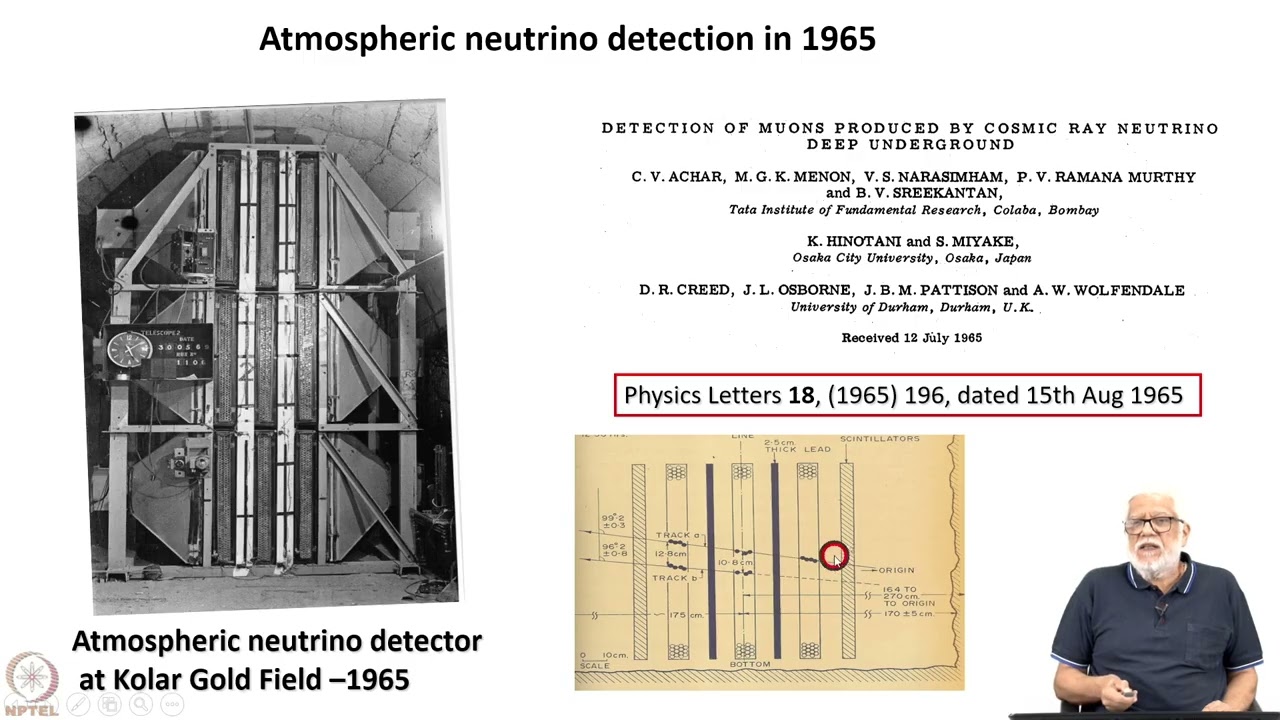
nutrino detection was done in 1965
by a TFR Osaka City University and
Durham University collaboration. So
these are the uh this is the paper which
was published in physics letters.
Interestingly the publication came out
on the 15th of August 1965.
So what they this is one event which is
shown here. uh they had several uh
detectors and there was a track
corresponding to nutrino interacting
with the rock and then producing muons
which were tracked in this uh detector.
[snorts] So a photograph of that
detector is shown here. Uh so there were
actually several detectors three to four
kinds of detectors. uh a an experiment
was also done in the South African gold
mine at similar depths uh by a group led
by Fred Rehes who if you remember
actually discovered the electron
neutrino in a reactor experiment in uh
the mid50s.
So he also uh uh carried out this
experiment and discovered atmospheric
nutrinos. The paper was published about
two weeks later than this paper.
So these are samples of nutrino events
uh front view and the side view. What
they realized when the TFR Osaka Darham
group measured these uh muons uh they
they found that there is a atmospheric
neutrino muon flux which goes like this
with zenith angle and at larger zenith
angles. So which means it traverses a
larger uh amount of earth before it
reaches this detector. Then it kind of
uh flattens out and this flattening can
only be explained if there are now
nutrino events here and not atmospheric
muons because the atmospheric muons
would have gone down this way. So for
instance they would be very small uh in
flux as compared to the event rates that
were uh found in the experiment.
So in any case uh what was realized was
that if you go to those depths uh more
than about uh uh 2 kilometers or so at
uh kgf that is a good place to put a
detector to look for uh proton decay.
Before I go there, let me also point out
that there were other searches which
were carried out before and uh they are
very nicely summarized in this annual
reviews of nuclear and particle science
uh review article by Don Perkins in 1984
where he talks about the proton decay
experiments. So the radiochemical
searches were the first ones and uh they
were I think they they were done even in
the 50s and 60s okay before some of
these big detectors got off the ground
and one of the ways of looking for it
was for protonuc or proton or nucleon
decay was to look for daughter products.
When a nucleon in a nucleus decays then
it can cause for instance if it is a
heavy enough nucleus it can cause
fishision and for instance thorium 232
has a very long halflife of the order of
uh uh 10 to the 10 billion years or more
uh sorry 10 to the 10 years which means
more than 10 billion years and uh they
looked for fishision which can happen if
a nucleon in this 232 thorium decays uh
Then you get fishision and you can see
tracks in mica caused by the headrons
that come out from the nucleon decay
causing spellation reactions because the
amount of energy released is large. Uh
so you can either look for fishision or
for tracks in mica caused by nucleon
decay. So these are two different kinds
of experiments but both uh either
radiochemical or track detector
experiments. So the lower limits uh the
best ones were for the fish part where
were I think in something like 2 10 27
years should be years here.
Uh
so uh this is the kind of limit that
limits that were put using radiochemical
or track detector uh experiments. These
are kind of offline experiments. They
are not realtime experiments. So you
expose something and then look at these
tracks and then infer a lifetime you
know you know the uh number of nucleons
that there are and you have seen uh how
much is the background and basically it
was background that they saw but you can
put a bound uh a lower limit on the
lifetime
direct or realtime searches were also
carried out later and as I told you the
the first one to get off the ground was
the KGF experiment and that used layers
of iron and active detectors. So the
first detector was a 140 ton detector u
uh at KGF and that used proportional
counters 10 cm by 10 cm square counters
long counters of the order of several
meters in length and they were
crisscross. So one layer had let's say
horizontal uh oriented detectors and
then the other layer subsequent layer
had detectors which are also horizontal
but at 90° to the earlier detectors. So
you could actually get X and Y
information not in the same detector but
in subsequent layers. So you could track
the particles charged particles that
were produced if uh the proton decay.
uh other detectors were used in new sex
uh which is streamer counters. Similarly
flash tubes were used in fridges and the
of course these came online a little
after the KGF experiment. So the KGF was
the first one to put uh uh lower bounds
on the uh lifetime of the proton. Uh
later there were also much bigger
detectors. uh the Kamioa detector was a
3 kiloton uh water churn and cough
detector. Similarly, Irvine Michigan was
I think something like a 2 kiloton or I
mean they were in the same ballpark uh
both being water and cough detectors.
These early experiments gave lower
bounds on the partial lifetimes uh
assuming of course uh likely decay
channels because of course if uh the
proton decayed into all nutrinos then
these uh bounds don't hold because then
the nutrinos would not be detected uh in
the detectors that were used. Uh but if
you look at the uh predictions of some
of these theories and uh in any case you
look at uh charged particles then you
can put bounds on uh some of these
branch uh lifetime times the branching
ratio and these came out to be of the
order of 10 ^ of 31 years or so. So no
evidence for this was found although
there were candidate events maybe a one
or two candidate events but they could
have been due to background. So the
conservative uh approach said that the
there is only a lower bound to the
proton decay lifetime.
So this was the KGF phase 1 nucleon
decay detector. That was as I said a 140
ton uh iron uh proportional counter iron
proportional counters kind of uh
sandwich detector. And this is some of
the early electronics that was used. Uh
and this is a picture taken when
Professor Abdul Salam visited the
underground laboratory. Uh this is
professor Shriantton who started the
first experiments at uh uh the Kolar
gold fields. Uh this is professor Mandal
and this is professor Narimum and so on
and several other collaborators.
uh
uh the KGF uh collaboration of course
upgraded their experiment and they ran
it for about 8 years or so uh in the
phase two of this uh experiment and that
was about a uh 350 ton or so detector.
So this is a picture shown when the
detector was being assembled and this is
a picture of the uh collaboration part
of the collaboration not all the members
are there and this is another view of
the same detector.
So in the uh 1982 Paris conference
Perkins summarized the situation uh in
the following way. uh nucleon decay if
it is ever discovered will have to be
based on unimpeachable evidence from
several independent experiments using
different techniques and in that year of
course he said we are a long long way
from such a goal.
uh present experiments of course put
much more stringent bounds and uh the
most stringent bound as of now uh for
the channels that have been looked at
comes from the uh super kamioe water and
detector which is a which is a total
mass of 50 kiloton but a fiducial mass
that means the uh the outer part of the
detector acts like a shield and so you
look at only events that are sort of
inside this 50 kilot detector in inner
volume. So the fiducial mass is less
than half of its total mass. And uh if
you use that then the uh toao is greater
than the branching ratio times 2.4 10 34
years at 90% confidence level. So toao
by branching ratio is something that is
quoted by all these big detectors.
Uh
so other DK channels of course have
their own uh bounds uh depending on the
branching ratio that is assumed. And so
the other uh branch branching that is
looked at is instead of p going to a e
plus pi0 you can look for a mu plus pi0
or a neutrino and a k plus mezison and
so on and you can put bounds on that and
indeed they have been put by all these
uh groups.
Okay. Now we'll come to another
interesting possibility. uh it may not
be the most popular possibility that has
been looked at but nevertheless uh the
question that some people have asked is
is the exponential decay law valid for
very short times as compared to the
lifetime that you are uh looking at.
uh for instance the exponential decay
law has only been tested for t by toao
where t is the observation time uh and
uh toao is the lifetime uh for greater
than 10us 10 uh so this is a paper by
Norman and company
in 1995 they looked at potassium 40
decay uh and uh So you can produce
potassium 40
by uh irradiating potassium 39. But you
can also look at uh the long uh
something that has existed since the
beginning when the earth was formed and
you can look for possible differences in
their decay rates. You know what is the
potassium 40 that is there in either of
these samples or even a mixture doesn't
matter. As long as you know what is
fresh and what is old, you can look for
any differences in the uh decay rates
and uh such a technique was used to put
a bound on decay at short time. So for t
by to greater than 10 the minus 10
indeed the potassium 40 shows
exponential decay. [snorts] Uh more
stringent tests of course could be
performed using longer even longer lived
uh uh nuclei such as 209 bismouth which
in principle decays to alpha plus lead
uh sorry
that uh 81 thallium 205 or for instance
uh
zenon 136 under goes uh double beta
decay with two neutrinos and two betas
and that has a halflife uh that is a
lifetime of about 3 10 21 years or for
instance 128 to which has again a uh 2
nutrino or 2 beta decay halfife of 3
into 10 24 years. So if you can somehow
freshly produce this in let's say a year
or few years uh and then look for its
decay and look see if it is different
from the old uh bisma decay then you can
look for possible differences uh in t by
toao which is of the order of 10 the -19
-21 or 10 the minus4 and this would be
relevant for proton decay because you're
looking at protons uh decaying with half
lives of the order of 10 to the 31 32
years and so on and the earth uh the
lifetime of the earth is of the order of
uh a few billion years. So a few billion
by 10 the 33 is of this order 10 the
minus 23 24. So if you can test the
exponential decay law on these time
scales uh using these nuclei then
perhaps you can say whether you can have
confidence that the exponential decay
law is still valid. And why is all this
uh you know why is it that people worry
about such a exponential decay law at
short times. There is something called
the kaline theorem is published in ' 68
and there is also a reference in physics
letters. uh the English version uh again
written by Khaline it it this theorem
says that the decay rate of an unstable
state using very general assumptions of
positivity of energy and so on of a free
quantum system uh that is zero ex
identically zero at t equal to0
now of course the theorem doesn't say on
what time scale
it comes back to the exponential decay
law or how it varies in between. Uh
however, this so-called quantum xeno
effect was discussed by Mishra and
Sudaran who concluded that uh the
slowing down of the evolution of a
quantum state in the limit that the
state is observed continuously. Uh so
you you this called the quantum xeno
effect. If you keep observing a quantal
system, it will not decay to first
order. Okay. And this is you can keep
looking at it and this was actually
observed experimentally by itano uh in
1987 experiment on an atomic system in
an atomic system.
So the argument goes like this. If I
look at the time evolution of the state
vector of a quantal object and h is the
Hamiltonian then for small t you can
expand and s of t is just 1 minus i is t
uh plus second order terms operating on
the state vector at zero time. Now if
you take uh the probability of survival
then you just sandwich this s of t s of
0 and take the square you get a 1 minus
delta h where delta h is defined like
this delta h squ is equal to the
expectation value of h squ minus
expectation value of the hamiltonian
squared uh and the difference between
the two uh then you can see that if you
take the derivative of tp dp then this
of of course is a constant so that
vanishes you get a t dependent term and
if you take the limit that t is equal to
zero then of course dp by dt is zero. So
probing a system at sufficiently small
intervals prevents the state from
decaying and this is the calfen
reference in physics letters uh 1982. So
Fleming uh uh this publication is in
1983 proposed that the non-observation
of proton decay could be just a
consequence of the culfin theorem. Uh
okay so if if you don't observe proton
decay it could mean that maybe the
exponential decay law is not valid at
such short times. Of course, uh,
Sudarian argued that this is not so that
in a in a nucleus or even in a perhaps a
free proton, there are things happening
inside that, uh, are akin to observing
something. And so, uh, you know, the the
you will still see exponential decay on
time scales, uh, much larger than 10us
24 seconds. However, uh I think this
argument of Lemming has not yet been
refuted.
So, as I already pointed out, the big
unknown is the time scale over which the
decay rate reaches that of the
exponential decay. So, uh if you were to
plot let's say uh uh lambda as a
function of time versus time,
then it is zero at t equal to0. But how
does it reach this uh uh lambda
infinity?
Okay, this time scale
uh is not known and uh if it is
extremely short 10us 24 seconds then of
course it will be it will follow the
exponential decay law. But if this
happens to be of the order of let's say
uh a billion years or 10 billion years
uh then uh you might not observe this if
uh [snorts] this falls within the calfen
regime of close to zero time.
Anyway, this is an at least an
intriguing possibility.
Future prospects for proton decay
searches uh are some of them are listed
here. There is already an experiment
called Juno which is looking at reactors
electronutrinos
to look for the mass hierarchy to look
for the mass ordering of the three mass
states. Uh they are operating at 20
kiloton a huge liquid cintilator. Uh
it's 20 times bigger than kamland as we
will see in a later lecture
or
you know borexino which is only a 300
ton liquid centilator. So this is the
biggest liquid cintillator uh experiment
uh in the world and uh this could also
address uh proton decay.
Uh so this is one experiment that is
already ordering. This is on their menu.
Uh not just looking at uh uh nutrino
mass ordering but also looking at other
exotic things. They will also look at
solar neutrinos uh proton decay etc.
There's a whole menu which they have.
[snorts] Similarly, hyper chamocioande
is a detector which will have roughly 10
times the fiducial mass the active mass
so to speak uh as compared to its
predecessor the super kamio detector
which had a fiducial mass of about 22
kilotons. So this will be about 10 times
bigger and this will commence uh data
taking in 2027.
This is in Japan uh in the Kamoka range
of mountains.
[snorts] Uh there is a experiment which
is coming up in the US. Unfortunately,
it has got delayed but uh it is based on
uh ultimately what they hope to have is
four 17 kiloton liquid argon time
projection chamber detectors and that is
also designed not for proton decay but
to address the neutrino mass hierarchy.
uh and uh they will do it uh once it
gets going they will have uh evidence
for the nutrino mass hierarchy at more
than five sigma level of uh which is the
gold standard in particle physics in
just a year but it is it has a higher
goal namely to look for CP violation in
uh in nutrino sector of course because
it is big and because it is a modern
version of a cloud chamber it can also
address proton decay and uh certainly it
is a very high resolution spatial
resolution detector and it can look at
some of the decay modes that other
detectors cannot look at. So uh this is
a picture of the Juno detector in China.
This is a picture of uh what HyperK
would look like uh when it comes up in
2027. And this is the dune detector
which will come up which is coming up in
uh the homestake mines in the US. You
can see that this is a huge detector uh
almost like uh you know 70 m long and
about 20 m wide 20 m in height. Uh what
is shown for comparison is uh the blue
whale. Okay. So it's just a it's just a
small entity as compared to this huge
detector.
Okay. So in summary we have discussed uh
the proton decay uh searches the early
bounds on proton decay uh some things
about the KGF experiments then the the
lowest bounds that have been got by
super kamio and an intriguing
possibility related to the quantum xeno
paradox and the kfine theorem and also
what future experiments are and what
they might tell us about whether proton
decay is there or not there at the level
that at the level of sensitivity of
these experiments. Thank you.
[music]
>> [music]