Video summary
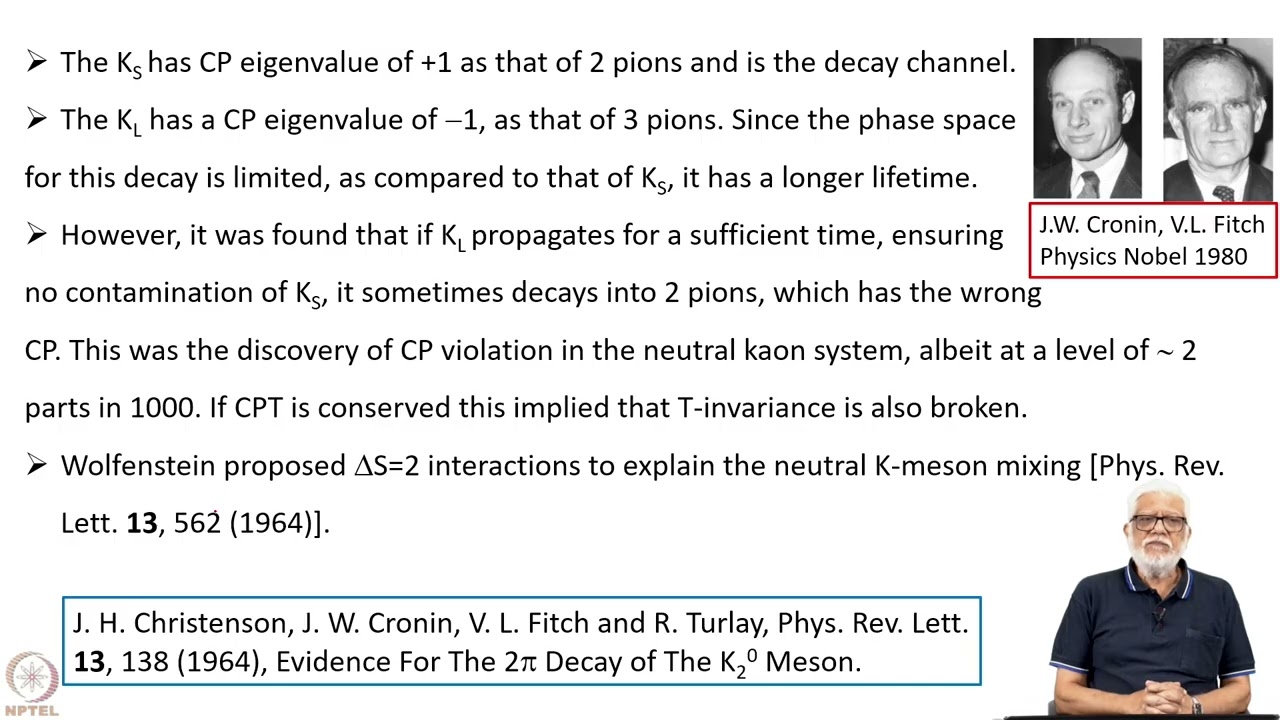
This lecture explores the phenomenon of CP violation within two fundamental neutral meson systems: the K0-K0bar system involving strange quarks and the B0-B0bar system involving bottom quarks. The discussion begins by defining CP as a combined symmetry operation representing charge conjugation and parity, noting that while parity was already known to be violated in weak interactions, the conservation of CP was initially assumed. In the neutral kaon system, this assumption was challenged when it was discovered that the long-lived KL meson occasionally decays into two pions, a channel forbidden if CP symmetry were preserved. This rare decay, occurring at a rate of about two parts in a thousand, provided the first experimental evidence for CP violation, earning Cronin and Fitch the Nobel Prize in 1980. The lecture further explains that since CPT symmetry is conserved in nature, this violation implies that time-reversal (T) invariance must also be broken.
The theoretical framework explaining these observations evolved significantly with the work of Makoto Kobayashi and Toshihide Maskawa. Before the discovery of the charm quark, a 2x2 mixing matrix was sufficient to describe weak decays, but it could not account for CP violation. Kobayashi and Maskawa proposed that a 3x3 mixing matrix, now known as the Cabibbo-Kobayashi-Maskawa (CKM) matrix, was necessary once three generations of quarks were established. This larger matrix introduced complex phases that allowed for CP violation to occur naturally within the Standard Model. Their groundbreaking paper, published in 1973, laid the foundation for understanding why matter and antimatter behave differently, a discovery that led to them sharing half of the 2008 Nobel Prize in Physics, though the lecture notes the historical omission of earlier contributors like Nicola Cabibbo.
Moving to the B meson system, the lecture highlights how modern asymmetric electron-positron colliders at facilities like SLAC (Babar detector) and KEK (Belle detector) enabled precise measurements of these processes. Unlike symmetric colliders that produce particles with zero net momentum, these machines operate with different beam energies to create a boost in the laboratory frame. This allows physicists to distinguish between B0 and B0bar mesons based on their decay vertices relative to the interaction point, effectively "tagging" the flavor of the produced meson. These experiments confirmed CP violation in the B system and observed direct CP violation in specific decay channels, such as those involving charmonium. The data from these high-precision studies demonstrated oscillatory behaviors in CP-odd observables over time, providing robust evidence for T violation and validating the predictions made by the CKM matrix across multiple quark generations.
Read the full video transcript
So in this lecture we'll look at uh uh
CP violation in two systems the K0 and
the K0 bar meison system and the B 0 and
the B 0 bar system. So uh just let me uh
for completeness say that CP uh is a
combined uh symmetry operation. C stands
for charge conjugation and P for parity
operation. U and the K0 and K0 bar meons
have the strange quark in them. Strange
and anti-range. Similarly the B 0 and
the B 0 bar have the bottom quark in
them. So they are heavier obviously. So
we'll discuss both these
in particular the kison the neutral kons
were involved in the so-called tao theta
puzzle. We have already seen that in in
an earlier lecture. Uh in fact that uh
was the uh signal for uh uh Lee and Yang
to uh propose that one should look at
parity violation in uh other systems
other nuclear systems. Uh
now these neutral chem also display as I
said CP violation and we'll come to that
in as we go along. Uh there have also
been precision measurements on the beam
masons uh using accelerators. Uh of
course even the neutral kones were
studied using accelerators but in the
case of the beamon uh specifically uh
collider in kk was built. uh there was
already a collider in uh in uh
slack and so both these were kind of uh
experiments were running in parallel
using two different detectors. Of course
the slack one was the Babar detector and
the KK detector was the ble detector. Um
and they looked very closely at uh CP
violating processes and all the BK
channels and so on.
So
the K0 K0 bar system uh let's first look
at the charged K meon. The charged
mezison K plus meison has a strange
quark content of uh US I think there's a
there's probably a
let me see this should be a US bar
so that it has a charge of one and it's
antiparticle
somehow the dashes haven't come I don't
know why so the K minus minus is a U bar
S. Okay, so this is minus1 charge. The
neutral K0 and K0 bar
have quarks which are um
the D
SAR and the D bar S respectively.
The mass is uh uh about 498 MV. Isospin
is half and the spin parity is 0 minus.
The neutral kon is found to decay into
two and three pions and that violates
parity because if you have two pions
each of the pions is a pseudoscaler. So
if you have two of them and you have l
equal to zero then you just have uh
positive parity in the final state.
Whereas if you have three pions you have
negative parity in the final state. Now
the neutral kon is found to decay into
either of these channels. So which means
that uh the final state can be positive
parity negative parity. So the neutral
kon is actually the decay is violating
parity. [snorts]
Now while strangeness is conserved in
strong interactions it is not conserved
in weak interactions. In fact, when K0
propagates in space, it actually shows a
uh
two lifetimes.
The weaken states are different from the
strong states in that the K S K S S
standing for short. uh this is equal to
K 0 + K 0 bar by 2
whereas K L is K 0 minus K0 bar
by 2
and these are states of CP. So it was
believed that okay uh parity is violated
in K0D case but perhaps CP is a symmetry
which is preserved. So these KS and KL
are the igon states of CP with igon
values of plus 1 and minus1
respectively. So the KS has a CPG value
of + one and uh KL has a CPG value of
minus1.
Now this uh the shortlived
uh kon the ks has a lifetime of about 90
picosconds and the long lived one has a
lifetime of about 51 nconds. So were you
to produce both of these uh let's say
you produce k 0 k 0 bar and you look at
only k 0 then the uh shortlived one
would decay f fast and if you look at
long distances which means you look at
long times uh as the kon propagates in
space then you have a pure k long uh
mison
Now as we already said the KS has a CPG
value of + one
uh is that of two pions and two pions is
the decated channel. The KL has a CP
value of minus1 and that of three pions.
Since the phase space for this decay is
limited as compared to that for KS
obviously it has a longer lifetime.
uh however it was found that if KL
propagates for a sufficiently long time
such that uh there is no contamination
of KS and the KS has decayed away it is
still found that it sometimes decays
into two piles which has the wrong CP
and uh at what level is this? This was
found to be at a level of about two
parts in a thousand and this was the
discovery of CP violation in the neutral
kon system. Okay. So this was discovered
by Cronin and Fitch for which they got
the physics Nobel Prize in 1980.
uh of course if you uh assume that CPT
is conserved and as yet we have no
experiment which shows that CPT is
violated then of course that implies
since CP is violated then it implies
that the T invariance is also broken. Uh
so both CP and T invariance are broken
uh symmetries in the K system.
Now Wolfenstein in 1964 proposed that uh
since you have mixing of K0 and K0 bar
uh he proposed that there are uh some
unknown delta S equal to 2 S standing
for strangeness which mix these neutral
kons
and uh this is a paper he wrote in ' 64.
uh uh also given here is the uh
discovery paper of CP violation in the
case system. Uh this paper is was
published in ' 64.
Uh
also same year as BFenstein proposed
this uh delta is equal to two
interactions.
Okay. Uh there is also CP violation in
other neutral masonic system with the
charmed quark for instance. uh and
indeed uh for quir for masonic systems
with the uh uh bquark
later direct CP violation and t
violation was discovered in the barber
experiment at slack and the LCB
experiment at CERN. Uh this is uh the
LCB is one of the smaller experiments at
sun. The big ones are uh of course the
CMS and Atlas and Alice. Uh however the
LSCB does a kind of precision job and
they found uh that CPN is violated in
some of these K neutral K and uh
Bisonic systems. Of course the bezison
system is very well studied uh at both
slack and uh kek. Uh the other
experiment that also looked at CPNT
violation was the CP leer experiment at
sun. This is a uh low energy anti-roton
ring. Uh and they looked for channels uh
where the observable was such that it
was CP odd and of course if you find a a
a
finite value for a CP odd observable
then it means that CP is violated just
as in the case of uh parity violation.
you try to look for a uh p odd
observable and if you find that it is
non zero then obviously parity is not a
good quantum number parity is violated
so these are some of the references this
is not a complete reference perhaps uh
later I will update these slides so as
to give you references for uh additional
references for these experiments but for
instance the barber collaboration uh
observed time reversal violation in the
B zero system and there was a paper in
2012 uh the LHCB collaboration has found
the first evidence for direct CP
violation in beauty to charmonium
decays. This was a paper published uh
fairly recently in 2025.
Okay. Now let's go to the B 0 B 0 bar
meison system. The B 0 mison has a
veence quark structure of DB bar. Uh and
of course B 0 bar is its antiparticle.
So it would have a veance structure of D
bar B. uh the isospin spin and parity
has not been measured uh in this B 0 B 0
bars Masonic system but the quark model
assigns it a isospin of half and a J pi
which means a spin and parity of 0 minus
so in that respect it is similar to the
K0 system also like the PI0 system pi0
is also a pseudoscalar object the mass
is much larger larger than that of the
K0 K0 bar mezison. It is about 5280 me
and it has a much shorter lifetime since
it mass is larger. There are more decay
channels and the face space for the
decay channels is much more. So the
lifetime of the B 0 meon is much shorter
uh is only 1.52 picosconds.
So as in the neutral kon system the
neutral b meons also oscillate just like
the k meison k0 meon oscillates
similarly the b neutral b meon also
oscillates and it shows cp violation.
Now Kabibbo
before the B meons and the B quark was
discovered Kabibbo in 1963 already
proposed a quark mixing to explain the
weak decays of the strange hedrons. So
as you remember uh the
we have the U and the D quarks.
Then you have the charmed and the
strange quarks. And before the discovery
or the proposal of the charmed quark, we
knew that there are certain uh hedrons
which have the strange quark in them.
And to understand or to explain their
decays, uh he proposed that there is a
mixing there's a quark uh mixing matrix
a 2x2 m uh mixing matrix with just one
parameter theta which mixes the uh UD
and S quarks.
Now, so Kobayashi and Muscava uh in uh
their 73 paper argued that because this
was post the discovery of the CP
violation, they argued that the 2x2
kabibu matrix mixing mat quark mixing
matrix is not enough if you want to
understand CP violation
uh in the quark sector. So they proposed
that you have a 3x3 matrix to understand
CP violation because then you have more
leeway. There are more angles. There are
uh three angles that you have and you
also have certain phases that come up
and uh that leeway allows you to
understand CP violation.
Uh, of course this was before uh the the
Kabibbo matrix mixing matrix was
proposed much before the discovery of
the charmed quark. Uh although it was
speculated that there is a fourth quark
uh it was speculated by Glau and his
collaborators in 1970.
Uh but uh the discovery of the of course
of the charm quark happened in 74. It's
known as the September 74 revolution.
uh where uh evidence was uh uh
gotten by two independent groups groups
at uh the uh you know proton induced uh
reactions at Brook Haven by uh by the
group led by Sam Ting and the E plus E
minus collider experiment at slack uh in
a team led by RTOR. So that was the
charmonium discovery. Uh and uh the
there was a prediction or it was
speculation by glacial that there has to
be a fourth quark but of course there's
no prediction of what its mass would be
and so on.
Okay. So in connection with the B 0B 0
bar and in general CP violation, this
was the paper of uh u Kobayashi and
Muscava published in 73 where they say
CP violation in the renormalizing theory
of ren normalizable theory of weak
interaction published in the Japanese
journal progress in theoretical physics
after the discovery of charm and the
third generation of charged leptons
namely the towel left on that was
discovered by Pearl uh somewhere in 75
1975.
Uh then the Kobayashi Mascawa paper
started started getting some attention.
Before that it was not getting uh I mean
attention it probably deserved. [snorts]
In 1977, Letterman, Leon Letterman uh
who if you remember discovered I mean
in a collaborative experiment of course
who discovered the uh new mu the muon
neutrino at Brook Haven in ' 62. Uh he
led a collaboration which found evidence
for a botonium uh resonance and that was
evidence for the bottom quark B.
Uh so the CP violation in the neutral
beamon system was as I said already
measured in two accelerator labs uh at
Slack using the Barber detector uh in
the US and at KK which is the
accelerator laboratory in Japan using
the Bell detector and they both used E
plus E minus collisions in a collider
mode and sitting on the B 0 uh resonance
uh not exactly the B 0 resonance. You
sit at a place where you produce uh B 0
and B 0 bar. Okay. [snorts] So um
uh so you produce actually this is this
is probably a a mis you you collider
mode uh
producing
B 0
bar uh resonances.
Okay.
Now there is another uh uh additional uh
trick that was used by both these
collaborations. Namely, uh since the you
want to tag these uh B 0 resonances, B 0
as well as the B 0 bar resonances uh and
they have a very short uh uh lifetime.
Then these colliders were operated not
in the symmetric mode which is uh which
was done for instance in LEP where you
had the same energy uh uh
uh where you had the same energy uh
electron and positron moving in opposite
direction colliding to produce the Z0
bzon.
Uh
so
what they did was at uh I mean roughly
similar kind of energies uh as symmetry
uh for instance at KK Japan they used a
8 GV E minus colliding with a 3.5G E+
at slack they used a 9 GV uh electron
colliding with a 3.1 GV+ plus such that
you could produce these B 0 and B 0 bars
and uh the idea was that you want to
have a vertex uh for decay of the beam
as on which is different from the vertex
of interaction. Okay. So that you can
separate out B 0 uh from other uh prompt
uh promptly produced particles in the
collision.
So a typical event at uh for instance uh
Babar or Bell is that you populate the
uh oopsilon 4s uh state and then that
decays to the B 0
uh and B 0 uh bar for instance uh and
then that further decay. The blue lines
indicate an invisible track because of
course both are being neutral particles.
They won't ionize uh anything in the
detector and they can only be seen
through their decays and for instance
they decay to a JSI which quickly decays
into a E plus E minus for example or it
decays into a K0 strange uh object which
then decays to a pi plus and pi minus.
So anyway the idea is that this uh v 0
uh which is produced
uh it then decays and there is a certain
decay length which you can use as a
handle to separate out the b 0 uh decay
events.
So uh for instance you see this uh one
of the I haven't defined this but there
is a uh CP uh you know observable CP odd
or even observable and as a function of
uh uh the uh decay uh time and uh you
see that this shows a oscilly behavior
which uh
using these 529 events as a function of
time and this is one depiction of that.
Uh, of course there are detailed papers.
I think I might have occasion to
actually discuss this in some subsequent
lecture where uh direct CP violation and
direct T violation uh will be discussed.
Anyway, this is just to give you a
flavor of the kind of measurements that
you do with this asymmetric uh uh
collider.
Okay. So all this data is kind of
summarized in this mixing matrix quark
mixing matrix. So the uh the igen states
of the full Hamiltonian uh are d prime,
s prime and b prime and they are
connected by a 3x3 matrix here uh which
has nine elements to it and that
connects this uh
the vectors with the full Hamiltonian
with uh another description where you
have the uh strong uh uh
you know vectors. Uh so uh this this is
similar to the neutrino mixing matrix as
we shall see later except that uh this
matrix the moduli of each of these
elements here is given in this uh uh
matrix
and uh you can see that the magnitude of
the diagonal elements. So the diagonal
elements are this this and this and they
differ uh they're very close to one but
they differ by less than 2 and a half%.
There's a small deviation but not very
large. Uh the offdagonal elements are
these uh this one this one this this and
similarly the these two. Okay, they are
small unlike in the case uh of the
neutrino mixing matrix as we shall see
later.
Now for this work uh Kobayashi and
Muskava uh got the shared the Nobel
Prize. So half the Nobel prize in 2008,
the Nobel Prize in physics went to
Kobayashi Muscawa
and uh Yoiro Nambu. Uh the citation for
Yoir Nambu was that he got the Nobel he
got half the share of the Nobel prize
for the discovery of the mechanism of
spontaneous broken symmetry in subatomic
physics.
and uh Kobayashi and Muskava uh got the
Nobel Prize. They shared half of their
Nobel Prize, so one quarter each for the
discovery of the origin of the broken
symmetry which predicts the existence of
at least three families of quarks in
nature.
uh of course there is a limit to the
number of Nobel prize winners and so
these already exhausted the total number
of Nobel laureates that Nobel uh that
the Nobel foundation could give but
surprisingly and Kabibbo was left out of
this share of the Nobel Prize. So some
people thought that Kabibbo should have
shared this Nobel prize with Kobayashi
and Muskava because uh he actually
introduced this uh park mixing matrix.
Of course it was a 2x two because this
was done very early when uh the uh even
CP violation was not yet discovered. Uh
perhaps Namboo could have got a separate
Nobel prize. Uh anyway that that uh
these these things happen and uh so
anyway Kobayashin Muskawa got the Nobel
Prize for uh this uh
CP violation basically CP violation uh
which needed a 3x3 matrix.
So in summary the K0 and the anti-K0
strange mezison show some interesting
properties such as mixing. uh they also
show CP violation. Uh similarly the
neutral uh beamons also show mixing and
CP violation. Uh and uh there are now
accelerators which are looking at this
very closely using asymmetric E plus E
minus colliders. In fact, uh the there
has been an upgrade of both the detector
and the accelerator to get luminosities
of the order of 10^ the 35 or 10 the 36
to enable even higher precision
measurements to be made at KK.
Uh so the direct measurements of CP and
T violations have been done. uh uh
direct uh measurements of CPA have been
done
in the K0 and the B 0 uh meison systems.
uh maybe in a future lecture I might
discuss these separately because uh
these are beautiful experiments and uh
I I I hope to do that in some later uh
lecture. Thank you.
[music]
>> [music]