Video summary
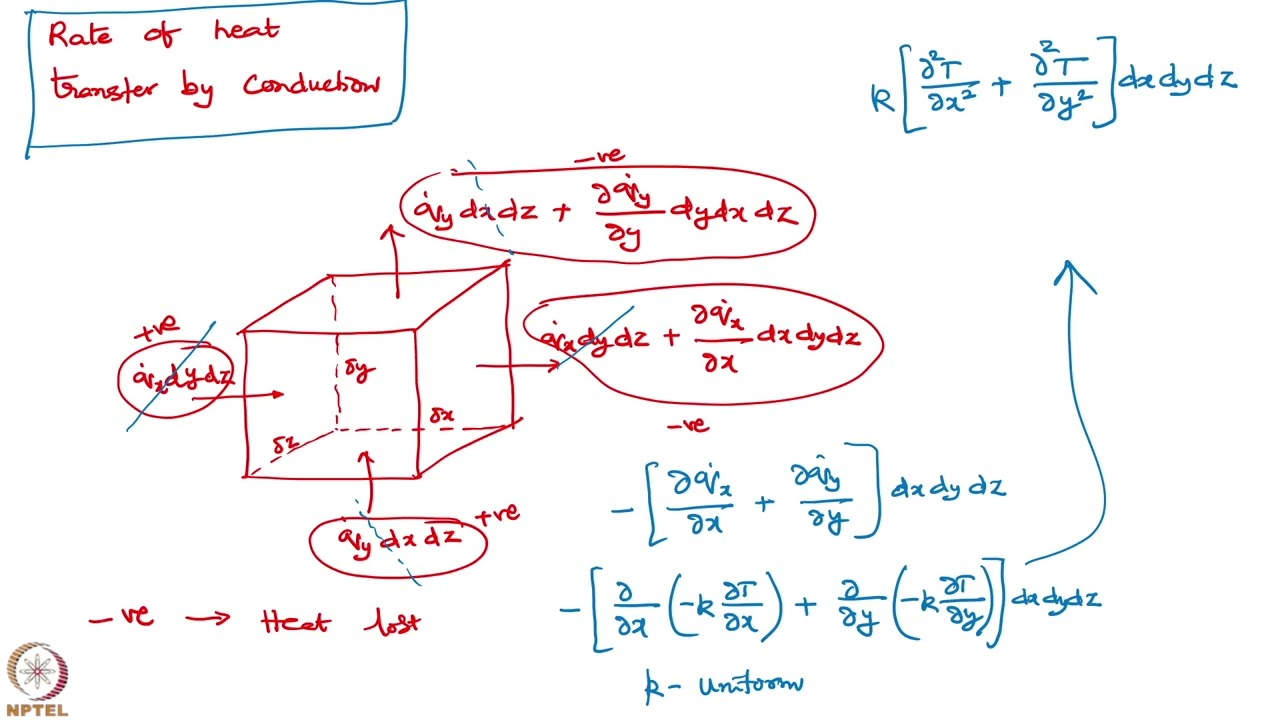
The lecture begins by analyzing the rate of work done by pressure forces, normal stresses, and shear stresses within a fluid control volume. The instructor explains that for pressure forces, the work done is positive when the pressure and velocity vectors align but negative when they oppose each other; however, these opposing effects on opposite faces of the element cancel out, leaving only the net divergence terms. Similarly, the work done by normal stresses involves outward forces where the contributions from adjacent faces also cancel, resulting in a net term representing the divergence of stress times velocity. The same cancellation principle applies to shear stresses, where the work done on opposing faces neutralizes each other, simplifying the expression to the sum of the divergences of shear stress components multiplied by their respective velocities.
After deriving the individual contributions from surface forces, the instructor combines these with conduction terms, body forces, and internal heat generation to form a comprehensive energy equation. This initial equation includes terms for kinetic energy changes, pressure work, viscous dissipation, and thermal conduction. To simplify this complex expression into a more usable form involving temperature, the lecture introduces a mathematical technique using the momentum equations. By multiplying the x and y momentum equations by their respective velocities (u and v) and adding them together, the instructor isolates terms that appear in both the energy equation and the combined momentum work equation. Subtracting this combined momentum work equation from the full energy equation allows for the cancellation of pressure gradient and normal stress terms, significantly reducing the complexity of the final expression.
The derivation further progresses by substituting the constitutive relations for Newtonian fluids, where stresses are expressed in terms of viscosity and velocity gradients. This substitution reveals a specific combination of squared velocity gradients known as the viscous dissipation function, denoted as phi, which represents the heat generated internally due to fluid friction. Additionally, the instructor introduces the enthalpy (h) by defining it as internal energy plus pressure divided by density. By taking the total derivative of this definition and applying the continuity equation, a relationship is established between the rate of change of enthalpy, internal energy, and pressure changes. This relationship is then substituted back into the simplified energy equation, causing further cancellations that eliminate the explicit pressure work terms.
The lecture concludes by setting the stage for the final step in deriving the standard energy equation, which relates the rate of change of enthalpy to heat conduction, viscous dissipation, and external heat sources. The instructor notes that substituting the definition of specific enthalpy (h = cp * T) into the current equation will yield the final form containing temperature gradients. This process not only simplifies the governing equation for fluid flow but also clarifies the physical significance of each term, distinguishing between heat transfer mechanisms and internal energy generation. The session ends with a promise to complete this derivation and explore similarity variables in the next class, emphasizing the systematic algebraic approach required to transform the fundamental conservation laws into practical engineering equations.
Read the full video transcript
[music]
[bell]
[music]
[bell]
[music]
>> Good morning. So, we were in the middle
of the deriving the rate of the work
done by pressure force. So, the question
is
whether this term is positive or
negative and what about this term. So,
to decide that we have to consider the
rate of work doing is force into
velocity. So, that is W equal to F D cos
theta. So, the pressure is acting
for example, for this, the pressure is
acting in this direction. The pressure
is acting in this direction. And the
velocity is acting in this direction.
So, work is F D cos theta. So, P into U
and theta both are in the same
direction, so theta is zero. So, cos
theta is cos zero is one. That means it
is positive plus one.
For example, here, the pressure is
acting in this direction, but the
velocity is acting. This is the pressure
which is acting. Pressure force is
acting in this direction. And the
velocity is acting in this direction.
So, the angle between the two theta is
180.
So, F D cos theta cos 180 is negative
minus one.
So, this term is positive because
pressure and velocity are in the same
direction. This term is positive because
pressure and velocity are in the same
direction. But on the other hand, this
term is going to be negative
because pressure and velocity are in
opposite direction. This term is
negative because pressure and velocity
are in the opposite direction.
So, you are going to this term this term
will get cancelled out with this term.
This term will get cancelled out with
this term. So, we are left with del UP
by del X plus del VP by del Y into DX DY
DZ.
Okay? So, that's about the rate of work
done by the pressure force. Similarly,
so we need to consider the normal
stresses. So, what are the normal
stresses? These are the normal stresses.
So, here
the normal stresses we are going to
consider are sigma XX and sigma YY. So,
if we consider that sigma XX and sigma
YY, what will be the rate of the work
done by these normal stresses is what we
are going to be concerned about. Okay?
So, we shall write that
here. That is rate of work done rate of
work done
by normal stresses.
That is you have again a parallelepiped.
And as you recall, normal stresses we
consider it as outward.
Pressure always acts inwards. Normal
stresses are considered as outward. So,
you get
sigma XX
into
force. That is DY DZ. This is DX DY
DZ. This is the force into velocity U.
And this one is sigma XX DY DZ into
velocity U plus do of
sigma xx U into sigma xx
divided by do x into dx dy dz.
Similarly, sigma yy
dx dz. This is the force.
into
velocity V. Now, at a distance
dy above, you have sigma yy dx dz into V
plus do by do y of V into sigma yy into
dx y into dx dz.
Now, again, using the same fundamental
idea that sigma xx
is in this direction, but U is in this
direction, so theta is 180. So, this
becomes negative. So, here again, sigma
yy is in this direction,
V is in this direction, so this is theta
is 180. So, this becomes negative.
Okay?
So, you have
this term negative,
this term negative. Here, in this case,
sigma xx is in this direction, U is
acting in this direction, theta is zero,
so cos zero is positive.
Okay? So, this term would be positive.
And this term would be positive.
So, this gets canceled out with this
when you add and this term gets
cancelled out with this term. So, you
are left with do of U sigma XX by do X
plus do of V sigma YY by do Y into DX DY
DZ.
So, this is the rate of the work done by
the normal stresses. Now, we need to
take up the rate of work done by
shear stresses. Rate of work done
by
shear stress.
by shear stress. So, again we consider
parallel pipe wide.
But this time, we will be taking the
shear stresses. So, you have sigma
This is sigma YX
into
D DX DZ into velocity U.
Okay? And this term
Okay, these are shear stresses. So, one
is in the left hand side and the other
one is the right hand side. So, you have
sigma YX
into U into DX DZ plus
do of sigma YX U by do Y into DY
DX DZ.
Now, you have these two terms. One is in
the top and the other one is the bottom.
So, you have sigma XY
into DYDZ.
And it is acting velocity V.
And here sigma XY
into V dy dz plus do of sigma XY into V
divided by do X into dx dy dz.
Okay? So, now
this here sigma XY is in the downward
direction and the velocity is in the
upward direction. So, theta is 180. So,
cos 180 is negative.
Is [snorts] negative. So, that means
this term is going to be negative.
Okay? Similarly, this term also will
become negative because sigma XY and
sigma YX is in this direction, U is in
this direction. So, you have theta equal
to 180.
On the other hand, here sigma XY is in
this direction and V is also in this
direction. So, theta is zero. So, cos
zero is plus one. So, this will become
positive.
And this will become positive.
So, if you add this term and this term
gets canceled out, this term this term
gets canceled out. So, you are left with
do of sigma XYV by do X plus sigma do of
sigma YXU
by do Y into
dx dy dz.
So, this is the rate of the work done by
the shear stresses. Now, we are ready to
go to combine everything. So, if you
recall
if you recall, so what we had here is
that we did the rate of the work done
with the normal stresses. Now, we did
the rate of the work done with the shear
stresses. Now, we can combine all of
them by putting the rate of the e
increasing e in CV. And this term we
have gotten we have gotten conduction
term, and we have gotten the work done
by the surface forces.
And of course, for the body force, you
can just take it as ufx + vfy.
Okay? So, if we combine all of this and
write the equation
So, what is that I get?
That is rho
d by dt. This is the left-hand side, if
you recall. e plus u squared plus v
squared by 2. Where did I get this?
That is here. So, you have this one. rho
d by dt of e plus u squared plus v
squared by 2. This term I have written.
Now, conduction term is k d squared t by
dx squared by dy squared is equal to
k into d squared t by dx squared plus d
squared t by dy squared minus of d of up
by dx plus d of vp by dy
plus
d of
u sigma xx by dx plus
d of v sigma yy by dy. Just let me
remind you, this is what we just derived
a little while ago. This is because of
the pressure force term. This term I
wrote. And
this term I wrote. Now, this is because
of the normal stresses. This term is
because of the shear stresses. So, this
term if we write, that is plus
do of v sigma xy by do x plus do sig u
sigma yx by do y
plus ufx, that is the work done because
of the body force in the x direction.
This is the body force in the y
direction, v into fy plus q dot triple
prime.
So, if there is any
energy generation within my control
volume, some chemical reaction took
place. That heat has gotten added, some
exothermic reaction has taken place.
That has to be added, that can be added
here. Or anything has occurred by
radiation by through flame. There is a
flame inside and by radiation, the flame
is giving heat transfer into my control
volume. That can be put here. Or there
can be a heater within my control volume
and that heater is adding continuous
heat, VI heat, that can be added here.
So, this is the term, these are the
terms which we have gotten added. Okay?
So, this if we expand this, so we'll
write this as rho d by dt
of e plus u squared plus v squared by 2
is equal to k into do squared t by do x
squared plus do squared t by do y
squared
minus of if I expand this, minus p into
do u by do x plus do v by do y. That is
first you keep p as constant and
differentiate here. P is constant,
differentiate here. Now, you take minus
of U into do P by do X
plus V do P by do Y. So, four terms you
should get when you differentiate this.
That's what we have gotten here.
Plus, similarly, plus U do sigma XX by
do X
plus
sigma XX do U by do X plus
sig V
do sigma YY by do Y plus sigma YY
into do V by do Y. That completes this.
Plus, now I'm expanding this term. Plus
sigma XY into do V by do X plus
V into sigma
do sigma XY by do X plus
U into sigma YX by do Y plus sigma YX
into do U by do Y.
Okay? These are the velocity terms which
you get by expanding that. So, then you
have UFX plus VFY
plus Q dot triple prime. This is a huge
equation. So, be it, we need to get this
C. There are various things here. Still,
this is energy term. Still, strain rate,
these are stresses. We have to put them
in terms of gradients. And this energy
term, and we have to find finally the
temperature has to look has to appear in
this energy equation. So, let us call
this as equation A. We need to do some
algebra to get this in terms of
temperature. So, to do that, so what do
we do is before that, we take up what is
called we had derived X momentum
equation. We need to do some algebra.
So, let's do it little patiently. So, X
momentum equation you have rho du by dt
is equal to minus do p by do x
plus
do sigma xx by do x plus do sigma yx by
do y plus fx.
So, if you multiply
if you multiply with velocity u
that is rho u du by dt multiply with
velocity u. So, you can this can be
written as rho into d by dt of u squared
by 2. If you differentiate this, you're
going to get back this. So, you get u
into minus u into do p by do x
plus u into do sigma xx by do x
plus u into do sigma yx by do y plus u
into f of x.
And if you do the same thing for the y
momentum equation, rho v dv by dt is
equal to rho d of v squared by 2 divided
by dt, you get minus v into do p by do y
plus v into do sigma xy by do x plus v
into do sigma yy by do y plus v into fy.
So, if you add these two terms, rho d of
u squared by 2 plus v squared by 2,
that's the left-hand side, divided by dt
is equal to
- u dp by dx
+ u d sigma xx by dx + u d sigma yx by
dy + ufx.
v dp by dy
+ v into
d sigma xy by dx + v into d sigma yy by
dy + vfy.
So, this, let me call this as equation
B.
So, if I do A - B
if I do A
B this is equation A we had gotten and
now this is the equation B we got. So,
if I deduct A - B, so this is your
equation A and this is your equation B.
Instead of rewriting in the write-up, I
can take this. You can see that many of
the terms get canceled out. For example,
u dp by dx, u dp by dx, v dp by dy, v dp
by dy, u d sigma xx by dx, u d sigma xx
by dx, u d sigma yx by dy, u sigma dyx
by dy. So, these get canceled out. An
interesting thing is that on the
left-hand side, you have e plus u
squared v squared by 2. And here you
have d u squared v squared by 2. u
squared by 2 plus v squared by 2. So,
this and this
get canceled out. So, you have I mean
vanish and you are left with rho d e by
d t. So, let us write down the left out
terms. That is rho d e by d t rho d e by
d t equal to
k into d squared t by d x squared plus d
squared t by d y squared
minus of p into d u by d x
plus d v by d y
plus
sigma x x d u by d x
plus sigma y y d v by d y plus sigma x y
d v by d x plus sigma y x d u by d y
plus q dot triple prime.
So, now is the time to substitute sigma
x x, sigma x y, and the e term. So,
sigma x x is we know in the momentum
equation we got we took it as 2 mu d u
by d x
plus minus of 2 by 3 mu of d u by d x
plus d v by d y.
And sigma xy equal to sigma yx equal to
mu into del u by del y plus del v by del
x.
And sigma yy is equal to 2 into mu into
del v by del y minus 2 by 3 mu into del
u by del x plus del v by del y.
del v by del y. So, if you substitute
this, so if I substitute this, that is
this term
if I substitute into this term, so I get
what is called phi.
That phi will be equal to
2 mu del u by del x whole squared
because this del u by del x is there and
this del u by del x is there. So, you
get del u by del x whole squared 2 mu
del u by del x whole squared
plus
2 mu
del v by del y whole squared
minus of
2 by 3 mu into del u by del x plus del v
by del y whole squared.
minus plus
mu into
del u by del y plus del v by del x whole
squared. This is small algebra to get
this which I have not
done. Please, I would request that this
just substitute this sigma xx here,
sigma YY here,
and sigma XY sigma YX here. You are
going to get this. So, what you get I am
calling that as phi, which we are going
to call that as viscous dissipation
term. So, you get rho d e by d t rho d e
by d t equal to k into del squared t by
del x squared plus del squared t by del
y squared
minus p of del u by del x
plus del v by del y
plus
phi
plus q dot triple prime.
Okay, still we have not arrived. Now,
let us try to get this. This is my
equation. So, let me uh
h equal to e plus p by rho.
So, if we took take total derivative of
this
d h by d t
is equal to d e by d t
plus
1 by rho rho you keep constant and
differentiate with respect to p
uh
differentiate p with respect to t and
then you have rho you differentiate rho
that is
p
1 by rho if you differentiate minus 1 by
rho squared d rho by d t.
But, by continuity equation you remember
that d rho by d t plus
rho del dot v is equal to zero. This is
continuity equation.
So, I can write d rho by dt equal to
minus rho into del u by del x plus del v
by del y.
So, if I substitute that, dh by dt equal
to de by dt
plus 1 by rho d rho by dp by dt
minus p by rho square into minus rho
into
do u by do x. For d rho by do t, I'm
substituting from here. Do v by do y.
So, you get this as de by dt
plus 1 by rho
plus 1 by rho dp by dt
plus p by rho
p by rho into del u by del x plus
del v by del y.
That is dh by dt. But, I don't want dh
by dt. I want equation for de by dt in
my energy equation. So, de by dt equal
to dh by dt
minus of 1 by rho dp by dt minus p by
rho into del u by del x plus del v by
del y.
Okay? This has to be substituted
in my energy equation, which was
which was rho do This is the equation
which I have to substitute. If I
substitute here, then my equation is, if
I just recall, my equation is rho
rho d e by d t equal to k into del
squared t by del x squared plus del
squared t by del y squared minus of
p del u by del x plus
del v by del y plus phi plus q dot
triple prime. So, substitute for d e by
d t from this equation. So, if I
substitute into this equation, so I get
rho into
d h by d t
minus one by rho d p by d t
minus
d p by d t minus p by rho del u by del x
plus del v by del y
is equal to k into del squared t by del
x squared plus del squared t by del y
squared
minus of p into do u by do x plus do v
by do y
plus
phi plus q dot triple prime. So, what
happens here is that So, what happens
here is that this term
rho into p by rho do u by do x and this
term gets cancelled out. So, I am left
with rho d h by d t
is equal to k into do squared t by do x
squared plus do squared t by do y
squared
plus
this term
that is dp by dt
plus phi plus q.
triple prime. We are almost there. We
have to just substitute that h equal to
h equal to cp into t.
So
that we shall do in the next class. That
is we shall substitute h is equal to cp
into t into this equation and we will
get the energy equation. So we shall
derive the energy equation and get the
physical significance of each of the
terms and get to what is called as
similarity variables. Thank you.
>> [music]
[bell]
[music]