Video summary
The webinar titled "Too Hot to Work, Too Poor to Rest" presents critical findings from a research report by the International Institute for Environment and Development (IIED) regarding the severe impact of extreme heat on informal workers in India and Bangladesh. The study surveyed over 700 households, revealing that climate-induced crop failures have forced many migrant families into urban settlements where they face life-threatening conditions. Extreme temperatures cause widespread physiological damage, with nearly 90% of workers suffering from heat cramps and over 50% experiencing heat exhaustion or stroke. These health crises are exacerbated by poor housing, such as tin roofs and overcrowding, alongside food insecurity and a lack of water access. The economic toll is staggering, resulting in an estimated $22.73 billion in lost wages globally and nearly 2% GDP loss for India alone due to missed work days and reduced efficiency, while also causing significant chronic kidney disease cases among the workforce.
To address these challenges, the presentation advocates for a holistic approach that combines immediate financial relief with long-term structural changes. Experts propose leveraging existing infrastructure like Aadhaar-linked bank accounts to implement heat-triggered cash transfers and parametric insurance programs that provide payouts based on temperature thresholds rather than individual claims. A hybrid model has proven effective, offering social protection cash transfers at moderate heat levels (38°C) and insurance payouts during extreme events (41°C) to prevent debt and medical crises. However, insurance alone is insufficient; it must be bundled with risk reduction measures such as early warning systems, passive cooling technologies like white roofs, and revised labor laws that establish work stoppage thresholds regardless of workplace size. Furthermore, the study highlights that current social protection frameworks often exclude migrant workers due to a lack of identification documents, necessitating policy reforms to ensure these vulnerable groups are included.
The discussion extends beyond immediate worker safety to address the broader societal impacts on children and communities, emphasizing that heat exposure disrupts sleep, learning, and nutrition for the next generation. Children face disproportionate risks due to their physiological immaturity, with extreme heat leading to school disruptions, food insecurity, and cascading effects like delayed healthcare and increased child marriage. The research also identifies key risk factors such as high-intensity physical labor, residence in hotter climates, and advanced age, noting that there is no distinction between outdoor and indoor workers regarding susceptibility when physical exertion is involved. Ultimately, the webinar concludes that solving this crisis requires a collective effort involving governments, unions, civil society, and supply chains to scale proven concepts into resilient infrastructure, ensuring that solutions address the full 24-hour cycle of heat exposure and protect both current workers and future generations from intergenerational cognitive damage.
Read the full video transcript
Good, good afternoon, good evening and
welcome everybody. Uh on behalf of the
international institute for environment
and development and all our partners,
thank you for joining us today.
>> So a warm welcome to all of you and I'm
Rubaraj. I'm the director climate
resilience finance and loss and damage
at IAD and I also lead a work program
called all act. So alliance for locally
led action and loss and damage. It has
uh representation from more than 50
governments and uh 70 plus grassroots
organization where all the organizations
or different types of stakeholders they
have an equal platform. Um so this is a
research that we have done too hot to
work too poor to stop. Uh this is
something that we have done in
partnership with our grassroots
organizations uh and and several of our
um so I I see Tom Mitchell has just
joined. So Tom, we just started off, but
maybe I'll hand it over to you uh to
give some brief introductory remarks.
>> Yeah, welcome everybody. Um delighted to
see you on this call and thanks for
making the time. Um I just wanted to um
thank Ritu and the team for the kind of
the work that they've been doing to kind
of prepare this report and also for the
the coverage it's received. I think you
will um appreciate uh that there's some
very kind of serious and sobering
findings that we're going to be sharing
today um that have also I think started
to raise some big questions about how
kind of whole economies are being
impacted by extreme heat but also how
that boils down to individual
experiences um and some really
challenging individual experiences that
can often have multi-layered and and and
you know quite um difficult and
intersecting impacts within families,
within individual people's health,
within the uh you know, areas of um
physiological impact that you don't
necessarily immediately pick up when you
think about um extreme heat. Um and also
the really tough choices that people
having to make dayto-day about, you
know, where their workplace is, is it
open, have you got access to water, are
you got access to sanitary facilities,
what are the um adaptations that are
possible? and equally what are the um
the rules around uh dealing with extreme
heat in the workplace. Now of course
this is research that's focused on India
but I'm sure that in many places um and
and people on this call are of course
you know working on these topics in very
many different places around the world
these will be um topics that are all too
familiar to you. So um I'm very much
hoping that during the conversation
today we can hear from a range of
experts and people giving kind of
commentary and insights where we can um
gather some of the experiences of what
are the practical approaches that we can
take to support and deal with um some of
the very localized and individual
experiences of extreme heat. but also
how can we raise this up to be um policy
topics that can gain very significant
attention and action now um where um
where pooling that experience is so
vital. So just wanting to um confirm
that ID is an organization you know we
are a a research body but we want to
make sure that our research turns into
practical policydriven solutions but
also makes a difference to people um at
the front line of these challenges. We
do work on extreme heat and particularly
in the context of cities um all around
the world. Um but it's something that
we're going to continue be continue to
be committed to do particularly looking
at the intersection with with health and
with work and so on. So um this is a
body of work that we're very much
committed to and look forward to working
with many of you on the call as we as we
take this agenda forward given certainly
given its seriousness and and presence
in it in everyday lives. Thank you.
Thank you Tom for that introduc those
those introductory remarks and I'm not
going to take too much time and I'm
going to straight away dive into the
findings uh that on the basis of which
we are going to have some some some good
uh discussions today. Uh we are also
very thankful to all our uh panelists
who have joined today. So you know I
I'll
and we are very very thankful to them
because this is an issue and as Tom was
mentioning it's it's about psychological
impact it's about the health impact that
they that these workers are facing. So
it was not very easy for these workers
to come and share their experiences and
we are very thankful to our partners
like change alliance OKOP uh and and
couple of other organizations that you
see there. They're absolute grassroots
organizations working with the workers
and that enabled them to open up and
share their experiences with us. uh we
are also very thankful to five of the
doctors who worked very closely with us
not only in the design of these uh this
research but also in the way in which uh
the the data was analyzed and how we
came out with some of the findings uh
that we did. Uh so I'm going to straight
away dive into uh what this research is.
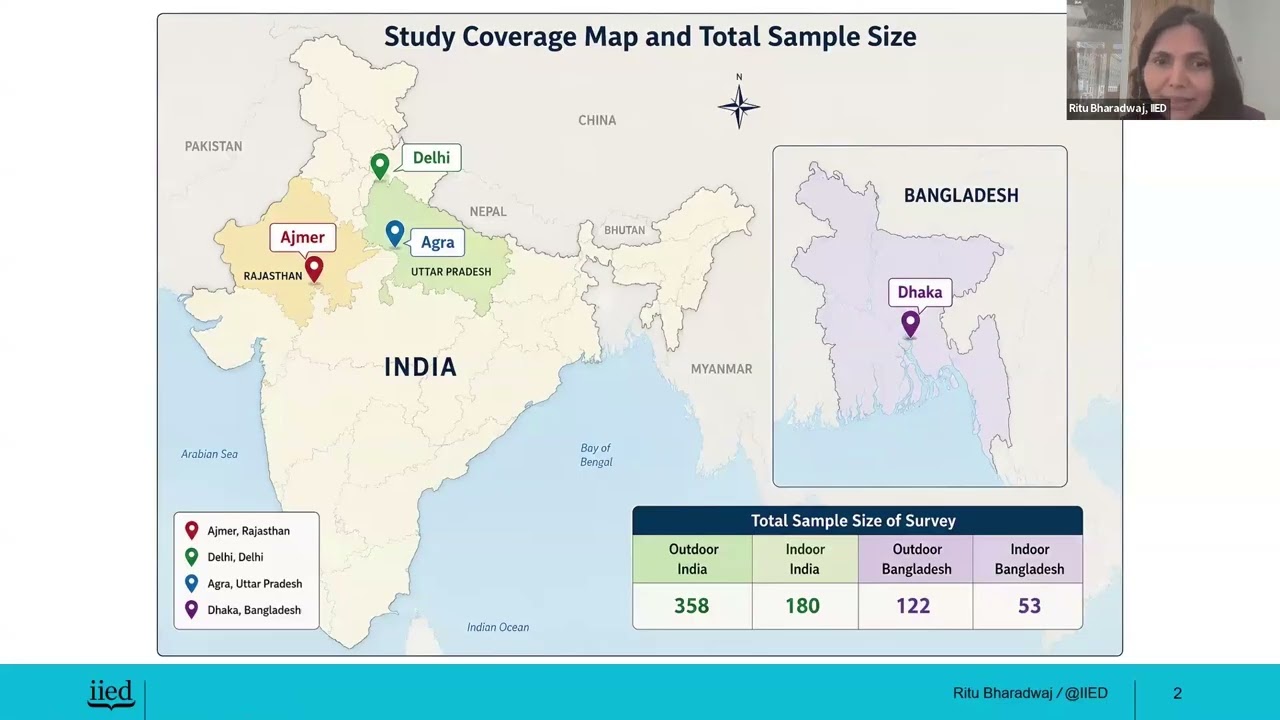
We covered this research in four cities,
three in India and one in in Bangladesh.
Uh today we are launch only launching
the paper related to India. Yeah, the
Bangladesh paper would be launched later
in this month. uh we surveyed close to
700 plus uh households and some of the
areas that we tried to cover through
this we we really we didn't want to
repeat what many of the other
organizations have already done because
you know these days research funding is
very limited and we don't want to
overress research the same thing which
has been we which we already know and
therefore we wanted to focus this
research more into trying to understand
uh some of the underresarched area. Now,
we typically when we talk about talk
about extreme heat, we only think about
outdoor workers. We don't care. We don't
really think that the indoor workers
might probably be exposed as much as the
outdoor workers. Um, and um I see I
think is
somehow my Can you still see my screen
there?
Yep. Okay. And the second thing we
wanted to highlight was to understand
the extent to which it's not just the
the health impact on on the bodies but
also the non-economic loss and damage
that these workers are facing. And the
third was around how much is like we
also typically think that the workers
are only exposed to heat at their work
site when they come back into their into
their living spaces. Probably the impact
of heat is not that experienced. We also
wanted to understand that plus combined
with all of this research we wanted to
come out with very practical solutions
something that Tom mentioned that you
know we are a research organization but
at the same time we don't just want our
research to sit in some paper or some
journal somewhere but we really want to
some of these research outputs to be
actioned upon and that's something that
we'll be discussing later on uh with
some of our esteemed panelists. Now this
is the way in which we have designed our
research. We are not just looking at the
precipitating factor. We not just
looking at the heat impact but we are
also very much looking into the
predisposing factor. what are the
conditions around the heat that really
makes the workers more vulnerable uh to
being exposed and then
broad broadly we covered the housing
condition, the social drivers, the
occupational drivers, the economic
demographic drivers but also to what
extent are workers themselves trying to
cope with this heat and to what extent
there's a lack of social protection
around them uh which really makes them
more and more vulnerable to the range of
uh impacts that they typically ally
phase. Now let's just first very quickly
go through the precipitating factor. Now
this is the average mean average annual
mean temperature and you can see we
started analyzing the data right from
191. So more than 125 years 125 years of
data and you can see the average annual
mean temperatures increased by more than
1°. But more more important to see is
this temperature anom anomaly. Now
temperature anomaly as you will see has
increased more in the last two decades.
And similarly the maximum temperature
has increased. Why maximum temperature
analysis was important? Because for you
know for us to understand the extent to
which a worker through the day
experiences the height of temperature in
the in their uh in in through the
throughout that day and also again here
you will see the maximum temperature
normally. You know we typically think
about 2024 uh is the year that we
remember as being the hottest in India
but I think if you look at this data
2016 was another year which was
extremely high peak. Now for the
predisposing factors we we try to
analyze who are these informal workers
who typically work in cities and in what
it worked out was you know this was a
random sampling. So what it worked out
was outdoor workers close to 90% were uh
migrant workers and indoor close to 77%
and and many of them they migrated with
their families. So you'll see a lot of
children u migrating with them as well.
But most interesting thing is to see
here is that majority of these migrants
started migration only in the last 5
years. And you know things something
that I've not presented in the slide
here is if you go and ask them the
reason as to why they migrated behind
that is a failed crop uh because of so
to a large extent it is the climate risk
that has pushed them from many of these
rural areas into these urban informal
settlements and because they are migrant
workers it is it becomes even more
important to understand their
predisposing factor because many of them
they stay in informal settlement they
don't have a permanent households and
that is why we we looked into this
housing heat exposure index and this is
made up of a number of factors for
example roof roof roof type roof height
per capita housing area and so on and
I'm not going to take you through too
much in in detail with this but
basically what you will see is in many
context the roof type is mostly tin
topppoline which barely protects them
any provides them any protection then
again the heat the roof height is very
low because heat typically rises on the
top and if it has no space to escape or
no it basically stays within the living
space of the people. Again uh we looked
at the wall type per capita housing area
again in one single room there are like
five or 10 people staying together. uh
availability of fans. You'll see close
to onethird don't have a fan and even
those who have fan there's just one fan.
There's no refrigerator. But what it
does is you will see that the food
security issue really increases around
the summer months. Why? Because a lot of
food gets spoiled but more than that
it's also because of lack of wages. Uh
the um people don't find work a lot uh
during the heat uh summer peak summer
months. And that is why you will see the
food insecurity issues goes up. Again,
water availability typically in summer
is an issue and also toilet facilities
at home. In terms of protective factor
which could have brought down some of
the impact that the the workers are
suffering, you will see on a scale of 1
to 10 typically the social protection
index is less than three or three or
around three. And this is this is when
if you look at the food aid program in
India, it's probably the best in the
world. Like when I say best the amount
of money that the government provide
spends on this plus India is probably
the only country where you have the one
nation one ration card uh program where
workers can avail their ration or or
ration from anywhere it does not ma
matter whether they're migrants or
non-migrants but still you will see a
lot of a third or in some cases around
40% of the households don't even have um
uh coverage or they don't have access to
those cards even those who have cards
are not able to avail it. Similarly is
in the case of health facility. India
again I would say is I do a lot of work
on social protection programs and I've
reviewed a lot of programs globally as
well. India's health program especially
the Aayushman and Bharat cashless
program allows people to go and seek
benefit or seek uh treatment cashless
treatment even from private hospitals.
But you will see a lot of people are not
aware of them. they don't have those
cards and even if if they have those
cards they're not able to go and avail
those facilities. Similarly, there's a
labor welfare scheme enrollment is
enrollment. You will see a lot of the uh
workers do not either are not aware of
them or they don't have access to them.
Now this is again the workplace heat
exposure index. Uh so to what extent
workplace facilities help workers cope
with the uh with the heat conditions on
a scale of 0 to 10 it is less than
three. Um it the indoor workers are
slightly better off than outdoor workers
but they're actually not that great. And
some of the ways in which we have tried
to understand this is the daily working
hours. You will see both for outdoor and
indoor workers. For indoor workers is
slightly longer. The work day is more
than 9 hours and again availability of
shaded workspace, cool water,
electrolyte is almost negligible.
There's no medical pro uh provision but
also there are ways in which the
exposure to extreme heat can be
regulated. For example, ban on midday
work, job rotation, work schedule
changes but none of that is happening
right now. Again, quality of toilet
facility at work becomes important
because a lot of workers which who we
interviewed said they didn't they didn't
drink water because there was no toilet
facility especially for women and that
you can understand has a even more
damaging impact. Now workers try out
different hacks or try out different
ways in which they can deal with the
with the impact of heat and but again
you will see on a scale of 0 to 10 it
stays less than halfway mark. There are
different ways in which they try to
adjust like rest in shade, cover the
head with cloth, avoid uh carry water to
work places and so on. But all of that
I'm I'm not spending too much time
because it's quite given a lot. Anyone
who stays in India or Bangladesh or any
of has seen many of these areas, they
would know that this is kind of a given.
Uh but what we don't really know is the
health impact. And to understand the
health impact we looked into three
category of impacts. One was heat. So
there and this is not us like we are not
the experts in the health area. So that
panel of doctors who really helped us
analyze this data they explained to us
that there are three types of health
impact that can come in. Now for it
starts with a lower like heat cramp is
the most common but if it becomes more
pronounced like then it can lead to heat
exhaustion and from there it can lead to
heat stroke and heat stroke probably is
the worst kind of impact that they can
suffer and that leads to acute kidney
injury in case of many workers and
repeated exposure to dehydration can
then lead to chronic kidney disease. Now
we try to understand the level to which
the workers are exposed to this heat
cramp, heat exhaustion, heat stroke and
how many of them are suffering from AKI
and uh chronic kidney disease. Now heat
cramp again you know these are some of
the symptoms of them. Uh these are the
share of workers you will see that you
know less than 14 15% are actually
seeking um medical care for for these
symptoms and this is the heat heat
stress prevalence index. So on a scale
to 0 to 10 8.99 like close to 90% of the
workers indoor and outdoor are suffering
from uh from
uh heat cramps. Now the second stage of
this impact could be is heat exhaustion.
Now these are the symptoms of heat
exhaustion and we then looked into how
much of the workers are actually
suffering from heat exhaustion in summer
and then the non-summer months. Now and
this is the scale at which or or you
know estimate of the workers who are
actually um seeking any kind of medical
attention for the impact that they are
suffering. You will see close to a a
third of the workers even if they are
suffering they are not seeking any
medical help for that.
Now the worst form of heat uh related
damage is heat stroke and this is the
scale at which it is happening which is
54% of outdoor and 51% of indoor workers
are suffering from heat stroke related
uh symptoms and of that
those who are actually seeking help in
terms of outdoor is close to 20%, again
in case of indoors it it is close to
19%.
Now heat score prevalence index this is
something that we de developed just to
understand the scale of damage. So you
can see in the summer month out of on a
scale of 10 it is around five again in
case of outdoor risk 5.42 in the rest of
the year it goes down which is quite
understandable but that's the scale at
which workers are suffering from heat
cramps, heat exhaustion and heat stroke.
heat stroke is almost a medical
emergency and that is what we were told.
Uh now we also tried to understand what
are the factors that really contribute
to that. So is it just the heat exposure
or is it a range of other factors and
for that we developed a regression model
and I have my colleague joining later in
the panel discussion who will explain
what this regression model output really
means.
We also try to understand that beyond
the physical health damage uh what are
the psychological impact that the
workers are suffering. Now some of the
ways in which we tried to develop this
psychological stress uh uh index was to
understand the increase and this is how
the workers themselves explained
irritability an being angry mentally
tired feeling sad hopeless having not
being able to sleep properly and these
are some of the factors that really
stood out very strongly and we also
compared it with non-summer months and
that is it was very clear that it bent
down in non-summer months compared to
the summer or or during the period of
extreme heat.
We we have we did all of this analysis
on a toolkit called seik. So
comprehensive.
>> Sorry. Me too. Apologies. Um people are
asking you to slow down in the chat.
>> Okay. Okay. So we used uh thanks
Marcela. So we use something called CIC.
So CEC is a comprehensive climate impact
quantification toolkit where we try to
understand the tangible intangible
intrinsic and functional damage that uh
that climate impacts create and we use
the same framework to identify the heat
impact on on the workers. Of course you
know you will see a lot of this uh
explained in greater detail in the paper
that my colleague must have shared in
the chat. uh but uh we'll have like we
can we'll have more discussion around
this in the panel. So I'm sorry for
being a bit fast because we have one of
the panelists who has to leave early. So
I'm I'm making sure that we get a chance
to hear from him as well. But this is
where I would really want you to to
focus. So what are the longerterm wage
and heat related kidney disease uh that
workers are suffering from? And here I'
I've presented both India and Bangladesh
data. So this is you know if you
remember I had mentioned about heat heat
cramps, heat exhaustion and heat stroke.
And in India the workers who are
suffering from AKI turns out to be
around 18.67%
of the total workers which is quite high
if you ask me. Bangladesh is around 23%.
Now in terms of in terms of the
estimated percentage of the workers who
who I would say graduate or who go from
AKI acute kidney injury to uh chronic
kidney disease in India it is around
4.82. Now you might feel that 4.82 is a
very small percentage but this is a
medical emergency. This is where their
kidney gets damaged and they might need
diialysis. Now you can understand a a
worker going to that stage means that
they will not be able to earn a a decent
or or a regular living anymore. Now
number of workers that it translates
into and this is something that we
projected uh based on our data is around
26.35 million workers might be suffering
from CKD purely because of heat related
uh exposure. Now the wages lost because
of exposure to CKD in terms of million
is around 4 45 4507 million in India and
of course 607 in Bangladesh and in terms
of uh the wage earning lost in billions
in purely in amount in India is close to
22.73 billion that is a huge amount
we then translated that amount into what
does it really mean in terms of GDP loss
so in India here that GDP loss purely
from CKD chronic kidney disease comes to
around 58% of GDP. India's a big
economy. You can imagine how much that
really means. Now beyond the heat,
beyond the health related damage, we
also try to work out the work days and
wages lost during extreme heat events.
So we try to calculate it on the basis
of three parameters. One is work days
missed because of heat related
illnesses. work days lost because of
inefficient working because they can't
work with the same uh efficiency. Uh and
the third is around a lot of workers
complain that because of extreme heat
and they are daily wage earners a lot of
construction sites are closed because of
regulations and therefore they can't
even find work. So combining all three
the the average amount of uh work days
which are lost but due to extreme heat
for outdoor workers it comes to around
24.3 days and for indoor workers around
14.8 days and in terms of uh the wages
lost per year is around $151 uh uh and
for indoor around $89. Now those of us
who stay in Europe or UK this amount
might seem very small but for a daily
wage earner this is a huge amount of
money and this is the level as it is
many of these workers are living below
the living wage uh but this heat related
uh damages
leads to even more decrease in that
living wage that they suffer. Now if you
like earlier I showed to you that close
to.58% of GDP is lost because of health
related issues but if you combine all of
this India's loss of GDP purely because
of extreme heat is around 1.99%
which is close to 2%. In case of
Bangladesh although the report would be
published later on uh in this month it
comes to around 1.38%.
Now we just didn't want to highlight the
issue. We also wanted to share the
solutions with you and the solutions are
actually within reach of India and that
is because India already has some
extremely good um as I say the systems
already in place. India has Aadhaar card
there's an eshum registration almost
most of the households have a bank
account which is linked to Aadhaar card.
So we already have that systems in
place. What we are saying is that if you
look at the and and majority of these
losses are concentrated in 13 states in
India uh and which you know if you only
look at the amount of workers which are
exposed to extreme heat it is around 350
million and if you
like currently in those 13 states 350
million workers are losing close to
36.36
billion uh dollar per
But if we were to provide them
coverage through a cash transfer program
uh and for this we have worked out three
models. We have taken the average wage
based on the MGNR regsbased
social protection program. So if you
look if and there the average the floor
ba wage floor is around $3.15.
So if you take that into account and in
a normal year based on the IMD
projection the heat days extreme heat
days comes to around 4 to 7 days. So we
have taken 6 days there for a normal
year. In in a in a very hot year it can
go up to 11 to 12 days. So we have the
second model is around 12 days and in a
record year it could go up to 18 days.
So what we are saying is that in a
normal and hot year that 6 to 12 6 or 12
days of wage should be paid to the
workers so that they can stop working in
those extreme heat days and stop causing
themselves permanent loss and damage
that they suffer on their body and their
mental health. But in case of record
year when it goes up to like 17 18 days
of extreme heat then that extra days can
come from insurance and this is based on
some of the experiences that we have
learned from uh India's sava model and
we have cla coming in later in the panel
discussion and she can explain more
about it. What we are saying is that do
not use insurance as the only way in
which workers can be compensated because
if you only look at the insurance payout
then it hardly covers $7 to $8 which is
like a very small percentage of what
workers actually lose. But if you
combine it with cash transfer then you
can provide a much better coverage so
that workers can actually stop working.
And what we are saying is that you know
there should be on a living wage
modeling approach. There should be a
heat triggered cash transfer. Uh workers
should be provided support to get better
access to Aayush manat uh PDI scheme. So
that the total you know if all of these
measures are combined then in a hot year
then the total expenditure that comes to
is around 1.45 45 on cash transfer alone
1.33 billion but that is nothing
compared to what workers actually lose
and you know we have our own analysis
which also shows that for every $1 that
is spent in early action you can
actually reap a benefit of about $5. So
why not do that and rather than letting
these workers face that loss and damage
on their body, we India also very
recently they came up with um uh a
revision in their uh labor laws where 13
different um obsolete laws were combined
together into one law. But what we
really urged the government is to also
introduce a heat related thresholds in
the code so that workers can be allowed
to stop work when it goes beyond a
certain threshold. Uh then also like
right now those regulations are only
applicable to um to workplaces above a
certain threshold of workers crowd but
heat impacts each and every worker and
there so it should not be based on the
worker count rather based on hazard
based approach. So the moment heat goes
above a certain threshold you know they
this regulation should come into action
and then again we are urging that heat
stroke and other heat related illnesses
should be considered as an occupational
disease because right now the state
insurance program does not recognize uh
heat stroke or heat related illnesses as
an occupational disease. So I know I
went a little bit fast uh and apologies
for that if you have not been able to
follow all the findings but we my my
colleague has shared link to the paper
and we'll be hearing more from the
panelist as well so they'll um so you'll
get a chance to understand some of these
uh issues in greater detail but with
that I will really request if we still
have u Dr. Kit Dr. Krishna what's and we
are very uh thankful for him to be
joining us today. He's a member and the
head of department uh for the National
Disaster Management Authority in India
and if uh we still have him um uh we I
would really request him to come and
give his opening remarks.
I know he had to leave and that's why I
was going a little bit fast. Um
Chandra, can you just confirm if Dr.
Watsa is still there?
No, I I can't see him in the meeting
room yet.
>> Okay. Um I'm really sorry colleagues. I
tried my best. I you know he had sent me
a me message that he had to leave uh
earlier. Um so um we are very sorry to
have him go but maybe if he is able to
join in later on then we can have uh
some of his comments. But uh I'll start
off with the first panel and we are
really um thankful uh for uh for four of
esteemed panelists to be joining us
today and all of them are experts in
their own field. Uh we have Mandakini uh
Balohi who's the director insurance
ministry of finance in India. Uh we have
Medeline Thommpson uh who's the head of
climate impacts and adaptation at
welcome trust. Uh we have Bart uh
Vanderh who scientific director and the
co-chair of IPCC working group 2 and we
have Claire Harborn who is the chief
executive uh officer of the Hen
Foundation. Almost all of them have
extensive work in the heat space. Um and
uh I am I'm very pleased that we have
them with us. So probably I'll start off
with you Mlin if you're okay. uh is
because I know I've been very closely um
associated with the climate health
impact awards uh pro initiative that you
have and we know that and and in most of
my own work I keep saying that we do
need to put numbers on these impact
because without putting numbers it
really loses the attention of the policy
makers. So from your experience Merlin,
how do you really see that the
importance of some of these findings
coming on the table and how do you
really see these evidence influencing
real action in the policy space and and
and especially the kind of social
protection programs that we've been
demanding for for the workers who are
exposed to these extreme heat and
suffering with their bodies.
>> So uh thank you so much and it's just a
pleasure to be here. I think uh
uh what struck me most about the report
is really how you lay out the breadth
and depth if you like of the heat
experience for individuals. Um quite
often you see quite simple statistics uh
on heat stress or heat stroke or uh loss
of uh uh labor time etc. but quite a
comprehensive
um and broad look if you like about the
impact of heat on on people and their
lives. I do want to actually um say
something else uh which um uh struck me
in your opening slides. In your opening
slides, you presented uh the rising
temperatures in India and you also
showed how they vary from year to year
and you showed the big peak years uh and
you described 2016 and then 2024 as the
last big peaks. Those were both El Nino
associated years. The 2015 2016 El Nino,
the 2023 2024 El Nino. What happens
during an El Nino is you get a lot of
heat released into the atmosphere and we
have this global rise in temperature
which we are experiencing at the moment.
So one of the things that um uh we
didn't you didn't discuss in the report
in the options for uh support the safety
nets uh the use of insurance etc. We
also do have the potential certainly for
these really um bad years uh to get some
sense of early warning because uh El
Nino allows us a bit of prediction about
what's going to happen in the climate
system. Uh so um
uh the other thing I just I thought your
presentation was so helpful is the
numbers of people you know like when we
talk about things at a country level and
we talk about one country we say oh you
know this is what's happening in the
Gambia this is what's happening in uh
Nigeria this is what's happening in uh
Fiji you don't get a sense of the
difference in population and obviously
the Indian population is a huge
population a very significant part of
the world's population and so any
percentage uh experienced in India has
huge ramifications
uh for the numbers of peoples involved
so I think presenting it both at a
country level and a people a number of
people involved is really really
important uh another area I thought that
we could elaborate on a bit more and you
do mention it in one of your slides is
the experience that people can't sleep.
We know from a physiological perspective
that sleep is actually where people
recover from the stress and strains of
the day. And if people can't sleep, they
can't recover. And so even if you set up
protection systems in the workplace,
ensuring that they have a cooler
environment to work in, ensuring like
you said um uh water breaks, uh not
working in the in the full heat, etc.,
etc. you still need to think about
workers at night so that they can
actually rest at home and you need to
have innovations. There's the white
roofs um uh that that are being
developed to um cool people's living
accommodation down. We need to think
about about people not just the way that
heat impacts all of their lives, but how
it impacts it across the whole uh
24-hour cycle, not just when they're
actually in the fields or um uh in the
factories. So um
so I think if you if you think there are
three things that are needed um you're
asking about how the evidence should be
taken up and first of all is as I
mentioned you've broadened the evidence
base about what counts really giving
that comprehensive overview including
both mental and physical health I think
incredibly important as well as the
other characteristics. Um we also need
to uh make visible as we do through our
climate impact awards the harms uh that
are being experienced and making that
visible tangible to decision makers and
the numbers really count there but not
just the numbers I think it's also the
lived experience the voices of
communities getting uh and enabling
those voices to be heard I think is a
really important part of the process and
um so listening to communities uh
intently and understanding their
experiences is where the evidence uh
really needs uh to come from. It's not
just an external look see and say oh
this is what we think is happening to
you but really directing the research
from the perspective um of the uh of
those who are actually living through
the experience. And so to me the
challenge is not that there is
insufficient evidence that climate
change is harming health. The challenge
is really uh that our institutions, our
funding systems, our decision-making
processes really under estimate the full
scale of those harms and we need to
measure them differently, value them
differently and fund them differently in
order to respond to that. Uh so yeah, so
welcome. this is really core uh to what
we think about what we try and do and um
I'm very appreciative of the work that
you've done because it also helps us
understand uh the processes better.
>> Thank you so much Meline. you know what
you have highlighted is is is is I think
it's very important and that's the
reason why we also
wanted to show like policy makers in
India especially that a country which is
growing and growing at the back of many
of these serviceled organi serviceled
industry and if the workers within them
start falling sick you know it's their
economic growth which is going to get
impacted so it is important for them to
take that like you know for because the
entry point was to get the attention of
policy makers by showing the scale of
damage that this was doing to their GDP.
Even if whether they care about the
workers or not, at least they would care
about the GDP and therefore then invest
in in their in the in the care and that
is needed for them. Especially like they
what we have gone and talked to the
policy makers and what they always tell
us is giving them 6 days 12 days without
them working but what they don't
understand that by giving them 6 or 12
days of pay without work will have a far
greater impact on protecting their own
economy and protecting the the
productivity of these workers who really
contribute to making the economy. So
I'll probably come back to you Meline
again. Um but I'll now move on to Bart
whose work has really inspired me
influenced me. Uh he is the co-chair of
IPCC working group 2. But the way in
which he is reformed uh or allowed for
different diverse knowledge systems and
evidence to come through is very
important. But more so what I really
like about your approach is you keep
pushing all of us even in IPCC that it's
you know we have to do something not
just to look into the impact
highlighting the impact of climate
change but also the value of acting on
it. What are the responses emerging?
what are the best practices emerging?
How can others um uh you know how how
can government can really act on on
them? So I wanted to understand from you
as to you know and we tried our best to
put hard numbers on both the physical
and mental health impact. So how do you
really see some of these analysis being
useful and do you think that we should
be changing or or modifying the way in
which we present this evidence and
analysis to make it more actionable?
Yeah, thank you very much, Ritu. And I
must confess that um reading through the
Guardian uh coverage this morning on the
work you do and now seeing again the
presentation,
it really gets to me if uh it it it's
also it's not only a factual story, it's
also an emotional story because it I
indeed I scale up an immense number of
people. I I scale up the immense
difficulty to for them to cope and to
find alternatives.
uh and that well that is that is that is
yeah uh that is touching touching me as
as IPCC I I definitely indeed call for
uh you know the time of diagnosis uh I I
wouldn't say is over but whenever we do
an an additional diagnosis or an
assessment or the current risks and the
impacts or whatever the the your your
work to to zoom in on individuals
although it is a large group of of it is
numbers it is it's immense but that that
gives a much uh more clearer picture of
what actually how climate change
actually looks, feels, smells that kind
of things by by the diversification and
I guess that is also where we really
want to make an upgrade relative to
previous assessments that we don't want
only to to have these gross numbers and
numbers of people but also zoom in on
regions on professions on on on that
kind of thing. So this is definitely uh
adding to that with with with all that
substance and yeah I I I would indeed
call this you know enriching the
evidence base for IPCC. you rely on uh a
lot of evidence that you collect in the
field so to say. It's it's not only a
modeling study. It's not only you know a
download of of federal statistics. It's
really going on into the grounds. And I
I I think that's a very important
contribution to also yeah the science
itself but ICC can pick it up readily
indeed. What I also like a lot is the
uh the suggestion that you make and you
have some some some experience as IED
with that with you know what is what is
the coping uh schematic for a government
or for that blended finance insurance
versus the social protection system. I
think that is also uh very well in line
with with the ambition not to do the
diagnosis only but also to find where
the remedy is. What I find really
challenging on this and and intriguing I
must say because
I uh there is in this solution thinking
and and definitely if you think about uh
social protection changes or blending um
insurance with with with
federal governments. I know or at least
I from your report I acknowledge the
microeconomic benefits of it. Uh but I
do not readily take the conclusion that
that microeconomics is thus the
incentive to to to act because there is
so many other interests that that that
actually yeah know uh will there will be
different ways to spend that money.
There will be different accountability
records to actually make sure who is
eligible for it and there may be other
policies that like that need to for
instance uh intensify the the industry
of insurance for instance and and and so
that is always my uh I think the
struggle that we have also within IPCC
is that uh there is there is in in a lot
of particularly governmental but also I
guess more businesses or whatever in the
solution space a lot of normative uh
arguments need to be uh settled as well
and so it's not even enough to to give
the solution. It's it's also important
to to actually make a map of what that
actually solution what how that actually
competes or is enabled or is is blocked
by surrounding conditions that also need
to be in place and also there the the
evidence base is is the IPCC bread and
butter. I would say if you can really
show that this blended finance or this
blended uh support system where you
indeed zoom in on okay in the excessive
years that is where you rely on
insurance but in the more mild years
this is more you know a more sort of
generic social protection scheme. If you
have numbers that can show applications
that this indeed worked, that indeed you
saw a reduction of uh of uh exposures
and an an increase in the profitability
of the of the go of the companies that
employed these workers. That of course
is our story to tell. Um there is always
I guess there is nothing wrong with
bringing in a normative justification
for this. We also embrace uh the notion
we we we want to work on the principles
of equitability on on just transitions.
We have uh in intense discussions within
the auto team what it actually is, how
you actually mainstream equity and
justice in our assessment. And very
often it comes down for our for us as
scientists that work with hard numbers.
It's about that diversification
that that uh explicit subcategorization
of these mean numbers. Zoom in on on
specific groups. not only look at their
uh immediate impacts but also look at
the number of years they need to recover
to actually uh come back from from the
economic fallback that they experience.
that kind of reasonings is is very
prominently there and that of course in
itself has some normative element
because as soon as you start zooming in
on specific groups you have to justify
why this group that but but and but
there's nothing wrong with that but I
think it would be good to to to have
this evidence base that it is shown from
practice that if you invest in this
direction with this this lens with this
um you know scope to to have a a huge
pool of potential labor hours being
saved for the sake of the greater good.
And if you can show that in this case,
that would give another evidence base
under a very normative discussion that
that society needs to go through and
that that is I guess what your report
definitely uh contributes to. But I will
I will keep on encouraging every author
in the team to chase uh the literature
that that don't takes necessarily
an an uh an emotional point of view or a
normative point of view but collects the
evidence that allows a good discussion
about the emotions that we all feel when
we see your numbers.
>> Thank you so much B. uh in fact the the
the purpose was to you know I was at the
heat stress international heat stress
workshop that government of India NDMA
in fact we missed out on um having uh
Krishna Watsu he was supposed to come
and give an opening remark but he said
he only he had to leave hopefully he
joins later but the whole point was
there were lot of insurance company in
that workshop and I was quite amazed as
to how many like how how come it's only
an insurance discussion and even there I
said insurance is part of the solution
but not the only solution and I'll come
to clear about this um and and probably
it's because
some very good experimentation has
already been done in India and there are
some learnings emerging from that as
well um and and that's why I'll bring in
Claire Harborn uh who is the chief
executive officer of Harden Foundation
and Claire I think Harden support no I
don't think I H howen did support a
scheme in India uh where women workers
receive received a cash payout when the
temperature became
unsafe to work. Uh and you have learned
quite a lot from that experience and
it'll be useful to understand from you
as to what those experiences are and
especially when we're talking about
scaling up similar experiences uh at a
panindia level and probably in other
countries as well. Uh what is it that
you would really uh tell us from your
from your learnings?
>> Thank you so much. It's a pleasure to be
here. I enjoyed reading the report this
morning morning morning and and hearing
you present it as well. I echo all the
comments of my previous panelists on you
know the combination of facts, reality
and kind of emotional engagement in this
topic is is really powerful. So yes,
you're absolutely right. Um Hen
Foundation, we had the absolute
privilege of supporting SA's excellent
work in India as part of our partnership
with an organization called HIA
previously known as climate resilience
for all. and I think colleagues from
both those organizations are on this
call as well today. So I'm going to talk
a little bit about that experience in
terms of what we learned and obviously
we learned via those organizations um
and the work the great work that they've
done and I think the first thing to say
is to echo previous comments. You know
insurance is a really important
solution. It's a powerful tool, but it
is not and can never be the whole
solution for different reasons and in in
different ways. So, I'll I'll say a bit
more about what I mean by that. But I
think the first thing just to hone in
on, make sure we're all really clear
when we're talking about insurance for
informal workers and when you know we're
referencing the work that SA and Her did
in India, we're very specifically
talking about parametric insurance
products. So, we're talking about
products that pay out based on a
pre-arranged trigger. We're not talking
about indemnity insurance where the
worker needs to go and prove their loss
and fill in lots of paperwork
afterwards. And I think if we're talking
about the positives of insurance for
these workers, that is one of the real
positives. So parametric insurance
products offer I think a couple of
things that do stand alone as really
powerful and those are simplicity from
the perspective of the consumer,
certainty. You know that when a trigger
gets reached something will happen and
that certainty is powerful and
meaningful and what that then gives you
is agency. And Tom mentioned in his
opening remarks the reality that these
impacts are impacting individuals in
different intersecting ways. And so
whether it be through insurance or some
other form of cash payout, being able to
access small amounts of money that then
you yourself decide what you need in
that moment is a powerful moment of
agency in a very volatile world. So I
want to celebrate the the positives of
insurance solution but I think we also
need to be cognizant of its limits and
your report calls that out and and
rightly so. It calls it out from a
financial perspective in terms of the
financial gap that is covered but the
reality being the financial gap that is
not covered by insurance and it doesn't
cover the whole the whole piece. It does
not cover the whole risk. It does not
reduce the risk. So I want to talk about
two things in terms of its limits. I
want to talk about the fact that it
doesn't reduce the risk and the impact
on you and why it must be bundled with
other solutions. And then secondly touch
on this point about how powerful it can
be when it is combined with other forms
of cash payout. And I want to reference
um a a great piece of work that was done
by Hera actually on the basis of this
work with SA and it's a report that they
released in 2025. It's it's brilliant in
its simplicity in calling out very
practically what they learned needs to
be bundled with insurance for it to work
well. And so this first point is that
for it to work well, it also needs to
come with risk reduction measures. So,
early warning systems, you talked about
those as well. Simple education about
how to protect yourself. I mean, no one
is lying in a hot house at 45° thinking,
"Oh, well, it's fine because I'm going
to get an insurance payout." You know,
that's just nonsense. You've got to be
bundled with sensible passive cooling
options, whether that's white roofs,
they were mentioned as well, um cooling
stations at work. All of these things
also need to be in place. And as a
foundation who cares deeply about the
role of insurance, we also recognize
that. And if you look at our portfolio
in India, we're also investing in these
other types of bundled solutions as
well. So it needs to be bundled with
with all of those pieces. But I think
crucially, and this is the sort of
exciting bit that I know you've pulled
out, this idea of it also being combined
with a cash layer. I think it's
something that was trial in in this
work. And now both Sabre and Hera are
taking this idea beyond including to new
geographies and we're excited to be
supporting that as well. So the way that
it worked in in in India is you know
once the temperature reached 38° there
was an option for a small cash payout
not insurance just a a cash transfer.
Once it reached that really extreme
temperature of 41, that's where
insurance kicks in and the insurance
payout comes. And Rita, you you kind of
showcase that idea in your opening
slides, right? So insurance should
really only be kicking in for the really
extreme, you know, extreme is a relative
term, but really really extreme heat
events. Other than that, it should be
social protection and other where where
appropriate kind of just risk reduction
and risk management measures. And we saw
it work. You know, if you look at the
stats, you have some of these in your
report. In 2024, 50,000 women were
signed up to this program. By 2025, that
was 225,000
women. That's insane scale in such a
short space of time for such a new
initiative. women literally voting with
their feet as they see that this works.
They see that combination of simplicity,
certainty, and agency play out. And in
that first year, 100% of women received
a cash payment at some point, and 92% of
women received the higher insurance
payout. And there are powerful powerful
stories of what this means to these
women and I won't try to do them justice
but stories of women who you know
suffered really significant health
impacts as a result of extreme heat who
then would have been plunged into debt
around medical bills and inability to
feed their families who were then able
to have some funds to continue to feed
themselves their families to pay off
some of those medical bills. These are
real life examples and hundreds of
thousands of women are those examples as
this scales. If you want to hear more
because I think the stories are real and
they are a powerful way of bringing it
to life. Um we have a lovely very short
blog on our website which brings to life
the story of an incredible woman called
Gizben and Kathy Boffman Mloud who's a
CEO of her tells that story really
powerfully and Gizen herself tells the
story as well. So I'll put the link uh
in the chat. Do go and watch it and
bring to life at least one example of
how this works. But I would agree Ru I
think it's powerful but it's not and can
never be the sole solution.
>> Thank you so much Claire. Uh and and
please do share that link because you
know that's that is what an NGO a small
initiative is trying to do. So that's
already a proof of concept what we are
asking government and and and small
organizations like SA and HA and others.
Now you are trying your best to prove a
concept but then it's for the government
to take it to scale and what we are
trying to prove through our numbers is
you know it's viable and it should be
done because if it is not done there's a
huge cost of inaction and it's quietly
being suffered by the workers
themselves. Um, now if and I'll I'll I
I'll request uh all three of you to
please be be there because we might come
back and I'll I'll seek your comment on
some of the inputs uh from other of the
panelists and I'm going to slightly
modify the program a little bit. We also
have a documentary but I don't want to
waste the time for everyone to go
through the documentary uh right now.
I'll probably ask my colleague to paste
the link to that uh in the chat so we
can spend more time in discussing with
all of you. I'll now bring in uh the
second panelist uh uh Dr. Archa Shukla
Mukharji. Uh she's the CEO of change
alliance and they were one of the anchor
partners that we had. So I'll bring both
the anchor partners now both from India
and from Bangladesh. Uh so Archa is part
of the our anchor organization in India.
And Archa you've been working in this
space for very long time. In fact I know
you for more than two decades. I'm
pretty sure like it's it's a it's a long
uh working association with you but what
the aspect I would really want you to
highlight is because we covered both
outdoor and indoor workers. So
especially to understand from you like
what do you really think is needed to be
done especially in in terms of bringing
in private sector in this space of
supporting the government action. Um so
Archa if you're still you were on the
screen but somehow I don't see you now.
>> Yeah. Hi.
>> Yeah. Yeah. Archa. Yeah. Go ahead.
Yeah, thank you so much Ritu. Um I I'm
very glad first of all I think we were
involved as part of you know uh
collecting so much of data and then uh
reaching out to the communities but I
have never thought of in my imagination
that the data will speak so much and the
kind of triangulation which has been
done by uh ID team is like commendable.
So congratulations for that. Um to start
with in terms of um because we we have
worked also on ground and we we are
continuously working in various supply
chains. So I think one very important
aspect which has come out through the
case studies as well that even if people
are uh falling sick uh they're not uh
the uh the u employer is not responsible
even to uh make them to reach to the
hospital if they are having heat stroke
and all that. one uh they're not
realizing two they do not have the
mechanism and three they do not have the
intent to you know provide those kind of
services because it will have its own
cost so I think one of the very
important aspect and as you already
mentioned in in your presentation that
how it can be included in ESI uh the uh
employees state insurance uh as heat
stroke can be included as occupational
disease uh that can provide
some kind of uh respite to these uh
workers but at the same time I think
accountability has to be fixed on the uh
private sector as well and there should
be a and we're continuously talking and
working very closely with the supply
chains also how to track and trace these
supply chains and not limited to tier
one and tier two and how we can look
into the informal sectors who are
working for your factories to be part of
your uh entire system. They are not
invisible workers and they are not
invisible citizens of the country. So I
think that's very important in terms of
how how are we putting accountability
but having said that I think um you have
already talked about um a lot of uh
suggestions from the policy framework.
What amazed me in fact uh the the
declaring uh outcome related to um uh
the kind of uh you talked I mean the the
report is talking about the uh very
limited access of u and link access of
voter ID card Aadhaar card uh bank
accounts uh access and linkage to the
Aish man cards even PDS for the migrant
workers um and and and cities like Delhi
NCR and Agura and Ajmir where we have
worked on. I think uh these were very um
uh typical kind of outcome which has
come out. So I think what what was very
glaring that uh there has to be a lot of
work to be done on ground in
coordinating in engaging meaningfully
with the multistakeholders
and also having lot of social dialogue
and support system for these migrant
workers um to be part of the system. I
mean at one level we are talking about
that we have lot of policies lot of um
you know instruments and mechanisms. I
completely agree on that but uh if it is
not reaching to the most vulnerable and
marginalized then I think we are not
doing something right. So I I feel that
it has to be looked into from the uh
policy framework from the private sector
looking into the entire supply chain and
also looking into uh the human stories
within it and how they can be supported
and and as the the the
report clearly talks about how migration
is you know impacting and it is not at
the urban space but also it is coming
from the rural setting and from the
source to destination. So how to look
into that and making not only the
government and private sector players
accountable but everybody all the
multistakeholders can come together and
work on it and there is a huge scope to
work on this kind of uh things and I
feel that everybody including unions
including the women collectives have lot
of role and civil society organizations
specifically have lot of role to play to
connect the dots which is completely
missing uh as per this study and it's
the the findings are very glaring. Ru
let me admit that. Thank you so much.
It just because uh as part of our
research and uh we also collaborated
with labor unions and they highlighted a
lot of issues and one of the
recommendations that we have made there
is you know government of India had a
very long elaborate discussion on how
how labor laws should be strengthened
and in fact they they brought together
13 different earlier labor laws and
created this one law which is
occupational safety, health and working
conditions code and it's it's it's
really sad to see that while there are
heat stress related discussions
happening at the government level there
is no heat heat does not even get a
mention there's no heat related
thresholds by which the workers should
be allowed to stop working uh stop work
and in fact some of the earlier laws
that were there in Tamil Nadu in Gujarat
in Maharashtra where there was a wet
bulb uh norm which allowed workers to
get some protection in terms of once the
those triggers were alerted even those
are no longer there. So we really need
to push and bring in some of those uh
changes but you know something that you
highlighted Arjuna we do need to bring
in a supply chain we do need to enforce
some of this through the private sector
through the construction company through
these garment manufacturing companies
and so on. So that brings me to our next
panelist uh who also uh uh who who are
who were our anchor partner in uh in in
Bangladesh and uh Shakirro Islam who's
the chairperson of obiwashi karmi unayan
uh uh program in Bangladesh and in fact
we have collaborated with them um over
several years they work very closely
with the migrant workers and some of the
findings that we got from Bangladesh of
course we'll be coming out with a report
by the end of this month but I wanted to
bring in uh Shakiri role into this
discussion because especially you know
we have seen that this extreme heat is
really reshaping the way in which people
live they work and the kind of income
that they receive. So from your context
and we have heard about some of the
social protection programs, some of the
labor laws in India, but from your
context like how do you think some of
these reforms should look like in
Bangladesh?
>> Uh thank you Ru. I think it's uh it's
it's our pleasure actually to be part of
this uh research and um it was really
interesting to uh to see your
presentation with all data and all the
things and uh yes we all are talking
about solutions how how we can actually
uh uh uh make sure that the people who
are affected by this kind of heat waves
particularly in the informal sectors or
formal sectors like uh the government
sectors how it look died and in my
opinion I'll say that yes the Bangladesh
has some sort of social protection
schemes but it does cover the extremely
poor people. it is not uh uh yet uh uh
responding uh to the people who are
affected by climate change for example
heat stress right so so there is no
special protection system for the
workers including migrant workers uh uh
who face uh heat stress and other
climate shocks so it's completely
missing in our country and uh when we
are talking about insurance uh how it
can cover So we have a lot of doubts uh
because uh the mass people have no trust
on the insurance company in Bangladesh
particularly because that uh uh uh they
have uh they actually do not comply with
the conditions most of the cases people
are frustrated to run after uh uh the
companies to get uh uh the insurance
claims right so so that's why it's again
it's a huge issue even if it it it is in
place what I want You say uh uh uh it's
it's it's really important actually to
talk with the affected people how they
look like the solutions whether it is
insurance whether it is social
protection whether it is something else
we don't know as an organization as a
grassroot migrant organization we are
trying our best to understand uh the the
sustainable solution what what can be
the sustainable solution when we are
talking about yes uh you know uh a
compensation for uh uh uh for for for a
uh for several days in a year during the
heat stress can help them. But it is
really helpful for the families for the
affected communities because uh the heat
stress is not creating the physical
health stress or the mental health
issues at the moment. Because of these
kind of health stress, people are going
through different kind of longer term uh
you know diseases and that is actually
really really uh concerning that they
don't have enough uh you know protection
system uh uh to uh uh to get them
treated right so so so uh uh I mean we
really need to think of that it is not
the instant issue there are implications
that come after a long period of time
and how the people will respond to uh to
this situation and uh you know uh
in in in in our context I mean uh uh
what I already said the social
protection the insurance uh it doesn't
actually make sense for the people who
are affected uh and if I give an uh talk
about the workers in in the government
factories uh they are indoor worker and
you know in government sector uh after
the Rana Plaza incident in Banglad
Bangladesh uh the compliance issue has
been improved and then uh the government
has adopted policies uh and all are
there in the written form but you know
the implementation of these kind of
policies are really really rare only the
first category of uh factories
particularly the government factories uh
it's very uh small number they actually
comply with the uh uh with the
compliance uh you know said by the uh
buyers and also according to the laws
and policy but most of the cases the
works uh I mean the subcontracting work
uh I mean uh uh the government works uh
factories who actually work under
subcontracting did do not follow uh the
compliances. So that's why the most of
the workers particularly the female
workers in the government sectors they
face a huge problem and they don't have
any facility to to get treatment and uh
the the facility for example the health
workers workers welfare center are there
but you know uh it doesn't make any
sense to the workers because the health
welfare center is open from 10 to 7:00
in the evening h but [laughter] this is
the time for the workers to work in the
factory right so they do not have uh any
uh I mean this is conflicting the
opening time and the you know working
time in at the head uh you know welfare
center and and the uh working time of
the workers uh conflict so that that's
why they do not take any uh service uh
out of this kind of system in the
factories uh there are uh some sort of
uh you know instant uh first aid
services uh for example they have saline
water but you know the saline water is
not good for every worker who have
particularly who have high high high
blood pressure like something. So it
actually if they take saline water
during the heat stress uh it it create
some other health issues for them and
how they will deal with that right. So I
I mean my point is like yes it's really
interesting to know and I also want to
convince the uh government officials
from the economic or macroeconomic
perspective that how the country is
being affected but it's really important
uh to bring uh uh uh uh uh the the
individual experiences because you know
this time uh the uh the countries like
in the EU have faced a huge heat wave
right so if we go through this kind of
uh heat stress we can realize what kind
of uh difficulties we are facing. So
this kind of thing also need to uh uh
need to consider and uh I don't know how
we can bring the policy makers and the
government officials into this kind of
discussion so that they feel that yes
the workers are human being so uh uh
they they they need to uh they need
attention from the from the authorities
to to get uh support protection and all
these things. So uh uh uh so I I will
finish with that that we should not uh
ensure uh only the preventive uh only
the I mean reactive measures that yes
people will get excess instantly but
it's really important uh uh to look at
the preventive measures as well so
people go through good health. Yeah
thank you.
>> Thank you. Thank you Shakir. In fact one
of the recommendation or one of the
things that we try to understand was
whether medical camps are organized. Now
you would say like why is it needed?
Because but what we found was if medical
camps are organized then many of these
workers who continue to work with high
temperature with all of those symptoms
they at least would get identified. Some
of those issues would be identified and
some preventative measures could be
taken and one of the ways through which
it could be done is by pushing some of
these private sector at least if it
starts happening in government sector.
if it starts happening in construction
sites uh you know it can gradually then
start getting mainstreamed uh all you
and that's why I sometimes feel that the
work that Hen foundation did with
insurance I understand insurance is not
the panacea but at least it provided a
model along with the the her model where
cash transfer plus insurance it provided
a a a proof of concept and it's
ultimately it's up to the government to
take it to scale you know no individual
or private entity or philanthropy can
take uh you know ever act at the scale
of the government but it's all about
putting the evidence there on the table.
I would now want to turn to Rajini
Mukharji and she's a very important
speaker here in this in this uh panel
because he represents something called
coalition for disaster resilient
infrastructure. This is again an
intergovernmental organization but a lot
has been discussed today about not just
the the work site related exposure to
heat but also the kind of heat people
experience in their homes low height tin
or tooline uh sheds and so on. So Rajini
coming back to you or coming to you is
to understand like what role do you
really see in in heat resistant or
infrastructure? What can be done at a
low cost and what can these poor workers
really do at their end? Um um or what we
could push the some of these the private
sector which employs a lot of these
workers uh to do. So over to you Rajni.
>> Um thank you. Thank you Ru. First of all
at the outset I would like to thank IED
for inviting CDRI into this important
discussion and uh and also kind of the
opportunity to go through this very
interesting presentation that you made.
Um now coming to I have I I was looking
at some of the key recommendations and
findings from your paper and uh of
course the heat the impact of heat does
not stop at the work site only and heat
is kind of a 24 into 7 risk and not a 8
hours occupational or workplace hazard
and for million millions of people who
are exposed to heat it continues even
after they return to their home. So they
are exposed to kind of uh you know
because of the heat trapped within the
housing the built environment they
continue to remain exposed to the heat
there is lack of power supply there is
lack of water supply and all this
emanates from heat. So basically
[clears throat] when we talk about
reducing the impact of it building
resilience of the infrastructure is
extremely important and then when I say
that uh we have to build it at the
household level at the workplace level
and at the city level or at the
environment level or the neighborhood
level where the people are residing. Now
at CDRI which is coalition for disaster
resilient infrastructure uh we have been
working with uh different governments on
extreme heat management but before
getting into what we have been doing or
what needs to be done I would just like
to share some data points because I saw
in your paper you're talking about
economic losses. Now we [clears throat]
what we try to do through our giri uh
model which is a probabilistic model
which tries to look at the impact of you
know various disasters and climate
change on different infrastructure
uh sectors and we have tried to look at
the impact of heat on different
infrastructure sectors and of course
only the direct impact because I'm just
looking at we just looking at the impact
of uh you know heat due to the resulting
to damage to c some of the
infrastructure assets are not at all the
indirect losses and that figure globally
is approximately $23.9 billion. So
that's the impact and that's what I'm
saying average annual loss that will be
incurred due to impact of beat on
various infrastructure sectors. And when
we look at the distribution across
sectors the highest is seen at the build
the building which is like more than 11
billion dollars. The next is the power
where the impact ranges between 8 to 8.7
followed by roads and railways again
some 4 to six billion. Now coming to
your point of uh what could be done like
you know at the household level if I
start from the household level um
resilient infrastructure can definitely
help in improving the thermal comfort by
introducing climate responsive building
designs cool roofs reflective materials
better insulation and of course natural
wiration and reliable electricity. We
have been working with the ministry of
power in India uh and many other
stakeholders to look at how you know we
can ensure supply reliable supply of
power during extreme heat situation
because for us when we say resilient
infrastructure what we meant is the
system that has the capability to absorb
the shock to respond to a shock and the
recover from a shock. So it is extremely
important that when there is an extreme
heat situation
there will there might be power outage
but at the same time the power
facilities the utilities the power
ministry should have the ability to
respond to that crisis and therefore we
are helping the government to come up
with standard operating procedures and
many other such measures and not get
into detail because then it becomes very
sectoral. Coming to the workplace as you
said now for workplace again we need to
prioritize the heat resilient buildings
shaded work areas cooling facilities
safe drinking water and here probably I
would like to highlight about the two
guidelines that we have developed uh one
is actually a guideline for managing
extreme heat management in public
transport system we have also come up
with a guideline on how to manage
extreme heat in schools and third we
worked very closely with national
disaster management authority in India
to come up with a guideline on cooling
shelter where people can actually go and
take refuge when the temperatures are
very high. So these are some of the
lowcost measures which can be introduced
at various levels by the government in
order to kind of you know manage the
impact of extreme heat.
Coming to your uh the other point that I
would like to mention here is also about
the city level because when we talk
about uh you know building uh resilience
to extreme heat uh and when we have and
because we work on infrastructure uh I
think when it is important to look at at
the city planning level. So we can do uh
there can be certain measures introduced
at the design level like as simple as
expanding tree cover, blue green
infrastructure you know maintaining the
water bodies so that there is a cooling
impact sensitive street design covered
uh walk you know cycle paths and
walkaways and as simple as cooling
centers located uh in different
location. Now that's about the existing
uh when you actually plan new
infrastructure what is extremely
important to do a risk assessment to
identify the hotspots and to ensure that
we do not get into developing our assets
and our you know settlements in areas
which are highly prone to heat. So
that's something could be introduced
when we were talking of developing new
infrastructure. Um so maybe if I have to
sum up I would say we need an integrated
approach. We cannot just you know it
requires a com integrated approach where
we combine infrastructure design and
upgrades urban planning governance
community preparedness and bring all of
this together to reduce the impact of uh
you know heat both at work and at home
and as I said to start with it is
extremely important to do a heat risk
assessment and integrate that into
infrastructure planning and sighting
because unless and until the data is not
available we are not aware about the
risk how much risk is embedded then it's
very difficult to design our systems um
design for natural again for the natural
ventilation I talked about that's a very
again a simple particularly when you're
designing something new uh there are
ways there are methods there are
guidelines there are codes even
available through which you can
introduce such designs u and finally I
would talk about the governance and I'll
end there uh because there is a there is
a need for a strong governance across
various level you need to have a heat
action planning which brings all these
elements together and uh along with
capacities of the government at various
levels to implement them so maybe I'll
stop here Ru and thank you very much
>> thank you thank you Rajni and if you
could post links to some of those
guidance and guidelines that you
mentioned it might be useful for for all
our uh participants I move to uh John
Pgram uh who I came to know very closely
very recently at London climate action
week and um I'd like to bring you in uh
especially to talk about how what should
be really done because there's one
segment we haven't yet talked about and
that's children and as I showed in one
of my slides that many of these migrant
workers they move with children now in
IAD we have a very strict protocol not
to click pictures of children not but in
most of the documentaries that you know
we had to take out some of those videos
because in most of the sites children
were alongside parents and they were
exposed to that extreme heat. So you
know from your units of experience what
do you think really needs to be added on
what we have done or what we are
recommending or how could we modify or
or what could be really done for those
children because children ultimately are
part of the household unit. So over to
you uh Journey.
>> Yeah thanks so much Ru and thanks and
congratulations also to to IED and
partners for for this for this excellent
study. I think it's really important to
shine a light on this issue. You know, I
think the report makes clear that, you
know, extreme heat isn't just an issue
for the workplace, right? It's also this
health emergency. It's also a household
crisis. So, um, you know, children are
really at the center of this. So, when
those informal workers, many of them are
caregivers, they're coming home and
there's no respite. There's no respite
from the heat. There might be lack of
access to to water, sanitation, adequate
food, and so on at home as well. And if
we're zooming in on children and what
this means for children, then there are
sort of two key pathways through which
this this affects children. You know,
direct impacts of heat um for their
health, for their education, for their
wellbeing. And I I'll come back to that
in a second. But also through these
cascading effects, these indirect
effects um of of their caregivers
occupational sort of heat exposure,
right? And I think it's really key to
understand when we're talking about
children as a segment of the population
and as you said Ritu they they do
generally actually tend to be a little
bit invisible in these discussions right
that that is a a key challenge that that
that faces children as a large segment
of the population but also it's really
important to understand that they don't
experience climate impact in the same
way as adults. they, you know, because
they're at this unique stage of
physiological development, cognitive
development, you know, they have a
unique sort of behavioral um
characteristics, unique developmental
needs and and as a result of all of
that, they do experience climate
impacts, including heat in in unique and
disproportionate ways. So, they are hit
harder and those effects do begin before
birth. So I think it's really important
to outline, you know, just just briefly
that sort of heat stress during
pregnancy, for example, we're seeing um
is linked to key adverse outcomes. Um we
see evidence linking a one degree C um
increase [clears throat] in heat
exposure during pregnancy to a five
degree a 5% heat um increase rather in
still births. Um and up to 16% increase
during a heat wave. So these are
significant figures. We're also seeing
significant increases in preterm birth.
So 4% increases per one degree C uh
increase in temperature and up to a 26%
rise in pre-term births during a heat
wave. So these are quite significant
impacts that we're seeing. Um during
childhood, children also um experience,
you know, disproportionate impacts. They
can't regulate their their body
temperature in the same way that adults
can. So if a newborn, for example, can't
sweat. So you know, during extreme heat,
um we're really seeing that that effect.
They can't cool down their bodies. um
and that can lead to organ failure and
and death. So these are sort of um you
know I would say the unseen effects um
or and and sort of not not uh
significantly sort of taken into account
in in the research and literature right
and the scale is is large. So in India
you know we have as many as 392 million
children or 92% of the child population
exposed to heat waves and in Bangladesh
83% of children are exposed to extreme
heat. So these are a large impacts and
when homes are hot at night you know
children can't sleep either they can't
recover I think Meline you were talking
to that sort of loss of sleep is really
important right for for all all humans
but especially for children it affects
their concentration their mental health
their cognitive and physical development
and it has that uh impact on their
ability to learn dayto-day but also
there's that sort of impact on
infrastructure that they require to
learn. So um you know heatwave
disruption to education. Um in 2024 we
had a study UNICEF conducted a study
that showed that schooling for 118
million children or at least 118 million
across uh children at Bangladesh,
Cambodia, India, the Philippines and
Thailand had disrupted schooling in
April 2024 alone uh because of extreme
heat. So those are some of the the
direct effects that children are
incurring on their health, on their
education, on their well-being. But
there are also these cascading and
indirect effects, right? That we're
talking about the sort of loss of
workers health, um reduction on income.
What does that translate to in the
household for children? It means
effectively reducing meals, lack of
nutrition, delaying health treatment, uh
withdrawing children from school, uh
perhaps sending adolescence, even
children, to to work or or to migrate to
make up for household, you know, loss of
income. Um and there are also I would
say that these impacts on children are
large but um also not felt equally right
so there will be gendered impacts for
example for girls or for children with
disabilities that will experience these
these impacts in in different more
heightened ways. Um we're also seeing
studies linking extreme heat to child
marriage and and very significant
increases in child marriage in in
certain in certain areas as well. So you
can really trace the lines from these
heat related illness, loss of
productivity, uh reduced household
income through to nutrition, health
care, education outcomes for children.
And of course, children are the
workforce for tomorrow. So there are
also those larger societal human
development impacts. If a child is not
healthy and they're not learning, then
what's the long-term implications of
that? And I think the key point I want
to convey is is really that these
consequences do remain unaccounted for
currently. Right? So we can calculate
lost wages, we can calculate medical
costs, but what we're not necessarily
taking into account are the impacts of a
child's loss of sleep, loss of learning,
loss of nutrition, loss of play, loss of
uh parental care, emotional security,
and future opportunities. So these are
real non-economic losses and damages
that are very real, cumulative and
shaping a child's entire life um sort of
opportunities and outlooks. So that
that's the key kind of message I want to
convey. And then in terms of the
measures that we can take to protect
families and children, I think many of
the sort of measures have been discussed
today. But zooming in from a child
rights perspective would say, you know,
assessments need to measure the full
household burden, right, of of heat
exposure. So using age, gender,
disability, disagregated data, we need
to capture those impacts on children's
health, on children's nutrition,
education, protection, psychosocial
well-being as well. Secondly, protection
needs to extend from the workplaces to
the settings where children live um or
or yeah experiencing um you know these
impacts. So homes, schools, childare
centers, health facilities um and and
what that looks like is really ensuring
that the housing and uh housing is is
climate resilient um and that they can
access essential services that are
climate resilient as well, the the sort
of essential services that they rely on
to to survive and thrive. And finally,
shock responsive social protection. So
heat triggered cash, health coverage,
food assistance, income support and
making sure the pregnant women are are
covered as well. So these are just a few
recommendations. Back to you. Thank you.
>> Thank you. Thank you Johnny. They're
they're all all very very relevant
points and uh well taken probably we
will cover some of those aspects in our
next research. But I want to quickly
bring in uh Karthik Nagar Rajan uh
because he's the one who developed that
regression model to understand because
it's it's okay to understand uh how heat
is leading to those health related
damages but then what are the factors
that really influence those like why are
workers suffering heat stroke why are
workers suffering heat cramps or heat
exhaustion what is really driving them
so Karthi do you want to come in and
explain a little bit about that because
I really rushed through a lot of graphs
and slides. So I want you to explain it
more like easily for people to
understand what that uh regression model
really conveyed and I know we are up for
time so I'm sorry about that.
>> Okay. Thank you so much. In fact there
is a question from Aaron
uh did you consider disability uh factor
in the study? So the question is related
to that. So uh we have employed uh a
regression technique called binomial
logistic regression model uh to
understand
who are prone to uh the heat
has 70% at the three levels of heat
form heat exhaustion and a moderate form
of illness and heat stroke which
requires medical emergency uh this new
in fact
also has presented like almost all 89 85
90% of the workers experienced heat crap
symptoms while
65 to 70% of the workers experience heat
exhaustive symptoms and around 50% of
the uh workers from India experience
stroke symptoms and through this uh uh
lost regression modeling we want to we
try to understand who are prone to
uh this these uh three levels of
symptoms. So we uh uh introduced or we
considered seven variables like uh
heat exposure whether the people who are
workers who outdoor workers or indoor
workers or the workers from
high
hotter regions are the wild hot regions
and workers with high physical level
intensity and workers with less physical
home and uh whether the safety measures
available at workplace uh affect the
heat illnesses and housing conditions
very importantly most of the studies do
not consider this but in our research we
have specifically
found out some important insights uh
whether uh uh the housing conditions
contribute to uh the the fut conditions
and the pract practice of coping
actions. The study findings, variation
model findings were quite interesting.
Uh so in terms of heat cramps almost all
of them, all the workers whether it is
outdoor workerity,
housing almost 80 90% of the workers
were experienced symptoms. But there are
two significant variables. Workers doing
physically demanding jobs or high
intensity labor jobs uh were more prone
to heat cramp symptoms. Uh and very
interestingly people who followed or
adapted uh using adapted coping measures
informal coping measures uh were less
prone to uh the heat symptoms. But the
contributing factors for heat
exhaustion, heat stress were almost
similar. Uh
people workers living in hotter climate
zones. Uh workers doing high intensity
labor works. Workers living in poor
housing conditions which are prone to
heat and aging people at least
particularly people workers above 45
years age. And uh very importantly for
specifically for heat stress conditions
uh the availability of uh uh better poor
workplace conditions contributed to heat
store conditions. So these conditions
contributed to heat exhaustion and heat
stress. So to sum up uh there's no
difference between outdoor workers and
indoor workers. Most of the research
works so far have considered the outdoor
workers but in our research we have
specifically found that
irrespective of the the the heat
exposure whether it is indoor or outdoor
during summer months the workers who are
involved in physical labor are prone to
the heat related illnesses and as the as
as the level of heat related illnesses
from heat to heat stroke structural
factors like housing and availability of
safer conditions contribute more uh
towards this heat exhaustion and heat
stress. So these are the uh findings.
Thank you.
>> Thank you. Thank thank you so much
Karthi. Basically you see the reason why
we did this regression is like we do
need to understand that the factors
driving different type of illness only
then we can address them. uh so do read
our report and I'm really really
thankful uh to all our partners uh
especially the grassroot partners who
who work like who like because data
collection a lot of time meant that they
had to do it beyond the office hours and
we are really thankful for them to have
shown that commitment and worked with us
um I'm also very thankful to all our
panelists and especially you know people
like uh Meline who I know personally
because they are doing a lot in this
space and I really appreciate that. I
put that at very high level because we
keep talking a lot but a few
organizations are really going out and
doing something and I really put that um
u at a very high level. Um uh and again
people like Claire uh who who went out
who had the courage to go and experiment
something and do and uh and all the
partners along with you who have tried
to do something and proven the concept.
It's up to government now to scale it
up. Uh we are also thankful to Bart
because I know at IPCC level he's trying
to do something different uh to Archa to
Shakiol um but also to um uh Rajini and
I hope Rajni we can work with you at
CDRI to scale this whole initiative or
or disaster resilient infrastructure um
both at the government level but you
know not just in India but in other
country context where CDR is working and
to Joan definitely uh we we will make
sure that we our next research really
focuses on trying to quantify some of
those intergenerational the cognitive
damages uh that heat or other uh
climatic impacts are creating. So thank
you so much and I hope we can continue
to work together because as I said this
is not an issue that you know IAD alone
can handle all hands on deck is needed.
So I would really appreciate that if we
can work together in future and and try
to come up with some innovative
solutions to so to these pressing
challenges. So thank you all um and and
see you soon. Bye-bye.