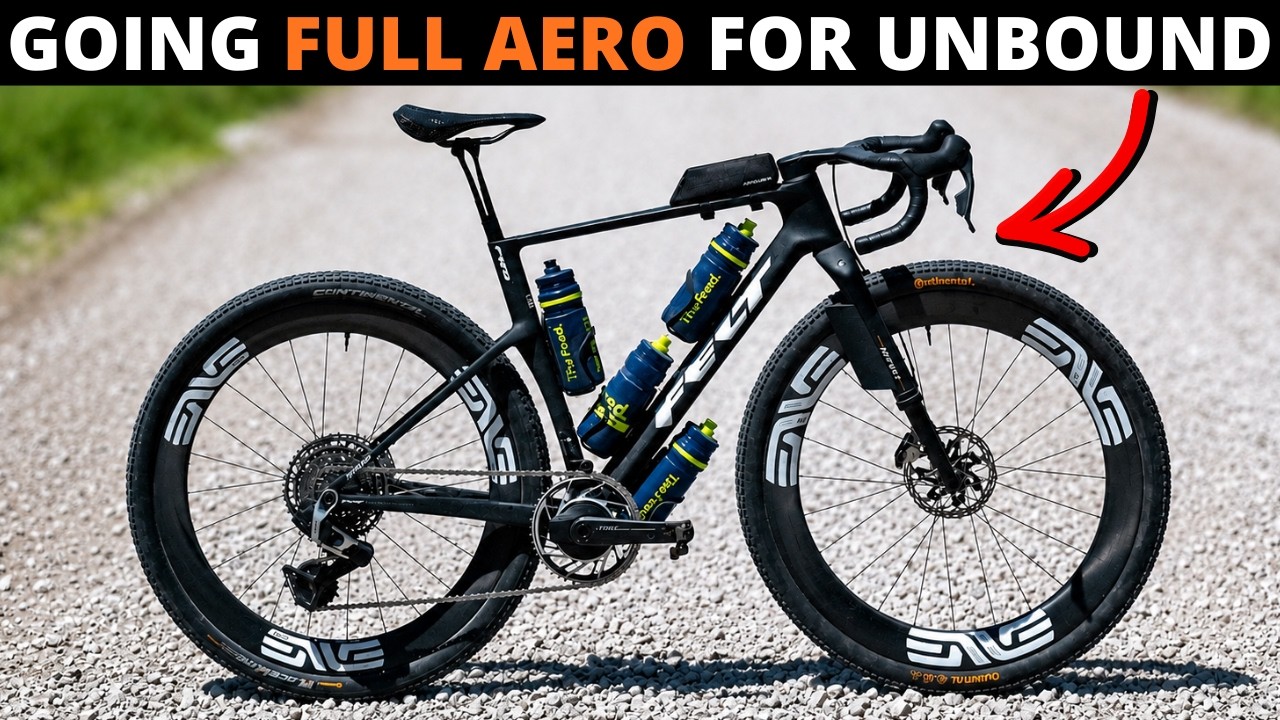
We Tested Gravel Equipment in the Wind Tunnel to Build the Ultimate Unbound Race Bike
Watch on YouTubeVideo summary
Silca and the presenter return to the ARC wind tunnel to scientifically evaluate gravel equipment for the brutal Unbound 200 race, marking a significant shift from the past where such testing was considered excessive. As gravel racing competitiveness intensifies every year, the focus has moved toward finding marginal gains in aerodynamics, even if it means wearing specialized socks to avoid ridicule. The testing methodology involved simulating real-world wind conditions by running tests at yaw angles of 0, 5, and 10 degrees, with all results averaged for accuracy. While high-speed tunnel runs were used to ensure clean data, the final savings were converted to a realistic race speed of 37 km/h, which was the winning average speed of the previous year's event. The presenter emphasizes that even at slower speeds, these aerodynamic improvements translate to significant time savings over the full distance due to the extended duration on the course.
One of the most counterintuitive findings involved wheel rims and tire widths, challenging the assumption that wider tires are inherently less aerodynamic. Testing revealed that using ultra-wide gravel-specific rims actually improves aerodynamics by smoothing the transition between the tire and rim, allowing airflow to stay attached rather than separating abruptly. Consequently, a 35 mm tire mounted on a wide rim proved faster than a narrower tire on a standard road rim, despite the increased physical width of the tire on the wider rim. This shape improvement outweighs the drag from the larger cross-sectional area. Furthermore, the presenter plans to run a 2.2-inch mountain bike tire in the rear for its superior rolling resistance and flat protection, while potentially opting for a smaller front tire to maximize aerodynamic benefits where they matter most.
The investigation into suspension forks presented a surprising plot twist regarding the Lauf leaf spring fork, which initially tested faster than a rigid fork but later proved significantly slower due to yaw sensitivity and tire interactions. In contrast, the Cane Creek Invert fork emerged as a strong contender with minimal aerodynamic penalty compared to a rigid setup. To further optimize performance, the team experimented with 3D-printed fairings for the fork, discovering that while long fairings increased drag, short versions offered slight savings without compromising too much on aesthetics or fit. The presenter concludes that while suspension adds weight and complexity, the Cane Creek option represents a viable balance between vibration damping and aerodynamic efficiency, especially when paired with a sleek matte black frame.
Finally, the video explores various other components including dropper posts, frame bags, hydration systems, helmets, and shoes. Dropper posts showed massive power savings at high speeds but were deemed impractical for Unbound due to added weight and mechanical failure risks on long climbs. Aero frame bags filled with nutrition proved beneficial by smoothing airflow around the head tube, while a hydration bladder integrated into a gravel skinsuit offered superior aerodynamics compared to traditional packs. Interestingly, adding a flask to the front of the jersey further improved performance by creating a more airfoil-like torso shape, though the presenter will likely stop at a single rear bladder for weight reasons. For helmets and shoes, cooling and ventilation were prioritized over marginal aero gains in hot conditions, leading to the selection of a ventilated helmet and traditional lace-up shoes that offer better breathability than full aero alternatives.
Read the full video transcript
Silca and I are back at it again testing
gravel equipment in the ARC wind tunnel
in the endless pursuit of finding the
fastest possible gravel race setup for
the brutal unbound 200. At this point, I
would say that the good old days of
seeing a gravel bike in a wind tunnel as
a bit overkill or, you know, going
against the spirit of gravel are well
and truly behind us at this point. And
I'm choosing to see that as progress.
Choosing. Dude, it's dumb YouTube videos
like this one that are the reason why I
have to wear arrow socks on the
Wednesday night gravel ride just to not
get laughed at now. The competitiveness
of gravel racing keeps ratcheting up
every single year, and with that comes
the arms race to find every marginal
gain possible. And of course, that
includes aerodynamics. Today, we'll be
testing wheels, forks, dropper posts,
arrow frame bags, shoes, and more. I
feel like I say this every time Silca
and I go into the wind tunnel, but
aerodynamics is not always intuitive,
and some of these results are not what
you might initially expect. So, stay
tuned. Welcome back to the channel. This
video is fueled by The Feed. Quick
methodology note before we get into the
results. We tested at 0, 5, and 10° yaw
angles to simulate the range of wind
conditions you'd actually encounter
during a race. And everything I report
will be an average across those three
angles. We also tested at 50 km/h, which
is obviously faster than anybody is
averaging on gravel. But before the
keyboard warriors go to town in the
comment section, there is a good reason
why we did this. When you're testing
something like fabric texture on an
arrow sock, for example, the specific
speed that you run the tunnel at matters
a lot. The aerodynamics can behave very
differently at different velocities. But
since we were purely testing shapes like
different shaped wheels and forks, for
example, we could run the tunnel at a
higher speed to get cleaner and more
consistent data, and then convert those
savings down to a more realistic race
speed. I'll be reporting everything at
37 km/h or 23 mph, which was the winning
average speed of last year's Unbound
200. I know, it is absolutely bonkers
that this race has gotten this fast.
That is 200 mi or 320 km off-road done
at that speed. I'll give you both the
watt savings and what that translates to
in time saved over the full Unbound 200
distance. And if you're thinking that
none of this applies to you because you
don't ride at that speed, just keep in
mind that at slower speeds you are on
the course for a longer amount of time,
and if you do the math, you actually
often end up saving even more time at a
slower speed over the full distance,
even though the watt savings are less.
Hmm.
Sounds like bro math, but you know what?
If it helps me justify spending my kids'
college tuition on a new pair of carbon
wheels, then
I'm not complaining. All right, let's
start with the wheel test because this
one can be pretty counterintuitive. If
you've seen my previous video on tire
width and aerodynamics, then you know
the basic principle. Wider tires are
generally less aerodynamic, all else
being equal. No shock there. I've also
tested wheel depth in the past, and
again, not surprisingly, deeper is
faster, even with wider tires. But one
thing I haven't addressed is rim width.
Does running wider gravel rims improve
the aerodynamics when you are using wide
tires? This has been theorized for a
while now, and wheel companies have been
coming out with wider and wider gravel
rims to try to achieve this. But what
kind of savings are we actually talking
about? To find out, we tested two
wheels. Both are Enve 6.7's at the same
60 mm depth, but one is their standard
road specific 6.7 with a 23 mm internal
width and 30 mm external width. And the
other is their gravel specific GSES 6.7
with a 30 mm internal and whopping 42.6
mm external width. So, this is
substantially wider and one thing to
point out is how much wider the tires
get when they're mounted to these mega
wide GSES rims. For example, a 35 mm
Pirelli Cinturato gravel tire on the
narrow road rims actually measures 36
mm. Put that same tire on the wide GSES
rims and now it measures 40.2 mm.
Now, I do just want to take a second to
point out that 35 mm tires are not
actually recommended for these rims, but
since I've tested them in every wheel
and tire test up until this point, I
wanted to test them here. Moving up from
there, the 40 mm tire goes from 40.3 mm
on the narrow rim to 44.5 on the wide
one.
The 45 goes from 46.7 to 49.8.
The 50 goes from 52.4 to 53.3.
And the Race King 2.2 MTB tire, which
already measures 56.7 on the narrow rim,
stretches to 57.9
on the wide one.
If you haven't noticed by now, the
number on the side of the tire is more
of a suggestion than an actual
measurement. So, the tire is now
substantially bigger on the wider rim.
And remember that the A in the CDA
equation for aerodynamics stands for
area. So, in principle, this should hurt
aerodynamics.
But, when we actually put them to the
test, we found the exact opposite. The
35 mm Pirelli tire on the GSES wide rim
saves 1.5 W or 54 seconds over Unbound.
The 40 and the 45 both save 2.2 W
or 1 minute and 19 seconds over running
them on the narrow rim. The 50 saves 2.6
W or 1 minute and 34 seconds. And the
Race King 2.2 picks up 2.3 W
or 1 minute and 23 seconds.
The reason for this, of course, is the
improved aero shape. The tire-to-rim
transition is smoother on the wider rim.
The sidewall doesn't drop away as
abruptly, so air flow stays attached
rather than separating at the edge. This
is what we expected, but what I think is
interesting is that this improvement in
shape more than makes up for the
increased tire size. Now, that's all
well and good, but here's the part that
I think is really worth sitting with.
You can compare tires that measure the
same physical width across from
different rim and tire combinations. For
example, the 35 mm tire on the wide GSES
rim measures 40.2 mm, and the 40 mm tire
on the narrower road rim measures 40.3
mm. Essentially identical widths. When
you compare these two combinations
though, the 35 mm on the GSES is 5 W
faster or 3 minutes over Unbound. Of
course, let's not be silly though. You
could probably find me working for
TrainerRoad before you'd find me riding
a 35 mm tire at Unbound.
But, the 2.2 MTB tire, which is what I
ran in 2024, and what I would argue has
the lowest rolling resistance on rough
terrain based on the test we did in this
video, now becomes as fast
aerodynamically speaking as the 45 mm
tire on the narrow rim, which measures a
whopping 11.2
mm smaller.
Now, that's what we're talking about.
For my 2026 Unbound setup, I'll
definitely be on the Enve SES 6.7
wheels. For tires, I'll be running a 2.2
mountain bike tire in the rear if it's
dry for all the reasons I've discussed
before. Better rolling resistance, flat
protection, vibration damping, comfort,
handling, etc. The front tire is
actually still an open question though.
Given that the SES rim makes tires both
wider and more aerodynamic, I may
actually opt for a smaller front tire. I
know, insert shock and horror faces
here. The reason would be for the
aerodynamic benefits, seeing as the
aerodynamics of the front wheel matters
substantially more than the rear since
it is the first to hit the wind. One
potential option might be Continental's
new 50 mm version of their Double
Fighter, which is essentially the
replacement for the Race King. This tire
would provide most of the benefits of
the 2.2 while being a bit more
aerodynamic. And keep in mind that on
these wide rims, 50 mm is measuring more
like 52 or 53, so still not narrow by
normal gravel standards. Just narrow by
my standards for Unbound specifically.
Next up, forks. And I'll be up front,
this section contains a plot twist that
I am still a little bit salty about.
Gravel suspension has been trending and
for good reason. Minimizing vibration is
one of the best ways to go faster on
gravel. A lot of people do this with
their tire choice, but you can also do
it with suspension. Of course,
suspension is both heavier and less
aerodynamic, at least we assume. But,
how much of an aero penalty are we
talking about? For the baseline, we have
the stock rigid fork on my Felt Breed
Carbon. Then, we have the Cane Creek
Invert, the Fox 32 Taper-Cast, and then
the Lauf leaf spring fork, which I have
run quite a bit in the past and has a
unique look, to say the least. Some may
describe it as ugly, but it actually has
grown on me quite a bit. Using the rigid
fork as the baseline, the Fox gravel
fork cost 3.3 W, or about 1 minute and
59 seconds over Unbound. And, to be
honest, I thought that it was going to
be much worse. If a suspension fork
smooths out rough terrain to recover
even 3 W, it might arguably be worth it
for the right course. But, things get
even better with the Cane Creek Invert,
which only costs 1.5 W, just 54 seconds
over Unbound. And, now for the plot
twist. In our first session, the Lauf
fork actually tested faster than the
rigid fork. It was one of the more
shocking results I've seen from the
tunnel. Well, this time, the Lauf was
the slowest fork on test. By a lot. It
cost 8.5 W over the rigid fork.
5 minutes and 6 seconds. I genuinely
don't have a clean explanation for this
one, and I'm not going to pretend that I
do. The frame and bike setup were very
close to the same, but there were a few
notable differences. This time, we did
that test with 2.2 mountain bike tires,
and I think the first time we did the
test, we did it with 45 mm tires on much
narrower rims. We also tested at a
broader degree of yaw angles, 0, 5, and
10 degrees, as opposed to 0 and 2.5
degrees last time. The yaw angles could
plausibly explain some of it, as the
fork performed particularly bad at 10
degrees yaw, but interestingly, the Lauf
was the slowest even at zero yaw. So,
it's not the whole story. Whether it's a
tire interaction or yaw sensitivity or
some combination, I'd want to do more
testing before I make any definitive
statements. What I can say is that based
on this particular data set, the aero
case for the Lauf fork becomes a lot
harder to make. And the case for the
Cane Creek fork becomes quite a bit
stronger. And not that aesthetics has
ever mattered to me, I am a fan of
monstrosities like the Dropper Mountain
Bike, for example. But, I got to say
that on my new matte black Felt Breed
with the matching matte black inverted
fork, this is probably one of the
best-looking and most seamless options
for a suspension gravel fork out there.
Time to completely jack up all those
newfound superior aesthetics though,
because we asked ourselves, how could we
make this Cane Creek fork even faster?
Enter fork fairings. Yeah, I wasn't
joking about jacking up the aesthetics.
Last year, Keegan Swenson and Sofia
Gomez Villafane showed up to Leadville
with prototype RockShox SID forks with
aero-shaped fairing lowers. Yes, in
2026, we have truly arrived at aero
mountain bike components. Somewhere in
the world, a baggy shirt-wearing Enduro
bro is yelling at his computer right
now. If fairings work on a mountain
bike, they might work even better on a
gravel bike where speeds are higher. So,
we 3D printed different versions for the
Cane Creek, a long version, a short
version, and we tested doubling up both
at once for the ultimate aero dorkery.
The long fairing went first, and in a
result that I think is best described as
deeply humbling, it was 8.1 W
slower than no fairing. 4 minutes and 52
seconds over Unbound. So, we've made the
bike look considerably more unhinged and
we go slower. The short fairing,
however, saved 0.9 W or 32 seconds. And
both fairings doubled up also came to
0.9 W or 32 seconds of savings. Not a
life-changing number, but crucially not
negative. My theory on the long fairing
disaster is that it had large flat edges
at the top and bottom where the airflow
was almost certainly separating badly.
The short fairing avoids the worst of
that geometry. The fit on all of these
fairings wasn't perfect, either, which
probably didn't help. Since the tunnel
trip, we've refined the design using CAD
files that Cane Creek kindly shared,
removing the hard edges at the top and
bottom and getting a much better match
to the actual fork shape. We haven't
retested this yet, but even with the
poorly fitting short fairing, we were
within 0.6 of a W or 22 seconds over the
entire Unbound distance. At a race as
rough as Unbound, I think there is
easily a case to be made that the Cane
Creek fork would come out ahead. And
depending on course conditions this
year, I will likely have one of these
forks on my bike. All right, dropper
posts. Yes, dropper posts for gravel
racing. This idea came to me from
watching Mohorič win Milan-San Remo in
2022 using a dropper seatpost on a road
bike. And look, I love watching Pogačar
win every race he enters just as much as
the next guy, but when somebody thinks
outside the box, particularly inside the
narrow rule book of road cycling, to
beat riders that are almost definitely
stronger than him,
there is nothing in this world that gets
me more excited than that. You're an
adult male and that's what gets you
excited?
I think you need to get your
testosterone checked, bro. I became a
massive Mohorič fan that day. When he
raced Unbound in 2024, he had a dropper
post on his gravel bike and was using it
regularly on the downhills. Sometimes
pedaling with it dropped, sometimes just
tucking. This planted a seed in my head.
Should more aero conscious gravel racers
be running dropper posts not for
technical terrain, but to reduce drag on
descents? Hopefully the trolls can
forgive us for this one, but rather than
spending valuable tunnel time installing
and un installing an actual dropper post
on the bike, we simply just lowered the
saddle to mimic a dropper post position.
At 37 km/h, the savings is 12.8 W. But
you'd really only use a dropper post on
descents where 50 km/h is more
realistic. At that speed, the savings
jumps to 31.7 W. Or to put it another
way, you'd gain roughly 0.8 km/h or
about half a mile per hour while
coasting. For obvious reasons, I will
not be giving the savings over the
entire Unbound distance because if you
rode Unbound with your seat down the
whole day, then your power output would
probably not like that very much, nor
would your knees. Now, despite that
being a meaningful number, I won't be
pursuing a dropper post for Unbound
specifically for a few reasons. First,
for a rider like me, I am far more
likely to get dropped from the leaders
on a climb rather than on a descent, and
a dropper post is heavier. Second, it's
just one more thing on your bike that
could mechanically fail and end your
race. 200 mi is a long way for something
to go wrong, and I would rather keep my
setup as bulletproof as I can. For a
more descent-heavy race, I would
definitely consider it, but for Unbound,
I'm going to keep it off for this year.
Now, aero frame bags. For some, that
might sound like a contradiction in
terms, but stay with me.
If If watched my previous wind tunnel
videos, you might remember that we found
that certain bags on certain frame
shapes can actually make the bike more
aerodynamic by filling in the
low-pressure turbulence zones behind the
head tube and down tube that are already
slowing you down whether you have a bag
there or not. Apidura took that concept
and designed a bag with the explicit
purpose of improving aerodynamics in
mind. We tested four configurations. No
bag as a baseline, the Apidura Aero Top
Tube Bag only, the Apidura Aero Frame
Bag only, and both bags together. Using
no bag as the baseline, the Aero Top
Tube Bag alone saves 4.2 W
or 2 minutes and 31 seconds over
Unbound. The frame bag alone saves a
mere 0.1 W or 4 seconds, which is
basically a wash. Both bags together
save 5.2 W or 3 minutes and 7 seconds,
which makes sense given that these bags
are designed to work together as a
system. The conclusion is hard to argue
with. If you're going to carry nutrition
for a long race anyway, then you might
as well put it in an aero frame bag.
You're going to have it there anyway for
your food, it just so happens to make
you faster. In fact, I'll be honest with
you guys, I have literally run a frame
bag on my bike during a race with
nothing in it
simply because it made my bike more
aero. I'll be running the Apidura Aero
Top Tube Bag at Unbound. Just the top
tube bag, not both together. The
marginal gain of adding the frame bag on
top is small enough that I'd rather have
that space open for a third water bottle
inside my frame if I need it. Next up is
further refining the fastest way to
carry hydration for this race. Some of
you may remember that in a previous wind
tunnel trip, I found that a USWE pack
was faster than no pack at all, at least
on me. Well, since then Rule 28
developed a gravel skinsuit with a
built-in bladder pocket on the back,
essentially integrating the hydration
pack into the kit itself. I used this
suit to great effect at Unbound in 2024,
and since then a lot of other companies
have come out with their own version of
it. And as it turns out, there is a good
reason for this. Running a 2-liter
bladder in the back of this suit saves
9.7
W, 5 minutes and 49 seconds over
Unbound. I think crucially though, if
you compare that savings to what I got
from wearing the U-suit pack, it was
only 1.3 W faster than not wearing a
pack. So, going with the Rule 28 gravel
suit and bladder is a faster solution
than the U-suit pack by 8.4 W. That's
all well and good, but things are about
to get extra dorky. Adding a 500 ml
flask to the front of the jersey on top
of the bladder in the back saved 11.1 W
or 6 minutes and 40 seconds. And then
running a 2-liter bladder in the back
and on the front saves 12.5 W or 7
minutes and 30 seconds. As it turns out,
the more you fill in the space both in
front and behind your torso, the faster
you go. Oh, so that must be the reason
why half the old dudes on the Saturday
morning group ride are rocking the
hunchback beer belly combo.
Freaking genius. The reason it works is
because your body becomes, in technical
aerodynamic terms, a slightly less
terrible shape. A flat chest to the wind
is not great, but when you start adding
stuff to the front and back, all of a
sudden the cross-section of your torso
is starting to look a little bit more
like an airfoil. That being said, I
wouldn't go using this shape on an
airplane anytime soon. For Unbound, I'll
definitely run the bladder in the back,
but a second bladder in the front might
be taking it a little bit too far and is
a lot of extra weight for your torso to
carry. A 500 ml flask might be as far as
I go. All right, helmets. We tested
MET's ventilated Trenta helmet against
the MET Manta aero helmet. The aero
helmet came in 0.2 watts slower, which
is basically a wash. But here's why this
result is more interesting than it
sounds. On a previous wind tunnel trip,
I tested 16 different helmets and in
that session, the MET Manta aero helmet
in the medium size came out the fastest
of the entire group. The size is
important. The large version of the
helmet on me tested further down the
pack in the upright gravel riding
position that we were using for the
test. My thoughts here are this, in an
upright riding position where your head
is in the wind, unlike in a TT position
where your head is tucked, the size of
the helmet starts to matter quite a bit.
In fact, at least on me in the testing
that we've done, the size of the helmet
seemed to matter more than whether or
not it was ventilated or had an aero
shell. This may explain why you see MET
sponsored riders like Pogacar very often
lining up in the ventilated version
rather than the full aero version. When
the aero difference between the two
helmets is negligible and you're racing
for hours in warm weather, it becomes a
bit of a no-brainer to go with the
cooler option. Unbound is almost always
hot, so again, this decision is an
obvious one. I'll be going with the
vented helmet. Last but not least,
shoes. We tested three options. A
Suplest aero shoe, a Giro shoe with
laces, and a Specialized shoe with Boas.
While these are all different brands,
the purpose of this test was to test the
difference between Boas, laces, and then
going to a full aero shoe like the
Suplest where the laces are covered. Not
surprisingly, the Suplest aero shoe came
out the fastest. The Giro shoe with the
laces is 1.2 watts slower than the
Suplest or 43 seconds over Unbound and
then the Specialized with the Boas is
2.4 watts slower or 1 minute and 26
seconds. On pure aero terms, the Suplest
wins, but I'll likely go for a more
traditional lace shoe for Unbound simply
because the Suplest is quite a heavy
shoe and more important than that, it's
not very well ventilated. Going back to
the helmet argument, for such a small
aero difference and for such a long hot
race like Unbound, you should really opt
for what is going to cool your body more
effectively. That's all for this wind
tunnel trip. If you want to follow my
racing closer, be sure to check me out
on Instagram. If you are interested in
coaching or training plans, check the
links down in the description below. And
finally, if you enjoyed this video, be
sure to give it a like, subscribe, and
share it with your cycling friends. I'll
see you in the next one.