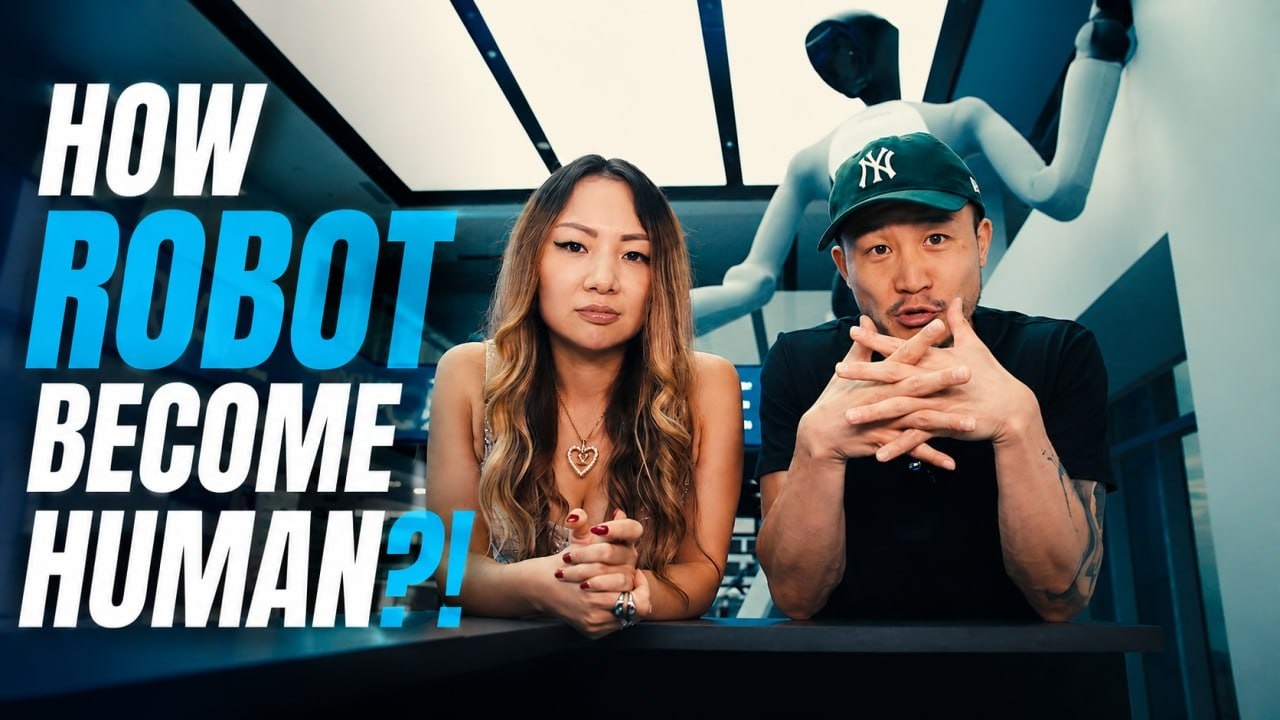
Video summary
The video explores the rapid advancements in robotics taking place in Shenzhen, China, specifically at Pasini Robotics, where the focus has shifted from mere automation to "embodied intelligence." This concept goes beyond simple mechanical movement or looking human; it involves robots that can perceive their environment through advanced sensors like 3D LiDAR and RGB cameras while simultaneously feeling textures, pressure, and force. The core argument presented is that true progress lies in creating versatile machines capable of handling complex, unstructured tasks—such as carefully squeezing a light bulb out of packaging or navigating soft objects without causing damage—which requires a level of dexterity and sensory awareness previously thought impossible for non-humanoid robots.
A significant portion of the discussion highlights how these technologies are designed to assist humans in dangerous or mundane jobs by learning from human behavior through simulation and real-world interaction. For instance, workers can wear gloves with scanners to collect data on tasks like plumbing repairs in hazardous environments, allowing robots to imitate those specific actions safely later on. The narrative emphasizes that the goal is not just to replace labor but to empower society by taking over dirty or unsafe jobs, thereby freeing humans for more creative endeavors while ensuring elderly parents receive better care than human children might provide alone. This approach addresses a critical demographic challenge in aging societies like China's, offering robotic solutions that can nurture and support families with the same empathy found in human interaction.
The transcript also touches upon the impressive transformation of Shenzhen from a fishing village forty years ago into a global hub for future technology, illustrating how this rapid development is reshaping perceptions of what robots can achieve. Unlike flashy but impractical concepts seen on social media platforms like TikTok or Instagram, Pasini's innovations are grounded in serious research conducted by dedicated PhDs who aim to solve real-world problems across various industries. The video concludes with a strong message that the future belongs to those willing to peel back the layers of this technology and engage directly with experts rather than relying on superficial content, as staying informed about these converging fields of AI and robotics is essential for not being left behind in an increasingly automated world.
Read the full video transcript
What if the future's happening already?
>> But most of us just don't know where to
look.
>> Welcome to Global Next China edition.
>> Let's discover what's next. [music]
>> [music]
>> Oh my god. What is that?
>> That's a tall robot.
In fact, that's the robot she told you
not to worry about.
>> Where are we, David?
>> We are at Pasini in Shenzhen right now,
>> [music]
>> and this is one of the most important
places that you can find out about the
future of robotics. And all I know is
that there are certain buzzwords like
[music] embodied perception and embodied
intelligence, and we have to find out
what they mean.
>> Let's get to it.
>> [music]
[music]
>> And we are here [music] with Dr. Susie
Wong.
What do you do here at Pasini?
>> Yeah, nice to meet you guys. I'm the
product manager for the robot
application from the Pasini.
>> What should we take a look at first? I
want to see it all because I don't know
if I got seen the robots do all [music]
these flips and dancing, but I want to
know because I know you guys you guys
focus here
>> Yeah.
>> on how robots can actually help humans
and change the real world.
>> Yeah, cool. So, first one we can notice
[music] that this our like showroom of
our robots. This is our tour one robot.
>> Right. [music]
>> What is free flexible operation?
>> Yeah, they can choose touch the the
package because most of the package is
soft.
>> Right.
>> We don't want to hurt like the item
inside the
package. They can also do some like
[music] the the lab work. They can scan
the QR code
and to [music] figure out what's inside.
>> So, this one's for a double one.
>> Yeah, for a double one.
>> Right, like this is obviously squeezing
in a light bulb. Not a lot of robots can
do this, right? This is pretty advanced
stuff.
>> So, I mean, I noticed there's like
[music] maybe four cameras here?
>> Yeah, and they have like the fish eye
camera and also they also have a RGB
camera and they also have like 3D lidar
here.
>> 3D lidar?
>> And lidar.
>> Okay.
>> Lidar here or [music] there.
>> Yeah.
>> And they can achieve notice that we we
can avoid obstacles [music]
>> Okay.
>> for that part.
>> So, I love that you guys are wanting to
push that forward because otherwise you
just end up with like a
>> [music]
>> 100,000 different specialized robots and
why not have one robot that can do
100,000 things?
>> Yeah, exactly. [music] We can provide
the all the technologies used for the
robotic and we [music] can provide the
all the sensor data, model, robot hand
[music] and make the the robotic more
professional and to can [music] cover
the all the test the solution for the
from the different industry.
>> So, that tells you on screen
>> Yeah, it can actually you can notice
some like sensor data.
>> Right.
>> And you can pressure that and they you
can
they can notice the force, pressure.
>> So, this robot can tell what is what
because [music] obviously these are like
pretty detailed like um an average robot
probably is just going to take a little
photo and try to tell but you some a lot
of this stuff you don't know until you
feel. I used to think that humanoid
robots just [music] look like a human.
But you guys are talking about robot
means it can think like a human and it
can feel and it can perceive and
pressure and
touch and know text textures and
textiles like a human. That's actually
[music] more human than just looking
like a human.
>> Yeah, right. Being the Pacini, [music]
we want to make sure the robot can
really learn the words and
do the human [music] task and also help
the human.
>> Oh, here. Here we go.
>> Oh, yeah, yeah, yeah. So,
I assume [music] this is something that
ooh
They're hot. So, let's just say if I
were to be, I don't know, like
>> [music]
>> a staff in a supermarket in China and I
need to like scan a bunch of things.
>> Yeah. [music]
>> So, I in order to
collect the data of my job, I just put
on the glove
>> Yeah. Probably
>> and use the scanner.
>> I think it's
>> And then
>> Yeah. Scan the QR code.
>> Put it there.
>> And actually over there
it's already like to in the simulation
world.
>> And that entire behavior will be
collected.
>> Yeah. Exactly.
>> in the system.
>> I think it would be cool, you know,
especially if you want a friend, you
know, you could teach the robot to give
you a dap like this and just be like,
"Yeah, this is my brother. [music] This
is my glimmer."
>> Yeah.
>> Like here.
>> Shake robot hands. Yeah.
>> Or maybe we do a thumb war.
You know, the dexterous hand guys, this
is it.
Whoa.
Uh-oh.
Trust me, guys. This is This is the part
that everybody
locked in.
>> [sighs]
>> Feel the power.
Crystal, will you hold my hand? Hold my
robot hand.
>> Very strong fingers here.
>> Hey, what's up, man? Nice to meet you.
Pleasure.
All right. I got to ask you, Crystal, if
you could model [music]
anything for
a tour of one
>> Okay.
>> what would you like to input into
[music]
the large data set?
>> I I mean, I don't know why I thought
about this example, but you know how
like
>> [music]
>> plumbers, they're going to go into some
unpleasant environment and things are
twirling or [music] whatever plumbing
system, and if you could just imitate
that, then so these people don't need to
do that job, you know, dirty job or, you
know, unsafe job anymore.
>> Yeah.
>> Yo, this showroom
>> [music]
>> is so crazy because it almost reminds me
of every science center that I went to
growing up, but like maybe 6,000 [music]
times better because these are real
technologies that you guys can deploy as
Pudu Robotics right now.
>> Yeah, exactly.
Yeah, and my [music] favorite part is
that I just really love how nurturing
and maternal these robots are cuz
>> [music]
>> it's so different from, you know, the
aggressive,
uh, fancy robots [music] we've seen on
like TikTok and Instagram. I feel like
this I can see I wanted to have a robot
at my place and helping me to do [music]
all sorts of stuff.
>> Yeah. Like the human, we can we also
make some mistakes when our living life,
right? But we can learn from mistake and
to improve [music] our ourselves exactly
same as the Pudu Robotics.
>> I mean, I just think it's amazing how
Shenzhen, like 40 years ago, was just a
fish village, and you know, you don't
have any of those buildings, and now
[music] that you're on the top of the
world almost, right, with this view, and
you're building future robots.
>> Yeah, exactly. [music]
>> From a place that didn't even exist 40
years ago.
>> You know what I love about it? This just
kind of shifted my whole perception.
It's not
about It is about what robots can do,
but it is so much more than that. It's
about what the robots can perceive.
[music]
>> Yeah, exactly. We want to make sure your
body is can be
feel the world and [music] do the right
action, do the right word. Yeah, there's
a lot of responsibility that come with
it, right?
>> [music]
>> So, we want to make sure that the the
robots are doing something good for the
world. Yeah, exactly. So, as you can
see, it's like empowering the society
through a technology. That's what the
slogan of our company, and we want to
make sure we can give some [music]
feedback for the to the society.
>> Society, yeah.
>> Listen guys, global leader in embodied
perception-driven general intelligence.
[music]
>> So, if people out there want to buy a
Passini robot to run the security
scanner,
>> Mhm.
>> they can do that. [music]
>> Yeah.
>> But if they want to just buy
the data, they could do that, right? Or
if they just want to buy the sensor
>> Yeah.
>> that is so advanced [music] from you
guys, they could just buy that.
>> Yeah, exactly. And also, if they want to
buy the all of them, if they can do it
also.
>> I mean, this was such an amazing
experience. Thank you for the showroom.
My own IQ for the robotic stack went up
like 10 times.
Like I I just wanted to see robots do
flips and, you know, transform. [music]
And then now I realized, oh, nah, that's
you know, that that's a level, but
there's a lot more levels. And you guys
are industry-leading
in all of them.
>> Yeah.
>> Well, thank you so much.
>> Thank you.
>> Dr. Suzie Wong, guys. Listen, talk to
the PhDs.
They went to the top schools. They did
the research. They dedicated their life
to this. You're going to learn
something.
I I learned something because it's like,
you got to go straight to the source.
Don't, you know, you you could go on
TikTok, you could
>> [music]
>> go on Instagram, go on IG Reels, but
you're not going to learn like you're
talking to Dr. Suzie Wong at Passini
because I'm telling you, they do the
research, [music] they dedicate their
life to this, they know everything, and
they can just blow your mind in terms of
what you thought you knew
or what this world actually is.
My biggest takeaway is this, I do not
want to be left behind. Today I learned
so much about robotics and AI and the
convergence of those two things, and I
[music] just want to peel back the
layers of the onion.
>> Yeah, and as a only child, uh my parents
were getting older every single year,
and I used to be so worried that [music]
who's going to take care of them when
they're older. but after viewing Asimov
and also their robots today, I'm very
confident that one of their robots will
be able to take better care of them than
I will ever be able to do in 10 years.
>> Wow, that's really thoughtful.
I'm not going to lie, that didn't even
cross my mind.
I'm a terrible son.
>> It's okay. Buy a senior [laughter]
robot.