Video summary
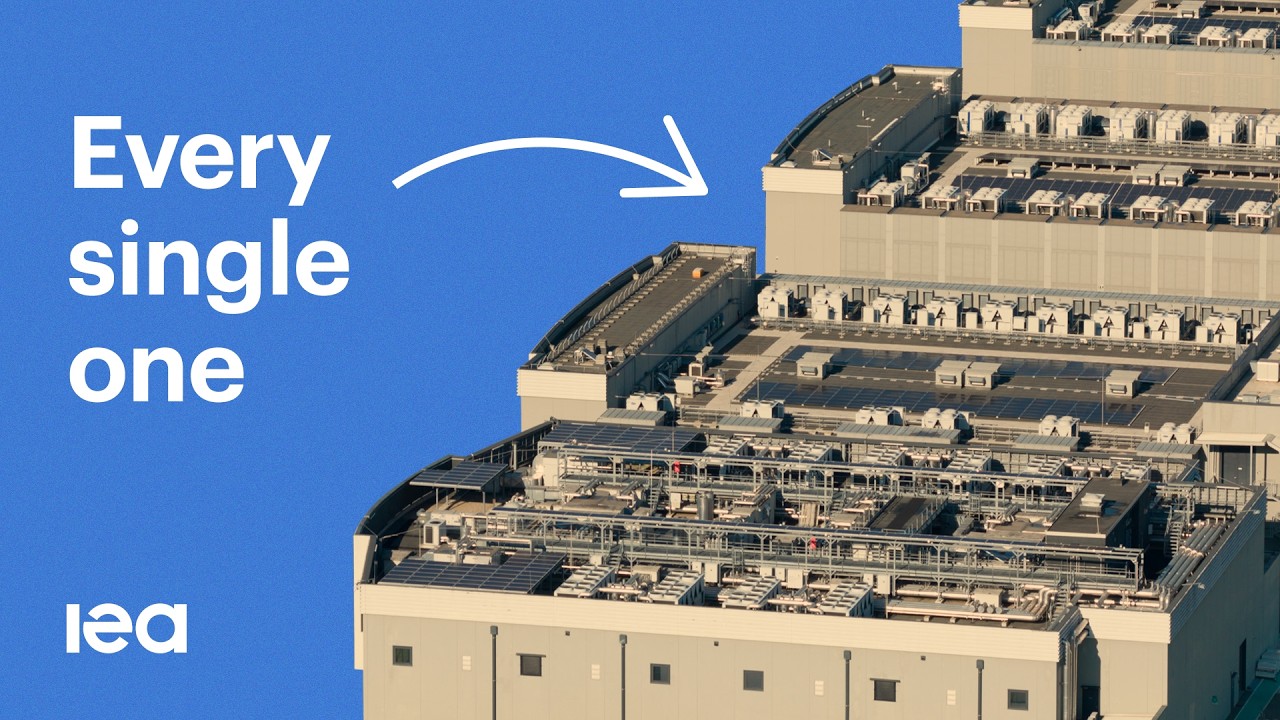
The video explores the massive physical infrastructure boom driven by artificial intelligence, contrasting it with historical achievements like NASA's Apollo program to highlight current investment scales. While AI is often perceived as a purely software-based advancement, its operation requires an enormous expansion of data centers and supporting power grids that are projected to cost over $700 billion this year alone. This surge in capital expenditure has led to a doubling of installed capacity for these specialized "AI factories" within just twelve months, fundamentally altering how the world generates and distributes electricity. The scale is staggering; a single modern server rack can now consume as much power as 65 households, meaning that typical hyperscale data centers use energy equivalent to over 100,000 homes, with some of the largest projects under development drawing power comparable to an entire country like Japan.
Despite this rapid growth, the video clarifies that electricity demand from advanced manufacturing and electric vehicles remains a larger global driver through 2030, though data centers are set to dominate in specific regions like the United States. There is significant concern regarding whether these new facilities will drive up local electricity prices or strain existing grids, particularly because they tend to cluster near urban populations rather than being sited remotely like traditional heavy industry. This clustering creates unique challenges where a single location can consume up to 30% of its local supply, and the trend toward denser clusters compounds pressure on regional networks. Consequently, developers are increasingly turning to innovative onsite solutions such as natural gas turbines, large-scale batteries, and even small modular nuclear reactors to ensure reliable power without solely relying on grid capacity that may already be near saturation.
The relationship between rising data center demand and electricity prices is not straightforward but depends heavily on market design, policy choices, and existing system conditions; however, the sheer speed of construction often outpaces infrastructure upgrades, leading to potential affordability issues. Financial markets reflect a nuanced reality where only about 20% of expected investments go directly into energy assets, while specific manufacturers of turbines and nuclear components see their valuations tied closely to AI-driven demand. To mitigate risks associated with overspending on infrastructure that may not be fully utilized if buildout slows, companies are adopting more measured investment strategies, and governments are providing support for emerging technologies like small modular reactors to help startups scale without relying exclusively on data center contracts.
Finally, the video presents a dual narrative where AI acts as both a significant consumer of energy and a potential solution to the sector's most difficult problems through improved efficiency and better management of complex systems. While general-purpose models driving chatbots and image generation are highly energy-intensive, much of the AI deployed within the energy system consists of smaller, purpose-built models with significantly lower footprints that can unlock massive savings in forecasting, security, and resilience by 2035. Although agentic tasks like video generation will increase per-task consumption as they become more common, overall efficiency gains mean it currently takes far less electricity to generate an AI response than a year ago. Ultimately, the distinction lies between the energy-hungry models powering consumer applications and the specialized tools helping optimize the grid itself, suggesting that with proactive planning and better data access, reliable power and affordability can coexist despite the unprecedented scale of this technological shift.
Read the full video transcript
I believe that this nation should commit
itself to achieving the goal
before this decade is out of landing a
man on the moon and returning him safely
to the earth.
>> Ignition sequence start.
Lift off. We have a lift off.
>> NASA's Apollo space program, which
landed [music] the first humans on the
moon and ran for over 10 years, is
estimated to have cost around $300
billion
>> [music]
>> from its inception to the very last
mission home.
>> That's
one small step for man,
one
giant leap for mankind.
>> Large technology companies spent more
than that last year just on data
centers. In 2025, some of the largest
technology companies invested [music]
over $400 billion in physical
infrastructure.
Most of that went to data centers,
[music] and they're on track to spend
75% more this year, $700 billion.
>> AI is often talked about as a software
story, but the technology requires an
enormous buildout of physical
infrastructure. Not only the data
centers [music] that train and run AI
models, but also the power plants and
grids needed to make them work.
>> And that level of capital expenditure
has major implications
>> [music]
>> for how the world's power system
generate and distribute electricity,
where it gets [music] consumed, and of
course, who pays for it.
>> To understand whether all of that
investment is actually turning into
infrastructure, we went looking [music]
for it. We used satellite-based tracking
and geospatial analysis to monitor the
buildout of what [music] many call AI
factories.
These are large data centers
purpose-built for AI,
and we found that installed capacity has
doubled in the last 12 months.
>> Inside these [music] vast, windowless
buildings are hundreds and even
thousands of rows of server racks,
>> [music]
>> each about the size of a large fridge.
In 2020, before the release of ChatGPT,
one of these racks used about [music] 13
kilowatts of electricity. That's roughly
the same as running five electric ovens
simultaneously.
Not insignificant, but manageable.
The latest chip sets being released are
much more advanced and [music] consume
much more power.
Over the next year or so, a single rack
could consume as much as 600 kilowatts
of electricity.
That means the same fridge-sized box as
a few years ago with different
technology in it
>> [music]
>> would consume as much power as 65
households. And that's multiplied across
hundreds or even thousands of these
racks in a large data center.
A typical hyperscale data center now
consumes roughly the same amount of
energy as 100,000 homes.
The largest data center currently under
development will use about as much power
as 2 million [music] households.
Globally, data centers are on track to
consume nearly 1,000 terawatt hours of
electricity by 2030 or roughly 3%
[music]
of the world's total demand.
That would put their energy use on par
with one of the world's largest
economies
consuming as much power as the entire
country of Japan.
>> Data centers are growing fast, but it's
worth putting that into perspective.
Globally, advanced manufacturing,
electric vehicles, and air conditioners
are all [music] even larger drivers of
electricity demand growth to 2030.
>> Nonetheless, in some regions, data
centers [music] are set to be the main
driver.
That is certainly true in the United
States, the world's largest data center
market.
In the US, almost half of the [music]
increase in demand for electricity to
2030 will come from data centers.
In fact, [music] by the end of the
decade,
the US economy is set to use more
electricity to power data centers than
all its electricity used for the
production of aluminum, steel, cement,
[music] and chemical products.
This strong growth has led to questions
on the impact of data centers on [music]
other parts of the energy system. For
example, do data centers raise
electricity prices for households?
>> The inflationary shocks brought on by
the COVID pandemic, the 2022 global
energy crisis,
>> [music]
>> and the more recent conflict in the
Middle East have made the cost of
electricity top of mind for many people.
The rising number of data centers
[music] being built, there are concerns
that their energy demands could compete
with the energy needs of other nearby
[music] consumers and potentially lead
to higher local electricity prices.
If a power system around a new data
center [music] is already close to
capacity, this could require grid
operators to make investments in new
[music] and upgraded infrastructure.
There are concerns that these costs to
upgrade networks could be passed on to
other businesses and households in the
area.
However, that does not always need to be
the case. [music]
The impact of electricity demand growth
on electricity prices depends [music] on
a combination of fundamental factors and
policy choices.
Think of a flight route between two
[music] cities serviced by an airline.
If the number of passengers was only
half of the plane's total capacity, then
[music] adding additional passengers
could help reduce the airfare for
everyone on board, since the fixed costs
would be shared more [music] widely.
On the other hand, if demand jumps above
the number of seats, pushing [music]
against the limits of capacity, prices
can climb.
In our analysis, [music]
we found that the relationship between
electricity demand growth and
electricity prices is not always direct.
That's because [music] demand growth
alone does not determine prices.
It also depends on existing system
conditions, how markets are designed,
[music] and policy choices around how
the cost of new grid infrastructure and
generation capacity are recovered.
>> [music]
>> That makes the relationship far more
nuanced than it first seems.
>> Having said that, it is important to
note that data centers can create
[music] special challenges electricity
affordability.
Data centers are built very quickly and
in many cases they need new electricity
generation capacity and infrastructure.
The key is getting ahead of it.
With proactive planning,
better transparency from technology
companies, and smarter management of
data center electricity consumption,
there's no reason why reliable
electricity and affordability cannot go
hand in hand.
>> Yet another energy sector challenge has
been the trend of clustering of data
centers.
The presence of a large number of data
centers in one location creates special
challenges [music]
for the local grid step.
>> The IEA conducted [music] a geospatial
analysis of every data center in the
world.
What it revealed is that they don't
behave like most energy intensive
infrastructure.
For example, steel smelters and aluminum
plants are often built away from
population centers, usually near large
power sources.
Data centers are different.
>> [music]
>> They cluster near cities, near the fiber
networks, and the customers they depend
on.
That can put enormous [music] new
electricity demand onto grids that are
serving large urban populations. At the
local level, data centers in these
clusters [music] can easily use up to
30% of the entire local electricity
supply. Our analysis also shows that
this clustering [music] is becoming
denser.
New data centers are typically built
near existing ones, compounding the
pressure on local [music] grids over
time, rather than spreading it.
And when data centers are built in new
areas, our analysis of the pipeline of
project applications around them reveals
that [music] new clusters are forming
around them, too.
That means the challenge is no longer
confined to areas with a history of
dealing with data centers on their grid.
It's moving into new regions, onto new
grids, and those new locations are
essentially starting from scratch.
>> Meeting that demand requires the data
centers to be connected to the
electricity grid.
But grid connections can be slow.
And especially in the United States,
developers are taking matters into their
own hands.
Many are looking for innovative
solutions to power data centers, from
generating electricity on the site of
the data centers itself using natural
gas turbines to large-scale batteries.
Some are even considering more emerging
solutions such as small modular [music]
nuclear reactors.
>> But providing reliable onsite power
generation isn't always simple.
Developers of onsite natural gas
generation [music] have to oversize
their turbine capacity compared to what
they actually need to ensure that the
power supply is reliable, which is
critical for data centers. [music] In
some cases, capacity is set to be up to
70% higher than what they would expect
to use on a typical day. And getting
your hands on a new gas turbine is not
always easy.
And many other crucial pieces of power
infrastructure also undergoing major
supply [music] crunches, too.
>> Data centers where AI training and usage
take place also experience large swings
in power demand at the server level.
In one example from 2025, energy use
jumped by 400% in just a quarter of a
second [music] during a training run.
A gas turbine simply can't accelerate
fast enough to service that rapid of a
demand surge.
So to handle these sudden spikes,
developers are adding energy storage at
data centers that can be tapped when
needed. [music]
In fact, the largest ever battery
project in the world, which is four
times larger than the previous record
holder, was recently contracted by a
data center developer.
Nuclear power and next generation
geothermal are also getting a boost from
the AI boom.
Some traditional nuclear plants are
being brought back online
and there's growing momentum behind
small modular reactors, although the
first of these won't be operational
until at least 2030.
There is a potential upside to all of
this.
Data centers with their own generation
and storage don't just have to draw
power from the grid.
They could support it as well.
Unused electricity from on-site gas
turbines could be supplied to nearby
homes and businesses. At the same time,
large on-site batteries could store
excess renewable energy from the grid
and release it when it's needed [music]
most.
>> So, one way to gauge what this all means
for the energy sector is to look at what
financial markets are saying. [music]
Broadly speaking, recent movements in
company valuations don't suggest that AI
has created a [music] broad-based uplift
for the energy sector.
It's important to point out that of the
trillions of dollars expected to be
invested in data [music] centers between
now and 2030,
only around 20% is actually directed
towards energy-related assets. The
remaining 80% that goes into computing
or other data center infrastructure.
That said, a slightly different picture
emerges when you look more closely at
the specific parts of the energy sector.
[music]
Manufacturers of gas turbines and
electrical equipment, certain nuclear
companies, and [music] a new generation
of energy startups
have seen their valuations become more
intertwined with market sentiment around
AI-driven demand.
That creates clear opportunities, but
also potentially risks. Companies that
invest heavily to meet data center
demand could be left exposed if the pace
of the buildout slows, leaving them on
the hook for the cost of new
infrastructure or manufacturing capacity
for demand that ultimately doesn't fully
materialize. In response, [music]
many large companies have opted for a
more measured approach to new investment
decisions, and at the same time
governments can also provide support for
the deployment of energy technologies
such as small modular reactors
so that startups in the space don't have
to rely solely on data center demand to
scale up.
>> Generating more power is the obvious
response to rising demand. But what's
happening on the other side of the
equation as AI itself becomes more
efficient?
>> When you look at how much energy takes
for AI to complete a single task, like
answering a question,
we see that it's getting much more
efficient.
In fact, the energy efficiency of AI by
this measure is improving at an
extraordinary pace.
It now takes much less electricity to
generate an AI response than it did a
year or two ago.
A simple text query today typically
consumes about as much electricity as
running a television for a few seconds.
If every traditional web search today
was replaced with an AI query, that
would add roughly 4 terawatt-hours to
annual electricity demand.
That's less than 1% of total power
consumption from data centers today.
AI is increasingly being used for much
more energy-intensive workloads,
including high-compute single tasks like
video generation and longer-running
multi-step workflows called [music]
agentic AI, such as coding or research.
Those kinds of agentic tasks can consume
hundreds or thousands of times more
energy than a simple text query. And as
AI agents become more capable and more
widely deployed, these could outweigh
the efficiency gains we're seeing at the
task level.
>> But meeting energy demand for AI is only
one half of the story.
>> [music]
>> AI also has huge potential to help the
energy sector solve some of its toughest
problems.
This is especially valuable today when
the pressures on energy security and
sustainability are triggering the need
for new and innovative solutions.
>> We've looked far and wide to understand
where AI could help the energy sector
tackle the challenges at hand. Already
we see that AI solutions are being
deployed globally across a wide range of
energy technologies. They help manage
complex systems, [music] improve
forecasting, strengthen resilience and
security, and drive greater efficiency.
[music]
We estimate that AI applications already
available today could unlock energy
savings of [music] 13.5 exajoules by
2035 if deployed at scale. To put that
into perspective, [music] that's roughly
equivalent to the amount of energy
Indonesia consumes today.
>> To deliver on the potential benefits of
AI, a few things need to be done in the
energy sector. AI needs data to train
on, a lot of it. However, data across
the energy system tends to be fragmented
and is often very hard to access. And in
many markets, the incentives make it
more financially attractive for energy
companies to build new infrastructure
[music] rather than adopt technology
that could make existing infrastructure
work better. And perhaps most
importantly, energy firms themselves see
the [music] lack of AI skills as the
single largest barrier to the uptake of
AI.
>> This is where an important distinction
[music] comes into play. The large,
general-purpose AI systems that power
[music] chatbots, generate images, and
write code are generally the kind to be
highly energy intensive. [music] They're
the primary driver of the increased
energy consumption we've been
discussing. But much of the AI being
deployed within the energy system looks
[music] very different. These are
smaller, more purpose-built models
trained on specific [music]
data for specific tasks. Their energy
footprint is typically orders of
magnitude lower than that of
general-purpose models. In other words,
the AI that is driving the surge in
energy demand and the AI that is helping
to manage and improve the energy system
are not always the same thing. The label
may be the same, but the technology, the
scale, and the energy footprint are not.