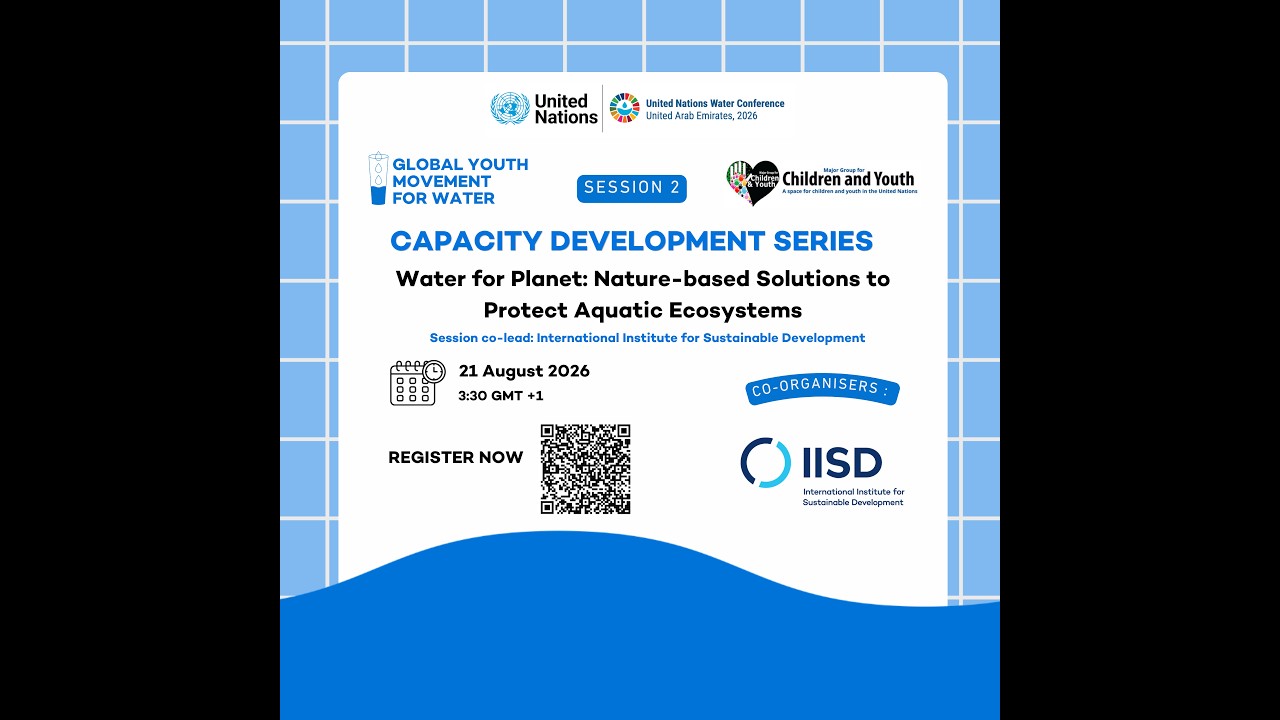
Water for Planet: Nature-based Solutions to Protect Aquatic Ecosystems
Watch on YouTubeVideo summary
The webinar hosted by Emily Croft of the International Institute for Sustainable Development (ISD) explores nature-based solutions as a critical strategy for protecting aquatic ecosystems ahead of the UN Water Conference in 2026. Central to this discussion is ISD's "NEWS" initiative, which seeks to integrate natural infrastructure into mainstream practice through research, policy advice, and implementation projects. The session highlighted diverse applications of these solutions across different regions, starting with the SANKASA project in Sub-Saharan Africa, which addresses severe flood losses in Kigali by restoring rivers and wetlands while simultaneously boosting carbon storage and habitat quality. In South Africa, innovative pilot programs utilize planted tanks to treat heavily polluted water for irrigation without relying on mechanical energy, demonstrating how nature can effectively manage contamination issues like mercury and lead.
Further expanding the scope of natural infrastructure, the discussion turned to marine environments in Belize, where efforts focused on treating coral disease and establishing rapid-response restoration brigades within protected reserves. Beyond ecological restoration, the project emphasized the importance of developing supplementary livelihoods such as seaweed farming and tourism training to reduce community dependence on extractive activities like fishing. On land, experts advocated for a shift from consumptive to regenerative water infrastructure, citing treatment wetlands that combine conventional engineering with nature-based benefits like habitat creation and sea-level rise attenuation. These solutions were shown to be particularly effective in areas like the San Francisco Bay Area, where subsurface flow wetlands treat wastewater while supporting native habitats, though challenges regarding stakeholder coordination and implementation timelines remain significant.
A recurring theme throughout the panel was the necessity of a community-centered approach, as local residents possess superior knowledge of native species and environmental conditions compared to external experts. This collaboration ensures that solutions are appropriately tailored to specific regions and prevents the introduction of unsuitable species, with project success heavily relying on engaging over 10,000 people, local leaders, and youth volunteers in activities ranging from watershed mapping to school-based tree planting initiatives. While technical aspects like plant selection may offer flexibility in certain contexts, the overarching motivation for these projects remains delivering sustainable outcomes where nature acts as the best architect, ensuring economic benefits such as tourism and jobs are shared with communities during and after implementation.
In conclusion, the webinar provided actionable advice for young professionals entering this field, encouraging them to partner with established organizations, seek donor funding, and acquire technical skills like engineering licenses to move beyond mere advocacy into direct implementation. The panelists noted that while regional contexts vary—from federal momentum in the US to strong public support in Rwanda despite initial land concerns—the core principle of integrating natural infrastructure remains vital for climate adaptation. As the session wrapped up with an announcement for the next webinar on September 4th, the consensus was clear that combining local knowledge with scientific innovation offers a powerful pathway toward resilient aquatic ecosystems and improved environmental quality globally.
Read the full video transcript
Hi everyone, welcome. We still have
quite a few people filtering in from the
waiting room, so I'll just give us a few
more seconds before we begin.
Okay, I think we're ready to get
started. Uh, it's so great to have you
all here with us today um on a beautiful
Friday. Um, so welcome to part three of
this webinar series in preparation for
the UN water conference of 2026.
Today we're going to be focusing on the
theme water for planet and specifically
we've decided to take a focus on
nature-based solutions to protect
aquatic ecosystems.
I am Emily Croft from the International
Institute for Sustainable Development
and me and my colleagues will be your
hosts for today. Just a few housekeeping
notes before we get started. First of
all, we are recording. Um, just to let
you all know, we have three incredible
speakers with us today, but we will be
saving questions for the end. We will
have a panelist Q&A at the end of our
session. So, if you think of a question
that you would like to ask, please put
it into the Q&A box function. You're
welcome to use the chat to give
greetings or share where you're from,
but for the Q&A session, we will only be
drawing on questions from the Q&A box.
Uh we also should let you know that we
will not be doing the hand raise
function um for Q&A during this webinar.
So again, don't do a hand raise, just
send us your question in the Q&A and we
will address as many as we can.
So with that being said, I think we
should jump right in.
I would like to begin today with a land
acknowledgement. For those of you who
aren't familiar with what this practice
is, for some of us who live on lands
that were historically colonized, we
like to acknowledge the original
stewards and owners of the land that we
are on. So for me, I am located in
Treaty1 territory in Canada. That means
the area where we would find modern-day
Winnipeg.
ISD's headquarters are situated in
Winnipeg on Treaty1 territory. And these
are the ancestral lands of the
Anachinab, Inu, Aninu, D, and Dakota
nations as well as the homeland of the
Red River Matey Nation. If anyone else
besides me is located on historically
colonized lands, I would definitely
encourage you also to find out whose
original land you are on.
I would also like to take a quick moment
to introduce the organization I'm
joining from, the International
Institute for Sustainable Development.
We are an independent policy think tank
working on sustainable development
issues and we're work towards our vision
which is a world where people and planet
thrive. Our mission is to solve today's
greatest sustainable development
challenges through trusted research
advice and collaboration. We transform
bold ideas into real world change that
leaves no one behind. For us that
involves a few different types of work.
Our first and biggest area of work is in
research and knowledge sharing. We have
an incredible team of experts both on
our water team as well as on our other
teams which include energy resilience uh
international environmental governance
and some flagship initiatives which are
working on expert level research on all
different areas of sustainable
development to help better inform
policy.
We also engage in advice. So sometimes
we work closely with policy makers to
give advice about how to improve
sustainable development initiatives.
We also love engaging and influence
which is what we're doing today engaging
with all of you to talk about one of our
favorite topics water for planet. And
finally we sometimes do implementation
projects. And you'll actually be able to
hear a bit about some of that today from
our first speaker. Um, so maybe I'll
hold off on explaining that myself.
What brings us to you today in
particular is a specific project of ours
called the news initiative. That's an
acronym standing for natural
infrastructure for water solutions.
For the news initiative, we are looking
at natural infrastructure becoming
mainstream or as we sometimes say it
taking it from novel to normal.
We are doing lots of research on this
topic including reports on policy,
finance, and on the ground solutions,
which again you'll be hearing a bit
about today. But on top of just
publishing reports, we have also held
some really excellent connecting
sessions with experts and implementers
from all across our region to work and
find scaling solutions together. We just
recently had one this past spring that
was a great success.
And finally, informing. It's great to do
new research on natural infrastructure,
but it's no good if you don't share it
with others. So, we prioritize
conferences, presentations, media, and
more so that we can share with everyone
all of the benefits that natural
infrastructure can have for water
systems. [gasps]
Now, that's enough about us, but before
we dive in with our speakers, I should
probably clarify what we mean by natural
infrastructure because it's a new
concept for many people.
Basically, natural infrastructure is a
spectrum and it includes things from
conserving existing ecosystems for all
of their natural benefits to restoring
ecosystems that were previously degraded
to even constructing assets like a green
roof, for example. But what all of them
have in common is using natural assets
to benefit some infrastructure purpose.
It's very closely linked to the concept
of nature-based solutions, if you're
familiar, and that we're trying to find
infrastructure solutions that really
depend on nature and all of its wisdom.
We at ISD don't necessarily view natural
infrastructure as replacing traditional
gray concrete infrastructure, but often
as something that they can both work
together to strengthen each other.
So, I hope that sets the stage for our
three speakers that we'll be hearing
from today. [snorts] And with that, I
think you've heard enough from me. And
we will go ahead and hear from our first
speaker um who is Deine Gloria Tui Kund
um from the IWA Rwanda YWP chapter.
Deine, the floor is yours.
Thanks Emily. Thanks uh for the
background and the introduction. Yeah,
as you said, I'm divine gloria to
Yukundi and I'm joining and presenting
from Randa Kali and uh I work with Randa
Young water professional the a chapter
of the international water association
and uh yeah and today I'll be presenting
to you uh the the one of the projects we
are currently implementing which is
called Sankasa and I think I can start
share with you and
yeah [sighs]
thanks. Uh as I was saying the project
is called Sankasa and this is this stand
this is a a short name for a long uh
long words. So this and uh from myself I
read divine gloria to yukund from the
rand water professional
and sankasa this this is actually in
full names or in full words is scaling
natur urban naturebased solutions for
climate adaptation in subsaharan Africa.
This is uh lead by the international
institute for sustainable development uh
together with the world resources
institute and this founded by the global
affairs Canada. Uh the project sankasa
is implemented if in three cities the
diridawa in Ethiopia kali randa here and
dro in South Africa which are all the
three cities in all all these are in
subsahara of Africa. Uh Jin just a
second. Can you Yes. Your presentation
sharing now because it has stopped.
>> Yes. Now, now it is if you can go back
to the first slide.
>> Yeah, the first slide. Yeah.
>> Yes. Thank you very much.
>> Okay. Thank you. Uh I was saying about
the project. This is like a cute picture
from us the young people implementing
the project and uh we are working with
different partners. uh but the project
is led by the international institute
for sustainable development the world
resources institute and us the local
partners among others because it's not
just us and it's founded by the global
affairs Canada the government of Canada
and um and is being implemented in three
countries here in subsahara and Africa
which are Ethiopia Randa and Droa in
South Africa in the three cities Dirawa
and Kegali and Drobe.
So the project actually started in 2024
and it's supposed to end this year 2026
and here in RA it will be imple it's
it's being implemented in the three
districts of the city like the whole
city by different uh partners. uh but as
nature solutions that we are
implementing we have agroforestry
activities or interventions forestation
reforestation and buffer res restoration
or gi protection and urban tree planting
these urban trees they are the the trees
that we plant along the road mainly in
the cuz this is a
project implemented in urban cities. So
um basically the project came after
analyzing that a lot of money is getting
uh lost or with due to the flats that
are that are occurring in the city where
we are according to the minofin which is
the ministry of finance here in Randa
estimated that around
193 million USD are getting lost in
flats which which is approximately 4% of
the national GDP which is a huge loss
loss
So the Sakasa came as a solution to just
not only Kgali but also the three uh the
two other cities but mainly the project
was for climate adaptation and reducing
the increasing the resilience of the
people of the people living in those uh
urban cities. So for instance restoring
the rivers and wetlands here in Kegali
if we we we did an uh a model during
this project where we we used
invest modeling and we uh we we found
that at uh there will be an increase of
30 31% of carbon storage across the
restored
landscapes because we are restoring a
lot of uh areas in the city and also 17%
of of the habitat quality will be
improved compared to the one that we
have before the project as well as the
storm water that we was getting lost is
going to be retained by the landscapes
which will be restored
and uh also we as young water
professionals we also analyze the flood
risk that the project will be reducing
and we found that 18% of peak discharge
which is from 100 year flood event. If
we we we took one um subcatchment
because we took like four model
subcatchments to assess the impact of
those nature based solutions that we
have proposing and 18% was reduced which
is quite a a a nice number as reduction
and going on the way that the project is
implemented we are working with
different uh this is a a project is
being implemented by to start with the
communities it is being implemented by
the communities is not just the partners
implementing partners but as well the
main focus is the community and uh to
implement them we involve or engage
people from the community where more
than 10,000 people were engaged and uh
we work with local local leaders cuz
here in Rwanda or basically in Africa if
I may say most the local community
listen more to the local people the
local village that they people that they
trust. So we work closely with them
especially in the regarding the
sustainability of the project and we
also uh developed 17 schools where we
call them green city clubs in schools
where we met students from the primary
students primary school where we mentor
them the importance of nature based
solutions espec especially the trees to
understand that the tree is uh the the
future. If you need you need we we need
to take care of our trees so that we
know our water or our environment is
well um kept and also during those those
in those schools we planted 3,000 more
than 3,000 school trees in the in the in
the schools where these trees are
basically planted by the students
themselves. We're just there to teach
them how to do and then those trees they
will be named each tree is named by a a
student who who own it's as like their
custodians of the or the guardian angel
of those trees.
Uh the approach that we are using as
young water professional is we are
working with with already existing
platforms from the from the local uh
where the people communicate and to make
the people understand the importance of
those nature based solutions or how
restoration needs to be done from the
community not by the the policy makers
or any other or development partners. So
we have different platforms where for
instance one we call um Uanda. This is a
monthly national community work here in
Rwanda which is done every last Saturday
of the of the month. It's done every
month and people do plan something and
they do it together but they have time
even to listen to talk together and um
this is a platform where we use or even
go to work in those naturebased
solutions or restoration activities. We
also use in this is community assemblies
where the the people meet twice a month
in the evening and they discuss the
problems that are in the community. We
also engage with the village as I said
we also talk uh with the youth
volunteers. These are groups of the
young people which are formed at village
level and we work with them, train them,
give them capacity building regarding
the maintenance of the trees, the the
species of the trees, how they affect
the the the ecosystem
and also where we work as young people.
We lead but not just the support we are
there. We also were implementing and we
map our own watershed because we now we
are the the young people that are living
in the in those legions or regions or
understand better the the sol the
problems that are in our communities. So
we are mapping our own water sheds and
act. So we also not only working on
ground we also push the naturebased
solutions in the local polit policies
where we talk with the people from the
government to advocate for naturebased
solutions alongside the rent
infrastructure and uh this is not just
done by sorry by g just the community.
We understand that we we need the gender
equality and social inclusion where we
we understand the pro the importance of
bringing in everyone leaving no no one
behind and social inclusion show is the
key to the success of the project. So uh
I had a small um video to show you like
of the as I as I told you there is um a
pro this project is being implemented in
three countries here in in Rwanda Kegali
but also in South Africa and Drobach. So
I prepared a small we have a video where
which shows what's being done in South
Africa and drawback.
The audio the audio is not showing. Can
you stop sharing and reshare your
screen? But remember to click in the
audio sharing so we can hear uh the
audio from the video.
>> Okay. So I stopped. I think I stopped
right.
>> Yes, you stop it.
>> Uhhuh. And then I share again.
Okay, sorry. Hang on.
>> Ecological risk category. [music]
>> And so what we're trying to do is the
Yukkeay River over here. So we have
mercury toxic in very very small
quantities.
>> This has become a bit of a sewer because
we've got sewers flooding in. We've got
a lot of industrial contamination as
well.
>> We have historical gold mining that
occurred here. So we have mercury toxic
in very very small quantities, lead,
arsenic, cadmium. Those heavy metals
cause the Yukkeay River over here to be
classed as the most severe ecological
risk category. And so what we're trying
to do with this system is to demonstrate
how natural processes can be used
without energy, without lots of
mechanical components to treat water so
it can be used for non-potable reuse. So
this is our eco filter system and the
way it works is these are essentially
miniature wetlands contained in these
tanks. These plants are growing
hydroponically. They're in these
different tank systems. Every one of
these tanks does a different job. The
water goes through a variation of of um
planted filters, gravel filters, an eb
and flow wetland and these floating
aquatic cells um where you get bofilm
growth which is it's it's the bacteria
and the macro invertebrates and the
micro invertebrates that are all doing
all the hard work like kind of eating
the sludge as it were. This one is
recirculating. So we can actually study
the water as it's recirculating through
the system. And the other one is a
complete flow through system. So we can
monitor different things. So the water
comes in through the top tanks. It
settles down and lets the sludge and the
sediment kind of settle out. It moves
through these series of of wetland
tanks. [music]
Where [music] the eco filter is situated
is actually in a community garden site.
And this community garden is helping to
provide food. It's helped to provide
opportunity. It's a women led
cooperative. [music]
>> We came up with the plan of building the
ecosystem to
>> TV. You are muted. Muted.
Devin, you're still muted.
>> Sorry.
>> No. Yeah. Now, now it's working.
>> Yeah. I was saying I was saying this
maybe this is a long video. Maybe if you
are interested, I can share in the chat
the the the video and you can go. But
this is the project that they're doing
in South Africa where they're trying to
to use nature based solutions to clean
their their rivers a river which is
super uh deteriorated if I may say or
polluted and uh it's kind the the water
that they're treating they're using it
for for irrigating the farmers uh crops
and this is getting this is like a a
pilot project but it's functioning and
maybe in the future it's going to be
upscaled to another level. Yeah, that
was my presentation. So, thank you very
much.
>> Thank you so much, Devin, for the great
presentation. Our next speaker is
Kadisha Austinine from WCS. Cadisha,
it's all yours.
Good morning everyone.
>> Okay.
Can you confirm if you're seeing my
screen?
>> Yes, we can see you.
>> Excellent. Thank you. I'm Kadisha
Augustus from the Wildlife Conservation
Society. I'll be providing a brief
overview as it pertains to some of the
activities that we completed under the
climate adaptation and protected areas
initiative that was funded by IISD
Canada and Global Affairs Canada through
the climate adaptation and protected
areas initiative respective to our
marine component of the BISE program. Um
the initiative focused on building
resilience of coastal and marine
ecosystems through the design and
implementation of nature-based
solutions.
So respective to bise our activity
focused on two marine protected areas
which included the glover's re marine
reserve and the saw water key marine
reserve. Our target stakeholders focused
on users of both marine reserve and also
included maybe the individual
fisher as well as the household and
extended family. So not only focus on
one individual but the extended family
could have been spouse, children and
other related family members. Persons
who utilize the marine reserve for
commercial fishing purposes and also the
Jesse consideration was ensured through
the implementation of this project.
Respective to our target stakeholders
and beneficiaries, we focused on seven
coastal communities in BISE. We had
Sertinha village, Biz City, Dangreatang,
Hopkins, Riverdale, Site and Placencia.
Now, traditionally these seven
communities have a high percentage of
fishers who utilize these marine reserve
for commercial fishing purposes.
The first activity focused on the
treatment and monitoring of stony
cororal tissue disease. Um this
implementation was led by our marine
technical assistant. So he was the one
who did the implementation of this
activity and respective to the treatment
of and monitoring of stony cororal
tissue loss disease. It was to identify
the effectiveness of an experimental
treatment to assess how it would be
beneficial to the coral colonies in the
Glover's reef marine landscape. notably
is that stony coral tissue loss disease
is a prevalent issue in our coral reef
system here in Bise.
Um so the treatment was done with 211
coral colonies which were monitored and
tagged on a regular basis. Um and it was
done between a 15-month period starting
in 2023
of March and ending in 2024.
Um the treatment was done to identify
the live tissue cover the coral
bleaching as well as the progression of
the coral disease. Um for this
respective site this coral here you can
see the decline as it pertains to the to
the coral itself though the treatment
was given. Um so from June 2023 we see
here in April 2024 that eventually the
coral you know it didn't receive the
treatment as effective as others and
following the monitoring of the stony
coral tissue it was identified that 71%
of the coral survive and also is that it
assisted us in identifying future reef
management for the restoration. ation
for our restoration efforts. Notably is
that many of the corals did contract
black band disease
during the monitoring and treatment
period and died off as a result.
So the second activity under the Kappa
initiative was the establishment of
financial protection for both the
Glover's reef as well as the saltwater
team marine reserve [screaming]
and one was the establishment of an
early reef brigade established
one one
was the establishment of our reef
brigade whereby we had 19 individuals
treated in emergency mergency response
to reef protection as well. [screaming]
Excuse me. Um we had 19 persons treated
in rapid response and emergency reef
restoration activities. Um for this
specific activities, we had a rapid reef
response protocol that was established
and hence the reason why the reef
brigade was established under this
protocol. Persons from both Glovers and
Saltwater Key Marine Reserve were treat
were trained as it pertains to Reef
Brigade and to assess coral reef damage,
storm brigade, sedimentation,
storm debris, sedimentation and other
reef disturbances following a storm
activity or any other tropical activity
for that matter. Notably during the
implementation of this activity, no
reef, no tropical storm or climate
activity was or did occur for the reef
to res for the reef brigade to respond.
Additionally was the implementation of a
parametric reef insurance that was done
for blow glovers and saltwater key
marine reserve under the kappa
initiative. respective to the parametric
insurance. Um appeal would have been
given to the institution once a tropical
storm hit and um
support was necessary in that case just
as the rapid response and an emergency
reef brigade. No storm occurred during
the implementation of this activity and
the copper. Um so no payout was made
and under this activity as well we also
had some of the trainers who trainees
who participated in the reef brigade
train subsequent individuals within
ptoas Mexico.
And the final activity under the kappa
initiative was was the supplementary
livelihoods initiative. And this with
this initiative we identified suitable,
sustainable and viable supplementary
livelihood initiative for persons to
partake in. As I mentioned before, our
stakeholders included persons or
fishers, family members of fishers who
utilize Glover's Reef and Marine Reserve
for economic support. So thereby their
livelihood heavily depend on on
extractive um activity in order to
sustain self and family. So the idea of
the supplementary livelihood initiative
was for us to train individuals in
activities that they identified so they
could have diversified their income and
lessen dependence on the marine
ecosystem.
So under this activity we had an audit
report which reviewed some of the
supplementary reliablehood activities
that were implemented in biz for the
past 10 years. After that audit report
was completed we did prioritization and
value chains analysis of um the
identified supplementary livelihood
activities and these prioritization and
analysis factors or thematic areas
included gender. It included
environmental um stability support. It
included enabling factors as well as
other thematic areas to support the the
implementation of a viable activity
under the supplementary livelihood
initiative. And there were several
interventions that were that were
identified by the community members and
therefore implemented. We had the
seaweed farming
and subsequent value added products of
seaweed. We have um skills training with
a focus on coastal and marine tourism.
So that included tour guide training for
some participants. It included um coxway
boat handling training, sewing and
crafting for those who were interested.
And lastly was the financial literacy
component. Many of the individuals with
whom we engage, they noted that do
though do though do though do though do
though do though do though they do have
the understanding of money management
they would want to have better
understanding as it pertains to how to
handle their money in a in an efficient
manner considering that it wasn't
something that they were formally
trained in
and those were the activities under the
kappa initiative that focused on
nature-based solutions here in Bise. Um,
thank you.
>> Thank you so much, Kadisha. That was a
wonderful presentation. We have one
speaker left today. But before I pass on
the mic, just a reminder to everyone in
our audience, our Q&A box is looking a
little empty. So, I'm seeing some
questions coming up in the chat, but
please do post them in the Q&A so that
we can answer them live. Otherwise,
we'll just end up with a pretty boring
Q&A session. None of us want that. Um,
so with that reminder, I will pass on to
our third and final speaker, Angela
Stigler. The floor is yours.
>> Apologies for that little delay. Can you
see my screen? Okay.
>> Yes.
>> Awesome. Um, well, I'm excited to be
presenting today. Again, my name is
Angela Stigler. I am a principal
scientist at Hazen and Sawyer, which is
an engineering consulting firm. Uh, we
plan, design, and construct water
infrastructure projects. Um, and I'm
based in Raleigh, North Carolina in the
United States. Um, so with that, I would
like to share with you um, some emerging
work on multibet treatment wetlands in
particular. And before I dive into
treatment wetlands, I just want to
acknowledge uh the growing challenges we
face with a changing climate. Uh
flooding, droughts, water quality
challenges are becoming the new norm. Um
and as we think about how the climate is
changing, we need to think about
implementing new and different types of
solutions.
So in response to this changing climate,
I want to share that there's really a
shift happening in how we think about
designing and building uh water
infrastructure. We're shifting away from
purely consumptive systems where water
flows into and out of cities in linear
ways towards regenerative water systems
where we we recycle waste water as a
resource and tap storm water flows um as
well. Now this the image on the left
showing a consumptive system was really
important and is really important for
supplying water and minimizing harm to
the environment. But critically it
relied upon stationerity as the basis of
design that the conditions of the past
would be the same into the future. And
as our climate is changing, our approach
uh should probably shift a bit to
improve our resilience to that changing
climate and maximize benefits from our
infrastructure solutions. So what does
that set of solutions look like? Um this
regenerative water future includes both
conventional and nature-based solutions.
This includes things like uh water reuse
systems or recycling, drainage systems
to improve conveyance of storm water
flows away from critical infrastructure,
treatment plant improvements. Um but it
also includes urban greening and
multibet park systems, uh flood
resilience projects, and I'll argue
here, uh treatment wetlands as well.
So treatment wetlands have been around
for quite a long time and we've learned
a lot about how to design, build, and
operate these types of systems. A few
examples are shown here. Again, sharing
some case studies from the United
States. Uh there's storm water treatment
wetlands that help manage high flows of
storm water in New York City. Uh surface
flow constructed wetlands like those in
Georgia, which actually enable water
reuse in a way. and then subsurface flow
systems where water flows underground to
provide treatment.
But these um are are kind of like the
initial ideas on treatment wetlands. But
what what can we think about in terms of
treatment wetlands that actually
maximize benefits for people and nature?
Um, this includes thinking about systems
that don't just polish or treat our
water, but they might also help us
attenuate sea level rise, uh, provide
some public amenities, recreational
benefits, or even uh, food. Uh,
expanding water supplies by polishing
wastewater, for example, or creating new
habitats uh, that might otherwise be
lost in our changing climate.
Uh so thinking about what these systems
could look like, I'd like to share uh
one particular case study on horizontal
levies. These are essentially a um
alternative to conventional storm water
uh control levies and armored rip wrap
shoreline shown on the left. So a
horizontal levey instead is a gradually
sloped wetland that's built along
existing storm control levies. Its
surface is planted with native
vegetation and underground there's a
water treatment layer that can provide
additional water quality benefits.
This type of solution on the right you
can imagine provides ecosystem services
that the conventional approach on the
left can't like habitat for native
species uh adapting to climate change as
the native vegetation tamps down on wave
action with increasing intensity of
storms and also of course improving
water quality.
Now this is a nice concept diagram I've
shared here. Uh but this concept is
being brought to reality um out in the
San Francisco Bay area where I did my
graduate work at UC Berkeley. So you can
see our experimental system that we
built shown here in the process flow
diagram for the wastewater plant that we
worked at. Um and this system to give
you a sense is about 7,000 square meters
in size or 1.5 acres. Um, it's located
in the San Francisco Bay area and we
built this experimental system to to
really test the water quality
performance of this subsurface flow
treatment wetland. Um, you can see our
different experimental treatments shown
here. Uh, this water flows through the
system.
And before I share with you a bit about
how this system performed in terms of
water quality, I'd like to highlight
that this work was really um a
collaborative effort among nonprofits
locally uh cities um
uh water utilities as well as academia
and science organizations in order to
learn in real time so that we can
implement effective nature-based
solutions. Um, so what did we see when
we uh did this experiment? I'll share a
few key results here, but there's a lot
more that you can find on my Google
Scholar page or in the scientific
literature where we publish the results.
Um, but the key take-home is that these
horizontal levies could provide reliable
water quality improvement. uh we
conducted experiments with both treated
wastewater and RORO concentrate which is
a byproduct from water reuse projects
and this treatment was compatible with
habitat quality and resilience goals. So
we didn't need to sacrifice um habitat
quality you can see our wetland on the
right uh to achieve that water quality
performance that we um needed.
So, as we think about implementing
horizontal levies and nature-based
solutions, there's of course some local
and regional considerations.
One is that sea level rise threatens a
number of wastewater plants in the San
Francisco Bay area and globally. Um, but
not all wastewater plants are suitable
for this kind of approach. So there's
been some momentum locally to look at
each uh wastewater plant and determine
their relative suitability um as an
adaptation strategy.
Some challenges and opportunities for
these types of multib projects include
um a big challenge which is coordination
across multiple stakeholders um which
prevents uh and presents some challenges
for timely implementation. We know
climate change is here and we need
solutions to adapt. Um but building
these kinds of nature-based approaches
um can take a significant amount of time
compared to some more conventional
approaches.
But there is some good news locally
here. Um the region has actually
authorized some public funds for
restoration projects through a measure
called measure AA which provides funding
for nature-based projects. So, as the
community rallies around uh these types
of systems, um we have some
opportunities to address those
challenges and implement great
solutions. Um so, with that, I want to
return just for a moment to this vision
of our shift from consumptive to
regenerative water infrastructure. And
hopefully I've shared with you at least
one example about multibet treatment
wetlands. And perhaps you think now that
that those types of systems can play a
role in this future um that we are all
designing for. So with that I will end
and thank you so much for the time.
Thank you so much Angela. That was
wonderful. We now have time for some Q&A
with all of our panelists. So I can ask
um Angela, Kadisha, and Deine if you
could give us your camera and mic and an
uh there we go. So let's get all of our
speakers back on video.
>> And thank you so much to our audience.
Now we have lots of questions in the
Q&A. Um so we'll have lots to talk about
for the next 15 minutes or so. But I'd
like to start off with a question that's
really for all of you. All of you are
doing such incredible work on
nature-based solutions for aquatic
ecosystems, but in very different
geographic regions. So, I'd like to ask
each of you to answer in the geographic
region where you work, what is support
like for these types of nature-based
solutions? And maybe I'll start us off
with Angela.
>> Sure. Um,
what is support like for nature-based
solutions? Well, I would say there's
there's a decent amount of momentum at
uh like federal and state levels in in
my region for implementing nature-based
solutions. But one of the the challenges
but is also an opportunity I guess in a
way is that um folks have lots of
projects that they want to implement
including conventional. And so having
nature-based approaches kind of line up
in the priority mix um is is something
to consider. Um but folks are are
starting to do it and and trying to
prioritize that as multiple sources of
um the public kind of come together and
support these projects.
>> That's really cool. Thank you. I'll pose
the question next to Kadisha.
>> Um during the implementation of this
activity, WCS as an organization, it was
the first time implementing implementing
NBS. So it was new to us as well as new
to our community members since a great
part of [crying] this project that the
involvement of our community members. So
while it was it is something that we
take and will use in future um
activities and project it was new to us
at the end. [snorts and clears throat]
>> Mhm.
>> Okay. So you're real trailblazers then.
Um that's always great to hear. Uh and
then uh Deine, what about in your
region?
Yeah, thank you. Yeah, for us I think uh
if I may say for Randa at least it's
like it's very supported the NBS the
nature based solutions are so welcomed
and as being a country is trying to be
as green as possible. So the all the
people love the nature based solutions.
Of course, there are some um people who
might not understand the the importance
of those naturebased solutions,
especially if you're talking of land.
They might be afraid that you are taking
their land if you want to plant some
things and some trees. So they there
there can be some rejections from the
population but with uh with engaging
them and making them understand as well
as showing them that they can not it's
not just a solution it's could be like a
business can it has some added values as
well and they could be making getting
jobs from there or even um getting for
instance if the the the res restoration
of a wetlands the there are some
tourists who can come to visit the place
and the people around that region will
get the money from those uh uh
activities. So now it's very much well
seen and welcomed.
>> It's so interesting to hear how the
considerations are different in all
three regions.
This next question is specifically
directed for Devine.
in your presentation where you showed
the uh plant filters that you were using
for your project, could that solution be
replicated in other regions?
>> Uh the filters, right?
>> Yeah.
>> Yeah. Yeah. Thank you. As I said, this
is a p pilot project which was um which
is being implemented in drawback in
South Africa. But I think it's yeah it
could be it could be replicated in other
regions as long as the you just know the
the the right species to get in your
filters that they can filter and also
know the purpose of the end product that
you want. Because if you want to treat
water for drinking, you can't rely on
that. That water especially this is
meant for irrigation or restoration for
the environment itself. So it can be
replicated but you also need to assess
the region where you want to replicate
it. So maybe in some regions you might
need different species to the ones that
are used used there.
>> Yeah, that's always the thing with
naturebased solutions, isn't it? It's so
geographically specific.
>> Yeah.
>> Uh this next question is directed
towards Angela. This is a question
coming from a young American who's
interested in this topic and they would
like to know um what are the most
effective ways that young people in this
United States can advocate for these
kinds of projects in their own state?
I think that um community engagement
meetings can be a great opportunity
because often um these types of projects
are identified at the very local level.
So if there's uh projects or actions or
ways to get involved in your local
community that can help to identify
those projects, but do some research.
there might already be um efforts
underway to improve uh parks or um
nature-based solutions around you and
you could even tag on to some of those
efforts that have already been uh
identified as well.
>> Thank you. Um I I now have a a question
coming from the audience that we can
direct at all of you. So I will ask all
three of you to respond for young
scientists and innovators who are on the
call today who are really interested in
naturebased solutions but they'd like to
move beyond raising awareness or very
smallcale projects. How can they become
meaningful contributors to the larger
scale scaling up of natural
infrastructure? I'll ask Kadisha to
answer first.
Um, I would suggest getting other
associations groups involved as well as
requesting assistance from our local
governmental institutions and seeking
funding from larger donor agencies
because um, unfortunately some of our
association and I speak because I work
with community members, they don't have
the support and or agency afforded to
them in comparison to others and so
whereby they can seek support funding
from donor agencies especially. Then I
do believe these support services can be
scaled up significantly for them
especially.
>> That's wonderful advice. Thank you. Um
I'll now turn the question to Deine.
>> Sorry, Emily. Can I get the question
again?
>> For sure. for young scientists and
innovators who want to do more than just
um raising awareness, how can they
meaningfully contribute to scaling up
nature-based solutions?
>> Okay. Uh okay. I think that that's there
is a great start because they already in
in the awareness which is a good start
and is also needed but uh but also to
get into uh implementation if I could so
they need as my as Kadisha said they
need to
uh partner with other organizations
which are already to better understand
the sector or what's going on and also
um be confident like uh the projects are
there and uh the needs are there cuz the
climate is changing and something needs
to be done. We don't just talk about it
and just sit. So we just need to be bold
and say our ideas and also act and start
to think beyond as young people. Try to
innovate, try to find some solutions.
Not just complain about the pro the
problems but also get involved in the
finding the solutions rather than just
the advocacy. But let's start and if you
may cuz you might say the finance is not
there. Yes, cuz young people it can be a
challenge. But you can just that's where
the partnerships comes just approach the
other who might have the funds that you
need and interest them and show how not
only those nature based solutions will
be a solution but it can be even be an
investment. So that's the approach that
I'll use. Thank you.
>> Thank you. And and now Angela same
question to you.
>> Sure. I will uh answer with one way.
It's not the only way, but it's the way
that um has worked for me. And uh what I
do now is I I work for a a group of
engineers who is responsible for for
creating the designs, laying out
contract documents, and working with
construction work uh to actually, you
know, get these projects built and in
the ground. Um, so if that's really
where you see yourself, if you want to
work on that level, then um, working to
get an engineering license or um, what
technical skills you need to engage in
that type of project work would be one
way that you can have a meaningful
impact. Um, and as more projects are put
in the ground and their success is seen,
then the more large scale projects will
keep coming down the road.
Thank you all for those great answers.
Um, our next question is getting into
the weeds a little bit. Sorry for the
plant pun. Um, but again, I'll pose it
to all three of you. When you're
planning for a natural infrastructure
project uh to work for water, how do you
determine which plants are going to be
useful or which species of tree, etc. to
actually include in in the project and
how do you know those will be useful
options. I'll go in the same order
starting with Kadisha.
So for our activities um we work closely
with the community members for them to
see um is what would be beneficial to
them, what has worked for them and more
so what will not work for them in
addition to the research that we have.
So I mentioned before that under one of
our activity we did an assessment of
some of the implementation support that
was done over the past years to find out
what did work and also these revealed to
us some things that we could have used
whilst in the implementation of the
Kappa initiative and at the same time we
did an analysis and identified thematic
areas whereby we could focus and
identify priority activities for our
community members. at the same time.
>> Okay. So, that's a a really in-depth
approach. Thank you. I'll turn to Dine
next.
>> Yeah. Thank you. I think that it's the
same approach as Kadisha where we are
mostly working with the community cuz we
believe they understand more more than
us whatever we are proposing as a
solution. And um those people they know
the non-native species they understand
their environment they know the the the
the native species and the invasive
species and also apart from that as
engineers or scientists we have we also
made some research to understand the
better the aquatic life of that region
so that we don't bring in uh species
which are not right. For instance, we
have there is a region where we have
water. So, we need to understand better
and and learn what's causing those water
and uh involve the community to to find
a solution in that. Yeah. Thank you.
>> I I can see some common threads between
those first two answers. I'll turn now
to Angela.
>> Sure. Um in terms of plant selection um
I think it yeah it's highly sensitive to
what's the local ecology and what will
work there. Um in our case and in the
horizontal levy example I shared um it
its performance was not sensitive to the
plant selection in terms of water
quality benefits. Um so that just gave
us a lot of flexibility in what planting
pallet we could use so that it could you
know fulfill the habitat quality goal
more so than uh be the critical factor
for treatment.
Uh okay so that that's even coming in
from a different perspective which is
really interesting.
Uh but staying on some of that technical
note um we're only have time for one or
two more questions now. Um, this next
one I'm not actually sure whether any of
our panelists will have an answer, but
let's give it a shot. In what ways are
technologies like invest modeling and
remote sensing being used um in the
planning of natural infrastructure
projects?
Is anyone on our panel able to respond
to that?
Okay. So, this this might not be quite
the right panel to answer that question.
Um, but I'll tell you what, if you keep
it in the Q&A box anyway, we'll try to
find someone who can answer by email
afterwards.
Um, so we'll try to answer the question
either way. Um, so we'll do one last
question then, um, for all of the
panelists. I'll ask you to limit your
responses to about 30 seconds or so for
time.
What inspires you to continue working on
natural infrastructure solutions? This
time I'll start with Angela.
>> Oh, I I think um well, I hope that my
presentation conveyed that I'm quite
inspired by this topic, but really at
the heart of it is uh people and
delivering sustainable solutions over
time. And that's that's water quality
and nature is the best architect I think
of water quality solutions.
>> That's beautiful. Thank you. I'll turn
to Kadisha next.
>> I will piggy back off of Angela and said
the benefits to the communities
especially when it is shared with us
during and after the implementation of a
project.
>> Awesome. Thank you. And last but not
least, Deine.
Yeah, I would say uh I'm passionate
about water. So as as I know and nature
B solutions are the mas that are
cleaning our water. So as someone
passionate about water as long as I know
the people are getting clean water. So
I'm passionate and also knowing that
people are going to breathe nice air
because of those solutions as well and
also getting a beautiful view some views
green is beautiful. So, yeah.
>> Well, if those three answers don't
inspire you to want to be involved in
naturebased solutions, I don't know what
will. Um, because that inspires me. Um,
but I want to give a huge thank you to
all three panelists. That was so
wonderful.
And I just have a few closing remarks
for everyone. Uh, thank you so much to
all of our audience for joining today.
I'm so happy with how engaged you all
were and how many questions we got in
the Q&A chat box. I will remind you that
if you enjoyed our webinar today, this
is the third in a series of six
webinars. Um, so I I may just quickly
ask Isabella to remind us the date of
the next webinar.
Thank you, Emily. Let me just work on on
my screen here. We are working towards
the planning of the second web sorry the
third webinar and it's going to be on
the
I forgot my calendar sorry on 4th of
September
>> on a Friday and I will be posting all
the information uh to the registration
in the IW website and all the partner
organizations will be responsible for
disseminating it accordingly.
>> Awesome. So September 4th, make sure
you'll be there.
>> Um, and then last but not least, if
anyone here is interested in these
webinars because you yourself will be
involved in the UN water conference,
please do reach out. We would be really
happy to be in touch with you. Um, and
don't be shy. My email inbox is open.
So with that, if there's no further
remarks, um I would just say thank you
so much to everyone and enjoy the rest
of your day or evening depending where
you are.
Yeah.
>> Thank you very much.
>> Thank you. Bye-bye.
>> Bye.