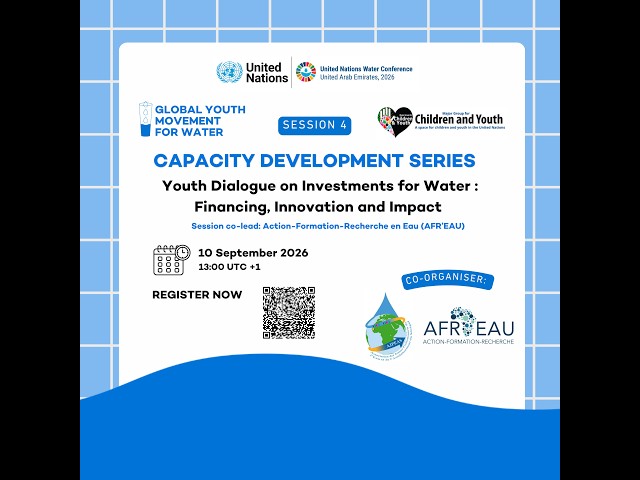
Water for Finance: Youth dialogue on Investments, Financing, Innovation and Impact
Watch on YouTubeVideo summary
The recent youth dialogue organized by Afro, a Malian youth-led organization, addressed the critical financing gap in the water sector as part of the Global Youth Movement for Water, preparing participants for the upcoming 2026 UN Water Conference in Abu Dhabi. Speakers highlighted that while public resources are constrained and private capital remains limited in developing countries, bridging this gap requires more than just commitment; it demands concrete investment in human capacity, innovation, and decision-making spaces. Dr. Amadu Gay emphasized that effective water investment must treat young people as entrepreneurs, engineers, and leaders capable of designing and maintaining sustainable systems, thereby transforming the demographic dividend into a "water innovation dividend" through access to skills, finance, technology, and networks.
To move solutions from pilot projects to scalable, revenue-generating models, practical steps were outlined that address significant barriers such as viable business cases, local community acceptance of pricing, talent availability, robust data systems, and appropriate legal structures for investment. Pratish Prasad noted the mismatch between large-ticket global capital and small-scale local needs, suggesting the formation of consortia or the use of innovative tools like social impact incentives and results-based grants. Furthermore, Chedd Moripe contextualized these efforts within broader continental initiatives, including the African Union's water leadership panel and South Africa's G20 presidency, stressing that only about 10% of fiscal budgets in many African countries currently go to water, leading to dilapidated infrastructure. He argued that solutions must include climate-resilient infrastructure, transboundary cooperation, disaster preparedness, and governance reforms to prevent corruption, ensuring that investment serves people, prosperity, and the planet simultaneously without burdening future generations with unsustainable debt.
Youth speakers also advocated for long-term infrastructure investments that benefit current generations while remaining functional for future leaders, urging young people to actively engage in consultations and hold authorities accountable. They called for the establishment of an annual UN commission dedicated to water issues, similar to existing commissions on women or disability, highlighting the convergence of Sustainable Development Goal targets 1 and 5. Examples of successful youth-led enterprises like Sanergy, JIBU, and Project Maji were cited as models utilizing franchise systems and community ownership to generate revenue and involve young entrepreneurs. However, challenges remain, particularly regarding access to credit and climate finance when competing with industrial projects on price, as well as the fact that approximately 28% of available annual financing in Africa remains unspent due to difficulties in planning, procurement, and operation.
In conclusion, the session underscored the necessity of securing a defined space for youth voices ahead of the 2026 conference to ensure intergenerational justice and effective implementation of water goals. Financial data revealed that household tariffs cover only half of water sector costs, with taxes covering a third and private financing remaining limited due to repayment risks, necessitating solutions like government guarantees for domestic lenders and revolving funds to test market viability. The overarching message was clear: turning commitments into local impact requires youth to be trained in skills transfer to maintain infrastructure and secure future financing, ensuring that water systems are not only built but also sustainably operated and financially viable for the long term.
Read the full video transcript
Afternoon everyone.
Uh thank you. Welcome to this youth
dialogue on investments for water
financing innovation um and impact. My
name is Hadi Toué Gindo. I am president
and co-founder of Afro which is a
youthled youth supporting organization
based in Mali and it is my pleasure to
moderate today's conversation. So this
dialogue is organized as part of uh the
global youth movement for water and UN
major group for children and youth
initiative. Um it is part of a bigger
capacity development series. This is the
fourth session. Uh there has been some
uh webinars in the past on the different
interactive dialogues themes and this is
all uh subscribed to the 2026 UN water
conference. um that will take place in
December in Abu Dhabi. So the goal of
these capacity building series is that
you ask all the questions during this
webinar so that you are ready um you are
ready uh for the conference if you're
about to take part. So we talk a lot
about the financing gap in the water
sector. So public resources are
restrained and constrainted um
especially when it comes to youth
financing right. So development
assistant alone cannot close uh the gap.
Private capital remains a small share of
water sector um investment in priorities
in developing countries. But for many
young professionals, entrepreneurs and
youth organizations, the question is
more immediate like what does water
finance actually mean for us? If you are
a young person attending um the UN water
conference and a session and the
interactive dialogue in Abu Dhabi in a
few months, what are you going to learn
from that and what what are you taking
away from that discussion? So that is a
practical conversation we hope to have
today and we look at both sides of the
investment questions. How do we mobilize
more financing for water globally and
how do we make the money already
available um work better and be more
efficient for a greater impact. So just
sharing how some housekeeping rules uh
please place questions in the chat
throughout. Um so we have reserved about
30 minutes in the Q uh questions and
answers. Um and we will try to group
similar questions. So my colleague Yaya
will make sure to monitor the chat for
similar questions and um take on the
end. If we have more time, we'll open
the floor for real time questions as
well.
Um so without further ado, I would like
to welcome Dr. Amad Gay for his opening
remarks. Um
it is my pleasure to welcome Dr. Amadu
Gay, senior wash expert and deputy uh
sherpa for the Republic of Sagal and I
just had a power outage.
Amazing. Um for the UN water conference
uh in 2026. So as Sagal prepares to
co-host uh the conference, Dr. Gay is
particularly well placed to help us
understand how young African
professionals can engage in the momentum
that is building around the process. So
a young professional may hear about the
UN water conference financing dialogue,
investment programs and global
initiatives but still ask where are the
actual opportunities and how do I find
them? So I have the main question to ask
uh Dr. Gale which is how can young
African professionals and organizations
uh use the preparations towards the 2026
conference to become better informed
about financing opportunities for their
projects and initiatives.
The floor is yours Dr. Amedu.
>> Thank you Hadi for this nice photo but
also you can ask me the question as a
young professional. I'm still younger.
Thank you. Thank you. I really happy to
to join you today on Can you hear me?
>> Yes, we can hear you
>> correctly. Okay.
>> Uh really happy to to join this uh this
webinar. I think this the third or the
the forefront.
uh firstly it uh express the the
commitment but also the the engagement
of the global youth in general but also
the the African uh youth on this on this
on this process. Uh I I know this
process give us just a momentum that
maybe to raise the action that you
already have. we is not uh in a way to
to create the new one but I think we are
already there in this conference give us
the opportunity
uh to spotlight what we are doing but
also to create new initiative that can
be aligned on this conference. Uh as you
know this conference is about
accelerating uh SDG6
uh the SDG related to access to water
and and sanitation. Globally you know we
we have this crisis of access to water
and sanitation. But if you look at
closely the the report but also the
figure we see the the crisis the
challenges is more located in the in the
global south. uh where we have also the
most young uh generation or people uh
when we when we show the the global the
the the global population. Uh it's mean
that the the the place that the young
people can play on that because they
must be the the most one that be can be
affected uh on when we uh lack water and
sanitation but because we we are working
we are talking about maybe access to to
school when young girls go for for
carrying water water but also if they do
not have maybe some real disposion when
they have this in agent issue
uh it's point that the the young people
is really involved on on on those
process but if come really to to make
program to to make process uh we need
really to involve them on on on on those
process uh it's uh why if I may respond
to to discussion regarding the process
is about the commitment uh but I think
this commitment go on on the both side
the commitment of the youth but the
commitment only cannot maybe be enough
to give them how we can also give them a
space um to to to to translate the
commitment they they have and this space
not just to to give them room and have
maybe webinar on like that but how to
involve them on those process when scams
I think I I'm just I I talk about
Muhammad from UNESCO yesterday also
Alexia I say mostly if you see people
talking about youth on on the speech
Dana we we need youth for innovation. We
know we need youth for this. But the
question they we must ask ourself if
those youth you are addressing this
question are them ready for for for
innovation. Are them ready really to to
to play those those role? I think that
the investment can go on on that how we
can invest on the readiness of the youth
to play the role that really we are
pulling on them. Uh and this conference
this uh give maybe the opportunity uh to
to really to raise the the discussion.
It's not maybe the place to to to answer
all the question but also is a place
that we can ask the right question
because we have the the the mobilization
of the the the global youth actor uh
where we can really hear here on on that
it's why I I I will take maybe the
question on angle how to to invest when
we when we when we talk about investment
I I think when you open had you talk
about that the gap of of investment is
is is real that we we we know we know
how many billion we need for for for
that but the gap but the master uh also
question that another fundamental
question that we we we can ask how we
turn those investment into result it's I
think it it is the the main question
that we been and the answer is uh
investment in and water and sanitation
are only effective when we have the
human capacity to design implement to
operate but also to maintain uh and also
innovation around around them. Uh this
mean that uh investing in water is also
investing in in people and above all it
means investing in in in young people.
Uh on that young people are not only the
water professional of today uh or of
tomorrow but they are already
entrepreneur. We we have some
entrepreneur there. We have some
engineer, we have some researcher, uh we
have also
some leaders. How we can develop
solution today for for water challenge?
It uh mean also investing uh for more
efficiency because when we we do
investment the most question is how we
can be efficiency and sustainable and
impactful. And therefore we we we must
invest in the readiness of the capacity
of young people today. uh giving them
access to a skill finance technology
network and also decision making space
it it's really I will I will I will
point there how we can bring them on the
table where where we make decision
because they they must be also there
this is particularly important to can
also your in your question on the global
south where I you see young people
represent a large share of the of the
population while those country where
those those young people are are very
important also face great challenge in
in accessing basic water and sanitation
and hygien and and those those things.
This situation I think represent both a
challenge but also an an opportunity and
the question is how we can maybe turn
those challenge to to opportunity. For
that we need really a strong commitment
to turn the demographic dividend into in
in into water innovation dividend. Uh
and for that we need space. Uh for for
me the initiative church the global
youth movement for water can play an
important role in this effort by
creating strong link between young
people in also innovator. We should go
further by developing mechanism for
monitoring capacity building access to
finance and also support youth fleet in
innovation. uh uh the 26 UN water
conference uh
we discussion on water finance must
therefore
>> I don't have anything to deceive you on
of course
>> how much we invest but the right
question is we we we can ask ourself
uh must or where where where where how
do we invest in the people who will
transform those resource into impact I
think you you are linking investment and
and and and and impact. Uh but when we
invest who who who will turn this this
investment impact uh because we there
there will be no efficiency investment
in water without the people capable of
of delivering it. No sustainable
innovation without young innovator and
no effective response to tomorrow's
water challenge without investing in in
in youth today. Uh before concluding uh
I I know I have just five minutes. I
would like to sincerely thank all of you
uh and your partner for the this
initiative but also the contribution you
are bringing uh to this process
particularly through your reflection on
different interactive dialogue. uh I I
remember I I I I opened the dialogue
about uh water for people and uh today
we are
discussing about water for for for
investment
but as a co-host of the conference we we
are really welcoming uh your
contribution very positively. uh we are
also committed to to to do we will do
our best to create a space uh for young
people to share the your idea experience
and recommendation and to ensure uh that
the voice and meaningful reflection will
be uh appear in in the conference but I
I would really like to invite you uh to
take the next step. I think the
reflection is good but also we we need
also to go move forward also to take
another
next step to think about how those ideas
and recommendation can be translated
into action. Uh the real uh test of our
commitment will be at the local level uh
where water and sanitation challenge are
experienced every day with community and
particularly at last miles where the
most vulnerable population continue to
face the great barrier to accessing
those basic service. Uh we therefore
encourage young people not only to
contribute to the global discussion also
to reflect uh on the mechanism
partnership and innovation that can help
bring the solution to communities and
create real and lasting improvement in
the life of the most vulnerable. Uh this
is where the true impact of our
investment will be ultimately be
measured. Thank you again for your
engagement, your ideas and commitment.
We look forward to working with you as
we move from dialogue to action and from
global commitment to local impact. Uh
let us invest in water but let us invest
in innovation. But lastly above all
let's invest in the young people who
will turn this investment into impact.
And thank you for your attention.
>> Thank you very much Dr. Gay and I very
much enjoy what you said about
empowering the youth and really making
sure as a co-host that they are part of
the process and also beyond the
conference. So thank you again um thank
you for always championing the youth
being a young person yourself. So we
will now unpack um that investment
ecosystem from three complimentary
perspective. Uh to open our main
discussion, we are very pleased to
welcome Chedd Moripe, chief director for
global cooperation and strategic
partnerships at South Africa's
Department of Water and Sanitation and
Sherpa of the Republic of South Africa
for interactive dialogue f investment
for water for the UN water conference.
JD brings extensive experience across
water governance, international
cooperation and strategic partnerships
as focal person uh for the Africa water
investment program and co-chair
representative of the ID on investment.
He is closely involved in shaping the
investment conversations ahead of the
conference. So we will start um again
with the big picture and J um the floor
is yours as well.
is shady here.
Let me see
from the list.
>> Adis, sorry. Uh, I just uh got a message
from from her. She say she just come out
of minister ministering meeting. She she
come soon but now she's not with us.
>> Okay.
Okay. Um it's okay to zoom in and then
zoom back out again. That's part of the
process. So um I know um let's say
we will pass it over to Nicholas
uh whose intervention is really about
closing the financing gap more money and
better use of money. So joining us is
Nicholas Tandi, global head of water at
SNV. Is Nick here?
Let's see.
I'm seeing people have a bit of
difficulties uh joining
the session.
Yeah, I don't think Nick is here yet.
So, we'll do I see Pratish. So we'll
pass it over to Pratish um on the
promising pilot to investment ready
solutions. Our next speaker um let's uh
we're getting there is Pratish Prasad
impact and knowledge management um
knowledge management officer at Aqua for
all. Pratish brings close to a decade of
experience across invest is invisory
impact investing developing finance with
experience spanning India, Africa and
Southeast um Asia. His works uh his work
focuses on investment and impact
investment assessment portfolio
monitoring and helping promising water
and sanitation solutions strengthen
their impact and of course scaling. So
that makes his perspective especially
relevant to one of the most practical
questions for our audience today. How do
you move from just a promising idea or a
pilot to something that is willing to be
financed by institutions? So uh Pratish
if you're here I'm ready we're here for
you.
>> Yes I'm here. Um
I was thinking of doing a bit of free
flow conversation. Um
so
no slides but if you want slides I have
them I can send it to you later but I
think for the ease of conversation and
accessibility I think probably talking
through it uh is helpful. Um so today I
think my larger focus is also to speak
to the youth because I also bring some
experience in my previous uh roles where
I have also worked with uh UNICEF and a
lot of youth uh related strategies. So I
really see a lot of potential um in
youth and youthled organizations to um
to really work on the water and
sanitation solutions from from various
angles and uh above all water and
sanitation is uh is a local problem to
solve for. So uh no ma matter uh how we
channel funding from other places uh the
delivery all of that has to be really
local. Um so that is where I think youth
really have a lot of role to play. Now
before going to um
all of um the specificities uh I think
we all understand why this sort of
conversation matters. Now we are all
aware of uh the financing gap that
exists and how much uh work
is needed still to make sure that
everyone has access to water and
sanitation.
And um
other challenges that we also see in
especially in the emerging markets is
that where there are already
infrastructure and connections available
they are also facing
uh challenges in terms of um non-revenue
water efficiency aging infrastructure
um and I think to solve for all of this
the biggest asset that we really have uh
looking at global south and especially
Africa
uh is the uh demographic dividend as um
Dr. K just uh mentioned.
Um and another challenge that we have is
the traditional funding sources are
shrinking.
Uh so typically grant funded
uh missions and grant funded solutions
to a lot of these problems
uh are not sustainable anymore. So we
have to start looking at uh solutions
that are that could be revenue
generating, self- sustaining
uh and can eventually attract more um
more private finance to scale and be
able to reach um everyone uh that
requires it.
So now when we think about wash
uh
as a sector it is often uh that we look
at it as a monolith which is this big
infrastructure that is delivering water
to people and uh that also makes it a
bit more difficult to place uh smaller
youthled organizations and movements in
uh in response to such
uh such an infrastructure project,
right? So, how do you sort of bring it
together? So, if you
look at it more from a value chain point
of view, you would understand that there
is one entire operation of you know
extraction, delivery, operations,
maintenance and all of that. Uh that is
one side of the equation. Then there is
uh all the
uh aligned allied functions which has to
do with data monitoring um which uh
ensuring quality ensuring um efficiency
of the services. Uh that is one part of
it. Second is all the
technology that is required for this. Uh
in a lot of times we are dependent on
uh foreign vendors and foreign
technologies that both make it expensive
to source uh
uh in local fluctuating currency
situations
uh and all of that that could uh make it
really challenging. uh so finding
alternatives to those
um
can uh can open up uh some more
opportunities for uh sort of younger
organization. Then there is this entire
piece of systems policy and advocacy uh
which is um a making general population
aware of uh the need for uh safe uh
drinking water and especially safe
sanitation and how it has multiple
uh layered roles to play in improvement
of quality of life opportunities
especially for women. Um,
sorry, I was looking at the chat. Uh,
probably Elanar, I can come back to it a
bit later.
I think one of the uh or if you quickly
want an answer to it, I think um
there are organizations that engage uh
young people for water quality testing
or data collection and things like that.
I I can't recolct uh which organization
that was but probably uh I can relate
back um at a later point but I was also
aware of some of the school projects at
Hadi you were mentioning about uh where
young children are involved in uh some
of these work
um so where was yeah system policy and
yeah yeah so one part is to making the
community themselves aware of
uh the necessities uh or demanding uh
quality water and sanitation services
and how that impacts people's lives uh
and the benefits of it so that there is
a viable business case for people to
start offering these things.
Um so
um that can really create uh a demand
not just for private services but also
That could also create um demand from
the local uh
regulators and local uh representatives
to address this at the policy level uh
create
things to to happen. Now what are these
things that needs to happen right? So
whenever now we were talking about
making solution scale from pilot to uh
to a sustainable model.
Um
so usually pilots get funded from
say grant money. Um and the moment you
are moving to scale, you require
multiple times of the same
um
multiple times the same u capital that
probably you invested in pilot.
And
for that to happen during pilot, there
are a lot of things that you already
need to have in place. And at at the
stage of a pilot itself, you have to
start thinking about how are we going to
make uh revenue in a way it is also
going to be affordable to people that we
are going to serve it. And that is uh
that is one part of it that revenue
model you need to uh figure out test out
if it is acceptable by the um local
community when you're operating.
And then are you also mapping out
uh not just the infrastructure and scale
that is required to scale that pilot but
also the associated systems. So you
would require uh
experienced people and talent
for when you want to operate at a scale
which
is very easy to do when you're doing a
pilot because uh you need fewer people.
You can kind of also get those things
done by having a consultant or a
consulting agency working on it. But the
moment you have to scale this, you need
to
quickly require a lot of talent at
scale. So if you don't already foresee
that and start investing in some of
those things uh leveraging some
solutions to get you to get trained on
some of these things where you already
planned to take this project at a
scaling phase that could become very
challenging
uh and may not really fare uh as you
expected before. Third is
um the process and data systems. So
during pilot you also have to think
about what are the data that you're
going to collect and again the
difference comes in when you're doing a
pilot uh the scale of operations is
smaller the cost of collecting data
processing it all of that uh looks very
different than when you have to do the
same thing at a scale uh so how are you
going to invest in a system um without
that the the cost of all these auxiliary
functions also growing as as the project
is growing otherwise then the scale
scaled model of the same thing will not
have the similar
uh
financial uh or unit economics. So the
the margins that you're expecting are
already thin when you are operating in a
affordable revenue range and on top of
it if you add all these costs which are
going to increase by multiples of it it
will stop being
um
being viable for somebody to put money.
Now the third thing is also not every
entity is fundable by all kinds of
capital.
Uh so probably a pilot is hosted in
inside a cor inside an entity which is
say is a nonprofit entity which can
accept grants.
uh but the moment you need investments
you need an entity where people can
become shareholders. So you will have to
look at local laws what kind of limited
liability corporate entities exist and
this project need to be placed within
such an entity so that you can actually
attract
uh investments and make them
shareholders
in your company. Uh and the other part
of it is if it is going to be uh more
banking solutions and banking solutions
you have to look at what are the local
banking laws what kind of loan products
are available and for that do you
require to have a lot of collateral is
your business really
uh something that can have these kind of
collaterals and you start building some
of those things uh at that stage. So
those are the things that you can sort
of do at the
when you're already designing pilot or
you're coming towards an end that how to
shape some of the things already so that
it is geared towards scale and you're
not thinking about okay after this pilot
we are going to start something new and
raise funding for that pilot and given
the trend how the funding is going it is
also going to be challenging in the
future to get similar kind of funding
for same kind of work, right? So a lot
of grant for again doing a lot of
nonprofit work
could be could be challenging.
Now an enterprise can do a lot at their
own level uh to set it up but that that
still is not enough for
for at scale to mobilize money. There
are also uh barriers at market and
instrument level. There are barriers at
system level. What we spoke about just
now are all the barriers that we see at
the enterprise level and we can already
plan and address them. But what the
other thing we have to look for in the
market is um
the kind of ask of money that we have
the that is the ticket size of it. How
much money are we going to ask
and what kind of money are we asking? Is
it a grant um or something in between or
up your commercial terms and the
timeline of it?
All these things have to then fit the
needs that we have at the enterprise
level. So that is another sort of
matching exercise
um that as an enterprise you can try to
do it but if something is not available
that makes it very difficult. So what
you see from the global north a lot of
capital that comes in usually comes with
bigger ticket sizes but relatively maybe
smaller
timelines which does not really fit it.
So those are the things also to think
about maybe build a consortium which can
accept this bigger ticket size and
subcontract and you know solving for
that. Now the third and the largest
barrier is at the policy level uh
because water especially is governed by
the local tariff laws
uh which itself is a very political
topic. Um so getting it to reflect at
least the cost that goes into providing
services
uh can be an uphill task. So that is
also some of the areas where youth level
youthled advocacy and all of that can
play some role
uh to make more reasonable regulations
around tariffs. Then the other part is
how the capital market laws themselves
are structured in a country. How easy it
is for foreign investors to bring money
of various kinds, have ownership in uh
companies locally. How easy it is for to
once they make profit to take that money
out of the country. These are things
usually not within the scope of uh
enterprises but really affects how money
can come in or go out or how much we can
actually mobilize for some of these
things despite having the need and
everything in um in place.
So tying it all together in terms of
taking pilot to
uh say a larger stage
uh I think we already spoke about what
pieces you can already think of when you
are designing a pilot and running it uh
to uh be ready for scale. Second is I
think because of the priority of the
sector there are uh including the
organizations like Aqua for all we have
instruments
um
innovative instruments that target uh
impact alongside uh financial returns.
So it can be sing which we call social
impact incentives or uh results based
grants technical assistance. So keep an
eye out for those kind of uh actors and
instruments and opportunities
uh to apply for some of these kind of
funding. Um also look at um
integrating again data and impact
system. Say for example Matt is a free
system uh which somebody can um um
just requires technical capability. So
you can they also provide like free
trainings. You can join some of them uh
have um
like data oriented uh capacity built
into your enterprise early on so that it
becomes easier for impact focused
funders uh to provide funding.
uh having audited financials,
um good financial management practices,
SOPs uh for your processes,
um
clarity on the skills that you require
and uh you know finding communicating
that and getting talent uh developed
around those thing those uh those
specific skills.
Uh so yeah I think uh those are the few
things that um
you can already start looking at um when
you're thinking about pilot and trying
to take it to uh to scale.
>> Thank you very much Pratish and I really
like your approach of having this as a
conversation instead. I think uh this is
where you can really pick on um people's
brain and what they really think when
you uh mention these big words of
bankable projects investments and you
know just the overall multilateral
processes jargon sometimes um that we
try we we use and if you uh to the
participants if you have questions for
Pratish please just note them down um
and then we'll leave the floor uh next
we were having some difficulties with
some speakers that um weren't able to
join I think uh thanks to uh because of
the registration link. I hope now
is back here. Ned, can you hear us?
>> Yes, I can hear you. I'm not sure what
you do.
>> Yes. So I had already introduced you as
a co-host for uh the interactive
dialogue on investments for water uh
from the South African side and you are
co-hosting this with France and um we
would really like to hear from your
perspective. I know we zoomed in with
Pratish but we'll zoom back out again
and um just getting hearing Pratish and
what he has to say practically from
young people. You can also share what
your perspectives are at a higher level.
>> Thank you. Thank you very much. Um
and I really have to apologize to all
participants on the platform
uh because of some technicalities and
you know meetings that goes beyond time.
uh but uh firstly let me greet everyone
who's here all the speakers all the uh
contributors and uh I know that some of
those who were on the concept are
colleagues that I worked with a long
time and for for many platforms that we
did together I don't know if Hank is
here I would like to greet him and Nick
Tandi is one of the guys that I work
with and um I know that we have the
co-host that we are the co-chairs as
South Africa and I saw Amadu is here I
don't know I saw him somewhere on the
list and my greetings to him as a
colleague that is too tied to me now and
I just want to say that it's good that
this platform was put together and uh
it's important actually for such
platforms to be put together by youth
the level that must be really
concentrating on what is happening today
because today determines tomorrow and uh
I want to say as co-host of this
important um uh ID uh we call it ID
because they call this interactive
dialogue. It's a dialogue that must h go
on. It's a dialogue that must be
consultative. It's a dialogue that
allows contributions. So we have been
doing this right from January after we
were announced as coaches with France.
We did a lot of them about eight of
them. The biggest of them was the one
that happened in Washington during the
spring meeting there. And we got a lot
of inputs right from there and in Ducham
and everywhere. And I want to take you
some few steps um back on what brought
us as Africa. Uh I'm going to include
Sagal because they were part what
brought us here and I want to include
Netherlands where Hank is coming from
because they were part as Africa we've
been going as if all is normal and we
have not been able to achieve on uh
providing clean water to our people as
if that was normal only after the then
SG UNG G decided with the well bank to
put together what they called the high
level panel on water which was
established and had 11 sitting
presidents in the panel. Uh they
appointed those 11 sitting presidents.
We were part as South Africa and I am
happy to say that Africa had three
countries that were participating there.
It was ourselves, Sagal and Mauritius.
And uh through the two years 2016 to
2018, we went on to engage and try to
check what is the problem with the whole
issue of SDG not moving because we
failed to do much during the the MDGs
and we we we then came into the SDGs
which uh you know that we are told we
are off track in terms of uh
implementation of SDG6.
Therefore
uh that high level panel had shepherds
who went on to check what is the problem
in all continents because we had
representatives all almost everywhere
and with Africa the outcome said Africa
requires a high level panel that will
deal uh
specifically on investments uh for water
in Africa and uh I know that there was a
lot of out outcomes or even
recommendations for all the other um
continents and areas and and countries.
But Africa took that recommendation to
heart. We came back and we reported to
the a to the AU. We worked on it and in
short that the AU appoints a panel on
water which is at leadership level that
would really look into this and dig down
to see what is this challenge of
investments
for water in Africa and uh we started
that in 2022. We worked on it. We took
uh the resolution to the AU. It was only
approved in 2011 where seven presidents
came on board. Sineagal being one of
them. They always have been on track and
they've always taught the same line to
make sure that we don't lose on what
came out of the two years of
investigating the challenge of water.
And we came in also as as South Africa,
Namibia came on board and
Tanzania and and and Zimbabwe and them
and that panel was established. The
leaders looked into it and the AU
approved it to say please go back and
look into it. We started first by uh
coming up with programs that were
launched when Hank the Netherlands and
Tajikistan hosted the first water
conference in 2023. We launched that in
investigative kind of program that was
saying uh we must make sure that we look
into this challenge and uh we we we we
had to revert back and say what is this
challenge and put it in front of the
leaders. We even came up with a program
where we award presidents who took care
of this program on and and who made sure
that they elevated water in their
countries. That program is still on. We
call it a the leadership program where
we are what those who are making a
difference. Every big conference where
we go, I think we'll do the same when we
go to the h to to the UAE to award those
um
leaders that we call change makers in
the water sector. But then going back to
the actual issue, then we started
digging out what is the challenge. The
challenge became that 10% of our fiscus
in other countries even two to 5% it's
allocated to water whether water makes a
lot of maybe um money into the
municipalities or every anywhere money
would come out out of the revenue of
water but it will pay for other things
maybe electricity roads and whatever
water will just get the least money that
comes out of where actually the money.
Therefore, the issue of taking care of
instructure in infrastructure on water,
the issue of paying for new
infrastructure, the issue of budgeting
for maintenance of of water
infrastructure became a challenge and
I'm not shying away from saying that we
know it as Africa that that is most of
the that is the biggest challenge that
we have in most of the countries where
infrastructure is dilapidated. We cannot
maintain it because there's no budget
either from the fiscals or even from uh
any other
uh revenue that we should come from.
Even if the the budget is out that
budget will be doing other things
outside the water
circle. Therefore that was tracked and
everyone would know that last year in
2025 South Africa hosted the G20 for the
first time in the African so in that we
took it again from the HLPW
high level panel on and say we've got
this that we have to track this that we
have to follow this that we have to
bring to the attention of all leaders
and ensure that we make change in in the
water sector. We took it to the G20 and
the G20 h we did not have a track. We
had we had no chair on the table of the
G20 to discuss water but we maneuvered
we made sure that through South Africa
being the president of G20. We took it
through the South African presidency. We
I don't know if I should say today now
that we we managed to say that we put it
through the window. It got to the table
and it was discussed and the outcomes of
G20 everyone can go and Google uh G20
2025 South African presidency you will
see that it is within the outcomes of
the leaders declaration we managed to
put it there. It is after that that um
we were ready as South Africa because we
took time engaging in this from 2016
tracking it from the time of the high
level panel on water to G20 to the AU
and everywhere and then when Sineagal
became the co-hosts they had to appoint
12 countries that would do the six
thematic areas that they are dealing
with and we we we raised our hand as
South Africa to say that we are also
ready because you had to submit
and and and and and say that we are
ready. We think we can handle this. As
South Africa, we knew that there are
five uh ideas or thematic areas that
happened in 2023. They had only five.
The investment on water was not there.
Now we had the water for people, water
for prosperity, water for planet, water
for cooperation and water for multi
multilateral process. I think we are now
having investments for water which is a
new uh idea that came in. you will agree
with me that if I go back and say uh
there's water for people, there can't be
water for people if we don't have
investments for water for people to be
able to get that. When we talk about
water for prosperity, it means there
must be water for development, water for
improvement of the lives of people. If
improvement of infra, there must be
prosperity, which means uh we must
enrich every country. Every country must
see the prosper out of the the the the
availability of clean water and
technologies that would be there
available to ensure that we develop in
terms of water. But then what do we need
to do that? We need investments in the
water sector. If we are say it's water
for planet, we are now talking about h
issues of disasters. Climate change is
on our you know on our heads. Every day
you go to the news, you hear about
floods there, droughts there, whatever
there. There's all sorts of things.
Glaciers are melting. Everything is like
in a mess. That requires a funding. That
requires, you know, disaster funds to
act on. That requires infrastructure
that would be climate change resilient
to be able to be there even when we get
the floods tomorrow morning. We should
still be able to pump water and clean
water and what not infrastructure that
will be swept away when we get floods
and whatever. We are not saying that
that would not happen but we need
infrastructures for water that will uh
resist and be sustainable
uh more than what we seeing today. And
uh when we talk water for cooperation I
am worried there because that's now the
transboundary issue. We all know in our
regions that trans boundary is one uh
area that can create battlefields.
People fight for water. People hot water
they stop it somewhere. It mustn't go
flow to that. They don't agree this
water belongs to that one. And that's
where the start of wars comes. And we
have been hearing in the news that where
there are wars or even conflicts I can
say happening we hear that people there
might be deprived of water can be
weaponized everybody knows that if you
don't have water you not going anywhere
you might not live for a certain period
because our bodies are made up of water
to a larger extent so water is something
when people say water is life. It's true
because if you are deprived water, you
you you can't live for long. You can't
go far. You will lose your life.
Therefore, it is important for
governments or leaders to make sure that
the issue of cooperation is looked at
and it's protected so that no one hot
water or stops water from flowing to
that country. downstreams and upstreams
and what people must work together,
rivers that we share and uh you know
aifas that are that we share. We need to
be able to do agreements and work
together and that requires a h
investments or
different member states that are sharing
this thing to build infrastructure that
they share as South Africa if I can say
even today as I'm talking I'm just
coming out of a meeting we share water
with lysoto a lot depends on lysoto for
water 70% of the water in job and and
parts of South Africa is coming from
Lysoto. The infrastructure that is
sitting in Lysoto is funded largely
almost 80% by South Africa. Why? Because
we know the importance of cooperation
for water. When we talk about water on
multilateral platforms it or processes
it's important because we can talk about
all of these things. We need a place, a
platform, a house, a roof that can look
into all of this and make sure that what
I was just talking about to say h we
need to have money to do this. We have
money for the water FOR THE PEOPLE.
SOMEBODY must be able to moni in a
platform to say that it's happening.
Yes, the investments are going. Yes,
we've got infrastructure that is
resistant. Yes, climate change has been
responded to. We have a h awareness. We
have all of these things. We have h
early warning systems in countries so
that people are not just swept without a
warning that there's floods coming and
all of those things. Therefore, all of
those things h together packaged. We
need investments to have this trail of
interactive dialog dialogues funded. And
then we can go out and say investments
for water. But what are we investing
for? We are investing for people to get
money. We are investing for prosperity.
Therefore, we find ourself um I I said
what I said just to bring it clearer to
you that this is one idea that is very
crosscutting. It can't work for itself.
We invest for all. we going going out to
look for money and make sure that
governance in all areas it's it's good.
Uh sometimes it's not about money. There
are countries that can still put up some
fiscals up to do infrastructure to make
sure that water reaches people but the
challenge with that becomes the in the
governance issue. money is getting lost.
Whatever corruption and what there's no
stable kind of governance processes that
are happening that makes it difficult
for investors even to come in to make
them even move further. Therefore we we
need skills transfer. That's where the
youth comes in. Skills transfer must
come to the youth so that going forward
you are the ones who maintains this
infrastructure that was invested in so
that we can be able to pay back the
investments. So that the investors must
be sure that when we invest in this h
product it will bring back the money.
They will be able to pay for it because
they will go back and and collect
revenue. the revenue will be used uh
profitably and will be used to pay back
the money so that we can do something
else after paying the first maybe big h
investment
uh thing that we took. So I I am saying
this with a a heart that actually
requires understanding from all of us
not yourselves as youth. You must be
worried about tomorrow. Worry about what
we say today and what we do today to
prepare tomorrow for you. Because if we
take investments that we can't deal
with, we are making it difficult for you
tomorrow. If we take investments and not
take h care of those h infrastructure
uh things that we did, we making it
difficult for you tomorrow because you
are going to come there and find your
country with big debts that you can't
deal with and there's no infrastructure
that you can point at. Therefore, it is
important for the youth to contribute to
this process to say yes, we want to see
uh investments for an infrastructure
that will benefit us our parents and our
and us today, but still be there when we
come in as leaders.
Still be there when we come in as
leaders. We shouldn't do investments and
put things here and when we go away
everything is wiped wiped off. You come
in, you start from the beginning as the
youth. Therefore, today is a platform or
a stepping stone for your tomorrow and
uh make sure that you sit on us as we
engage as we consult like today h as
Praep was talking. Make sure that you
sit on us to represent you correctly.
Make sure that you are there to make
sure that you contribute and you hear
your voices in what we say today because
then otherwise you will not uh hold us
accountable tomorrow when you come in
and find things disarrayed or not waking
up. Therefore
uh we we are now counting minutes. We
are on a countdown to come off the
chairs. you will be taking the chairs uh
from us. Make sure that you find the
chairs seated where they are around the
tables for you to be able to do that.
Those who are in engineering as youth
make sure that you follow and track um
water for planet make sure that you know
what is happening. Those who are
political in mind make sure that you
follow water in multilateral processes
so that the UN can house water
somewhere. If you know what the UN does
annually or you hear about the big
programs and and annually, there is
always what we call CSW
H commission on the status of women
annually because that was identified as
a problem. There is a commission
annually that talks to disability. There
is a commission that talks annually to
issues of um issues of
say population development on
data on whatever everything on health
and on everything. Therefore, let's make
sure that there is a commission annually
that tracks issues of water just like
all other commissions that tracks
everything. This is what uh this uh ID
number five water on multilateral
processes should look at. As a ID number
six ourselves, we are working very
closely. We are required to converge
somewhere or to look at interlinkages
between the IDs. We identified ID number
one, water for people and ID number
five, water for multilateral as the
closest to us because we want somebody
once the investors are saying we are
available and not leaders to be able to
go back and work on their policies to
allow investments and work on their h
ministers of finance to work on h you
know their governance and you know
everything that scares investors.
These are leaders who can go and make
sure that that happens in their
countries. Therefore, it is important
for us to be closer to that multilateral
process because there must be somebody
who's going to follow up on the
recommendations that comes out of all of
this like we did in 2016 to 2018. It the
outcomes and the recommendation are
still alive. We are still talking what
we spoke uh about in 2016. We never
thought we will come to this level of of
talking about investments globally in in
in URL next week in the UN we will be
gathering leaders to launch the GIP
global investment program because in
Africa it's there. Our leaders endorsed
it at the U AU level. We are tracking
it. We are following it. We are doing a
pipeline of projects. We are working
together under the AU with the outpat
and everyone. It is only for countries
to be inquisitive and know what is
happening there and make sure that they
tap into that and h ensure that they are
members they are their people their
civilians everyone can be actually to
take something out of it. Now we are
going global. We are rolling it out. We
are scaling it up for other leaders to
come in and do that in other in other
provinces. I mean in other regions and
all of that. We know that in you know
the world can never be the same at the
same level. We've got countries that
even doesn't need this. They might even
think we are mad when we start talking
about these things because they are at
another level. The challenges at
globally can be the same posed by
climate change and everyone but the
needs are not the same because we are
not at the same level and the technology
is there but we don't access it the same
way and we are not at the same level on
technological level. Therefore, the
youth that can go out there and acquire
that knowledge and train themselves to
come back. Do that for the benefit of
your coming generations, they must come
and have change that was brought by
yourselves because you started today
tracking this process that must live on
to make sure that all the regions Africa
particularly as I'm here. I want to hear
when I'm all sitting at home that you
guys are still on track. You are still
working on this and we we are going to
win. We are going to see our grandkids
living in better
uh conditions, getting water from the
tap that is clean. We can talk about
other challenges but not a challenge of
uh not
worrying about development. Development
is important. Hence, water for
prosperity is about that. We want to see
movement in what we do. I'm here for
questions. I know that I came late and
apologies for that. I will await
questions. I listened to the
presentation before me. It was very
interesting and uh he spoke about a lot
of things that we are looking at as the
ideas. I didn't want to go
into those technical issues. We have
them here. Those who should talk to that
and I'm happy I'm here with you. Thank
you very much.
>> Thank you very much.
I think this was very inspiring. I could
I could I could see and we were very
motivated as well from your kind words
and encouragement as a young uh people.
I think Amadu has a comment and
reflection on what you said. So I will
leave him uh the floor.
>> Yes. No just my my my sister's shady
cannot introduce you without
having any comment on on that shi we we
really want to to thank you and also
>> to recognize
the great work that you are doing on on
as a co-chair as an African cause of the
this conference we are really proud all
of cochair coming to to those the global
south but mostly South Africa that the
the leadership that take and you you
demonstrate it. Uh you do not take talk
about only the the IDF that you are
sharing but also you do the cross
cutting between the the the the old
ideas. is mean also the the implication
that you have on on that also the great
experience that South Africa have on
raising the issue of uh investment on on
on on water at the highest level at the
highest level that I think you you come
on on on on that and I I share really
all what you you say here but uh you
know I I know you are working on on on a
flagship to to see how we can raise I'm
I'm as a young people I'm I'm just
working for them how to place also a
flagship for how you finance the project
from youth the entrepreneur the water
entrepreneurship I think it'll be great
maybe to to see how we can explore this
opportunity on on on this conference to
having something some some something
that are really focusing on how we can
maybe finance or have uh dedicated
channel or area that young people can
can go and and and carry uh maybe
finance to to to put their project at at
this spot because they have many ideas
but at this level it will be not easy
for them maybe to mobilize money how we
can create this facility for for young
people also to have to to having this
this opportunity thank you for for all
and happy to to see you and I think we
will be in ha inshallah but I'm not
tired to see you always happy
>> thank you Amadu for your inputs I I
think uh this like she said in the
beginning, right? These are her old
friends. Uh you can't really go without
each other. And um of these friends are
also Nick um Jedi mentioned Nick who
tried really effortlessly to join um the
webinar and he was in for a few minutes
and then his mic was not working
unfortunately.
um I don't see him again and we from
exchangings in preparations for this
webinar he was very keen and excited
that this initiatives was taken from
young people so I will really make sure
that he saw us get transferred to you um
unfortunately I don't see him online so
we will have to move on
um yes so you heard many perspectives on
and we will also share share um the
slides from Nick uh to the participants
so you can get a a sense of what he
wanted to share. So it'll be really
interesting uh for us to hear from you.
You've heard from uh the bigger
multilateral processes. You've heard
from the insight of what really happens
when uh policies are being made, when
countries get to talk to each other. And
you also got to experience like what you
uh what you need from the ground to get
your idea from a pilot to a full scale
project. And I think as young people
there's many entrepreneurs um that
really are eager to exchange and get in
touch with um um our participants and
participants to the panel. So I would
leave the floor to first some questions
that were asked in the chat. Um maybe
yeah you can try to read some of the
questions that weren't answered uh
before and we'll try to see if Nedi and
Pratish can answer them.
>> Okay Adidi thank you for the floor. I
think u we have some question practice
try to to response that in the chat from
do the speakers have any example where
young leader organization have been
integrated into invest in investment
where I mean capital and investment
projects
that's the first
And uh yes I think
>> maybe we'll see we'll see if Pratisha
has something to answer. Um you can open
your mic and add um if you if you feel
like
>> thank you. I uh shared some examples in
chat itself. So uh there are few
projects for example Sanergy now it is
called fresh life which was started by
young MIT grads uh who run their O andM
on a uh franchisee model and this
franchise are run by uh young
entrepreneurs. Uh similarly you have uh
JIBU
um in Rwanda, Kenya, DRC and Ghana. uh
their model is also in a way to
capitalize on young entrepreneurs. uh so
they take care of a lot of uh capital
part uh and runm themselves. Uh whereas
uh the franchisee owners are again uh
young people. Um project maji does uh
these modular
um
solar powered uh water kiosk and how
home delivery services. Uh so they raise
grants from philanthropies uh to set up
this for the first time but then the
focus that they have is that there is
community ownership of the model. So
that also targets uh sort of young
people as uh operators for that and they
are paid from the uh revenue that they
generate from sale of water. So yeah
there are there are quite some uh
examples.
I hope that answers um Eleanor.
>> Yes. Um thank you Pratish for sharing
this. Uh when you talk about this I I
know we have um Sanata in the team who
actually just came back from Kgali. Um I
know they had a full innovation track, a
youth innovation track and many young uh
people organi youthled organizations had
the chance to to share and pitch to uh
potential investors. So I'll invite her
to speak and also maybe give some
contribution on the topic.
>> Yeah,
>> good morning everyone. Uh my name is
Samira. member of AFO and I would like
to thank all the organizer and the
speakers who really brought a really
deep insight today. I think it's
complete already what we have been
talking in Kalia. So the youth dialogue
uh was much more about highlighting the
innovations uh
innovations that the youth the African
youth is really bringing in the sector.
So we we were lucky to say um to see
many you know innovation as we talk
about nonrevenue water uh there were
innovations about how to uh involve more
the communities in the water sector. I
think the main thing that came along is
the the investment issue. You know many
of the youth especially in the circular
economy uh track we had many um
innovations coming in but the youth uh
was already struggling to have you know
the credit or the the investment from
you know it can be climate finance it
can be u other sources. So we were
asking the question how can the youth
you know really have access to those
funds
and uh that was the bedroom because we
have always been talking about youth
capacity and I think this uh symposium
highlight that the youth really already
have the capacity but they need more you
know space more funding you know to
excel their project. So how can the
youth already have like uh those joint
venture um opportunities with big you
know structure that already have those
access to those climate finance or big
investment regarding uh innovation or
regarding you know advancing access to
water and sanitation services. So it was
really um interesting to have um the
perspective of uh people that are uh
already in this um investment uh how can
I say channels investment structures and
uh from uh today's discussion I think
that I also have a question to all the
the the speakers here. So how how can we
advance that? How can we really take
this farther? How can we really put the
youth like to build more trust around
the youth innovations and uh encourage
even the people to use those innovation
because uh one major example that came
out was about the product coming from
the sanitation circular economy but
those product could not compete with the
industrial maybe
industrial project coming on the market.
So they were much more lower price and
uh people tend to go towards those um
innovations but the circular economy uh
things like the innovation brought about
the youth
>> maybe uh looks more
>> expensive maybe to the communities but I
think they also need some type of
regulations to make of course.
So that was my take about
this in Kali and thank you again for for
organizing uh this session. It was
really insightful and
>> thank you Satan.
>> I think Nick just joined. I'll try one
last time. Uh can you hear us Nick
because he can actually answer the
questions um that you just had. Nick has
a lot of experience working with the
World Bank. Um, and he just disappeared.
Okay, we tried.
>> We tried everyone.
>> Hi, honey. Can you hear me?
>> Hi. Oh my god, I'm so happy to have you,
Nick. The floor is all yours.
>> Yeah. Um, you know what happened,
colleagues? It's um it's a total mess.
I'm so sorry. The network the the the
the network we have here was blocking
me. So when I switched now for the
network to my personal network uh I'm
I'm now able to uh to speak to you. So
my sincere apologies for that. Maybe
what we can do is I I'm always happy to
record the presentation and and send it
as a as a recording if needed.
>> No, we we I think I talked so much about
you Nick. You can't you can't really go
anywhere. You have to uh tell us what
you prepared for this presentation. Yes.
>> Okay. So maybe I just do a five quick
quick minutes and then we can talk if
that's okay.
>> Yes, that's fine.
>> Um all right. Uh um great to be talking
to you colleagues. So on on the left
what you what you see here is um what
what we need finance for right on the
continent. It's it's typically those
three uh subsectors water supply and
sanitation which gets by far the most uh
financing for obvious needs. um
agricultural water management, things
like irrigation and then water resources
management,
uh everything to do with monitoring
networks, um uh groundwater management,
etc., management of floods and and the
key cost drivers of what that
expenditure uh is for is one is just
capex for infrastructure of course. So
on the water supply and sanitation side
um a lot of that expenditure has been um
uh capital expenditure.
Under normal conditions the operational
expenditure over let's say 20 or 30 year
lifespan of a project should be higher
than the capex but sometimes it's the
other way around and that's where you
see things break down. So the opex uh
should be higher than the capex on a
life cycle basis but sometimes that
doesn't happen. And then thirdly, of
course, we need the people uh and the
institutions that actually do the work.
So, so that's on the left side. What do
we need the money for uh in terms of
financing? Then on the right side is is
where does the money come from? And it's
really a simple formula that we all know
is the so-called three T's, right?
Tariffs, taxes, uh transfers.
This for me to be honest sometimes comes
as a surprise but for some of you it may
not which is that by far um household
expenditure I've called it tariffs but
maybe um it's a lot it's a bit more
loaded in that um household expenditure
by far outstrips
almost uh uh all the expenditures that
are used for uh uh for water and
sanitation either in the form of
themselves
say putting up a um say a water supply
point that they finance uh or sanitation
infrastructure or indeed paying back uh
uh through a charge. So that's about 50%
uh globally. uh taxes which is just
general sort of budget expenditure from
the government uh that's 33% ODA very
small 3% but quite big sometimes in in
some countries right there we've put in
borrowing but to be honest that is just
um an an instrument it's it's really not
a source of finance because if you think
about it borrowing is basically moving
money between time so that accounts for
14% but what really it is is uh you
borrow the money now and it's still the
three T's that eventually uh pay for it.
So that picture I think is important for
the for what we'll go into into next
right. So that's the demand what we need
the money for that's the supply and
between those uh AFDB and others
estimate that gap that we just showed.
Now if we look at just the borrowing
right the money that comes from
financiers uh into a country water in
particular is quite peculiar compared to
say transport uh or energy for example
in that there's not much private sector
uh uh financing
right so you will see there that it's
mostly public sector uh but if we were
to compare that with uh uh with uh with
energy, let's say, or telecoms for
obvious reasons, right? They're not
public goods, then you have a lot more
public uh private sector participation.
So, that statement at the bottom there
is really to do with the fact that to
get financing,
especially private finance, what has to
be clear is
how what is the mechanism
that that financing is going to be paid
back. It's it's pretty much run on a
think of it as a business. You borrow
money and then the question is always
who who is going to be pay paid back and
how is it going to be paid back and
that's the the the key challenge there
with private finance uh uh for
infrastructure. So that's sort of if you
like the the broad landscape. Uh our
next slide please.
Uh this is also uh uh a landscape slide
what's going on broadly on private
sector participation. If you go onto the
um uh World Bank site or you can just
type PPI database you'll be able to see
this database and it shows all the
private sector participation globally in
all the sectors for water. you can see
that um the private sector participation
has been going down. Uh a lot of the
PPPs uh are are distressed
um and and that's that's driven
primarily because the the the what you
then charge if you do a project in water
uh can't recover even a typically O&M
costs. Um, and so,
you know, it's it's important to keep
this in mind when we when we get start
talking about what the solutions to to
water management could could be. So,
that's that's me trying to rush the the
the broad overview and then uh I'll go
to the next uh uh stage of the of the
discussion.
Um, next slide please. So how does this
money how does it if we have a budget in
a country how does it flow exactly and
where the problems are right so this is
if you like a generic financial flow
diagram for rural wash financing it
starts off right at the top there in the
national budget of the ministry of
finance right uh it can be collected
from taxes or it can be borrowed money
from uh development banks and Then
through national government processes
it's split into uh uh the different
sectors and ministries and from there if
it were rural wash if you have for
example in your country a rural wash
agency at national level it could go
there if not it goes directly
typically to to local government in the
form of uh uh grants right sometimes
there are nonconditional grants uh in
some countries uh they will calculate
for example based on the number of
people in a place. That's an
unconditional grant to say this region
has so many people. We have a
calculation for um uh uh what goes to
local government based on population.
But a conditional grant would be to say
for example this is very specific grant
to a district or a province specifically
for wash but all of those financial
flaws eventually land up at local
government. This is a typical typical
picture, right? And then the World Bank
did a study I think um it's maybe less
than a decade old now and I can always
send it to say for rural wash
which type of service provision
uh seems much better in terms of
sustainability in terms of operation and
maintenance and what was clear was for
the local government to itself deliver a
service is is um is typically uh are not
performing that well,
right? Private sector performs um uh
better uh a utility for example um if
you are from uh Pina. So I'm thinking
I'm I'm just using ONA as an example or
wherever else you may be that performs
the best private sector almost as close
government not as good right in actually
then using that money at the bottom to
deliver a service because that requires
in rural areas for example that they
have to contract uh smallcale providers
who then um say build water points
maintain water points uh uh etc. In some
cases there's some payment back. In some
cases there there isn't. So I just want
to go to the right side because this
explains partly the 72%
of money that's already available. Sorry
the 28% that is not used right for me I
want to highlight that because if we say
current expenditure in Africa is
estimated at $19 billion
right in the water sector annually and
then we say but 28% of that is not
executed in any given uh in any given
year. So even if we take 10% of that 19
billion that's 1.9 billion right if we
make it 20% closer to the 19% that's
that's uh uh 3 3 uh 3.8 billion that is
a lot of money right before we start
talking about borrowing new money and so
on of money that is not either not spent
and sent back uh or is is spent in in
ways that could be that could be
improved. the top top problem there at
right at the top irregular financial
flaws. I'm going to skip it because
that's a national government. Um I I
don't want to talk much about it because
I don't see much of an opportunity to
discuss with you. But the second one on
the right which is area wide planning,
coordination, procurement. This is a
typical challenge if you walk into a
local government office and try to see
why is it that the money that was um
budgeted for for wash was not spent in
any given year. Right? It's because
number one to do wash properly you need
plan for an area. Right? You can't do
water point by water point. You need a
plan for an area and then when you plan
for that area you need a procurement
plan and then you have a preparation and
design of those projects so that when
the money flows you can then immediately
do the procurement for uh those who do
construction those who dom to actually
do it. So that lack of planning uh uh uh
that lack of uh procurement expertise
for example is is one part of the
problem. The second part of pro problem
is even when there has been procurement
done then you have some challenges
sometimes especially in remote areas of
design and construction uh challenges
right that later lead to the
infrastructure that um uh doesn't
survive that doesn't live as long as the
the life cycle of the the the the design
is same for 20 years but then the
infrastructure breaks down much much
earlier and then lastly is either On the
operation maintenance side, there hasn't
been enough money budgeted for operation
maintenance or indeed there are not the
skills to do it or indeed some genuine
challenges which is for rural water and
supply and sanitation. It's it's large
areas. Back to the planning again, I
hope the point makes sense. If if you
haven't planned for that operation
maintenance to be done sort of regularly
for a large area and it's only reactive,
then uh that's when it's it starts to
fall apart. So I'm mentioning these
things which don't have anything to do
with money on the surface because they
explain the uh reason why 28% of the
financing that's already available uh is
not well executed. I say this because I
believe this is the first source of
financing before we look for new money.
Second uh to the next slide please. uh
uh which makes the similar point but for
a different uh sector.
Again this is a simplified uh financial
flaw for um for urban sanitation. Right?
Same story. We start at the top uh say
some money comes from taxes some from
MDBs. It goes into a national revenue
fund in the government right and then
from the government it can go to local
government or some specialized agencies.
In the case of uh um uh nonsword
sanitation in in towns and cities,
you can have say a town or a city
corporation and I use city corporation
here because we were preparing this for
uh for Bangladesh. Um then that city
just on the left there a local
government right then um uh will
contract engineering firms say to build
a fo slice treatment plant for example
but here's where it gets gets
interesting with nons sanitation
because that is a service chain uh
unlike rural wash right it's a service
chain that starts off with
um an urban household has a toilet
um and it's not connected to the SW
system. So you need an operator to come
and empty safely that um that
containment structure uh transport the
sludge to a
yeah
um transport the sludge to a to a safe
disposal site for treatment uh uh uh
etc. Right? So just to use an example of
uh something happening right now in our
work in Bangladesh is the team there has
worked with the government on something
called small PPP guidelines
and small PPP guidelines basically is if
you were a private operator doing this
emptying and disposal
now it's possible to have a service
level agreement right with a city to be
able. If there's a plan to service a
much bigger area that makes it possible
now for a um this to be operated not as
sort of if you like an informal a small
business but to think of it as a as a
potentially a big business that can then
actually be financed because now if you
carry a service contract for a larger
say service area
that is in a sense um if you're walking
into a finance year.
Uh uh we say on the back of on the back
of a of a service level contract say for
5 years or whatever the time frame may
be uh uh then you can start to seek uh
financing to do this.
It's not easy. Of course, let's be
honest. Probably what will be needed is
that that financier gets a guarantee,
right? A guarantee, let's say from
government or use donor finance, we use
World Bank financing to say we know this
type of business is not only useful for
the city, but we know that it can be
viable. So we will guarantee you um bank
X in country Y that um not more than 10%
of the loans you give out to these uh uh
operators will um uh not more than 10%
of the loans will be non-performing,
right? That they won't pay back the
money. So I
I'm now trying to make the link again
between the 72% that's unspent because
you know there's all of these problems
that happen in the system to how
potentially
um water sanitation businesses could
solve the problem. But there's still a
missing link right in that story uh
which we'll come to later which is that
financiers don't yet trust that all of
this works. Um they typically will need
some kind of um um let's say guarantee
or revolving fund or something for them
to actually uh test this market that
they find to be risky. Uh next slide
please.
And and by the way before I I I talk
about this one um just this morning I
was talking to a colleague in Ghana
uh where we worked with a local bank in
Ghana uh small scale to try out a
revolving fund tomemes and to households
for a sanitation provision. And the idea
was that this bank through this uh
revolving fund would learn this business
and understand that this market is not
as risky as they thought. 97% paid
repayment rate very very very very it
was a very small revolving fund but I I
hope you get the idea that then now the
bank learns that this could actually
work and then the hope is that uh after
the revolving fund elapses they're able
to take this uh forward. Now the one for
irrigation which I'm getting to now this
slide it's a lot more messier I can
always fix it uh uh for you it was uh uh
because the financial flaws they are
split between two the left side in blue
is um irrigation schemes so I won't say
much about that but the right side is
farmer irrigation right and and think of
the distinction as um large scale um
shared infrastructure
uh that would be a scheme
um
farmer being um either small farmer
groups or individuals that are doing
irrigation on on their own. Um and the
equipment being um um yeah, let's say
somebody has an individual um um a pump
and a pump for the field or or or shared
um infrastructure. And there the first
typical challenge we hear we've been
working our colleagues in energy and in
agri food I mean water have been working
on this uh in different parts of east
Africa uh for example uh Nepal we did
some work um and the first issue we find
uh in working with farmers that want to
expand production they want to use more
irrigation is just getting over that
initial capital cost to put in replace
the irrigation system, right? And this
financing comes from either own savings,
it comes from banks, comes from local
lenders, it comes from agro dealers who
say provide um um uh say fertilizer and
um or who buy from the farmers also then
can provide some finance and then it
also comes from the equipment suppliers
who could offer some terms but
it's typically just not enough uh um uh
or indeed the terms are not favorable
for farmers. What we tried there was uh
some results based grant. Um so think of
it like this. We go to an equipment
supplier who supplies solar powered
irrigation for example and say you're
only supplying people who who you know
are close to the capital are um sort of
medium income probably could do this on
their own. We would like for you to
extend your service to resource
constraint pharmacy, but we will only
pay you a small grant uh as an incentive
if you reach them. Right? So after the
fact, we think there's a a business for
you to to extend to them. Um and and
that worked um uh for some of the
equipment suppliers who had a system
called PGO already in in installed which
is basically some of them uh let's say
as an example would have um equipment
that you can uh uh a payment scheme that
you can do via mobile money. Um and then
they could spread out the payments say
over two seasons. um you could stop some
of the equipment, let's say, if if
there's no payment, etc. Uh if they
already had that in place, it was
possible for them to take up um uh to
take up uh this uh this grant and extend
their services to to to more uh farmers
than they would have. So that's one um
potential challenge, one potential
solution. Um also typically is that then
farmers don't get um an irrigation
service um or many farmers don't get an
irrigation service they just get
equipment right you purchase equipment
but um when that equipment breaks down
it's now um a very very big task to go
and find the parts uh after you find the
parts to exactly do the the the
maintenance
Um and in Ethiopia for example, what we
one idea we we played around with was to
have working with the district to
establish some centers where you have
some enterprises that are able to uh do
this O&M but also do O&M for other
things right because or else they won't
be viable if they're just focused on on
irrigation. So they could also do water
points uh uh uh etc.
But again, I think all of this, what we
just talked about, the capital costs,
the on andm, all of this also needs
financing, right? So, I'm I'm trying to
string a story here between
um where we started, right? Uh $19
billion uh uh financing currently that
we have in um on the continent for um
water supply and sanitation, uh for
water resources management, for
irrigation. some of it not so well
spent. So that is an opportunity in a
sense in a very twisted way, right? If
you solve that challenge then uh um
we're potentially tapping into financing
but even to do that uh is not easy needs
maybe new financing instruments. So
that's the kind of where I'm trying to
go here uh as fast as I uh as I can. So
now to end uh with two quick slides and
then and then happy to hear from you and
thank you so much for for for uh sitting
through this after I was so late.
So
um the the the a lot of the money that
is transacted is is transacted through
most of the financing of that 19 billion
is is traditional financing methods,
right? Some of it goes through
government. Um as I showed you for rural
wash. Um some of it is say uh
development bank loans that also go
through government follow that same
rural wash uh pathway.
Um a little bit of it is private finance
too too too too little if you ask me
that should be expanded. Um so that's
the traditional side. uh for irrigation
in the past a lot of it was uh
irrigation schemes now slowly uh the
example I gave for example of uh results
based financing for entrepreneurs that's
starting to come up so what are these
new innovations that are starting to
come up and which ones maybe could be
useful in the future so the very first
one I would like to point out is
>> sorry Nick I think um uh Hank joined as
yeah as he said so uh I'll just ask you
just to wrap up a little bit to give him
um the floor for closing remarks.
>> Sounds good. Okay. Yeah. So the first is
that um um if the the traditional most
of that financing that's already coming
into the system is more results based.
World Bank have something called a
payment for results.
Then it incentivizes performance to
reduce that 28% that's not always well
spent. The second would be if we want
local financing institutions to finance
say um an entrepreneur who's solving
irrigation problems or an entrepreneur
who wants to expand the irrigation
production or an entrepreneur who is in
the sanitation uh business who wants to
do um um um sludge emptying and expand
that business then potentially a good
use of the current money some of it is
to guarantee to domestic institutions to
lend to the entrepreneurs water funds
that's for water resources management
and on&m PPPs uh tricky but we tried
something for example in SMV in um in
Mali actually uh with what I think were
promising results so something maybe to
to to to look at which is basically
again entrepreneurs uh with a contract
uh for a large area not reactive to go
and do scheduled maintenance. So I think
these potentially these innovations also
open up some space uh for um for
financing. Um and um yeah the rest of
the slides you can uh you can read much
later and hello Hank wherever you are.
>> Thank you so much Nick. We really
appreciate uh your passion as well. And
uh before we turn it to Hank he's in the
car in Sri Lanka. It's amazing that he
can actually join us. Um so we are a
bunch of young people and also very um
experienced youth champions that heard a
lot about financing um as we prepare to
head into the UN water conference in
2026. Uh some of us have attended 2023
conference, some of us are looking, some
of us don't have funding yet. We just
want uh to know what your expectations
are on the youth that are re here really
keen to learn and um yeah your
impressions just in general as a closing
remark.
>> I'm in I'm in a call. Hello. Yeah, don't
worry and the whole team. I'm not sure
if you can actually see me.
Uh is can you
>> Yeah, we can. Yeah, we can.
Okay. I don't see an image of myself, so
uh it made me
>> We hope you're not driving.
>> No, no, I'm in the back of a car.
>> Okay. uh to together with actually the
co-chair um that we co-chared as I
explained uh the first ever IPCC uh
water climate expert meeting here in
Colbo in Sri Lanka that was sponsored
and co-hosted by EI the international
water management institute and I had the
honor to co-chair this together with
Cromwell who's with me in the car and we
uh just had three amazing days on how to
bring a water and climate community
together,
experts from around the world. They were
from science, indigenous peoples, youth
and beyond policy makers that came
together to explore uh the opportunities
towards AR7, the upcoming assessment
report of the IPCC, but also to
understand how water and climate can
strengthen in the policy space the work
towards the 2026 UN water conference and
the SDG summit next next next year. So
after 3 days of hard work, not a lot of
sleep, uh but amazing work, uh it's
great to tell you that these were
amazing days and that your voice was in
that room too, although you were not
physically there to ensure that we
talked a lot about intergenerational and
intergenerational justice. The voice of
youth was amplified. next and future
generations that were are not even born
were message and the linkages across
cultures and continents was very much
part of this conversation. So beyond
technicalities this was a a a
conversation uh across cultures across
disciplines towards the this nexus
between water the water cycle and
climate change. So, I'm very happy and
encouraged with that. I I'm so happy to
see you. Uh uh I saw you uh uh last week
at IIA uh
on on on the screen and um it's it's
just empowering
to hear every time how Afro's work is
moving forward and how you're able to
bring uh younger generations with other
generations together uh to work hard on
water security for all and everyone.
Everyone on this call, your voice is of
critical importance
>> in advanceing
the water agenda
for the UN water conference that we will
always ensure that that voice is not
only heard but has a secured space, a
defined space to provoke what we're
doing today and to inspire what we're
doing tomorrow. Thank you so much and um
I hope your
>> and he was uh muted back. That's
amazing. Thank you so much Hank for your
contribution. And I think before we
actually just close off uh the entire
time and thank you Nick for answering
the questions that we were having as you
were speaking. I just want to um I just
want the participants to just reflect on
the beginning of this webinar and just
think about the word commitment. Um I
personally had issues with my laptop and
I thought I had different uh ways to you
know cope with uncertainty but then I
committed to just moderate this webinar
from my phone. same as Nick who tried to
log in so hard we've exchanged like six
or seven emails for him to try to get
into the meeting and he was able to
finally make his point and exchange with
some people in the chat as well and Hank
you know joining from the back of a car
in Sri Lanka I think this is all common
to the commitment we have to push the
agenda that we have that we're looking
for which is wash financing which is
really getting youth
and young people to speak up and really
get into these spaces. So that's a great
takeaway message that I want to uh you
to take uh from home and we stay in
touch for the development and I see you
in Abu Dhabi in December. Thank you
everyone for joining and have a great
day.
>> Hi Hank, how Nick, hi Madu, my friends,
all of you.
>> Thank you so much everyone. Thank you.
And hi. Hi, dear friend.
>> Thank you. Good to see you. Thank you.
Take care. Good luck.
>> Take care.
>> Thank you.
We want