Video summary
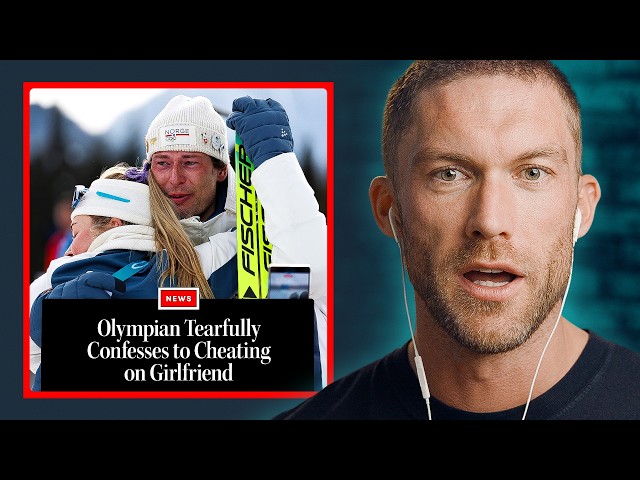
Norwegian biathlete Sturla Holm Lægreid recently made headlines after winning a bronze medal in the men's 20-kilometer event, an achievement he used as a platform to confess to cheating on his girlfriend of six months just three months into their relationship. In a viral post following the interview where he won, Lægreid revealed that she had dumped him after learning about his infidelity and stated in Norwegian tabloid VG that even with his public declaration of love, it is difficult for her to forgive him. He described himself as committing "social suicide" by broadcasting this confession on national television in an attempt to win her back, a move the hosts analyze through both psychological and strategic lenses. The discussion centers heavily on whether Lægreid's actions were premeditated or an impulsive reaction driven by emotional dysregulation. The speakers note that if he had planned such a grand gesture beforehand, it would suggest a calculated attempt to manipulate public perception rather than genuine remorse, potentially signaling low credibility and poor character judgment. Conversely, the hosts argue that his behavior likely stems from the intense fear of losing connection with someone one cares about deeply; when faced with the scary prospect of relationship failure or personal guilt, individuals often oscillate between taking steps forward toward reconciliation and retreating into avoidance mechanisms. This "approach-avoidance" dynamic explains why people might make desperate, high-stakes moves like public confessions rather than engaging in steady, low-key efforts to repair trust over time. A key distinction made during the analysis is that fixing broken relationships requires trying better, not harder. The hosts emphasize that grand gestures are often counterproductive because they lack the necessary element of delayed gratification and safety-building required to coax a partner back from under the metaphorical "car." Instead of diving in aggressively with dramatic declarations on live TV, which risks further damaging one's reputation as a cheater, effective repair involves slowly demonstrating reliability and patience. The transcript highlights that while Lægreid may feel he is doing the right thing by dedicating his crowning career moment to her, this approach often chases people away rather than pulling them closer, illustrating how human beings frequently rationalize reactive behaviors with higher-order cognition even when those actions are detrimental in the long run. The conversation also touches on the romanticized nature of such situations, likening Lægreid's plight to a clumsy protagonist in a romance film where bad timing and poor execution could have been spun into a story about redemption if handled differently. However, the reality is that his public admission has likely cemented negative perceptions among observers who view him as someone lacking virtue rather than simply making a mistake. The hosts conclude by expressing sympathy for Lægreid's predicament while maintaining that he needs to reallocate his efforts from dramatic displays of emotion to consistent behavioral changes. Ultimately, the episode serves as a cautionary tale about how relationship struggles can lead individuals down irrational paths where shame and guilt drive them toward actions that exacerbate their problems rather than resolving them.
Read the full video transcript
Norwegian biathlete, Sturla Holm
Lægreid. Have you seen this? Yep.
>> Okay, so
this 28-year-old guy chose the Olympics
as a place to shoot his shot with his
ex. After he won the bronze in the men's
20-km
biathlon, in a viral post after his win
in the interview, this guy confessed to
cheating on the love of his life,
revealing that she dumped him after he
came clean a week ago,
and said he was committing social
suicide in the hopes of winning her
back. Seems like his plan might backfire
since his ex, who has remained
anonymous, reportedly told Norwegian
tabloid VG that it's hard to forgive
even after a declaration of love in
front of the whole world. So, for the
people that haven't seen it, Dean will
cut it in now.
Six months ago, I met the love of my
life. The world's most beautiful,
wonderful person in the world. And 3
months ago, I made the biggest mistake
of my life and cheated on her.
As you can see, that guy used
probably the crowning moment of his
entire career or maybe his entire life,
right? You work from a child to do this
thing. Biathlon's the
rifle shooting with the skiing thing, I
think.
>> That's I believe so, yeah.
I'm way more of an expert on
relationships than on [ __ ] biathlons.
I chose that moment, the crowning
moment, as he gets to do the interview.
Could have thanked his mom, could have
thanked God, could have thanked all the
hard work, used it as the opportunity to
try and do it.
Dissect this from a science-based lens
for me, please. What's going on?
>> Yeah. Well, I mean, the first thing I
want to know is was this planned? You
know, did he think this through? Cuz to
me, that is very different. If he's
like, okay, I know what I'm going to do.
I'm going to try to get her back, and
he's rationally, you know, got some
reasons. Or if this was just like, hey,
I'm in front of the camera. I'm all
excited. I don't know what to say. I
don't know how to regulate myself. Let
me just let this fly. I think the
results are going to be the same
regardless, but the feedback I would
have for him would be very different
depending on whether he did this on on
the fly
Yeah, yeah.
Well, I mean so if he did this on the
fly I would you know going forward I
don't know how you walk this back first
of all I mean he like you said he shot
his shot here in front of the whole
world this is his crowning achievement
He shot his shot after shooting many
shots actually
>> That's exactly what you know I'm going
through my head it's like biathlete like
just stick to your 50 meters or whatever
it is don't let's not shoot this kind of
shot in this situation right
So that's and that's what I would tell
him I think in a lot of ways you've got
to you got to use humor there to diffuse
the situation with the individual
because he just blew up his life really
because it's
this is not just going to affect his
relationship with this woman now every
woman on the planet is like oh this
guy's a cheater okay cool
and that's not the message that I don't
I don't think you want that out there
and and again that's this is what I
would tell him just straight off the
cuff is like look man we've got two
things to do is one is repair the damage
and then the second is what do we do for
you to help you regulate and think
through what you know what you're what
you're going to do in the future now if
he planned this out I would ask
questions instead and my first question
would be like what were you thinking
what what what was going through your
head here cuz I don't know honestly
I think there is this desire probably to
tell
her and tell the world that like no I'm
I'm a good guy I'm trying to do the
right thing and that would be my hope
here is that ultimately he's trying to
do the right thing and he he feels bad
and that kind of shame and guilt that
you would feel after cheating is going
to motivate people to great lengths to
try to repair and restore so if we're
thinking about is this guy a good guy he
might actually be a really good guy who
made a mistake or he might be an idiot
and that and that's why I don't think
I think we'd have to ask more questions
and and find out and I don't know the
guy and so it's
it's fun to think about him being an
idiot but at the same time I feel so bad
for him.
Look, I
I get it.
But there is a bit of
this is the beginning of a potentially
[ __ ] rom-com going on here. 100% Oh,
100% When we look at sort of the cliches
in romance, especially romance films and
stuff where there's a
clumsy protagonist, historic eye on the
side and all the rest of it.
It's strange how with the right lighting
and a slightly better script, this could
be
the beginning, you know, either crowning
achievement of this guy's life and he
sort of lays down this this
accomplishment at the feet of this
woman. I think one of the things that
most people get skeptical around is if
if he'd used that opportunity to win her
back after he'd broken up with her
and said, "I realized I made a mistake."
That feels different to
the sort of rumbling of his
lack of virtue, this sort of low
credibility man potentially who is sort
of using
I I did see one person say that it was
emotional manipulation. I think if
anybody is being emotionally
manipulated, it's him by himself. I
think that he is doing he may be
Is it emotional manipulation or is it
kind of just "Holy [ __ ] I [ __ ] up and
and maybe I'm a bad guy or maybe I'm not
a bad guy but I'm just like I I
clambering clambering to get back into
connection with this person. I'm so
disregulated. I just need something and
if she sees me
basically dedicating the greatest moment
of my life to her." That being said
he was in a relationship for 6 months.
He cheated 3 months in and told her a
week ago.
Um
I
I Look, if you're going to be an Olympic
athlete, [ __ ] keep it in your pants
for 6 months, dude. You've worked toward
this for a long at least 4 years. Holy
[ __ ]
Well, and in that to mention, I I think
you're right on point there in terms of
he's probably dysregulated. He's
probably trying anything and not in his
maybe right mind in that way. And that's
what happens is often when a
relationship fails, people they'll
they'll do anything and they'll try
anything. It's like they're allocating
their effort to the wrong things. So,
this is not a situation where you want
to try harder. This is a situation where
you want to try better. And for him
here, rather than being like, you know,
on national international television,
hey, I cheated.
Hey, I I messed up my relationship and I
just want to say sorry to
Melinda or whoever whatever her name is,
you know.
And that kind of reallocation
is essential. Because it's not Trying
harder is not going to it's not going to
do this. Trying harder in fact often
chases people away. That's an
interesting one. Talk to me about some
of the ways that the romantic mind tells
people to try and fix breakups that the
sort of status-driven slightly more
rational mind has got a bit of a an
aversion to.
Yeah, you know, I I think in many ways
we have no idea what we're doing in
human relation Nobody does, you know, in
human relationships because we are
animals. And we are very reactionary.
And it but it doesn't feel like it
because we have this higher-order
cognition that makes a lot of sense and
it tries to convince us that no, I'm
doing this for a very specific reason.
And so as a result, people rationalize
what they're doing at a level that is
always going to feel like it makes sense
from the inside and from the outside.
>> [laughter]
>> Very different.
And so I we let me get let me get let me
give you an example. There's this
concept out there that nobody's talking
about in terms of relationships, but
learning theorists know it really well,
and it's called approach-avoidance.
And it's not the kind of avoidance that
you would talk about when we're talking
about relationships. Like this person
doesn't want a relationship with me,
therefore they're avoidant. This is
All this is to say is that sometimes
scary things are also desirable, and
sometimes desirable things are also
scary. So, in other words, I want to
pursue this relationship, but I know I
might get hurt. And what that causes me
to do is take some steps forward and
then take some steps backward. And same
with a breakup. This bad thing has
happened, and you might have to deal
with some hard truths to get this person
back or to fix what's going on in
yourself to not be a cheater anymore or
whatever, and that's hard and that's
scary. And so, you take a couple of
steps forward and a couple of steps
back. And
this also applies when we're trying to
get somebody back. So, suppose you you
broke up with somebody, and you you
know, you'll do anything to get them
back. That is a slow process. And people
think that grand gestures are the way to
go.
They're not. Grand gestures like suppose
you had a scared cat under a car. And
you know, it's been living in your
neighborhood for a long time. It's
getting hungry. It's not doing well, and
you want to coax it out from under the
car. And you decide you're going to dive
under the car and grab it by the tail
and pull it out.
You're never going to see that cat again
if you miss the tail.
And that's often what we do with
breakups. That's often what we do when
we really like people. It is we dive
under that car, and we we make this
grand gesture, this big grab. But really
what you need to do is very slowly
approach that car. Maybe a days for days
you do this. And you, you know, offer
that piece of food, or you put out that
water. You show that you are a safe
person.
That's an investment, and that takes a
lot of time, and it requires delayed
gratification. We don't have a lot of
ability for delayed gratification in
adult society, unfortunately.
You want to look and feel good when
you're in the gym, and Gymshark makes
the best men's and girls gym wear on the
planet. Let's face it, the more that you
like your gym kit, the more likely you
are to train. Their hybrid training
shorts for men are the best men's shorts
on the planet. Their crest hoodie in the
light grey marl is what I fly in every
single time I'm on a plane. The geo
seamless t-shirt is a staple in the gym
for me. Basically, everything they make
is unbelievably well fitted, high
quality, it's cheap, yet they have 30
days of free returns, global shipping,
and a 10% discount site wide. If you go
to the link in the description below, or
head to gym.sh/modernwisdom,
use the code modernwisdom10 at checkout.
That's gym.sh/modernwisdom
and modernwisdom10 at checkout.
Congratulations for making it to the end
of a clip. Your brain has not been fried
by TikTok. Uh, watch the full episode
here.