Video summary
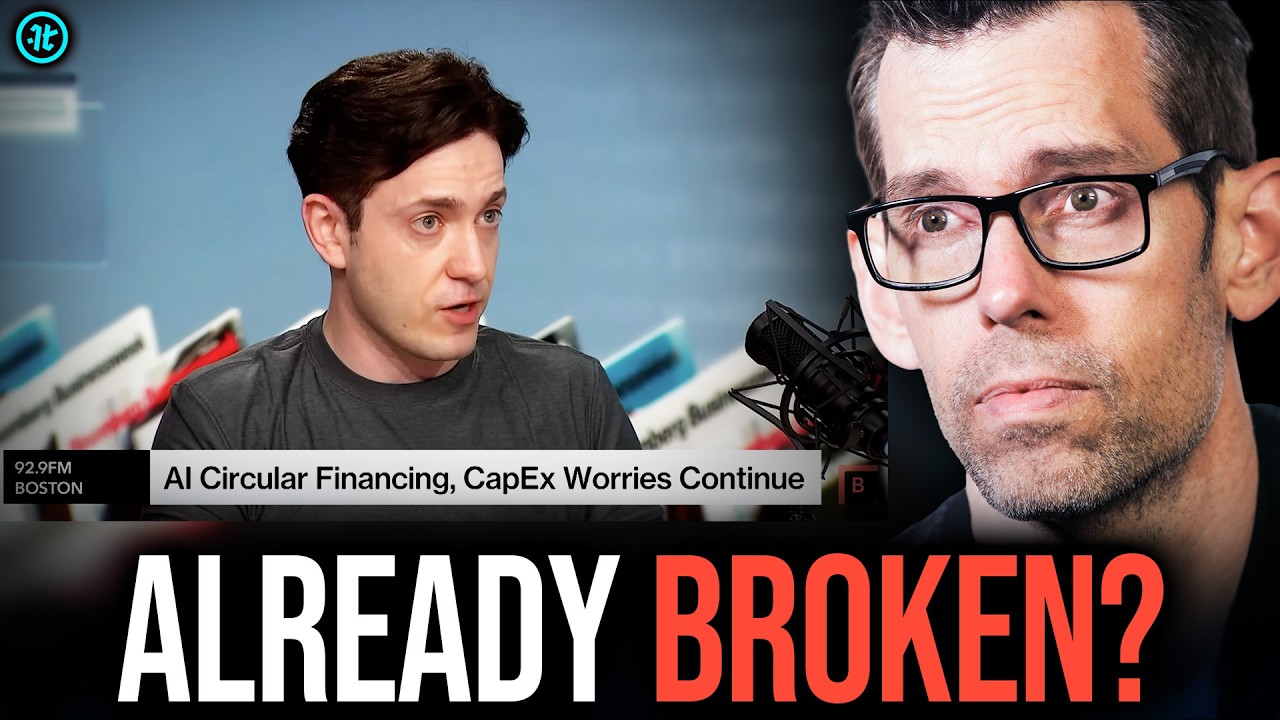
Wall Street analysts are drawing alarming parallels between current artificial intelligence developments and the Enron scandal, citing unsustainable financial practices that could trigger a major market crisis. The core of this concern lies in "circular financing," where cloud providers fund massive data center infrastructure with the expectation that their own customers will eventually purchase services from them to repay those costs. This model is viewed as extremely risky because it relies on continuous venture capital and debt rather than genuine profitability, effectively hiding billions in losses through accounting manipulations like unrealistic depreciation schedules for hardware chips. Critics argue that major entities such as OpenAI and Anthropic are projected to generate a significant portion of Google Cloud's revenue yet remain unable to cover their own operational bills without constant external funding, creating a fragile bubble built on speculative risk rather than solid economic fundamentals.
The financial architecture supporting this boom has shifted heavily toward shadow banking mechanisms because regulated banks cannot hold such high levels of speculative debt due to strict regulatory constraints. Consequently, credit risks are being transferred through complex instruments like Collateralized Loan Obligations and mortgage-backed securities similar to those that fueled the 2008 crash, spreading systemic danger into pension funds, life insurance portfolios, and individual retirement accounts like 401(k)s. Analysts warn that if this revenue model collapses before debts mature, it could necessitate massive government bailouts or currency manipulation to prevent an economic collapse, potentially destabilizing global markets including the yen carry trade. The situation is further exacerbated by rising interest rates and debt burdens originating from Japan, with some observers fearing a ticking time bomb where trillion-dollar language models emerge only after years of unsustainable spending that masks true losses estimated in the tens of billions.
Beyond the technical financial risks, there is growing social anxiety driven by what speakers describe as "anti-AI fervor," which stems less from opposition to technology itself and more from anger over perceived financial shenanigans at the industry's top tier. While tech giants like Microsoft and Google appear to thrive on opulence fueled by circular ecosystems, regular people struggle with stagnant real wages, high living costs, and mortgages, leading to fears that a bursting bubble could trigger massive backlash against a distorted world order similar to the pitchforks of historical economic collapses. The speakers emphasize that this crisis echoes previous distortions from 2008 and pandemic-era policies while occurring alongside significant global cultural shifts; however, they argue that smart diversification remains the only viable strategy for investors who cannot save society but can certainly protect themselves by taking profits early rather than greedily riding winners until failure.
Ultimately, experts like Ed Zitron are serving as bearish voices mapping these systemic risks to help individuals navigate a landscape where perpetual growth in tech stocks is increasingly unrealistic against stagnant wages and mounting infrastructure costs. The consensus among analysts is that relying on the assumption that massive capital expenditures will eventually drive diverse demand without immediate profitability is dangerous, especially when companies utilize accounting tricks to present a false picture of health while pushing debt onto the broader market. While some suggest delaying issues through initial public offerings or private equity until entities become too big to fail, these projections are often dismissed as unrealistic comparisons to impossible physical feats; instead, investors are urged to recognize that being wrong about timing is inevitable but can be mitigated by ensuring not everything fails simultaneously. The conclusion serves as a stark warning against assuming endless expansion in the AI sector without addressing the underlying debt structures and accounting realities that could lead to a prolonged gap between high spending and delayed profitability for everyone involved.
Read the full video transcript
AI right now, if you have a 401k, is
something you have to understand. The
debt obligations, the way that it's
being hidden, whether it's legal or
illegal, we're going to talk about that.
Buckle up. We're going to be uh looking
at Ed Zitron. So, this guy's a
researcher. From where I'm sitting, he's
sort of come out of nowhere uh as very
much an AI bear. And uh let's hear what
he has to say about the places that this
debt is hiding.
>> Where are we in terms of the AI
narrative in your view? What's the
reality?
>> Well, I think investors have to ask the
question right now. What am I getting
into when I invest in Microsoft, Google,
and Amazon? So, UBS estimates that 27%
of Google Cloud's revenue this year will
be OpenAI and Anthropic, increasing to
over 48% next year. That is a remarkable
amount of money. That's going to be over
$124 billion next year. Everyone is
buying into these stocks because they
believe all of that capex is going
towards diverse and spread out AI demand
when in fact what it's actually doing is
helping create infrastructure for two
unprofitable unsustainable companies.
>> It is very possible that he's right
about them that he's certainly right
about them being unprofitable. He might
even be right about the fact that um
they are essentially doomed and these
aren't going to be the players that are
going to stick around. We've seen this
thing repeat throughout history. Um, but
where this is going to get more
interesting is we get into something
that he just alluded to, which is these
companies have all this circular
financing. Um, later in this he's going
to talk about this being like Enron. And
um, there's other people out there that
are saying that this is like Enron. Now,
he he is very gentle when he brings this
up, but one of the things I want to talk
about today as we go through this is
that the things that are being done
aren't illegal, but they are
extraordinarily risky. So keep that in
mind. Not illegal but whoa is this
risky.
>> Other one would be anthropic. Yes. Is
you argue. So give us more data because
you have the micro you're citing
Microsoft but what about AWS?
>> Well that was what I was saying. So
Barclays actually says that this year
13% of AWS revenue will be both open air
and anthropic and next year will be 18%.
AWS much bigger business than Google
cloud. Now just to be clear when I was
saying that 27% this year and uh 48%
next year for Google cloud I meant both
anthropic and open AI most people don't
know that openai is a large customer of
Google cloud
>> it's not a well it's not a well-known
fact but this was this was actually
mentioned by UBS's Steven J.
>> So where would those companies be right
now without Anthropic and without open
AI?
>> Well I have serious questions about
that. So in calendar year 2025,
according to my own reporting about
OpenAI's numbers, 69% of the
yearover-year growth of Microsoft
intelligent cloud segment was actually
from OpenAI. Without that, it would have
only grown 8% year-over-year, which is
barely beating inflation. And so
everyone is being sold what I consider
kind of a lie. It's honestly kind of a
scandal.
>> This is where it gets interesting. So
calling this a scandal is um it's one of
those things that as a society we're
going to have to decide. Is this a
scandal or is it not? Because this is
how companies run. If you think about
the way that even a used car salesman
moves units, what they do is they say,
"Oh, you can't afford the car? No
worries. I'm going to give you seller
financing. So, you're actually going to
borrow the money from me to buy the
asset." And this is something that
Nvidia has done like crazy. Um, a lot of
these companies are doing that kind of
thing where it's like, I'm going to
invest in your company, but I know that
you're going to use the investment that
I just made to buy my product. So
whether that is you're um investing in
the data center that they're building,
knowing that they're going to be doing
something on your behalf or that the
data center is actually going to be
built on your cloud service or whatever
that kind of stuff is, it's very
typical. So this is where people look at
the map of all the circular financing
and they feel like hold on a second like
is this actually above board or not? And
the question becomes entirely is it
being disclosed? And the reality is that
as you push on this stuff, it is all
being disclosed. Now, it might be put on
page 88 of their um reporting, but they
are disclosing this. I haven't seen
anybody that's saying that these guys
aren't disclosing it. So, the real
question isn't is this a scandal? The
real question is who is this putting at
risk? And that's where all of this uh
stuff really starts to get crazy. And so
there are we'll get into more detail as
we go, but for right now just anchor
around this. There are three basically
risky ways that debt is pushed away from
banks and into the broad system. So all
of us are probably looking at the way
that these companies are getting their
financing and saying, "Well, this is
either cash on hand or they're raising
this money from the banks." Keep in
mind, even Google has gone cash flow
negative for the first time. That is
wild. They haven't been negative since
they went public. So, none of these guys
are doing it all through cash flow. The
capex buildout of AI is so massive that
they're they're having to scoop up money
from the banks now. Okay, cool. The
banks are taking the risk, right? Well,
not really. The banks are pushing that
um risk out into the public. I'm not
going to get into how yet. We're going
to get to that in a minute. But right
now, as just a reminder to everybody, AI
right now basically is the US stock
market. The US stock market is a
gigantic portion of the global stock
market. When money is looking for a
place where it can get a return, it
comes disproportionately to the US,
which means that that money is coming
disproportionately to AI. So basically
the world is making a bet on AI. The
world is making a bet on AI for growth,
right? So there's this underlying idea
that the real um idea that we'll have
perpetual growth ended back in like
2011, 2012, somewhere around in there.
And now this idea that tech companies
are just going to grow forever. They
they've run out of ideas. It's just
become an advertising play on the major
social media platforms and that's it.
And so, um, it looked like for a second
web 3 was going to be the thing that
petered out, went nowhere. And so, now
because they just need something to give
that growth story because remember real
wages are not growing. So, people that
are looking for the answer to how the
[ __ ] do I beat inflation, they're all
turning to there's got to be some growth
story in assets. Okay, cool. So, I'm
going to put all my money into and then
this amazing story comes along about AI.
Now, I think the right way to map this
is AI is real. It's going to become the
absolute big massive juggernaut that
everybody thinks it's going to become,
but
it is going to take much longer for the
revenue to come in than the debt will
hold out.
If that ends up being true, and keep in
mind it's been true of every major
technological revolution, so I have no
reason to believe that the one that's
happening now that has the much bigger
capex requirements to build out is going
to be any less true. And we saw revenues
coming in way slower than people
expected. And that was before China
started launching things like Kimmy K3
where now we're seeing companies go,
"Oh, well, this is a lot cheaper, so I'm
going to move over to that." Okay. So,
that's the the big ball of yarn of stuff
that we're worrying about. And the
punchline, and again, we're going to get
into the the separate mechanisms in a
minute, but the punchline becomes the
banks aren't dumb. And so, they're
taking that debt, that high-risk debt,
and they're pushing the risk partly down
onto basically your 401k. That that's an
oversimplification, but this is why
people need to understand what's going
on. We'll we'll get more into the
mechanism in a minute.
>> So this goes back to I feel like we have
companies the circular financing the
circularity of it all and kind of
creating demand for their products. So
when does it start when does the I asked
this earlier with a guest when does the
party end in your view and how Yeah.
>> So with OpenAI's IPO I think that could
be one of the flash points. Remember
this company was meant to go public this
year. They failed about a month or two
ago and now the New York Times has
reported that they're considering they
are delaying until 2027. That's lethal
for a number of people. But OpenAI and
Anthropic need continual flows of
capital. They do not pay their bills out
of existent cash flow. So when anything
happens to that cash, I think that's the
first thing kind of domino to fall. But
then again, there's also the overall
problem of data centers just not getting
built very fast, taking about 12 to 36
months, depending on how small or large
a data center is actually being built
at. And the problem is is that everyone
believes that AI is coming out of cash
flow, that AI is coming out of just this
diverse revenue base when it's really
not. It's extremely narrow. The
information reported a few months ago
that 89% of the largest AI companies,
well, their revenue comes just from
OpenAI and Anthropic. It's heavily
centralized. I I'm gonna get a little
bit nerdy and you guys are going to
teach me whether we should do this again
or not in the future. Um, so you have to
understand part of the reason that the
accounting trick that they're playing
works is the way that they're running
the math. So there's something called
EBIT DAW. So it's earnings before
interest, uh, depreciation.
Um, [ __ ] I need to pull it pull it up
in front. I think we have it here. Uh I
always forget uh all I need to see are
the letters. Uh earnings before
interest, taxes, depreciation, and
amortization. Thank you. Uh so that is
when you're running an IBIDA
calculation, what you're saying is
basically I'm going to run my math sort
of detached from the real world. And the
reason I'm going to do that is because,
you know, once I buy it, um it it's like
the I have to take a lot of the money up
front, but then I can only take the
expense slowly over time. And so it just
it creates a complication and that would
be great if um your equipment was going
to last forever, but it's not. And so
you're going to have to replace it. And
so it becomes a critically important
part of the way that you do um your
the actual health of your business will
be determined by how frequently you
actually have to uh replace that. And so
one of the big accusations about AI is
that they're not being honest about how
often they're going to have to replace
those chips. And so if you're saying
you're going to replace them every five
or six years and that's how you're
running your EBID schedule, then it's
like, okay, this is going to be um
basically [ __ ] that you're much
farther underwater than you would have
people believe. And the reality is that
um I think it was Warren Buffett that
called Ebidaw, either Warren Buffett or
Charlie Mer, they called it a reverse
float. Um meaning that you have massive
costs upfront, but then you can only
take the um actual like tax deduction or
expense deduction slowly over time. And
so it becomes a way where people can
really hide a lot of things. And then
there's another type of accounting that
you can also use where you're actually
changing the um the uh it's called like
adjusted revenue or adjusted IBIDA
adjusted earnings, excuse me. Um
adjusted earnings or adjusted IBIDA and
that becomes something that's basically
completely made up. So now every
corporation can say well the way that we
do things this is actually going to be
different and so we're going to carve
out a lot of things. So, um, maybe we're
not even going to, uh, count the fact
that we compensate our employees with
stock options. Okay, this is a big one.
So, if you want to know why people get
pissed off about corporations buying
their stock back, part of the reason is
they're buying their stock back so that
they can pay their employees in stock,
but because it's corporate stock that
they're then going to give as stock,
they actually don't count it as a
financial expense. And so people are
like, "What the [ __ ] you talking about?
you just bought that stock back. So now
it like gets into this thing where
they're not even reporting that as an
actual cash expense. And so they make
their business look better and better.
Now, if you're a financial analyst, you
know where all this stuff hides. And so
you can do the due diligence. You can
actually find out what's going in these
companies. You can see precisely where
debt is being offloaded, where there are
expenses that they're not saying. And
this was the thing that Michael Bur was
trying to get everyone to see. He's
like, "Their um amortization schedule is
not honest." And because it's not
honest, they're hiding, I think it was
like 72 or 76 billion in losses already
that they had suffered, but they were
able to hide by saying, "No, no, no.
What do you mean three years? These last
for five or six years, the chips." So,
Michael Bur's like, "Yo, their numbers
are not what they say." Now that matters
because remember the entire AI game, the
entire bet that the world is making
right now is predicated on will the
revenue come in before the debt comes
due.
Now if they're saying that oh [ __ ]
we're expecting this to last five or six
years, but really we have to refinance
again to replace these chips in three
years. Now you just keep pushing that
profitability out and out and out and
out and out and you run the risk that
finally they succumb to the weight of
their debt. And so what Ed Zitron is
pointing out here is that hey these guys
are basically selling a big lie. Now,
that I don't think will meet legal
scrutiny of a lie. But are they trying
to uh propagandize to let people's
imagination sort of run away with them
to give you a simple number on the
front, the headline? That's actually uh
basically they're just adjusted
earnings, which I'm going to call fake.
I I and I think it was EBIT EBITDA,
which is better than adjusted earnings.
Charlie Munger called [ __ ]
literally just outright. He's like,
"That's just bullshit." And so, um,
we'll get right back to the show in a
second, but first I want to talk about
the customers you're losing without ever
knowing it. And why today's episode is
brought to you by Quo, the business
phone system built so you never miss an
opportunity. Most businesses track leads
coming in. It's very important, but very
few track the ones that slip through the
cracks after a drop follow-up or a
buried voicemail. Quo fixes that. All
your calls, texts, and voicemails now
live in one place, so your team has the
full history and nothing slips through
the cracks. Quo is the number one rated
business phone system on G2 and trusted
by over 90,000 businesses. Quo's
built-in AI agent handles after hours
calls, answers questions, and books
appointments so you never miss a lead.
When money is on the line, always say
hello with Quo. Try Quo for free. Plus,
get 20% off your first six months at
quo.com/impact.
That's quo.com/impact.
We'll get back to the show in a second,
but right now, let's talk [music] about
something that keeps me up at night.
People impersonate me. Fake emails and
fake texts go out to my team all the
time pretending to be me. Stuff like,
"This is urgent. Click this link. I need
gift cards. Send it over right now. And
in that split second of panic, someone
almost always lets their guard down. The
scam works precisely because personal
information can be bought and sold. And
that's where Incogn comes in. You
authorize them once, they track your
personal data across hundreds of broker
sites and get it removed. When it
reappears, and it will, they take it
down again. Plus, with custom removals,
you can send them any link where your
information shows up, and their team
will handle the rest. They can't come
after you with data that they can't
find. [music] So, go to
incogn.com/impact
[music] and use code impact for 60% off
an annual plan. Try it risk-free for 30
days. That's ngni.com/impact
and use code impact. Now, let's get back
to the show. It becomes very important
for people to know what the real
amateurization uh amortization schedule
actually is. When this stuff is going to
be profitable, when they are likely to
have to raise money, when that
trajectory of increasing revenues is
actually going to cross over uh with the
ability for it to be the self-sustaining
economic engine and without that, you
put yourself in a very precarious
situation. All right, let's back to Ed
here. this is expensive to do or no in
terms of data center buildout and so on
and so forth and what's going to make um
AI generative AI the ability for it to
be really really good is having access
to lots of information so doesn't it
have to be to some extent Ed
concentrated
>> well when I say concentration I mean
concentration of revenue in these two
companies
>> no I understand but to make it good so
doesn't it make sense that those who are
exposed the most it's going to be
concentrated to some extent
>> well I mean when we're talking about so
sighteline client climate said that they
saw back in February about 190 gawatt
worth of data center capacity being
built in the next few years. It was is
built or under planning. Now if you work
that out with a pee, so just the
efficiency rating of 1.3, you're coming
out to 12 million a megawatt over $1.6
trillion of annual revenue needed to
satiate those data centers. Having two
customers is not going to do that. Even
their most spendy anthropic and open
AAI, well, they can't afford anything.
They need venture capital, but they're
only going to spend 400 billion a year.
And that's if they get that far, which I
don't believe they will.
>> And they need 1.6
trillion.
>> Dude, these numbers are so wild. They
are pulling forward god knows how many
years of revenue to say, hey, our stock
is worth this, which by the way,
something we haven't even talked about.
I can't remember if he touches on it,
but uh SpaceX
is still, please verify, but I'm pretty
sure it's still trading below where it
uh opened at when it did its IPO. It's
It's back on a green candle, but it's
still below where it was when it IPO'ed.
So, yesh,
red candles red candles down 9% today.
>> Ah, God. Okay. So, now Jesus. Uh,
imagine it goes like even worse as we're
sitting here watching it. So, imagine
that you've got this big bet everybody's
making. uh you've got these revenue
demands that so far outstrip the revenue
that you're actually earning and you
have this looming potential question
about whether or not your um chips last
as long as you say which may mean that
you're even more underwater than people
think and then on top of that you've got
all these risk mechanisms pushing this
down. So what I want to do now is uh
what minute are we at on this just so I
know roughly. Okay. So, um I want to go
through the the three risky ways that
debt is actually being pushed away. So,
um it is critically important to
understand as he said, these companies
cannot cash flow what they're doing. So,
they've got to find a way to bring in
money and given that even Google is now
turning uh cash flow negative for the
first time since they went public,
everybody's having to rely on the banks.
But the banks really can't touch this
because it's it's so speculative. AI is
a huge question mark. AI is incredible.
Nobody believes in more than me. But if
you're a regulated bank and you start
like taking huge positions in these very
speculative companies, the regulators
are going to be like, "Bro, come on.
Don't be ridiculous." Okay? So the banks
are like, "We've got to find ways to
offload some of this risk." Okay. Here
are the three key ways that risk is
being pushed out into a place where you
have to worry about it where it becomes
systemic risk for um the average
investor. So one is something called
wholesale funding. So this is lending to
the lenders. Now in many cases the banks
really are still loaning the money to to
these banks to the companies but they
they do it through an intermediator
intermediary shadow bank. Okay. What is
a shadow bank? It's basically a private
bank that is not beholden to the same
types of regulations that then lend to
these companies that are doing the deal.
So, it could be a VC that goes to a
shadow bank or private equity, whatever
goes to a shadow banker gets this money.
It could be the VC or the the private
equity firm themselves that are raising
the capital. They could be going out to
um the pension funds is a place where
these guys get a ton of that money, but
they've got to get the money somewhere.
And so those guys are like basically
we're going to go get the money from the
bank. The bank now has the plausible
deniability because they didn't loan to
the AI guys. They loan to us and then we
go and make the loan to the AI okay to
uh companies. So that's the first way.
The second one is something called
credit risk transfer. Okay. So sometimes
banks uh make the loans to the corporate
borrowers but they use like financial
engineering to push the risk off of
their own books. And they do it through
this mechanism known as credit risk
transfer. And in doing that you're
basically trying to push the risk. You
you package things up. Okay? So you say,
"All right, we just took on this debt.
We're going to create a financial
instrument and then we're going to sell
that debt to people." So they're going
to buy that debt. And if this reminds
you of 2008 with the uh mortgage back
securities, that is exactly correct. But
for AI, so you're trying to get the
credit risk off of your books so that
again, if the regulators look at this,
it's like you're not left holding the
bag. So that's sold into places like
pension funds. Again, why people need to
worry about this. Uh so that it it gets
out there, you're able to make the loan,
but you're not having to hold it on your
books. And then the third is the
originate to distribute. You can think
of this like a conveyor belt. So, uh in
this method, the bank acts purely as a
middleman. So, they're gathering a bunch
of corporate um like software AI
infrastructure loans, things like that.
They bundle them together into complex
financial uh a a very specific, excuse
me, complex financial product. It's
called a CLLO, a collaterized
collateralized loan obligation. And then
they immediately sell um pieces of that
off to people in institutions that are
really trying to get a yield. So this
will be life insurance companies,
pension funds, but it creates a trap of
a kind. So the bank is able to pocket
like the big fees for arranging the
deal, but then they're able to walk away
essentially with zero risk on their
balance sheets. Now, the reason that the
other guys take it is one, they're not
going to be able to um find the
different loans and loan products and
things. So, they want somebody to
package them up, but they also just want
to take a piece of the deal. So, they're
like, "Okay,
th this gets super nerdy and it gets
into something called mezzanine debt
where you're looking at like think of it
as uh if I'm uh loaning you money, I've
got sort of three ways to look at this.
The bottom layer is the equity. I'm just
taking an equity stake. I get the
biggest upside, but if I get wiped out,
I'm the first to get wiped out. So, if
your company's in trouble, we're going
to burn through everything that I mode
first. That just goes away. Then we get
into the middle layer, this mezzanine
layer, and that is something where I'm
sort of hedging myself. I'm protected
from the people that get eaten by the
equity first, but I get eaten before the
senior debt holder. And so I take um I
get a bit bit of protection, but I'm
going to get less upside, but I am going
to get wiped out still before the senior
guy. So if I can't be the senior guy, I
want to be in the middle. Cool. So
they're going to package that up, sell
it off for people who are like, I need
sort of a mid-tier risk thing. It's
going to be like it's not certainly not
going to be AAA. Might be a BBB rating
kind of thing. So I'm going to be
somewhere in the middle, but I've got
potential bigger upside because I've got
a class of people that are going to get
eaten before I get eaten. And then
you've got the top of this three layers
which is like the AAA you just owe me
the [ __ ] money and everybody gets
obliterated before I lose a single
dollar of my principal. Okay. So again
I'm going to learn here whether people
like this nerdy [ __ ] numbers are doing
well. Uh so yay. But that is um what
they're doing. So they they take that
middle slice and they sell it off. Now
that frees up a bunch of money on the
bank's sort of pretend balance sheet.
Remember, they're still exposed because
they've only sold part of this, but on
their balance sheet, they look much
better. So, a regulator looks at that
and goes, "Oh, you just freed up $26
million, whatever." Making that number
up. Uh, you just freed that money up.
Great work, man. You're looking good.
But if if everything goes to hell in a
hand basket, they're still exposed to
that debt. They look good on paper, but
they're exposure is still there. So, as
people go through this, everybody's
asking the questions like, "Is this
legal? Is this a scandal?" Instead, we
should just be talking about how much
risk is getting pushed out into the
marketplaces, how is it getting pushed
out? And the the terrible thing is that
it's complicated enough that the average
person just doesn't want to look. They
they don't want to try to figure out
what's hiding where, what do I have in
my portfolio. And so that's why at a
minimum
never lose sight of that there is
tremendous capital being raised. The
risk is being diversified out into the
broadest market possible. It's all going
to look relatively clean on paper 2008,
but in reality there's like all of this
risk floating around. Now will this ever
end up like 200? I don't know. Nobody
knows because this is private credit. It
is very difficult if not outright
impossible to figure out the scale of
this. But if you guys watch the deep
dive that I did on the private credit
market, the private credit markets are
showing signs of distress.
Let's let's tie some of these things
together. The whole world's making a bet
on AI.
AI is not able to fund itself. AI is
having to raise so much capital that
even companies like Google are now cash
flow negative
as they bring on all this debt. They may
be lying to themselves or just outright
lying about the um depreciation schedule
for the asset, the chips. And that is
hugely consequential in terms of how
much capex they are going to need which
is directly related to how much debt
they will have to raise. And then that
debt is being provided largely by shadow
banking known as private banking which
is not regulated in the same way that
the normal banks are regulated. But the
normal banks are using that as a way to
still do it but hide it huh light on the
hide because it's still there. It's
visible. Everybody knows what's going
on. But the math makes them qualify for
their regulations. So the banks that we
think are being protected or were
protected from that systemic risk that
we succumb to in 2008, we think we have
the protections from it because these
banks are regulated. But those banks are
actually loaning money to the largely
unregulated shadow banking sector. And
then the risk that they do carry,
they're diversifying even further out
into the normal markets through pension
funds, life insurance, etc. Okay, so all
of that's looming as we ask the
question, are we actually going to um
get revenues in fast enough to deal with
this? As China is saying, hey, those
revenues are never coming because we're
going to make this cheap. As the yen is
wobbling and the US Treasury is telling
the Fed to make more dollars available
to try to stabilize them so we can
stabilize our own bond market.
And it all just starts to feel very
unnerving. I didn't even get to Iran. I
didn't even get to China. I didn't even
talk about the dollars that may never
come from the Middle East that we are
certainly counting on.
Lot of instability.
Now, when I hear people talk about this,
they don't just keep bringing it back to
the risk profile. What's going on? What
touches what? So, as you hear this kind
of stuff, very important that you bring
it back. What's the risk profile? How
much of this stuff is being distributed?
What's my likely exposure? How do I
diversify so that I'm not uh if we had a
2008 style moment where private credit
collapses and then is those dollars get
sucked out of the economy? How does my
life look? If um AI outright has that
gap in the way that the internet had
that gap and it ends up being exactly
what we think it's going to be, but it's
10 years delayed. What does that look
like for me? How do I make sure that I
survive that? Okay, those are the things
as we're we're going to listen to a
little bit more of this. But as as we
think through this, that's what we want
to be holding in our minds.
>> Balance sheets. Really? Really?
>> Well, I from personal from personal
experience a great deal about Open AI
because I reported their auditive
financials with the Financial Times,
>> right?
>> And it's a company just burning cash.
They lost $20.9 billion in 2025 and
things are only getting worse. And
what's crazy as well was over $800
million of Open Eyes revenue came from
SoftBank for their Crystal Intelligence.
And yes, that's really what it's called.
Their Crystal Intelligence program,
which I can find no evidence of actually
anything happening. And SoftBank, a
large shareholder of Open AI with no
board seats.
>> So, so, oh, go ahead, Carol.
>> One more question though. Like you talk
about for Google Cloud, um, the
exposure, right? Mhm.
>> And you said 48% next year in terms of
these two customers. I have to say that
there are smart people running these
companies and normally you would say
your exposure to just a handful of
customers is not a great thing. Do you
say that these companies that aren't
doing their due diligence be it Alphabet
or you know pick your hyperscaler? I
think they did their due diligence in
the sense that they said we are going to
create our largest customers and we're
going to own large parts of them and on
top of that we're going to own all of
their infrastructure. Google has a nice
they have a nice thing going here. They
buy TPUs from well sorry Broadcom sells
TPUs
>> to Google. They are then sold to
Anthropic and then rented back to
Anthropic through Google. Google gets to
double up on revenue. This sounds really
good right up until you realize that
anthropic and open AI are unsustainable.
So what they may be and the problem is
with saying these are smart people is it
immediately makes me think of Enron the
smartest guys in the room.
>> Not saying anything like that's
happening
>> but I'm just saying you have a fiduciary
responsibility and you're right you go
back to Enron or World
>> and I think the point I'm making is
>> with Google they probably thought there
would be more customers. I imagine with
Azour and with AWS they thought would be
more large players but the problem with
Anthropic and Open AAI is they've raised
2003 $3300 billion of funding but
they've actually raised more because
OpenAI and Anthropic got all of their
infrastructure built for them by
Microsoft, Google and Amazon. They
didn't have to pay I think in the Samman
Elon Musk trial one of the Microsoft
executives said that they cost hundred
billion so call it like 70 80 billion of
infrastructure. So the problem is is
that nobody else can get as big as them.
No one else can get that much compute.
No one else could afford that compute
and have the chance to do the
pre-training runs necessary. Except now
China's coming up behind them, right?
>> And it's unclear how anyone really deals
with any of the problems I've been
listing for years, which is
unsustainable, unprofitable, and also
not really finding the ROI in AI. A
>> a big part that I don't think um Ed
certainly isn't talking about it. it's
not coming up in this conversation but
you have to understand the psychology of
the people that are investing in this
the psychology of uh the the companies
that when he says like I think they
thought there would be a lot bigger um a
lot more big players I think they have a
different mentality when they're looking
at what's happening here so the initial
narrative was one thing and it's now
shifting to something else I think the
initial narrative before people
understood just the magnitude of the
capex that you were going to have to
keep scaling these brains the data
centers for these things to keep getting
smarter. Before people realized there
weren't just going to be, you know, 300
open AIs, the narrative was different.
Now the narrative is shifting to, okay,
we're basically building out the
electrical g grid, but instead of
electricity, what we're getting is
intelligence. So, yes, we're going to
have to put a ton of money up front, but
this is just like laying the pipe in the
internet. Um, by doing that, we're going
to be creating our own customers. So
right now there aren't a lot of people
taking advantage of this yet because
people haven't figured out what AI is
going to be in the same way that they
had not figured out what the internet
was going to be. But keep in mind these
people are looking at it and saying,
"Oh, I know how this played out." So the
last time what ended up happening was
everybody uh they got in over their
heads. There ended up being this delay
and so the people still ended up winning
making just ungodly amounts of money.
remember all of the mega wealthy people
today sort of with the exception of Elon
Musk who who really made his bones um in
cars but he was able to do that because
of his success on the internet anyway uh
you've got the vast majority of the
hyperw wealthy people today they all got
wealthy in that second wave of the
internet so post crash people go thank
god that this pipe exists and we're
going to now build on the back of that
so all of these guys are sort of
forgetting the pain of that gap the fact
that there was such a big gap they
realize there's no hyperrowth story
left. If they're going to make a return,
they've got to find the next big thing.
AI proves to be actually the next big
thing. They are tricking themselves
about the fact that there's likely to be
this lull in the middle that we almost
certainly will wipe out a spate of
investors that are out over their skis
with debt before we get to the
inheritance generation that will come
along and actually be the Jeff Bezos's
of the world and will build the, you
know, the next mega things on the back
of this. And so where I think they're
making a mistake is they're still taking
on all that insane amount of debt. I
don't think they're making a mistake
about we've got to be here. we've got to
be an AI, we've got to be building on
this. I think they just have to be more
thoughtful about remembering that if you
want to be one of the the people that
supply the commodity of intelligence,
then yes, you've got to make a move now.
You've got to be one of the people in
the data centers. Okay, fine, fair
enough. But you better figure out who
your customers are going to be. Because
if right now you don't have a path to
waiting 5 10 years to get all of the
revenue that you need to make that data
center pay itself back and knowing that
you're going to have to keep buying new
chips and all of that, you're going to
end up in trouble. So that's the part
that worries me. If you think, okay,
cool. I'm going to wait. I'm going to
let that first generation of people
discover if there's a problem or not.
Because really this is about the
companies that end up using the
intelligence, not the core intelligence
itself. And yes, I am hyper aware of the
idea that you want to be the pickaxes,
but remember you want to be the
inheritance generation of the pickaxes
when you're talking about incredibly
expensive infrastructure. So the like
typical like imagine you actually had to
build the gold mines for people to go
mine. You can't be the pickaxe until the
gold mines exist. Those are the data
centers. So if you think about this as
commodified intelligence supplying
electricity and now we're waiting for
all the things that use electricity to
be built and you want to be part of
either um you know whatever those things
are going to have in common chips or
whatever uh so that you can be agnostic
to who wins. That's the pickaxes.
Or you want to be part of the companies
that are going to be built on the back
in the same way that Facebook was built
on the back of the internet, Amazon was
built on the back of the internet, so on
and so forth. And so that's where this
becomes important to understand where
are we on the timeline. Okay, the future
is not guaranteed. So nobody knows for
sure if this gap I'm talking about is
actually going to play out. It's played
out every time, but that hey, it's no
guarantee it's going to happen now. But
where are we at on the timeline? How
confident am I that this is going to
play out this way? And then am I better
off trying to scramble, get in now, be
sort of on the ground floor of what I
think are the pickaxes? And am I right
about that? Because I think if you think
the data center is a pickaxe, you're
going to be in trouble. But am I right
about that? What investing generation am
I? Am I the one that's going to get
obliterated if I'm right about that
timeline? Or am I one that's going to be
part of the inheritance generation? And
then obviously we have what we've been
talking about before, which is all the
systemic risk and how do I protect
myself against that if that dip actually
happens. and all the companies that are
big now, all the companies that are
making the data centers worth building
go out of business and then now we've
got some downtime before we're able to
bring that inheritance generation to
bear actually building this stuff out.
All right,
>> really really quick. It seems like we're
getting toward too big to fail territory
where although we should let them be the
railroad, the nonprofitable failure
companies. It seems like we're too
they're so ingrained in all the other
mag seven companies that it's now going
like if OpenAI and Anthropic fail, it's
going to impact Google and Microsoft.
It's going to impact the internet. And
I'm starting to see like they're getting
in the bed with all these other people.
So that way it's like if we go down,
everybody goes down.
>> It's even more terrifying than that.
[laughter] Remember my mental model of
Iran is Iran was AI is too important to
fail. I've got to go make sure that
those $2 trillion in investments come my
way. U so part of what I'm doing here is
those guys promised investments and now
I've got to take care of Iran to make
sure they don't become a problem.
Obviously a mistake, but nonetheless I
think that that was part of his
calculation. Um the banks really are too
big to fail right now. If AI tanks, your
economy will blow up so hard that
>> I can't even fathom like what kind of
money printing you would have to do,
what that would look like. It would be
it would be barbaric, man. That would
just be a nightmare of untold
proportions. Uh especially because
you're doing it at the time where the
yen carry trade has already created
instability and problems there and may
create problems for you in your uh debt
market. And so if all of a sudden you
have to put out the world's largest
amount of debt uh in order to like
stabilize the economy because AI tanks,
who buddy, right? As your biggest buyer
of debt is like, I I'm trying to sell
right now. Dude, that would be wild.
That would not be a good time. Uh so
that's where it's like this is not a
time to panic. Everybody should be just
super thoughtful about, okay, what is
the risk? Like I'm not going to nothing
in the stock market or anything like
that. Um I think you have to be way more
careful than that. I think you have to
have way more humility to say okay
there's a lot of risk here. Doesn't mean
it's going to happen. You just need to
be aware of what the risks are. So I
think that the banks would get bailed
out if they get into trouble. I think
that this is the reason that the AI
companies are desperately trying to get
the government to basically take a stake
in them. So the government would be like
well
>> we we can't let this fail. They're
trying to get it seen as a national
security thing again so that if they
don't have the money, they're like,
"Well, bro, do you really want China to
slap us around? Like, we've got to be
absolutely cutting edge." Uh, so the
fact that we don't have the dollars and
cents to make this a profitable
business, that doesn't matter. Why would
that matter? We need to just make sure
that the government is funding this
because this is a weapon system. So, it
it is like this AI has become so
behemoth. And the terrible thing is it's
really real as we just saw with um
Claude's latest version like
jailbreaking or open AI open AI
jailbreaking and getting out and then
being like oh [ __ ] like we got to clamp
this thing down and then before that you
had uh Fable breaking out and then being
like oh [ __ ] this is finding uh hacks
and like everything we we can't release
this to the public. So it it is it is a
weapon system and it is a matter of
national security. Uh the risk is now
wildly systemic and the current crop of
companies are not bringing in revenue
fast enough to be um mapped as anything
other than as Ed said uh unsustainable
as of now. um the revenue may start
flowing and and maybe that picture
changes, but it's a question of will it
change fast enough to deal with this
debt burden at a time where interest
rates are rising here and in Japan where
so much of this capital is actually
originating. Jesus, dude. Yeah. The more
uh I research this stuff, the more the
hairs on the back of my neck stand up.
>> Is there like a a time bomb or is there
a time crunch to this or can they kick
the can? circular finance,
IPO, double down, get some private
equity money, and kind of keep kicking
the can until somebody creates an actual
trillion dollar LLM company.
>> I don't know.
>> Nobody knows.
>> Um, I think we've got a lot of pressure
from the stability of the US economy,
but any real number prognostication
isn't real. And so
it's more that um
if you were watching a guy do push-ups
>> and you said how many push-ups do I
think that guy can realistically do?
Like I can buy that he can do a hundred.
Do I buy that he can do 500 without
stopping? By the way, do I buy that he
can do 500? Yeah.
Do I think he can really do a thousand?
That starts to get hard to believe. Do I
think he can do 5,000? Absolutely not.
The record for push-ups is 10,000 or
more. It might be more. Look at Ryan. Do
you mind looking it up?
>> Yeah. What is the world record for most
continuous push-ups? I think the number
is 10,000 or more.
>> And that number is so fake. I never
would have believed it.
>> 10,57
from October 1980.
>> Without stopping.
>> Indian in the 80s.
>> Yeah. 1980.
>> That was all Coke. That was that was
that was Coke push-ups. No way.
>> So perfect. [laughter] I love that. So
now it's like I don't know what the coke
is going to be in the markets that could
like drag this out. So I'm going to look
at all this and be like, "Bro, there's
no way. We can't go past insert ins uh
absurd number here." But if my like
there's no way he's doing more than a
thousand. That's ridiculous. And it's
actually 10 times more coke that the
system can actually ingest and keep
going. It it's it's one of those
unfortunately for all of us that have to
invest having the right hypothesis but
getting the timing wrong is the same as
being wrong and getting the timing right
is almost impossible which means all of
us are almost guaranteed to be wrong
which is why I build my strategy trying
to say I know I'm going to be wrong so
like how do I diversify enough that
given I won't know what I'm going to be
wrong about but not everything if I'm
diversified well enough not everything
will be able to mechanistically be wrong
at the same time because things move in
different directions. Then it's like,
okay, can I actually pull that off? And
that becomes the magic of all this. Can
you actually put yourself in a situation
where you are wrong, but you're
prepared, literally prepared
mechanistically, to be wrong, and you
come out the other side doing just fine.
Because being up 3% in a time where
everybody else is down 30 is like you're
laughing all the way to the bank. And as
a reminder, Ray Delio for one in the
2008 crash still returned 9%. They were
up 9%
when the rest of the world was melting
down. So there is a way to be
diversified smartly enough that you
don't get caught with your pants down.
And so that's more or less how I'm
thinking about this. So I had a major
win on one of my stocks. like ridiculous
when I told my wife how ridiculous. Um
that got some praise and be real honest
with you. And I was like sell
immediately because I don't need to be
greedy. Like it could double again from
here and I'll be like yep I'm fine. Uh I
am perfectly happy to take my wins now.
But most people do not. Most people are
like, "Well, it's doing well. I've got
to just keep riding. Let's keep going.
Keep going. Keep going." You've got to
have a number in your head where you're
like, "If I hit that, I'm going to
diversify out into something else."
Otherwise, you get caught. You get
caught. Last time you were on with us,
we got an really incredible response to
be honest. And it a lot of people who
weren't typical viewers or or listeners
of our show saw what you did and
listened to what you did and it really
seemed like there's this uh what you're
saying is resonating with a lot of
people. Like there's a
>> it was almost like there's this anti- AI
fervor
>> that that's out there and I'm just
curious why you think that is. So, I'm
not sure it's it is anti-AII, don't get
me wrong, but I think it's also
anti-inancial shenanigans. I think
everyone sees the circular financing. I
think they see that Microsoft, Google,
and Amazon gets basically all of their
AI revenues either through products
they're pushing on their customers or
indeed compute spend from anthropic and
open AI. And the average person's
existence right now is so expensive, so
hard, so difficult. Getting a mortgage
as a regular person is so difficult. But
if you're standing up a theoretical data
center in 36 months full of Nvidia GPUs,
the banks fall over themselves to give
you the money. Core, we've just raised
what, a 9% bond. I mean, you can raise
anything if you have a data center. And
I think regular people can see that AI
does not deliver what people promise.
They can see the opulence of the people
at the top of the AI industry. They can
also see that they're being lied to and
being deliberately scared on top of all
of this egregious circular financing.
So, this is the thing that worries me.
We're creating all this systemic risk.
Uh, and it that risk really is real. And
if this goes wrong, you want to talk
about pitchforks. People are going to
lose their minds. There is already
massive anti-AII sentiment. Uh if you
put on top of that, you just broke the
economy with your um high-risk uh
endeavors into AI because you wanted to
grow at all costs and you guys were
already wealthy and it was already hard
for the average person to make ends meet
and now you guys wanted to get [ __ ]
richer. You wanted what an even bigger
bunker. Uh people are going to lose
their ever loving minds. And so this is
one of those times where boy do I hope
that uh prudence begins to win out. that
at a minimum the average person begins
to protect themselves from some of the
systemic risk that's being put out there
so that if it hits that it doesn't hit
you. Uh I have long believed you're you
may not be able to save society but you
can always save yourself. And so think
about like where does this go because
boy if this breaks we're really going to
have a problem. And so it's very
interesting. Ed I think is becoming um
as big as he is precisely because he's a
bear. He's talking about listen guys,
this is not going as well as you think
it is. These are the things that people
need to be paying attention to and he's
coming with the receipts of actually
mapping this stuff out. Um so this is
certainly a voice that you can expect us
to be bringing on more in the future.
Um, but as if you're trying to figure
out like why I cover the things that I
cover, all of this stuff is tied into
why we have uh directionality in the
culture in the US for sure, more broadly
in the west that is getting more and
more distorted by the day. Uh, and so
understanding how all of these pieces
connect to each other, how a lot of what
we're living through right now is
actually an echo of 2008 still that we
never got back on our feet. It's an echo
of the um things that happened in terms
of making life uh more expensive for the
average person during COVID. Uh it's an
echo of the wild way that humans get
optimistic uh and then are intentionally
blinding themselves to debt. It's the
fact that um the world is far more
interconnected than we want to think.
from Iran and GCC investments into the
US market to Japan and the way that
they've provided global liquidity to the
general malaise of a nation of people
that are prone to be radicalized because
you've spent so much time financializing
the world that there aren't the sort of
good mid-tier jobs that people used to
be able to count on that created a
thriving middle class. also all
happening at the same time where you've
got um Islam as a culture just having
way more energy, way more drive to push
out and get people on board all just
like happening at the same time. It is
this crazy time where the world order
culturally, the world order
economically, the world order militarily
is all changing right now in real time.
And I'm trying to make sure that I'm
paying attention to all of those
different threads that are reinforcing
in each other and sharing energy in that
same circular fashion that these
companies are investing in a circular
way. And until next time, my friends, be
legendary. Take care. Peace. If you like
this conversation, check out this
episode to learn more. Everyone right
now is comparing today's AI stock boom
to the dot bubble of 99. But the
sharpest minds on Wall Street have a
different vision. One of those people is
Warren Buffett. Warren Buffett is uh I
know that he's known