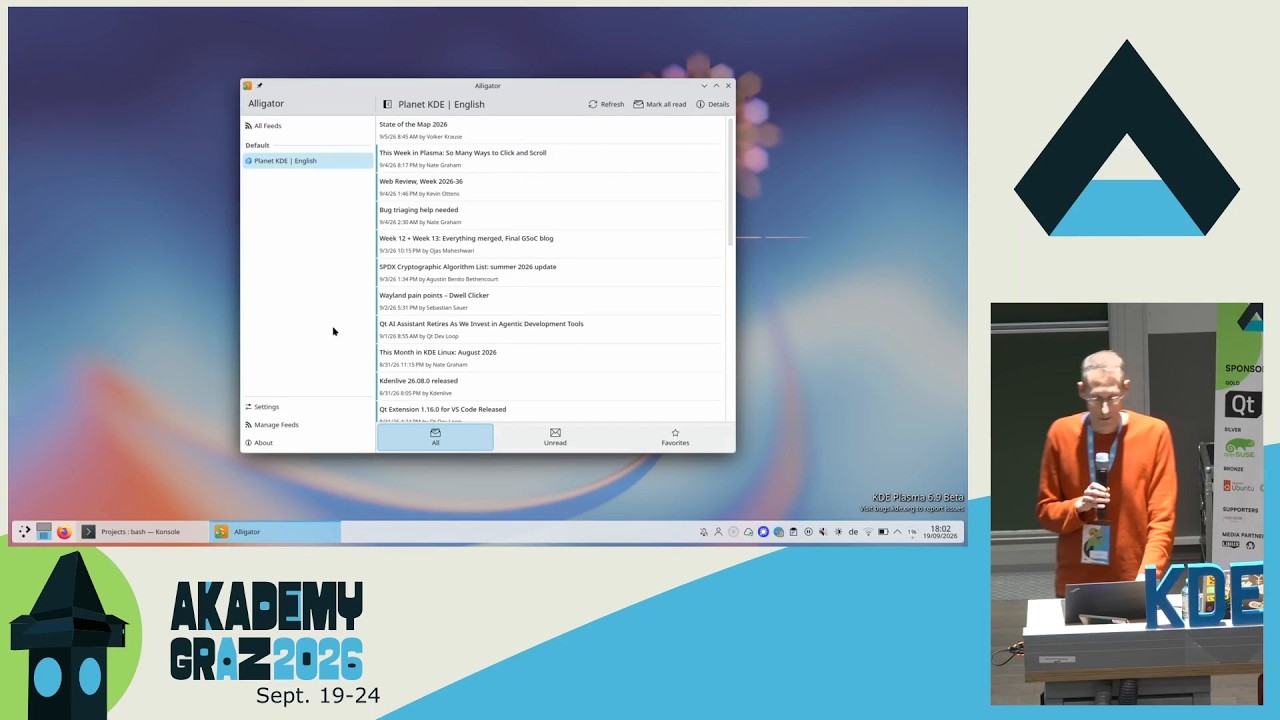
Volker Krause: Turning users into contributors - CD in application development
Watch on YouTubeVideo summary
Volker Krause discusses the transformative journey of adopting continuous delivery (CD) builds in application development, highlighting how this shift turns passive users into active contributors. Traditionally, bug reports often lagged significantly behind the actual issues because users were stuck on older Long Term Support versions while developers worked on months-old code. Even with pre-releases, fixing bugs and distributing patches could take weeks, meaning feedback loops were slow and often ineffective. By transitioning to a model where daily drivers use leading-edge CD builds, the team drastically reduced this latency; serious issues now surface within a day or two, and fixes can be deployed and verified by users in as little as fifteen minutes. This rapid cycle allows developers to push debug outputs and receive immediate diagnostics, a level of responsiveness that is impossible with standard release schedules.
The core enabler for this success is the establishment of high-quality, reliable CD builds that users can trust with their data and daily workloads. This requires maintaining development branches in a continuously releasable state, ensuring that dependencies are managed correctly and regressions are addressed as top priorities. When these builds are trusted, the responsibility shifts entirely to the distributor; there is no longer an excuse to blame upstream or downstream breaks. Furthermore, effective communication becomes vital in both directions, utilizing channels like Matrix to capture not only critical bugs but also subtle user feedback regarding new features and usability improvements. To mitigate the annoyance of constantly changing software, the team has implemented infrastructure for in-app release notes with translations, providing users with clear context on what is changing while opening a direct line for them to suggest UX enhancements.
To facilitate this seamless interaction between developers and users, Volker demonstrates a practical workflow using Flatpak, which allows for automatic updates without requiring root permissions or interfering with the existing system session. By creating a modified version of an application that runs alongside the official one, developers can test changes instantly on various distributions, from rolling releases to immutable systems, within just two minutes. While this approach has limitations regarding specific desktop environments like Plasma or complex framework hacking, it covers approximately eighty percent of use cases across most applications with minimal setup costs. This method effectively lowers the barrier to entry for testing and validation, allowing users who might otherwise remain casual consumers to naturally evolve into contributors. As these users gain familiarity with the development process, they often identify small issues that can be turned into merge requests, creating a virtuous cycle where the community actively participates in quality assurance without even realizing they have joined the QA team.
Ultimately, the goal is to replicate this accidental success of "itinerary" elsewhere by fostering an environment where users feel excited to be part of the development process rather than just consumers of finished products. The presentation concludes with a demonstration of how easy it is to spin up a modified build and test it locally, emphasizing that such tools should not require deep system integration or administrative privileges. Volker invites the audience to provide feedback on whether this approach should be further explored, suggesting that by making development accessible and safe for daily use, organizations can cultivate a robust community of contributors who help flush out distribution problems before they reach production. This strategy not only accelerates bug resolution but also enriches the software ecosystem by leveraging the collective intelligence and immediate engagement of its user base.
Read the full video transcript
Okay, now. Okay, so I want to talk a bit
about the experiences we made on our
journey way with using continuous
delivery CD builds.
Um
Many of you might share those
experiences right so if you get bug
reports
um
they are often
for something we worked on months ago
and that is the best case right people
actually using the latest release not
some some LTS version.
Um
and we we do have pre-releases betas and
release candidates.
Um and they help to flush out some
distribution problems but they aren't
really widely tested so um
when it comes to
to testing anything before the
production release right you are mostly
on your own.
Uh and if you make fixes
uh it takes again in the best case weeks
until they make it to the person who
actually had that problem so the chances
that you ever get a feedback that this
actually fixed the problem uh relatively
slim.
Um
this changed a lot for us in our journey
way when we got a whole bunch of people
to daily drive leading edge CD builds.
Um because now if we have um serious
issue it takes a day or two until
um people start screaming.
Um so basically you get the bug reports
for the stuff you are currently still
working on.
Um and same in the other direction.
Um so if I push a fix within 15 minutes
the person who reported that problem has
the fixed version on their device
and can confirm that I actually fixed
the problem.
Um and if I didn't
I cannot even do stuff like um
push some debug output
and within minutes I get diagnostics
from the affected person or the affected
device, right?
Um that would simply be impossible with
uh waiting for regular releases.
Um
and as a side effect of that, the people
daily driving the CD builds have
basically stopped being
normal users, they have become
contributors and are now part of the QA
team.
Um I mean for itinerary this kind of
happened by accident,
um but there is still uh a few things I
think we can uh can learn from this and
trying to to replicate it elsewhere.
Uh so the first and probably most
important thing is
we really need high-quality and reliable
CD builds for this.
Um
And so this needs to be in a state that
people trust it with their data and can
rely on it uh to actually get um get
their work done.
Um
So this this basically means your um
your your development branch needs to be
in a
uh continuously releasable state, but
since most of us use time-based
releases, that's a good idea anyway,
right?
Um and that's also where all the stuff
fits in that Pushan and and Nico talked
about earlier.
Um
It also means that um
for the CD builds you are the
distributor, right? So there is no
longer
upstream broken or downstream broken as
an excuse.
If any of that happens, and it will
happen, it's your responsible
uh responsibility to take care of it.
So it's a good idea to understand the
how the the whole CD pipeline works and
how you
can pin a dependency or patch a
dependency and and do things like this.
Uh and whenever there is a regression,
right?
That has to be the priority to to
address this.
Um the second important part is um
communication. And that goes in in both
directions.
So for itinerary, we have a lot of the
daily driving users on on Matrix.
So that's the the channel you want to
closely watch um not just for the
serious issues.
Um there's also a lot of
more subtle between the line feedback
then.
Um like people asking how to use a a new
feature for example, right? That gives
you some tells on how you might be able
to improve the the UX. Again, for
something you're currently working on,
right?
Um and then for the other direction,
um
I mean, using software that constantly
changes, right? Is can be kind of
annoying.
And you can mitigate that to some extent
by actually telling people what you're
changing.
Uh since a few releases in frameworks,
we have infrastructure for in-app
release notes
um that are based on upstream. So they
have uh translations and all of that
uh for free. Um Carl added standardized
UI components for this 2 days ago or so.
Um so that's that's a new channel we are
getting for this. Of course, any other
communication channel also helps.
Um and then the third part, if you have
a packaging system that does automatic
updates like we have for Android,
um that helps a lot. Uh for Flatpak, I
think it's a bit of a mixed situation.
Uh for the other platforms, we don't
have that yet.
Um
Right. And then, as I said, we have a
bunch of people that have become
contributors without even realizing
this.
Um they have have gotten in touch with
the community and they are starting to
experience the excitement of being part
of this. So they're good candidates to
pull them in uh even deeper.
And they might find something small that
is a good first merge request candidate,
right?
So, in order to test this, we ask them
to install a whole bunch of
um
packages that a distro might or might
not have, and then build 200 modules,
and maybe break their session on the
way.
Um
that's not great, right?
Um but I think we can do better.
And that's what I'm going to show you
now.
So, this is a
vanilla off-the-shelf alligator.
The only thing I have modified here is a
small patch in Kirigami add-ons, adding
this uh new action in the about screen
here.
And then a small local UI handler.
Um if I click on this, I'm asked whether
I want Oh,
where to I want to clone the repository
if I haven't done this yet.
Um and I hope the network works.
And never mind that this is GNOME
Builder, right? This is just to
demonstrate the workflow, um because
none of our tools can do this that
nicely yet.
Um
so, and and let me
do a small change here.
And then let's quickly build and run
this.
And I mean, as you can probably guess,
this is all based uh based on Flatpak.
Right? So, it doesn't matter if I'm on
the latest rolling release distro or
some immutable Debian old stable, as
long as it can do Flatpak, right?
This this will work. Uh I don't need to
install anything on the system.
Um I don't need root permissions. There
is no risk of interfering with my
existing session.
Um it it's going to give me a
a second version modified running
alongside the other one within 2 minutes
or so.
Um
and yes, I mean it's flatpak, so it will
have all kinds of limitations, right?
So, it's not going to work for plasma.
It's not going to work for frameworks
hacking.
Um and a whole bunch of other special
cases.
But I would say for 80% of the things we
do on 80% of the applications,
that is more than sufficient.
Um and it has basically no sunken setup
cost, right? So, if I need the the full
thing, I can easily do that um
whenever I want.
Um
yeah, so that's basically what I wanted
to show you. Um
I would be very interested to hear your
feedback over the next days on whether
that's an approach that we should uh
look into further.
Um yep. Thank you.