Video summary
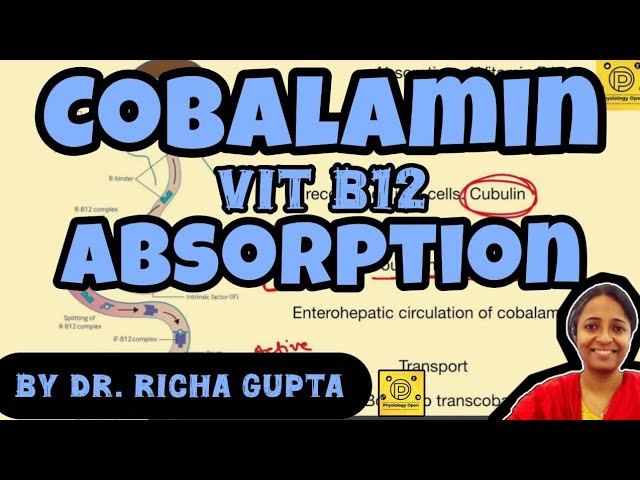
The absorption of dietary vitamin B12 begins in the stomach where the vitamin is initially bound to protein complexes. Upon entering the gastric environment, these proteins are broken down by enzymes present in the stomach, duodenum, and jejunum, allowing for the release of cobalamin. A specific salivary protein known as haptocorrin, or R binder, binds to the released vitamin B12 within the stomach to protect it from acidic conditions. This complex then travels to the intestine, where pancreatic trypsin digests the haptocorrin, freeing the vitamin so that it can bind with intrinsic factor, a protein secreted by the parietal cells of the stomach lining.
Once the vitamin B12 is bound to intrinsic factor in the small intestine, this specific complex travels to the ileum for absorption. The apical membrane of the ileal cells contains receptors specifically designed to recognize and bind the intrinsic factor-vitamin B12 complex. This binding event triggers active transport, facilitating the uptake of the vitamin into the intestinal cells and subsequently into the bloodstream. While this receptor-mediated pathway is the primary method of absorption, it is worth noting that approximately 1% of dietary cobalamin can be passively absorbed through mucous membranes, a mechanism that becomes clinically significant when high doses are administered orally to treat deficiencies caused by intrinsic factor issues.
After entering circulation, vitamin B12 is transported bound to the protein transcobalamin and eventually stored in the liver within hepatocytes. The body maintains substantial reserves of this vitamin, sufficient to last for three to four years without dietary intake. To prevent depletion, the liver releases excess vitamin B12 into the bile, which enters the intestine where it can be reabsorbed by the ileum, creating an enterohepatic circulation loop. This recycling process is crucial for maintaining adequate levels of the vitamin, especially since malabsorption issues or disruptions in this circulation can lead to rapid development of deficiency compared to individuals with low dietary intake alone.
In summary, the physiological journey of vitamin B12 involves a precise sequence of binding events starting with haptocorrin in the stomach, followed by intrinsic factor binding in the intestine, and culminating in active transport via specific receptors in the ileum. The existence of passive absorption pathways and the enterohepatic circulation ensures that the body can maintain stores for years, but any impairment in these mechanisms, such as malabsorption disorders, accelerates the onset of deficiency. Understanding this complex pathway is essential for grasping how the body manages cobalamin homeostasis and why high-dose oral therapy can be effective even when intrinsic factor production is compromised.
Read the full video transcript
How does absorption of vitamin B12 take
place? So, dietary cobalamin is bound to
protein complexes. So, see this diagram.
So, when we take it in diet, it is bound
to protein complexes, and it is released
from these protein complexes by enzymes
which are present in stomach, duodenum,
and jejunum, right? Now, there is a
salivary protein which is released known
as haptocorrin, popularly known as R
binder. So, here we see that there is a
protein being released R binder.
Actually, now the term for this is
haptocorrin. Okay?
So, this is B12 attached to the proteins
is going into the stomach. So, here it
is also attached. Now, in the stomach,
it is released from these protein
complexes, okay? So, what we see that
after being released from these protein
complexes, your R binder or haptocorrin
is binding to this vitamin B12, okay?
So, here you see it is bound R binder
and vitamin B12 complex.
Now, it reaches to the intestine, and
there we have the binding of intrinsic
factor with B12. Actually,
haptocorrin released from the salivary
fluid, and intrinsic factor, it is being
released from the parietal cells in
stomach.
Okay? But, best part is that they are
not binding to vitamin B12 at the place
where they are released. They are
binding at the next place. So,
haptocorrin released from the salivary
fluid binding with vitamin B12 in the
stomach. Intrinsic factor released in
the stomach by parietal cells, but
binding with vitamin B12 in intestine,
okay? So, yes, as it goes, it there is a
splitting of this R binder and B12,
because this R binder or haptocorrin, it
is digested by pancreatic trypsin. And
now, your intrinsic factor combines with
vitamin B12. So, here this is intrinsic
factor B12 complex. And on the ileum on
the ileum, we have receptor for
this intrinsic factor. So, here you see
that this is ileum.
The luminal membrane, the apical
membrane or the luminal membrane which
faces the lumen, we have the intrinsic
factor receptor. Intrinsic factor
combined with vitamin B12 binds to this
intrinsic factor receptor, okay? And
then it is taken inside. So, this is
also active transport.
Okay?
So, this is the main method of
absorption of vitamin B12.
Now, generally we study this only, okay?
Before we proceed, just remember that
this receptor is also known as cubilin,
okay? So, we were telling that generally
if we study this pathway only, but
remember that 1% of cobalamin in diet is
also passively absorbed through mucous
membranes. Understanding?
So,
if vitamin B12 consumption is high, then
substantial amount of vitamin B12 can
also be absorbed through these mucous
membranes passively. And when there is
intrinsic factor deficiency, then for
treatment high doses of vitamin B12 can
be given orally so that this passive
absorption takes precedence and adequate
amount of vitamin B12 can be absorbed
even in the absence of intrinsic factor.
Then next is that this it is getting
absorbed in the ileum and ultimately it
is stored in the hepatocyte.
From hepatocyte, it is being released
into the bile and then again it is being
reabsorbed in the ileum. So, there is
enterohepatic circulation of cobalamin.
Okay? Now,
if anybody is having problem of
malabsorption,
then
they will develop this vitamin B12
deficiency very fast because of absence
of this intrahepatic circulation of
cobalamin as well. So, yes, there will
be vitamin B12 absorption which will be
affected and intrahepatic circulation of
cobalamin also it will be affected. So,
these people develop vitamin B12
deficiency much faster than the people
who are having less vitamin B12 B12 in
their diet. Understanding? So, these
people develop vitamin B12 deficiency
faster than that of the vegans. Okay?
So, these are certain concepts with
vitamin B12. Now, vitamin B12 is
transported in the blood bound to a
protein, transcobalamin, to and which is
stored in liver as I told you and the
stores are sufficient for 3 to 4 years.
So, that was about vitamin B12
absorption in the gut. We saw how
vitamin B12 is first binded with certain
proteins from where it is released, then
it binds with haptocorrin, then it binds
with intrinsic factor, and then
intrinsic factor vitamin B12 complex
binds with the receptors present on the
ileum from where it is absorbed by
active transport.
I hope you liked the video. If you did
like it,
do consider downloading my app where we
have full physiology videos for MBBS as
well as for MD physiology. Thanks for
watching the video. If you liked it, do
press the like button. Do share the
video with others and don't forget to
subscribe to the channel physiology
open. Thank you.