Virtual Wildfire Timber Salvage Planning Guide Orientation (External) – June 2026
Watch on YouTubeVideo summary
This orientation session introduces significant updates to the Wildfire Timber Salvage Planning and Admin Guide, a collaborative tool designed to coordinate salvage operations following wildfires since 2017 among Agreement Holders, BC First Nation Forestry Council representatives, and government agencies. Led by Aaron Lindberg alongside other presenters, the guide reflects over a year of feedback received after its initial release in September 2024. The planning framework is structured into five phases: Phase One focuses on annual readiness between November and March to develop strategies that align retention, reforestation, and land values with local perspectives, while Phases Two through Five prioritize rapid timber recovery during and after fires to prevent value deterioration by addressing active fire actions, amending or creating Cutting Permit Strategies, and assessing complex incumbrances such as wildlife habitats under FURPA rules.
Key operational enhancements include the management of over 15,000 kilometers of fire guards built since 2021, offering options like pile-and-burn or lop-and-scatter treatments for non-salvaged timber to reduce hazards while engaging Natural Resource Districts rather than BC Wildfire Service directly due to harvesting complexities. The guide also introduces "ribbonless boundaries" effective from January, which allow salvage operations without physical layout using geo-referencing tools, alongside comparative cruise policies for permits exceeding 5,000 cubic meters that require regional executive director approval. Furthermore, four pricing programs now cover cruising, appraisals, stumpage rates, scaling, and waste reporting; although making the Crown whole often necessitates waste assessments to protect shared resources, these processes are being streamlined with simplified methods where possible to reduce costs and administrative delays.
The session highlighted critical opportunities for addressing systemic weaknesses, particularly regarding First Nations that face low allowable cuts under 10,000 cubic meters annually, which previously prevented them from utilizing wildfire timber despite existing Wildfire Salvage Opportunity Agreements (WSOAs). Approximately 20 such agreements have been issued province-wide with potential ten-year terms, though uptake remains limited outside specific local successes; these mechanisms allow eligible nations to apply for exemptions and receive associated NERFLES or FLTCs post-agreement. Additionally, major timber licenses currently suffering from significant undercuts due to delays on Timber Supply Rights present a unique opportunity for First Nations without forest licenses to partner in salvage operations using available unused cut, thereby maximizing resource recovery while fostering early relationship building among partners including industry and government ministries.
Ultimately, the Playbook aims to increase current low salvage rates by clarifying responsibilities and facilitating case-by-case collaboration despite challenges like conflicting provincial priorities and limited personnel resources. The guide's tools and processes are recognized as strengths that ensure consistency across the province when properly refined to include 100% exemption requirements for wildlife visuals and other values, noting that exemptions may not always be necessary if salvageable portions exist. To maintain this momentum and incorporate further improvements before public posting on the wildfire resource page, stakeholders are encouraged to submit comments via email to pricing or tenure branches, ensuring the document evolves effectively through continuous feedback from all involved parties.
Read the full video transcript
Okay, welcome everybody.
Good afternoon.
My name is Aaron Lindberg. I am the
timber tenures forester with tenures
compensation and business analysis
branch.
I am happy to call Prince George home
and I respectfully acknowledge the
ancestral lands of the Clay Tennena
where I live, work and play.
I am grateful for my fellow presenters
on the call today, Bruce, Fred,
Gretchen, and Jeff. And uh they'll be
helping present along the way. And if
there's questions, we will be able to
field those as well.
So today we're going to be talking about
the wildfire timber salvage planning and
admin guide. This is our second
presentation uh orientation for this
guide that was released originally in
September of 24 and then in its more um
completed final draft or final um form
in February of 2025.
So we did an orientation last June and
so this is much like that. However,
we've done a little bit of adaptation
and um [clears throat] we there will be
uh small edits coming out in a a third
version of it hopefully in the next
month or two. Really just looking at
highlighting a few pieces from feedback
we've received over the year and um
ensuring that tools are top of mind and
uh consistently being shared out
accordingly.
We were requested by the BC First Nation
Forestry Council and Kofi
representatives at a meeting recently to
share this orientation again. So, we're
happy to do so. And you'll notice that
on the slide that I'm sharing, there's a
video at the bottom. This is a link to a
video that was created out of the merit
area um as to success and collab from
collaboration and relationship building
that happened um locally there when it
came to wildfire salvage. So, I
encourage you to have a look at that
video if you haven't seen it already.
This recording, this recording, and this
PowerPoint will be available as well
when we're done.
So, why you might be wondering why why
did why did this guidance document come
about? Um it like I mentioned it was
created and released in 2024 and it was
a joint initiative between agreement
holders BC First Nation Forestry Council
and government to coordinate processes
for wildfire timber salvage. Uh it
really was in response to the wildfire
presence especially since 2017 and um
pieces like relationships, planning,
efficiencies, consistencies, processes
and tools all in one place. These were
all reasons why it was deemed necessary
to make sure we had a collaborative
tool.
I'm just going to ask my team members um
Gretch and Jeff if you see hands up
along the way will you please um jump in
and interrupt me because I'm really I'm
really okay with us having conversations
unless we have too many conversations
and we have to go back to following the
slide deck. But I can't see if questions
are coming up. So help me with that if
you would please.
>> They'll do.
>> Uh so the scope of the playbook,
um
simply put, it's to increase wildfire
timber salvage in BC with these
parameters. We want to see retention
achieved and reforestation where it
where we where reforestation is viable
while considering all values on the
land.
Where can all the resources be found?
One of the pieces that we wanted to make
sure was that it was available as much
as possible in one location. So you'll
see that arrow pointing to the forest
tenures website that houses wildfire
timber salvage information. And so if
you're ever in doubt where to go, one,
you can come to this PowerPoint and
these links are embedded within or two,
you can go to this forest teners
website. The other websites listed there
are supporting documents and websites
that go along with the permitting
processes and they are all linked within
the playbook as well. I think I
neglected to mention though I might have
the guide that I'm speaking of
affectionately known as a playbook is
just so that I don't have to say
wildfire timber salvage planning and
admin guide every time.
So something to consider if you will on
this call
while we're going through the
presentation we're always looking for
feedback. What is working? What isn't
working? what are our strengths? What
are our weaknesses? And where can we
improve?
So, this is just me jotting down a few
ideas from some discussions we've had.
And definitely there's some blanks that
can be filled in.
So, we will come back to this uh slide
at the end of the presentation. In the
meantime, if you think of something, jot
it down in the chat or the Q&A and uh we
can review it at the end or be prepared
with your comments towards the end of
the presentation.
So our agenda today
is all about the playbook.
Part one addresses five phases five
phases of salvage planning. Part two are
cool current tools and resources and
we'll have a feedback opportunity at the
end.
So annually the Ministry of Forest
releases its goals and you can see here
that increasing wildfire timber salvage
remains a priority for the province as
we see it embedded in one of the four
objectives.
The playbook part one has five phases
for timber salvage planning. Phase one
really is about the planning and is
encouraged to be reviewed on an annual
basis for each forest district area in
the advance of a fire season. Phases two
considers the action that occurs during
the wildfire or could happen during the
wildfire. And phase three to five are
post-w wildfire phases that prioritize
timber and fiber recovery in a very
short time frame. We know we have a
limited amount of time to recover said
timber before it deteriorates in value.
In phase one, this is that preparation
annual readiness planning piece. The
outcome of this is a wildfire timber
salvage strategy plan.
The idea is to have something efficient
and effective for a salvage approach.
Where we're considering retention and
reforestation, we must always remember
those three go together. And considering
the bullets that are mentioned here
where we're aligning values if possible,
understanding values and objectives,
where we have this provincial guide for
consistency with that local district
area perspective, which is so important,
where you're really considering who's
involved, who's around the table, what
is the inventory of mills that can take
burnt wood and to what degree? and
always be thinking about um BC Wildfire
Service engagement as far as um
potentially salvaging fire guard timber,
what that could look like, and just
maybe some of the local uh
considerations that we won't know unless
we have those conversations.
We [clears throat] know that a shared
understanding between forest tenure
holders and decision makers regarding
cutting permit application requirements
and acceptable conditions and targets to
be achieved on the landbased prior to
reacting to a catastrophic wildfire
event is a good idea.
>> [clears throat]
>> So this strategy plan that I speak of is
captured just a visual there of the
table of contents. This guide was
developed with a subgroup of
representatives
uh since we released the playbook last
spring.
And the idea behind this is to um
basically guide through the topics for
consideration in this planning phase.
Now a challenge we already know is we
have conflicting priorities in our
province and we have limited people
resources.
So we somehow have to find a way to work
through that. And really the strategy
plan is all about relationship building,
collaboration and planning for salvage.
This document will be available on that
same forest tenures website under
wildfire salvage resources.
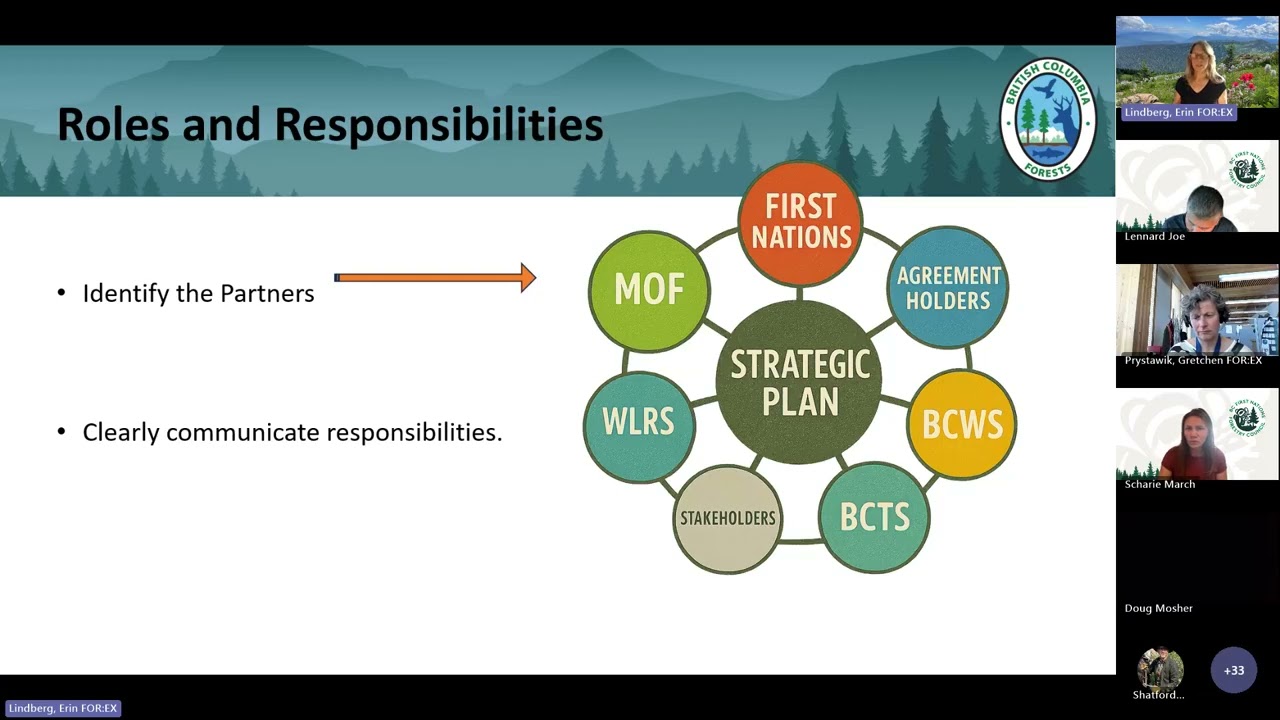
So roles and responsibilities very very
important to outline this at the
beginning. Identify who the partners are
going to be. These are the these are the
suggested partners that are outlined in
detail in the playbook. And so um
there could be there could be others and
really it comes back to that local area
perspective on who needs to be having
conversations. So keep that in mind.
We're trying to create provincial
guidance for consistency.
Always noting that that local
perspective is critical and then
ensuring that you have clear
communication of responsibilities for
those partners and where they come into
the game.
As mentioned, collaboration is key to
everything we do. [snorts] Uh it's key
here that relationship building
development and maintenance must occur
continue to occur that early and regular
communication is happening between
partners
that we're leveraging meetings,
gatherings that we're already having to
have dialogue around salvage.
Um and also maintaining awareness that
there's varying support for wildfire
timber salvage across the province
depending on where you are.
And again, that combined knowledge,
experience, and collaboration between
partners will help design the best
management practices and planning for
forest resources in relation to salvage.
Well, Lenny, I see your hand up.
>> Yeah, I think this is a definitely is
needed. One of the things that that
comes to mind is who initiates this? Is
this a First Nations should be initiated
or is or is this coming out of each
district office or Right.
>> It's a good question, Lenny. It's
something uh the pro I'll say the
province has been struggling with from
the beginning of since this has been
released. The leadership
rests with whoever has capacity to do
so.
And what we're trying to do right now is
we're trying to encourage strategy
development out of the district offices.
However, it doesn't sit solely on the
district office shoulders. So what we
hope to see is that
by supporting strategy development at
the district area level, there will be
outreach that occurs to reach out to
licenses and and first nations to start
having these conversations and get the
feedback starting to roll. Um that is
the model we're currently using because
we are aware of the lack of people
resources to provide leadership on this
and it is varied across the province
depending on capacity. So if a first
nation, if a lency happened to really
want to prioritize something, they could
lead in the outreach to the district to
start the conversations.
Okay, thank you.
So on this nice busy slide, what we're
trying to capture here is this is these
are the rest of the phases. Phase one is
all about the planning before wildfire
season. So let's say November till
March.
Uh phase two to five is guidance and
outlines how to prioritize CPS according
to the status on the development
timeline and the values, requirements,
limitations on the land base that lead
us to a no-go or a go-go. So the top
arrow here is showing you what you would
be considering in your area if a fire
has occurred. Do you have any approved
CPS?
Is there a new or existing blanket
salvage cutting permit in place? Is this
an opportunity to develop FLTC major or
the the NERFL associated with the Wasoa?
Is there development and planning that
can be occurring? Phase two is all about
while the fire is burning. So you know
where the fire is, you have an idea
where it might spread to. be thinking
about how you could jump into salvage by
considering the timeline of those CPS
or not. Phase three and onward
exercises similarly, you're looking at
your approved CPS. Do you have any in
the area? Can you amend them to get on
the ground quickly as soon as you can
access the site?
Are you developing new C new CPS?
phase four tend to be looking at new CPS
because you've already moved through
phase three and on down the way. The
bottom arrow is speaking to what kind of
values and incumbrances
and access issues um assessments are
required to be able to do salvage as
quickly as possible. Hence the looking
at approved CPS first because you've
done most of that work or you've done
all that work because it's been through
and it's it's already been issued. So
these are the visual pieces to be
considering
as you're dealing with a wildfire in
your area and they are captured from the
playbook as well. So what we're doing
with this pres this orientation
presentation is we're tying you right
back to the playbook. The playback is a
very
hefty document and it's used it's
intended to be used as a reference. So
this information is
fully connected to the playbook.
>> Oh now's a chance for Jeff to join us.
>> Thanks Erin. Yeah, good afternoon
everybody. I'm Jeff Shadford. I'm a
habitat biologist. Um, and I advise
staff around the province on the
management of wildlife habitat areas and
under the winter ranges. Uh, and in your
encourage you in as you're doing your
planning um to know the landscape and
and by that I mean to know the the rules
that apply on the land and under furpa
there's many rules that apply across the
landscape and then there are additional
rules um for what uh to manage extra
value the non-timber values. So,
wildlife habitat, community watersheds.
And so, I encourage you to know and work
with your planning staff to know what
those are. The the spatial the map data
is available on the BC data warehouse.
And then the extra rules that apply for
forestry are available on the the
government action regulation website and
other websites um maintained by the
government for those values. Um, so know
know what applies and and recognize that
there it's challenging and under the
wildlife habitat area program we're
managing over 50 different species of
wildlife. So from rattlesnakes to
grizzly bears to tailed frogs and so it
the rules are different for different
species and different areas in different
parts of the province. So it is a
challenge. We recognize that. But um the
data is information is there for your
access. And be aware that in a few cases
um there's protected rare birds and
reptiles where we actually don't release
the name of the species and the rules
and you need to actually have a data
sharing agreement and that that can
complicate things even an extra level.
But I just wanted to point that out in
case you're bumping into that. Um
and then if we go to the next slide, um
it's important to recognize that so
these are values those ones listed there
under the government action regulation
um with the special rules in different
parts of the the province that there are
different if you need to apply for an
exemption. So if there's a fire and
you're interested in the areas, you're
understanding the rules and they you
might be a no harvest constraint. For
example,
if you think you there's a rationale to
get in there or to get into part of the
area, you can apply for an exemption
uh for some of these and that the
decision maker is uh sometimes in
different ministries. So sometimes in
the ministry of forest uh and sometimes
in the ministry I work for the water,
lands and resource stewardship. So that
is another level of complication. that
uh don't be dissuaded and um and I
encourage you to talk for wildlife
habitat particularly with the regional
ecosystem biologists who are responsible
for managing and making recommendations
and working with licences. So, and if
you have any specific questions uh you
can certainly email me and I think we'll
have some of that discussion at the end
of this. Anyways, thanks for the
opportunity.
>> Thanks Jeeoff.
Okay. Um, moving on to
the playbook part two. This is where uh
it houses current tools and processes
available for timber salvage. And I want
to highlight that there are two areas of
salvage for focus and that would be our
general timber salvage
or standing timber and then fire guard
salvage which is
not standing timber.
Uh from a permitting perspective, we
still use the cutting permit for this.
Um
the there are tools available within the
cutting permit structure that are able
to be used on a case-byase basis as
well.
So both salvage are described in phase 2
to five. It tends to be a bit trickier
for fire guard salvage, but we're still
targeting that removal during phase 2 to
five. It's trickier due to the loc due
to the location and varying condition of
said timber.
So from a wildfire rehab perspective,
we know that there's over 15,000
kilometers of fire guard constructed in
BC since 2021. And BC Wildfire Service
is required to address the fire hazard
for these fire guards. They would like
to see an increase in timber salvage as
as Ministry of Forests would like to
see. So there's four situations that
fire guards are left in. And this is
really from a for an awareness for
everyone on the call in case you don't
know. Um fire guards can have pushed
over timber as noted on the far left
where timber is literally a big
schmuzzle in the bush. Um, it can be
bunched and left in the bush as the
second photo shows in piles or not. And
tops usually are still on here. It can
be decked roadside as you see in the
third picture. 95% of the time they'll
still have the tops on the trees. And
then there's these large scale
operations they have as shown in the far
far photo there.
So
their primary treatment options to
reduce the hazard associated with said
fire guard are these three mentioned.
They have pile and burn and lop and
scatter as their as their two options if
the timber is not salvaged. So, for
obvious reasons, they're f they're
trying to well, they're communicating a
lot uh with tenurs especially to see if
we can encourage the salvage of said
fireguard timber.
And I also wanted to acknowledge that
Kyle Miller, wildfire rehab provincial
specialist, has provided us with this
information. He just wasn't able to
present, so I get to today.
So, it is best to contact the Natural
Resource District to discuss
opportunities for wildfire timber
salvage as opposed to um BC Wildfire
Service directly. Um it's good
awareness, it's good to have the
awareness that there are numerous
departments in the BC Wildfire Service
that are associated with cutting and
harvesting of timber and therefore
require the district involvement. Um,
also note that there are um that not all
districts are staffed for wildfire work
to the same degree. And this visual here
is just to help people understand the
different areas within BC Wildfire
Service. In the first column,
prevention, preparedness, response, and
recovery. And the highlighted in kind of
that orangey color are the different
programs that are um held at district
with the wildfire risk reduction
program. Um and wildfire suppression
rehabilitation is something where
BC Wildfire Service is working with the
district and uh even under the response
piece there could be that collaborative
piece that we already talked about from
phase one where we're all in the know
and working together to figure out how
best to extract timber on a in a timely
manner.
Now Gretchen's going to share.
>> Good afternoon everybody. Uh my name is
Gretchen Pristoick and I'm the North
area revenue team lead. So you've got
across the province two other folks who
are in similar positions to me. Bruce
Sullivan is in the south area and Fred
uh is on the coast. We are all here to
answer questions and help you navigate
um the wonderful world of pricing which
I'll talk about on the next slide. But
this slide really is about two what we
think are really um new and um helpful
operational opportunities to um advance
salvage opportunities. One is the
ribbonless boundaries policy and the
other one is comparative cruise. So when
I'm done speaking I'll put the links to
both of these documents in the chat. But
the ribbonless boundary policy was um
released in January of this year and
basically it provides an opportunity for
salvage without layout.
Uh in a nutshell, there's some
requirements and applicability that you
need to be aware of um really around
machines having uh geo referencing tools
available so that they know where they
are so that we don't trespass. Um you
must use ribbonless boundaries in the
interior with comparative cruise which
is the second policy on the right. In
the interior, we have a standard um
policy. Uh Bruce just put it in the
chat. Thank you. It's an interiorwide
policy available at the link. Um if you
want to do comparative crews on a
cutting permit over 5,000 cubic meters,
it's a decision that goes to our
regional executive director. And if it's
a smaller than 5,000 cubic meter cutting
permit, it stays with the district
manager.
Again, lots of details on that policy in
the chat. Thanks to Bruce. On the coast,
things are a little bit different.
um the red in each of the two coastal
regions will make an approval decision
and Fred and his team will walk you
through the process to um apply and have
your proposal reviewed.
Any questions or comments on that from
the group or from my colleagues?
So, is is this similar to just how it's
been in the past? Is this or is like I
know it's in the it's in the uh it's in
the playbook, but is this very similar
to just how we've we've dealt with
things in in the past?
>> Good question, Lanny. So the um
ribbonless boundary is new and it's a
formal newness since January.
It was being piloted in some areas
previously, but now it's it's formalized
and standard and hopefully much more
available to um everyone across the
interior. The comparative cruise policy
in the interior has been formalized
since 2024.
So it's not necessarily new. Um but at
that time [laughter] it was formalized
also in a standard policy.
>> Okay. Thank you.
>> Anybody else?
>> All right. Thanks again to Bruce for
putting the um two links in the chat.
The first one's the ribbonless boundary
tool which is on the tenur's website and
the comparative cruise policy is on the
timber pricing branch website.
Aaron, I think that's it for this slide.
All right. So, next slide. When we think
of um pricing considerations on salvage,
uh we think of
four programs. So, timber cruising
appraisals or the stumpage rate
determination on whatever cutting
authority you will be applying for once
the uh timber is cut or if it's already
cut and you're accessing it and the
scaling requirements and processes. And
then lastly, waste and residue reporting
if it's required.
Um, this can be a challenging process to
navigate. So, um, we've got lots of
manuals that help provide consistency
and transparency to everybody on the
coast. Many of you will be much more
familiar than me with the coast
appraisal manual. In the interior, we
have the interior appraisal manual. Um,
again, if you have questions on pricing,
we've got timber pricing officers across
the province who are able to help you.
If you're unsure who to contact, uh, I
mentioned at the start of my section
here, Bruce is in the south, Fred is on
the coast, and I'm up here in North
area. Um, the first bullet on this slide
I didn't speak to, but I believe it was
in 2024, Timber Pricing Branch made a
big summary document that's linked uh
there. I will put it when I'm done
speaking. It's uh sort of the ins and
outs of consideration, some Kohl's notes
on pricing wildfire damage timber in BC.
Um most of you working in pricing will
be aware that our appraisal manuals are
updated
at least annually. The um interior
manual is expected to have an update as
per usual on July 1st. Uh if there's any
uncertainty in those in that document
specifically, do reach out to us.
There's no stupid questions and we'll
help you um on your objectives.
That's all I wanted to say. Bruce and
Fred, did I miss anything andor
questions from the group here?
>> No, I think you did really well. It's
good.
>> Thanks, Gretch. And and just to just to
know the uh this this uh slide deck does
have the link. So wherever it says here,
that's the link to this document that
Gretchen was speaking of as you can see
in the blue ink there. So
okay,
so that's it. Now we move on to
questions, comments and uh I hope that
I hope that uh that was a good cover of
the basics of the playbook.
Um we do want to come back to our
discussion
our discussion page here and see if we
can get some comments from the group.
Um when we're thinking about all the
resources that have been created uh
since well I would say in the last 5
years when it comes to wildfire timber
salvage uh we are curious around what is
working what's not working and how we
can do better and we're always open to
feedback. So even if you think of
something after this you can email us.
>> You've got a question there.
>> I see a hand up. Yeah.
>> Go. Um yeah, question around uh fire
guard salvage. Uh we were issued a a
cutting permit uh to retrieve fire guard
salvage wood and within the cutting
permit document it stated the the
requirement to conduct waste and residue
uh post operations. Just curious if that
was maybe an error from the district
manager that issued the cutting permit
because we were issued uh a permit for
another fire guard uh that had a cutting
permit that did not require waste and
residue. So just I guess the question is
uh where does the waste and residue
apply or not apply with regard to fire
salvage?
Gretchen, do you want to take this or
would you let me?
>> Hi, Jeremy. Um, long time no see.
[laughter]
Uh, tricky subject. I think it would be
best if you and I talked offline. I'm
assuming with um the northeast district
piece and maybe we can get everybody on
the same page for forward looking. It
can be pretty complicated.
Gotcha. Oh, that sounds good.
>> Yeah. Okay.
I guess uh not to be ky but um you know
if we're all thinking about doing
wildfire salvage uh we just think about
sort of the crown being made whole. So
if the crown has if the crown is selling
timber um and the lency has the
opportunity to cut and remove most often
there is a requirement to do a waste
assessment. That's not always the case
but if you're looking at your cutting
authority documentation
um you want to be thinking about what
your obligations are. So Jeremy, that's
a really good point. Uh to understand uh
what you're required to do, also what
the opportunities are. So our teams can
help out with um scaling alternate
methods of scale in some cases. Bruce's
team has led a lot of work on providing
concurrent residual harvest system
opportunities for some burnt wood. So,
we're trying as much as we can to
innovate and provide economical
opportunities to meet obligations. Um,
but if we all are aware of what the
obligations are and can talk about them
and unpack them, we'll be better ahead.
>> Thanks, Ken.
Okay,
there is a question for Jeff and I think
before we lose Jeff here, I think it
would be great if you could answer it.
Brian Drobe in the chat
>> regarding values. Can you see that Jeff?
>> Yeah, I can just see it. I'm reading it
now.
>> Okay.
um the the
expediting those I would say it's it
just goes through the regular process
but I think the advantage of this
conversation and what Aaron was
introducing earlier was that you know
who to call so you know know who the
ecosystem biologists and the decision
makers are in your region uh be familiar
with the processes But in terms of I
mean you if you're putting in a an
application for an exemption and you put
expedite on it that will get attention.
I just can't say that depending on I
guess a case by case uh really what it
comes down to.
>> But thanks for the question.
>> Yeah Jeeoff it's Brian. So, I mean,
given the significant amount of work
that we've done with our partnerships
um with First Nations to to get things
expedited, uh I find it a bit
disappointing that government hasn't
take that initiative to remove any
potential
on the impediments to to get things
rolling. I I think you know uh being
species based or value based I think
there is work that could be done
proactively to understand the various
circumstances that you'd come across um
and you know and that could be timber
type or extent of impact fire severity
all those sorts of things that would a
enable you to much much more prompt
respond to you know either approval or
variance required um so that you know
that isn't one aspect of a holdup um
given all the other good work that's
occurred between companies and bands.
>> Yeah. No, I I appreciate it. Um there
is, as you said, there there is um
expedited
uh data available on fire um intensities
in some cases. I I I don't tend to have
access to that, but you know, my
awareness is that there is information
and the province is working to make that
information available for planning
purposes. But it still comes down to a
case-by case basis. It's hard to
predicate how intense is the fire
uh the season before and and uh
authorize something when until you might
have to have eyes on the ground or eyes
on the the data that's supporting the
decision. So, I think that's where we're
at. It's like there are processes to
expedite this, but it's not necessarily
going to um avoid the questions of how
is it impacting the various species that
I mentioned earlier.
>> Hi, I this is Len. I I I like where
where where Brian is going and I and I
like where this discussion is right now
because you know um we look at at
opportunities and I'm wondering what you
know again case by case or or region by
region you know we're looking and if
things like this can be can come up at
our at our you know phase one of of of
of planning because I I really do think
that's that's the one thing is um when
these things happen uh especially when u
you have Let's, you know, I'll just, you
know, the best case scenario, you you've
got a a really good uh um lency
uh that that has a great reputation and
and a and a and a really good
relationship at with the First Nations
level and and and a lot of information
and capacity and readiness, you know,
that's sort of the best case scenario.
And and I think that those are the
things again that that should be added
as as opportunities and what is needed
because when when this happens,
I think it's uh again it's it's the best
to not have that as as an unseen hurdle
that that comes once once you're trying
to move it move it forward. So that's a
this is a good good time to bring it
bring that up as as an opportunity.
Thanks.
Would
you say that that parap paraphrasing
that would be phase one planning from
what you just said there? Yeah, that's
what I thought you said.
>> Yes.
>> Okay. I see less.
>> Yeah. Just to further to Lenny's and a
question for Jeff really I mean if you
if you got the pre-planning done and all
the players involved in that particular
area agree I would suspect the
pre-planning would indicate existing
wildlife habitat areas what have you and
the pre-plan would say okay what are we
going to do should there be a fire the
exemption piece just delays things and
maybe there should be thought to put uh
those areas that would qualify for no
exemptions
depending on the severity of the fire,
where the fire was, and what level of
pre-planning was done because I find the
exemption is just an unnecessary delay
in most areas, particularly if the
habitat is destroyed.
>> I appreciate the question. Um the issue
is challenged by you know uh I've seen
um
unal winter ranges that have burned up
and one could on one hand one might say
the entire habitat is lost whereas you
could also look at the area and say
there is a lot of uh snow interception
canopy left uh it's in some of it's very
green some of it's very brown some of
it's very black. It's hard to make that
assessment until you actually have it.
So, it's it's hard to give a a
pre-exemption like that's the challenge
that our ecosystem staff has when
they're um overlapping. Uh, you know,
and maybe an angel winter range isn't a
great example. Wildlife habitat areas
that many of them are much smaller. It's
again hard to predetermine what what the
impact of that uh fire is. If it's an
underburn, it might actually have great
improvement on that. Um it depends again
on the species being managed for and the
the extent of the burn. So uh just
removing or providing a blanket
exemption in my would be wouldn't be
something that I would support or
recommend. Um I appreciate people could
make the case for that and that that's
what I'm hearing but it is again case by
case.
>> Yeah Jeeoff and I don't think what's
being suggested as a blanket exemption
is always conditional. So you know in
the I mean even these these ideas that
you're raising uh those are the
attributes that would consider it as
part of a conditional exemption. So with
the male deer winter range you know uh
whether it be a size of a polygon or
percentage of the the crowns that has
have been damaged. Um there's other
aspects of deer winter range such as
access and regeneration and those sorts
of strategies all of which could be put
in place that very quickly understanding
the circumstances that exist with a
wildfire. Um, again, you know, as less
suggested, uh, you know, an exemption
route, uh, from our experience, you
know, down to areas, you know, even less
than a hectare just take forever to get
approved. And, and I think even, you
know, that element in terms of the
magnitude of what's being contemplated,
leaves an opportunity for uh, you know,
to to bypass a variance or an exemption.
>> Yeah. And I think that's why uh you know
I think the program here is encouraging
people to have those conversations uh
bring those values and those variables.
I mean it's these factors that you've
that have been brought forward today
that are impacting but in you know I
work at a provincial scale. I think you
need to speak with the Angula wind range
managers in your respective areas. have
those conversations in November
uh as the case might be and bring those
ideas forward and uh that's I think the
the intent of this program.
>> Just further to what Brian said, Jeff, I
mean I didn't infer that there'd be
blanket exemptions for everything. It's
sightsp specific and I would hope that
the people that are doing the
pre-planning would have some indication
from their local uh biologists or
wildlife people there. And it just makes
more sense. It's not really a blanket
exemption, but as Brian indicated, a
conditional
uh, you know, go-kart rather than having
to delay it by going through just a
administrative exemption request, which
has no bearing on what the outcome will
be.
>> Yeah. Well, um, the one of the
challenges and I I see in in the
slowness of the response sometimes is
getting a prescription for what what's
going to be left behind. And I think
that's often the the concern for the
wildlife biologists is and so getting
that prescription and maybe working on
some of what that looks like ahead of
time would be also maybe an advantage
for this group.
>> Yeah, it really points to the strategy
planning of phase one. And so, um, I
think if you have those early
conversations with the biologists in
your area, um, from
those partners around the table and just
identify
what are the what are the barriers in
our area and how can we get a better
understanding so we can move forward
more efficiently. Like Jeff's saying,
that is the whole point of the strategy.
Mhm.
>> It takes it takes person power up front
and it's going to probably save time
further down the timeline.
And that's the challenge right now is
it's that investment of time up front
for something that might happen that is
not translating to everyone.
Um
less
>> yeah another not not on the same theme
here but a question to Gretchen she
indicated that uh you need to make the
crown whole and that's that's why you
have the waste and residue survey for
these fire guards and I just question
why in the sense that the first two
pictures you showed Aaron where where
the fire guard all the timber is just
scattered are not utilized. And yet
where we're able to harvest a fire
guard, you're going to have to do a
waste and residue their age. It just
seems again uh an impediment for people
for doing that because uh they are
making the crown a little bit whole by
actually making the fire guard efficient
rather than burning more crown timber.
So just understanding why you would want
a waste and residue survey in that
situation, it it just makes no sense to
me.
>> It's a good question and a good point.
So not all of the cutting authorities
that are issued to salvage timber will
require a waste and residue survey. Um
this is the sort of technicality and in
intricacies of the process. uh when you
are working with a district staff
person, usually an appra or what are
they called? Authorizations
uh specialist, they will help you
navigate what your obligations are. Um
in some cases, if you're taking if
you're purchasing u stacked logs,
basically uh depending on the cutting
authority, you might not have
obligations for a waste and residue
survey. The province understands,
appreciates that waste and residue
surveys can be cumbersome and can get in
the way of um
it's going to turn someone's mic off
here. Um waste and residue surveys can
be cumbersome and can get in the way.
And so there's been many changes to the
waste manual in the last little while to
streamline the process and to reduce the
costs of said surveys. We have tools um
like simplified waste, uh district
averages, all kinds of things. So again,
we're kind of getting into the weeds.
Probably don't need to talk about it
now. Um, in general, our our
requirements about making the crown
whole are really about protecting the
asset that is a shared resource um from
the people of BC nations and and
citizens, the crown, as I said, with
crown. So, Lenny, go ahead.
Yeah, you know, this is this is really a
great discussion because although we're
recognizing the the need to make the
crown whole and and we're developing a
level level of assurance, you know, the
there also needs to be uh the other side
of of uh funds available to make it
operationally feasible, right? And and
even the one thing is, you know, I've
done I've done a few uh uh a few salvage
operations on on, you know, so so if
you're actually trying to salvage, you
know, and get and get this wood and and
move it in a in a timely basis, um
you're you know, you've got kilometers
of of uh of down and decked wood that
you know, and then and you're you're
doing a winter log, say, and by the time
you come out, by the time spring comes,
you're not going to go back in in there.
and and of course you're going to get
dinged with with waste and residue of of
things that that are that are unseen
because when you're a lot of a lot of
the uh you know so I think that's the
one thing is I would I need I I think
salvage operations need to consider
how how the fiber was you know was was
made of was made available.
Um the other one is uh just just putting
forward examples. Um when is an unulant
winter range not an unulate winter
range? You know it's identified as one
and then then a fire goes through. I
just went through a two billion tree
program uh replant and uh their biggest
concern is that the uh um is that
there's going to be a lot of blowdown
from from the fur that was left behind
and it wasn't taken after the fire
because it was deemed unulate winter
range and there's no there's no canopy
whatsoever. But the but you know so I
was looking at things and saying you
know again even wildfire uh you know you
you've got burnt areas that can
contribute to allowable cal or you got
burnt areas that can contribute to to um
to operations forest operations
um and and have a have a return that
that we're looking in current current uh
hurdles uh prevented and it's actually
going to probably impede in the in the
in the the rehabilitation of the the the
planted trees that were were were put in
amongst it. So those are things that I I
keep thinking about as I think they're
they're definitely
things that should be considered when
we're actually moving things forward and
and so again that's that's the the
ability to have crossorganizational
uh discussions you know like with
wildfire with ministry force with walrus
um industry and and first nations uh but
but these are these are some of the
things that
that and so so I look and say, you know,
right now what is the current percentage
of um that that that is actually uh
salvaged, you know, and and to to areas
burnt and what are what are the hurdles
that are that are preventing that, you
know, and so I I just keep I just look
at it and just want to bring it up at
this conversation. Thanks.
Did Lenny, did I just hear you ask what
are the current um salvage rates?
>> Yeah. Yeah. Yeah. It was just, you know,
is it 5%, is it 50%. Right.
>> From a general from a general
perspective, we know that 5% of the THLB
is available for uh salvage and
>> right,
>> we're seeing less than that um from an
actual salvage perspective. Right. So
when the province looks at salvage,
we're wanting to increase that salvage
number,
>> right? So one is, you know, if the crown
is looking to to be made whole, I think
it needs to look at at the balance of of
what it what needs to be out there in
order for for that to happen because it
it becomes almost a loss opportunity.
Every percentage that that is not being
salvaged is is a percentage of of crown
uh loss.
Yeah, exactly. And that and that tight
timeline that we we have associated with
timber recovery is so key to that. After
3 years, depending on where you are and
what sites you're on,
>> you're the fire's pretty much
>> left. It's not it's or not the not the
fire, the timber's left. It's no longer
Yeah.
>> worth recovery
>> from a timber pentric perspective. Yes.
>> Yeah.
right now, you know, lack of better
words, there's there's there's not
enough carrots that that is attracting
investment into into wild wildfire
salvage.
>> Yeah,
this is this is the feedback we're
looking for in this conversation. Um
>> I'm curious if I just I see your your
face here. Um March, I think it is. I'm
wondering if maybe you have something
you wanted to contribute to the
feedback piece.
>> Hi. Sorry.
>> Hi.
>> I was just trying to find that unmute
button.
>> No problem.
>> Um right now I don't have anything um to
add. What Lenny said was great. Um,
but
yeah, no, I honestly think this is a
really good conversation and I'm really
happy that we're able to talk about this
today.
>> Okay, great.
Um,
less.
>> Yeah, just one more time. I mean, if
you're the whole intent of this uh
playbook and guide is to increase
salvage
and currently all I see is sort of
impediments and weaknesses
rather than opportunities as being
positive. And I would say that under
your weakness column Aaron, you should
also put the 100% exemption requirement.
And it's not just for wildlife, it's
for, you know, visuals, etc., and other
values that uh require exemptions. And
from my perspective, maybe I'm just
dumb, but I mean, if a visual corridor
burns up, I'm not too sure what the
aesthetics are there and why you would
even look to get an exemption if a
portion of it is salvageable. So, just a
couple of comments for you to consider.
Does that capture it for you in a
summary?
Hope so.
Lenny,
>> I think another opportunity again is um
we're well below our our cut control.
Um, not every everyone who holds a
tenure um has has much volume. There's a
lot of First Nations that have very
little less than 10,000 cubic meters and
uh and to apply that uh to uh to a to a
burn and and losing losing an allowable
cut uh um on a year. Um, so I'm looking
at another opportunity is is maybe maybe
we're going to have to uh create a
process to apply for uh wildfire uh
nerfles or other things. Um
>> well, we have a we have a process under
the wildfire salvage opportunity
agreements for First Nations. And so so
that that's something I'm glad you
brought that up. I wanted to make sure
it was highlighted in this um in phase
uh one where we're planning this is
where when nations come to the table
they can express an interest in this
wildfire salvage opportunity agreement.
Yeah.
>> In phase two when that fire is actually
happening on the land base.
>> This is an opportunity again for nations
to come forward and say we don't have a
forest license. We would like to have an
opportunity to salvage in our area and
the first step is this WasoA is the
>> yes
that has accompanying Nerfles and FLTC
that would be issued post WasoA.
>> Can I ask how much traction that's
that's getting? And um
>> well I think I'm guessing off the top of
my head we have about 20 issued Wasoas
in the province but I'd have to double
check that for exact numbers. um Lenny.
But yeah, so it is getting traction and
it's also got the associated agreements
having been issued once those fires
happen. But the wasoa is a good
agreement to put in place
>> in the area regardless. I believe it has
a 10-year term. I'd have to double check
that, too. Um but there the link is in
this spreadsheet. Uh sorry, in this
PowerPoint as well.
>> In the PowerPoint. Perfect. And and you
know I I I brought that because I I I
remember the discussion happening. I
actually um I know that there was a
local band here or local uh uh forestry
group here that that applied but but
other than that I I really haven't heard
much. So it'd be really interesting to
see what the the the hurdles or
opportunities are within within that as
well. Right.
>> Thanks.
>> Thanks for the question.
said l again just under the values under
weaknesses I would rewrite that and say
where exemptions may not be required.
>> Ah
thanks
I like it when you spell it out for me.
>> I'm off to a another meeting. So
>> thank you Lenn for being here. Yes.
Okay. So I see in comment in chat Romero
Marorrow says most major lency h
licences have lots of undercut right now
with TSRs being so far behind schedule.
So potential there to partner if cut is
an issue for first nations.
Julie noted did you want to say anything
more on that Maro? I don't know if I'm
saying your name right but
>> um no just just that that that's kind of
the situation most major licences are in
and and obviously First Nations a lot of
these fires are happening you know right
in their backyards but if they don't
have the the cut to deal with it then
you know there's a potential there. Um
because there there definitely is unused
cut uh right now and would be nice to
facilitate the salvage Yeah. of the
timber and hopefully the the cut isn't
an issue
or an impediment to that happening.
>> Right. I I definitely think that so is a
good agreement to uh bring top of mind.
Again,
thank you for that comment. I appreciate
it. Any
other questions?
Um, I can't remember who said it might
have been less around this the
weaknesses and the the opportunities
outweighing the strengths. Um I think
what has been done from a tools and and
process perspective has been a big
strength and it stands under almost one
bullet. the fact that we have so much
available uh to try and ensure some
consistency across the province and and
to um
hopefully
create a venue for the Q&A opportunity
like we're having right now or just that
simple invite to provide feedback always
to the tenures branch um or pricing
branch. Um
we're we're in this together. We're
moving forward as best we can. We're
noticing from feedback what's working
and what's not working and these
conversations. And so we really value
that and hope to continue. And so if you
do have further comments that you'd like
to make um and you'd prefer to do it
offline, please email myself and uh or
or pricing a pricing person or Jeff and
we'll see if we can get back to you.
We'll make sure that we're all aware of
those questions that came in so we can
move forward in a better way together.
Are there any last comments from my
co-presenter uh Gretchen or Bruce
or Jeff? I see Jeff's still here.
>> We're all good.
>> Yeah, thanks for leading us, Aaron. Um,
like I mentioned, the email address is
for the pricing folks are on a a slide
deck, which are it clarify for us.
That's in our email, right?
>> This is going to get going to get posted
to the uh the wildfire resource page
there. So, available publicly.
>> Okay.
>> Yeah.
>> So, maybe I'll just cut and paste the
pricing contacts in the chat. if you
keep your window open, you'll be able to
cut and paste them out of there. And
thanks for hosting us, Erin.
>> Yeah, thank you for helping with this. I
really appreciate it. And to all those
on the call, thanks for joining us
today. I hope it was informative and
appreciated.
>> Thanks, Aaron. Thanks, Aaron. Thanks,
professor. Thanks, everybody. Thank you
very
>> Thank you.