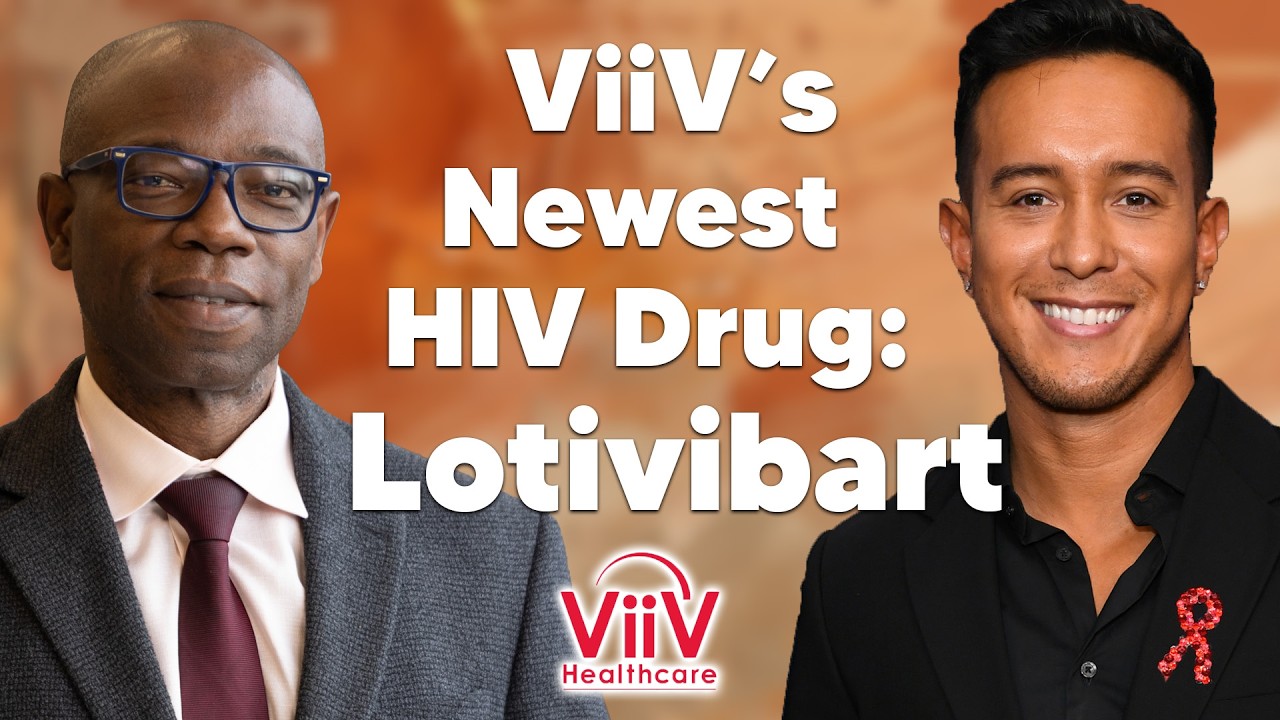
ViiV’s Lotivibart could forever CHANGE HIV Treatment! | Dr. Babafemi Taiwo
Watch on YouTubeVideo summary
Dr. Babafemi Taiwo joins ViiV Healthcare as Vice President and Head of Early Development to lead efforts in creating a future where HIV treatment is simplified and highly effective. With over 28 years of experience ranging from clinical practice at Northwestern University to leading major AIDS Clinical Trials Group studies, Dr. Taiwo emphasizes that the global journey toward ending HIV requires strategic "retooling" despite significant progress like having 32 million people on treatment. He highlights critical areas needing improvement, such as reducing new infections which reached 1.3 million in 2024, combating persistent stigma, and addressing disruptions to funding systems that hinder access for vulnerable populations including children born with HIV.
A central theme of the discussion is the shift from complex multi-drug regimens to simpler, long-acting therapies driven by social determinants of health and patient needs. Dr. Taiwo explains how ViiV incorporates community input early in development to design medicines that reduce burdens like frequent clinic visits, aiming for dosing intervals as infrequent as every six months. This evolution is largely powered by the potency of dolutegravir, which enabled a successful transition from three-drug to two-drug regimens and has made single-pill or long-acting injectable options increasingly viable while maintaining safety profiles that do not contribute to chronic comorbidities like liver issues or metabolic decline in aging populations.
The conversation also delves into the latest research presented at CROI regarding Lotivibart, a broadly neutralizing antibody currently being tested in combination with cabotegravir under the EMBRACE study. While current trials involve administering these drugs every two to six months respectively, the ultimate goal is a streamlined regimen where both medications are given once every six months via intravenous or subcutaneous routes. Lotivibart offers unique benefits beyond simply suppressing the virus by potentially boosting immune function, representing a significant step forward in creating highly effective, long-acting treatments that can be customized to individual patient needs and lifestyles.
Looking ahead, Dr. Taiwo expresses optimism about the next 15 years of HIV care, predicting a landscape dominated by long-acting therapies available as injections or oral medications tailored specifically for each person. He envisions a future where more than half of people living with HIV could be on such regimens, offering unprecedented choices to help end the epidemic entirely. For newly diagnosed patients today, this progress means they can expect to live full lives with normal life expectancy and relationships regardless of their diagnosis, effectively removing HIV as a death sentence or significant barrier to achieving personal goals like having children.
Read the full video transcript
Hey everyone, Raifter O'Razi here, and
today I am excited to have a
conversation with our special guest, Dr.
Babafemi Taiwo, to discuss early
pipeline development in pharmaceuticals,
specifically at ViiV Healthcare. Their
ongoing clinical trials, which are
aiming to bring once every 6-month
two-drug HIV treatment to market,
including sharing some of their latest
research presented at CROI, which
includes a bNAb, or broadly neutralizing
antibody, something we've talked about a
number of times on this channel. If
you're unfamiliar with bNAbs, I'll put
up a card here. Be sure to watch Gil
Broder's beautifully presented talk on
what they are and how they work. But
first, a brief introduction. Babafemi
Taiwo, MD, joined ViiV's team as Vice
President and Head of Early Development
at ViiV in September 2024. In his role,
Dr. Taiwo oversees early clinical
development teams and research strategy,
and serves on the leadership of the
research and development and global
medical team and the research and
development team. Dr. Taiwo has more
than 28 years of clinical practice and
research experience. He previously
served as the Gene Stollerman Professor
of Medicine, Chief of the Division of
Infectious Diseases, and Principal
Investigator of the Chicago Clinical
Trials Unit of the ACTG, or AIDS
Clinical Trials Group, all at the
Northwestern University in Illinois. In
addition, Dr. Taiwo served on the
Executive Committee of the ACTG and was
Chair of the Antiretroviral Treatment
Strategy, or ARTS, Committee. He has
chaired numerous clinical study teams,
including ACTG A5353, which contributed
to the development of Dovato, and ACTG
A5357, which served as an important
proof-of-concept study demonstrating the
efficacy of cabotegravir in combination
with a broadly neutralizing antibody.
Dr. Taiwo has also served on the
Advisory Council of the NIH Office of
AIDS Research and the DHHS
Antiretroviral Treatment Guidelines
Committee. He was on the PIs of ICARE
Nigeria. He is widely published with
more than 200 articles and book chapters
and served as associate editor of
clinical infectious diseases and on the
editorial team of the Journal of
antimicrobial chemotherapy. Hi, Dr.
Taiwo. How are you doing today?
>> I'm fine, thank you. How are you?
>> Good. Thank you so much for hopping on
with me again.
Um so I'd like to start with a really
broad question
um that I ask all my interviewees, which
is what is your assessment of the
current state of the global HIV AIDS
epidemic. However, you want to answer
that.
>> Well, I'll I'll describe it as a journey
that we're we're on. Uh we're very clear
about the destination, which is to end
HIV.
And uh right now this phase of the
journey we have uh we can
say that we've made a lot of progress.
However, we need to do some uh
retooling if I might call that to make
sure that we don't miss some of the
critical targets that we have set for
ourselves on this journey. So you can
imagine if you're driving
on a on a highway and you need to maybe
inflate your tires.
Uh maybe you know, uh add some little
gasoline to the to the car to make sure
that we we have the car working tip-top
shape. What do I mean by that?
Uh I mean that we have right now mixed a
mixed bag uh that includes things that
we've done quite well in. We've
uh there's now about 32 million people
are on treatment, which is great.
But we know that there are also areas
where improvement is needed. For
example, in 2024 there were 1.3 million
new infections, which is way higher than
we would like to see.
We know that stigma still exists. We
know that there have been destructions
in the in the global funding system that
has made uh
some of the
uh access issues more more challenging.
Uh we know there are still kids who are
getting who are born with uh with HIV.
So, there are many things that we can we
can improve upon on this journey. And
so much work to be done.
>> Yeah, and in our in our last chat, you
also talked about social determinants of
health.
And
you know, it's
surprising to hear someone who works on
uh early pipeline talk about something
social determinants It's not something
that we often hear talked about
together. So, I'm I'm curious to to know
what Well, first of all, for those that
aren't familiar, can you briefly
describe what social determinants of
health are? And then, how do you
incorporate those factors in your early
stage pipeline development?
Well, social social determinants of
health uh
those things that are really not medical
by themselves,
but they in a very profound way affect
health outcomes
and also affect equity access to health.
And those things are really things that
happen to us on a day-to-day basis,
where we live, where we go to school,
where we buy our foods, the kinds of
access we have to transportation. All of
those things are sort of immediate
normal human needs that can affect
health outcomes. But, in the bigger
picture, you're talking about you're
looking at things such as
public policy, political climate, social
norms. All of these things in very
tangible ways can affect how health is
lived beyond the impact of genetics,
beyond the impact of medication. Uh
these things really can impact treatment
and and overall outcomes.
>> Yeah, and we've been seeing that a lot,
especially in the last year with so many
changes to the political climate and
social norms and public policy, all
those things you mentioned. So,
in considering those factors,
how do they influence
the kinds of decision-making or the
direction that you decide to go in
early-stage pipeline development?
>> I think one of the things that we do is
engage the community
to make sure that we really have
community input at the very as early as
possible into the development process.
And this is important because our goal
is to make medications, so to deliver
medicines that really work for the
person as opposed to the person trying
to fit themselves into the medicine.
And we do that in a variety of ways such
as thinking about how we can make the
medicines last longer when they're
administered. So, instead of going to a
healthcare facility to get medication
every other month as it is available
today, can we make that burden Can we
lighten that that
requirement by making it you know twice
a year? By making it three times a year?
That would have an immediate impact and
instead of mediating or moderating those
sorts of issues, and how can we do
things that would address social factors
such as stigma?
How can we think about using medication
to How can we remove the the
maybe the impact of stigma in that
person's perception that they need to
take medication on a daily basis? That
make it more easy for them to uh forget
about living with with HIV. So, these
are some of the
things that we try to incorporate as
early as possible and it leads us in a
direction which is really one that we're
sort of quite focused on and then making
significant progress on
the creation or delivery of medicines
that uh continue to be excellent in
terms of how effective they are,
excellent in terms of how safe they are,
but also meeting the needs of persons in
terms of reducing the stigma,
remind us about living with HIV, and
having long-acting duration of
activity.
>> And you were instrumental in the in the
development of Dovato, is that correct?
>> Yes, I was.
>> I think that's a good example, too, of
from
even at that point from a three-drug
regimen to a two-drug regimen for a lot
of people was really exciting because it
suggested perhaps less toxicity, less
side effects, as well.
>> Right, I think one of the major
contributions, or major changes,
developments, advances, you can choose
whatever word you want, that we've seen
in the field over the last, I'll say,
decade or more,
has really been the adoption of two-drug
therapies as mainstream
in HIV therapeutics. If you look back
to, say, 15 years ago, the whole idea
that you could treat somebody with two
medications was something that
we whispered initially because the the
field had really come to this point
where three drugs were considered to be
absolutely critical.
And the field didn't get to that
that
common sort of agreement by chance. It
was because
we had tried single medications called
monotherapy, didn't work.
We tried two drugs called dual therapy,
it didn't work. And so, we found that
three drugs worked. And so, the world
had gotten to this really comfortable
area where three drugs appeared to be
what you had to do. And it seemed like
we were dialing back the clock when we
said, "Actually, look here, we can treat
with two medications." But guess what?
The reason that whole idea was possible
is because of the power,
the effectiveness, and the safety of a
drug called dolutegravir.
That drug really changed the face of HIV
treatment, and remains to date the most
potent medication, certainly
by the way I and many others look at it,
the most potent HIV medication that's
in current clinical use. And that really
allowed us to do what we could not do
before, which is to try to create
two-drug regimens, which is why the
early generations of two-drug regimens
that the field embraced were actually
dolutegravir-based.
That was the drug that's at the core.
And you fast forward till today, when
you look at the pipeline of drugs that
are in development across our fields,
you will struggle to find
any regimen that has three. Perhaps I
can think of one regimen in development
that has three, but in essence, but all
the other drugs essentially have two
medicines. What a change we've seen over
the last decade.
>> And I guess that begs the question, too,
do you see the potential in the future
for a single-drug regimen?
>> When you say single-drug regimen, I
assume you mean one medicine
as opposed to one medicine that has two,
one pill that has two drugs in it, or
maybe
um
co-formulated medication. But if if
we're talking about just having a single
medicine instead of the two that we have
now, that is a bar that is actually
uh considered very, very high.
And right now, I think we're all we've
sort of gotten um
comfortable with the with using two
really good medicines. The idea of using
just a single medicine is one that uh
it's it's it's way it's it's a little
outside of what we have been able to to
achieve. We never say never.
But the challenge in front of us is
significant. And it is because the virus
really is very smart.
In that it can mutate, it can change in
ways that make it difficult for make it
eventually to overcome
many of the drugs that that that one
could could envision.
But there are certain things that are
still that have been talked about to
make this whole um
simplify treatment and make it
essentially seem like you're taking one
medicine.
Co-formulation things, for example,
would be uh
done that with a pill and
maybe we can even think about it in
other ways.
>> And okay, so how do we ensure that or
how do you ensure that community has a
seat at the table during early stage
pipeline strategy?
>> One of the things that we do is to have
advisory boards.
And those advisory boards occur early
and they occur multiple times during
development process. This is where we
essentially lay bare the the
the thoughts that we have and get ins-
input into our thinking, where we need
to make changes, and that really has
become
part of our I call it standard
operational operating rules. And they,
of course, are extremely important in
shaping the final design of our clinical
trials, the final design of our uh
approach to even how we roll out
product, etc.
All of these have significant input. And
why do we do that? We do it because we
believe that
everything we do must have the person at
the center of it. And so, we can imagine
that it's hard to to develop something
for a person without the person's input.
And so, that is really part of our
culture that we hold very dear.
>> And earlier you mentioned um
health equity.
How do you prevent new innovations from
widening the health equity gap that
already exists? Um things that including
um
like funding or supply chain
consideration, access.
>> There is um there's a commitment
that um
we've shown that ViiV has shown as a
company over the the years, which is to
really
um
make medicines that address the needs of
persons, but also to uh be very
thoughtful about how these medicines are
made available to persons who need it.
And there are are examples of really
outstanding success that that has been
demonstrated. If you look, for example,
at how our pediatric uh medications have
been made available for a pediatric
populations, but even the drug that I
alluded to earlier on, dolutegravir,
you'll know that you should know that
dolutegravir is currently being used by
about 25 million people
uh globally.
And that is really uh because of very
creative uh collaborative collaborative
work that ViiV did with governmental
agencies, with um
uh the medicine uh patent uh group, and
and other stakeholders, community
members to make sure that these
medicines are available. Uh similar
things have been done uh
for cabotegravir. And so, this ongoing
um
commitment culture of of doing things to
make sure that medicines reach uh
persons who need them, regardless of
where they're located, is something that
uh
as exemplified and and actually led him
and continue to do.
>> Okay, so
with over half the population in some
areas of the world um being people
living with HIV over the age of 50,
should we also be pivoting or expanding
uh
the pipeline to treat specifically
HIV-associated
chronic inflammation and the
comorbidities that can go along with
that?
>> That's an interesting question, Raif. I
mean I mean the most effective way to
prevent these comorbidities that we're
talking about
is to keep HIV fully suppressed.
And that is number one goal.
And the medications that are medicines
that are available now actually do that
quite well.
The other thing that is important is to
make sure that those medicines don't by
themselves
contribute to these chronic conditions.
And when you think about these chronic
conditions, the heart
comes looms large. Liver complications
loom large. Um kidney issues
another consideration. Neurocognitive
brain-related issues. So all of these
things are potential effects of HIV by
itself
or um some of the medications that we
used to use before. So it is important
that as we progress, which is one of the
things that we're really proud of,
is that the medicines that we're
bringing uh forward are intentionally as
opposed to not only suppress the virus,
but also to be uh to have excellent
long-term uh safety. Because as persons
get older,
they naturally will have
more
and higher risk of having some of these
comorbidities. And the last thing you
want is a medication that would
complicate that.
And that speaks to why one of the
reasons that really informed the move
towards two drug therapy.
And we're beginning to learn more and
more now that actually giving somebody
three medicines when two can do the job
is not not a
good idea because the third medication
we're learning can actually do things
and have a
some
some effects long term like maybe on the
liver, maybe on metabolic health and
things like that.
So
the history that we have right
talking about the two drug paradigm
talking about focus on medicines that
are safe and have long term evidences
support that.
Really would help in the long run to
reduce some of these things that we're
worried about in older person as person
get older.
>> Mhm.
Okay.
So speaking of
new research, um
can we talk a little bit about the
latest findings that you that was shared
at CROI this year
for the embrace study? It's the
medication known as N6LS.
>> Yes. The medication
is also
known as Latuvibart.
So it's now gotten a that new name
Latuvibart.
>> Okay.
>> It is in a class of medicines called
broadly neutralizing antibodies.
What that means is that these are
proteins that the body makes that can
fight HIV and so kill HIV.
And they
made into medicine.
Not only can it fight HIV, there's the
expectation that perhaps it has an
effect on the immune system to boost the
immune system in ways that might benefit
the person. So, this drug actually, we
think might have a
work in two ways. One is to just simply
fight HIV, kill it, but also to help the
immune system, which makes it a very
special uh medicine. And thinking about
uh drugs in this category uh is the one
that perhaps the one that has is one of
the ones that has the best in terms of
how well it can
work.
And EMBRACE study essentially took this
new uh medication, lutetium bars, called
N6 cells.
And combined it with
a tested, well-known medication called
cabotegravir.
And that was the regimen that was
tested. And the whole idea is, can we
give this medication as a long-acting
regimen?
And when combined together, what it
showed essentially
>> [snorts]
>> was that it was effective in keeping the
virus suppressed.
Which means that it worked well as an
antiviral.
And participants were followed up to 12
months. And the 12-month data is what
was reported at CROI, showing that in
these persons who were given the
medications intravenously, it really
worked uh very well. And some patient
some participants also got the
medications through the subcutaneous
route.
But we've actually sort of made the
decision after looking at all the data
and all the evidence that we will be we
are uh moving uh forward with the
intravenous
>> Okay.
>> of this medication. And and uh
the next step
>> that means using an IV for those
wondering.
>> using an IV, right, in combination with
with a a second drug. And right now
we're we started actually we started
enrolling. We are fully enrolled now. We
fully enrolled into what is called
EMBRACE part two. Very exciting because
in EMBRACE part two, both the drug I
mean this drug this drug is being given
every 6 months. Lutetium bar
is being given every 6 months. Why is
that important? It's important because
we're looking for treatment that can be
given
every 6 months.
And Lotivir Lotivir part in combination
with an integrase inhibitor is showing
significant promise as a combination
that might get us to that uh Q6 months
treatment regimen. And so we're moving
closer to it. We're super excited about
it. And look forward to sharing more
data about it in upcoming uh
conferences.
>> So in this EMBRACE part two, the the
Lotivir part is going to be once every 6
months and the cabotegravir is that once
every 4 months?
>> Uh in this study,
it's given every 2 months. The
cabotegravir
>> Every 2 months. Okay. Got you.
>> The Lotivir part is given every 6
months. Now mind you, when we're done
with our full regimen, we're going to
our goal is to come up with a regimen
that both drugs are given every 6
months. But this is the journey that
we're working toward. This is not,
right? This is still the phase two
study. We're still building the case. By
the time we get to phase three, by the
time we get it into the clinic, what we
hope to deliver is a regimen that both
medicines will be given
every 6 months.
>> Okay.
So folks, this is kind of like the
progression of clinical trials and you
have to start with
these uh
smaller durations to make sure it's safe
and effective um for the new new drugs
and the the
the uh
already approved drug. And then so we're
working up towards the 6 months here. So
that's that's exciting though.
>> Super exciting. Super exciting.
>> Babafemi, you've spent decades looking
at HIV through a microscope, but also
on a clinical chart.
When you sit across from a newly
diagnosed patient today,
what is the single most hopeful thing
that you can tell them that you
maybe necessarily couldn't tell them 10
years ago?
>> Uh
I hold their hand
and I look in their eyes
and tell them
that
despite this new diagnosis,
they can still expect
and plan
to live the full life
that they had envisioned for themselves
before this diagnosis was known to them.
And that's because
they can expect to have
the life expectancy that they'd planned
before.
They can expect to have the
relationships that they'd planned to
have before.
They can expect to have
whatever sort of
um life they had. If they were
uh desirous of having children, they can
still expect to have that.
In other words, this should not
significantly bend the trajectory of
their lives.
And that they can
go on and still have an amazing life
despite the diagnosis.
>> And in kind of looking at your role as a
doctor, I'm curious to know how you
originally got into work related to HIV.
>> Well, I trained uh in Nigeria. I went to
medical school in Nigeria, and when I
came to the United States, I wanted to
uh
specialize in something that would have
global significance. Meaning that I
would be able to not just work and have
an impact in the United States, but be
able to impact uh the rest of the world
and specifically sub-Saharan Africa and
more specifically Nigeria.
And looking at the sort of available uh
options and where the need was greatest
at that time. It was really HIV. People
were
dying from HIV. We hadn't gotten to this
where we are now where HIV is now uh
can be treated is a treatable
disease the treatable condition. It was
then really um a life sentence that that
was a death sentence in many cases. And
so it seemed like something that that
really could uh engage
my my interest. I could put my time
there and and hopefully make a an impact
on the global scale.
>> And when you are not
researching
groundbreaking innovative potential new
treatments, prevention,
what do you do when you are clocking out
at the end of the day and going home?
How do you unwind? How do you ground
yourself again?
>> Well, uh
I like to to run.
Uh I do that uh religiously and I get
very angry when I'm not able to do that.
>> [laughter]
>> So I'm I'm an obligated runner. I like
to read things that are not medically
inclined at all. Uh so I I read I read
very widely across a a range a range of
things. And I like to spend time with uh
with my family.
And and uh also
watch watch movies and things like that.
>> Excellent. Well, thank you so much for
sitting down with us today um and giving
us a little more insight into your work.
Is there anything else you'd like to
share uh that we haven't been able to
address yet?
>> I I think um
we are at an amazing uh
moment here where new treatments are
really
coming up.
And when I think about the next 15 years
in HIV landscape of the HIV landscape, I
think it'll be quite different from
where we are today.
I think there will be a significant
presence of long-acting treatment than
ever before, perhaps more than half of
people may be on some kind of
long-acting therapy.
Uh many of them will be injectable, some
will be taken by mouth, which is
fundamentally different from where we
are today.
And that means that we'll have more
choices, more more options that will be
able to be customized to the person uh
to each person uh to make sure that we
at the end of the day uh end HIV. So,
the very hopeful future on the journey
that I initially described that to you.
>> Well, thank you again so much. It's been
a great conversation, and I hope to to
bring you back on for some more, you
know, in-depth conversations about
specific topics as well.
>> Thanks for the opportunity.
>> Folks at home, please um comment below
your thoughts, comments, and questions.
I'm happy to follow up. Don't forget to
like, subscribe, hit that bell so you
get a notification every time a new
video comes out, and please share this
with anyone who might find value in this
type of content. Those are the best ways
that you can help support me and my
channel. All right, until next time.
Cheers.