Video summary
At the August 12, 2026 meeting of the Valley Green Energy Working Group, representatives from Pelham, Northampton, and Amherst officially approved the minutes from their July gathering before turning to a presentation by Henry Hearnden, Executive Director of the Community Power Coalition of New Hampshire (CPCNH). Established in 2021 as a Joint Powers Agency serving sixty-eight municipalities with one hundred eighty thousand customers, CPCNH operates without taxpayer funds or profit motives, instead accumulating reserves for risk management while passing utility avoided costs directly to consumers. Hearnden outlined their evolution from utilizing group net metering on smaller solar projects to aiming for wholesale contracts with larger generators and integrating local battery storage under emerging regulatory frameworks that support time-of-use rates and virtual power plants involving electric vehicles.
The discussion highlighted significant challenges regarding scale and resources, as Bob Agolia noted that while CPCNH's model is impressive in New Hampshire, Valley Green currently lacks the size or membership base required for similar grant eligibility without expanding to include neighboring communities or forming a regional coalition with other Massachusetts Community Choice Agencies. Concerns were also raised by Ben While and Adele Franks about limited staff availability due to existing municipal duties, suggesting that establishing an aggregation program would require dedicated resources or broader collaboration rather than relying solely on volunteer efforts from current members. To address these structural hurdles, the group emphasized the necessity of forming external partnerships with entities like Mass Power Choice or connecting directly with Samuel Golding of CBC&H, who assisted in drafting CPCNH's charter and business plan during its three-year formation period funded by initial grants and deferred service contracts.
Looking toward future development, Henry argued that new public power institutions can drive long-term energy market innovation despite the limitations of legacy utilities, balancing current renewable mandates against the need to build financial stability for future projects. The group acknowledged that entering into twenty-year power purchase agreements requires a solidified business plan and substantial scale, which may necessitate legislative or procedural recommendations to authorize longer contract terms needed to secure low capital costs for infrastructure like solar farms. While current contracts remain shorter at two to three years, the consensus is clear that scaling up membership and exploring enabling legislation are critical steps to evolve local control models and ensure long-term viability in a competitive energy landscape.
To move forward with these strategic goals, the Working Group decided to invite Samuel Golding to their next meeting on September 17th to further discuss charter development and business planning strategies. The attendees agreed that expanding beyond the initial three towns is essential for achieving meaningful impact and accessing necessary funding mechanisms that smaller entities cannot secure independently. By focusing on collaborative procurement, leveraging existing expertise from successful models in neighboring states, and preparing for potential regulatory changes regarding battery storage and virtual power plants, Valley Green aims to transition from short-term agreements to a robust, sustainable energy future that balances immediate rate concerns with long-term renewable infrastructure investment.
Read the full video transcript
Okay, we are now recording. Um, pursuant
to chapter 2 of the acts of 2025, this
meeting will be conducted via remote
means. Members of the public who wish to
access the meeting remotely may do so
via Zoom or by telephone. No in-person
attendance of members of the public will
be permitted, but every effort will be
made to ensure that the public can
adequately access the proceedings in
real time via technological means. This
is the regular meeting of the Valley
Green Energy working group. And today we
are joined by Henry H. Hearnden um who
will um engage us in conversation. But
before we get to Henry um I just want to
see if we have any public which we do
not. So no public comment. Um but I do
want to approve the minutes and just get
that out of the way for um the minutes
from the meeting of July 23rd which were
in your packet.
to approve a second.
>> All right, just give me one second and
then a vote voice vote in no particular
order. A googlia.
>> Uh I
>> while
>> yes
>> and I am also a yes. So the minutes are
approved.
All right. And with that I will turn
this over now to Henry. We want to
welcome you so much for joining us. I
didn't know if you do you have a
presentation or something that you'd
like to share or
>> Yeah, I have some slides and maybe
before I get into the slides, it might
be a little bit helpful for me just to
uh better understand the group a little
bit and and the folks in the room and uh
your maybe perspective or goals on
community power or community choice
aggregation.
>> Sure. Well, why don't we first um
introduce ourselves? Why don't we start
with that? So, Bob, I'll start with you.
>> Okay. Hello, Henry. Um, my name is Bob
Agolia and I serve as the chair of the
select board in Pelum, one of the three
towns or two towns in one city that are
involved in this aggregation. Um and um
you know I'm I'm really anxious to hear
I if I understand correctly what you're
going to be talking about um the
potential for groups like ours,
aggregations like ours to really partner
or or integrate local locally um sourced
power because we and Pelum are in the
midst of although the application has
not come in yet uh the potential for a
very large um installation a solar
installation with battery here uh by a
company called Pure Sky.
>> So really looking forward to hearing uh
what you have to offer to us.
>> Thanks Bob and Ben.
>> I'm Ben While. I'm the director of
climate action and project
administration for the city of
Northampton. Um
and we're also interested in stuff that
Bob is interested in.
>> Um and then Dell, uh why don't you go
next? I know you've met Henry before,
but go ahead.
>> My name is Adele Franks and I'm a
citizen member of the working group and
I've been involved
ever since the idea came up. [laughter]
Um, and so, um, I'm a board member of
local energy advocates.
>> Thank you, Adele and Darcy.
And um I have basically the similar
credentials to Adele. We we are the
community members of this group and uh
have a parallel organization called
local energy advocates and we've been
sitting as non- voting members on this
group since it started.
>> And I'm Stephanie Chigarella, director
of sustainability for the town of
Ammerst. Um, I've also been a member of
this group since its origins. Uh, well,
maybe not origins origins, like when the
community members started, but certainly
once we convene this group, I've been
involved since the beginning. So, um,
we're very happy to have you here,
Henry. My interests are similar to what
others have stated. So, with that, I
guess we'll we'll turn it over to you.
>> Yeah, thank you. That that's helpful to
to get me a little bit oriented. And um
my brother actually lives in
Northampton, so I'm down there see my
niece and nephew from time to time and I
I like the area. I'm a I'm a relatively
regular visitor. Uh let's see if I can
get my screen shared. Try to share the
screen
and then
potentially I can.
Is that showing a
>> Yep, it's there.
>> Okay, great. Um,
okay. And just by way of introduction,
I'm Henry Hearnen. I'm the executive
director of the Community Power
Coalition of New Hampshire. We're a
nonprofit joint powers agency of uh 68
cities, towns, and counties that have
come together to create their own uh
nonprofit corporation to manage their
aggregation programs collectively. So,
we are essentially we are a public power
agency that is controlled and owned by
our member municipalities and we manage
the wholesale energy portfolio on their
behalf and supply electricity to um
180,000 retail customers within those
member jurisdictions. Um and so yeah,
pleased to join the group and talk a
little bit about our how we got to where
we are and and what it is that we do.
Let's
see.
Um so we were established in uh 2021
incorporated as a joint powers agency.
Um that is uh an agreement among and
between all of the 65 municipalities and
four county members. Um, it sets forth
our bylaws, our board of directors, our
governance structure, um, you know, uh,
all the requirements of our sort of
nonprofit corporation and that was
approved by the attorney general. um
where our membership is open to all
cities and towns in the county and um
having launched service in 2023, we grew
quite quickly to our current scale and
you can see sort of our map, our
footprint of service area across the
state where we are the default provider
of electricity and we manage electricity
aggregation on behalf of those member
communities. Uh we are the second
largest electricity provider in the
state of New Hampshire. Again, we're not
a distribution utility. were just
managing the energy portfolio.
Eversource and the other distribution
utilities continue to own and operate
the electric grid uh and deliver that
power. And again, we're a public agency,
so we're transparent. We're subject to
the same right to know requirements as
you are and your cities and towns are.
So, our board meetings, our committee
meetings are open to the public. Our
finances and records are all open to the
public. Uh we we take our sort of
commitment to public service and
transparency and accountability very
seriously. um and that sort of that
local control community governance
aspect of what we do. It's a really key
part of our mission and vision. Uh so
taking this large energy portfolio and
and putting it under the purview of
public service and public control and
accountability, putting those
significant revenues uh and cash flows
associated with that under the public
control um and empowering local
decision-making through that is a key
part of our mission. So we have about
180,000 uh retail electric customers
that we serve electricity for. It's
about 1.5 million megawatt hours of
annual electricity load and our 2026
revenue was about $170 million in annual
revenue. Um
I think we're all familiar with the
general concept, but um you know we you
may say municipal aggregation or
community choice aggregation. We say
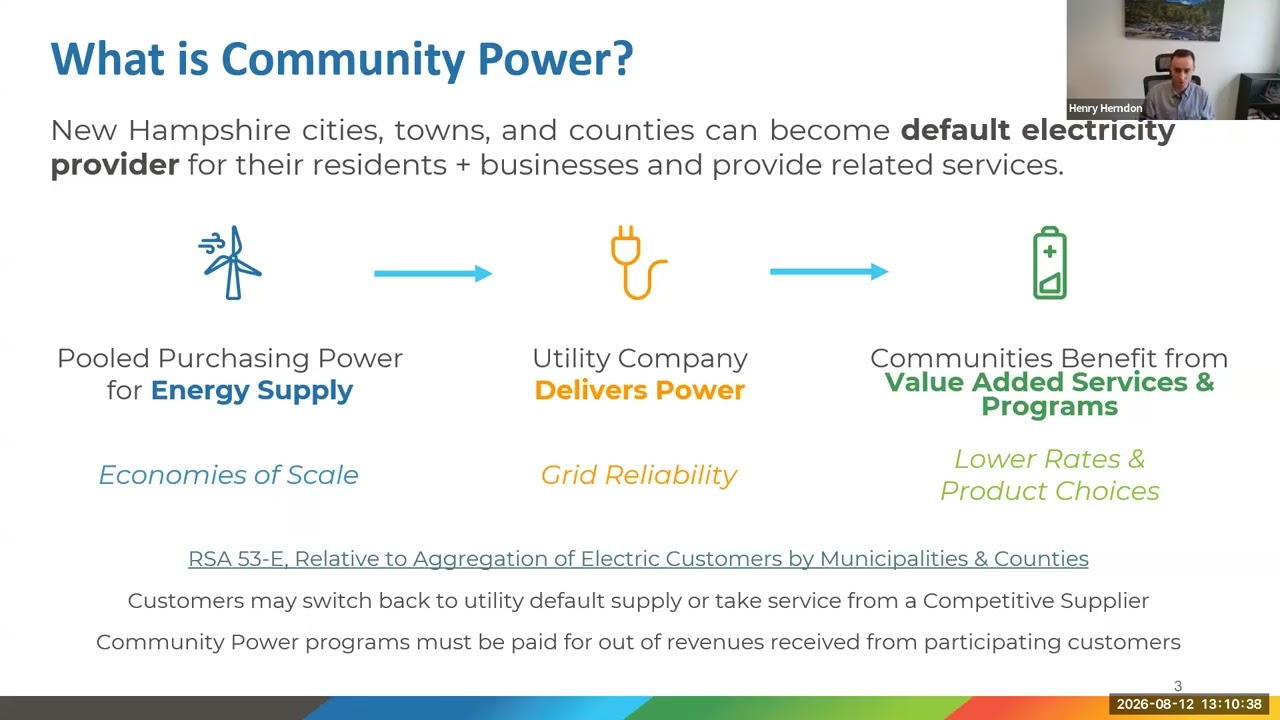
community power in New Hampshire. These
are all the same concept. Um, but under
our our law, cities, towns, and counties
can become the default provider of
electricity for residents and
businesses, creating more choice for the
customers, uh, and allowing more of that
local control. Um, so that economy of
scale, purchasing power for the energy
portfolio can create benefits. Utility
will deliver the power. And then there's
sort of this range of new programs and
benefits that can come with this,
whether it's clean energy options,
customers choosing 50% or 100% renewable
power or some of the other types of
energy innovations that more mature um
community power markets um get into. So
have our legislation referenced here in
case anyone wants to take a look at it.
Maybe similar or somewhat different to
Massachusetts in some ways. Um customers
have the choice to come and go from the
service. they can opt out back to the
utility or choose another electricity
provider and we are entirely funded out
of the revenue from the sale of
electricity. We are not uh authorized to
use taxpayer funds of any kind. So there
are no tax implications associated with
our operations or our service.
Um, I talked a little bit about our
mission, vision, values, but um, you
know, we power New Hampshire communities
with local energy solutions, education,
and advocacy. We envision a future where
communities are empowered to realize
their energy goals through innovative
and competitive means. Uh and we're
really focused on creating value for
members by jointly contracting for
services, developing projects, programs
together, educating the public and the
membership. Uh and then being an
advocate for communities and customer
interests at the legislature and the
public utility commission. So a key part
of our value is that whereas
legislatores are often perhaps dominated
by you know investorowned energy
companies or utility companies having
the a community interest voice that is a
technical expert at scale to participate
alongside those incumbent utilities or
monopolies is um I think a real value
that our members appreciate and we're
able to help further innovative energy
policy frameworks that are good for
communities and customers. ers.
>> Um, so yeah, we're focused on reducing
costs, competitive markets, and
innovation, balancing the diverse
interests of our members. Many of them
are very motivated by clean energy and
renewable energy, and several of them
have 100% renewable energy goals. Um and
through this model, the one of the most
sort of amazing things to experience
over the past five years or so has been
the transfer of knowledge from the power
sector to the communities that sit on
our board and sit on our committees. You
know, the energy markets are very
technical and complex. We have the ISO
New England. We have, you know, federal
rules and markets. We have local state
regulations. Um and you know, you can be
in this this industry for decades and to
keep learning. And one of the things
we've done is we've sort of lifted the
hood and created an enormous amount of
education for our communities about how
does England actually work. What does it
mean to manage an electricity portfolio?
How does the market work? Um how can we
actively participate in that market or
even shape that market towards our local
interests? So there's a real empowerment
factor um in this model. Um, and it's
part of the reason I think we have so
many engaged and dedicated volunteers.
So, of those 60 communities, you know,
they each have one or two member
representatives. They come to our annual
membership meeting, they elect our
board, many of them sit on our
committees. Um, so they're very engaged
and um, yeah, like many of you, you
know, members of the community
volunteers, some members of municipal
staff or select boards or city councils,
they're the the folks that, you know, we
serve and that, uh, govern us.
Um, so just more on governance and
staffing. So um again that board of
directors composed of the member
community representatives
um and we have a number of committees of
volunteers that provide oversight
executive committee finance committee
you know approving our budget um our
board approves our rates that we charge
to customers. Um we acrew reserve funds.
So whereas a private company would
charge a supply rate and include sort of
a profit margin within that rate um
perhaps not visible to the communities
but within that there is some you know
markup that is now under the purview of
the communities. So the vast majority of
our budget is you know the cost of
electricity but there is an acrruel of a
net margin or a profit margin so to
speak on top of that. It's really
capitalizing the community reserve and
that's long-term risk management. You
build up a reserve fund. You become a
robust, you know, financial entity. You
become a [clears throat] desirable
counterparty to contract with solar
developers to build new projects or to
otherwise, you know, finance investments
that are beneficial for the members. Um,
and so let's see. And then on the staff
side, so you know within the member
governance, you have myself, I'm the,
you know, executive director of the
organization and we have a staff of nine
soon to be a bit more. Um, we have power
operations team that is actively
responsible for managing our wholesale
power purchasing. Um, we have a finance
team, you know, cash flows, receivables,
payables, um, our credit, um,
accounting, other financial functions.
We have a member services team that's
really about overseeing a customer
service vendor, a contact center,
engagements with all our cities and
towns, um, communications, websites,
newsletters, events, things like that.
We have a regulatory and legislative
affairs team. Um, that's, you know, at
the state house representing the
interests of the members and at the
public utility commission would be the
department of public utilities in
Massachusetts. and of course general
counsel and then a number of contracted
service providers as well um reporting
to those staff those senior staff
leaders. Um so again accountability and
controlled by the uh cities and towns
but then operated by a team of experts
on behalf of um the community interests.
Um so yeah this is sort of you know some
of the points I've touched on but um you
know this governance framework we find
to have enormous potential for
transformation. [clears throat] Um it
can be very difficult for any individual
community to
you know significantly change a state's
energy market but when acting in the
collective together they uh there's sort
of a an amplification of their voices
and their power. Um so um and really we
looked to California in a lot of ways.
They have an interesting CCA market um
where they're contracting for enormous
amounts of renewable energy and
developing battery projects and and
innovating in other ways and we have
some aspirations to um do more of that.
I'll talk about some of the projects
we've done but uh we are at the early
stage just being a couple years into our
operations. Um so mentioning the size of
the membership again the state policy
engagement um project development so
I'll talk about one of the solar
projects that we've constructed um and
again putting the cities and towns in
control of that significant capital flow
associated with default energy service
for all our communities. So I don't know
exactly the population of some of your
towns but I imagine you know 10,000
30,000 50,000 might not be probably have
decent scale among yourselves and um you
know there's one approach where you you
know you strike the three-year contract
with a broker or supplier and you can
maybe come back and reset that contract
at the end of that period of time but
that one extra step of actually acrewing
the the margin uh for the community
benefit benefit. It really opens up a
world of possibilities um is what we
found. And again, we're so being, you
know, sort of a corporate entity that we
are, we have independent financial
audits annually, um published to the
membership. Um you know, we're very
focused. There are there is it's a
technical business. you know, energy
portfolio risk management is um
there's a lot of technical sort of back
end that goes into that in managing how
we buy energy in in sort of a volatile
and difficult wholesale power market. Um
so that does require you know
significant expertise on a staff or
contractor level. Um
and that's part of our structure that
we're we're continuing to build out. We
started and we're reliant on thirdparty
consultants
uh and are now hiring more staff inhouse
to assume those responsibilities more
more closely.
Um and then yeah just close by showing
you a photo. This is our uh community
solar project in Warner, New Hampshire.
It's a 5 megawatt project. Um so you
know you mentioned the project you're
looking at. It might even be
significantly larger than this it sounds
like. And Massachusetts is well ahead of
New Hampshire in terms of solar
development in a lot of ways. But um
this we think of this as sort of the tip
of the iceberg. Our first you know real
community solar project, the first of
many hopefully to come and hoping to
move towards you know solar plus storage
more dispatchable resources that
maximize our our portfolio value. you
know, solar is really great. Uh, and we
can lower cost for customers and the
system as a whole better if we can pair
that solar with batteries and say when
we want it to flow back onto the grid
um, when it's most valuable. So, that's
sort of just an overview, but really I I
wanted to think of this presentation as
an introduction and a framing so that we
could have more of a dialogue, a Q&A,
just discussion around what it is that
we do. Um, so yeah, I'll pause there. I
appreciate being invited in and getting
to meet you all.
Great. Thank you so much, Henry. Um,
yes, I was going to launch into
questions. So, Ben's already got his
hand up, so go ahead, Ben.
>> It's all right, Stephanie. If you if you
wanted to start, that's fine.
>> That's fine. You go right ahead.
>> In a sense, I just want to really
clarify to make sure that like the model
that you are and think about it in
relationship to what we are. So, and I'm
restating stuff that's dummy level,
right? So, so right now all we do is
like you said we get a a contract for uh
energy at a price. First point energy is
is is the one who does the wholesale
interaction with the wholesale market
and they make the profit. You know they
they have to build in some profit into
their estimates etc. They take the risk
as well uh or at least they take that
portion of risk. Um,
my understanding of what you're talking
about is that your
company, for one of a better word, your
joint powers entity is a company that
would be is doing what First Point is
doing
for us.
>> Yeah, that that's exactly right. So, we
are, you know, we're not and you may
have just gone directly to First Point.
There may have been a broker that helped
you strike that deal. We're not the
broker. We are first point, but we are a
nonprofit owned and controlled by the
cities and towns we serve. So they see I
have a direct view into how are we
buying power? What's sort of the the
cost revenue side of that? Where's the
markup? But that's a perfect analogy. We
are the supplier. We're just a nonprofit
locally controlled transparent supplier.
>> So that's really helpful.
>> You had to build
the capacity to do that.
>> Yes. Um, and
at least initially, right, you're just
purchasing power on the wholesale market
just like First Point, hoping that you
can do it better.
But it, at least initially,
were you able to
have a higher fraction of renewables in
your in your portfolio than say the the,
you know, the kind of the commercial
competitors? And were you able to offer
nonetheless the lowest rate?
>> Yeah, that's a great question. So, for
the first two years or so of service, we
had the lowest rates in the state and
had, you know, significant savings
relative to the other providers. Um, and
for the past year and a half or so,
we've had a a slight premium to some of
the utilities. And there's a number of
reasons to that that I can get into.
There were a couple of expensive
winters. utilities actually have
deferred some costs and are sort of
operating at a loss and and waiting to
recoup some of those costs. And there's
a number of factors there. So, our rates
have been better and worse in some
instances. And then some of our towns
choose a higher renewable energy
default. Um Hanover, Durham, some of the
other ones have done that. Not all of
them do. We're not primarily um you know
our mission is not necessarily 100%
renewable energy but some of our towns
we facilitate that for um
>> so when you do that I'm sorry Bob I just
want to like
>> keep going get so when you do that
you're okay we have certain towns that
are getting higher renewable energy
percentages that they've negotiated with
you essentially right
>> um are those real renewables or are
those wrecks
>> uh those are wrecks and they are New
England wrecks. So they are local wrecks
in lot New Hampshire, but they are not
we haven't
>> other than that uh one 5 megawatt
project. That's the only new development
we've constructed. We as we have
aspirations to build a lot more
renewables
>> thus far the majority of our like
renewable content is wreck content,
>> right? So it's Rex participating in
basically the same market that our
wrecks are participating in. And as you
probably know, at least right now, that
wreck market is kind of broken from the
perspective of actually driving new uh
uh new development basically because of
circumstances beyond our control. Yeah,
I I feel somewhat similar in that, you
know, one of the things that motivated
me and motivates many of our members
into this joint powers agency model is,
you know, the set it, forget it, strike
a deal for some contract that maybe has
some more Rex in it that maybe you're
from New England or maybe are national
Rex, you know, is that really changing
anything? And that was sort of the
question we asked. And um then you ask,
well, how do you build new renewables?
And we found that this joint powers
agency model was how we thought we could
best do that.
>> So this Warner uh solar development, the
one you you showed us, that's your first
one where as a
contra essentially the the contractor
that's that is supplying electricity to
to these cities and towns. You've this
is the first kind of uh generator you've
built.
>> That's right. using
and the source of the funds for for
building that generator.
>> We have it's a power purchase agreement.
We don't own the project. We have struck
a power purchase agreement with a
developer. They have financed it and
used their third party capital to
construct it to own it and we have a
deal to buy the output and really tech
you know technically it's a group net
metering construct um which is a special
set of circumstances but only through
our existence and our being the offtaker
so to speak
>> right you're the off taker
>> we're the off taker yeah
>> um so two question I'm sorry Bob like I
just want to call this so
>> so you're the off taper taker of net
metering credits which are dollars not
kilowatt hours.
>> That's right.
>> So
your customers, right, the the the CCA
customers from all these different towns
are getting some sort of dollar credit
on their overall bill
related to this project.
the electricity price that they pay and
the supply the electricity supply is
actually not changed. Correct.
>> That's correct.
>> Okay. Um, so it's so it's a it's a PPA,
but it's really not a PPA. It's actually
essentially community solar. It's net
metering.
>> And what is the length of time that you
entered into a contract to be the
offtaker for all of those credits? Uh,
and it's either 20 years or through
2040. Um,
>> okay. But 20 a long time. In other
words, like it's it's not it's it's a
long long-term agreement. Um,
one more question, Bob. My totally done.
>> Keep going, man.
>> So, if we wanted to do you one better,
right? So if if I if I wanted um net
metering credits right now, in fact, the
city is being, you know, we are
considering entering into one of these
long-term agreements to basically
uh pay uh 90 cents on the dollar uh for
net metering credits used to be better.
Now that's seems like about as well as
we're going to do. Um and the city is
one big offtaker. Obviously the act just
the municipal operations but like the
actual
actual say VGE territory would be a much
much larger offtaker. Um
so you know we could do that and in a
sense you wonder well what what do you
actually need the CCA for?
You just need a set a list and some
schedule Z's to distribute or schedule Z
is what we call it in Massachusetts
where you distribute those credit dollar
credit.
>> Your group your group membership
>> you just distribute it to the group.
It's an email. It's a it's a mailing
list.
>> Yeah.
>> Right. That the CCA isn't really playing
a role because it's not producing power.
If we wanted to do one better and say
actually we want to be the like you are.
You're a wholesale purchaser. We want to
be the wholesale purchaser of the actual
power off of say Warner like like like
if it had been
>> So I guess two questions in that one.
Was that something you guys considered
where you're the actual purchaser over
some presumably long contract period and
how would that have affected your rates
versus how you ended up doing it and
why?
>> Yeah. So I'm just I'm thrilled by your
level of understanding of all this and
the um the question. It's because this
is exactly the crux of like how do we
design an effective marketplace and
actually that's not net metering. Net
metering is not an effective marketplace
and we need to move beyond it. Um and so
I'll try to answer your question.
Essentially in this circumstance at the
1 to 5 megawatt scale group net metering
is all we've got. Um and it's the most
economical.
Um, but for all the reasons you
described, it's not actually a part of
the portfolio. We're not actually
supplying those kilowatt hours to all of
our customers. We have this sort of
convoluted group net metering
administrative construct where uh
there's a net metering credit and that's
divvied up and cut checks to different
members. And so that's like
administrative top down. It's sort of
like a central planning approach. We
want to create a marketplace. You ask
why wouldn't we do a wholesale contract?
There's a threshold which is 5
megawatts. When you exceed 5 megawatts
or greater than that, you have to
register with ISO New England as a
wholesale generator. We would like to
contract with over 5 megawatt solar or
storage or other ISO New England
wholesale generators as part of our
supply. We have not yet done that, but
that's in the works. And then really our
objective is to change the rules
um for the sub 5 megawatt
scale. We want to create what we call
load reducers. Essentially, a local
marketplace where instead of net
metering, you can buy and sell energy
um within New Hampshire. This avoids our
ISO New England costs for energy, for
capacity, and for transmission.
>> And we want to be compensated for those
values. So there's sort of this value of
distributed energy resource
uh there's this value there but the
state
>> so would you then as the wholesale
purchaser essentially capture that value
as part of your profit?
>> Yes. Um, and then you're able to just be
the wholesale purchaser of this smaller
uh
production from
>> and the current rules and regulations
don't allow us to do this and we have to
change the rules and regulations. But um
that would then offset or reduce our
wholesale load obligation, the volume of
power we have to buy at wholesale, the
cost of capacity that we pay at
wholesale, and the transmission cost for
all of New Hampshire. Right now, we
don't have exposure to those price
signals, but we want to target monthly
peak load reduction by dispatching solar
plus storage locally beneath the ISO
England level and then be compensated
for the actual reduction in wholesale
costs associated with our transmission
load reduction essentially and that
requires regulatory change. Would would
you be the ones managing the battery,
monitoring the markets and discharging
and and charging?
>> It could be us. We could pay a third
party to do it. Um but yeah, essentially
it would be us or will be us through a
contract we strike with some provider.
>> Okay. Um but so this is really getting
at the crux of like the very technical
challenges we're up against where we
have designed an energy system with one
set of rules and regs and that metering
and market signals and utility control
over data and metering and
infrastructure and certain business
systems and those things in order to
actually create this marketplace where
you know household like proumers
transactive energy you have 5,000
batteries and 5,000 homes that are all
dynamically responding ing to price
signals and reducing load when it's
valuable. And we all of our electric
vehicles are now generating revenue for
us because they charge in the nighttime
when it's super cheap or they discharge
power into the grid during high load
times and the customers now all getting
paid because if you have those 5,000
electric vehicles that's a power plant.
You don't need the power plant anymore
because you have a virtual power plant
of customers.
>> Yeah. So I sorry Bob but now he's
bringing up this other thing which is so
we don't have time of use rates
>> do you?
>> No and we have a partner we we are
working with UNIL which is one of our
smaller utilities who in a rate case
settlement agreement to which we were a
party and a collaborator they have
agreed to do more data sharing towards
time of use rates in partnership with us
on a pilot basis. So we want to start
doing that but ever source is so
>> so the supply portion is getting time of
use rates but the de the delivery side
is not.
>> Neither are getting time right now.
>> So how are you
how how are you making money from off-
peak charging?
>> No, we're uh we're I'm what I'm saying
is the vision of the future. I'm not
saying we right now are doing that. I'm
saying the the clear and logical
objective and evolution of the system is
to have time of use rates and
dispatchable local resources. We're
going to build that future. It's in
process.
>> Okay, great. So, yeah. So, in that in
that way, we're in the same same boat.
Everyone's afraid of actually seeing
real prices and I'm like, "Show me real
prices,"
>> right? We're like, "Show us real
prices." was like, "Please show us real
prices or at least allow our customers
the choice to be shown real prices."
>> Yeah.
>> All right. Sorry, Bob.
>> No, don't apologize, Ben. That was
really great. Glad you showed up.
>> And almost all of it was way above my
pay grade, so I'm glad you were you were
taking it on there, Ben. Um my my
questions, Henry, are a little bit more
about structural
um organizational structural aspects of
this. So here we are um Valley Green
Energy, three communities um you know um
and there are many other aggregators,
community aggregators throughout
Massachusetts
um but you know most of us don't talk to
one another. Um so I'm I'm wondering
from a structural perspective in terms
of your organization
were was your um joint powers um agency
created by a collaboration of a whole
bunch of aggregated uh aggregators
through in communities throughout New
Hampshire.
>> Uh no but sort of. So, we got our
legislation enacted in 2021 or in 2019
and then there was sort of a legislative
fight you could call it and we updated
it in 2021.
Um
and
um so we we were authorized under
legislation in 2021 and simultaneous to
this I worked with my role just my
background is I work for clean energy
New Hampshire which was a nonprofit sort
of trade association you know worked on
policy for the solar companies and also
had a membership of cities and towns. So
my job was there are 70 local energy
committees in New Hampshire. My job was
to run their newsletter and help them
write their RFPs for solar projects and
run their conference and network them
with grants and resources. And through
that building of those relationships and
then the enacting of our community power
law formed a work group of initially
four of those cities and towns to say
how do we want to implement community
power and then that grew to the initial
14 founding members that we you know we
drafted our corporate charter or joint
powers agreement and um each town adopts
that contract and becomes a member to
the organization. We did all of this
before there was any aggregation
operational in the state. So the first
launch of any aggregation was CPC&H
launching 10 towns under a joint powers
agency model. There had never been been
anything before 20 April 2023.
So in other words, you you did it we're
doing it the opposite way, I guess you
could say, because the the aggregations
of of different within different
communities or of different communities
exist, but the big umbrella now there
may be some joint power agencies in
Massachusetts. I just don't know. But
the big umbrella, which is what you are,
is the way I see it, [clears throat] um
doesn't exist here. And it it also leads
me to um wonder [clears throat] about
scale because we have talked about
the creation of a joint power um agency
um but you know looking at our our three
towns so you know we're looking at
Northampton I don't know about 30,000
people Amoris at about 40,000 people pel
at about 1,400 people um you know so
this is tiny this is really small stuff.
>> I mean, it's not it's enough. I mean,
our first well, we had Nasha, which was
80,000 people in the first launch, but
together I mean, you're almost at, you
know, I don't know, you're not too far
off from 100,000 people, which is
sufficient scale, and you could
Massachusetts is a much bigger market
than
>> Okay. And then so one other comment I
just have to say this before I forget
but
if you take away one thing from this
conversation it should be that you
should meet with Samuel Golding
who lives in Amherst
at um he's at the Cherry Hill co-housing
community um and he was one of the
co-founders of CBC&H and it is because
of his deep knowledge about joint powers
agency and power markets that we were
able to do everything that we did. Um he
you know he's there in the beginning and
you know we had a great network of
communities and local energy knowledge
and he had a California perspective of
here is how to establish a joint powers
agency. Write your contracts. Write your
business plan. negotiate for millions of
dollars in credit support and hire, you
know, a market participant with ISO of
New England and a portfolio manager and
and put put sort of the business side of
this together and he's right there with
you all. So, you you really have to meet
with Samuel Holding and I'm happy to
introduce you.
>> Great.
>> That's great, Henry. Thank you so much.
Um, Bob, if I could jump in because I
think the challenge and I was going to
ask you about developing a business plan
because that's something where we're
sort of we sort of hit a bit of a wall
with with that. Um,
we definitely have a need to do so
obviously. So, um, you know, this is
great. Contacting someone like him would
be really enormously helpful because I
think we
um started to draft an RFP. uh we have
one that's drafted. Um but it would be
great to have somebody like him look at
it and give us input and feedback and
then to maybe proceed with next steps.
So that's such a great Thank you so much
for that. That's
>> I mean the there is um we sort of had a
trifecta of I I had this relationships
with all many cities and towns. We had
somebody on our team, Clifton Bo, who uh
spent six years in the legisl or six
years in the house, six years as a
senator and six years as a public
utility commissioner and was now a city
councelor in in Lebanon. Um who
understood the legislative and
regulatory framework better than anyone.
And then Samuel Goldie understands sort
of the business perspective. And so
yeah, he'd be really valuable to connect
with him. And um you do to you know I I
may have glossed over the arduous
process and pathway that was
establishing a joint powers agency. It
is no small order to do.
>> Yeah. How long did that take? Just out
of curiosity.
>> We started in 2020. So was 2020
um was sort of organizing
and 2021 was legislation and in
incorporating and then 2022 was startup.
So it was at least I would say at least
three years uh yet organizing the
communities writing the corporate
charter the JPA um
getting a critical mass of talents to
buy in and say we're going to put in the
time and sit on the board and do the
work to oversee this um and then having
the right you know it for us it was
myself and Samuel were the two
professional consultants who did you
know did the work and then we hired a
general counsel a lawyer to help us
write the uh JPA. Um, and then Samuel
wrote the RFP to hire what was
ultimately Calpine, Ascend Analytics,
uh, and a couple of other contracted
service providers to sort of run the
business side, the customer service, the
power procurement. Um, and so I'd say
three years, but you all have an
existing market and you're all very well
educated already about what aggregation
is. So it could be much a lighter lift.
And if you have a critical mass of your
three or four towns and if there are a
couple, we had this concentric circle
model. We said we're going to start with
four communities to do the heavy lifting
of drafting this thing. But we know
there's a network of another dozen to
two dozen that are kind of on the
outside looking in. We'll have a a
webinar for them every six months or a
big summit once a year and get them
interested and then we'll kind of grow
from the four to the 12 and and from
there on out. Those are just some
thoughts. So, I just have a follow-up
question and then I'll hand it over to
Bob and then you, Ben. Um,
so I think what I'm
sort of unclear about is like in terms
of when you started that staffing of
getting this going, like how did you
fund that initially?
>> So, we had a pretty small grant from our
community development finance authority
that paid myself and Mr. building not
all that much. And then we wrote a RFP
that was a um
for services and credit support under an
at risk structure and it said if you're
willing to uh provide our ISO New
England market services and our
portfolio management and help launch us
and finish up our business plan at no
cost upfront. then you will be repaid
after we launch and we get revenue and
cash flow over a 3-year period. And we
did this in such a way where Kalpine and
Desend and other firms agreed to
essentially
um
contribute to launching the organization
at no upfront cost at their own risk
under an understanding that once we had
revenue flows they would recoup their
investments from that. And because of
our scale, you know, we launched maybe
initial 50,000 customers. We had a
business plan that said we're going to
grow about a h 100red million a year in
revenue. Um that was justified. We're
we're now 180 million in or 170 million
in annual revenue. So there's a the yeah
the business plan makes sense if you
have the technical folks on your side to
convey to the service providers like
we're serious, we're real, we have a we
can make this happen.
>> Yep. And just one last question. Um, the
grant funding, what was your initial
grant funding that you had to la to pay
you and Sam?
>> I think it was like $75,000.
>> Okay. Thanks. All right. Uh, Bob,
>> so one of my I want to test this out.
One of my takeaways from this um
discussion um is that frankly I believe
we're too small. Um you said, "Oh, no,
no, you aren't. We're about 72,000
people in our catchment or our or
service area of the three towns." Um,
and it seems to me that the um um that
what all of what you're describing, what
you have described, which is incredible
work, and by the way, my hats off to
you. What a what a great uh great thing
you've done. Um, but but all of that
incredible work, it seems to me in our
case anyway, I feel like it needs a
bigger base. And I don't know whether
that bigger base is simply seeing if
there are some surrounding towns
most of which are relatively small um
that are who want to come into the
aggregation. I don't even know how that
works frankly structurally and and
legally. Um but but also the other
thought that I have is well there are
other um CCAs like us and maybe the
better strategy is to reach out to those
and see if there's a way that we can
come together um and do something and
and there are some CCAs of some of
course this you go eastern Massachusetts
big big um you know so I I don't know
but my takeaway and this is what I
wanted to really ask you Henry My
takeaway is it it just feels like we
need um um a greater um numbers um in
order to really make this thing go and
and you know to attract for example a
grant like the one that you got as a
startup kind of thing and so on as
opposed to our three relatively well
modestsiz
communities. It strikes me that among
yourselves, you have the right anchor of
dedicated people who can see this
through and then maybe you're right that
if you can start to lay tracks with
who's the the early adopters after you,
who's like in waiting in the wings to
after you've maybe done some of the
upfront lifting can can come along in
and help the scale. That's not a bad
idea.
>> I guess what I wanted to do was share
some of that heavy lifting beyond beyond
just the three communities that are
here. But anyway, I'll let Ben go now.
>> Yeah, I just just to follow up, sorry,
really quickly on what Bob is saying. I
think the challenge for us is that, you
know,
>> at least Ben and I, you know, have jobs
beyond just working with this. Like we
can't devote 100% of our time just to
working on this, right?
>> And it's like the getting it going
really does require a lot of time. I've
been the staff leazison um since the
beginning. Well, not from the very
beginning, but for quite a while now.
and it's um it does require a lot when
we're developing RFPs and that kind of
thing. So um just you know I think
that's the concern um that we have is
that we don't necessarily have the time.
>> Yeah, that's legitimate concern.
>> Okay. Go ahead.
>> So So where both of you are coming from
is I think where I where I'm coming to
next which is when I hear what you're
describing and it goes back to my first
question. So you guys are basically just
first point but maybe nicer,
you know, um, and you know, with more
governance. Um, but from the perspective
of any of these individual cities or
CCAs,
you're just the low bidder or the best
bidder, you know, the one who who who
gets the the contract. And so the
question I just to be kind of like uh
contrary is like is a joint powers
agency necessary?
Could one find
a just a purely private sector company
or put together
some entity that either already does
this wants or wants to to do it to break
in to start offering
uh you know so let's say you are a
company that what you're going to do is
manage virtual power plant you're just
going to be tweaking people's
thermostats and and EV chargers and you
know like that kind of stuff. And if
that was your investment and maybe it's
solar and batteries, whatever it was,
you make these these investments. You're
that that company and it you're just
going to say, well, I'm going to bid
that this is the power and this is the
sources and here's the price. And
if it should if it should work for a
joint powers entity, why shouldn't it
work for
just another entity? I think it's a fair
question and um I in New Hampshire I
think the answer is no because I think
um essentially it's a question of
leadership and who is going to lead the
next hundred years of energy markets and
development and we look around and we
see our state and our regulators and our
department of energy and our investor
own utilities none of them are going to
lead it. it's not happening and you have
a different landscape maybe in
Massachusetts and your legislative
framework and you're pro- clean energy
ethos is stronger let's say than ours uh
so maybe you don't have the same
challenges maybe you have the the
framework that's needed we looked around
and said there's all this leadership at
the municipal level we see the ways the
system is uh I don't know if
dysfunctional is the right word but is
suboptimal let's say and how it could be
better and some some we need a
institution that is equipped to to shape
and lead that at a really an
institutional state level. And that's I
think the vision that you get you can
get with the joint powers agency is now
it's not just well whatever the sort of
legacy incumbent 100-year-old utility
company says. Now there's a new
institution that's a totally new form of
public power and through that vehicle we
really can start to shape like a
long-term planning for the state the
state energy market. Uh so that that's
our perspective but I think you make a
fair point like is all the trouble and
the governance and the time worth it? Um
one of the things I love about New New
Hampshire and really knowing that I'm
from Lexington, Massachusetts actually.
Um, you know, the there's so much
dedication to public service, folks
serving on their select boards, local
communities, their committees. Um, and
so, you know, we're just an evolution of
that. We're just sort of the next way in
which that local control public service
is kind of manifested.
>> Yeah. No, I I think that's relevant and
and I and I wouldn't say that we have
this fully highly functioning um utility
regulatory system here. Um yeah, no,
that's that's that's that's well taken.
Um and and if I just add, so I think our
next chapter, we've sort of like, you
know, we've launched, we've scaled,
we've stabilized, we've hired key
professional staff. Our next chapter is
sort of a pivot back to the external
world into partnerships and to say okay
how do we work with the utility
companies with the you know the
organizations in the state that shape
state policy how do we become partners
and expand our sort of external
coalition work with them
>> um which is going to be really key
because again we can't do this in a
vacuum then you have to be the then you
have to actually play nice to some
degree with with all the other
stakeholders to to move things. Oh,
yeah. This was another question. I think
it's Conway, New Hampshire. I could be
wrong with that. That is their own
municipal like they they had a
pre-existing
municipal light plant.
>> Not Conway, but Wolfboro, Littleton, a
couple of others.
>> Yeah. Some places that had like, you
know, legacy dams that were doing
hydropower.
>> Um I can't remember her name. There was
a sustainability person from one of
these cities who kind of like
>> You all have MW. Do you know Emwick?
>> Yes.
>> Yeah.
>> So, so are any of these municipal
uh utilities
also participating in your
power purchasing
entity? No.
>> No. They they do their own thing, but it
the idea hasn't been floated of would be
worth a conversation to see if there's
some mutual benefit in scale in joint
procurement. We haven't done that, but
we also have a co-op. We have a New
Hampshire electric co-op, which is maybe
10% of the state,
>> right? Yeah.
>> That, you know, is cooperatively owned.
>> So, can I ask a question, Stephanie?
>> Yeah, go ahead. Um,
so when I think about your organization,
Henry, and all of the staff and the
subcontractors that you have, I mean,
obviously there's, you know, a fairly
substantial budget involved there, I
would imagine, um, in order to run to to
run your organization. Um, and what I'm
wondering is how does that affect the
rates that are charged to customers? Um,
and in fact, I you know, why not why not
ask what what are what are you what are
the rates right now for electricity per
kilowatt hour to your customers? And I
know we can't compare New Hampshire and
Massachusetts
apples to apples on that, but it would
just be curious to know.
>> Yeah. So, I'll just I have this up and
uh is that showing that work chart?
>> Not yet.
>> Oh, there we go.
>> Notice.
>> Yeah. So, this is this is our work
chart. So, yes, our operating budget is
about um
$8 million.
Um and that's, you know, staff, myself,
four department leads, uh a number of
staff here, um
you know, accounting, contracting,
portfolio manager, market participant,
customer service, IT functions,
lobbyist, regulatory council. So, um,
and then, you know, financing, office
space, some of the overhead costs,
things like that.
>> Um, I don't know, external auditor,
general counsel. So, that's what it
looks like. Uh, it's in in terms of rate
impact, that's small. That's um
less than half a cent kilowatt hour,
closer probably to 0.25 cents a kilowatt
hour, I think. Um, and the overall rate
right now we charge uh 14.9 cents for
Eversource residential customers and
Eversource charges I think 14.1 cents.
So Eversource is slightly lower a little
less than a cent lower a little yeah
than us. Um so if that answers your
question
>> and but Henry um in and what in terms of
what you're buying you know we we have a
reg we have regulatory market here which
requires that the suppliers have a
certain percentage of renewables in the
basic rate.
>> Um I don't know whether New Hampshire
has a requirement.
>> I forget what the percentage is right
now of renewables that are required.
Bener Stephanie you probably know.
>> Not at the top of my head. Well, anyway,
it's a, you know, some amount that is
there and it's and it increases each
year and there was legislation, I don't
know if you you all saw this, that seems
to be on its way to passing that
eliminates the biomass, which is great.
So, that will no longer be able to be
counted um in that percentage uh which
is going to make the market go a little
haywire, I think, uh for a while. But
Henry, I don't know whether in in New
Hampshire your 14.9 cent rate um is is u
um what percentage of renewables is
built into that I guess is what I'm
wondering.
>> Uh that is reflective of the minimum
requirement renewables which is 25%.
>> Okay. And then we offer you know uh
granite plus 10% or more clean 50 clean
100
>> and some towns take a higher level as a
default
>> which
so and just to add to this so there is
there's an operating expense in the rate
that is relatively small and there is a
reserve adder and that's what would be a
profit margin for a private company and
that is a part of our premium at least
right now although we have we expect
that we're trending towards sort of more
parody with the utilities. Um but we we
do have to meet a target and build up
our cash reserves over a 3 to 5 year
period. And in doing that will create a
lot of future rate relief. And there is
a we're on a runway to that. And there
is a tension between making the joint
powers agency financially robust and
going to be around for decades and have
a credit rating and short-term lowest
cost power. and our members, some of our
members are feeling that right now and
we're getting pressured to lower rates.
Um, so that's just a dynamic that is
we're experiencing
>> and and you know, just hearing that,
Henry, first of all, very helpful. Thank
you. Um, and seeing you know, the the
what the organization looks like and
what its budget needs to be and so on.
Um, reinforces my thinking that we need
a bigger we need a bigger base. I mean,
you're dealing with a a much larger
population that you're serving. Um and
so if anyway it just reinforces my
thinking about that.
>> Thank you.
>> Y
>> yeah the organizational piece is huge.
>> Have you all done the math on what is
what's the annual revenue of your
combined town's power supply?
>> Yeah it's roughly right now um
>> oh I'm sorry not the revenue
>> probably 50 to$100 million.
Yeah, I don't think we've actually
looked at the revenue.
>> Yeah, I haven't looked at that. The the
whatever we call it the the the the
little bit we we save
>> the adder that we have
>> the adder is is one mil.
>> Yeah. And we got we make like 125ish.
>> Yeah.
>> But if you have 50,000 people and they
each spend how much money does a
household spend a month?
>> We actually have se we actually have
72,000 people. But anyway, go ahead.
I don't know. This is going to be really
bad math. Um
100 times 12. I mean, if they each spend
a hundred bucks a month on electricity
times 12 months, that's $86 million. But
if you're if you have 72,000 in
population, really, you have half as
many electric accounts.
>> Y divide that by two and you get 36,000
accounts times 100 bucks a month, which
is low, times 12, and that's 43 million.
So, I mean, you're talking an annual
revenue of 50 to 100 million. Um, and
you could support a $4 million operating
budget out of that with limited rate
impact. So, this is the business plan
that you show the service provider. They
say, and again, that's I think a big
shift in the mindset when you're just
signing a contract. You don't quite
realize like there's a lot of money on
the other side of these deals with
suppliers.
>> Yeah.
>> Well, I think the business plan
development is obviously, you know,
>> Yeah. an enormous need. So, um, Henry,
thank you so much. I know you've given
us an hour of your time. I mean, we have
another half hour of our meeting, but
certainly if you need to go, um,
>> I do have to go. Thank you.
>> I really enjoyed the conversation. I'd
be happy to chat with you again. I'll
send you Sand Gold's contact information
and maybe I don't maybe always meet
virtually, but it could be worth meeting
him in person. He's just he's quite uh
he's I think one of the national experts
in this space. So,
>> well, I'm definitely going to reach out
to him and try to invite him to our to a
meeting. So, thank you so much. Really,
really appreciate it.
>> Yeah. Until next time. Yeah. Thanks so
much, Henry. Really.
>> Thanks so much. Bye.
>> Take care, Henry. Thank you.
>> All right.
That was inspiring and sobering all at
the same time.
>> Exactly. [laughter] That's a good way to
put it. Stephen,
>> you know. Um, yeah. I I think, you know,
I'm I'm so excited to know about Samuel,
though, and I think that's great. Um, so
it's funny. I wish I had known that. Um,
like a year ago I had gone to do a
presentation at Cherry Hill. They just
invited me and the health director to
just go speak to people about what we do
and have a conversation. So, um, I'm not
even sure he may have been there and I
didn't even know. So,
um, okay. So, um, I'm going to move
along in our agenda. Uh, is there any
any followup? I mean, I think the
follow-up for me is like, let's try to
get
>> invite Sam Golding in.
>> That's the takeaway I'm coming with. So,
what about anybody else? Was there
anything else that any thoughts people
had before we move on?
>> I mean, I like Bob, I just see the whole
thing as extraordinarily daunting. Um,
and so the thing I'm kind of interested
in is basically can get somebody else to
do it. And um uh it's possible that
someone like Power Options
has the like the legislation that they
operate under for cities might cover
procurement of a of energy services
for an aggregation and especially if we
could bring in aggregations from other
places to give them a big market.
if they might be the type of entity that
could basically pull together this the
equivalent function without us having to
do it ourselves.
>> Yeah, I think us having to do it
ourselves. I I just I think it's to me
it feels very much like bringing in Mass
Power Choice, right? Because all of the
details, all of the work that they do
behind the scenes, like they do so much,
you know, we wouldn't have I know that
initially when we launched we were going
to try to do this on our own. I don't
think we would have really been able to.
I think the knowledge that they bring
and the facility that they bring to
making it happen was enormous. So I see
this as like a you know again same I see
us needing to have another outside
entity help us with this. Adele you have
your hand up.
I was wondering uh what you meant, Ben,
by
um
we have to create First Light.
>> Oh, just that I just meant like First
Light is is the company that sells us
our power, right? They do all the
wholesale contracting. They're the ones
who go out there and find the power and
make the deals.
what his joint powers entity does is
exactly the same thing.
>> Okay,
>> they created a new company that does
that job but has different governance
structure
>> and maybe some different values.
>> Okay.
And and one one other takeaway that I
would add, Stephanie, first of all, I
think you're absolutely right that um
getting this person to, you know, talk
to us, but I think I'm going to keep
pushing for we got to be bigger. Um and
I'd like and I'd like to test that with
him.
>> Yeah.
>> Um you know, and I really want to have
that conversation with him. I think we
have to be bigger and it would be great
if we could pull together other CCAs um
and and and share a vision and all get
excited together u because I think that
that kind of um um those numbers will
really make this more of a reality. I'm
sorry. Go ahead. Yeah.
>> Yeah. Can I Darcy before I just want to
follow up quickly on what Bob just said?
I think having the conversation with Sam
will be enormously helpful to to that
degree. And I think if we have something
that's more that we have more I think
the business plan is super important,
but I think if we have something that's
a little more solidified, it would be
easier to bring other CCAs in. And I
feel like that's also where my
connection to the New England Municipal
Sustainability Network could really be
advantageous
because there are now there's I think we
have over 100 communities now that are
involved. It's really grown. So um go
ahead Darcy.
Yeah, I guess I just stem coming from
our history of of kind of assuming that
we were going to scale up at at the
outset and and deciding that just to
start we would start with these three
communities. But there was always the
assumption that we would scale up and
that would be the only way that we could
really bring in the kind of revenue that
would enable us to do some of these
projects. Um, and that's why we wrote
the JPA
uh and because that that was going to
enable new members to join. And so we
went through a whole lot of, you know,
how are we going to uh do the voting?
You know, do big population cities have
a different vote? Is it a weighted vote?
And anyway, I'm just saying a lot has
gone into this discussion of scaling up
over the years. Um, and that's always
been my assumption is that we would have
to scale up
I don't think there's any disagreement
there.
[laughter] I think we all know that. I
think we agree with you. Um,
any any other comments before we move
on.
Okay. Um, Darcy and Adele, thank you so
much for bringing Henry to our attention
and making the connection. I think it's
great. Um I and I love that he's a UNH
Sustainability Institute fellow
graduate. That's that just reinforces to
me the reason why I keep going to that
program for getting the fellows to do
the work we happen to do. Our current
fellow has been amazing. So um it's been
Yeah, it's great. Nice connection. So um
okay, moving on. Uh the next agenda item
is Valley Green Energy Updates. I don't
really have anything uh at the moment,
so nothing to report on. Um and the next
agenda item after that is local energy
advocate updates. Do you all have any
updates for the group or announcements?
>> Well, just that Adele and I attended the
Northampton Energy Committee meeting
yesterday, which we which I was very
impressed with. Thank you, Ben. But uh
and one of the agenda items was
how Valley Green Energy, you know, what
what
projects Valley Green Energy might
engage in. And that was uh of of uh of a
lot of interest to I think both Adele
and me. And so I'm I'm really happy that
um you're getting the community involved
in that. and also that there's so many
um knowledgeable people on your
committee. Uh that's super exciting that
they were able to all understand what
each other was saying. [laughter]
I can't I cannot say that I understood a
lot of it but um but yeah so new ideas
which uh are exciting. Can can I add to
that just because I would say the big
takeaway from that discussion was oh
well we need to put onto our agenda for
the next time
a
recommendation or not like you know to
decide to make a recommendation to
enable us to vote to allow Valley Green
Energy to engage in very long-term
contracts. Right. So, right now we're
doing these two-year, three-year
contracts.
If we want to do direct power purchase
agreements, which we could do, right?
And we could put that into the mix. We
could say like
first point just to to keep picking on
them, you know, in the RFP, you have to
include the things that we've already
agreed to as part of our PPA and and
build from there. and that's just part
of your your mix, you know, like that
would be plausible, but it can only
happen if you're doing 20-year
contracts. And for a city to enter into
a 20-year contract is something.
>> Yeah. You're not going to get Amoris's
town manager to come into that.
>> Yeah.
>> Length. Not at this time, you know.
>> Yeah. So that that's why I bring it up
is is to like
>> that's really the only path,
>> right, for any of these things where
there's no fuel, there's no, you know,
the ongoing costs are low. It's just
that you need to to have a long-term
contract so that the
capitalist who's, you know, some
whoever's providing the capital for the
project has the revenue stream at a at a
rate that they can accept. Um, and so
any of these agreements are all like 15
to 20 year to 25 year agreements.
>> Well, again, when this thing gets sort
of more
flushed out and has a more solidified
path forward,
>> yeah,
>> that might be the time once that's
complete. I mean, I think the business
plan is just absolutely key, necessary.
>> Well, I'm saying this is separate that
this is
>> I hear you, but I'm saying but I'm
saying for to make that level of
commitment. I mean, I know you're
talking about when we're sort of
>> at a point where we might be investing
in producing energy, you'd have to and
to become that, you'd have to have the
longer term contract.
>> Yeah. But I'm just saying that
to make that level of commitment, we'd
have to have more of a solid
substantial piece to um
justify that level of commitment.
Like something that's more solid behind
why we're we're doing this.
>> Oh, sure. Right. But that so just
hypothetically speaking, right? you've
got a a project, you say, "We're going
to engage in this long-term contract and
we've basically fixed our price for 20
years, right? And it's almost guaranteed
to be lower than anything else, right?
So, and solar is just that is the way
it's it's looking.
But there's that second question of
like, but can you agree to anything for
20 years?" you know, so
it would be possible to make something
solid like that's just an RFP and you
have somebody present something that's
solid and fun financed
>> but it's getting what's that
>> interrupt because I have a 215
>> Adele. Thanks Adele.
>> Did you want to say something Adele?
Okay. Um I I just want to make sure I
understand what we were just talking
about.
>> Um and I want to translate it to again
the potential project that is happening
here.
>> Yeah.
>> Tell them. So, if I understood what you
were saying, Ben, um you know, the
question is, is Valley Green Energy
positioned in our current iteration to
enter into a contract with this company
uh that is creating this and say, "We'll
we'll enter to a 20-year contract to
purchase power from you." Is that what
we're talking about here?
>> Yes.
>> Okay, got it.
>> It's that simple, right? They say,
"Here's our perspectus. Here's what
we're going to make. Here's the rate.
You're you're you've got a locked in
rate for 20 years.
>> Okay.
>> Will you take it? And can we, you know,
so can we do that? And can can we have a
city or three communities all authorize
Valley Green Energy to enter into that
kind of a contract?"
>> Yeah. Okay. Got it. Got it. And and one
more followup on that.
So, so let's assume that
this pro just use this project. I I
forget what it's going to be. Um it's
going to be 30 acres of of solar. It's
huge.
>> It's big.
>> Um I think I've got that right. Anyway,
um let's assume for the moment that we
want to do this and um the amount of
energy that it will produce
does not equal what we need,
>> right? That means Valley Green Energy
then enters into multiple contracts like
one contract with them and another
contract with somebody else.
>> Yeah.
>> Yeah. Okay. Okay.
>> And those those other ones could be
shorter term contracts essentially
driven by the cost of fossil fuels.
>> But we could structure our RFP
to First Point or whoever it is to say
you're just making up the difference.
>> Yeah. And you have to bill for
everything.
>> Yeah. Okay.
It's becoming a little clearer in this
buddy here.
>> Okay.
>> Well, great. Um
Okay. Um next agenda item is topics not
anticipated. I don't think we have
anything. Um
>> yeah. Um [laughter]
uh so for the next meeting agenda, I
think we could I could reach out and see
if we can get Sam to the next meeting.
>> Yeah.
>> Um just to sort of talk to him in
general about what we're doing. Um that
next meeting is September 17th.
>> Yes.
>> So
I will take it upon myself to track him
down.
Um and if we don't get him, I don't
know. will
have just the usual standing items
unless somebody has if something comes
up just shoot me an email and let me
know you have an agenda item and I'll
add it. Um
there is no public for public comment.
So we could have a motion to adjurnn.
>> So move second.
>> All right. And I'm also Yes. So thank
you all so much. This was a great great
meeting. Great interesting information.
>> Yeah. Thanks a lot everybody.
>> All right. Thanks everybody. Bye.