Video summary
Colin Watson introduces Debusine, a collaborative project developed by Frixian and Debian developers aimed at improving the quality assurance process before uploading packages to Debian Unstable. While the existing Salsa CI system provides essential distribution-wide testing, it is shared among thousands of developers, which can lead to coordination challenges when multiple people work on adjacent projects simultaneously. Debusine addresses these issues by offering a scalable infrastructure that allows developers to experiment with changes at a large scale without risking instability for others or incurring high setup costs. The tool is designed to facilitate thorough testing, including rebuilding reverse dependencies and analyzing regressions against a baseline, ensuring that only well-tested code is committed to the main archive.
The system operates on a robust data model consisting of workspaces, artifacts, collections, and workflows to manage complex testing tasks efficiently. Workspaces provide isolated environments with specific access controls and expiry rules, allowing users to create ephemeral spaces for experimentation without cluttering shared resources. Artifacts are stored by hash in an object store to prevent duplication, while collections organize these items into logical groups like suites or archives. Workflows orchestrate various tasks, such as building packages, running auto package tests, and signing binaries, with the ability to handle bursty loads through cloud-based scaling of compute and storage resources. This architecture supports diverse hardware configurations and aims to avoid vendor lock-in by utilizing S3-compatible object storage and multiple cloud providers.
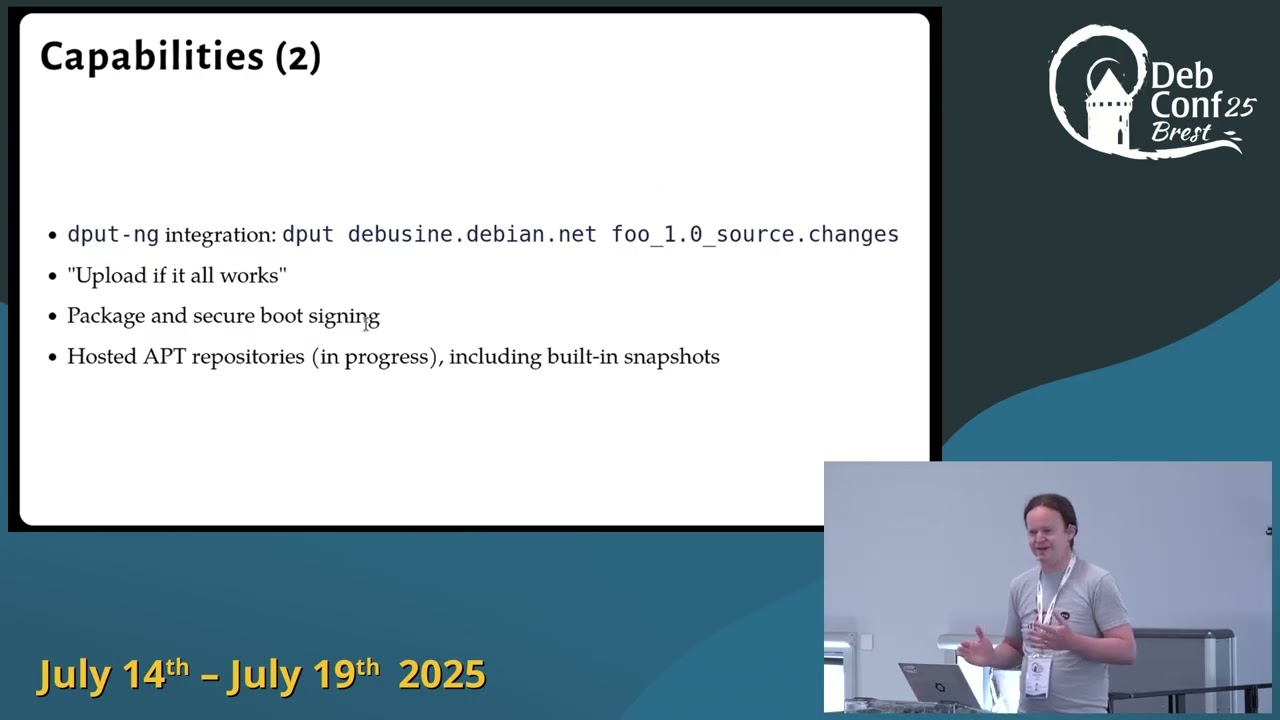
Debusine integrates seamlessly with existing Debian tools like dput and offers advanced features such as secure boot signing and the ability to host personal or application repositories similar to PPAs in Ubuntu. Users can mirror repositories, access historical snapshots of data for testing past states, and even cancel uploads after tests fail without affecting the main archive. The project is open-source under the GPL license, with development work visible on Salsa, and it is already deployed on Debian Stable for production use. Future plans include enhancing regression analysis capabilities, expanding support for less common architectures, and potentially integrating directly with tools like tag to upload to create a unified workflow from initial source code to final binary release.
The presentation concludes with a live demonstration showing how Debusine automatically generates a tree of work requests to test a package against its reverse dependencies, providing clear visibility into the testing progress and allowing users to abort workflows or sign packages as needed. The team emphasizes their commitment to making this an official Debian CI solution that simplifies the upload process while maintaining high standards of quality. By fostering collaboration among developers and offering flexible infrastructure, Debusine seeks to reduce the chaos often associated with simultaneous uploads and provide a more reliable environment for contributing to the Debian project.
Read the full video transcript
Hello everyone. Um, welcome to the next
session of Debcon 25. Uh, I'm excited to
introduce you Colin Watson Watson who is
um, longtime Debian developer since 2001
and now he's collaborating with a
company Frixian which is working very
closely to Dian. And uh it's very
interesting to uh hear uh one more talk
about new tool uh for Debian which uh
helps us to make the project better. So
it's about debusine to protest your
unstable uploads. Please welcome Ken.
[applause]
>> Thank you. Welcome. Uh, I'm going to
tell you about a system we've been
working on called Debucine and how you
can use it to make your uploads better
by doing more thorough quality assurance
before you upload them. Uh, Debucine has
more applications than QA as well. And I
hope we can also spark some interest in
those as we go along. Uh, I'm Colin
Watson. Thank you, Anton, for the
introduction. And, um, my colleagues
Enrico, Raphael, and Stfano are also
here. Uh, Carles has had to go home. Uh
we're all collaborators at Freaksian
which is uh which is a Debian services
company that among other things is also
responsible for organizing the long-term
support init initiative for Debian. Uh
so this is the usual best practice for
doing cross package testing today. Uh it
might also involve a trip through
experimental if you're feeling extra
cautious or depending on the freeze
rules that are in force at the time. And
of course, not everybody uses sali, but
uh I think this is pretty much what the
the the median developer, if you like,
relies upon. Uh so could you put your
hand up, please, if you've ever uploaded
anything to Debian Unstable.
Okay, good. Uh put keep your hands up.
Keep your hands up. Uh put your hand
down if you've ever uploaded anything to
unstable that broke another package.
Okay. Right. [laughter]
Put your hand down. Okay. I was good.
There are still a few people with their
hands up. Uh, put your hand down if
you've ever uploaded anything to
Unstable without waiting for Salsa CI to
finish first.
Okay. So, there there are a few people
who have impeccable practices and maybe
I don't have anything to offer you, but
the rest of you uh I hope you'll listen
to the rest of this. Uh so we have uh
distributionwide CI in unstable. It's
great. Uh lots and lots of uh
complicated systems that run over all
our uploads and make sure they're uh as
excellent as they can be before we put
them into testing. But there's only one
of it and it's shared between all of us.
Not just of course not just all of us in
this room, but the thousand odd Debian
developers. And as a result, it's very
possible to get into tangles when
multiple people are working on uh
somewhat adjacent things at the same
time. And we only avoid uh complete
chaos uh as much as we do by quite
careful coordination with things like
transition bugs coordinated via the
release team. Experimental does help of
course. Uh but again, there's only one
of it and setting up another one is very
far from trivial. uh there's a lot of
complicated machinery involved. So uh
what we want is a system where you can
run experiments on possible changes that
you might want to make to Debian. Maybe
you haven't even decided whether it's
the right thing to do yet. Maybe you're
just trying things out. Uh but you want
to experiment at a large scale without a
high setup cost and without fear of uh
breaking things for other people. Uh and
then if it all works then you can
actually commit to pushing the whole lot
into Debian.
Uh so this is where debut scene comes in
and it's what originally got me excited
about it. Uh when I talked to Raphael
about maybe doing some work for Freakian
and he pitched this to me. Uh we now
have the we know we now have a slightly
loftier goal of providing an integrated
solution to build distribute and
maintain a Debian based distribution. Uh
that's because we realized that uh a lot
of the things we were doing were useful
for Freaksian's extended LTS project uh
that funds developers to extend security
support for old Debian releases for up
to 10 years. Uh and uh we we think it
might also be useful to other Debian
develop Debian derivatives. It may also
be useful for Debian itself to use. Uh
though Debian's infrastructure teams do
of course tend to be rightly very
conservative about the critical pieces
that we need to to make the distribution
work. Uh but we'd very much like to work
with anybody's interested on that front.
Uh by the way, it took me an
embarrassingly long time to realize this
after I started working on the project,
but uh us is a French word meaning
factory. So deb usine undeb us is a
factory for debs.
Uh all right so all the people working
on debucine are Debian developers. Uh
we've got nearly a century of Debian de
Debian experience between us which made
me feel very old when I when I did those
sums. Uh we're working on this because
we want to make Debian better by making
it easier for people to do effective CI
at the distribution scale rather than
everybody having to put together their
own infrastructure.
At the same time, uh, obviously we need
to pay our bills and that sort of thing.
So, this project's been generously
funded by Frixian as well as by, uh, a
grant from the Sovereign Tech Fund in,
uh, in Germany, uh, that, uh, covered
our work last year in 2024. Uh,
collectively, we've put over 6,000 hours
of work into it so far. Uh, we have an
instance on debutcene.debient.net.
Uh, this is intended purely for Debian's
use. If you're a Debian developer or a
Debian maintainer, you can sign into it
via salsa. We also have an instance on
debin.frxian.com.
Uh this runs Frixian's work on extended
LTS. Uh but we've also begun to make it
available to customers who pay us to use
it and to uh have some say in our
development priorities. We'd very much
like to make this a sustainable project
over the long term. Uh [snorts] so if
you work for an organization that might
be interested uh please get in touch
with us after this talk. Okay that's a
sales pitch. Uh we started out then by
building the nuts and bolts of a system
that could run a variety of QA tasks
within the same infrastructure. Uh to
begin with this inevitably seemed a
little bit like reinventing the wheel.
So uh la last uh last autumn by the mini
debcon in Tulus uh we had capabilities
that were in the same sort of ballpark
as salsa and so of course it was
reasonable to ask why we'd bother
because salsa already exists and is
widely used
but uh CI on a single repository is
mainly about making sure that the
contents of that repository are as high
quality as possible. What we're trying
to do is more about the middle entry in
that uh motivation slide uh few minutes
ago. Uh so we started adding things like
a way to run auto package tests on all
the packages that depend on your
package. Uh of course that happens if
you upload to unstable or experimental.
But this way you don't have to worry
about stepping on anybody else's toes.
You can just work completely
autonomously and uh play about. Uh we've
also begun planning for a way to rebuild
all of your reverse dependencies in in
our system. Either single stage like the
the RAT tool that stands for rebuild all
the things or uh multi-stage like the
sort of thing that you do if you're
planning I don't know a Python version
transition or a Haskell compiler change
or one of those things that requires a a
a stack of staged uploads uh step by
step. Um, of course, once you do this
start sort of thing, it starts becoming
pretty hard work to analyze the results.
They're probably not all going to be
passes and the the previous state might
not be completely clean either. Uh, so
we're working on a system to uh track
and report on regressions against a
baseline. Uh, again, this is a bit like
the system for migrating from unstable
to testing, but [snorts] uh without
committing to anything in the Debian
archive first.
If you're using dootngng, we have
integration for that. Uh this saves you
uh having to learn how to use our debut
scene client for simple cases. Uh so
this uploads all of the files in your uh
source package with apologies to Ian uh
and then uh starts a suitable workflow
on them. Uh you can ask Debusine to do
the upload to the target archive for you
if it all works. Of course, you have to
provide a signature to do that. Uh we've
begun using this for contributors who
are uploading to ELTS. In that case,
Debcene also acts as the official build
demon. Uh so developers sign the source
package, Debc signs the binaries and
then uh Debcene uploads the lot. Uh we
have secure boot signing. Uh so we've
got uh separate signing workers uh that
can hold keys either uh with either for
low value keys with uh software
encryption at rest or for anything a bit
more important in UBHSMS. Uh we needed
this once Buster moved into ELTS uh
because that in Buster already had
support for signed bootloaders. So so to
avoid regressing uh we had to have a way
to issue security updates for those. Uh
we've also begun working on hosting app
repositories in Debusine. Uh so you you
might call these PPAs if you wanted to.
Uh we're we're thinking about better
names that are a bit more uh clearly
distinct from Ubuntu system. uh which I
used to work on which uh so maybe
something like I don't there there's a
pad with a bunch of ideas for this uh
PDAs for personal Debian archive or I
quite like NDAs for not a Debian
archive. Uh there's there's a few
different options. Um we've been
planning this for some time. We designed
a lot of the core data structures here
with with this in mind. Uh but we only
really started on it properly a couple
of months ago. Um, nevertheless, we're
at the point where you can mirror a
repository from somewhere else and
republish it from debris scene with
snapshot capabilities uh as long as
we've got enough storage.
I should say something about tag to
upload uh because uh there's an obvious
overlap uh in in some cases. Uh right
now uh I I'll confess that debut scene
doesn't really work with type to upload
which makes me a little bit sad because
I like both systems. uh you more or less
have to choose whether you want debusine
to help you with your distro wide CI or
whether you want tag to upload to help
you make the the source package and uh
track the life cycle there. You can
deput to debine cancel the upload to
Debian after it's run all the tests and
then use get dead push separately but
that's that's quite a clunky experience.
Um all the same type to upload seems
like a very good thing for Debian. uh
we'd like to figure out how to work how
to support it in a way that feels
idiomatic. Um uh and we we do have an
open issue about this. We've been
talking about it. It doesn't feel quite
sensible to tag a release and then just
upload it. Internet because CI might say
you have something wrong. Um so we
started thinking about some kind of
counter signed conditional tag
arrangements or something like that. Uh
we'd also like to support support to
support uploading to debutcene hosted
repositories using tag to upload and at
that point maybe we want to host the web
hook receiver and run some part of tag
to upload within debucine. Uh I'm not
quite sure of exactly how that will end
up looking. Uh but uh I expect we're
going to figure out how to integrate
this uh over time. Please get in touch
with us if you have ideas.
All right. uh if you're if you're doing
uh auto package tests across the whole
distribution and rebuilding piles of
reverse dependencies and things then
obviously you generate a lot of load
very quickly in very bursty ways. Um
Frixian has a dozen or so workers
attached to each of our instances to to
handle u the sort of thing that if
you're running par sessions you talk
about as best load. uh but uh we expect
a lot of bursty load as well. Um people
like uh I don't know if they're in the
audience but people like Lucas Nusbal
and Santiago Villa who do a lot of uh
rebuild testing for Debian tend I
believe to use some kind of cloud
provider to do so whether that's uh the
French grid 5000 system or AWS whatever
uh that sort of thing makes makes a lot
of sense here. Uh so we do have basic
cloud uh uh scaling support for both
compute and storage. In the compute
case, this takes the form of pools of
workers that can run tasks for us and
that we can scale up or down depending
on our task queue. Uh in the storage
case, all our files were already content
addressed with uh references in the DB
and our local file store already looked
a bit like an object storage system. So
uh hooking up cloud-based object storage
was pretty easy. uh we've we've tried to
avoid depending on just one big tech
provider here. We don't want to be
dependent on Amazon working or Google
working or whatever. Uh S3 compatibility
is pretty widespread for object storage.
Lots of providers implement something
compatible, but uh cloud compute tends
in practice to be a bit more provider
specific. Uh so far we've implemented
both Amazon EC2 and HNER cloud to give
us at least minimal diversity. uh but
there is support for plugging in others
if we decide we need to do that. Uh we
try to avoid lock in so the core service
doesn't assume any cloud provision at
all. Uh and we we have support for
migrating files around between different
object stores and that sort of thing if
we need to. Uh that said on on our main
instances on our main instance right now
we only have about a terabyte of files.
So it's actually cheaper at the moment
for us to just self-host that. Uh as we
as as more of you start to start to use
Debine, uh we expect that this number
will grow.
Uh all of our development work is in the
open on Salsa. Uh the project is
straightforwardly GPL. There's no
contributor license agreement or
anything like that. Uh if you're a
Python web developer, it's actually a
pretty nice project to work on. Uh we
have full type annotations across the
whole project. Uh 100% test coverage uh
or 100% unit test coverage uh uh across
branches and uh lots of documentation.
Uh we have some byte-size tasks in our
issue tracker on salsa. Uh if you're if
you have things you'd like to change,
we're very happy to help you.
Uh this is a project by Debian
developers for Debian. So of course it's
also in Debian. We deploy production on
Debian stable from packages that are
built from git by SalsaCI uh so that we
can deploy fixes reasonably quickly but
it's all the same packaging that goes
into Debian. Uh when we aren't in a
freeze we usually make a couple of
uploads a month. Uh if you like you can
install the whole system for yourself
from these packages. uh our
documentation covers how to do that, but
most people will just need the Debc
client package uh which lets you
interact with an instance that's hosted
on somebody else's computer.
So, uh let's have a quick look at some
of the basic pieces involved in Debine.
As a user, you don't need to have a
detailed knowledge of all of this, but
it is helpful to have a quick vocabulary
lesson. uh if you want to help us extend
debut scene then you will need to know
more about this and to start
understanding more of the detailed
design involved.
Uh so uh workspaces are the first piece
they're the uh they're where they're the
container within which everything else
lives. Uh they can be they can have
various access control. Uh they have
various expiry rules. Uh so you might
perhaps have an ephemeral workspace that
only lasts for uh two weeks after the
last thing you did in it. Um on WC
Debianet we have uh two sort of main
workspaces that that you might need to
see. Debian/base has all of our
infrastructure like mirrors of the
Debian archive so that you can build
things against them. uh the
uh rules for building the container and
VM images that we use to launch all of
our tasks. Uh and also the de
Debian/developers workspace which is
very roughly it's for things that that
somebody is intending to enter Debian
but it's not a it's not a one-toone
correspondence with Debian because some
of those uploads might uh might might
break in CI in some way. uh workspaces
can inherit from each other. So
developers inherits from base. Uh if you
try to look something up in developers
and it's not there, we'll look in best
instead. Uh and we have this we have an
idea of experiment workspaces which are
uh ephemeral workspaces based on another
one. Uh the idea here is that if you are
uh that if you're playing around with
something, you can ask us for a
workspace that uh is just owned by you.
Uh you can do whatever you want in
there. Uh and uh you can set things up
in it like your own workflows, your own
uh uh published archive, uh all that
sort of thing. [snorts]
Next major piece is artifacts. uh the
these are the the lowest level uh
storage abstraction in debus scene. So
uh you have some data and a few files.
Source package is probably the easiest
thing to look at to understand this sort
of thing. So for a source package you
have a DSC and maybe something like a
Debian Tartgyz and a and a Ridge TXZ
something like that. Uh so you've got a
few files that are very closely
associated and that travel around
together. Uh the there's also metadata
extracted from those. So for for a
source package, you normally want to
know at least the the source package
name and version and what architectures
it wants to be built for. Uh
there are uh a whole bunch of there
there's a whole zoo of other uh
artifacts uh implemented. uh Debian
linten for instance is a a result from
running linten but parsed in a way that
you can uh uh search effectively across
multiple artifacts uh and lots of things
that are used for debcen's own purposes
as well. Uh all of the files and
artifacts uh live in an object store. Uh
they're stored by hash. So if uh this
same artifact
uh sorry if multiple artifacts share the
same files uh then uh we we won't
duplicate storage for that. Uh
collections live above artifacts.
They're sets of items that form
something more complicated. So a suite
is the is the easiest example of this. A
suite contains a whole bunch of source
and binary packages. uh and you can look
up uh uh packages within a suite by name
and version and maybe architecture. Uh
an archive contains multiple suites. Uh
so you can have collections of
collections. Um
some uh some collections are just of
basically blobs of data. So the results
of QA tests don't necessarily involve
any actual files. Sometimes they're
really just small bits of uh parsed
metadata.
Uh collections can control the expiry of
the things they contain. So uh if you uh
if you have an artifact that that is in
a suite, then it shouldn't expire until
it's no longer active in that suite. Uh
and uh in some cases, you might actually
want a little bit of uh uh some kind of
grace period there uh to make sure that
things don't disappear immediately. uh
and uh there's there's a quite a
sophisticated lookup system for uh
taking a collection and saying I want to
find an object within that.
Uh so uh once you once you've got all of
those primitive operate primitive pieces
uh you need some way to ask Debc to do
things for you. uh work requests are the
the lowest level system for this. Uh so
uh when you create a work request, you
give it a task name, you give it some
task data, which is a a key value sort
of thing. Uh and the task data would
usually say uh here are my input
artifacts, the things that uh I want to
to uh build or test or sign or or
whatever. uh and some options for how
it's going to do that. This is very kind
of arbitrary code execution engine,
right? So, so you obviously want some
kind of sandboxing to make sure that it
doesn't immediately go horrible. Um we
we execute most work requests on an
external worker. Uh that's usually
sandboxed in some way. Uh we we support
at the moment uh unshare for uh for for
sort of lightweight kinds of things. uh
Incas containers, Incas virtual machines
and QME virtual machines. Uh the
instance administrator and the workspace
owner between them can control what uh
what levels of sandboxing are needed.
Uh work requests usually produce some
kind of artifact uh as output. It might
just be the log but uh more usually it
will be will also include some files
like auto package test output or debs or
something like that. and those will
often be immediately added to a
collection.
Uh so yeah, some examples of work
requests, s build, uh auto package test,
uh package upload, all that sort of
thing.
Workflows are where things start to get
pretty special because they let you tell
Debusine to do many tasks with some
ordering constraints and those can
involve tasks across lots of different
packages. So for example, we have the
reverse dependencies auto package test
workflow uh that finds all of the
packages in a given suite from Debc's
point of view that depend on or declare
a test suite trigger on one of the
binary packages that you pointed at uh
and then runs all of their auto package
tests against those binary packages by
creating sub workflows. Um eventually we
want to allow for custom workflows once
we figure out a a suitable domain
specific language to for for doing that
sort of thing. But for the time being we
have a number of built-in ones. Uh so
for most people probably the most
interesting one is uh the Debian
pipeline workflow. Uh that's that's
quite powerful. It stitches together a
lot of other pieces. So it uh it builds
the package. It does all of the usual uh
single package CI tasks. Uh, but it then
also runs all of the distributionwide CI
that we've written so far and it has the
option to upload your package to Debian
at the end of it if you so desire.
All right, so uh that's a a very quick
tour. Uh we promised to show you how you
can use these features to do QA work in
Debian right now. Uh so here are a few
live demos. Um [snorts] I hope
everything is up and working for this.
Uh these only really scratch the surface
because Debuscene is really a feature a
framework for running lots of different
tests in a structured way. Uh and if you
have have ideas, we hope you'll come to
our uh debusine workflow buff after
lunch to talk about what else we could
build in this framework.
So uh let me see what I can do here.
this uh take we're going to take a
source package with a few reverse
dependencies
and uh I've chosen uh zip zip.esting
which I happen to maintain uh and uh
sorry it's a little hard to type this
way um and uh I've prepared a a very
simple modification to that uh so I'm
going to deput that to wc.debian.net
that
uh and
uh it will uh as expected fail in the
first step because uh normally it will
work out which workflow to run based on
the distribution in your changes file.
But in this case there's no we don't
have a workflow set up for unreleased.
Uh so uh in in this case we're just
testing. So, uh I'm going to override
that. Uh
and say upload this to unstable.
Uh so that uh uploads all of the files
uh to to debut scene. In principle, it's
a bit like deeper. In practice, this is
uh implemented behind the scenes using
the Debcene client. uh and uh at at the
end of it, I hope you can see that at
the bottom of the screen, uh it uh it
creates a workflow. So, uh I'm going to
uh if I can grab this
and uh
open this in debut scene. Goodness,
that's going to be a bit giant, but
uh hope you can see what's going on. So
it's uh it's created a big tree of uh uh
of work requests. I deliberately chose
one that had some reverse dependencies
but not too many so that uh it would all
complete reasonably quickly. Uh and uh
you can see that uh these are organized
into subworkflows each of which does a
smaller chunk of the work. So, so this
one as I said looks up which packages
have predepends or depends or test
triggers on the package on zip.esting uh
or on Python 3 zip.esting rather and
creates an auto package test workflow to
each of those. Uh so if I click click
through to one of these and look at its
dependencies tab you can see that it's
waiting for the the builds to finish
first. Actually it's not because it
finished quite quickly. Um otherwise
tasks will start as soon as an
appropriate worker is a is available for
them. Uh so if you're curious you can uh
you can click through and uh look at the
list of workers down here and uh see
what see what they're all doing. Uh oh
maybe somebody else is using depine as
well. Uh the so that will um that shows
you all of that and uh I'll just reload
this and we can see that a whole bunch
of stuff has finished. Uh I'm not going
to wait for all of this. Uh if I uh
click through to the excuse me a moment.
Uh if I uh look at the waiting for
signature task here, if I can find where
my mouse has gone.
There we are. Uh then
uh this has uh this has some
instructions on what you want to do if
you want to actually upload this thing.
So run dep provide signature this thing.
Uh you you might well want to say
actually you know what I've changed my
mind. I don't want to I don't want to do
this. So you can abort that and uh that
will if I go back uh cancel cancel the
rest of the workflow. Uh so in this case
obviously I don't want to actually
upload this thing to to unstable. it
would be rejected anyway. So, uh so I'm
just going to cancel that. Uh but if if
I had wanted to sign that, what it would
do is uh do something very like debar
sign essentially.
Uh so maybe you want more control over
what Debbie does or uh you want to do a
set of
uh throwaway tests that uh you don't
intend to upload and you also don't want
to litter a shared workspace with them.
Uh so for this sort of thing it's useful
to be able to create your own
workspaces. Uh I mentioned experiment
workspaces earlier. By default only you
can write to an experiment workspace you
create. Uh they come with an effect of
them so you can add other people to them
if you want. Uh
once again, where is my mouse pointer?
Uh right, let's see.
Uh no, there we go. I'm just going to
retype this. Sorry.
Uh so I'll say uh create a workflow uh
uh starting with the developers
workspace.
Uh and actually I'll show you this uh
this example here.
Uh so the this is some task data for
workflow. It just says here's the name
for my experiment. Uh I want it to
expire after one day because it's very
boring. Uh but of course that might be
longer. So uh this is uh create this uh
and what have I done wrong here? Uh I
have forgotten to say create experiment.
Uh so that will that will create uh the
workspace for you. At the moment
unfortunately this doesn't give give you
a URL to the new workspace but if you go
look at the front page of wc.dew
internet you can find it. uh and uh way
down at the bottom.
So I'll open that and here we have a
brand new workspace. Uh so within that
uh I can uh create uh workflow
templates. So I can say uh
uh uh I'll show you the uh template
again. Uh this is uh kind of similar to
the one that's configured by default in
the developers workspace, but the the
main difference here is that it's not
configured to upload to Debian at all.
So you can't you can't make a mistake
with it. uh the um uh you you might well
for this sort of thing say actually I
want to uh build
uh build all of my packages against
something else maybe against my private
archive or I want to uh uh run all of
the tests in virtual machines because
they're they're crazy things that
involve tearing down bits of network
configuration or something uh and uh and
so on. So, oops, what did I do? There we
go. Uh, so I can create another workflow
with that uh or create a workflow
template with that. And I can upload
that uh same package that I uploaded
earlier here. Uh, and uh just using the
force option because I already uploaded
it a moment ago. Uh, but that will
upload it to uh to my private workspace
instead where it can do its own thing.
You can see that the URL has zip. Demo
in it. Uh so it's outside the scope of
this demo, but you can also use the
binary artifact uh binary artifacts that
this produces as additional input to
other workflows. Uh it's all a bit
manual at the moment, but we're planning
to hook things up soon so that you can
tell a workflow like this to publish the
output into a suite collection in Debine
as an alternative to uploading to an
upload queue. At that point, you've
pretty much got the equivalent of a PPA.
Speaking of which, uh let's have a quick
look at where our app repository support
is at the moment. Uh so uh this uh
script here
uh is just a a simple thing that uh
creates some apt configuration
uh and uh so a kind of private bit of
apt configuration that I can uh use as
an ordinary user. Uh and it this points
it at deb.wc.frixian.com.
frixian.com/frexianbase
uh which is uh Debbie's mirror of all of
the stuff in uh uh in Frixian ELTS
uh specifically this points to our
mirror of the the ELTS repository for
Buster. So I can at this point run uh
oops
I can at this point run uh uh apt config
equals point to the new thing apt update
uh and that will just do an apt update
from uh from debutc all works uh that's
fetched the indexes so I can then go
okay download uh this is a security
update that I looked up that was
published on the 1st of July. Um, so so
far that's just kind of mirroring. Uh,
but I can also ask it about older state.
So we started mirroring indexes a couple
of weeks ago. Uh, and that means we have
uh, some older data as well. I can say I
can tell apt to uh, use the snapshot
from midnight on the 30th of uh, of
June. Uh there's no specific uh uh we
don't have like specific uh cut offs for
the snapshots. You can you can pick any
date you like and we'll just use
whatever uh whatever was current at that
point. Uh and uh once you once you do
that we can then say
uh okay pick whatever was current for
that package uh at that date instead.
And you can see that instead of picking
uh -2 plus dev 10 U1, it picked 2.1-2
instead and got the older version. So
you can use this sort of thing in the
same way that you might use snapshot
debian or to look at the state of a
repository in the past and uh even run
tests against it using something like
debisect. At the moment we only retain
older snapshots for ELTS and not for our
current suites. That's partly to save on
space costs and partly because well
snapshot debian or is already doing
that. Uh but once we have personal
archives you should also be able to get
snapshots of them for free.
Uh so what's next? Uh a lot of our
current work uh current road map
involves finishing things we started. So
we want to make debut scene more useful
for LTS and ELTS contributors by
finishing our work to support analyzing
regressions. uh that's one of the
biggest remaining gaps uh with respect
to previous processes for for for LTS
and DLTS contributors and it's going to
be very useful in general in uh in the
process of getting your head around uh
the the output of complicated workflows.
Uh I'm personally very excited to finish
app repository support as well. I think
that will make a big difference to to
how Debian operates. Uh but after that
we're really looking for people to
embrace Debine to to help us decide on
its future maybe even to help us build
it. Uh we've had quite a few
conversations already even just this
week uh with people who have specific
use cases. Uh and we as I said earlier
we I hope we'll uh see some of you at
the deputy scene workflow buff uh this
afternoon to explore those further.
Uh that's all I've got. I'm happy to
take questions.
>> [applause]
>> Yeah, thanks Colin for uh for uh the
introduction of this new very
interesting tool and uh it's it's nice
to see that in Debian we have more and
more tools which help which makes our
life easier. So let's go to questions.
you uh showed us the like data model
basically. Um you're expecting this
question, right? I notice you didn't
explain how git is git source code is
stored in debine. That's correct. I
didn't uh it's not currently, but I
think it probably can quite easily be.
So, uh my expectation is that uh we'll
have some kind of new artifact type. Uh
you saw me exploring the artifact model.
uh it's very flexible uh so you you can
have uh pretty extensible sets of
artifacts at the moment we do just have
Debian source package which is a trad
source package but I don't think there's
anything stopping us having like debine
sorry Debian colon git source or
something like that which uh I'm not
sure whether we'd store a git bundle or
whether we or git archive effectively or
whether we'd h just store a pointer to
uh to um something as hosted somewhere
else. Uh but uh uh it's it's perfectly
allowed for in the data model. The only
reason we haven't done so yet is because
we'd end up building source packages
internally anyway. Uh so we because
we're uh because most of the work uh
that is done by our tasks is done by
existing deb existing Debian tools. Most
of those expect source packages and so
we basically need one for internal
purposes. But one thing I'd like to do
is uh uh have a task that basically does
the equivalent of the tag to upload
builder uh that goes from uh a git
archive that we stored in one artifact
produces another one which is a
compatibility source package and then we
can feed everything else to that. Um
happy to talk through the details of
that. I think is very possible. Thank
you.
>> Okay. Thank you Colin for this
interesting talk. I I sorry I I need to
um uh correct myself. I raised my arm at
the at the wrong place. I for sure I did
uploaded something which break other
things. And so uh
>> haven't real.
>> Yeah. I really like this deep interface
because it was new to me because this
this is really great but uh and and very
simple and so but it triggers a question
in me is usually I contact duck with
deepot is deepen somehow
doing a similar top job to duck at some
point in time
>> similarish so uh uh deeput has deepen g
at least it's a bit more complicated
With uh traditional deepoot, but with
DUTNG, it's got uh a very flexible
workflow or sorry uh hook and profile
system. Um it's a little more
complicated than it needs to be in some
places. Uh I've made some fixes to get
it to work for us. Uh but uh you can you
can tell it instead of uploading to that
upload queue, then upload to to this one
instead. Or actually, you can tell it to
execute basically its own code. That's
>> I'm talking about the putng.
>> Yeah.
>> Right. So um really dutng doesn't
interact directly with DAC anyway. It's
it's interacting with an upload queue
which uh traditionally in deb in Debian
there's another piece of machinery that
then transfers all of that over to DAC.
Um we just substitute ourselves for an
upload queue and uh uh and and do what
we need to do there. Uh what we what we
don't quite have is uh machinery for
actually putting your upload into a
suite collection which would then be the
equivalent of uh DAC uh of of D install
effectively. Uh but we're quite close to
that.
>> Really good. I would have a lot more
question but I'll leave it to others
now.
Um, [clears throat] yeah. So, one of the
pain points that I have with uh Debian
and auto backage test in particular is
running those on lesser common
architectures. Is that something uh
Deben can help me with?
>> Uh yes, though maybe not immediately
quite yet. Uh we have AMD 64 and ARM 64
workers right now. Both of those I guess
you probably count as common. They're
they're reasonably widespread. Um, but
there's there's absolutely nothing to
stop us hooking up uh uh others apart
from just getting hold of the right
hardware and putting it in the right
places. Um, what what are you interested
in particularly
>> all the supported architecture?
>> Right. Uh,
we want to get there. It may take a
little while to deal with procuring all
of that. Uh, but uh, but we do want to
get there. Yes.
Okay.
>> Yes.
>> The the model um is very generic uh
which I like. Um what are your future
plans for um using that genericness to
be able to build other things apart from
debs? So could this be a future OBS type
thing? As you can yeah as as you observe
it is very generic. We've carefully
namespaced all of the things that we
think are very Debian specific with
Debian colon at the start. Uh so that we
we don't design ourselves out of that.
Uh I think probably for the short term
we would we would rather do a better job
of fewer things rather than doing a bad
job of everything.
>> [snorts]
>> Um but uh there's but there's plenty of
room for it. If we had customers who
wanted us to to build that then uh it's
then we're totally open to that. Uh the
current team doesn't have a lot of
expertise with RPMs or uh arch packages
or or whatever. Um just because we're
we're mostly Debian specialists. But uh
there's there's there's space for it.
Okay, any more questions?
It's not really a question because I'm
[laughter] part of the team, but just to
uh
tell you that the the view that we have
or that at least I have is that we want
this to be something integrated.
Obviously we're trying to integrate it
with the current Debon situation which
means well uh we have to start with
source package and we have to upload
them back to to Deon but we can only
upload source package right now but
obviously if we test binary package and
we know they're good we would like them
to be used directly instead of being
rebuilt in a different environment. So
one of the obvious and interesting next
step uh for us is to help convince
Ourelia and the other from the build
team to uh consider rely on debin to uh
build the debian package the official
Debian package and uh yeah we really see
that as a uh ultimately as the official
Debian CI uh that uh you use
automatically when you do your work
uploads
Don't know how many people
uh are worried of this future or would
like to see this future. Maybe we can
have a raise of hands who would like to
uh see an official
workflow from scratch from the initial
upload up to the upload to Debian
maintained by a single unified
architecture instead of many random
tools.
>> Okay, not too bad.
>> Okay, promising.
Thank you.
>> Okay, please. Last question.
Um, thanks for the talk. You you Yes.
Um, you mentioned uh that it was um
doing what salsa is already doing, but
uh would it be imaginable to plug salsa
to trigger debuts in jobs?
>> It's definitely a possibility. I think
one of my colleagues was doing a bit of
early exploration of that uh at dev
camp. Uh we I I think we need to work
out what to what extent some of that is
useful and to what extent it ends up
being confusing uh because if you have
uh I mean we have a lot of multi-layered
systems in in Debian. Sometimes if you
end up with all of them calling each
other, it can be quite confusing to work
out what does what. Uh but uh I'm not in
principle opposed to the to the idea and
we may end up with something like that.
Yeah.
>> But really lost. Okay.
>> So this seems like a really really good
tool to spend all the disk space in the
world.
>> Yes. um in addition to all the CPU of
course uh except that which is being
consumed by LLMs and scraping.
[laughter]
Uh so what kind of controls do you have
or kind of reporting and and similar do
you have for for managing that in a way
where we don't end up with uh people
accidentally or intentionally consuming
like significant amounts of of uh
capacity because
>> if we are going to to adopt this for for
Debian and make this more generally
available I can very much see people
consuming hundreds of terabytes of this
space before we uh yeah
>> indeed uh we have quite aggressive
expiry really. Um in some cases a little
more aggressive than I'm comfortable
with. Uh although I a few weeks ago I
discovered a bug where uh we were we had
uh accidentally not expired two
terabytes of data. So oops but uh so
there's
it's moderately aggressive right now. We
don't currently have great reporting for
workspace owners. So uh so most of our
most of our reporting is more at the
instance administrator level. Uh I would
like to expand that to workspace owners
because once we well from Freynium's
point of view once we start having
customers uh who are using this uh for
their own purposes most likely they'll
want to to see how much space they're
using. uh but there is reporting at the
uh uh at the instance administrator
level where we can see what's being used
by which uh uh which sort of scopes. Uh
and uh I expect to expand that. Um most
likely we'll we'll end up needing
something where you can where you can
see what is what is keeping artifacts
non-expired. Uh so there are only a few
reasons why artifacts can can be kept.
Um there's like explicit expiry or being
referenced by collection or being
referenced by relations from other
artifacts. Uh and uh uh all of those are
quite easily data database
introspectable from our point of view.
So we can uh we can expose that a bit
more publicly.
>> Okay. Thanks Colin. uh one more time for
your nice presentation, for your work uh
on this tool and the whole Frexen team
for doing this uh job. Please continue
to do it and keep us updated with news
from from this tool and I can only
promise that I will try to use it for my
personal needs. Thanks a lot. Please
welcome uh this grid for one more time.
[applause]
Thank you.