Using Conversational AI to Support Federated Certificate Administration in Higher Education
Watch on YouTubeVideo summary
The video presents a practical case study from the University of Maryland regarding the deployment of a conversational AI system to manage digital certificates within a federated higher education environment. The primary driver for this initiative is the impending industry-wide mandate, set for March 2029, which will reduce the validity period of TLS certificates to just 47 days. This drastic change renders manual renewal processes impractical for institutions managing thousands of certificates, as they would need to renew them eight times a year instead of once. To address this scalability challenge and prevent service outages, the university developed an AI-assisted automation pilot that successfully reduced help desk tickets by approximately 64%, significantly alleviating the burden on IT specialists who previously answered repetitive queries from non-expert departmental administrators.
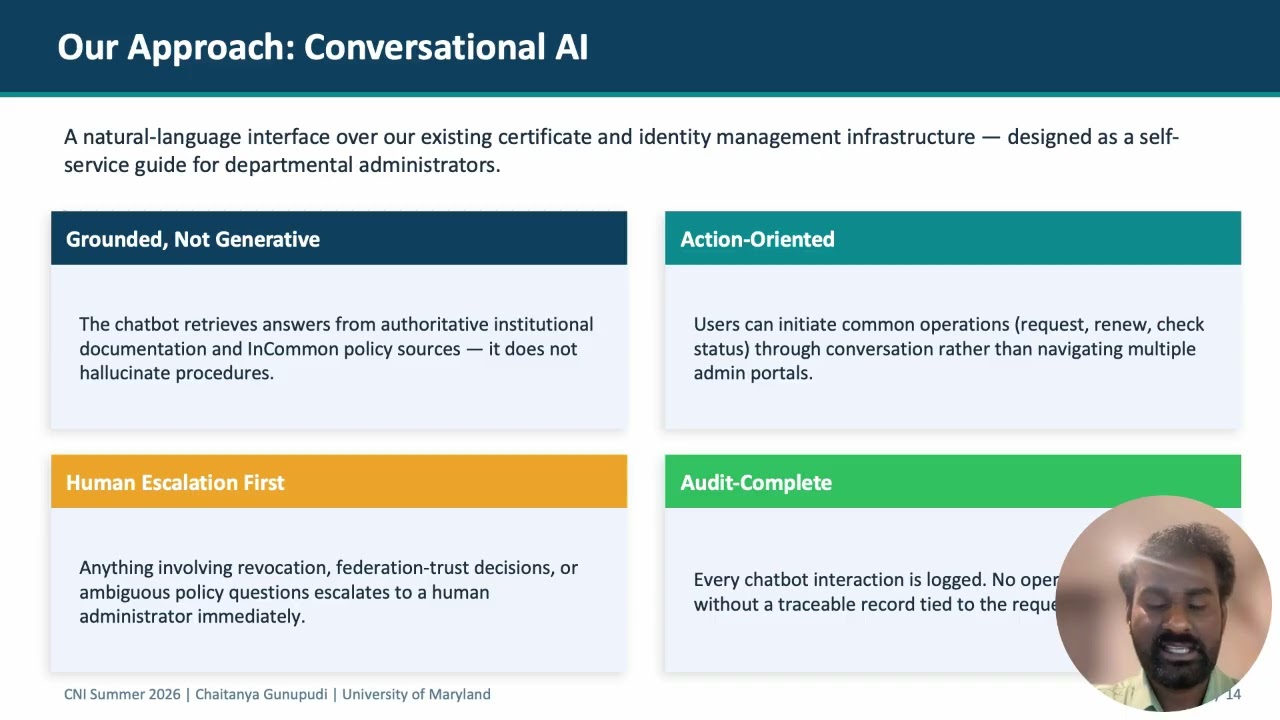
To ensure safety and reliability in an operational context, the system was built upon four core design principles: being grounded, action-warranted, confidence-aware, and audit-complete. The AI is strictly grounded by retrieving answers only from authoritative institutional documentation and policy resources, ensuring every response includes citations to its source data. It is action-warranted because it performs specific tasks like checking expiry dates or initiating renewals through conversation rather than acting as a static FAQ page. Crucially, the framework employs confidence thresholds; if the AI's certainty about an answer falls below a set level, it explicitly declines to guess and instead escalates the request to a human administrator. Finally, every interaction is logged and tied to a user's identity via single sign-on, creating a complete audit trail for accountability.
The architecture integrates multiple entry points, including a web portal, a Slack bot, and email triggers, all authenticated through Shibboleth to identify the user's department and affiliation. The system utilizes a Retrieval-Augmented Generation (RAG) engine that queries a corpus of specific policy documents before generating responses, while strict rules define where AI autonomy ends and human intervention begins. For instance, the chatbot can autonomously guide users through renewal steps or explain policies but is programmed to immediately open a ticket for any revocation requests, wildcard certificate issues, or data involving sensitive information like student records. This "human-in-the-loop" design ensures that critical actions requiring high stakes always involve human oversight, mitigating risks associated with AI hallucinations on complex edge cases.
Despite its successes, the pilot revealed important lessons regarding user trust and technical limitations, such as users initially over-trusting the bot and some non-English speaking staff experiencing inconsistent results. The presentation concludes with several takeaways for other institutions, emphasizing that confidence-aware design frameworks, including visible uncertainty signals and audit trails, must be built into the system from day one rather than added later. Future work includes connecting the chatbot directly to ACME protocol endpoints for fully automated renewals and collaborating on shared policy corpora to improve accuracy across the broader InCommon federation. Ultimately, the project demonstrates that while conversational AI can drastically improve certificate administration, it must be deployed with rigorous governance, clear escalation paths, and a commitment to continuous red-teaming to maintain security and trust in critical infrastructure.
Read the full video transcript
Hi.
And welcome. My name is Chaitanya
Gunupudi. I'm a senior platform cloud
engineer and AI researcher at the
University of Maryland College Park.
Uh the briefing the briefing is about
something we actually built and deployed
in production. A conversational AI
system for managing digital certificate
across our institution.
But it's not about the
design principle that I'm going to talk
about today. And I believe it is very
essential
um
for the artificial intelligence to the
system deployed in operational constant
context that is like
confidence our design frameworks need to
be deployed when we are deploying
AI
infrastructure in our cloud environment.
Over the next 30 minutes, I want to
share both the practical story and what
we built, what we work on, what you get
surprise. And the governance and the
governance framework which is
which we use is very safe which is is
very safe to deploy.
Here
and today
next slide.
So here what we will cover. We'll start
with the operation problem.
Why certificate administration at
research institutions have genuinely
uh is genuinely hard. We'll explain the
urgency need around like 47 47 date
mandate that's coming for all of us.
From there I will walk through our
conversational AI
problem, AI research problem.
And this is this is this is what I want
to share
um
in the AI design framework. In this kind
of design framework, um we'll be talking
more about like a confidence aware
framework, like how it counts
Yeah, how it counts and how it behaves
and it is like more uncertain. We'll
like we'll look into the architecture,
the pilot results, and with some open
questions and takeaways you can use at
your institution. So, that is the main
problem. So, because
uh due to the due to this we are getting
like more
uh more
more help desk tickets, questions, all
kinds of practices which we're going to
uh discuss today.
And let me start with this real problem.
Uh so, right now in our institution at
the University of Maryland, College
Park,
um we have around eight we have around
8,000 SSL certificates across
um across 39 departments and 150 plus
domains we have. Every one of the
certificates eventually expires. Every
problem Every renewal involves a
departmental administrator,
often someone who is not a IT specialist
who has to figure out the right process.
What actually happens? That is like they
open a help desk ticket. They ask us
some questions. They ask last year, and
what certificate type do they need? And
how do I validate my domain? What does
this error mean? Our IAM IAM team
answers the same questions repeatedly
repeatedly every year and uh every year.
To resolve this, we designed a AI
assisted automation pilot and cuts
almost like 64% of the service now
tickets. That's the
uh That's the uh That's the number our
leadership board has been uh justified.
Before what's coming for all of us is
like 47 47
uh 47 days certificate validate mandate
in the future, like in the mostly that
the target date is is
March 2029. The public TLS search can
only be a valid for 47 days. That means
institution that renew once a year will
need to renew
eight times per year. So, that is very
impractical if you're planning to design
using manually. So,
we need to have some kind of
automations.
I think this is the this is the similar
problem which I was talking about like
the scalable problem. How
So, for this for this we have as as we
mentioned. So, we don't have we don't
right now have
unlimited unlimited certificate. We need
to make sure
the 47 day validate period is is present
validate validate date is
and date is present. We need to make
sure
we need to have a proper proper
automations. That which we're going to
talk about like more more in more
more in today.
The next slide.
The next slide is about the InCommon. It
is the
It is the vendor It is the vendor who
who have
and about the 47 day validate. Let me
give some context about the federated
landscape. InCommon
is a national trust
federation
operated by Internet2 connecting more
than
1,000 US research universities and
federal agencies. It provides unlimited
SSL EV
client and code signing certificates
under a single annual fees.
The CA browser
ballot SC00081V3 approved April 25
mandates a phased reduction in TLS
certificate validity. Like today right
now it's 398 days. March 2026 it's 200
days. March 2027 it's 100 days. March
2029 is 49 is 49 days.
Think about Think about like what 47
days means operationally. A certificate
you used it to renew every 1 year need
to be renewed like
eight times per year.
For any institutions managing like
hundreds or like usually hundreds of
certificates, manual processes simply
not viable. You need to have a proper
automation and
and almost right now 40 to 60% of the
institutions doesn't have a proper
They don't have a proper automation tool
to renew these kinds of certificates. So
we need to have a proper automation to
renew these certificates and a proper
pipeline is very important. So that is
where
So that is where like we need to
immediately validate
the certificates. Otherwise they will be
compromised and some of the search will
be decommissioned
like down the line. So we need to make
sure the expiry date, the automations is
very mandatory. We need to have a track
to set all kinds of reminder and avoid
and avoid any kind of outages.
To resolve these kinds of stuff, we need
to have a automation that we're going to
talk about like more deeper
uh deeper deeper in the presentation.
Uh
the next slide is about the the thing
which I'm going to talk about is our
approach, the conversational AI which we
are using in our institute. Our approach
is built around like four principles
that I want to name explicitly. Like
because they are not what made this safe
to deploy in an operational context.
First, grounded. And it's not very
generative. The chatbot like the chatbot
retrieves
we need to build a chatbot
which will be talking which which will
be talking in
with in common or Shitty Go or any kind
of
federated services like uh
in
EM sign. So any kind of
REST APIs you can able to talk you can
able to talk with your
conversational AI.
So first, it should be very grounded. It
should be very generative. The chatbot
which you are planning to design should
retrieve answers from a authoritative
institutional documentation and in
common and in common policy resources.
It doesn't improve. Every answer should
have site its resources uh sites its
resources.
That means one of the confidence AI
framework. So if you don't site the
resources which the data it is coming
from, the confidence level of the
customer or the user who is trying to
use um will be very less. So only like
we need to make sure it is
the it is getting properly cited. The
second, action warranted. Wouldn't want
another FAQ use page. Users can can
check expiry status by domain, initiate
a renewal, open a ticket through a
conversational rather than rather than
going like different steps
in an in common in an in common
interface. So we need to make the
convert like
chatbot
through very chat through very
conversationally. And it it need to
provide these kinds of operations, which
is very important. So, that is one of
the second framework. The third
framework is the Conversational AI
design. This is the principle I want to
spend most of the time in this briefing,
like explicitly
like uh explicitly, the threshold
determines when the chatbot expresses
uncertainty. So,
so whenever we get a data from a
chatbot, we need to make sure it is
properly confident. So, we need to give
a confidence confidence number
or like how much confident
it is about. So, based upon the
confidence uh
the the data which we are getting uh
which we are getting should be properly
determined. So, if the confidence level
is less, we need to make sure a human is
present always or it should decline the
answer. The system is designed to say,
"I don't know." rather than a guess
because we are dealing with the proper
certificate data, which is very
important research data. The domains,
all these are like very important for
the institution. So, the answer which we
are getting it should be properly
validated. The fourth, audit complete.
Every interaction is logged. Every
operation is tied to the requesting
identity through single sign-on.
And you need to make sure
all the actions which is present in the
conversational AI chatbot which I'm I'm
mentioning for the certificate
automation should be properly audited
and it should be properly logged. This
is These are the minimum frameworks we
need to have when designing a a
conversational chatbot for a
certificate automation.
So, now I want to talk about how the
chatbot handles. in terms of scope. The
chatbot handles like four four category
four categories of operations. Like one
is issuance guidance. Like which So, in
the issuance guidance like which
sub-type for your use case, domain
validation requirements, and how long
issuance takes, and how long
the like certificate authority
recommendation based upon institution
portfolio. That is called issuance
guidance. The second step is renewal
support. So, this is where like our
highest priority of
like service now tickets get generated.
Like we need to make sure when we are
building
renewal support the chatbot need to look
up the existing domain. It What are the
step-by-step renewal guidance for every
server setup? ACME automation. So, is
there any
ACME automation setup? Is
Right now it is possible.
And how does the 47-day validity
planning? So, right now we have 2 years
from 2027 to 2029. Like what are the
steps we are trying to follow for this?
And the third we are
we need to make sure the chatbot
explains the process and how the
revocation is appropriate. But any
actual revocation
action immediately escalates to a human
administrator. No exemption because the
reading operations you can you can make
like however you want. But when you are
writing or deleting the certificate, we
it need to make sure it is properly
notification has been sent properly to
the administrator who maintains the
domains. And a successful There should
be a two kinds of notification. One is
initiated, the another one is
successfully done. So, those are the two
revocation assistance. But if there is
any happens,
always a service now ticket need to be
automatically generated and escalated to
a human. The second one is policy and
trust questions.
As per certificate authority grounding
through rag chain of trust explanations
and hard
explanation of federated trust
decisions. So, we need to make sure the
policies are explained properly. So,
only like we designed rag a rag method
where we deployed all of our
documentation and so that so that the
customer or administrator can able to
review all kinds of policy documentation
through our rag analysis, but using a
chatbot interface so that he can able to
get all kinds of policy information
rather than going all over the place.
The key design across all four
categories, the chatbot knows how it
handles and what it doesn't and when it
when it's outside its scope or below its
confident level, it knows how to how to
like propagate through a human human
interface either through creating
service now tickets.
Now, the [clears throat] next slide.
The next slide is about the
architecture. Let me Let me walk through
architecture architecture briefly.
Entry points are three, a web portal, a
Slack chatbot, which turned out to be
our most popular interface,
and and an email trigger for the renewal
for the renewal reminders. All entry
points authenticate through Shibboleth.
So, that is very important for an
institution. Shibboleth. So,
Shibboleth
through InCommon Federated Identity. The
chatbot know who who it is talking to
and what department institution it is
affiliated with and what certificates
are associated with the Yeah, each
department with each department.
From there, request go to a confident
confidence aware LLM framework, and then
it is propagated to a plug
rag engine. Before the model generates a
response, it it retrieves relevant
documentation through from our corpus.
So, in common and Sedico, so our mean
our corpus is present about in common
and Sedico policy documents, our
institutional procedures, and CEA
specific configurations. So, all these
are present in our corpus name
specified directory.
So, the model generates a response
grounded in that retrieved content, and
and it will make sure it it sites all
the resources. If the confidence is very
low, when the output is when the output
we got from from the AI framework is
very low,
it either redirects to a
help desk ticketing tool or
help desk ticketing tool, and opens a
ticket and notified to the on-call team.
Everything is logged, every query, every
response, every confidence level at a
decision time. That's audit trail. And
everything will be logged so that if
something happens in the future, it will
be it can be easily tracked.
So, that is very key important.
This is the like high-level architecture
when to design to design in the
conversational AI chatbot.
The next slide.
The next slide is the hardest part,
policies through an LLM. I want to be
very direct
what was hardest because
because I think it's a mostly general
generalized lesson which which
anyone who is designing the rag
framework they can able to understand
that. So, getting operational facts
facts right is achievable like when does
my certificate expire? It's a It is a
retrieval problem like
on like through rest APIs.
So, getting policy document getting
policy documents is much harder. Policy
documents are not in sections. In common
mostly relies on these policy documents
and subscriber agreements like are
written through a very legal compliance
not user facing
operational guidance. So, mapping that
language to a practical user questions
requires significant prompt engineering
and document pre-processing.
So, because there will be like more
hallucination on very edge cases like
example like when a user asks about
multi-domain wildcard without no
standard sign configuration the model
can provide
plausible sounding some kind of
incorrect answers. So, due to that the
rag reduces the risk does not completely
eliminate these kinds of edge case
scenarios. So, we need to be very make
sure
make sure about this.
And federational context is contextual
when a certificate is trusted by feder-
by federation partners depending upon
issuing CA the certificate profile and
federation
metadata configuration. These are deeply
contextual decision than the chatbot
which we are making generalizedly for
the audience.
So, only like our mitigation the
confidence
thresholding per query category
mandatory is very important. So, some of
the framework which are already
mentioned is mandatory source citation
on every answer
and 12 and escalation strategy like what
kind of escalation strategy which we
have whether it's always going to a
human when the answers are when the
answers are not accurate
and regardless of regardless of a model
confidence when a confidence is below
threshold the chatbot explicitly should
open a service now ticket.
Next slide, please.
So, the early results when we deploy uh
so when we deploy this chatbot to the
departmental administration
administrators across our school and
some departmental at university.
So, roughly 70% 70% of the routine
renewal questions were resolved without
querying without querying high
escalation to the IAM team. So, that's a
meaningful reduction in help desk
load like when when
when at least some of the
at least some of the tickets has been
resolved through this rag analysis
through this analysis.
So, first response time. How long an
administrator awaited for a useful So,
some of the analysis we have done is how
how long an administrator has been
waited to get a right answer when from
So,
usually like how much time
a
a ticket has been raised
from a help desk
from help desk. We just compared the
help desk service now ticket creation
versus the chatbot giving answer is
ridiculous like
the answers are very fast. We defined 12
escalation rules or categories based
upon the pilot we built. The number will
grow as we expand.
What worked well like step-by-step
renewal walk-throughs are highly valued
by non-expert admins. The certificate
type decision
The certificate type which we mentioned
the decision trees reduce the wrong
certificate requests meaningfully and
domain status lookup was the
was the single most
uh single most single most user
question where every people are trying
to access this access this.
So, what really surprised us is
this is most important fact is
users
initially over trusted the chatbot more
than we expected like setting setting
and communicating expectations through
significantly
is more important like we also found
that the chatbot had two ti- two times
the management of the web portal. So,
the interactions are very high
rather than comparing with the web
portal.
What didn't work out really is real-time
what are the real-time certificate
retrieval retrievals was too high for
some users. The
and
and we considered some of the
revocations need like more guardrails
than we expected like some of
non-English speaking staff had
inconsistent experience quality. So,
that is one thing which we are trying to
improve in our frameworks.
Next slide is about um
human in the loop design framework. So,
one of the most important design
framework was was made
being explicit like very explicit about
where
AI ends and human begins. The left hand
the left side shows when the AI handles
autonomously like explaining sub types,
walking through renewals, answering
policy questions, retrieving expiry
status, opening informational tickets.
So, those those are the perfect steps
which is designed through our AI rack
framework.
The right side shows like what always
humans what always requires a human for
any query with no exceptions. All the
certificate
revocations, feder- federated trust
configuration changes, wildcard and
multi-domain SAN edge cases, anything
below confidence threshold, and anything
students or patient or health data or
um
or
award management's data or federated
data. So, these for these kinds of data,
always human or ticket management system
is established. These rules are very
hardcoded. Those are not configuration
options. The chatbot cannot cannot
directly revoke a certificate. It If
someone asks for it, it opens a ticket
and notifies the IAM team. So, that is
the
human human like
human in the loop is very mandatory.
Define your escalation rules before you
launch. We discovered some of our some
of the things
that almost went wrong in the pilot
mode. So, you don't want to discover
you were
you want to you want to discover in your
pilot state like what are the escalation
strategies at what point the human need
to the human is present in this chatbot
interface. So, so so uh
so those kinds of entities is very
important.
And some of the open questions which
which I would like to
ask is Let me Let me close this Let me
close this
sub
Let me close this section
which we haven't solved yet because I
think this is where peer conversation is
most most
most valuable. Accuracy at scale, like
we don't have a
we don't have a systematic team to
detect wrong answers because they cause
certificate outages. We need better
automated red teaming of the policy Q A
pipeline. We need so
rather than a human evaluation, we need
to have a
red team strategy like
if something goes beyond our control, so
a team need to be always present like
how we have
ongoing hours at team hours. So we need
to have a red team hours. So where some
of the issues can be resolved, but it's
not mandatory. It's very in the initial
stages.
And next is auditability and
accountability. If an administrator
follows all the chatbot guidance that
that usually is sometimes
that turns out to be wrong. Who bears
the responsibility?
Whether
the A chatbot or the or your team. So
that need to be we need to make sure
that the next one is the model drift. In
common policy documents update
regularly. So because whenever as we are
in the migration phase or new
development stage, so there will be
there will be the the documents are
updated very frequently. How do we
maintain a retrieval corpus?
So that is always correct and alerts
when a guidance has been changed. So
that is very important. And in common
corpus sharing, so our grounding corpus
is only the UMD specific but institution
usually has a different policies and
different guidelines. So we need to so
every institution need to have a proper
corpus of their policy documents.
And some of the takeaways is six
six things to check back at your
institution is start with the highest
volume.
Lowest risk questions like renewal start
when when you when you are planning to
deploy these kinds of chatbots like
so what are the critical questions an
administrator is trying to ask with the
IAM team or certificate authority team
that we need to make sure.
And ground your
large language models to your CA
certificate authority actual
documentation strictly. Don't mix
Don't mix it up with other kinds of
policy documentation such as in common
or DJ's policy documentation or any kind
of
federated policy documents because those
are two different documents. And you
need to define
escalation policies before you are
launched.
And the next one is the building the
confidence of a design framework from
the day one. And
which is like
in this kind of framework you need to
make sure what is uncertainty threshold,
the visible signals, and audit trails
cannot be
retrofitted. They must be designed in.
Set user expectations persistently in
the interface. Users will always trust
with the answers, so you need to make
sure
they need to maintain the trust using
the confidence. Talk to your peers.
We should not each rebuild the same in
common like in common policy. Q&A from
the from scratch. So, this analysis it
should be should be properly used by the
community to get which we can gain
many things by sharing these kinds of
frameworks like
like overall.
So, some of the So,
some of the ongoing ongoing things which
we are which we are working on right now
is
mainly
in Q4,
we are connecting the chatbot through a
Acme Acme protocol endpoint, moving from
guidance to action for automated
renewals through Acme through the Acme
interface as well.
And in 2027 we are hoping to work with
Internet 2 commodity partners on a
shared shared in common policy corpus
like what kind of like documents we have
documents we have from the higher level
so so that our corpus can be updated
frequently
based upon the based upon their
documentation and ongoing we are trying
to form a
red team program with our IAM team as
advisers actually finding the very edge
case scenarios.
So
these are the main so ongoing things
which we are working on.
So thank you for watching and I hope
this was very and I hope this was very
useful whether you are deploying similar
systems managing in common in common
interface or thinking about confidence
aware design applies to your
own AI deployments. I would like to
connect with anyone working with similar
problems you can reach me at
cgunput@umd.edu
if you're exploring conversational AI
over operation system start a
conversation. The community has a lot of
things to learn and I think this
framework would be very useful like when
you start building on building building
on this CA authority management systems.
Thank you.