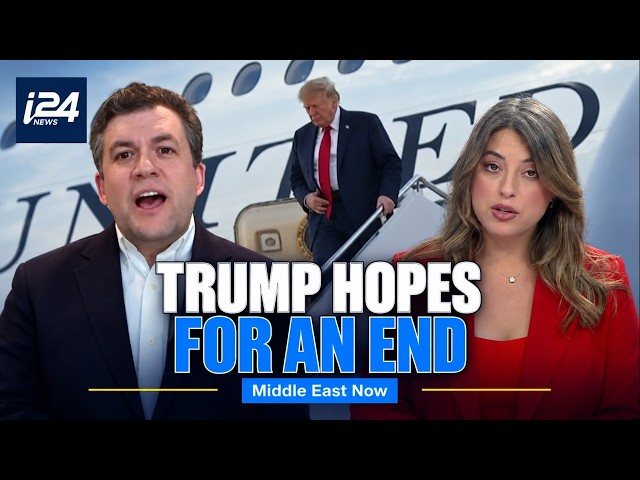
US President Trump says he hopes the fighting is finally coming to an end
Watch on YouTubeVideo summary
Following nearly seven months of conflict with Iran, President Trump has expressed hope that the fighting is finally nearing an end, claiming he has received direct signals from Tehran indicating a desire for a deal. However, these comments arrive amidst ongoing hostilities where Iran continues to launch attacks and the war has expanded into a new front as Houthi forces target Saudi Arabia. While Trump is scheduled to meet with Gulf leaders in New York next week to discuss both the current conflict and post-war strategy, experts caution that diplomatic progress may be premature. Analysts suggest that both the United States and Iran currently believe they possess enough room to escalate or continue their limbo phase rather than submit to a settlement, leading to a situation where periodic US retaliatory strikes and economic sanctions against Tehran are likely to persist without immediate resolution.
The core of the diplomatic stalemate lies in the differing positions regarding past agreements and future security priorities. Although Iran has expressed interest in returning to the Islamabad Memorandum of Understanding, President Trump has shown no interest in reviving that agreement, which experts describe as fatally flawed. Instead, the primary focus for US partners in the Gulf Cooperation Council (GCC) is currently on curbing Iran's missile and drone programs and addressing its network of terrorist proxies that cause significant damage across the region. The nuclear program, while a long-standing concern, is not the top priority at this moment; rather, the immediate agenda revolves around stopping regional chaos and ensuring freedom of navigation, particularly in light of Iranian interference in the Strait of Hormuz which Iran has seemingly lost leverage over due to US capabilities.
The escalation of attacks by Houthi forces against Saudi Arabia has further complicated the geopolitical landscape, as Iran attempts to compensate for its diminished influence in the Strait of Hormuz by opening another front around the Bab al-Mandab strait. This strategy highlights deep divisions within the GCC, particularly between Saudi Arabia and the United Arab Emirates regarding their approaches to Yemen, which have hindered a collective response against Iranian aggression. Consequently, a major objective for the upcoming discussions in New York will be for the United States to foster unity among Gulf nations to present a cohesive front against the Iranian regime's efforts to sow instability. Building this diplomatic consensus is seen as crucial for enabling a more decisive regional response and potentially creating conditions where a diplomatic resolution becomes more viable, rather than allowing Iran to gain further leverage by exploiting these fractures.
Read the full video transcript
Well, after nearly 7 months of war with
Iran, President Trump says he hopes the
fighting is finally coming to an end.
Trump says Iran wants a deal and that
he's heard from Tehran directly,
although he does not provide any details
about that. His comments come as the war
continues with Iran still launching
attacks and the conflict now spilling
into another front with Houthi forces
targeting Saudi Arabia.
Trump is also expected to meet Gulf
leaders in New York on the sidelines of
the UN General Assembly next week to
discuss the war and what comes after it.
So, is there actually a diplomatic
off-ramp emerging here or is Trump
getting ahead of the reality on the
ground? Well, joining us now is Jason
Brodsky, policy director of United
Against Nuclear Iran. He's joining us
from New York.
Jason, Trump says he hopes we are toward
the end of the war. He says Iran wants a
deal.
Based on what we know right now about
Iran's position and its behavior,
especially of course with the ongoing
attacks on Saudi Arabia by the
Iran-backed Houthis, what would you need
to see before taking those signals from
Trump seriously?
>> Well, it's great to be with you. I think
we need to look at the pain and gain
calculations of both sides and right now
I think both sides believe they have
more pain tolerance and room to
escalate or continue on to this limbo
phase that we've been in than you know,
than they would have to totally submit
to any kind of diplomatic settlement
right now. So, I think that the US and
Iran are to be expected to continue this
limbo-like phase of periodic strikes by
the US to retaliate against Iranian
provocations while maintaining the naval
blockade and economic sanctions against
Tehran.
So, also both sides are not on the same
page diplomatically. The Iranians want
to return to the Islamabad MOU, but
President Trump is not interested in
returning to that very fatally flawed
agreement.
>> Trump is also expected to meet with Gulf
leaders next week to discuss a post-war
strategy.
What should the United States be trying
to achieve in those talks, particularly
when it comes to Iran's nuclear program,
uh its missiles, and I think most
importantly right now, the regional
proxies?
>> Well, right now, I think if we're
looking at what's at the top of the
agenda for uh US partners in the GCC, it
is Iran's missile and drone program, and
its uh uh terrorist proxies that are
running around the region and causing a
lot of damage. That is the top priority
right now. The nuclear program um given
its state right now is not uh the first
on the agenda. For the GCC, first on the
agenda is uh the missile and drone
program for the Iranian regime and its
terror proxies and partners. Also,
freedom of navigation, let's not forget
that. And so, I think it's going to be
important for the United States to come
up with a united front uh within the GCC
uh to the extent that it's possible,
because I think what has hobbled a
collective and more decisive response
from the GCC have been the divisions in
the block itself. Uh so, uh I think that
the US has an opportunity to try to uh
create and build unity here uh where
they can.
>> With the Houthis now escalating attacks
against Saudi Arabia,
do you think there could be perhaps you
know more of a chance of a diplomatic
resolution with Iran?
Uh could it be made more urgent perhaps
on the part of the United States? Or do
you think this is ultimately just giving
Iran more leverage to negotiate from?
>> Well, I think the Iranians uh believe
that they've lost leverage over the
Strait of Hormuz given the United
States' ability to circumvent uh Iranian
interference in the strait and in
threats as well. Uh so, they're trying
to compensate for that loss of leverage
in the Strait of Hormuz with opening up
another front around the Bab al-Mandab
and encouraging their Houthi partners to
escalate against the Yemeni coalition
forces. So, that's what the Iranian
regime believes right now
and the GCC has been divided over Yemen.
The Saudis and the UAE have been on at
loggerheads over Yemen for uh some time
now and so I think it's going to be
important to build unity diplomatically
in order to present a united front
against the Iranian regime and its
desire to sow chaos throughout the
region. So, that's going to be what's
important to during UNGA at the summit.
>> [snorts]